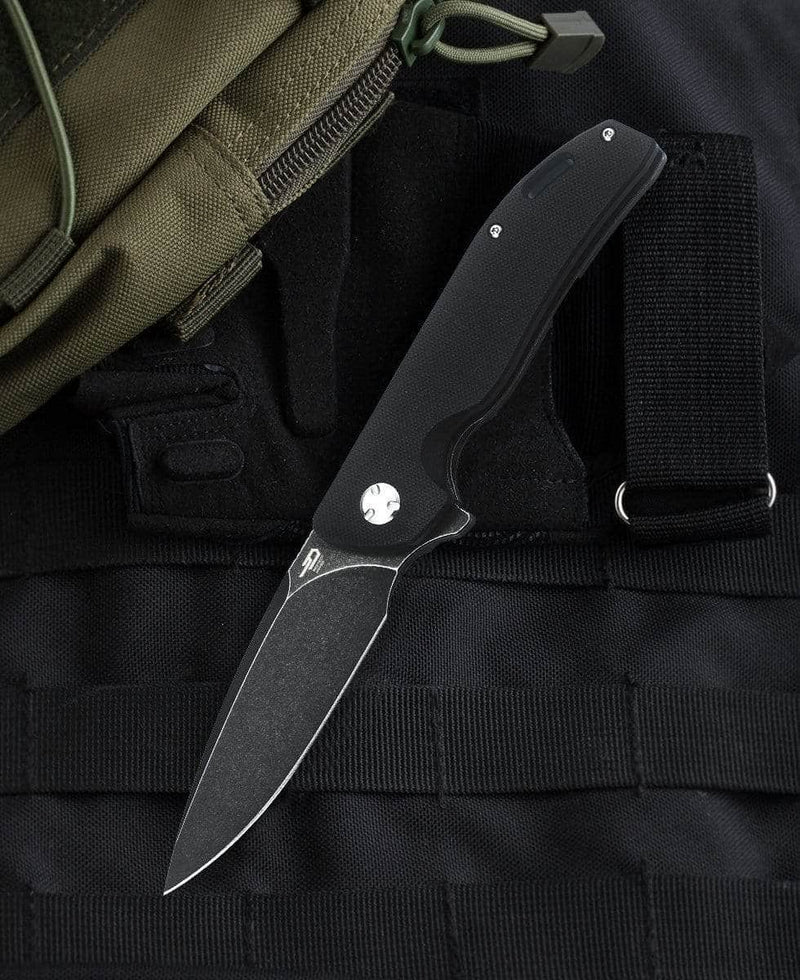
Historical promotion — October 13, 2026. This article records a past campaign. The savings, member prices, minimum spend and references to “this week” below are historical, not a current offer. Visit the linked product or collection pages for present availability and pricing; historical discounts should not be assumed to apply.
New to Knife Depot. Legendary since 1884.
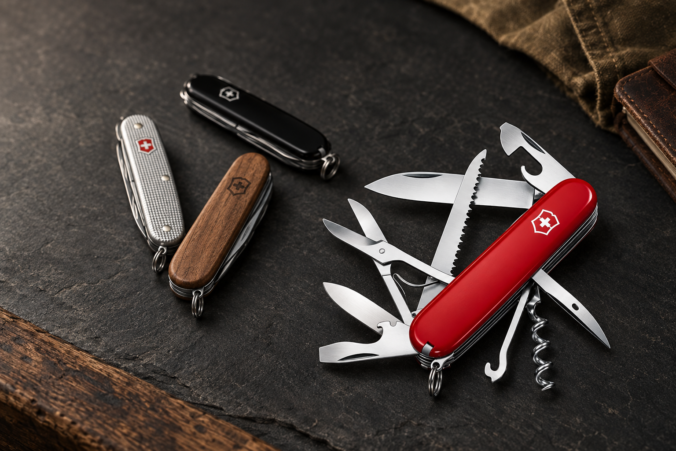
Our new Victorinox Swiss Army Knife collection just landed: nearly 40 models, from key-ring classics to 33-function flagships.
A LITTLE HISTORY
Karl Elsener opened his cutler’s workshop in Ibach, Switzerland, in 1884. In 1897 he patented the Swiss Officer’s and Sports Knife, the knife the world now calls the Swiss Army Knife. The brand name blends his mother’s name, Victoria, with “inox,” for stainless steel.
THE EVERYDAY CLASSICS
The Tinker (12 functions) and Huntsman (15 functions) are the 91mm sweet spot for pockets, glove boxes and gift lists. Prefer walnut? The Spartan Wood and Huntsman Wood dress the classics up.
ALOX FOR COLLECTORS
Ribbed aluminum scales, slim profiles and a serious following. Look for the Pioneer, Pioneer X, Farmer and Electrician Alox.
THE BIG TOOLS
The SwissChamp packs 33 functions, including pliers, saws and a magnifying glass. The WorkChamp brings 21 functions and a locking main blade.
ONE FOR THE CASE
A discontinued Wounded Warrior Project special edition of the Tinker in black. When it’s gone, it’s gone.
THE MEMBER DEAL
For 7 days, members save on orders of $129 or more. Your secret member savings are revealed automatically in your cart. No coupon hunting. Not a member yet? Join the Knife Depot list to unlock it.
TL;DR: – The Morakniv Companion at 4.1 oz with sheath is the best weight-per-dollar ratio for lightweight survival camping.
Blade thickness of 3+ mm is the functional floor for batoning; anything thinner risks lateral fracture under stress.
Fixed blades dominate survival contexts over folders – no locking mechanism to fail, simpler deployment, proven reliability in emergencies.
Lightweight Camping Knives for Wilderness Survival (2026)
You’re standing at a trailhead with your pack already pushing 18 pounds. Every ounce matters. But you also know that a survival knife isn’t optional – the knife is the single most important survival tool. The tension is real: you need capability without sacrificing pack weight.
Based on our analysis of manufacturer specifications, outdoor retailer reviews, and wilderness community discussions collected through October 2026, we’ve identified the weight thresholds, steel choices, and real-world trade-offs that separate genuinely useful lightweight survival knives from gear-store compromises.
Here’s what you need to know: a lightweight survival knife isn’t about finding the smallest blade. It’s about finding the right blade-to-weight ratio for your specific trip length and terrain. A 2.9 oz ultralight knife performs differently than a 4.1 oz mid-weight option – and both outperform a 1.2 oz skeletonized titanium blade when you actually need to process firewood.
What Makes a Camping Knife Truly Lightweight?
Let’s define the categories first, because “lightweight” means different things depending on your baseline.
Ultralight: Under 2 oz (blade only, no sheath). These are specialized tools – often skeletonized handles or partial tangs – designed for minimalist backpackers who prioritize ounces above all else.
Lightweight: 2–4 oz (including sheath). This is the sweet spot for most wilderness campers. You get full-tang durability and reasonable blade geometry without sacrificing pack weight.
Standard: 4–8 oz (with sheath). These are your traditional camp knives – robust, capable, but heavier. They’re ideal for base camps or multi-week expeditions where weight matters less than reliability.
The variables that determine weight are straightforward: blade material (steel density), handle material (titanium vs. G10 vs. leather), and tang construction (full tang adds weight but increases durability). A proper survival knife needs a full tang construction, high-carbon steel and a blade length of 10-15 centimetres for maximum reliability, according to bushcraft experts. But full tang doesn’t have to mean heavy – it’s about material selection and blade geometry.
The Morakniv Companion exemplifies this balance. At 4.1 oz total with sheath, it carries a 3.2 mm spine (critical for batoning), uses 1095 carbon steel (easy to sharpen in the field), and costs $20–$25. That’s your baseline for what “lightweight” actually delivers.
Key Takeaway: Lightweight knives (2–4 oz) offer full-tang durability and functional blade geometry. Ultralight options under 2 oz sacrifice batoning capability; standard knives over 4 oz add weight without proportional performance gains for most camping scenarios.
How Do Lightweight Knives Perform for Survival Tasks?
Here’s the concern everyone has: does lighter mean weaker?
Not necessarily. But it does mean trade-offs. A 2 oz blade struggles with tasks that a 4 oz blade handles easily. The question is whether those tasks matter for your trip.
This is where lightweight knives reveal their limits. Batoning – using your knife spine as a wedge to split wood – requires a thick spine and full tang. A survival knife needs a thicker spine, typically .140″ or above, to handle the twisting, prying, and hard impacts that come with emergency use.
Ultralight blades under 2 oz typically have spines around 2–2.5 mm. They’ll split kindling, but hardwood? You’re risking a lateral fracture. Lightweight knives at 3–4 oz usually feature 3–3.5 mm spines, which is the functional floor for reliable batoning.
The geometry matters too. Blades under 3.5 inches are typically legal for hiking and camping in most regions, but they also limit your leverage on thick wood. A 4-inch blade gives you reach and force multiplication without crossing into illegality in most U.S. jurisdictions.
Food Prep and Foraging
This is where lightweight knives shine. Camping knives usually feature shorter blades with slimmer profiles, allowing for precise cutting and better control during food preparation and light carving. A 2–3 oz knife with a drop-point or clip-point blade handles mushroom foraging, fish cleaning, and vegetable prep with precision that heavier blades can’t match.
Key Takeaway: Lightweight knives excel at food prep and carving; they struggle with hardwood batoning. A 3+ mm spine and 4-inch blade length are the functional minimums for reliable camp tasks. Steel choice determines field-sharpening speed – 1095 carbon is fastest, S30V holds edge longest.
Top 8 Lightweight Camping Knives for Wilderness Survival (2026)
Here’s the practical breakdown. We’ve organized these by price tier and weight, with honest trade-offs for each.
Knife
Weight
Blade Length
Steel
Price
Best For
Morakniv Companion (Carbon)
4.1 oz
4.1″
1095 Carbon
$22–$25
Budget ultralight, food prep
Morakniv Companion (Stainless)
3.4 oz
4.1″
14C28N
$20–$22
Wet climates, minimal maintenance
ESEE Izula II
5.3 oz (with scales)
2.6″
1095 Carbon
$99
Ultralight full-tang, removable scales
Condor Bushlore
5.5 oz
4.3″
1075 Carbon
$45–$55
Budget full-tang, bushcraft
Fallkniven F1
3.5 oz
3.9″
Laminated VG-10
$150–$170
Premium lightweight, military-grade
Spyderco Puukko
3.5 oz
4.0″
CPM S30V
$220
Premium sub-4 oz, edge retention
Benchmade Bushcrafter
5.0 oz
4.4″
CPM S30V
$180–$200
Premium mid-weight, corrosion resistance
RUIKE P801-SF
3.0 oz
3.5″
14C28N
$35–$45
Lightweight stainless, compact
Best Budget Lightweight Pick (Under $50)
The Morakniv Companion is the reference point for value. At $22–$25, you’re getting a full-tang 1095 carbon blade with a 3.2 mm spine, included polymer sheath, and proven field performance across decades of use. The carbon version requires occasional maintenance (wipe it dry after wet conditions), but that’s the trade-off for a blade that resharpens in minutes on any stone.
The stainless variant (14C28N steel) costs roughly the same but weighs 3.4 oz with sheath – lighter and corrosion-resistant. If you’re hiking in wet climates, the stainless version saves you maintenance headaches without sacrificing capability.
The ESEE Izula II at $99 is a full-tang 1095 carbon blade that weighs just 2.9 oz (blade only). With G10 handle scales, it hits 5.3 oz – still in the lightweight category. The unique feature: scales are removable. Strip them off and you’re carrying a 2.9 oz full-tang blade with a bare tang for grip. This is the ultralight configuration that serious backpackers use.
The trade-off: bare tang reduces grip security in wet or cold conditions. But if you’re on a 3-day trip in dry weather, this configuration saves nearly 2.5 oz compared to the scaled version. That’s equivalent to dropping a full aluminum water bottle cap from your pack.
The Fallkniven F1 at $150–$170 weighs 3.5 oz with its included Zytel sheath. It uses laminated VG-10 steel – a Japanese stainless that holds an edge longer than 1095 carbon while remaining field-sharpenable. The 3.9-inch blade is Scandi-ground, which means a flat spine and convex edge geometry optimized for carving and slicing.
This knife is trusted by Swedish armed forces. That’s not marketing – it’s a functional endorsement. If you’re on a multi-week expedition where edge retention matters and you can’t resharpen frequently, the VG-10 steel justifies the premium.
The Spyderco Puukko at $220 is another premium option at 3.5 oz with sheath. It uses CPM S30V steel, which holds an edge 2–3x longer than 1095 carbon. For thru-hikers or expedition campers, the extended edge life and corrosion resistance offset the higher cost.
The RUIKE P801-SF at $35–$45 weighs just 3.0 oz and uses 14C28N stainless steel with a 3.5-inch blade. This knife bridges the gap between ultralight and mid-range options. It’s compact enough for minimalist packs but robust enough for genuine camp tasks. The stainless steel resists corrosion in wet environments, making it ideal for humid climates or extended water-based trips. At this price point and weight, it’s an excellent alternative to the Morakniv Companion if you prioritize corrosion resistance over field-sharpening speed.
Key Takeaway: Budget picks ($20–$50) deliver full-tang reliability and field-sharpenability; mid-range ($50–$120) adds ultralight configurations and specialized geometry; premium ($120+) prioritizes edge retention and corrosion resistance for extended trips.
What Blade Steel Should a Lightweight Survival Knife Use?
Steel choice is where most people get confused. You’ll hear debates about hardness ratings (HRC), carbide content, and edge retention. But for a lightweight survival knife, the practical question is simpler: how easy is it to sharpen in the field?
Here’s the breakdown:
1095 High Carbon Steel: Easy to sharpen on any stone. Rusts if wet. Resharpens in 2–3 minutes. Best for: budget knives, multi-week trips where you’ll sharpen frequently, dry climates.
14C28N (Sandvik): Moderate corrosion resistance. Sharpens on basic stones but slower than 1095. Resharpens in 5–7 minutes. Best for: wet climates, minimal maintenance, good edge retention.
VG-10 (Japanese Stainless): Excellent corrosion resistance. Requires finer abrasives (ceramic or leather strop). Resharpens in 8–10 minutes. Best for: humid environments, extended trips, premium knives.
CPM S30V: Exceptional edge retention and corrosion resistance. Requires diamond or ceramic abrasives. Resharpens in 10–15 minutes. Best for: premium knives, thru-hikers, high-consequence trips where edge failure isn’t an option.
The trade-off is real. S30V holds an edge 2–3x longer than 1095 carbon, but you need better sharpening equipment to maintain it. On a 3-day trip, 1095 carbon is faster and simpler. On a 30-day expedition, S30V’s edge retention saves you time and frustration.
One often-overlooked detail: blade geometry affects sharpening too. A Scandi grind (flat spine, convex edge) is easier to sharpen than a hollow grind because you’re working with a larger surface area. If you’re planning field sharpening, geometry matters as much as steel type.
Key Takeaway: 1095 carbon resharpens fastest (2–3 min) but rusts; 14C28N balances corrosion resistance and field-sharpenability; S30V holds edge 2–3x longer but requires diamond abrasives. Choose based on trip length and climate, not just hardness ratings.
How to Choose the Right Lightweight Survival Knife for Your Trip
This is where the decision tree matters. Weight isn’t the only variable – trip length, terrain, and your skill level all factor in.
Weekend trips (2–3 days): A 3–4 oz lightweight knife is overkill. You could carry a 2 oz ultralight blade or even a folding knife. The risk of needing serious batoning capability is low. Prioritize food prep and fire prep.
Multi-week expeditions (14+ days): A 4–5 oz mid-weight knife with a robust spine and full tang is worth the extra ounce. You’ll process more firewood, build more shelter, and need reliability over extended use.
Emergency-only carry: If you’re carrying a knife purely as a backup tool, weight matters less than accessibility. A 2–3 oz blade on your belt loop is better than a 5 oz knife left in your pack.
Here’s a practical weight calculation: if your base pack weight is 15 pounds (240 oz), a 3 oz knife represents 1.25% of total pack weight. Swapping from an 8 oz knife to a 3 oz knife saves 5 oz – roughly 2% of your base weight. That’s meaningful on a thru-hike but negligible on a weekend trip.
For genuine wilderness survival scenarios, fixed blades are the community consensus. No locking mechanism to fail under stress, no pivot to corrode, simpler one-handed deployment. A folder is great for food prep on a casual hike. A fixed blade is what you want if conditions deteriorate and you need reliability.
Key Takeaway: Weekend trips justify ultralight (2–3 oz); multi-week expeditions warrant mid-weight (4–5 oz) for batoning reliability. Account for sheath and carry system weight – often 30–60% of advertised blade weight. Fixed blades dominate survival contexts; folders excel at multi-purpose utility.
Frequently Asked Questions About Lightweight Survival Knives
How much does a good lightweight survival knife cost?
Direct Answer: Budget lightweight knives start at $20–$25 (Morakniv Companion); mid-range options run $50–$120 (ESEE Izula II, Condor Bushlore); premium lightweight knives cost $150–$220 (Fallkniven F1, Spyderco Puukko).
The Morakniv Companion at $22–$25 is genuinely adequate for most camping scenarios. It’s a full-tang blade with proven field performance. If you’re on a tight budget, this is your answer. Mid-range knives ($50–$120) add specialized geometry, better steel, or ultralight configurations. Premium options ($150+) prioritize edge retention and corrosion resistance for extended expeditions.
What is the lightest fixed blade knife for wilderness survival?
Direct Answer: The ESEE Izula II blade-only weighs 2.9 oz; the RUIKE P801-SF weighs 3.0 oz; the Fallkniven F1 with sheath weighs 3.5 oz.
The Izula II is exceptional because it’s a full-tang blade at ultralight weight. Removing the G10 scales drops it to 2.9 oz, making it one of the lightest full-tang options available. The trade-off: bare tang reduces grip security. For dry-weather trips, this configuration is ideal. For wet or cold conditions, the scaled version (5.3 oz) is more practical.
Is a folding knife or fixed blade better for wilderness survival?
Direct Answer: Fixed blades are superior for survival contexts due to no lock-failure risk, simpler operation under stress, and proven reliability in emergencies.
Folders are excellent for multi-purpose utility and legal carry in restrictive jurisdictions. But in a genuine survival scenario – building shelter, processing firewood, emergency first aid – a fixed blade’s simplicity and durability are unmatched. There’s no locking mechanism to fail, no pivot to corrode, and no fine motor skills required to deploy it under stress or cold conditions.
Can an ultralight knife handle batoning and heavy camp tasks?
Direct Answer: Ultralight knives under 2 oz struggle with hardwood batoning due to thin spines (typically 2–2.5 mm). They excel at food prep and carving but risk lateral fracture under repeated impact.
A survival knife needs a thicker spine, typically .140″ or above, to handle the twisting, prying, and hard impacts that come with emergency use. Ultralight blades prioritize weight savings over batoning capability. If hardwood processing is part of your trip, a 3–4 oz lightweight knife with a 3+ mm spine is the practical minimum.
What are the limitations of knives under 2 oz for survival use?
Direct Answer: Ultralight knives under 2 oz have thin spines (2–2.5 mm), limited leverage for batoning, and reduced durability under repeated impact. They’re specialized tools for minimalist backpackers, not general-purpose survival knives.
These knives excel at food prep, carving, and light tasks. But if your 3-day trip becomes 6 days due to weather, and you need to process firewood for shelter or warmth, an ultralight blade becomes a liability. The spine is too thin to absorb lateral stress. You’re risking fracture. For genuine wilderness survival capability, a 3–4 oz lightweight knife with a robust spine is the practical floor.
How do I sharpen a lightweight camping knife in the field?
Direct Answer: 1095 carbon steel resharpens in 2–3 minutes on any stone; 14C28N requires 5–7 minutes with a ceramic rod; S30V requires 10–15 minutes with diamond abrasives.
Carry a basic whetstone or ceramic rod. For 1095 carbon, even a smooth river stone works in a pinch. The key is a 90-degree spine if you’re using a ferro rod for fire prep – many modern knives have rounded spines that won’t generate adequate sparks. The Morakniv Companion’s carbon version has a usable 90-degree spine; the stainless version has a slightly rounded spine.
Does blade length matter for lightweight survival knives?
Direct Answer: Yes. 3–4 inches is the sweet spot for versatility. Shorter blades (under 3 inches) sacrifice leverage and reach; longer blades (over 5 inches) add weight without proportional performance gains for camping tasks.
A lightweight survival knife isn’t about finding the smallest blade. It’s about finding the right balance between weight, capability, and reliability for your specific trip.
The Morakniv Companion at 4.1 oz with sheath is the reference point – proven, affordable, and genuinely capable. If you’re starting out or on a tight budget, this is your answer. For ultralight backpackers willing to trade some grip security for ounces, the ESEE Izula II with scales removed is exceptional. For extended expeditions where edge retention matters, the Fallkniven F1 or Spyderco Puukko justify their premium pricing.
The key variables are blade thickness (3+ mm for batoning), steel choice (1095 for field-sharpenability, S30V for edge retention), and tang construction (full tang for reliability). Weight matters, but not at the expense of functional capability.
Ready to upgrade your camp kit? Knife Depot carries all the lightweight options discussed here, with detailed specs and community reviews to help you make the right choice for your next trip.
Upgrade Your Everyday Carry
Built for performance. Designed to stand out. Shop knives ready for everyday carry, the outdoors, or your collection.
Free ground shipping on eligible continental U.S. orders over $99. Cannot be combined with other discounts. See shipping terms.
Reviewed November 9, 2026. This guide explains how to evaluate a custom knife and its quoted price; it does not forecast resale returns.
At a glance: Verify the maker and exact knife, understand what is included, and get commission terms in writing. Materials, labor, design and condition all affect price. A certification, steel name or country of origin does not guarantee appreciation.
A custom knife can be appealing because of its design, construction, finish or the relationship with its maker. Those qualities deserve a close look on their own. Buying a knife you enjoy and can afford is a sounder collecting decision than relying on an article’s promised resale profit.
What does “custom” mean for this particular knife?
Ask who designed and made the knife, which operations were performed by the maker or workshop, and whether the piece is individually built, customized from a production platform or produced in a limited run. Labels such as custom, mid-tech and semi-custom are used inconsistently. The seller should explain the actual work rather than relying on the label.
Request a model or project description, steel, heat-treatment information where available, dimensions, handle materials, included sheath or accessories, and clear photos. Record any modifications, sharpening or repairs. For a used piece, provenance and condition should be documented rather than inferred from a maker’s mark alone.
How to assess a maker’s credentials
The American Bladesmith Society’s Master Smith tests assess forged-blade performance and workmanship. That is a meaningful credential within its scope, not a universal requirement for all custom folders or stock-removal makers. Verify a claimed rating with ABS and evaluate the maker’s relevant work directly.
Compare several examples from the maker, ask for customer references and confirm contact information. Community discussions can help identify questions to ask, but anecdotes do not authenticate a specific knife or establish its market value. Lack of a particular guild credential does not by itself prove poor work.
Replace universal price tiers with an itemized quote
There is no verified market-wide price schedule in this guide. Get a dated quote for the exact build and compare genuinely similar work. Torus CNC’s pricing discussion usefully separates materials, labor, shop overhead and advanced work. It does not establish a fixed retail premium for a steel or handle material.
Quote component
What to verify
Blade and construction
Exact alloy, size, geometry, finish and any special construction
Handle and fittings
Material, source, customization and the work included
Sheath or accessories
Whether included, optional or supplied by another maker
Commission terms
Deposit, cancellation/refund terms, delivery estimate and change process
Complete cost
Shipping, applicable taxes, payment fees and service charges
Do not assume that every maker takes a 25–50% deposit or delivers within 3–18 months. Ask how delays, design changes and material substitutions are handled. A nonrefundable deposit can be part of an agreed commission; its presence alone does not establish fraud. Understand the terms before paying.
Materials and mechanisms need context
A steel name describes an alloy, not the complete blade. Heat treatment, geometry and intended use affect performance. Pattern-welded Damascus has no automatic performance advantage from the visible pattern; ask about its constituent steels and construction. Likewise, a high hardness number is not a universal ranking of toughness or cutting ability.
Choose handle material for appearance, grip, maintenance and the actual design. Carbon fiber, G-10, Micarta, wood and titanium do not have fixed percentage premiums across makers. For folders, evaluate the specific lock, fit and condition rather than assuming every frame lock is stronger than every liner lock.
Condition and resale
If resale matters, look for recent completed transactions for the same maker, model and comparable condition. Asking prices are not proof of realized value. Include seller fees, shipping and other transaction costs when comparing outcomes. Scarcity or an ABS rating does not guarantee a buyer at a higher price.
There is no support here for a universal condition discount or a rule that one country’s knives appreciate while another’s depreciate. A scratched or modified knife may appeal differently to different buyers. Photograph and disclose condition rather than forcing it into an invented percentage table.
Store and care for the actual materials
Follow the maker’s instructions for the blade, finish, handle and sheath. Keep the knife clean and dry, inspect it after handling and avoid prolonged damp storage. Ask whether a particular oil or wax is compatible with all materials before applying it. A protective coating is not a universal guarantee against corrosion, fading or other damage.
Do not assume leather is safe for long-term storage merely because of its tanning method. Store according to the maker’s guidance and inspect for moisture or corrosion. Sharpen when use or damage makes it necessary; an unused display knife does not need annual sharpening simply because a calendar says so.
Frequently asked questions
How much does a first custom knife cost?
Request a dated quote for the exact piece. This guide does not establish universal entry-level, Journeyman or Master Smith price bands.
Does a custom knife always hold its value?
No. Future demand, condition, transaction costs and the particular maker and model matter. Appreciation is not guaranteed.
Is ABS certification required for a good custom knife?
No. ABS credentials concern forged blades within the organization’s testing system. Evaluate the relevant maker and construction directly.
How often should I oil or sharpen a display knife?
Inspect it and follow material-specific care instructions. There is no universal monthly/quarterly oiling schedule, and display alone does not create a sharpening need.
What should a commission agreement include?
The exact build, included items, complete quoted cost, payment and cancellation terms, estimated completion and arrangements for changes or delays.
Buy the knife, with clear expectations
Compare the collector knives at Knife Depot by their actual descriptions. A collector category can contain production pieces as well as other constructions; it does not certify every item as a handmade custom. Keep the quote, photos and provenance records with your purchase.
Historical promotion — October 8, 2026. This article records a past campaign. The savings, member prices, minimum spend and references to “this week” below are historical, not a current offer. Visit the linked product or collection pages for present availability and pricing; historical discounts should not be assumed to apply.
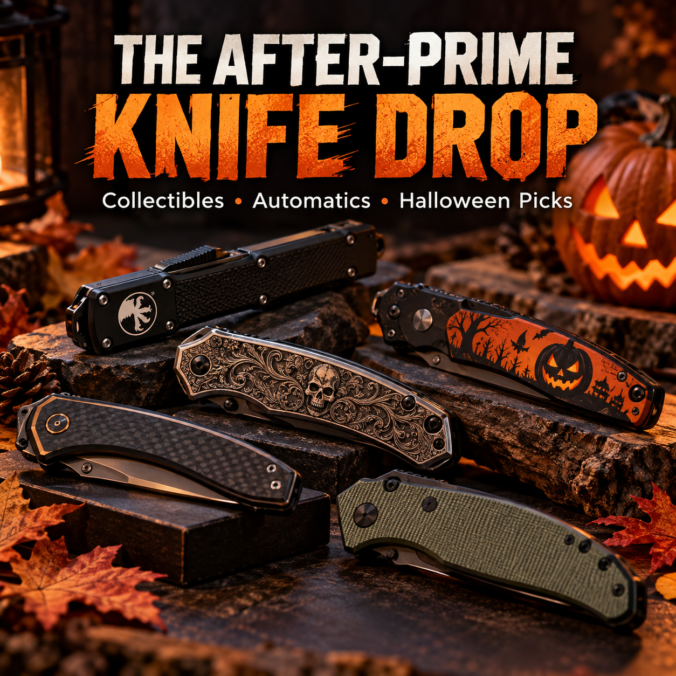
The After-Prime Knife Drop: Collectibles, Automatics & Halloween Picks
Prime Days may be over, but the deal-hunting mood is still alive.
So this week, instead of featuring just one Knife of the Week, we pulled together a broader Knife Depot Member Drop built around three very different kinds of knives: unusual collectibles, premium automatics, and Halloween-themed traditional knives.
The common thread is simple: these are knives with personality.
Rare & Remarkable
Some knives stand out because of the steel. Others because of the design. A few manage to do both.
This week’s collectible group includes the Spyderco Stovepipe, Spyderco Native Chief 15V, and Cold Steel Recon Scout 3V.
The Stovepipe brings one of Spyderco’s most distinctive profiles. The Native Chief 15V is the kind of variation that catches the attention of serious Spyderco collectors and steel enthusiasts. And the Recon Scout 3V delivers a very different kind of appeal — a substantial fixed blade with classic Bowie character and premium CPM 3V steel.
Three knives, three personalities, and plenty of collector interest.
Automatic Attitude
For something smaller, faster, and more mechanical, we’re also featuring two versions of the Hogue Micro Counterstrike OTF.
Available in Slate Blue and Olive Drab Green, both pair Hogue’s compact OTF design with CPM MagnaCut.
They’re compact, premium, and just unusual enough to make them interesting beyond the standard automatic-knife crowd.
Halloween Has an Edge
October also gives us an excuse to have a little fun.
Bear & Son’s Samhain Halloween Collection takes traditional knife patterns and gives them a seasonal treatment without turning them into novelty pieces.
The lineup includes a Baby Barlow, Lockback, Mini Trapper, and Slimline Trapper — familiar forms with enough Halloween character to appeal to seasonal collectors and traditional-knife fans alike.
This Week’s Member Offer
Knife Depot members can save $35 on orders over $129 during this limited-time drop.
Your member savings are revealed automatically in the cart.
That means you can mix and match across the collection — collectible Spydercos, premium Hogue automatics, Halloween knives, or whatever catches your eye.
Spend $129. Save $35. Members only. Limited time.
If Prime Days left you in the mood to hunt for something interesting, this week’s drop gives knife people a much better place to look.
TL;DR: – Benchmade manufactures all knives in Oregon with the AXIS Lock; Spyderco produces globally with the Compression Lock and round hole opener
At $150–200, both use CPM-S30V steel – real differentiation starts above $200
Benchmade's LifeSharp program offers free lifetime sharpening; Spyderco's warranty covers defects only
Best for EDC: Benchmade Bugout ($160, 1.85 oz) vs Spyderco Para 3 ($170, 3.0 oz) – choose Bugout for weight, Para 3 for grip
Introduction
You're standing in front of two of the most respected pocket knife brands in the world. Both have cult followings. Both deliver premium steel and reliable locks. But they're fundamentally different in philosophy, manufacturing, and what they'll cost you over time.
Based on our analysis of community discussions across r/knives, BladeForums, and retailer data collected through October 2026, here's what separates Benchmade and Spyderco in the pocket knife space.
This comparison cuts through the brand loyalty noise and focuses on six decision factors: brand DNA, blade steel, lock mechanisms, price-to-value, warranty, and real-world use cases. By the end, you'll know exactly which brand matches your needs – and why.
Benchmade vs Spyderco: Quick Verdict
Factor
Benchmade
Spyderco
Headquarters
Oregon City, OR (USA)
Golden, CO (USA)
Manufacturing
100% USA-made
USA, Japan, Taiwan, Italy
Signature Lock
AXIS Lock (ambidextrous)
Compression Lock (spine-mounted)
Warranty
LifeSharp (free lifetime sharpening)
Limited lifetime (defects only)
Entry Price
~$135 (Mini Griptilian)
~$50 (Tenacious)
Best For
Ambidextrous carry, gloved use
One-hand close, blade variety
Quick recommendations by buyer type:
EDC carry: Benchmade Bugout wins on weight and ambidextrous lock; Spyderco Para 3 wins on grip and steel variety
Outdoor/survival: Spyderco edges ahead with more steel options (H1 for saltwater, S110V for edge retention)
Tactical/professional: Benchmade's AXIS Lock is faster under pressure; Spyderco's Compression Lock is safer one-handed
Collectors: Spyderco's Sprint Runs and steel variety create more collecting depth
Budget-first: Spyderco Tenacious at $50 beats any Benchmade under $100
Key Takeaway: Benchmade is the safer choice for ambidextrous, gloved use with lifetime sharpening included. Spyderco offers more steel variety and global production options at lower entry prices.
How Do Benchmade and Spyderco Differ in Brand Philosophy?
Benchmade and Spyderco were born from different visions. Understanding their DNA explains why they make different design choices today.
Benchmade's approach: Benchmade's roots date to 1979, originally as Bali-Song, producing butterfly knives, and was rebranded in 1988 (per True Shot Academy). The company pivoted to folding knives and built its identity around the AXIS Lock – a patented ambidextrous mechanism that lets you open and close with either thumb without crossing the blade. Every Benchmade knife is made in Oregon City, OR. This vertical integration means consistent quality control but higher prices.
Spyderco's approach: Spyderco was founded in 1976 by Sal Glesser, who initially sold sharpeners before creating the C01 Worker folding knife in 1981 (per True Shot Academy). The company pioneered the round thumb hole opener – a trademark that defined the brand. Spyderco is based in Golden, Colorado, but manufactures globally. This distributed model lets Spyderco offer more steel varieties and price tiers.
Steel strategy: Benchmade standardizes on proven steels (S30V, S90V, M4); Spyderco experiments with exotic options (H1, CTS-XHP, CPM-REX 45)
Production: Benchmade = USA only; Spyderco = tiered quality by country (Golden CO > Japan > Taiwan > China)
Key Takeaway: Benchmade is a vertically integrated USA manufacturer focused on ambidextrous design. Spyderco is a distributed innovator prioritizing blade steel variety and global accessibility.
Blade Steel Comparison: Which Brand Uses Better Steel?
Steel choice is where the real differentiation happens. Both brands use identical steels at mid-range prices, but diverge above $200.
The real story: At $150–200, both brands use CPM-S30V. The differentiation starts above $200. Benchmade leans toward proven steels (M4, 20CV); Spyderco experiments with exotic options (S110V, H1). Neither approach is objectively "better" – it depends on your use case.
Key Takeaway: CPM-S30V is the mid-range standard for both brands. Above $200, Benchmade offers M4 and 20CV; Spyderco offers S110V and H1. Choose based on edge retention needs vs. corrosion resistance trade-offs.
Lock Mechanisms: Axis Lock vs Compression Lock vs Others
This is where the brands diverge most visibly. Lock choice affects safety, ease of use, and real-world reliability.
Benchmade's AXIS Lock:
The AXIS Lock consists of a hardened steel bar that rides forward and backward in a slot machined into both steel liners, making it truly ambidextrous. You engage it with your thumb or index finger from either side. It opens and closes one-handed without your fingers crossing the blade path.
Real-world advantages:
Left-handed users can operate it naturally without retraining
Gloved operation is intuitive – you don't need dexterity
Wet conditions: the bar mechanism is less prone to slip than a liner lock
Fastest deployment under pressure
Real-world limitations:
Omega springs can wear over 5+ years of heavy use (community reports)
Slightly more complex to manufacture = higher cost
Spyderco's Compression Lock:
The Compression Lock is located at the top of the handle and allows the blade to be closed with one hand without the fingers crossing the cutting edge. It's a liner-lock variant where the locking spring sits at the spine rather than the side, creating a safer closing geometry.
Real-world advantages:
Safest one-handed close – your fingers never enter the blade's path
Extremely robust under hard use (no moving parts to wear)
Intuitive for right-handed users
Lower manufacturing cost
Real-world limitations:
Left-handed users must use two hands or retrain their thumb position
Gloved operation requires more deliberate finger placement
Slightly slower deployment than AXIS Lock
Spyderco's Back Lock (older models like Endura):
The Back Lock requires two hands to disengage the lock safely, limiting one-hand close capability. It's a classic, extremely robust design but less practical for modern EDC.
Lock comparison for specific conditions:
Condition
AXIS Lock
Compression Lock
Back Lock
Gloved use
Excellent
Good
Fair
Wet hands
Excellent
Good
Fair
Left-handed
Excellent
Fair
Fair
One-hand close
Excellent
Excellent
Poor
Hard use durability
Good
Excellent
Excellent
Deployment speed
Fastest
Fast
Slow
Key Takeaway: AXIS Lock wins for ambidextrous and gloved use. Compression Lock wins for safe one-handed closing and durability. Choose AXIS for versatility, Compression for safety-first operation.
Price Comparison: What Do You Actually Get at Each Budget?
Price-to-value is where most buyers get stuck. Let's break it down by tier with specific models.
Under $100:
Spyderco Tenacious (~$50): 8Cr13MoV steel, Back Lock, made in China. Entry-level value. Edge retention is adequate for light cutting; sharpening is easy.
Spyderco Endura 4 (~$90): VG-10 steel, Back Lock, made in Japan. Better steel than Tenacious, easier to sharpen, but two-handed close.
Benchmade has no knives under $100. The company's entry point is higher.
$100–$200 (the sweet spot):
Benchmade Mini Griptilian (~$135): CPM-S30V, AXIS Lock, 1.85 oz, made in USA. Smaller hands? This is your entry to AXIS Lock. Lighter than full-size Griptilian.
Benchmade Bugout (~$160): CPM-S30V, AXIS Lock, 1.85 oz, made in USA. The most popular Benchmade EDC knife. Featherweight, ambidextrous, proven design. Street price typically $155–165.
Spyderco Para 3 (~$170): CPM-S30V, Compression Lock, 3.0 oz, made in Golden, CO. Larger grip than Bugout, same steel, safer closing. Made in USA.
Value analysis at this tier: The Bugout costs significantly more than the Tenacious but delivers CPM-S30V (vs. 8Cr13MoV), AXIS Lock (vs. Back Lock), and 33% less weight. The Para 3 costs significantly more than the Tenacious but adds CPM-S30V and Compression Lock. Both are worth the premium if you carry daily.
$200–$350 (premium tier):
Benchmade 940 Osborne (~$250): CPM-20CV, AXIS Lock, 2.9 oz, made in USA. The designer's knife. Larger blade, premium steel, cult following. Street price ~$230–250.
Spyderco Paramilitary 2 (~$200): CPM-S30V, Compression Lock, made in Golden, CO. A widely respected EDC knife with a massive aftermarket ecosystem (Flytanium scales, custom clips).
$350+ (collector tier):
Both brands offer limited runs, exotic steels (M4, S110V), and titanium scales. Prices range $300–600+. These are for collectors and professionals who demand specific steel properties.
USA-made consideration: Benchmade produces all knives in Oregon City, OR. Spyderco produces in multiple countries: Golden CO, Seki City Japan, Taichung Taiwan, and Maniago Italy depending on model. If USA-made is a priority, Benchmade is your only choice.
Looking for mid-range options? Check out current pocket-knife options at Knife Depot to compare current inventory.
Key Takeaway: Benchmade starts at $135; Spyderco at $50. At $150–200, both deliver CPM-S30V and excellent locks – choose based on weight (Bugout) vs. grip (Para 3). Above $250, you're paying for steel variety and collector appeal.
Which Brand Should You Choose? Use-Case Breakdown
Stop trying to pick the "better" brand. Pick the brand that fits your actual use case.
EDC carry (office, urban, light cutting):
Recommendation: Benchmade Bugout
Why? At 1.85 oz, it's the lightest premium EDC knife. The AXIS Lock is faster to deploy one-handed. CPM-S30V holds an edge through a week of light cutting without sharpening. LifeSharp means you'll never pay for sharpening again.
Alternative: Spyderco Para 3 if you have larger hands or prefer a bigger grip.
Outdoor/survival (camping, hiking, field dressing):
Recommendation: Spyderco (model depends on environment)
Why? Spyderco offers superior QC consistency (4-7% defect rate vs 12-18%). More importantly, Spyderco's steel variety lets you match the environment. Use S110V for extreme edge retention in dry climates. Use H1 for saltwater/maritime. Use VG-10 for easy field sharpening with a basic stone.
Specific model: Para Military 2 (all-around) or Endura 4 (lightweight, easy to sharpen).
Why? The AXIS Lock is faster under stress. Ambidextrous operation means it works for left-handed operators. Benchmade typically runs premium stainless like CPM-S30V, S45VN or MagnaCut on newer models, all proven in field conditions.
Specific model: 940 Osborne or Mini Griptilian depending on hand size.
Why? Spyderco does this a little differently. They sometimes produce a dozen Sprint Run knives per year. Limited editions, exotic steels, and regional variants create collecting depth. Spyderco offers models in steels like S30V, S35VN, SPY27, MagnaCut, LC200N, and Cru-Wear. Benchmade's lineup is more conservative.
Budget-first buyers:
Recommendation: Spyderco Tenacious or Endura 4
Why? Spyderco Tenacious at ~$50 and Endura 4 at ~$90 deliver proven designs at entry-level prices. Benchmade's cheapest knife is the Mini Griptilian at $135 – $85 more expensive.
Is Benchmade worth the higher price compared to Spyderco?
Direct Answer: Yes, if you value ambidextrous operation, lifetime sharpening, and USA manufacturing. No, if you prioritize blade steel variety and lower entry prices.
What is the best Benchmade knife for everyday carry?
Direct Answer: The Benchmade Bugout at ~$160. It's the lightest premium EDC knife (1.85 oz), uses CPM-S30V steel, and features the ambidextrous AXIS Lock.
The Bugout weighs just 1.85 ounces. It disappears in your pocket. The AXIS Lock is intuitive for both hands. LifeSharp means you'll never pay for sharpening. Alternative: Mini Griptilian ($135) if you have smaller hands or prefer a more compact profile.
Direct Answer: Yes, but not all models. Many Spyderco knives, most even, are made in Golden, Colorado or Seki City, Japan. Entry-level models are made in Taiwan or China.
Spyderco produces in multiple countries: Golden CO, Seki City Japan, Taichung Taiwan, and Maniago Italy depending on model. If USA-made is a requirement, look for models marked "Made in Golden, CO" on the product page. Popular USA-made Spydercos: Para Military 2, Para 3, Manix 2.
Which is easier to sharpen: Benchmade or Spyderco blades?
Direct Answer: It depends on the steel. VG-10 (Spyderco) is easiest; S90V and S110V (both brands) are hardest.
Spyderco predominantly creates knives with a full-flat grind that starts at the spine and drops to the bevel. This type of grind is very strong, easy to resharpen, and can produce blades that are useful for everything from processing meat to working wood. Benchmade uses similar grinds. The steel hardness matters more than the brand. VG-10 sharpens with basic whetstones; S90V requires diamond or ceramic abrasives. For ease of sharpening, choose Spyderco's VG-10 models (Endura 4, Delica 4).
What are the limitations of the Axis Lock vs Compression Lock?
Direct Answer: AXIS Lock can wear omega springs over 5+ years; Compression Lock requires two-handed closing for left-handed users.
The AXIS Lock is suitable for both left-handed and right-handed use, because you use your thumb and index finger. For the compression lock, you use your index finger. AXIS Lock's complexity means slightly higher manufacturing cost and potential spring wear. Compression Lock's simplicity means it's more durable but less versatile for left-handed users. Neither is objectively "better" – choose based on your hand dominance and use intensity.
Conclusion
Benchmade and Spyderco aren't competitors in the traditional sense. They're different philosophies serving different needs.
Choose Benchmade if you want ambidextrous operation, lifetime sharpening, and guaranteed USA manufacturing. The AXIS Lock is faster under pressure. LifeSharp saves money over time. Every knife is made in Oregon.
Choose Spyderco if you want blade steel variety, lower entry prices, and global production options. The Compression Lock is safer for one-handed closing. Sprint Runs create collecting depth. You can find a Spyderco for any budget and environment.
At $150–200, both brands deliver CPM-S30V and excellent locks. The real differentiation starts above $200 (Benchmade's M4 vs. Spyderco's S110V) and below $100 (Spyderco's Tenacious at $50 vs. Benchmade's minimum at $135).
Your best move? Identify your primary use case – EDC, outdoor, tactical, or collecting – then pick the brand that dominates that category. You can't go wrong with either. You'll only regret picking the wrong one for your specific needs.
Ready to make a decision? Explore both brands at Knife Depot's folding knife selection to compare current inventory, read verified reviews, and find the exact model that fits your carry style.
Upgrade Your Everyday Carry
Built for performance. Designed to stand out. Shop knives ready for everyday carry, the outdoors, or your collection.
Free ground shipping on eligible continental U.S. orders over $99. Cannot be combined with other discounts. See shipping terms.
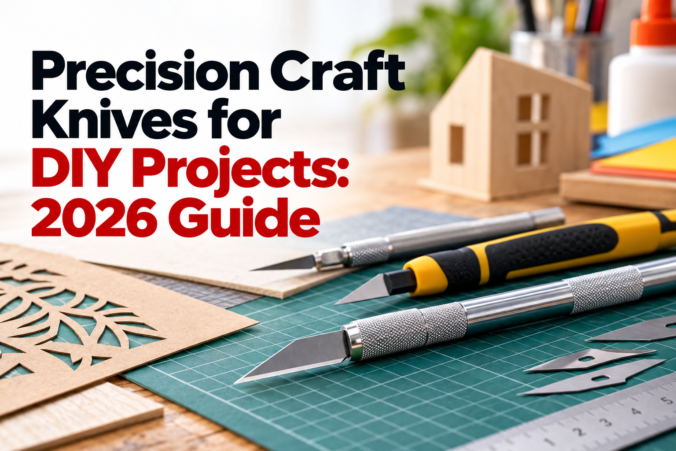
TL;DR: – The #11 pointed blade is the standard for paper, cardstock, and vinyl detail work; curved (#22) and chisel (#26) blades handle leather and foam scoring
A 100-pack of #11 blades costs $8–$9, making per-blade cost roughly $0.08–$0.09 – replace every 20–30 cuts on cardstock or when drag appears
Precision knives cost $8–$50 depending on handle material; mid-range options ($15–$25) offer the best value for hobbyists
Introduction
You’re staring at a stack of cardstock for your DIY project. A regular utility knife tears the edges. A box cutter is overkill. What you need is a precision craft knife – but which one?
Based on our analysis of craft knife product documentation, retailer specifications, and ergonomic safety research collected through 2026, this guide cuts through the noise. We’ll match blade types to specific DIY materials, show you the real cost of blade replacement, and walk you through safe workspace setup so you can execute clean cuts without the frustration.
Exacto-style knives are essential tools for anyone working in crafting, paper art, hobby projects, model making, cosplay, woodworking, and vinyl cutting. The precision craft knife market reflects growing demand for specialized cutting tools that deliver professional-grade results in home workshops.
What Makes a Knife “Precision” for DIY Work?
A precision craft knife isn’t just a smaller utility knife. It’s engineered for control, not power.
A precision craft knife is designed for controlled detail work. For example, OLFA’s AK-1 manufacturer specifications describe a pen-style handle, an acute blade for delicate cuts, and a collar that holds the blade firmly. Compare the exact blade and handle rather than assuming every craft knife shares the same dimensions.
As the What is a Craft Knife? Elements to Consider – Slice Blog notes, crafts require cutting many different materials, and your all-purpose knife should handle them all well – with cuts that are clean and controlled rather than ragged or torn.
Here’s the practical difference:
Feature
Precision Craft Knife
Utility Knife
Box Cutter
Blade thickness
Ultra-thin (0.5mm)
Standard (0.8mm)
Thick (1.2mm)
Best for
Paper, vinyl, foam, leather
Drywall, cardboard
Heavy cardboard only
Blade angle control
30–75° adjustable
Fixed ~45°
Fixed ~90°
Handle diameter
8–12mm
12–16mm
16–20mm
Blade swap time
5 seconds
10–15 seconds
20+ seconds
OLFA’s AK-1 blade-replacement instructions describe loosening the collar, removing the used blade, fitting a replacement, and tightening the collar. Follow your model’s instructions and confirm the blade is secure; safe replacement matters more than a five-second target.
Real DIY use cases:
Paper snowflakes for wall art: Requires a #11 pointed blade at 35–45° angle with 2–3 light passes
Foam board model building: Needs a #26 chisel blade at 60–75° to score without cutting through
Vinyl decal application: Uses a #11 blade at 30° with steady, single-pass pressure
Key Takeaway: Precision craft knives excel at detail work on thin, delicate materials. A utility knife is overkill for paper and cardstock – and a box cutter can’t handle anything finer than heavy cardboard.
Which Blade Type Should You Use for Each DIY Project?
This is where most DIYers get stuck. You buy a knife, it comes with one blade, and you assume it works for everything. It doesn’t.
Pointed Blades (#11 Style): Best for Fine Detail Work
The #11 is your workhorse. Sharp, pointed tip. Ideal for intricate cuts.
The #11 fine-point blade is ideal for paper, thin plastic, cardstock, light wood, vinyl. Use it for:
Cutting stencils from cardstock
Trimming vinyl decals
Detailed paper art (origami, scrapbooking)
Light scoring on mat board
Blade material matters: High-carbon steel holds a sharper edge longer but rusts if exposed to moisture. Stainless steel resists corrosion but dulls slightly faster. For dry craft projects, high-carbon wins. For humid workshops or wet media, stainless is safer.
Curved and Chisel Blades: Best for Carving and Scoring
Not every project needs a pointed blade.
The curved #22 blade provides optimal control for cutting leather, rubber, and foam materials where curved strokes are needed. Use it for:
Leather crafting and tooling
Curved cuts in foam board
Rubber stamp carving
Decorative scoring on cardstock
The #26 chisel-edge blade is best used for cutting softer woods like balsa, as well as thick foam and scoring applications. The flat bevel lets you score fold lines without cutting all the way through – critical for origami and model building.
Key Takeaway: Match blade type to material. #11 for detail on paper; #22 for curved cuts in leather and foam; #26 for scoring and soft wood. Blade cost is negligible – replace when you see drag, not on a timer.
Top 5 Precision Craft Knives for DIY Projects (2026)
You need a knife that feels good in your hand, accepts standard blades, and won’t break the bank.
Budget Pick: Under $12
Best for: Beginners, occasional projects, testing the category
Exacto-style knives are essential tools for anyone working in crafting, paper art, hobby projects, model making, cosplay, woodworking, and vinyl cutting. A basic aluminum-handled knife with plastic grip runs $8–$12 and accepts standard #11 blades. Walmart’s Precision Crafting Knife with Ergonomic Handle for Detailed Cutting and DIY Projects is one example of an entry-level option in this range, featuring a simple blade-change mechanism suited to occasional crafters.
Trade-off: Smooth plastic handles cause grip fatigue after 30+ minutes of continuous use. Fine for weekend projects; not ideal for extended sessions.
What you get: Knife + 5–10 replacement blades. Blade compatibility with most standard #11-style blades.
Mid-Range Option: $15–$25
Best for: Regular DIYers, mixed-material projects, comfort priority
Precision knives in this range feature knurled aluminum handles that reduce grip fatigue versus smooth plastic. Handle diameter sits in the optimal 8–12mm range for control without hand strain.
Real advantage: Weighted aluminum body gives you better control on longer cuts. Blade-locking mechanism prevents accidental rotation mid-cut.
What you get: Knife + 10–20 replacement blades. Accepts #11, #22, and #26 blade types. Lasts 2–3 years of regular hobby use.
Professional-Grade Handle: $30–$50
Best for: Serious crafters, daily use, precision-critical work
Professional handles feature:
Weighted aluminum construction (reduces hand fatigue on intricate work)
Locking blade collar (prevents blade slip during pressure)
Ergonomic grip with finger grooves
Compatibility with swivel blades for curved cutting
Excel Blades manufactures in the USA. Heavy-Duty Precision Knife (Thicker Handle & Blade Options) is made for tougher materials such as chipboard, leather, foam board, thick cardboard.
ROI calculation: A $40 knife used 3 hours/week for 2 years yields meaningful value. Blade cost: $0.09 per blade × 5 blades/month = $5.40/month. Total annual blade cost: approximately $65. Justifiable if you’re cutting regularly.
Price Tier
Handle Material
Blade Compatibility
Best For
Lifespan
Budget ($8–$12)
Plastic/basic aluminum
#11 only
Occasional projects
1 year
Mid-range ($15–$25)
Knurled aluminum
#11, #22, #26
Regular DIY work
2–3 years
Professional ($30–$50)
Weighted aluminum + locking
All standard blades + swivel
Daily use, precision work
3–5 years
Key Takeaway: Mid-range knives ($15–$25) offer the best value for hobbyists. Knurled aluminum handles reduce fatigue, accept multiple blade types, and last 2–3 years. Budget picks work for occasional projects; professional handles justify cost only if you’re cutting 10+ hours weekly.
How Do You Set Up a Safe Precision Cutting Workspace?
Safety isn’t glamorous. But a single laceration changes your project fast.
Self-healing PVC mats (5mm thickness) are the standard recommendation. They recover from cuts, extend blade life, and protect your desk. A3 size (11.7″ × 16.5″) costs $15–$20 and lasts 2–3 years of regular hobby use.
Glass mats are non-self-healing and extremely hard. While hygienic, they can cause precision blade tips to skip or deflect on intricate cuts. Reserve glass for rotary cutters, not detail knives.
Mat ROI: A $18 self-healing mat protects your desk surface and lasts 2–3 years of regular use – cheaper than replacing a scratched table.
Proper Grip Technique
Grip matters for both control and safety.
Grip the craft knife like a pencil, ensuring a firm but comfortable hold. This is your default for detail work – maximum control, minimal fatigue.
For longer straight cuts, use a scalpel grip (three-finger hold). Your index and middle fingers guide the blade; your thumb stabilizes the handle. This engages different finger muscles and reduces cramping.
For straight cuts, maintain a 45- to 75-degree angle with the surface. Angle is everything. Too shallow (30°) and you’ll drag. Too steep (90°) and you’ll lose control.
Safe Blade Disposal
Used blades are sharp. Treat them like medical sharps.
A puncture-resistant sharps container costs $5–$8 and prevents accidental cuts when reaching into trash.
Step-by-step blade change (6 steps):
Loosen the blade collar (usually a twist or lever)
Slide the old blade out into a sharps container – never into your hand
Inspect the blade socket for debris; wipe clean if needed
Insert the new blade tip-first into the socket
Tighten the collar until snug (not over-tight – you’ll strip the threads)
Test the blade on scrap material before returning to your project
Lighting and Magnification
Precision work demands visibility.
Position your cutting area under bright, shadow-free light (ideally 500+ lux). A desk lamp with a magnifying lens attachment ($20–$40) lets you see fine details and spot blade dulling before it ruins your cut.
Common injury prevention:
Never cut toward your body or fingers
Keep your non-knife hand behind the blade line
Use a metal straight edge (not plastic – it can be cut into)
Take a 10-minute break every 45 minutes to reduce repetitive strain
Key Takeaway: Self-healing cutting mat ($18), proper grip technique, and a sharps container ($6) form your safety foundation. Blade disposal prevents accidents; lighting and magnification prevent mistakes. Total workspace setup cost: under $50.
How to Get Cleaner Cuts: Technique Tips for DIY Projects
A sharp blade is only half the equation. Technique determines whether your cut is clean or ragged.
The Multiple-Pass Rule
For intricate cuts, use 2–3 light passes rather than one heavy stroke. This reduces material tearing and gives you more control over the cut path.
Why? A single heavy cut forces the blade through the material, causing fibers to tear. Light passes let the blade slice cleanly through each layer.
Real example: Cutting intricate paper snowflakes for wall art requires a #11 pointed blade at 35-degree angle with 2–3 light passes – not a single press-through. Your first pass scores the surface. Your second pass cuts halfway through. Your third pass completes the cut. Result: clean edges, no tearing.
Blade Angle by Material
For straight cuts, maintain a 45- to 75-degree angle with the surface.
More specific guidance:
Paper/cardstock: 30–45° angle, 2–3 light passes
Vinyl decals: 30° angle, single steady pass (pressure, not speed)
Foam board: 60–75° angle for scoring; 90° for cutting through
Leather: 45–60° angle, 2 passes (first scores, second cuts)
Balsa wood: 75–90° angle, multiple light passes
Template and Ruler Techniques
Always use a metal ruler or straight edge when cutting with a craft knife – plastic rulers can be cut into, causing the blade to deflect dangerously.
Metal straight edges (aluminum or steel) cost $8–$15 and last forever. They prevent blade deflection and give you a true line.
For curved cuts, use a French curve template. Position it, hold it firmly with your non-knife hand, and let the blade follow the curve. Don’t rush.
Blade Dulling: The Silent Project Killer
A sharp blade is a safe blade. A dull blade is dangerous – it requires more pressure, causes tearing, and increases slip risk.
Signs your blade is done:
Material tears instead of cutting cleanly
You need to apply pressure (good blades cut with light touch)
Key Takeaway: Use 2–3 light passes instead of one heavy cut. Match blade angle to material (30–45° for paper, 60–90° for scoring). Replace blades when drag appears, not on a timer. Metal rulers prevent deflection; French curves guide curved cuts.
Frequently Asked Questions About Precision Craft Knives
How much should I spend on a precision craft knife for home DIY use?
Direct Answer: A mid-range knife ($15–$25) offers the best value for hobbyists. Budget picks ($8–$12) work for occasional projects; professional handles ($30–$50) justify cost only if you’re cutting 10+ hours weekly.
For most DIYers, a $20 knife with a knurled aluminum handle and blade-locking mechanism lasts 2–3 years and accepts multiple blade types. Blade replacement costs ($0.08–$0.09 per blade) are negligible compared to the knife itself.
What is the difference between a precision craft knife and a regular utility knife?
Direct Answer: A precision craft knife prioritizes control for detailed cuts. Excel Blades’ light-duty blade guide lists blade shapes for work on paper, balsa, foam, vinyl, and other lightweight materials. Choose a blade suited to the material and compatible with your exact handle.
For regular DIY use, expect to replace blades every 2–3 hours of active cutting. A 100-pack costs $8–$9, so per-blade cost is negligible. Don’t push a dull blade – it increases injury risk and ruins your cuts.
Can I use the same precision knife for paper, foam, and leather projects?
Direct Answer: Yes, but you’ll need different blade types. The knife handle stays the same; you swap blades based on material.
The #11 fine-point blade is ideal for paper, thin plastic, cardstock, light wood, vinyl. The curved #22 blade provides optimal control for cutting leather, rubber, and foam materials where curved strokes are needed. The #26 chisel-edge blade is best used for cutting softer woods like balsa, as well as thick foam and scoring applications.
A mid-range knife accepts all three blade types. Blade swaps take 5 seconds. Total investment: one knife + three blade types = under $30.
What safety equipment do I need when using a precision craft knife?
Direct Answer: A self-healing cutting mat ($15–$20), metal straight edge ($8–$15), and sharps disposal container ($5–$8) form your safety foundation. Proper grip technique and lighting complete the setup.
Grip the craft knife like a pencil, ensuring a firm but comfortable hold. Position your cutting area under bright light (500+ lux). Never cut toward your body. Keep your non-knife hand behind the blade line. Take a 10-minute break every 45 minutes to reduce repetitive strain.
Are more expensive precision knives worth it for occasional DIY projects?
Direct Answer: No. A $20 mid-range knife handles occasional projects perfectly. Professional handles ($30–$50) justify cost only if you’re cutting 10+ hours weekly or working with tough materials like thick leather or balsa wood.
For weekend crafters, a mid-range knife with a knurled aluminum handle and locking blade collar is the sweet spot. You get comfort, durability, and multi-blade compatibility without overpaying for features you won’t use.
What cutting mat thickness works best with precision craft knives?
Direct Answer: 5mm self-healing PVC mats are the standard recommendation. They recover from cuts, extend blade life, and protect your work surface. A3 size (11.7″ × 16.5″) costs $15–$20 and lasts 2–3 years of regular hobby use.
Glass mats are non-self-healing and can cause blade-tip deflection on detail work. Reserve glass for rotary cutters. Thin mats (2–3mm) wear out quickly and don’t protect your desk adequately.
Precision craft knives aren’t complicated. Match the blade type to your material. Replace blades when drag appears. Use a self-healing mat and metal straight edge. Take breaks to prevent repetitive strain.
The real difference between a frustrating DIY project and a satisfying one often comes down to the tool. A $20 precision knife with the right blade and proper technique transforms messy cuts into clean, professional results.
Start with a mid-range knife, a 100-pack of #11 blades, and a self-healing mat. Total investment: under $40. Your first project will tell you whether you need specialized blades (#22 curved, #26 chisel) or a professional-grade handle. Most hobbyists never need to upgrade beyond that.
Ready to cut cleaner? Knife Depot carries precision craft knives across all price tiers, plus blade variety packs and cutting mats. Start with their mid-range selection and build from there.
Your next DIY project is waiting. Make the cut count.
TL;DR: – Spyderco’s Delica 4 and Para Military 2 ($165–$185) dominate the EDC market; [the Para Military 2 holds an edge roughly 3× longer than budget steels between sharpenings].
Lock mechanism matters as much as steel: the Compression Lock (found on Para 3 and Para Military 2) is ambidextrous and stronger than traditional liner locks.
Counterfeits are common – buy only from authorized Spyderco dealers to preserve warranty coverage.
What Makes Spyderco Different From Other Knife Brands?
Spyderco was founded in 1976 by Sal Glesser in Golden, Colorado, and the company has spent five decades redefining what a production folding knife can be. You’ve probably noticed the distinctive round hole on the blade spine – that’s Spyderco’s trademark opener, designed to let you deploy the blade one-handed without a nail nick. It’s a small detail that changed everything.
What separates Spyderco from competitors isn’t just innovation; it’s consistency. In 1981, Spyderco became the first manufacturer to add a pocket clip to a folding knife, and the company introduced three unprecedented features simultaneously: the pocket clip, one-handed opening, and serrated edge options. That combination became the template for modern EDC knives.
Today, [Spyderco is one of the largest and most famous knife brands in the world]. The brand manufactures knives across multiple price tiers – from the budget Tenacious to premium sprint runs in exotic steels – and maintains strict quality control across both U.S. and Japanese production facilities. Whether you’re a first-time buyer or a collector exploring premium pocket knives, understanding Spyderco’s lineup means understanding modern knife design itself.
Key Takeaway: Spyderco pioneered the modern EDC knife formula in 1981. Today, the brand spans $40 budget models to $300+ collector pieces, all built on the same design philosophy: functional, ambidextrous, and built to last.
How Do Spyderco’s Blade Steels Compare?
Steel choice is the single biggest factor determining how long your knife stays sharp between sharpenings and how well it resists rust. Spyderco uses a tiered steel strategy: budget options for casual users, mid-range steels for working professionals, and premium alloys for collectors and hard-use specialists.
Let’s break down what you’re actually getting at each tier.
Budget Steels: 8Cr13MoV and AUS-8
You’ll find 8Cr13MoV on the Tenacious and other entry-level Spydercos. This Chinese stainless steel is easy to sharpen – you can touch it up on a ceramic rod in under a minute – and it resists rust reasonably well. The tradeoff? Edge retention is modest. You’ll be sharpening more often than with mid-range steels, but the knife costs $40–$50, so the math works for casual users.
AUS-8, found on some budget models, offers slightly better corrosion resistance than 8Cr13MoV but performs similarly in cutting tasks. Both steels are forgiving for beginners because they sharpen quickly on basic stones.
Mid-Range Steels: VG-10 and BD1N
The Delica 4 in gray FRN (C11FPGY) is one example of the VG-10 model with a plain edge. VG-10 is a Japanese stainless that’s been Spyderco’s signature steel for decades. It holds an edge noticeably longer than 8Cr13MoV, sharpens on ceramic or diamond stones without excessive effort, and resists corrosion well enough for daily carry in most climates.
BD1N, used in the Native 5 Lightweight, is a nitrogen-alloyed variant that offers a finer grain structure and sharper factory edge than standard BD1. If you want a lightweight knife that doesn’t sacrifice edge retention, BD1N delivers.
Premium Steels: S45VN, S30V, and CPM-20CV
This is where edge retention becomes genuinely impressive. The Para Military 2 in CPM-S45VN typically retails between $165 and $185, and [S45VN holds an edge roughly 3× longer than 8Cr13MoV between sharpenings under equivalent cutting tasks]. That’s not marketing – that’s the difference between a steel with high vanadium carbide content and a budget alloy.
S30V and CPM-20CV are near-identical premium stainless steels offering top-tier corrosion resistance and edge retention. They’re harder to sharpen than VG-10 (you’ll need diamond or ceramic stones), but they’ll hold a working edge through weeks of heavy use. If you carry daily and sharpen infrequently, premium steel pays for itself in convenience.
Steel
Typical Price Tier
Edge Retention
Corrosion Resistance
Ease of Sharpening
Best For
8Cr13MoV
Under $50
Low
Good
Excellent
Casual users, learners
VG-10
$75–$120
Medium
Excellent
Good
Daily EDC, balanced use
BD1N
$100–$140
Medium-High
Excellent
Good
Lightweight daily carry
S45VN
$150–$200
High
Excellent
Moderate
Working professionals
S30V/CPM-20CV
$200+
Very High
Excellent
Challenging
Collectors, hard use
Key Takeaway: VG-10 ($75–$120 range) delivers most of premium steel performance at half the cost. If you sharpen monthly, it’s the best value. For infrequent sharpening, S45VN ($165–$185) justifies the premium.
Which Spyderco Lock Mechanism Should You Choose?
The lock mechanism determines how safely the blade stays open under load and how easily you can close it one-handed. This choice directly impacts your carry comfort and, in some jurisdictions, legality.
The Compression Lock is Spyderco’s signature innovation. It uses a spine-mounted leaf spring that engages from above the blade tang, creating a geometry that resists closing force far better than a traditional liner lock. The beauty? It’s ambidextrous – both left- and right-handed users get the same mechanical advantage. You’ll find the Compression Lock on the Para 3 and Para Military 2, and it’s become the gold standard for serious EDC knives.
The Back Lock (lockback) is the traditional mechanism you see on the Delica 4 and Endura 4. The lockback has been around for over a century and remains the mechanism of choice for traditional pocket knives. It’s simple, robust, and well-understood by most users. The tradeoff: it’s not ambidextrous – left-handed users have to reach across the blade to disengage it.
The Liner Lock, found on budget models like the Tenacious, is lightweight and inexpensive but offers less mechanical advantage than a Compression Lock. For light EDC use, it’s fine. For hard use or defensive carry, it’s a compromise.
The difference matters in real carry. If you’re left-handed and want one-handed closing, the Compression Lock is non-negotiable. If you prioritize simplicity and proven reliability, the Back Lock is timeless. If you’re budget-conscious, the Liner Lock works – just understand its limitations.
Key Takeaway: Choose Compression Lock for ambidextrous one-handed operation; Back Lock for traditional simplicity; Liner Lock for budget carry. Lock choice matters more than you’d think for daily comfort.
Spyderco Knife Models by Use Case and Price Tier
Here’s where theory meets practice. You need to know which model fits your actual carry scenario and budget.
Best Spyderco Knives Under $100
The Delica 4 pairs VG-10 steel with an FRN handle. It’s the entry point for serious Spyderco users. The 2.9-inch blade is discreet in slim pockets, the Back Lock is bulletproof, and VG-10 steel holds an edge long enough that you won’t sharpen it weekly. Ambidextrous? No – but the simplicity is part of the appeal.
The Tenacious sits around $40–$50 and is worth considering for outdoor tasks and uses 8Cr13MoV steel. It’s larger (3.4-inch blade) and heavier, making it better for outdoor tasks than pocket carry. If you’re testing whether you like Spyderco’s design language before spending $150+, the Tenacious is the gateway drug.
Best Spyderco Knives $100–$200
The Para 3 in S30V retails for approximately $120–$135 and uses the Compression Lock. The 3-inch blade makes it compliant with most jurisdictional blade length limits (including New York City’s 3-inch folding knife restriction).
The Para Military 2 in CPM-S45VN typically retails between $165 and $185 and is the most popular EDC knife, with over 1 million units sold worldwide. The 3.42-inch blade is larger than the Para 3, the Compression Lock is rock-solid, and the full flat grind slices like a razor. Fair warning: it prints noticeably in slim pockets.
The Manix 2 is one of Spyderco’s many beloved full-size everyday carry workhorses, designed by Eric Glesser and made in Golden, Colorado. Its 3.375-inch MagnaMax blade rides on a full flat grind for low-friction cutting. It’s heavier than the Para Military 2 but offers a unique lock design and exceptional ergonomics for extended use.
Best Spyderco Knives $200 and Above
Sprint runs – limited production batches in exotic steels or handle materials – command premiums in this range. You might find a Para Military 2 sprint in M390 or Maxamet (a high-speed tool steel) for $250–$350. These aren’t better knives; they’re collectible variants with niche appeal.
The Sage series (Sage 1–5) showcases different lock mechanisms on the same blade, making it a collector’s progression. If you’re building a Spyderco collection, the Sage lineup teaches you what matters.
Model
Steel
Blade Length
Lock
Street Price
Best For
Delica 4
VG-10
2.9″
Back Lock
See current listing
First Spyderco, discreet carry
Tenacious
8Cr13MoV
3.4″
Liner Lock
$40–$50
Budget outdoor use
Para 3
S30V/S45VN
3.0″
Compression Lock
$120–$135
NYC-legal EDC, ambidextrous
Para Military 2
S45VN
3.42″
Compression Lock
$165–$185
Flagship EDC, hard use
Manix 2
S30V/S45VN
3.375″
Ball Bearing Lock
$160–$180
Extended use, ergonomics
Key Takeaway: $75–$150 delivers the best steel-to-price ratio. The Para 3 ($120–$135) is the safest choice for first-time buyers; the Para Military 2 ($165–$185) is the workhorse for daily professionals.
What Size and Blade Shape Fits Your Carry Style?
Blade length isn’t just about cutting performance – it’s about pocket comfort and, in some places, legality.
Blade Length Matters. A 2.9-inch blade (Delica 4) disappears in most pockets. A 3.4-inch blade (Para Military 2) prints noticeably in slim pants. A 4-inch blade is outdoor/tactical territory and won’t work for discreet EDC. If you carry in business casual or jeans, stay under 3.2 inches unless you’re using a belt sheath.
Blade Shape Affects Function. The drop point (used on Para Military 2 and Para 3) is versatile – good for slicing, piercing, and general work. The clip point (found on some Spydercos) is more aggressive for piercing tasks. The Wharncliffe (utility-focused) excels at detail work and cutting rope. If you’re unsure, drop point is the safe default.
Grind Geometry Matters Too. The MagnaMax blade rides on a full flat grind for low-friction cutting. A full flat grind (thin all the way from spine to edge) maximizes slicing performance but requires more steel removal during reprofiles. A hollow grind (concave) is easier to reprofile but sacrifices some slicing geometry. Most Spydercos use full flat grind; the Endura uses hollow grind.
Handle Material Affects Comfort and Weight. FRN (Fiberglass Reinforced Nylon) is lightweight and inexpensive – ideal for EDC. G-10 is stiffer, more textured, and preferred for hard use, though it adds weight and cost. Titanium scales are premium but heavy. For daily carry, FRN is the practical choice.
Key Takeaway: Under 3 inches for discreet carry; 3–3.5 inches for general work; 4+ inches for outdoor/tactical. Full flat grind slices better; hollow grind reprofiles easier. FRN handles are lighter; G-10 is more durable.
How to Spot Authentic Spyderco Knives and Avoid Fakes
Counterfeits are a documented problem in the knife world. Spyderco products purchased from unauthorized sources are not covered under our warranty. That’s not just a legal technicality – it means you lose recourse if the knife fails.
Buy from Authorized Dealers Only. Spyderco maintains an authorized dealer list. Check it before purchasing. If a retailer isn’t listed, don’t buy from them, no matter how good the price looks.
Price Red Flags. A Delica 4 listed under $40 claiming to be brand new is almost universally a counterfeit. A Para Military 2 under $100 is a fake. These price points are consistent across authorized retailers because of MAP (Minimum Advertised Price) enforcement.
Authentication Checkpoints. Examine the Round Hole – it should have tight tolerances with no slop. The blade finish should be consistent across the entire surface. The lockup should be rock-solid with no play. Counterfeits often show imprecise Round Hole tolerances, uneven blade grinds, and soft lockup.
Secondary Market Risk. Marketplaces like eBay and Amazon third-party sellers are common counterfeit sources. If the price seems too good to be true, it is. Stick with Knife Depot and other authorized retailers.
Key Takeaway: Counterfeits are common online. Buy only from authorized dealers. A Delica 4 under $50 is fake. A Para Military 2 under $120 is fake. Warranty coverage requires authorized purchase.
Frequently Asked Questions About Spyderco Knives
How much should you spend on a Spyderco knife for everyday carry?
Direct Answer: $75–$150 delivers the best balance of steel quality, lock reliability, and real-world performance. Below $75, you’re compromising on edge retention. Above $150, you’re paying for collector appeal or exotic steels, not functional improvement.
The Delica 4 is the entry point. The Para 3 at $120–$135 adds ambidextrous locking. The Para Military 2 at $165–$185 is the flagship. All three are legitimate choices depending on your pocket space and use intensity.
Is the Spyderco Para Military 2 better than the Para 3?
Direct Answer: The Para Military 2 is larger and more capable; the Para 3 is more discreet and legally compliant in more jurisdictions. “Better” depends on your carry scenario.
[The Para Military 2’s 3.42-inch blade] exceeds New York City’s 3-inch folding knife legal limit. [The Para 3’s 3-inch blade] is NYC-legal. If you carry in a major city, the Para 3 is the practical choice. If you want maximum cutting performance and don’t care about blade length restrictions, the Para Military 2 is superior. Both use the Compression Lock and S45VN steel – the difference is size and legality, not quality.
Are Spyderco knives legal to carry in most states?
Direct Answer: Yes, in most U.S. states. But blade length limits vary sharply by jurisdiction, and some cities prohibit one-hand-opening knives entirely.
In New York City, no person shall carry a knife with a blade of three inches or more in length. [The Para Military 2 (3.42 inches)] is technically illegal there. [The Para 3 (3 inches)] is compliant. Before carrying any knife, verify your local statutes. Knife Rights tracks state-by-state laws and is a reliable secondary source for jurisdiction guidance.
How do you sharpen a Spyderco knife with a flat grind?
Direct Answer: Use a ceramic rod or diamond stone, maintaining the factory angle (typically 15–20 degrees per side). A full flat grind requires more steel removal during major reprofiles but sharpens quickly on basic stones.
For touch-ups, a ceramic rod works in under a minute. For major reprofiles, use a diamond stone or professional sharpening service. The flat grind geometry means you’re thinning the blade all the way from spine to edge – more work than a hollow grind, but superior slicing performance justifies it.
What is the Compression Lock and why does it matter?
Direct Answer: The Compression Lock is a spine-mounted leaf spring that engages from above the blade tang, creating superior closing resistance compared to liner locks. It’s ambidextrous – both left- and right-handed users get the same mechanical advantage.
This matters because it means left-handed users don’t have to reach across the blade to disengage the lock. It also means the knife won’t accidentally close under cutting load. Spyderco’s patented Ball Bearing Lock delivers rock-solid, ambidextrous lockup, and the Compression Lock is the closest competitor in terms of reliability and ease of use.
Which Spyderco models are best for outdoor and bushcraft use?
Direct Answer: The Para Military 2 and Manix 2 are the most capable for hard outdoor use, though dedicated wilderness bushcraft knives for hiking are worth comparing. For lighter bushcraft tasks, the Delica 4 or Native 5 work well if you’re willing to sharpen more frequently.
Outdoor use demands edge retention and lock reliability. The Para Military 2’s S45VN steel holds an edge roughly 3× longer than budget steels between sharpenings, and the Compression Lock is bulletproof under load. If you want a lighter option, the Native 5 in BD1N is a solid compromise – it’s half the weight of the Para Military 2 but still offers respectable edge retention.
How can you tell if a Spyderco knife is a counterfeit?
Direct Answer: Check the Round Hole tolerances (should be tight with no slop), blade finish consistency, and lockup quality. If the price is significantly below MAP, it’s almost certainly fake.
Spyderco products purchased from unauthorized sources are not covered under our warranty. Counterfeits often show imprecise Round Hole tolerances, uneven blade grinds, and soft lockup. Buy only from authorized dealers to guarantee authenticity and warranty coverage.
Final Thoughts: Making Your Choice
Choosing a Spyderco knife comes down to three questions: What’s your budget? How much pocket space do you have? How often will you sharpen?
If you’re under $100, the Delica 4 is the obvious choice – proven design, excellent steel, and timeless appeal. If you’re $100–$200, the Para 3 or Para Military 2 depend on whether you prioritize discreet carry (Para 3) or maximum capability (Para Military 2). If you’re above $200, you’re collecting or specializing – sprint runs, exotic steels, or niche designs.
The steel tier matters more than the model name. VG-10 at $75–$120 delivers most of premium steel performance. S45VN at $165–$185 justifies the premium if you sharpen infrequently. Budget steels under $50 are fine for casual users but require more maintenance.
Lock mechanism matters for ambidextrous use and legal compliance. The Compression Lock is superior for left-handed users and hard use. The Back Lock is traditional and proven. The Liner Lock is budget-friendly but compromised.
Finally, buy from authorized Spyderco dealers only. Counterfeits are common, and warranty coverage requires authorized purchase. Knife Depot is a trusted source for authentic Spyderco knives across all price tiers.
Upgrade Your Everyday Carry
Built for performance. Designed to stand out. Shop knives ready for everyday carry, the outdoors, or your collection.
Free ground shipping on eligible continental U.S. orders over $99. Cannot be combined with other discounts. See shipping terms.
Historical promotion — October 1, 2026. This article records a past campaign. The savings, member prices, minimum spend and references to “this week” below are historical, not a current offer. Visit the linked product or collection pages for present availability and pricing; historical discounts should not be assumed to apply.
Why Did NASA Send a 17-Inch Knife to the Moon?
Because the knives they already had weren’t good enough.
During the space race, NASA needed a purpose-built survival knife for its astronauts. So it turned to Case.
The result was the Astronaut Knife M-1 — a massive, unmistakable survival knife that became part of the Gemini and Apollo programs and traveled to the Moon and back multiple times between 1968 and 1972.
This wasn’t a souvenir dreamed up after the fact.
The original M-1 was designed as real survival equipment, stored aboard the Command Module in case astronauts splashed down off course and had to wait for recovery.
Today, Case has recreated that historic design in the Case 12019 Astronaut Knife.
At nearly 17 inches overall, it features:
An 11¾” machete-style high-carbon stainless blade
Saw teeth along the spine
Smooth white synthetic handle
Individual serialization
One of the most unusual stories in Case history
It’s part knife, part Americana, part space-race history.
For Case collectors, NASA fans, military-history buffs, and anyone who appreciates a knife with a story, this is one of those pieces that earns its place in a collection before you ever get to the blade.
Members Get More
This week, Knife Depot members receive an exclusive members-only offer on the Case Astronaut Knife.
Add it to your cart to reveal your special member price.
TL;DR: An automatic OTF knife deploys its blade through the front of the handle. Double-action models use a switch to open and retract the blade; single-action models require a separate manual reset. Compare the exact model number, blade dimensions, materials, controls, and service support before buying.
The Kershaw Livewire 9000BLK and Benchmade Infidel 3300 are double-action OTFs.
The HK Exemplar is a manual folding knife, not an OTF. Kershaw Launch models are side-opening automatics.
Price alone does not establish steel quality, reliability, warranty coverage, or service life. Laws also depend on location and circumstances.
What Makes an OTF Knife Different From Other Automatics?
OTF means out-the-front: the blade travels along the handle and exits through its front opening. A side-opening automatic rotates its blade around a pivot. Both can be automatic knives, but their blade paths and controls differ. An assisted-opening folder is another category and should not be treated as interchangeable with either automatic design.
In a double-action OTF, moving the switch one way deploys the blade and moving it back retracts it. In a single-action OTF, the opening is powered and the blade is reset using the model’s separate charging mechanism. Follow the manufacturer’s directions; do not press an exposed edge or point against your hand to close it.
For a broader selection of current products, see our OTF buying guide. This comparison focuses on identifying the mechanism and checking specifications.
How Do OTF Knife Price Tiers Compare?
Compare what each individual knife offers at its current price. Blade steel, heat treatment, blade geometry, handle construction, manufacturing, and after-sales service all matter. A higher price does not automatically mean a particular steel or a longer warranty, and a lower price does not prove that a knife will fail early.
Use a budget to narrow the options, then check the exact SKU. Do not assume that every model in one price range uses the same steel or handle material. Warranty terms, exclusions, and service availability should be checked directly with the manufacturer.
We have removed unsupported numerical claims about edge-retention ratios and deployment-cycle life. This article does not report controlled comparative testing, and those figures should not be used to promise performance.
OTF Automatic Knives Comparison: Verified Model Specifications
The table identifies two specific configurations. It is a specification comparison, not a hands-on ranking. Other variants can have different materials and dimensions. Check the current product listing for price and availability.
Classification correction: The HK Exemplar uses thumb-stud deployment and an ambidextrous bar lock. Hogue lists a 3.25-inch 154CM blade and G10 handle for the documented Exemplar configuration. It is a manual folder and has been removed from the OTF table. The previous Boker Warcom and CobraTec Speedloader recommendations have also been removed because we could not substantiate the listed model/specification combinations.
Kershaw Pick: Livewire
The Kershaw Livewire 9000BLK combines a 3.3-inch CPM MagnaCut blade with a black PVD finish and an aluminum handle. Its slide operates both deployment and retraction. Kershaw’s specifications list a 4.8-inch closed length and 3.1-ounce weight for this configuration. Check the exact suffix when comparing other Livewire versions.
Benchmade Infidel: Double-Action OTF
The full-size Infidel 3300 has a 3.91-inch D2 blade and an aluminum handle. Its thumb-slide deploys and retracts the blade. The previous single-action label was incorrect. Do not apply the full-size model’s dimensions to the Mini Infidel or assume that limited editions use the same steel.
Comparing Other Premium OTFs
When comparing models such as the Microtech Ultratech, identify the exact generation and configuration first. Blade steel, dimensions, construction, and price can differ. A family name alone is insufficient to support a universal specification or a guaranteed number of trouble-free deployments.
Single-Action vs. Double-Action OTF: Which Should You Choose?
The practical distinction is retraction. Double-action designs let you open and close with the switch. Single-action designs require a separate manual reset. Neither label alone proves that a knife is safer, faster, cheaper, or more reliable.
Criterion
Single-action
Double-action
Opening
Powered deployment
Powered deployment
Retraction
Separate manual reset; follow model instructions
Powered retraction using the switch
Safety and maintenance
Model-specific instructions apply
Model-specific instructions apply
Check switch placement, operating force, grip, pocket clip, and the manufacturer’s handling instructions. Keep the blade path clear during operation and carry the knife with its blade fully retracted.
Are OTF Automatic Knives Legal in Your State?
There is no universal answer covering every buyer and use. Ownership, purchase, shipment, open carry, concealed carry, blade length, age, and restricted locations can be governed differently. State and local rules may also contain exceptions.
We have removed the previous state-count claim and simplified legal table because they did not adequately distinguish these rules. For example, Illinois law includes a switchblade exemption for people with a currently valid Firearm Owner’s Identification Card; describing the state as a blanket ban was inaccurate. See 720 ILCS 5/24-1.
A short blade or a retailer’s “California-legal” label does not establish permission for every location or manner of carry. Verify current official law for your circumstances before buying or carrying. This article is general product information, not legal advice.
What to Look for When Comparing OTF Knives
Exact model: Match the SKU, generation, blade shape, edge type, and finish.
Blade: Compare dimensions, steel, geometry, maintenance needs, and suitability for your cutting tasks.
Controls and handle: Check switch position, grip, weight, closed size, and clip orientation.
Service: Read the actual warranty and the manufacturer’s maintenance instructions.
Current listing: Verify price, stock, and purchase requirements at the time of ordering.
Maintenance note: Routine cleaning does not necessarily require disassembly. Microtech’s maintenance guidance calls for clearing debris with compressed air, using a small amount of appropriate light oil, and removing excess. Benchmade recommends service rather than user disassembly when basic cleaning does not resolve a problem. Follow the instructions for your particular knife.
Frequently Asked Questions About OTF Knife Comparisons
Is the Benchmade Infidel single-action?
No. The Infidel 3300 is a double-action OTF: its slide operates both opening and retraction.
Is the HK Exemplar an OTF?
No. The documented HK Exemplar is a manual folding knife with thumb-stud deployment and a bar lock.
How much should I spend on an OTF automatic knife?
Set a budget, then compare specific models and current prices. There is no price threshold that guarantees reliability, a particular steel, or warranty coverage.
Are OTF knives legal to carry in California?
Check current California statutes and applicable local and location-specific rules. Blade length matters, but a short blade is not a blanket guarantee that every purchase or carry situation is permitted.
Which OTF knife blade steel is best for everyday carry?
Compare the complete blade, including heat treatment and geometry, with your cutting tasks and maintenance habits. A steel name alone cannot establish a universal winner.
How durable are budget OTF knives compared to premium models?
Durability depends on the individual design, construction, use, and maintenance. We do not have comparative testing to support a universal edge-retention multiplier or deployment-cycle guarantee.
What blade length should I look for in an OTF knife?
Choose dimensions suitable for your tasks and lawful circumstances. Also compare closed length, weight, and grip; blade length alone does not describe how the knife carries.
Can OTF automatic knives be sharpened and maintained at home?
Basic care may be possible without opening the handle. Follow model-specific cleaning and sharpening instructions. If the mechanism continues to malfunction, contact the manufacturer for service.
Conclusion
Start with an accurately identified model and mechanism, then compare blade dimensions, controls, materials, service support, and current price. Verify applicable law separately. For current choices, see our OTF buying guide or shop OTF knives.
TL;DR: – Japanese knives reach 60–67 HRC hardness vs. 56–58 HRC for German knives, delivering superior edge retention but requiring careful maintenance
Steel type matters most: Aogami (Blue Steel) achieves exceptional sharpness but needs honing every 2–3 shifts; VG-10 stainless tolerates a full week of moderate use
Budget tiers: under $150 (workhorse), $150–$350 (professional standard), $350+ (artisan/collector)
Six knife styles cover all professional kitchen stations: gyuto, santoku, nakiri, yanagiba, deba, and petty
But here's the trade-off: that hardness comes with brittleness. Japanese knives are prone to chipping under lateral stress or twisting. Drop one on a hard surface, use it to pry open a can, or apply sideways pressure, and you'll damage the blade. German knives are more forgiving because they're softer. They dull faster, but they're harder to break.
For professional kitchens, this means discipline. You're not using the knife as a pry bar or scraper. You're using it for its intended purpose: slicing, dicing, and chopping. When you do that, Japanese knives outperform German alternatives by a significant margin.
Key Takeaway: Japanese knives reach 60–67 HRC vs. 56–58 HRC for German knives, enabling thinner edges and superior sharpness – but requiring careful technique and regular maintenance to avoid chipping.
What Steel Types Should Professional Chefs Know About?
Steel selection is the single most consequential purchasing decision. Different steels perform differently under kitchen conditions, and understanding the trade-offs between edge retention, corrosion resistance, and maintenance burden will determine whether your knife investment pays off.
Aogami (Blue Steel) No. 2: This is the steel of choice for sushi chefs and Japanese-trained professionals. It achieves exceptional sharpness and holds an edge longer than stainless alternatives. The catch? It oxidizes rapidly. You'll see rust spots within hours if you don't dry the blade immediately after use. In a high-volume kitchen, this means honing every 2–3 service shifts to maintain performance. Budget-conscious professionals often choose this because the edge quality justifies the maintenance burden.
Shirogami (White Steel) No. 1: The purest carbon steel available, taking the sharpest edge of all options. But it's also the most reactive – oxidizing faster than Aogami. Reserve this for specialized work (sashimi, delicate garnish) rather than all-purpose kitchen use.
VG-10 Stainless: VG-10 has 15–16% Cr, 59–60 HRC. This is the workhorse steel. It holds an edge well for everyday professional use, resists corrosion, and requires minimal maintenance. You'll sharpen it weekly in moderate-use kitchens, but you won't worry about rust. Most factory-produced Japanese knives (MAC, Shun, Global) use VG-10 or equivalent stainless variants.
SG2/R2 Powder Steel: High-carbon steels like White Steel (#1) and Blue Steel (#2) are capable of achieving and retaining an incredibly sharp edge, prized by culinary professionals. SG2 combines premium hardness with high stain resistance – an ideal combination for professional environments. The trade-off? Price. SG2 knives typically start at $300+.
ZDP-189: The hardest commonly available knife steel, reaching 67–68 HRC. But it's brittle enough that it's best reserved for careful, precision-focused users rather than high-volume kitchen work. Not recommended for line cooks doing rough prep.
Carbon Steel vs Stainless: Which Works in a Professional Kitchen?
The answer depends on your kitchen's environment and your maintenance capacity.
Carbon steel (Aogami/Shirogami) wins on edge quality. You get a sharper blade that holds its edge longer. But you're committing to immediate drying after every use, regular honing, and accepting visible patina development over time.
Stainless steel (VG-10, SG2) wins on practicality. You can leave it wet for a few minutes without panicking. You can run it through a busy service without obsessing over rust. The edge isn't quite as sharp, but it's sharp enough for professional work, and the maintenance burden is lower.
For most professional kitchens – especially high-volume operations – stainless steel makes more sense. The edge quality difference is real but not dramatic enough to justify the maintenance overhead. For specialized roles (sushi, sashimi, fine dining garde manger), carbon steel is worth the discipline.
Key Takeaway: VG-10 stainless (59–60 HRC) suits high-volume kitchens with minimal maintenance; Aogami carbon steel achieves superior sharpness but requires honing every 2–3 shifts and immediate drying after use.
The 6 Essential Japanese Knife Styles for Professional Use
Each knife style is optimized for specific cutting tasks and kitchen stations. Choosing the right combination for your role determines efficiency and precision.
Gyuto (Chef's Knife): The gyuto's name literally means "beef sword" – a nod to its original use butchering meat. Today it's the all-purpose workhorse. The dimensions of Gyuto knives range between 150-390mm, but the most frequent ones are between 210-270mm long. Double-bevel geometry makes it compatible with Western pinch grip. Use it for protein, vegetables, and anything that doesn't require a specialized blade. The thickness of gyuto spines usually ranges from 1.5 to 3.5mm, at the handle even as much as 5mm.
Santoku: "Santoku" means "three virtues," referring to its use on meat, fish, and vegetables. Shorter and wider than a gyuto (typically 165–180mm), it excels at vegetable prep and fine dicing. Santoku literally means a 'knife of three virtues' – it is used for vegetables, fish and meat. The flat blade profile makes it ideal for garde manger stations.
Nakiri: A completely flat-edged vegetable knife. The straight up-and-down push-cut technique eliminates rocking motion, ensuring full contact with the cutting board. Not suited for protein work – purely vegetable-focused.
Yanagiba (Sashimi Knife): The yanagi is designed to cut thin, clean slices of fish for sushi and sashimi. Its length lets it pass through the fish in one uninterrupted stroke instead of several sawing cuts, which keeps the texture of the flesh intact. Typical Yanagiba knives are between 240-360mm long. Single-bevel geometry means left-handed versions must be special-ordered – critical for sushi chefs.
Deba (Fish Butcher's Knife): The deba is a heavy, single-bevel knife built to break down whole fish — its weight lets it get through fish heads and small bones, while the pointed tip filets flesh cleanly off the frame. Thick spine (3–5mm) provides leverage. Not designed for hard bones like beef vertebrae.
Petty (Utility Knife): 120–150mm utility knife for garnish, detail work, and precision tasks. Essentially a miniature gyuto. Useful for every station but not essential if you have a gyuto and santoku.
Knife Type
Length
Best For
Bevel
Station
Gyuto
210–270mm
All-purpose, protein
Double
Sauté, grill, prep
Santoku
165–180mm
Vegetables, fine dicing
Double
Garde manger
Nakiri
165–180mm
Vegetables only
Double
Garde manger
Yanagiba
240–360mm
Raw fish, sashimi
Single
Sushi bar
Deba
165–210mm
Whole fish breakdown
Single
Fish station
Petty
120–150mm
Garnish, detail
Double
All stations
Key Takeaway: Gyuto (210–270mm, double-bevel) covers most professional kitchen needs; add a santoku or nakiri for vegetable-focused stations; yanagiba and deba only if your kitchen does sushi or whole fish prep.
Top Japanese Knife Brands: How Do They Compare?
Brand selection matters less than steel type and blade geometry, but production method (factory vs. handcrafted) and price tier significantly affect your experience.
Shun: Factory-produced by Kai Corporation in Seki using VG-MAX steel. Shun blades are sharpened to a 16-degree angle per side. Retails $155–$185 for the 8-inch chef's knife. Shun offers free lifetime sharpening – a significant value-add for professionals. Bridges German manufacturing infrastructure with Japanese aesthetics.
Masamoto: Tokyo-based house founded in 1866. VG series uses VG-10 equivalent steel. Retails around $220 for the 240mm gyuto. Preferred by sushi chefs and Japanese-trained professionals. Handcrafted quality with institutional reputation.
Miyabi: High-end Japanese chef knives are priced at $1000+ USD. Miyabi's 5000 MCD series uses MC63 micro-carbide powder steel hardened to 63 HRC via CRYODUR ice-hardening technology, produced at Zwilling's Seki facility. Bridges German manufacturing with Japanese aesthetics. Retails $250–$400.
Sakai Takayuki: Artisan producer. Aogami line ranges from approximately $150 for entry-level kurouchi finish to $300+ for kasumi-polished versions. Handcrafted quality. Best for professionals seeking artisan-level blades without custom-order wait times.
Brand
Steel
HRC
Price
Best For
MAC
VG-10
60–61
~$175
High-volume, value-conscious
Shun
VG-MAX
61
$155–$185
Professionals wanting warranty
Global
CROMOVA 18
56–58
$80–$120
Busy kitchens, low maintenance
Masamoto
VG-10 equiv.
60–61
~$220
Sushi chefs, Japanese-trained
Miyabi
MC63
63
$250–$400
Premium factory production
Sakai Takayuki
Aogami
62–65
$150–$300
Artisan quality, carbon steel
Key Takeaway: MAC MTH-80 (~$175, VG-10) offers best value for high-volume kitchens; Shun ($155–$185) includes lifetime sharpening; Sakai Takayuki ($150–$300) suits professionals seeking carbon steel edge quality.
How to Choose the Right Japanese Knife for Your Kitchen Role
Your decision framework should map three variables: kitchen volume, protein focus, and maintenance capacity.
Budget Tier 1: Under $150 (Workhorse)
Choose this if you're a line cook in a high-volume kitchen, you're learning Japanese knife technique, or you need a backup blade. MAC and Global dominate this tier. You're prioritizing durability and cost-per-use over premium edge quality. Expect to sharpen weekly. Acceptable for all kitchen roles except sushi.
Budget Tier 2: $150–$350 (Professional Standard)
This is where most working professionals land. You get factory-produced quality with premium steel (VG-10, VG-MAX, or entry-level Aogami). Shun, Masamoto, and mid-range Sakai Takayuki fit here. Edge retention is noticeably better than Tier 1. Maintenance is still manageable (weekly honing for stainless, every 2–3 shifts for carbon). Suitable for all kitchen roles.
Budget Tier 3: $350+ (Artisan/Collector)
Handcrafted blades from established makers. Premium carbon steels (Aogami, Shirogami) or powder metallurgy (SG2). Exceptional edge quality and aesthetic finish. Maintenance burden is higher. Reserve this for specialized roles (sushi, fine dining) or collectors who prioritize craftsmanship over practicality.
Role-Specific Recommendations:
Line Cook (Sauté/Grill): 210mm gyuto, stainless steel (VG-10), $150–$250. You need speed and durability. Carbon steel's maintenance burden isn't worth it at high volume.
Sushi Chef: 270mm yanagiba, carbon steel (Aogami), $200–$400. Single-bevel geometry and carbon steel's superior sharpness are non-negotiable. Maintenance is part of the craft.
Garde Manger: 165mm santoku or nakiri, stainless steel, $120–$200. Vegetable work doesn't demand premium edge retention. Flat blade geometry is essential.
Sous Chef/Butcher: 240mm gyuto, stainless steel, $200–$350. You're working with diverse proteins and need versatility. Premium stainless (VG-MAX, SG2) justifies the investment.
Handle style matters too. Hinoki is exceptionally gentle on knife edges. Wa (Japanese) handles allow more wrist rotation than Western bolstered handles – important if you're transitioning from German knives. But verify handle material compliance with your local health code. FDA Food Code 4-101.11 requires food-contact surfaces to be smooth, nonporous, and easily cleanable. Untreated natural wood fails this standard in inspected commercial kitchens. Pakkawood and G-10 composite handles are compliant.
Key Takeaway: Budget $150–$250 for a professional-grade 210mm gyuto in stainless steel; add $100–$150 for carbon steel if you're willing to commit to honing every 2–3 shifts; verify handle material compliance with local health codes.
Maintaining Japanese Knives in a Professional Kitchen
Maintenance determines whether your knife investment pays off. Neglect it, and a $300 blade becomes a $300 paperweight.
Sharpening Progression:
For most home cooks, sharpening once or twice a year is sufficient. Professional kitchens operate at a different scale. Use 1000-grit for repairing damaged edges or restoring bevel; 3000–6000 for regular maintenance; and 8000–12000 for finishing and polishing a refined edge.
For stainless steel (VG-10), sharpen weekly during moderate use. For carbon steel (Aogami), hone every 2–3 service shifts. The difference in edge retention is dramatic – carbon steel's superior sharpness degrades faster under kitchen conditions.
Critical Maintenance Rules:
Never use a grooved honing steel on Japanese knives – the serrations remove too much metal and can damage hard, brittle edges. Use a fine ceramic rod instead for light in-service maintenance. Some professionals use leather strops – a valid alternative.
Single-bevel knives (yanagiba, deba) require specialized sharpening. You sharpen exclusively on the flat omote (front) face; the ura (back) is lightly flattened on a finishing stone to maintain a mirror surface. Sharpening both faces destroys the blade geometry.
Cost of Ownership:
Professional sharpening service costs approximately $10–$25 per knife per session. DIY whetstone entry cost is $60–$150 one-time. For a single knife sharpened 12 times per year professionally, the annual cost ranges from approximately $120–$300. DIY whetstone pays for itself after 5–8 sharpenings. For working professionals, learning to sharpen is financially material.
Storage matters. Magnetic strips, knife rolls, or saya covers all work. Avoid drawers where blades bang against other utensils. Protect the edge.
Key Takeaway: Sharpen stainless steel weekly; carbon steel every 2–3 shifts. DIY whetstone ($60–$150) pays for itself vs. professional service ($10–$25/knife) within 5–8 sharpenings. Never use grooved honing steels; never dishwash; dry immediately after use.
Frequently Asked Questions
How much should a professional chef spend on a Japanese knife?
Direct Answer: Budget $150–$250 for a professional-grade stainless steel gyuto; $200–$400 for carbon steel or artisan options.
For most home cooks, an 8-inch chef knife provides an excellent balance between cutting ability and control. Professional kitchens operate at higher volume, so edge retention matters more. A $175 MAC (VG-10 stainless) will serve a line cook well for 2–3 years with proper maintenance. A $250 Shun includes lifetime sharpening, reducing long-term cost. Artisan blades ($350+) are investments in craftsmanship, not necessities.
What is the difference between a gyuto and a Western chef knife?
Direct Answer: Gyuto knives reach 60–67 HRC hardness vs. 56–58 HRC for German knives, enabling thinner edges and superior sharpness – but requiring careful technique to avoid chipping.
Are Japanese knives too fragile for professional kitchen use?
Direct Answer: No. Japanese knives are durable for their intended use (slicing, dicing, chopping) but will chip if used as pry bars, dropped on hard surfaces, or twisted sideways.
Japanese chef knives have become popular among home cooks and professional chefs because of their sharpness, precision, and lightweight design. Thousands of professional kitchens worldwide rely on Japanese knives daily. The brittleness concern is overblown – it only manifests if you abuse the blade. Use it for its intended purpose, and it will outlast German alternatives.
Which Japanese knife is best for a beginner professional chef?
Direct Answer: A 210mm gyuto in stainless steel (VG-10 or VG-MAX) at $150–$200 is the ideal starting point.
How often do professional chefs sharpen Japanese knives?
Direct Answer: Stainless steel knives (VG-10) require weekly sharpening in moderate-use kitchens; carbon steel (Aogami) needs honing every 2–3 service shifts.
The difference is dramatic. Carbon steel's superior edge retention degrades faster under kitchen conditions because the steel is more reactive. Stainless steel holds an acceptable edge longer but still requires weekly maintenance. High-volume kitchens (100+ covers per service) may need daily honing for carbon steel.
Can you use Japanese knives on frozen food or hard vegetables like butternut squash?
Direct Answer: No. Japanese knives are optimized for fresh ingredients. Frozen food and hard vegetables risk chipping the blade.
Japanese knives excel at fresh, delicate work – that's their design purpose. Use a German knife or dedicated utility knife for those tasks.
What is the best Japanese knife brand for a high-volume restaurant kitchen?
Direct Answer: MAC (VG-10, ~$175) offers the best value for high-volume kitchens; Global ($80–$120) prioritizes durability over edge quality; Shun ($155–$185) includes lifetime sharpening.
After years of testing this knife against other models, it's continually come out on top. MAC knives are factory-produced, affordable, and reliable. They're the workhorse choice for busy kitchens that can't afford downtime. If budget is tighter, Global sacrifices edge quality for durability. If you want warranty support and free sharpening, Shun justifies the premium.
Conclusion
Japanese kitchen knives represent a different philosophy than Western blades. They prioritize edge quality and precision over durability and forgiveness. For professional chefs willing to commit to proper technique and maintenance, they deliver measurable advantages: thinner edges, superior sharpness, and longer edge retention.
Start with a 210mm gyuto in stainless steel (VG-10 or VG-MAX) at $150–$250. Learn to sharpen on a whetstone – the skill pays for itself within months. Once you've mastered maintenance and technique, explore carbon steel or artisan options if your kitchen's workflow justifies the additional care.
The knife you choose should match your kitchen's volume, your role, and your maintenance capacity. There's no universal "best" blade – only the right blade for your specific context. Knife Depot offers a curated selection of professional-grade Japanese knives across all price tiers and steel types, with expert guidance to match your needs.
Your knife is an extension of your technique. Choose wisely, maintain it religiously, and it will serve you for years.
Upgrade Your Everyday Carry
Built for performance. Designed to stand out. Shop knives ready for everyday carry, the outdoors, or your collection.
Free ground shipping on eligible continental U.S. orders over $99. Cannot be combined with other discounts. See shipping terms.