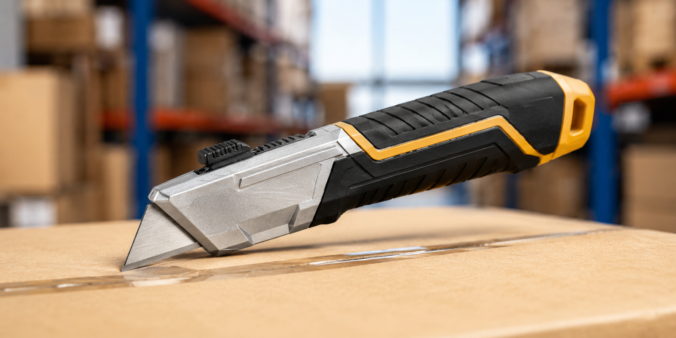
TL;DR: – Best overall for warehouse use: Stanley FatMax Retractable – durable metal body, tool-free blade swap, universal blade compatibility
- Biggest cost lever: SK5 blades at ~$0.30/blade vs. bi-metal at ~$0.80/blade = $1,040 annual difference per 10-worker team
- Best for safety-focused operations: Slice 10558 Auto-Retract – blade disappears on contact loss, ceramic edge reduces laceration depth
- Who this is for: Warehouse managers and fulfillment center workers processing 100–200+ boxes per shift
You’re reading this because someone on your team just nicked their hand, or you’re sourcing knives for a crew and don’t want to buy 20 of the wrong thing. Either way, the best utility knife for box cutting and warehouse work isn’t the one with the most Amazon stars – it’s the one that holds up across 150 boxes a shift, works with gloves on, and doesn’t become a liability.
Based on our analysis of product specifications, verified blade pricing data (June 2026), community discussions from Bladeforums, and safety data from OSHA and the National Safety Council, this guide ranks six utility knives on warehouse-specific criteria: auto-retract reliability, blade swap speed, gloved-hand grip, blade capacity, and cost-per-blade at volume.
What Makes a Utility Knife Good for Warehouse Use?
A utility knife optimized for warehouse box cutting is a tool evaluated on five criteria that most DIY-focused reviews skip entirely.
The five warehouse-specific criteria:
- Auto-retract safety – Does the blade retract automatically when cutting pressure is released, or does it require a manual action?
- Blade swap speed – Can you change a blade one-handed in under 30 seconds without tools?
- Gloved-hand ergonomics – Does the handle maintain grip with A4–A6 cut-resistant gloves on?
- Blade capacity – How many spare blades does the handle store onboard?
- Durability at volume – Can it handle 200+ cuts per day without the mechanism degrading?
According to Wirecutter, up to one-third of all manual-tool injuries involve utility knives and box cutters. That stat reframes the buying decision: this isn’t just about cutting performance, it’s about risk management at scale.
Retractable vs. fixed-blade vs. auto-retract – quick comparison:
| Type | Safety Level | Best For | Tradeoff |
|---|---|---|---|
| Standard retractable | Medium | General warehouse use | Manual retraction required |
| Auto-retract safety | High | High-turnover teams | Higher unit cost |
| Fixed-blade utility | Low | Controlled environments | Always-exposed blade |
| Snap-off segmented | Medium | High-volume cutting | Loose segments need disposal |
For locking mechanism reliability in folding utility designs, the liner lock vs. frame lock distinction matters – a topic worth understanding before committing to a folding utility knife for shift-long use.
Key Takeaway: Warehouse knife selection should prioritize auto-retract safety, gloved-hand grip, and blade swap speed over raw sharpness. A blade that’s fast to change and safe to carry prevents both downtime and recordable injuries.
Top 6 Utility Knives for Box Cutting and Warehouse Work (2026)
Quick comparison table:
| Knife | Auto-Retract | Blade Change | Glove Grip | Blade Storage | Best For |
|---|---|---|---|---|---|
| Stanley FatMax | No (manual) | Tool-free | Good | 5 blades | Overall best |
| Slice 10558 | Yes (auto) | Tool required | Moderate | 0 onboard | Safety-first ops |
| Milwaukee 48-22-1994 | No (manual) | Tool-free | Excellent | 5 blades | Gloved hands |
| DeWalt DWHT10319 | No (manual) | Tool-free | Good | 0 onboard | Budget teams |
| Olfa L-1 | No (manual) | Snap-off | Moderate | N/A | Heavy-duty cutting |
| Gerber EAB Lite | No (manual) | Tool-free | Moderate | 0 onboard | Light-duty/receiving |
Real usage scenario: A worker processing 150 boxes/shift × 5 days = 750 boxes/week. At roughly 200 cuts per SK5 blade, that’s 3–4 blade changes per week per worker – a figure that makes onboard blade storage and swap speed genuinely important, not just a spec-sheet feature.
Best Overall: Stanley FatMax Retractable
The Stanley FatMax earns the top spot for warehouse use because it solves the most problems at once. Die-cast metal body, tool-free quick-change blade mechanism, and storage for 5 spare blades onboard. It accepts all standard utility blades, which matters enormously for bulk blade purchasing.
Popular Mechanics and This Old House both consistently recommend it across hands-on testing. The metal body adds slight weight but eliminates the flex and creak that plastic-bodied knives develop after weeks of daily use.
Best for: Operations running standard retractable knives at volume with blade standardization as a priority.
Best Auto-Retract Safety Cutter: Slice 10558
The Slice 10558 uses a ceramic blade that retracts the moment cutting pressure is released – no thumb action required. According to Fulgent Tools, facilities report 30–50% fewer minor cutting injuries after switching to auto-retracting safety cutters. That’s a meaningful reduction when you’re managing a team of 20.
The ceramic blade won’t rust and Slice claims it lasts up to 11× longer than steel in comparable tasks – though that figure comes from internal testing. The tradeoff: ceramic is brittle and unsuitable for boxes with staples or metal fasteners.
Best for: High-turnover teams, food-adjacent warehouses, or any operation where OSHA recordable injuries are a priority concern.
Best for Gloved Hands: Milwaukee 48-22-1994
The Milwaukee Fastback stores 5 blades onboard and deploys one-handed via a flip mechanism – a genuine advantage when you’re wearing A4-rated cut-resistant gloves. Wirecutter named it their top pick, citing the comfortable grip and one-handed open/close operation.
The handle diameter sits at the larger end of the utility knife range, which aligns with ergonomic guidance for power-grip cutting tasks. One-handed opening mechanisms like this flip design reduce the fumbling that causes micro-injuries during high-repetition shifts.
Best for: Workers wearing gloves full-shift who need fast, one-handed deployment.
Best Budget Team Buy: DeWalt DWHT10319
At roughly $8–$12 per unit, the DeWalt DWHT10319 is the most defensible choice for outfitting a team of 10–25 on a constrained budget. Rubberized bi-material grip, tool-free blade change, and compatibility with all standard utility blades. It’s a folding design, which some workers prefer for pocket carry.
The limitation: no onboard blade storage means workers need a separate blade supply nearby. For a receiving dock with a blade dispenser mounted at the station, that’s a non-issue.
Best for: Budget-conscious bulk procurement where per-unit cost matters more than premium features.
Best Heavy-Duty: Olfa L-1
The Olfa L-1 runs 18mm snap-off blades through an aluminum die-cast body with a steel-reinforced blade channel. That anti-deflection channel matters when you’re cutting double-wall corrugated or poly strapping – materials that flex standard utility knives sideways.
According to Benchmarkinc, snap-off blade strips carry 8–10 segments each, meaning a fresh cutting edge is always one snap away. The Olfa LB-50B blade pack (50 strips) yields up to 400 fresh cutting edges – the lowest effective cost per edge of any blade type covered here.
Best for: Heavy corrugated, double-wall boxes, or any application where blade deflection is a problem.
Best Folding Utility Knife: Gerber EAB Lite
The Gerber EAB Lite weighs 1.5 oz and accepts standard utility blades in a compact folding format. As Knifeinformer notes, it offers replaceable blade utility at a price point that makes it accessible for occasional-use roles like receiving clerks or quality control staff.
This isn’t a high-volume cutting tool. It’s the right pick for workers who cut 10–20 boxes per shift and need something pocketable that takes the same blades as everyone else on the team.
Best for: Light-duty receiving roles, occasional cutting, or as a secondary knife for supervisors.
Key Takeaway: For most warehouse operations, the Stanley FatMax handles daily volume, the Milwaukee Fastback wins for gloved-hand use, and the Slice 10558 is the right call when injury reduction is the primary metric.
Auto-Retract vs. Standard Retractable: What the Safety Data Actually Says
Auto-retract knives retract the blade automatically when cutting pressure is released; standard retractable knives require a deliberate thumb action to retract. That single mechanical difference has significant safety implications at warehouse scale.
According to OshaEducationCenter.com, box cutters are responsible for nearly one-third of all workplace injuries involving tools, and four out of five hand injuries are caused by cuts or lacerations. The same source notes most incidents stem from preventable mistakes – including leaving blades extended.
Side-by-side comparison:
| Factor | Auto-Retract | Standard Retractable |
|---|---|---|
| Blade exposure between cuts | None | Until manually retracted |
| Unit cost | $18–$25 | $6–$12 |
| Cutting speed | Slightly slower | Faster |
| Injury risk | Lower | Higher |
| Best use case | High-turnover teams | Experienced workers |
The ROI math is straightforward. According to the National Safety Council, the average cost of a medically consulted workplace injury is $42,000. At $18–$22 per auto-retract unit, a single prevented recordable incident pays for over 1,900 safety knives.
Fulgent Tools reports that the biggest safety improvements come from changing habits alongside tools – auto-retract knives work best when paired with blade disposal protocols and basic cutting technique training.
OSHA’s 29 CFR 1910.138 requires employers to provide hand protection when workers face laceration hazards, but doesn’t mandate auto-retract designs specifically. The choice is employer-driven – which means operations managers carry the liability decision.
Key Takeaway: Auto-retract knives cost $10–$13 more per unit upfront. One prevented OSHA recordable injury – averaging $42,000 per NSC data – justifies the upgrade for a team of 20+ workers.
Blade Types and How Long They Last at Warehouse Volume
Blade selection is where warehouse knife economics actually live. The knife is a one-time purchase; blades are an ongoing operational cost.
Blade type breakdown:
| Blade Type | Est. Boxes Per Blade | Cost Per Blade | Best For |
|---|---|---|---|
| SK5 carbon steel | 20–47 boxes | ~$0.20–$0.35 | Standard cardboard, high volume |
| Bi-metal (HSS edge) | 40–100 boxes | ~$0.60–$0.90 | Heavy corrugated, tape, strapping |
| Ceramic (Slice) | Long-lasting* | ~$1.50–$2.50 | Light cardboard, film, no staples |
| Snap-off 18mm | 8 edges/strip | ~$0.04–$0.05/edge | High-volume, heavy-duty |
*Manufacturer claims 11× longer than steel; treat as directional.
According to Knifeinformer’s blade testing, a single quality blade cut through 47 cardboard boxes before noticeable degradation – more than double what budget alternatives delivered. Budget blades in the same test managed 20–25 boxes per blade.
The annual cost math for a 10-worker team:
A worker processing 150 boxes/day × 5 days = 750 boxes/week. At 35 boxes per SK5 blade (midpoint estimate), that’s roughly 21 blade changes per week per worker, or about 4 per day. Across 10 workers for 52 weeks:
- SK5 at $0.30/blade: 4 changes/week × 52 weeks × 10 workers × $0.30 = $624/year
- Bi-metal at $0.80/blade: Same formula = $1,664/year
- Annual difference: $1,040
Understanding blade steel hardness and edge retention helps explain why bi-metal blades last 2–3× longer in heavy corrugated – the high-speed steel cutting edge resists dulling under load in ways that standard carbon steel can’t match.
Snap-off blades explained: The Olfa LB-50B 50-pack yields up to 400 fresh cutting edges at roughly $0.04–$0.05 per edge. As notes, you snap off the dull segment with pliers to expose a fresh edge – no blade change required. The tradeoff: loose segments need puncture-resistant sharps disposal containers.
According to Benchmarkinc, dull knives are a leading cause of injury because they’re more likely to slip during use. Snap-off designs solve this by making “fresh edge” the default rather than a deliberate maintenance step.
Key Takeaway: SK5 blades are the cost-optimal choice for standard cardboard at $0.30/blade. Snap-off 18mm segments beat everything on cost-per-edge at $0.04–$0.05. Bi-metal earns its premium only on heavy double-wall corrugated or strapping.
What to Look for When Buying Utility Knives for a Warehouse Team
Sourcing knives for a team of 10–50 workers is a different decision than buying one knife for yourself. Four factors dominate the analysis.
1. Blade standardization Pick one blade format across your entire team. Standard utility blades (18mm or the universal trapezoidal shape) work across Stanley, Milwaukee, DeWalt, and most other brands. Standardization means one bulk blade order, one disposal protocol, and no confusion when someone grabs a coworker’s spare.
2. Ergonomics for shift-long use OSHA ergonomic guidance recommends tool handle diameters of 30–40mm for power-grip cutting tasks. Most utility knife handles fall in the 1.0–1.4 inch range; the FatMax and Milwaukee Fastback sit at the larger end, which benefits gloved-hand use. Weight under 6 oz matters for workers making 200+ cuts per shift – handle materials and grip durability directly affect fatigue over an 8-hour shift.
3. Storage and accountability Belt clips reduce set-down injuries (knives left blade-up on surfaces). Holsters keep knives accessible without pocket carry. Blade disposal boxes – puncture-resistant containers mounted at workstations – are required under OSHA’s General Duty Clause when loose blades create a recognized hazard.
4. Bulk pricing Industrial suppliers like Grainger offer 10–25 unit pricing breaks on most utility knife models. For food-safe warehouses, BRC Global Standard Issue 9 requires color-coded knife programs by zone – Slice and other safety knife brands offer color variants specifically for BRC compliance.
You can browse a wide selection of EDC and utility-oriented folding knives at Knife Depot – useful when you want to compare handle formats and blade compatibility before committing to a bulk order.
Key Takeaway: Blade standardization and onboard storage are the two highest-leverage decisions for team procurement. One blade format across 20 workers cuts supply complexity and enables bulk pricing that compounds annually.
Frequently Asked Questions
What is the safest utility knife for warehouse workers?
Direct Answer: The Slice 10558 Auto-Retract is the safest option for warehouse use – its ceramic blade retracts automatically when cutting pressure is released, eliminating the most common exposure window for lacerations.
According to Fulgent Tools, facilities switching to auto-retracting safety cutters report 30–50% fewer minor cutting injuries. Pair any safety knife with A4–A6 cut-resistant gloves rated under ANSI/ISEA 105 standards for maximum protection.
How often should you change utility knife blades in a warehouse setting?
Direct Answer: Change blades when cutting requires noticeably more force – not on a fixed schedule. In practice, a worker processing 150 boxes/day will typically need 3–4 blade changes per week with standard SK5 blades.
According to OshaEducationCenter.com, a worn or damaged edge is a leading cause of implement injuries. reinforces this: dull knives slip, and a sharper knife is genuinely a safer knife. For maintaining folding utility knives properly, regular inspection of the blade seat and locking mechanism matters as much as blade freshness.
Are auto-retract knives worth the extra cost for box cutting?
Direct Answer: Yes, for teams of 10+ workers or high-turnover environments. The $10–$13 per-unit premium pays for itself if it prevents a single recordable injury.
The National Safety Council puts the average medically consulted workplace injury at $42,000 in direct and indirect costs. At $20/unit for an auto-retract knife, that’s 2,100 knives per prevented incident. For smaller teams or experienced workers with strong safety habits, standard retractable knives remain cost-effective.
What is the difference between a box cutter and a utility knife?
Direct Answer: A box cutter is a subset of utility knife – typically a simpler, lighter tool optimized for cardboard cutting, often with a fixed or limited-retraction blade. A utility knife is a broader category that includes retractable, folding, and snap-off designs suited for multiple materials.
In warehouse contexts, the terms are often used interchangeably. The practical distinction is blade format: box cutters typically use single-edge razor blades, while utility knives use the trapezoidal utility blade standard. For budget options across both categories, exploring budget folding knife options can help clarify what format fits your team’s workflow.
How much does it cost to outfit a warehouse team with utility knives?
Direct Answer: Expect $8–$25 per knife depending on type, plus $0.20–$0.80 per blade in ongoing costs. A 20-person team costs $160–$500 upfront for knives, plus $1,248–$3,328 annually in blades at 150 boxes/day per worker.
Amazon’s best-seller data shows quality retractable utility knives ranging from $12–$28 per unit. For budget team procurement, the REXBETI 12-pack runs approximately $9.99 for 12 units – under $1/knife – though blade quality and durability vary at that price point.
Can utility knives be used with work gloves on?
Direct Answer: Yes, but handle design matters significantly. Look for handles with deep finger grooves, rubberized overmold grip, and a diameter of 1.25–1.5 inches for optimal gloved-hand control.
The Milwaukee 48-22-1994 Fastback is the strongest performer for gloved-hand use among the knives reviewed here, per hands-on testing. Pair with ANSI/ISEA 105 A4–A6 rated gloves for cut protection without sacrificing too much dexterity.
What blade size is best for cutting cardboard boxes?
Direct Answer: Standard trapezoidal utility blades (18mm wide,.024″ thick) handle the vast majority of warehouse cardboard cutting. Heavy-duty blades (.025″–.035″ thick) add rigidity for dense double-wall corrugated.
According to Knifeinformer’s blade testing, standard blades at.024″ thickness handle most applications perfectly. The upgrade to heavy-duty thickness is worth it specifically for double-wall boxes, poly strapping, or taped seams where blade flex causes the cut to wander.
The Bottom Line
The best utility knife for box cutting and warehouse work comes down to your team’s specific risk profile and volume. For most operations, the Stanley FatMax handles daily volume reliably. If injury reduction is the primary metric, the Slice 10558’s auto-retract mechanism justifies its premium. For gloved-hand use, the Milwaukee Fastback is the clear choice.
The blade decision matters more than most buyers realize. SK5 at $0.30/blade versus bi-metal at $0.80/blade is a $1,040 annual difference per 10-worker team – and snap-off 18mm segments undercut both at $0.04–$0.05 per cutting edge. Run the math for your team size and box volume before committing to a blade format.
Whatever you choose, is right that most cutting injuries are preventable. The right knife, the right blade, and basic cutting discipline eliminate the majority of the risk.


Leave a Reply