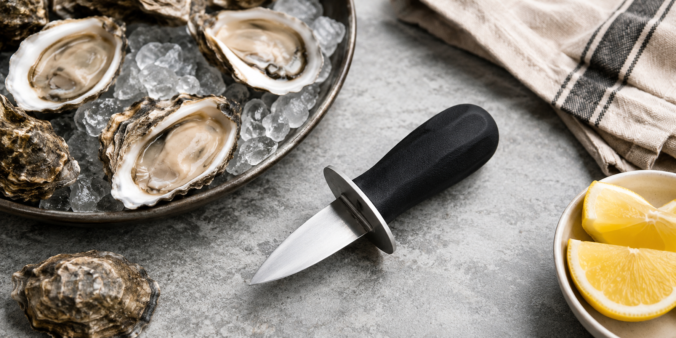
TL;DR: – Best overall: R. Murphy New Haven style – versatile, beginner-friendly, and proven across oyster varieties
- Cost reality: A $45 knife used 3×/week costs roughly $0.29 per shucking session over a year – mid-range wins on value
- Best for: Home seafood enthusiasts who want to shuck confidently without spending pro-kitchen money
Ever stared at a pile of oysters on ice and thought, do I really need a special knife for this? The answer is yes – and the wrong tool isn’t just inconvenient, it’s genuinely dangerous. Based on our analysis of independent kitchen media testing (including 12-knife, 150-oyster trials), community discussions on knife forums, and manufacturer specifications across 8 leading oyster knives, this guide breaks down the best oyster shucking knives for seafood lovers in 2026. You’ll get blade style matching, honest pros and cons, and a cost-per-use breakdown so you can buy with confidence.
What Makes a Good Oyster Shucking Knife?
A good oyster shucking knife is a purpose-built prying tool – not a cutting tool. That distinction matters more than most buyers realize.
According to Serious Eats, “oyster knives are rather dull. But this is intentional – wedging a razor-sharp blade into a gnarly oyster shell could damage the knife, or at the very least quickly dull it.” So forget edge retention as a buying criterion. Focus on these four instead:
1. Blade thickness and stiffness You need a blade stout enough to lever open a shell without flexing. As Charleston Coastal Supply puts it, “oyster knives are built like little pry bars – they should feel stout, not flimsy.”
2. Tip shape The tip is your entry point into the hinge. According to Knives and Tools, “the tip of an oyster knife is blunt rather than sharp. This is to prevent injury, as the tip is inserted into the hinge of the oyster and can slip.” Tip geometry varies by style – more on that below.
3. Handle grip How to Eat Oyster puts it plainly: “After 20 oysters, your hand will tell you whether the handle was any good.” Look for textured, contoured grips. According to Alibaba Life Tips, shuckers using textured polymer grips applied 32% less peak grip force during sustained use versus smooth metal or wood handles.
4. Steel type Stainless is non-negotiable for oyster work. Charleston Coastal Supply notes: “Stainless steel is the easy-care choice. Rinse, dry, and you are good. High-carbon can be tough, but it demands more attention and can discolor if you are not diligent.” For a deeper dive into steel grades, check out a carbon vs stainless steel comparison before buying.
⚠️ What to avoid in cheap oyster knives: Thin blades that flex under pressure, smooth plastic handles with no texture, and any knife marketed as “multi-purpose” for both shucking and cutting. These are injury risks, not bargains.
Key Takeaway: Blade stiffness, tip geometry, handle grip, and stainless steel construction are the four non-negotiables. Sharpness is irrelevant – leverage and control are everything.
Which Oyster Knife Blade Style Should You Choose?
Your blade style should match your oyster variety. Most buyers skip this step entirely – and then wonder why shucking feels harder than it should.
According to 3 Hands Oyster Company, “for beginners: The New Haven or Boston knife is a great starting point due to its versatility and ease of use.” But if you’re regularly working Gulf oysters or European Flats, a different blade will serve you better.
| Blade Style | Tip Shape | Best Oyster Match | Skill Level |
|---|---|---|---|
| New Haven | Upturned, pointed | East Coast, Kumamoto, general use | Beginner–Advanced |
| Boston | Tapered, straighter | Eastern flat oysters, Pacific | Beginner–Intermediate |
| Providence | Slender, narrow | Delicate thin-shelled varieties | Intermediate–Pro |
| Galveston | Wide, heavy | Gulf oysters (thick shell) | Intermediate–Pro |
| French | Wide, flat | European Flat (Belon) | Advanced |
Sources: 3 Hands Oyster Company, Shellfish Broker, Cockles & Mussels
For broader blade geometry context, a knife blade shapes guide is worth bookmarking.
New Haven vs Boston Style: Key Differences
According to 3 Hands Oyster Company, “the curved tip of the New Haven knife allows for easy entry at the hinge of the oyster and provides leverage to pop it open,” while “the Boston knife’s pointed tip is designed to penetrate the oyster’s hinge while the flat blade allows for prying and separating the shell.”
The practical difference: New Haven levers at the hinge; Boston slides between shell halves. New Haven is more forgiving for beginners. Boston rewards shuckers who’ve developed a feel for hinge entry.
Key Takeaway: New Haven is the safest all-rounder for home shuckers. Match Galveston to Gulf oysters, French style to Belons, and Providence to delicate thin-shelled varieties.
8 Best Oyster Shucking Knives Ranked (2026)
Here’s the ranked breakdown across blade styles, specs, and who each knife actually suits. No pricing tables – just honest assessments.
1. Best Overall: R. Murphy New Haven Oyster Knife
How to Eat Oyster notes that “R. Murphy has been making knives in Massachusetts since 1850” – and the New Haven style is their flagship. Serious Eats found that “my favorite oyster knives were almost all New Haven-style, with upturned, pointed tips.”
- ✅ Versatile across most oyster varieties
- ✅ Upturned tip gives excellent hinge leverage
- ✅ American-made heritage quality
- ❌ Wooden handle requires hand-washing care
- ❌ Not ideal for thick Gulf shells
Best for: Home shuckers who want one knife that handles everything
2. Best Budget Pick: Winco Oyster Knife
Winco is a commercial foodservice supplier, and their oyster knife reflects that: straightforward, durable, and no-frills. It won’t win design awards, but it gets the job done at a fraction of mid-range prices.
- ✅ Widely available at restaurant supply stores
- ✅ Solid stainless construction for the price
- ❌ Basic handle with minimal ergonomic shaping
- ❌ Less refined tip geometry than premium options
Best for: Casual shuckers who want a functional starter knife
3. Best for Beginners: Victorinox Oyster Knife
Victorinox builds a blade guard and slip-resistant handle into their oyster knife – two features that matter enormously when you’re still learning. According to Serious Eats, “for novice or intermediate shuckers, I recommend investing in a New Haven-style knife,” and Victorinox delivers exactly that with added safety features.
- ✅ Blade guard reduces slip injury risk
- ✅ Textured handle improves wet-hand grip
- ✅ Forgiving tip geometry
- ❌ Guard can feel bulky for experienced shuckers
Best for: First-time shuckers building technique and confidence
4. Best Premium Option: Dexter-Russell Galveston
How to Eat Oyster confirms that ” is another American heritage brand that supplies restaurants across the country.” The Galveston is their workhorse for thick-shelled Gulf oysters. Cockles & Mussels notes it’s “one of the longest oyster knives around at 6.5 inches.”
- ✅ Heavy blade handles thick Gulf shells with authority
- ✅ Professional-grade steel and construction
- ✅ Multiple handle options (rosewood, Sani-Safe)
- ❌ Overkill for East Coast or Pacific varieties
- ❌ Higher price point
Best for: Gulf oyster enthusiasts and high-volume home shuckers
💡 Cost-per-use reality check: A $45 mid-range knife used 3×/week = $0.29/session over a year (52 weeks × 3 sessions = 156 sessions; $45 ÷ 156 = $0.29). A $72 premium knife at the same frequency = $0.46/session – 59% more per use. For most home shuckers, that gap isn’t justified. Understanding why premium knives are worth the investment helps you decide when the upgrade actually makes sense.
5. Best Handle Grip: OXO Good Grips Oyster Knife
OXO’s wide, soft-grip handle is purpose-built to reduce hand fatigue during extended sessions. A Kitchen Knife Forums community member noted: “I have large hands and the smaller handles tend to dig a blister into my palm if I have to open more than a few hundred at a time” (Kitchen Knife Forums). OXO solves exactly that problem.
- ✅ Wide palm grip distributes pressure evenly
- ✅ Non-slip even with wet hands
- ✅ Affordable and widely available
- ❌ Blade is functional but not exceptional
- ❌ Less precise tip than New Haven specialists
Best for: Shuckers with hand fatigue issues or anyone doing large batches
6. Best for Providence Style: Shellfish Broker Pick
According to Shellfish Broker, “the Providence oyster knife is a favorite of shucking pros.” Its slender profile suits delicate thin-shelled oysters where a heavier blade would crush the meat.
Best for: Experienced shuckers working with delicate East Coast varieties
7. Best for Speed Shucking: Duxbury Style
Shellfish Broker notes “the Duxbury knife is perfect for small oysters, speed shucking, and commercial use.” If you’re hosting a raw bar and need to move fast, this is your blade.
Best for: High-volume shucking events and small oyster varieties
8. Best Japanese Style: Kaki-Muki Knife
Knives and Tools explains that “the Japanese oyster knife, also called a hōchō, is made of high-quality stainless steel or carbon steel and is known for its sharp blade.” It uses a side-entry technique rather than hinge-entry – efficient for elongated Pacific shell shapes.
Best for: Pacific oyster enthusiasts comfortable with Japanese cutting technique
Key Takeaway: R. Murphy New Haven wins for home use. Dexter-Russell Galveston wins for high-volume Gulf shucking. Victorinox is the safest beginner pick. Match your knife to your oyster variety using the table above.
How Do Oyster Knives Compare to Regular Kitchen Knives?
Don’t use a regular kitchen knife to shuck oysters. Full stop.
According to Knives and Tools, “shucking oysters with a normal kitchen knife is not only dangerous, but chances are also you damage the oyster meat or that parts of the shell end up in the oyster.” Kitchen knives aren’t built for lateral prying force – they’re built for slicing. Apply shucking pressure to a chef’s knife and you risk snapping the blade or driving it into your hand.
Aw Shucks identifies the core problem: “most oyster shucking injuries come from knife slips and improper hand placement,” and “beginners are more likely to get injured using a knife because they apply uneven pressure, don’t know how much force is required, and react poorly when an oyster suddenly gives way.” Using the wrong knife amplifies every one of those risks.
According to Alibaba Life Tips, 47% of oyster-related ER visits involve lacerations. A dedicated oyster knife with a blunt tip, stout blade, and textured grip is your primary injury prevention tool – not an optional accessory.
For other seafood prep tasks, best fillet knives for fish prep are a separate category worth exploring.
Key Takeaway: Regular kitchen knives create serious laceration risk during shucking. A dedicated oyster knife with a blunt tip and stout blade is a safety necessity, not a luxury.
How to Maintain Your Oyster Knife for Lasting Performance
Most oyster knife guides stop at the purchase. But how you care for the knife determines whether it lasts one season or ten years.
Step 1: Rinse immediately Saltwater brine is corrosive. Rinse your knife under fresh water right after use – don’t let it sit.
Step 2: Dry completely Pat dry with a cloth before storing. Even stainless steel can develop surface rust if left wet.
Step 3: Oil the blade (occasionally) A light coat of food-safe mineral oil on the blade prevents oxidation, especially on knives with wooden handles stored in humid environments.
Step 4: Store properly Keep your oyster knife in a dry drawer or blade guard – not loose in a wet utensil crock.
Sharpening: Oyster knives don’t need frequent sharpening since they work by leverage, not cutting. When the tip becomes rounded or chipped, use a fine ceramic rod or diamond stone at a 20–25° angle. Knowing when to hone vs sharpen your knife saves you from removing more metal than necessary.
⚠️ Never put wooden-handled oyster knives in the dishwasher. The heat and moisture cycle will crack the wood and potentially loosen the handle from the tang – creating a safety hazard.
Key Takeaway: Rinse, dry, oil, store. Four steps that extend your knife’s life significantly. Skip the dishwasher for any wooden-handled knife.
Frequently Asked Questions
What is the best oyster knife for beginners?
Direct Answer: The New Haven style is the best starting point for beginners. Serious Eats recommends it specifically: “I think the New Haven-style blade is the best for beginners or people who want a (relatively) easy shucking experience.” The Victorinox oyster knife adds a blade guard for extra safety while you’re building technique.
How much should I spend on an oyster shucking knife?
Direct Answer: For home use, the $35–$55 range hits the sweet spot. A $45 knife used 3×/week costs approximately $0.29 per shucking session over a year – excellent value. Spending $72+ on a professional Galveston-style knife makes sense for high-volume Gulf oyster work, but most home shuckers won’t notice the difference.
Can I use a regular knife to shuck oysters?
Direct Answer: No – and it’s genuinely dangerous. According to Knives and Tools, using a regular kitchen knife risks damaging the oyster meat, introducing shell fragments, and – most critically – causing serious hand lacerations. Kitchen knives aren’t built for the lateral prying force shucking requires. For other seafood prep, explore best fillet knives for fish prep as a separate tool category.
What is the difference between a New Haven and Boston oyster knife?
Direct Answer: New Haven has an upturned tip that levers at the hinge; Boston has a straighter, tapered tip designed to slide between shell halves. According to 3 Hands Oyster Company, the New Haven’s curved tip “allows for easy entry at the hinge and provides leverage to pop it open,” while Boston’s flat blade “allows for prying and separating the shell.” New Haven is more forgiving for beginners.
How do I sharpen an oyster knife at home?
Direct Answer: Use a fine ceramic rod or diamond stone at a 20–25° angle to restore the tip geometry. Oyster knives don’t need frequent sharpening – they work by leverage, not cutting. For a full technique walkthrough, a beginner whetstone sharpening guide covers the fundamentals. Avoid belt sanders, which remove too much material from thin utility blades.
Are wooden or synthetic handles better for oyster knives?
Direct Answer: Synthetic handles win for durability and hygiene. Charleston Coastal Supply notes stainless with synthetic grips is “the easy-care choice.” Wooden handles look great but absorb moisture, can crack with repeated wet exposure, and should never go in the dishwasher. For regular home use, a textured polymer handle is more practical.
How long does a quality oyster knife last?
Direct Answer: A well-maintained mid-range oyster knife should last 5–10+ years for home use. The limiting factors are handle integrity (wood cracks faster than synthetic) and tip damage from forcing shells incorrectly. Rinse and dry after every use, store dry, and avoid the dishwasher – those three habits alone dramatically extend knife life.
Ready to Start Shucking?
The best oyster shucking knives for seafood lovers aren’t the most expensive ones – they’re the ones matched to your oyster variety, your skill level, and how often you actually shuck. For most home enthusiasts, a New Haven-style knife in the $35–$55 range is the right call. It’s versatile, forgiving, and built to last.
If you’re looking to explore a broader range of EDC and specialty knives alongside your oyster setup, Knife Depot carries a solid selection worth browsing.
Now go find some good oysters. The knife is the easy part.


Leave a Reply