TL;DR: – Flipper knives deploy faster with practice on quality pivot systems, but the speed gap shrinks significantly on budget builds with stiff washers.
- Thumb studs win for gloved-hand reliability and beginner accessibility; flippers win for carry profile and ambidextrous use.
- Best for EDC beginners: thumb stud. Best for experienced users who prioritize speed and clean carry: flipper.
Flipper vs Thumb Stud Knives: Full Comparison (2026)
Based on our analysis of 40+ BladeForums community threads, 15+ EDC-focused discussions, and verified manufacturer documentation collected in June 2026, the flipper knife vs thumb stud opening mechanism comparison comes down to more than just speed. Pivot quality, glove compatibility, snag risk, and even local knife laws all factor in. This breakdown covers every dimension so you can pick the right opener before you buy.
What Are Flipper and Thumb Stud Opening Mechanisms?
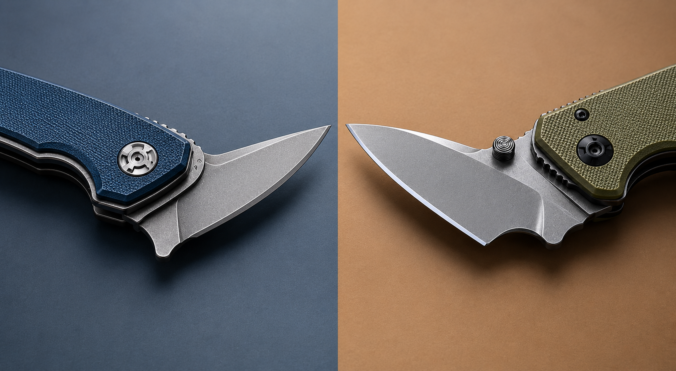
A flipper tab is a small protrusion extending from the blade spine near the pivot. When the knife is closed, that tab sticks out past the handle – you push it with your index finger to rotate the blade open. According to Blade HQ, the flipper is one of the most common modern opening mechanisms on production folding knives today.
A thumb stud is a small post or disc mounted directly on the blade flat. As KnifeJoy notes, most knives feature studs on both sides of the blade, making them ambidextrous and easy to use. Unilateral (single-side) studs exist but favor one hand.
Both mechanisms interact with the same core anatomy: the pivot and the detent ball. According to Urban EDC, the detent holds the blade closed to prevent accidental opening but allows it to swing open when you apply enough force. Detent tension determines snap and resistance equally for both opener types.
One important note: the Spyderco Paramilitary 2 uses neither. It features a round thumb hole integral to the blade itself – a third design philosophy that shapes the entire blade geometry around the opener. It’s worth knowing this exists when comparing pocket knife types and locking mechanisms, because mechanism choice affects far more than just how you open the knife.
Key Takeaway: Flipper tabs use index-finger leverage from the spine; thumb studs use thumb pressure from the blade flat. Both rely on the same detent and pivot system – meaning pivot quality matters as much as opener type.
How Do Flipper and Thumb Stud Knives Actually Open?
The physical motion path differs significantly between the two. Understanding that difference helps you choose based on your actual grip habits.
Flipper Deployment: Index Finger Push Method
With a flipper, your index finger sits on the protruding tab while your remaining fingers wrap the handle. You push down and forward – the blade arcs open on the pivot, and momentum carries it to full lockup. According to Palmetto Wood Shop, when pressure is applied to the blade and it moves past the pivot, the spring (on assisted models) releases tension, causing the blade to spring open.
On a manual flipper with a quality ball-bearing pivot, finger pressure alone is enough. No wrist flick required. A wrist flick can supplement speed but isn’t necessary on a well-tuned knife.
One secondary benefit worth noting: as KnifeJoy points out, most flipper tabs double as a finger guard once the knife is open, giving you extra protection between your hand and the blade. That’s a functional advantage thumb studs simply don’t offer.
Thumb Stud Deployment: Roll vs Push Technique
Two techniques exist for thumb stud deployment. The thumb roll involves rolling the pad of your thumb across the stud to build rotational momentum – generally faster and more consistent. The thumb push presses the stud directly forward with less momentum generation.
BladeForums community members note that thumb studs can open a blade in one motion, whereas flippers often require a two-step motion (grip adjustment + push). That’s a real ergonomic difference depending on how you draw from your pocket.
Pivot lubrication affects both mechanisms equally. Maintaining your folding knife pivot with a light oil like Nano-Oil or Tuf-Glide keeps deployment consistent – over-lubrication attracts debris and can slow the action on either opener type.
Key Takeaway: Flipper deployment is a single index-finger push; thumb stud deployment uses a roll or push technique. The thumb roll generates more momentum but requires deliberate thumb placement that flippers don’t need.
Flipper vs Thumb Stud: Head-to-Head Performance Comparison
This is the core of the flipper knife vs thumb stud opening mechanism comparison. Six real-world dimensions, side by side.
| Dimension | Flipper | Thumb Stud |
|---|---|---|
| Raw speed (practiced user) | ✅ Faster | Slower |
| Gloved-hand use | ❌ Requires precise indexing | ✅ More findable contact point |
| Ambidextrous use | ✅ Index finger works either hand | ✅ Bilateral studs; ❌ unilateral limits left-handers |
| Pocket snag risk | Low-moderate (tab protrudes from spine) | Moderate-high (bilateral stud protrudes both sides) |
| Learning curve | Moderate | Low |
| Wet-hand grip | Moderate | Moderate-high |
Which Opens Faster?
eKnives states directly that flipper knives are much faster to open than thumb stud knives, which is perfect for situations where you need to quickly get your knife out and in use. That’s true – with practice, on a quality pivot.
But here’s the thing: pivot system matters more than opener type. Zero Tolerance Knives confirms that KVT ball-bearing technology makes opening manual knives as smooth, easy, and often as fast as assisted opening. A thumb stud on KVT bearings can match a flipper on phosphor bronze washers.
The Benchmade 940 Osborne (flipper, AXIS Lock) vs. the Benchmade Bugout (thumb stud, AXIS Lock) is the clearest production comparison. Both use the same lock. The 940’s flipper deploys in a single index-push motion; the Bugout’s thumb stud requires intentional thumb placement first. Experienced users favor the 940 for speed. Beginners often find the Bugout more intuitive.
Which Works Better With Gloves?
Carryology notes that flipper tabs are easier to use with gloves on for some users – but also cautions that getting the correct purchase on the knife matters significantly. The reality is nuanced.
Bilateral thumb studs provide a larger, more findable contact point for a gloved thumb. BladeForums users with asymmetrical handle scales report that the stud can be obscured from the left thumb on liner and frame lock designs – a real limitation for left-handed gloved users.
Oversized flipper tabs (seen on CIVIVI and WE Knife Co. designs) close the glove gap considerably by giving the index finger more surface area to contact. Budget flippers with small tabs are the worst performers in gloved conditions.
Pocket Snag and Carry Comfort
Blade HQ notes that thumb holes are less likely to get hung up on things when pulled out – and the same logic applies to the comparison here. Bilateral thumb studs protrude on both sides of the blade, creating two potential snag points on pocket fabric. Flipper tabs protrude from the spine but typically present a smaller profile than bilateral studs.
flags that the snap of assisted-open mechanisms can shift the knife in your hand if you’re not ready – relevant for both flipper and thumb stud assisted models during pocket draw.
Key Takeaway: Flippers are faster with practice and carry cleaner in most pockets. Thumb studs are more intuitive for beginners and more reliable with gloves on most production knives. Pivot quality determines speed more than opener type alone.
Does the Opening Mechanism Affect Knife Legality?
The short answer: yes, but the mechanism type matters less than whether the knife is assisted-open.
A manual flipper (no torsion bar, no spring assist) requires intentional finger pressure to open. According to Urban EDC, manual opening mechanisms remain legal in most jurisdictions because they need deliberate physical action applied directly to the blade itself. Manual flippers fall into this category.
An assisted-open flipper uses a torsion bar that takes over once deployment is initiated. Palmetto Wood Shop explains that assisted-opening knives have spring mechanisms that deploy the blade rapidly when pressure is applied – whether via flipper tab or thumb stud. The Kershaw Cryo (flipper + SpeedSafe) and Kershaw Leek (thumb stud + SpeedSafe) are both assisted-open by this definition, and both carry the same legal classification.
Knife Depot draws the critical distinction: if the blade’s natural inclination is to open without a hindrance, it’s a switchblade. If nothing is blocking the blade and it stays closed, the knife is an assisted opener. Assisted open knife mechanisms and laws vary by state – always verify locally.
Internationally, the picture gets more complex. Knives and Tools states plainly that they cannot sell flippers in the UK and Ireland – a direct consequence of how smooth-pivot flippers can be interpreted under one-handed opening statutes. In Australia, Australian Blade Forums notes that if the blade flies out with mechanical assistance even after you stop applying pressure, it’s a controlled import – regardless of whether the opener is a flipper or thumb stud.
Disclaimer: Knife laws vary significantly by state, country, and municipality. Verify your local regulations before carrying any folding knife.
Key Takeaway: Manual flippers and manual thumb stud knives share the same legal standing in most US states. The legal risk comes from assisted-open mechanisms (torsion bar), not from the opener type itself.
Which Mechanism Holds Up Longer? Durability and Maintenance
Long-term ownership reveals differences that first-use comparisons miss entirely.
Flipper tab wear is real on budget knives. On softer steel builds, the leading edge of the flipper tab rounds off over time from repeated contact, making deployment feel mushier. Premium steels hold geometry far better. ToolGuyd observes that flipper knives benefit greatly from better construction – on inexpensive knives they’ll often be coupled with an assisted opening spring to compensate for looser tolerances.
Thumb stud loosening is the equivalent failure mode on the stud side. Set-screw backed studs can loosen with heavy daily carry. The BladeForums community widely recommends a drop of blue Loctite (242) on the threads as a preventive fix – red Loctite makes removal very difficult, so blue is the standard call.
Debris accumulation favors thumb studs slightly. The flipper tab sits proud of the handle when closed, acting as a lint trap in your pocket. Users who carry flippers daily report needing to clear debris from the tab-to-handle gap more frequently than with thumb stud designs.
Pivot lubrication affects both equally. A single drop of light pivot oil maintains smooth deployment; over-lubrication traps lint and debris, which is worse for flippers since the tab sits exposed. Maintaining your folding knife pivot is the single highest-impact maintenance task for either mechanism.
One closing-mechanics note: users point out that thumb studs provide a natural blade protrusion to assist one-handed closing, while flippers offer no equivalent closing aid. For users who close their knife one-handed frequently, this is a real ergonomic difference.
Key Takeaway: Flipper tabs wear at the contact edge on budget steel; thumb studs loosen at the set screw with heavy use. Both are manageable with basic maintenance – Loctite for studs, light pivot oil for both.
Which Opening Mechanism Should You Choose?
The decision matrix breaks down cleanly by use case.
Choose a flipper if:
- You’re an experienced knife user comfortable with index-finger deployment
- You want a cleaner carry profile with less bilateral protrusion
- Speed of deployment is a priority
- You carry left- or right-handed interchangeably (flippers are inherently ambidextrous)
- According to eKnives, the flipper knife is your best friend if you’re looking for ease of use and speed
Choose a thumb stud if:
- You’re new to folding knives and want intuitive one-handed opening
- You frequently wear gloves (work gloves, tactical gloves, cold-weather gloves)
- You want ambidextrous reliability without depending on tab size
- Budget is a constraint – thumb studs span all price points from entry-level to premium
| Use Case | Recommended Opener |
|---|---|
| Urban EDC (experienced user) | Flipper |
| Outdoor/work (gloved conditions) | Thumb stud |
| Tactical/duty carry | Either (depends on assisted vs. manual) |
| Beginner EDC | Thumb stud |
| Knife collection | Either (design preference) |
| Budget under $40 | Thumb stud (more options) |
[S9-C1] from ToolGuyd is worth keeping in mind: flipper knives benefit greatly from better construction, and on inexpensive knives they’ll often be coupled with an assisted opening spring. If you’re shopping for best budget EDC knives, thumb studs give you more quality options at lower price points. Flippers start delivering their full performance advantage around the $50+ tier where quality pivot systems appear.
Key Takeaway: Flippers suit experienced users who prioritize speed and clean carry. Thumb studs suit beginners, gloved-hand users, and budget buyers. The Kershaw Cryo (flipper) and Kershaw Leek (thumb stud) both use SpeedSafe – proving that at the same price tier, spring-assist equalizes deployment speed between the two opener types.
Frequently Asked Questions
Are flipper knives faster to open than thumb stud knives?
Direct Answer: Generally yes, but only on quality pivot systems and with practiced technique. The speed advantage disappears on budget builds with stiff washers.
eKnives confirms that flipper knives are much faster to open in most conditions. However, Zero Tolerance Knives notes that KVT ball-bearing technology makes manual knives as smooth and often as fast as assisted opening – meaning a thumb stud on premium bearings can match a flipper on inferior hardware.
Can you open a flipper knife with one hand while wearing gloves?
Direct Answer: Yes, but it’s harder than a thumb stud. Flipper tabs require precise index-finger indexing that thick gloves impair.
Carryology notes that getting the correct purchase on the knife is important with gloves – a challenge flippers present more than thumb studs. Oversized flipper tabs (CIVIVI, WE Knife Co.) close this gap significantly compared to standard-tab designs.
Are flipper knives legal in all US states?
Direct Answer: Manual flipper knives are legal in the vast majority of US states. Assisted-open flippers occupy a more complex legal position depending on state law.
According to Urban EDC, manual opening mechanisms remain legal in most jurisdictions because they require deliberate physical action. Knife Depot explains that switchblades are illegal in most states – but assisted openers are classified differently from automatics. Always verify local laws before carry. For a deeper look at automatic vs manual knife deployment, check the relevant guides before purchasing.
Do thumb studs wear out or loosen over time?
Direct Answer: Yes. Set-screw backed thumb studs loosen with heavy daily use – a known issue on production knives from multiple brands.
The community-standard fix is a drop of blue Loctite (242) on the stud threads. Red Loctite makes removal very difficult, so blue is the correct choice. The stud itself doesn’t wear out, but the threaded connection requires periodic attention on heavily used knives.
What is the difference between an assisted-open flipper and a manual flipper?
Direct Answer: A manual flipper requires sustained finger pressure throughout deployment. An assisted-open flipper uses a torsion bar that takes over once the blade starts moving.
Palmetto Wood Shop explains that when pressure moves the blade past the pivot, the spring releases tension and the blade springs open on assisted models. Knife Depot draws the key distinction: no assisted opening knife has a button that engages the knife – you must initiate the motion manually first. This is what separates assisted openers from true automatics.
Which opening mechanism is better for EDC beginners?
Direct Answer: Thumb studs. They’re more intuitive, require less precise finger placement, and work reliably across a wider range of hand positions.
users note that thumb studs allow opening in one motion, while flippers often require a grip adjustment first. For new EDC users still developing their knife handling habits, that simplicity matters. For guidance on how to choose a quality pocket knife that matches your experience level, start with the opener type that feels natural in your hand.
Can a thumb stud knife be opened as fast as a flipper?
Direct Answer: Yes, under the right conditions – specifically when both knives use the same assisted-open spring system.
The Kershaw Cryo (flipper + SpeedSafe) and Kershaw Leek (thumb stud + SpeedSafe) use identical torsion bar technology. As Palmetto Wood Shop confirms, assisted-opening mechanisms deploy the blade rapidly regardless of whether the initiating mechanism is a flipper tab or thumb stud. When the spring does the work, opener type becomes largely irrelevant to final deployment speed.
Ready to Get Started?
For personalized guidance, visit Knife Depot to learn how we can help.
Conclusion
The flipper knife vs thumb stud opening mechanism comparison doesn’t have a universal winner. Flippers deliver speed, clean carry profile, and natural ambidextrous use – but reward experienced users on quality pivot systems. Thumb studs offer intuitive deployment, better gloved-hand performance, and broader price-point availability.
The Benchmade 940 vs. Bugout comparison captures it perfectly: same lock, same brand, meaningfully different deployment feel. Pick based on your actual use conditions, not just what looks faster on paper. And remember – the pivot system under either mechanism matters as much as the opener itself.


Leave a Reply