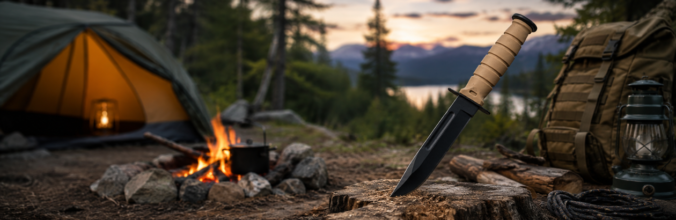
TL;DR: The best camping knife steel depends on your environment and maintenance preferences. Carbon steels like 1095 offer superior edge retention for batoning and bushcraft but require daily oiling in humid conditions. Stainless steels like 154CM eliminate rust concerns with minimal maintenance but need sharpening 2-3x more frequently. For extended backcountry trips, premium MagnaCut combines both advantages at 2-3x the cost.
What Makes Good Camping Knife Steel?
The best camping knife steel balances five critical performance metrics: edge retention, corrosion resistance, toughness, ease of sharpening, and cost. Unlike kitchen knives that prioritize slicing performance or EDC folders that emphasize compactness, camping knives face brutal outdoor conditions – batoning firewood, processing game, exposure to moisture, and limited sharpening access.
Here’s what actually matters when you’re three days into the backcountry:
Edge retention determines how long your blade stays sharp through heavy processing tasks. According to Knife Steel Nerds, sharpening angle dramatically affects performance – “using 10 dps sharpening (20 degrees inclusive on the chart) leads to about 5x the edge retention of 25 dps.” For camping, you want steel that maintains a working edge through feather stick processing, rope cutting, and food prep without constant touch-ups.
Corrosion resistance becomes critical in humid environments or coastal camping. Ruike Knives explains that stainless steel “contains a significant amount of chromium (typically at least 12%) which enhances corrosion resistance.” Carbon steels lack this protection and will rust within 24-48 hours if not properly maintained.
Toughness prevents chipping during impact tasks like batoning. Knife Steel Nerds found that “the 25 dps sharpened knife saw almost no edge damage with 2 ft-lbs while a 15 dps edge saw a significant chip with only 0.3 ft-lbs.” Steel composition matters, but so does how you use it.
Ease of sharpening determines whether you can maintain your blade in the field with basic tools. High-carbide exotic steels require diamond stones, while simple carbon steels respond to ceramic rods or river stones in emergencies.
Cost ranges from $30 budget knives to $400+ premium blades. The steel grade directly impacts price – powder metallurgy steels cost 2-3x more than conventional grades.
Key Takeaway: Camping knife steel must balance edge retention for extended use, corrosion resistance for wet conditions, and toughness for impact tasks. No single steel excels at everything – choose based on your specific camping environment and maintenance willingness.
Carbon Steel vs Stainless Steel for Camping
The carbon versus stainless debate defines your entire camping knife experience. Let’s cut through the marketing and look at real-world performance.
Carbon steels (1095, A2, O1) contain 0.6-1.2% carbon with minimal chromium. Wildland Blades notes that “carbon content above 0.6% creates steel hardening significantly through heat treatment.” This produces exceptional edge retention – Ruike Knives describes 1095 as offering “excellent toughness and edge retention.”
But here’s the catch: carbon steel rusts aggressively. In humid conditions above 60%, you’ll see surface oxidation within 24-48 hours without daily oiling. One forum user on Rokslide explains the chemistry: “You have to have minimum of 10.5% chromium to be considered stainless.” Carbon steels fall far short of this threshold.
Stainless steels (420HC, 154CM, S30V) contain 12-17% chromium. Wildland Blades confirms that “stainless steel provides corrosion resistance through chromium content exceeding 10.5%.” This chromium forms a passive oxide layer that prevents rust in typical outdoor conditions.
The trade-off? Lower edge retention. Stainless steels require sharpening 2-3x more frequently than carbon steels under identical workloads. Outdoor Life notes that 1095 “will need to be sharpened or stropped fairly often” – but stainless grades need it even more frequently.
| Performance Metric | Carbon Steel (1095) | Stainless Steel (154CM) |
|---|---|---|
| Edge Retention | 5-7 days heavy use | 2-3 days heavy use |
| Corrosion Timeline | Rust spots in 24-48 hours | Weeks before visible corrosion |
| Field Sharpening | Easy with ceramic rod | Moderate with diamond stone |
| Maintenance Required | Daily drying + oiling | Clean after food prep |
| Toughness | Excellent for batoning | Good, slightly less impact resistant |
| Typical Price Range | $40-120 | $80-180 |
Semi-stainless steels like D2 occupy middle ground. Knife Steel Nerds explains that “D2 has enough chromium to be stainless (~12%) but its high carbon means that too much chromium carbide is formed to leave enough chromium for stainless levels of corrosion resistance.” You get better edge retention than true stainless but still face rust concerns in wet conditions.
When to choose carbon: Dry climates (Southwest desert, high-altitude camping), extended trips where edge retention matters more than convenience, bushcraft tasks requiring maximum toughness. You’re willing to spend 2-3 minutes daily maintaining your blade.
When to choose stainless: Humid environments (Pacific Northwest, tropical camping), coastal areas with salt exposure, shorter trips where convenience outweighs performance, food processing where acids accelerate corrosion. You want minimal maintenance hassle.
Key Takeaway: Carbon steel holds an edge 2-3x longer than stainless but rusts within 24-48 hours in humid conditions without daily oiling. Stainless eliminates rust concerns but requires more frequent sharpening. Choose based on your climate and maintenance tolerance, not marketing hype.
Top 5 Camping Knife Steel Grades (2026)
Let’s examine the specific steel grades you’ll actually encounter when shopping for camping knives, with real performance data and honest limitations.
1095 Carbon Steel
Best for: Bushcraft, batoning, dry-climate camping
1095 is the workhorse carbon steel that’s dominated camping knives for decades. Outdoor Life describes it as “a relatively tough steel” that delivers excellent impact resistance for batoning firewood. The high carbon content (0.95%) allows hardening to 57-60 HRC, creating an edge that holds through heavy processing tasks.
The downside? Zero corrosion resistance. Without daily maintenance, you’ll see rust spots within 48 hours in humid conditions. Field sharpening is straightforward – ceramic rods or even smooth river stones work in emergencies.
Typical knives: Mora Kansbol ($35), Ka-Bar BK2 ($70), ESEE-4 ($120)
420HC Stainless Steel
Best for: Weekend camping, wet conditions, beginners
420HC is the entry-level stainless steel that appears in most budget camping knives. Knife Informer highlights the Mora Kansbol at “about just $35” – exceptional value for casual campers. The 12-14% chromium content provides solid corrosion resistance with minimal maintenance.
Edge retention is modest. You’ll need to sharpen every 2-3 days under heavy use, but the steel responds well to basic ceramic rods. Wildland Blades notes that “basic stainless knives start under $30” – perfect for testing whether you enjoy camping before investing in premium steel.
Typical knives: Buck 119 ($60), Gerber StrongArm ($65), Kershaw Camp 10 ($45)
154CM Stainless Steel
Best for: Serious recreational camping, balanced performance
154CM represents the sweet spot for most campers. Montana Knife Company reports it’s “rated six out of 10 by Knife Steel Nerds” for edge retention – significantly better than 420HC while maintaining stainless-level corrosion resistance.
The 14% chromium content prevents rust in typical outdoor conditions, while 4% molybdenum and vanadium improve edge retention. You’ll sharpen every 4-5 days under heavy use – half as often as 420HC. Field sharpening requires diamond stones for best results, though ceramic works acceptably.
Typical knives: Benchmade Bushcrafter ($180), Bradford Guardian 3 ($140), Fallkniven F1 ($160)
CPM-3V Tool Steel
Best for: Extreme batoning, cold weather, professional guides
CPM-3V prioritizes toughness above all else. Outdoor Life calls it “one of my all-time favorite steels” for demanding outdoor use. The powder metallurgy process creates fine carbide structure that absorbs impact without chipping – critical when batoning frozen wood in sub-freezing temperatures.
Edge retention is good but not exceptional. You’ll sharpen every 5-6 days, similar to 1095 carbon steel. The steel is semi-stainless with minimal corrosion resistance – expect rust within 3-4 days in humid conditions without maintenance. Field sharpening requires diamond stones due to the carbide structure.
Typical knives: Bark River Bravo 1 ($220), LT Wright Genesis ($190), custom makers ($250-400)
CPM-MagnaCut Stainless Steel
Best for: Extended expeditions, harsh conditions, maximum performance
MagnaCut is the newest premium steel that breaks traditional trade-offs. Montana Knife Company explains it was “designed by Larrin Thomas specifically for knives” to combine high edge retention with superior corrosion resistance. Outdoor Life describes it as “currently my favorite general purpose knife steel.”
The nitrogen additions allow hardening to 62-64 HRC while maintaining 15-16% chromium in solution for corrosion resistance. You’ll sharpen every 7-10 days under heavy use – matching or exceeding carbon steel performance without rust concerns. The catch? Premium pricing – expect to pay $200-300 for MagnaCut blades.
Field sharpening requires diamond stones. The high hardness and fine carbide structure resist conventional ceramic or aluminum oxide abrasives.
Typical knives: Benchmade Altitude ($240), Montana Knife Company Blackfoot 2.0 ($220), custom makers ($300-500)
Honorable Mention: D2 Semi-Stainless
D2 appears frequently in mid-tier camping knives ($80-150 range). Rokslide notes “D2, high carbon 1.4-1.7 with 11-14% chromium and its not stainless although it shows some stain resistant properties.” You get better edge retention than true stainless (sharpen every 4-6 days) but still face rust concerns in wet conditions.
The problem? Heat treatment quality varies dramatically between manufacturers. Budget D2 knives often under-harden to 55-58 HRC instead of the optimal 60-62 HRC, eliminating the performance advantages. Stick with reputable brands like Benchmade, ESEE, or Bradford if choosing D2.
Key Takeaway: For weekend camping in dry climates, 420HC or 154CM offers best value at $40-180. Extended backcountry trips justify premium MagnaCut ($200-300) for reduced sharpening frequency and zero rust concerns. Carbon steel 1095 ($35-120) maximizes edge retention if you’re willing to maintain it daily.
How to Match Steel to Your Camping Style
Choosing steel based on generic “best” lists ignores your actual camping conditions. Here’s how to match steel to your specific use case.
Weekend Camping (2-3 Days, Established Campgrounds)
Recommended steel: 420HC or AUS-8 stainless
You’re car camping with access to your vehicle, doing light food prep and occasional firewood processing. Corrosion resistance matters more than maximum edge retention since you can sharpen at home between trips. Knife Informer notes that “for only $40, this knife offers incredible value” – referring to budget stainless options perfect for casual use.
Budget pick: Mora Companion ($20-30, 420HC) Mid-tier pick: Kershaw Camp 10 ($45, 420HC)
Extended Backcountry (5-14 Days, Remote Locations)
Recommended steel: 154CM or CPM-MagnaCut
You need reliable edge retention with minimal rust concerns since you’re carrying limited maintenance supplies. Off Grid Knives recommends that “for serious camping or survival use, a fixed blade knife is recommended because it’s stronger and more reliable” – and steel choice becomes critical for extended trips.
The extra $100-150 for premium steel pays off when you’re 50 miles from the trailhead. You’ll sharpen half as often and eliminate rust anxiety during multi-day rain.
Mid-tier pick: Bradford Guardian 3 ($140, 154CM) Premium pick: Benchmade Altitude ($240, MagnaCut)
Bushcraft/Survival Focus (Heavy Processing, Batoning)
Recommended steel: 1095 carbon or CPM-3V
Toughness and edge retention trump convenience. You’re batoning firewood, carving trap components, and processing game – tasks that generate high impact forces. Knife Steel Nerds warns that “there is no such thing as a steel that is a ’10’ in both toughness and edge retention” – you must prioritize based on tasks.
Carbon steel 1095 offers maximum toughness at budget prices if you’re camping in dry climates. CPM-3V provides similar toughness with better edge retention for 2-3x the cost. Both require daily maintenance in humid conditions.
Budget pick: Mora Garberg ($80, 1095 carbon) Premium pick: Bark River Bravo 1 ($220, CPM-3V)
Wet Climate Camping (Pacific Northwest, Tropical, Coastal)
Recommended steel: 154CM minimum, MagnaCut ideal
Humidity above 60% or salt exposure eliminates carbon steel as a practical option unless you enjoy spending 5 minutes daily fighting rust. Ruike Knives advises to “regularly clean and oil your blade after use, especially if exposed to moisture” – but stainless steel reduces this burden dramatically.
For coastal camping within a mile of ocean, consider specialized high-corrosion steels like LC200N or MagnaCut. Knife Steel Nerds notes that “LC200N has similar properties to those two but with saltwater levels of corrosion resistance.”
Standard pick: Fallkniven F1 ($160, VG-10 stainless) Premium pick: Montana Knife Company Blackfoot ($220, MagnaCut)
Decision Framework
Ask yourself these questions:
- How many days between resupply? Under 3 days = 420HC acceptable. Over 5 days = 154CM or better.
- What’s the humidity level? Under 40% = carbon steel viable. Over 60% = stainless required.
- Primary tasks? Light processing = prioritize corrosion resistance. Heavy batoning = prioritize toughness.
- Maintenance tolerance? Willing to oil daily = carbon steel saves money. Want minimal fuss = pay premium for stainless.
- Budget ceiling? Under $80 = 420HC or 1095. $80-180 = 154CM or D2. Over $180 = MagnaCut or CPM-3V.
If you’re camping in the Southwest desert doing bushcraft tasks, 1095 carbon steel at $80 delivers 90% of the performance of $240 MagnaCut. But if you’re backpacking the Olympic Peninsula in October, that $160 price difference buys you peace of mind and reduced maintenance burden.
Key Takeaway: Match steel to your specific conditions – not generic recommendations. Weekend campers in dry climates achieve equivalent performance from $40 stainless as $200 premium steel. Extended backcountry or wet conditions justify the premium for reduced sharpening frequency and corrosion resistance.
Steel Maintenance in the Field
Even the best steel fails without proper field maintenance. Here’s what actually works when you’re miles from civilization.
Carbon Steel Field Care
Carbon steels demand daily attention in humid conditions. After each use:
- Wipe blade completely dry with cloth or bandana – moisture is the enemy
- Apply thin oil coating using mineral oil, gun oil, or even cooking oil in emergencies
- Check for rust spots each morning and remove with fine abrasive if found
Ruike Knives emphasizes to “regularly clean and oil your blade after use, especially if exposed to moisture.” This isn’t optional with carbon steel – skip one day in 70% humidity and you’ll see surface oxidation.
What to pack: Small bottle mineral oil (1 oz), microfiber cloth, 600-grit wet/dry sandpaper (for rust removal)
Stainless Steel Field Care
Stainless requires minimal maintenance but isn’t maintenance-free:
- Clean after food prep to remove acids and salts that accelerate corrosion
- Dry after heavy wet exposure (crossing streams, rain)
- Monthly oil application in very humid climates (optional but beneficial)
The chromium oxide layer provides passive protection, but blood, citric acids, and salt can penetrate it. A quick rinse and wipe-down after processing game prevents issues.
What to pack: Bandana or cloth for wiping (no special supplies needed)
Field Sharpening by Steel Type
Simple carbon steels (1095, A2): Respond to ceramic rods, Arkansas stones, or even smooth river stones in emergencies. Outdoor Life notes these steels “will need to be sharpened or stropped fairly often” but the process is straightforward.
Mid-tier stainless (154CM, VG-10): Require diamond stones for efficient sharpening. Ceramic rods work but remove material slowly. Pack a dual-grit diamond stone (600/1200 grit) for extended trips.
Premium steels (MagnaCut, CPM-3V): Demand diamond abrasives. The fine carbide structure resists conventional stones. A 3-4 oz diamond bench stone is mandatory for trips over 5 days.
Recommended field sharpening kit (6 oz total):
- Dual-sided diamond bench stone, 600/1200 grit (3 oz)
- Leather strop with green compound (2 oz)
- Small bottle honing oil (1 oz)
Sharpening Frequency by Steel Grade
Based on heavy outdoor use (batoning, extensive processing, food prep):
- 1095 carbon: Every 5-7 days
- 420HC stainless: Every 2-3 days
- 154CM stainless: Every 4-5 days
- D2 semi-stainless: Every 4-6 days
- CPM-3V tool steel: Every 5-6 days
- MagnaCut stainless: Every 7-10 days
These intervals assume you’re maintaining a working edge, not a razor edge. Knife Steel Nerds found that “using 10 dps sharpening (20 degrees inclusive on the chart) leads to about 5x the edge retention of 25 dps” – but field sharpening typically produces 20-25 degree edges for durability.
Emergency Sharpening Without Tools
If you forgot your sharpening kit or lost it crossing a river:
Concrete curbs or foundation stones work on soft steels (1095, 420HC). The fine aggregate acts as abrasive. Wet the surface and use circular motions.
Smooth river stones can restore a basic edge on carbon steel. Look for fine-grained stones without visible crystals. This produces a crude edge but functional for camp tasks.
Unglazed ceramic (coffee mug bottom, ceramic plate edge) works surprisingly well on simple steels. The hardness is similar to ceramic sharpening rods.
Leather belt with compound (or even without) can strop and realign an edge that’s dulled but not damaged. This extends time between full sharpenings by 50-100%.
None of these emergency methods work on high-carbide steels like S90V or M4. If you’re carrying exotic steel, pack proper sharpening tools – there’s no field improvisation.
Common Field Sharpening Mistakes
Excessive pressure: Light pressure with more strokes beats heavy pressure with fewer strokes. You’re removing microscopic amounts of steel – let the abrasive do the work.
Inconsistent angles: Changing angle mid-stroke creates a convex edge that dulls quickly. Maintain steady 20-degree angle throughout.
Insufficient burr removal: That “sharp” feeling is often a burr that will fold over on first use. Alternate sides with light pressure until burr is gone, then strop.
Skipping stropping: Regular stropping (even on leather without compound) realigns the edge and extends time between stone sharpening by 50-100%. Takes 2 minutes daily.
Key Takeaway: Carbon steel requires daily oiling in humid conditions but sharpens easily with basic ceramic rods. Stainless needs minimal maintenance but demands diamond stones for efficient field sharpening. Pack a 6 oz diamond stone kit for trips over 5 days – emergency improvisation only works on simple carbon steels.
FAQ: Camping Knife Steel Questions
What is the best knife steel for wet camping conditions?
Direct Answer: 154CM or CPM-MagnaCut stainless steels offer the best balance of corrosion resistance and edge retention for wet camping environments.
In humid conditions above 60% or coastal areas with salt exposure, carbon steels rust within 24-48 hours without daily maintenance. Wildland Blades confirms that “stainless steel provides corrosion resistance through chromium content exceeding 10.5%.” For Pacific Northwest rainforest camping or tropical environments, the convenience of stainless steel eliminates constant rust-fighting. MagnaCut provides premium performance if budget allows, while 154CM delivers 80% of the benefits at half the cost.
How often do I need to sharpen carbon steel camping knives?
Direct Answer: Carbon steel camping knives require sharpening every 5-7 days under heavy outdoor use (batoning, extensive processing, food prep).
Outdoor Life notes that 1095 carbon steel “will need to be sharpened or stropped fairly often.” The exact frequency depends on your tasks – light camp duties might stretch to 10 days, while aggressive batoning and game processing might require touch-ups every 3-4 days. The advantage is that carbon steel responds well to basic ceramic rods or even improvised river stones, making field sharpening straightforward. Daily stropping on leather extends intervals by 50-100%.
Is expensive steel worth it for weekend camping?
Direct Answer: No – weekend campers achieve equivalent functional performance from $40-80 mid-tier stainless steel (420HC, AUS-8) compared to $200+ premium grades.
Knife Informer highlights budget options like the Mora Kansbol at “about just $35” that deliver excellent performance for casual use. Premium steels like MagnaCut justify their cost for extended backcountry trips (7+ days) or professional guides who depend on their tools daily. For 2-3 day car camping trips, the performance difference between 420HC and MagnaCut is negligible – you’ll sharpen at home between trips regardless. Save the premium investment for when you’re actually pushing your gear to its limits.
Can you sharpen high-end steel in the field?
Direct Answer: Yes, but high-end steels like MagnaCut and CPM-3V require diamond abrasives – ceramic rods or conventional stones are ineffective.
The fine carbide structure in powder metallurgy steels resists cutting by aluminum oxide or ceramic abrasives. You must pack a diamond bench stone (3-4 oz) for field sharpening. Knife Steel Nerds explains the metallurgy behind this – high carbide volume creates hardness that conventional abrasives can’t efficiently cut. Budget an extra $40-60 for a quality diamond stone if choosing premium steel. The trade-off is you’ll sharpen half as often, so the total time investment may be similar to simpler steels with more frequent sharpening.
What steel do professional bushcraft knives use?
Direct Answer: Professional bushcraft knives predominantly use 1095 carbon steel or CPM-3V tool steel, prioritizing toughness and edge retention over corrosion resistance.
Carbon steel dominates the bushcraft world because it offers maximum toughness for batoning and impact tasks at accessible prices. Ruike Knives describes 1095 as offering “excellent toughness and edge retention” – exactly what bushcraft demands. Professional instructors accept the maintenance burden (daily oiling) in exchange for superior performance. CPM-3V appears in premium bushcraft knives ($200-300) for users who want even better toughness and are willing to pay for powder metallurgy manufacturing.
Does stainless steel hold an edge as well as carbon steel?
Direct Answer: No – stainless steel requires sharpening 2-3x more frequently than carbon steel under identical outdoor workloads.
The chromium content that provides corrosion resistance reduces carbide volume available for edge retention. Montana Knife Company rates 154CM stainless at “six out of 10 by Knife Steel Nerds” for edge retention, while simple carbon steels score higher. In practical terms, 420HC stainless needs sharpening every 2-3 days of heavy use versus 5-7 days for 1095 carbon. Premium stainless like MagnaCut narrows this gap but still trails high-carbon steels in pure edge retention. The trade-off is convenience – stainless eliminates rust concerns that plague carbon steel in humid conditions.
How do you prevent rust on carbon steel camping knives?
Direct Answer: Prevent rust on carbon steel by wiping the blade completely dry after each use and applying a thin coating of mineral oil, gun oil, or cooking oil daily.
Ruike Knives advises to “regularly clean and oil your blade after use, especially if exposed to moisture.” In humid conditions above 60%, this isn’t optional – skip one day and you’ll see surface oxidation. Pack a small 1 oz bottle of mineral oil and microfiber cloth. After processing food or getting the blade wet, wipe completely dry and apply a thin oil film. Check for rust spots each morning and remove immediately with 600-grit sandpaper if found. Some users develop a patina (controlled oxidation layer) that provides mild rust protection, but this takes weeks to establish.
What’s the difference between D2 and true stainless steel?
Direct Answer: D2 is “semi-stainless” with 11-13% chromium – it offers better edge retention than true stainless but still rusts in wet conditions, unlike steels with 14%+ chromium.
Knife Steel Nerds explains that “D2 has enough chromium to be stainless (~12%) but its high carbon means that too much chromium carbide is formed to leave enough chromium for stainless levels of corrosion resistance.” You get edge retention approaching carbon steel (sharpen every 4-6 days) but must still maintain the blade to prevent rust. D2 works well for dry-climate camping where you want better edge retention than 154CM without full carbon steel maintenance demands. Avoid D2 for coastal or tropical camping – it will corrode.
Conclusion
The “best” camping knife steel doesn’t exist – only the best steel for your specific conditions. Carbon steels like 1095 deliver maximum edge retention and toughness for $40-120 but demand daily maintenance in humid environments. Stainless steels like 154CM eliminate rust concerns at $80-180 but require more frequent sharpening. Premium MagnaCut at $200-300 combines both advantages for extended expeditions where performance justifies cost.
Match your steel choice to your camping style: weekend warriors in dry climates thrive with budget 420HC stainless, serious bushcrafters accept carbon steel maintenance for superior performance, and backcountry expeditions justify premium stainless for reliability. The knife that stays sharp and rust-free in your hands beats the “perfect” steel sitting unused because maintenance became a burden.
When you’re ready to invest in quality camping steel, Knife Depot offers a curated selection of fixed blade knives across all steel grades and price points, with expert guidance to match your specific outdoor needs.

Very informative article! I’ve been looking for a camping knife and this helps me understand the different steel options. By the way, I found a great camping gear store called FunBoxie that offers a variety of outdoor equipment.