TL;DR: – Best overall: Tojiro DP Nakiri – VG-10 steel, 60 HRC, ~$65–$75, best price-to-performance in the budget tier
- Best mid-range: Shun Classic Nakiri – VG-MAX steel, 60–61 HRC, hollow-ground dimples, ~$130–$190
- Best premium: Miyabi Birchwood SG2 – 63 HRC powder steel, thinnest grind, ~$220–$260
- Who this is for: Home cooks doing serious vegetable prep who want a dedicated Japanese-style nakiri from $40 to $300
Your Chef Knife Is Holding Your Vegetable Prep Back
Most home cooks assume their chef knife handles everything. For vegetables? That assumption costs you precision.
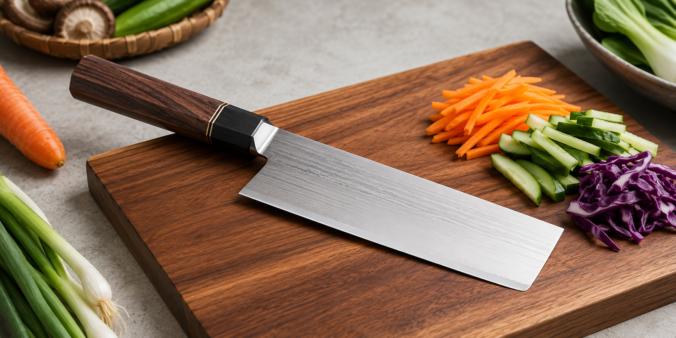
A nakiri knife is a Japanese vegetable knife with a rectangular blade, flat cutting edge, and a profile specifically engineered for push-cutting produce. According to Cutlery and More, “its flat profile allows full contact with the cutting board, making it perfect for clean, efficient cuts through vegetables and herbs without rocking.”
That geometry difference is the whole story. A curved chef knife rocks. A nakiri pushes straight down – full edge contact, every stroke.
As Serious Eats notes, “before the Western influence, knives were very much separated to task. The nakiri was your vegetable knife.” That specialization is exactly why it outperforms an all-purpose blade for dedicated vegetable work.
Bon Appétit describes it simply: “a short cleaver-style knife used for chopping vegetables” – and in the last 20 years, Japanese knives have become increasingly popular with home cooks who’ve discovered that specialization matters.
This guide covers 7 nakiri picks across $40–$300, with verified steel specs, honest assessments, and a clear answer on who should skip each one.
Key Takeaway: A nakiri’s flat edge delivers full board contact that a curved chef knife physically cannot match – the geometry advantage is real, not marketing.
How We Evaluated Nakiri Knives
Testing criteria for the best nakiri knife for vegetable chopping Japanese style comes down to four measurable factors.
Steel hardness (HRC) determines edge retention and sharpening difficulty. According to Oishya’s 2026 buying guide, “where a German knife might be forged from steel at 56–58 HRC, a Japanese blade typically sits at 60–63 HRC.” Higher HRC = longer edge life, but more brittle and harder to sharpen at home.
Blade thickness at the spine affects food release on dense vegetables. A 2.0mm spine creates more drag on carrots and parsnips than a 1.6mm spine – the physics are straightforward.
Edge angle matters for maintenance. Japanese nakiris are typically ground at 10–15° per side vs. 20–25° for Western knives. Sharpen at the wrong angle and you’re wasting steel.
Handle fit determines fatigue over long prep sessions. D-shaped wa-handles are right-hand specific; octagonal profiles work for both hands.
| Steel | HRC Range | Edge Retention | Sharpening Ease | Rust Resistance |
|---|---|---|---|---|
| German (X50CrMoV15) | 56–58 | Low | Easy | High |
| AUS-8 | 58–59 | Low-Medium | Easy | High |
| VG-10 / VG-MAX | 60–61 | Medium-High | Moderate | High |
| SG2 / R2 | 63–64 | Very High | Difficult | High |
| Blue Steel #2 | 62–63 | High | Moderate | Low (reactive) |
As Cutlery and More explains, “Japanese knives are often crafted with harder carbon steels with a 60–66 Rockwell Hardness, which allows them to maintain a fine, sharp edge” – while Western knives typically land at 56–58 HRC.
Chubo Knives recommends that people “new to Japanese knives and sharpening start with knives on the lower end of that range” – meaning VG-10 at 60–61 HRC is the sweet spot for most home cooks.
Key Takeaway: For most home cooks, VG-10 at 60–61 HRC hits the sweet spot for knife steel hardness – enough edge retention to matter, manageable enough to sharpen at home without specialized skills.
The 7 Best Nakiri Knives Ranked for 2026
| Knife | Steel | HRC | Spine | Best For |
|---|---|---|---|---|
| Tojiro DP F-502 | VG-10 | 60 | ~2.0mm | Budget value |
| Victorinox Fibrox | X50CrMoV15 | ~56 | ~2.5mm | Beginners, easy sharpening |
| Misen Nakiri | AUS-8 | 58–59 | ~2.0mm | Budget, Western handle |
| Shun Classic | VG-MAX | 60–61 | ~1.8mm | Mid-range, hollow-ground |
| Masutani VG1 | VG-1 | ~60 | ~1.7mm | Mid-range, Sakai-made |
| MAC Japanese Series | HC Stainless | 58–59 | ~1.8mm | Beginners wanting quality |
| Miyabi Birchwood SG2 | SG2/R2 | 63 | ~1.6mm | Premium performance |
Best Budget Nakiri Under $80
Tojiro DP Nakiri (F-502) – VG-10 core, 60 HRC, 165mm blade, ~2.0mm spine. This is the most consistently recommended sub-$80 nakiri across major review outlets. Serious Eats tested it against significantly pricier options and it held its own on edge sharpness and consistency.
The VG-10 core gives you real Japanese steel performance at a price that doesn’t require a second thought. The handle is functional rather than beautiful – Western-style, comfortable, nothing special.
Who should skip it: If you want a traditional wa-handle aesthetic or plan to do heavy-duty root vegetable work daily, the 2.0mm spine will create more drag than a thinner premium blade.
Victorinox Fibrox Nakiri – German X50CrMoV15 steel, ~56 HRC, ~$40–$50. Bon Appétit notes a comparable budget option at “around $40 at the time of writing” as “a great value and a good addition for any kitchen.” The tradeoff is clear: easier to sharpen with tools you already own, but you’ll sharpen it more often. Cutlery and More confirms Western knives “usually use softer stainless steels, with a Rockwell hardness between 56 and 58.”
Who should skip it: Anyone who already owns a German-steel chef knife and wants something that performs differently. The edge retention gap is real.
Best Mid-Range Nakiri ($80–$160)
Shun Classic Hollow-Ground Nakiri – VG-MAX steel (Shun’s proprietary VG-10 variant), 60–61 HRC, 165mm blade, D-shaped PakkaWood handle, hollow-ground dimples. Cutlery and More rates it 4.9 out of 5 stars across 41 reviews. The hollow-ground dimples reduce suction on starchy vegetables like potatoes and daikon – a practical feature, not just aesthetics.
Made in Seki City, Japan, where Kai Group has produced blades since the 14th century. Shun’s own documentation confirms: “the blade’s straight edge makes push cuts easy and ensures complete contact with the cutting board for precise cuts every time.”
Who should skip it: Left-handed cooks – the D-handle is right-hand specific. Also skip if you’re not ready to commit to whetstone sharpening; VG-MAX won’t respond well to a pull-through sharpener.
Masutani VG1 Hammered Nakiri – VG-1 steel, ~60 HRC, 165mm, ~1.7mm spine, Sakai-made, ~$90–$110. This is the mid-range sleeper pick. Sakai produces an estimated 90% of Japan’s professional knives – the regional provenance matters for fit and finish quality at this price point. The hammered (tsuchime) finish also reduces food sticking without requiring hollow grinding.
Who should skip it: Cooks who want a Western handle or need easy replacement parts. The wa-handle is traditional and excellent, but unfamiliar to some.
MAC Japanese Series Nakiri – Proprietary high-carbon stainless, ~58–59 HRC, ~$155. Slightly softer than VG-10, which actually makes it more beginner-friendly for home sharpening. Tech Gear Lab notes the Shun Premier (similar tier) offers “excellent blade and solid ergonomics” – MAC competes directly at this level with a more forgiving steel.
Who should skip it: Experienced sharpeners who want maximum edge retention. The softer steel is a feature for beginners, a limitation for enthusiasts.
Best Premium Nakiri ($160–$300)
Miyabi Birchwood SG2 Nakiri – SG2 micro-carbide powder steel, 63 HRC, 6.75-inch blade, ~1.6mm spine, birchwood D-handle. Oishya’s guide confirms “SG2/R2 (powdered steel) – a step above VG10 in edge retention and hardness (64 HRC).” The thinner spine measurably reduces wedging on dense root vegetables compared to budget options at 2.0mm+.
Serious Eats measured the Yoshihiro (comparable premium tier) at “an average pressure of 83.3 grams needed to cut through the wire on the edge sharpness tester – sharper than a double-edged razor blade.” Premium steel delivers premium sharpness.
Who should skip it: Anyone not ready to invest in a proper whetstone setup. At 63 HRC, this knife will punish a pull-through sharpener. Also skip if you prep meat regularly – this blade is optimized for vegetables.
Key Takeaway: The Tojiro DP at ~$65 is the clear budget winner. Step up to Shun Classic for hollow-ground food release. Go Miyabi SG2 only if you’re committed to whetstone maintenance.
Nakiri vs. Usuba vs. Santoku: Which Do You Actually Need?
| Feature | Nakiri | Usuba | Santoku |
|---|---|---|---|
| Bevel | Double | Single | Double |
| Skill required | Beginner-friendly | Professional | Beginner-friendly |
| Best for | Dedicated veg prep | Professional veg work | Multi-purpose |
| Sharpening | Whetstone, manageable | Expert only | Whetstone or pull-through |
| Entry price | ~$40 | ~$150+ | ~$30 |
The nakiri vs. usuba distinction is the one most buying guides skip. The nakiri is double-bevel – sharpened on both sides, forgiving to use and maintain. The usuba is single-bevel, used primarily by professional Japanese chefs, and requires years of skill to sharpen correctly.
For home cooks, usuba is essentially off the table unless you’re training seriously in Japanese culinary technique.
The santoku question is more practical. Bon Appétit is direct: if you cook a variety of proteins and vegetables and want one Japanese-style knife, a santoku is more practical. The nakiri wins when vegetable prep is your dominant cutting task – not as a general-purpose replacement.
Choose nakiri if: You prep large volumes of vegetables regularly and want dedicated performance. Choose santoku if: You want one Japanese knife that handles everything reasonably well.
Key Takeaway: Nakiri beats santoku for pure vegetable work. Santoku beats nakiri for everything else. If you already own a chef knife, a nakiri is a genuine performance upgrade for vegetable prep – not redundant.
How to Use a Nakiri Knife the Right Way
The push-cut is the nakiri’s native technique. Press the blade forward and down in a single stroke – full edge contact with the board on every cut.
Don’t rock the blade. This is the most common beginner mistake. Rocking a nakiri eventually bends the flat edge profile, reducing the full-board contact that makes the knife worth owning. Cutlery and More notes that if you’re more comfortable with rock-chopping, “go for a longer nakiri, as the length will provide more leverage” – but ideally, learn the push-cut.
Three cuts to master with a nakiri:
- Thin slices – push-cut cucumber or daikon paper-thin; the flat edge prevents accordion cuts
- Julienne – square the vegetable first, then push-cut into matchsticks with consistent thickness
- Rough chop – straight-down chops through cabbage or leafy greens, full edge contact each time
Board surface matters. Wood boards – particularly end-grain hardwood or traditional hinoki (Japanese cypress) – are significantly gentler on high-HRC Japanese edges than plastic or glass. Hard surfaces accelerate micro-chipping on 60+ HRC steel.
Common beginner mistake: Using the tip as a pivot point. The nakiri has no tip designed for pivoting – treat it like a cleaver, not a chef knife.
Key Takeaway: Push-cut only. Wood board only. Never rock. These three rules protect the flat-edge geometry that makes a nakiri worth buying in the first place.
How to Sharpen and Maintain a Nakiri Knife
A nakiri is only as good as its edge. And Japanese steel has specific requirements most home cooks ignore.
Sharpening angle: 10–15° per side. This is narrower than Western knives (20–25°). Sharpen at the wrong angle and you’re rebuilding geometry, not maintaining it. Cutlery and More is unambiguous: “when your Japanese nakiri needs sharpening, we only recommend using a whetstone or having it sharpened by a professional.”
Why honing rods don’t work here: Standard honing rods cannot realign the hard, brittle edge of 60+ HRC Japanese steel. They may actually chip it. A leather strop works for light touch-up between whetstone sessions – a steel rod does not.
Whetstone grit progression:
- 400 grit – chip repair and major reprofiling
- 1000 grit – bevel setting and regular maintenance
- 3000 grit – edge refinement
- 6000+ grit – finishing and polishing
A combination 1000/3000 stone (~$40–$60) handles 90% of home maintenance needs. Compare that to professional sharpening at $15–$25 per session, 2–3 times per year ($30–$75 annually) – the whetstone breaks even by Year 2.
Storage: Magnetic strip over knife block. Repeated insertion into a block creates friction on the thin edge. A magnetic strip or blade guard keeps the edge protected between uses.
Learn more about honing rod vs sharpening stone and check our whetstone sharpening guide for beginners for step-by-step technique.
Key Takeaway: A $40–$60 combination whetstone breaks even against professional sharpening in Year 2 and gives you on-demand edge maintenance. For 60+ HRC Japanese steel, it’s not optional – it’s the only viable long-term approach.
If you’re ready to pick up a nakiri, Knife Depot carries a solid range of Japanese-style folding and fixed blades across all price tiers – worth browsing alongside the specific models listed here.
Frequently Asked Questions About Nakiri Knives
How much should I spend on a nakiri knife for home use?
Direct Answer: $65–$130 covers the sweet spot for most home cooks. The Tojiro DP at ~$65–$75 delivers genuine VG-10 Japanese steel performance. Spending more gets you thinner grinds and better fit-and-finish, not a fundamentally different cutting experience.
Chubo Knives notes that some mid-range options “perform like a $300 knife but at a much friendlier price.” Beyond $200, you’re paying for premium steel (SG2 at 63 HRC) and craftsmanship – worthwhile if you sharpen regularly and will notice the difference.
What is the difference between a nakiri and a usuba knife?
Direct Answer: Nakiri is double-bevel and designed for home cooks. Usuba is single-bevel, professional-grade, and requires expert sharpening skills most home cooks don’t have.
Both are Japanese vegetable knives with rectangular blades. The practical difference: a nakiri is forgiving and maintainable at home; a usuba demands years of sharpening practice to use correctly. For home use, nakiri is the right choice every time. See our chef knife vs santoku differences guide for broader Japanese knife comparisons.
Can a nakiri knife cut meat or is it only for vegetables?
Direct Answer: It can cut boneless meat, but it’s not designed for it. The thin blade geometry optimized for vegetables can chip on bone, sinew, or frozen food.
Serious Eats tested this directly – the nakiri will handle soft proteins but there are better tools for regular meat work. Use it for what it’s built for: vegetables.
What steel type is best for a nakiri knife – VG-10, AUS-10, or carbon steel?
Direct Answer: VG-10 at 60–61 HRC is the best all-around choice for most home cooks – strong edge retention, corrosion resistant, manageable to sharpen.
AUS-8 (58–59 HRC) is easier to sharpen but dulls faster. Carbon steel (Blue Steel #2 at 62–63 HRC) holds an edge longer but rusts if you don’t dry it immediately after use. confirms SG2/R2 powder steel at 63–64 HRC is a step above VG-10 – but demands whetstone skill to maintain. For a full breakdown, see our carbon steel vs stainless steel knife comparison. Understand knife steel hardness and Rockwell scale before committing to a steel type.
How do I sharpen a nakiri knife at home without damaging the edge?
Direct Answer: Use a whetstone at 10–15° per side. Never use a standard honing rod on Japanese steel above 60 HRC – it can micro-chip the brittle edge.
Start with a 1000-grit stone for regular maintenance, 400 grit for chip repair, 3000 grit for refinement. A combination stone handles most home needs. Cutlery and More recommends only whetstone or professional sharpening for Japanese nakiris – no pull-through sharpeners.
Is a nakiri knife worth buying if I already own a chef knife?
Direct Answer: Yes – if you prep vegetables frequently. No – if you want a single do-everything knife.
The nakiri’s flat edge delivers full board contact that a curved chef knife physically cannot replicate. Tech Gear Lab found that a well-chosen nakiri “dispatched hard vegetables like carrots with ease” in ways that general-purpose knives don’t match. If vegetables are a significant part of your cooking, the nakiri is a genuine upgrade – not a redundant purchase. Check our VG-10 vs AUS-10 Japanese knife steel comparison to choose the right steel for your cooking style.
The Bottom Line
The best nakiri knife for vegetable chopping Japanese style depends on where you’re starting from.
Budget-conscious? The Tojiro DP gives you real VG-10 performance at ~$65. Mid-range? The Shun Classic’s hollow-ground dimples and 60–61 HRC VG-MAX steel justify the step up. Premium? The Miyabi Birchwood SG2 at 63 HRC is the sharpest, thinnest-ground option in the home-cook range – but only buy it if you’re ready to maintain it properly.
The nakiri isn’t a replacement for your chef knife. It’s a specialist. And for vegetables, specialists win.
Ready to Get Started?
For personalized guidance, visit Knife Depot to learn how we can help.

Leave a Reply