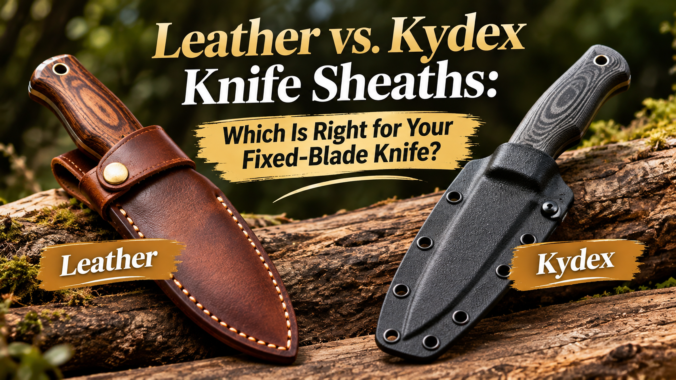
A good fixed-blade knife deserves a sheath that does more than simply cover its edge.
The right sheath protects the blade, supports secure storage, and makes transporting the knife more convenient. But when shopping for a fixed-blade knife, one decision often gets less attention than it should: choosing the sheath material.
Two of the most common options are traditional leather and modern Kydex.
Leather has a long history in knife manufacturing. It offers a classic appearance, natural texture, and a familiar feel that many collectors appreciate.
Kydex takes a different approach. This molded thermoplastic material is valued for its rigid construction, moisture resistance, and ability to retain a specific knife model.
So which one should you choose?
The answer depends on your preferences, environment, maintenance habits, and the particular knife you’re buying.
Let’s look at the differences.
Why Does a Knife Sheath Matter?
A fixed-blade knife doesn’t fold into its handle like a pocket knife. It requires a separate storage solution to cover the blade and support safe transportation.
A properly designed sheath serves several purposes:
- Covers the blade edge during storage.
- Helps protect the knife from external damage.
- Supports secure retention when properly fitted.
- Makes transportation more convenient.
- Helps prevent accidental contact with the cutting edge.
The material is only one part of the equation. Fit, construction, retention, attachment options, and overall quality matter just as much.
A premium knife with a poorly fitted sheath isn’t a combination worth settling for.
1. Leather Knife Sheaths: The Traditional Choice
Leather has been used for knife sheaths for generations.
Its popularity comes from its traditional appearance, flexibility, and natural material characteristics.
Many hunting knives, traditional fixed blades, and heritage-inspired designs are paired with leather sheaths.
What Makes Leather Different?
Leather offers a softer, more flexible construction compared with rigid molded materials.
Depending on the leather type and manufacturing process, it can develop a distinctive appearance as it ages.
Some collectors particularly appreciate the way a leather sheath complements traditional wood handles, brass fittings, and classic blade designs.
Advantages of Leather Sheaths
Classic appearance
Leather has a distinctive look that pairs naturally with traditional hunting knives and heritage-inspired fixed blades.
Natural flexibility
Leather generally offers more flexibility than rigid plastic-based materials, which can contribute to a comfortable fit against the body.
Traditional craftsmanship
Leather sheaths are available with different stitching patterns, finishes, embossing, and decorative details.
Repairability
Depending on the damage and construction, certain leather sheaths can be repaired by a qualified leatherworker.
Things to Consider
Leather also requires maintenance.
It can absorb moisture, and prolonged exposure to damp conditions may contribute to deterioration, mold, or corrosion on a stored blade.
Regular inspection and appropriate leather care help maintain its condition.
Another consideration is retention. Leather sheaths rely on their specific construction and fit to hold the knife securely. They should not be assumed to offer the same retention characteristics as a properly molded sheath.
2. Kydex Knife Sheaths: Modern Construction and Practicality
Kydex is a thermoplastic material commonly used in rigid knife sheaths.
It is molded around a particular knife design to create a shaped enclosure.
The result is a sheath with a defined profile that can provide secure retention when correctly manufactured and fitted.
Kydex has become popular among outdoor enthusiasts, knife owners, and people who prefer modern sheath construction.
What Makes Kydex Different?
Unlike leather, Kydex does not absorb moisture in the same way.
Its rigid construction also allows manufacturers to create specific retention points and attachment configurations.
Depending on the design, Kydex sheaths may include adjustable retention hardware, mounting systems, and different carry configurations.
Advantages of Kydex Sheaths
Moisture resistance
Kydex is resistant to water absorption, making it suitable for environments where a leather sheath may require additional care.
However, moisture can still become trapped between the sheath and blade, so regular inspection and drying remain important.
Rigid construction
Its molded shape helps maintain a consistent profile during normal use.
Retention options
Many Kydex designs use molded retention points or adjustable hardware to hold a compatible knife in place.
Low-maintenance material
Kydex generally requires less material-specific care than leather. Cleaning usually involves mild soap and water when appropriate.
Modern attachment systems
Depending on the design, Kydex sheaths may support different mounting accessories and configurations.
Things to Consider
Kydex isn’t perfect.
Its rigid construction can feel less comfortable against the body than some softer sheath materials.
It may also produce noise when the knife contacts the molded interior or when the knife is inserted or removed.
Poorly designed or contaminated sheaths can also cause scratches or finish wear on a blade.
Fit and internal cleanliness are important.
3. Leather vs. Kydex: How Do They Compare?
Here’s a closer look at the differences.
| Feature | Leather | Kydex |
| Construction | Flexible natural material | Rigid thermoplastic |
| Appearance | Traditional | Modern |
| Moisture resistance | Requires additional care | Resistant to water absorption |
| Maintenance | Periodic leather conditioning and inspection | Generally simple cleaning |
| Retention | Depends on fit and construction | Often molded retention |
| Flexibility | More flexible | Rigid |
| Customization | Stitching, tooling, and finishes | Molded shapes and hardware |
| Wear characteristics | Can stretch and soften | Can scratch or wear with friction |
| Common appeal | Traditional knives and collectors | Modern fixed blades and outdoor gear |
Neither material is automatically superior.
The best choice depends on what you value most in a knife sheath.
4. Which Sheath Is Better for Outdoor Activities?
Your intended environment should influence your decision.
A knife sheath used during occasional outdoor activities may have different requirements from one that is regularly exposed to rain, mud, or changing weather conditions.
Camping
For camping, both leather and Kydex can be suitable.
Leather may appeal to people who prefer traditional outdoor equipment and appreciate classic craftsmanship.
Kydex may be attractive to campers who prefer rigid construction and easier material cleaning.
Regardless of material, inspect the sheath regularly and keep the blade clean and dry before storage.
Hunting
Hunting knives are often paired with traditional leather sheaths.
Leather complements classic hunting knife designs and offers an appearance that many hunters appreciate.
Kydex is another option, particularly for owners who prefer a molded fit and moisture-resistant construction.
When choosing a hunting sheath, pay particular attention to retention, accessibility, cleaning, and how the knife will be transported.
Hiking and Backpacking
Weight and attachment options become more important when carrying equipment over longer distances.
Some Kydex sheaths offer different mounting configurations, while leather options may provide a more traditional carrying experience.
Compare the complete sheath and mounting system rather than judging the material alone.
Wet Environments
Kydex has an advantage in environments where the sheath is regularly exposed to moisture because it doesn’t absorb water like leather.
However, a water-resistant sheath doesn’t eliminate blade maintenance.
Always remove the knife when appropriate, inspect both surfaces, and dry them thoroughly before storage.
5. How to Choose the Right Sheath for Your Knife
Choosing a sheath should start with the knife itself.
Not every sheath is compatible with every fixed-blade model, even if the blade dimensions appear similar.
Here are five things worth checking.
Knife Compatibility
Confirm that the sheath is designed for your exact knife model or is explicitly compatible with its dimensions.
Blade width, thickness, handle shape, and guard design all affect fit.
Retention
A sheath should hold the knife securely according to its intended design.
Check the manufacturer’s retention specifications and make sure the knife doesn’t move excessively when properly secured.
Attachment Options
Consider how the sheath is designed to be transported or stored.
Depending on the model, options may include belt loops, mounting clips, or compatible accessory systems.
Construction Quality
Inspect stitching on leather sheaths and molding, hardware, and attachment points on Kydex designs.
A sheath should have consistent construction without obvious defects.
Blade Protection
The sheath should cover the cutting edge appropriately without creating unnecessary contact or damage to the blade finish.
A properly fitted sheath should also allow the knife to be stored and removed according to the manufacturer’s intended design.
6. How to Maintain a Leather Knife Sheath
Leather benefits from regular inspection and appropriate care.
You don’t need an elaborate maintenance routine, but ignoring moisture and dirt can shorten its useful life.
Consider these basic practices:
- Wipe away dirt with a soft cloth.
- Allow damp leather to air-dry naturally.
- Avoid placing leather near direct heat sources.
- Use a suitable leather conditioner when needed.
- Inspect stitching and attachment points periodically.
- Store the sheath in a dry, ventilated location.
Avoid excessive conditioning, which can soften leather and affect its structure.
Always remove the knife before applying leather-care products, and make sure the sheath is completely dry before storing the blade.
7. How to Maintain a Kydex Knife Sheath
Kydex is generally easier to maintain, but it still requires occasional attention.
Dirt and debris inside the sheath can scratch a knife’s finish.
Here are some simple maintenance considerations:
- Remove loose dirt and debris.
- Clean with mild soap and water when appropriate.
- Rinse away cleaning residue.
- Allow the sheath to dry completely.
- Inspect retention hardware and mounting points.
- Check the interior for abrasive particles before reinserting the knife.
Avoid harsh chemicals or excessive heat that could affect the material.
If the retention system becomes loose or damaged, follow the manufacturer’s instructions for inspection or replacement.
8. Can You Replace a Leather Sheath With Kydex?
In some cases, yes.
However, replacement isn’t simply a matter of finding a sheath with similar dimensions.
The replacement must accommodate the knife’s blade geometry, handle shape, guard, and overall construction.
A sheath made for a different model may not provide appropriate retention even if the knife appears to fit.
Before purchasing a replacement, verify:
- Exact knife model compatibility.
- Blade dimensions.
- Handle and guard clearance.
- Retention design.
- Attachment requirements.
- Manufacturer recommendations.
If you’re replacing a damaged sheath, consider contacting the knife manufacturer or a reputable sheath maker for compatible options.
9. Which Sheath Should You Choose?
If you’re still deciding between leather and Kydex, think about the characteristics that matter most to you.
Choose leather if:
- You appreciate traditional knife aesthetics.
- You own a classic hunting or heritage-style fixed blade.
- You prefer flexible natural materials.
- You enjoy maintaining leather products.
Consider Kydex if:
- You prefer rigid sheath construction.
- Moisture resistance is important.
- You want a molded fit for a specific knife.
- You prefer straightforward material maintenance.
- You want to explore different mounting configurations.
There is no universal answer.
A well-made leather sheath can be an excellent match for a traditional fixed blade. A properly fitted Kydex sheath can be equally appealing for someone who prefers modern materials.
The knife, sheath, and intended application should work together.
Explore Fixed-Blade Knives at Knife Depot
A fixed-blade knife is an investment in a particular design, construction, and set of features.
The sheath is part of that overall package and deserves the same attention as the blade itself.
Whether you prefer the traditional appearance of leather or the modern construction of Kydex, understanding the differences can help you choose a knife and storage solution that suit your preferences.
Knife Depot offers a selection of fixed-blade knives in different styles and configurations.
Explore the Knife Depot Fixed-Blade Collection to discover available designs and compare your options.
The right blade deserves the right fit.
Frequently Asked Questions
1. Is leather or Kydex better for a knife sheath?
Leather offers traditional styling and flexibility, while Kydex provides rigid construction and moisture resistance. The better option depends on the knife, intended environment, and personal preferences.
2. Do Kydex knife sheaths scratch blades?
They can. Dirt, debris, or friction between the blade and sheath interior may cause scratches or finish wear. Regular cleaning and proper fit help reduce this risk.
3. Do leather knife sheaths absorb water?
Yes. Leather can absorb moisture, which is why proper drying and occasional maintenance are important.
4. Are Kydex sheaths waterproof?
Kydex itself is resistant to water absorption, but a complete sheath assembly should not automatically be considered waterproof. Moisture may still enter through openings or become trapped inside.
5. Can you use leather conditioner on a knife sheath?
Yes, provided the product is suitable for the leather and used according to its instructions. Remove the knife before conditioning and allow the sheath to dry fully.
6. How do I know if a knife sheath fits properly?
Check the manufacturer’s compatibility information and inspect the fit, retention, and blade clearance. The knife should remain secured according to the sheath’s intended design without excessive movement.
7. Which knife sheath is easier to maintain?
Kydex generally requires less material-specific maintenance. Leather requires more attention to moisture, conditioning, and storage conditions.
8. Can I carry a fixed-blade knife in a Kydex sheath?
Kydex sheaths are commonly designed for fixed-blade storage and transportation. However, applicable knife laws and carry restrictions vary by location, so check local requirements.
9. How long does a knife sheath last?
Lifespan depends on material quality, construction, frequency of use, environmental exposure, and maintenance. Both well-made leather and Kydex sheaths can provide long-term service when properly cared for.