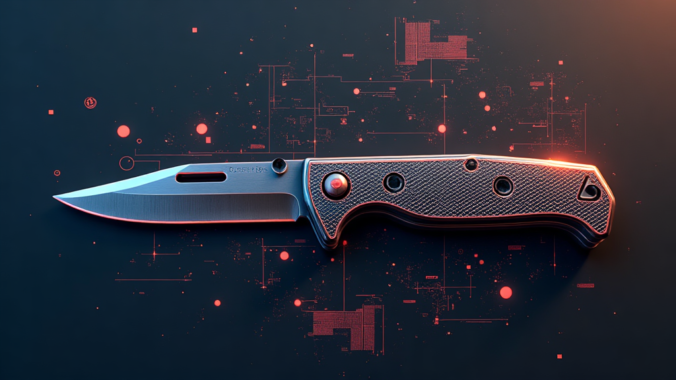
OTF means “out the front”: the blade travels out through the front of the handle instead of rotating around a folding pivot. This guide focuses on automatic OTF knives. In a double-action design, a control operates both deployment and retraction; a single-action design requires a separate manual resetting procedure.
What Is an OTF Knife?
The term describes the direction of blade travel. It does not, by itself, identify every detail of the opening system or establish legal status. Check the exact model’s action type and operating instructions.
Understanding those controls helps you choose a knife you can operate comfortably. Many folding knives also offer one-handed opening, so that feature is not exclusive to an OTF.
How Does an Automatic OTF Mechanism Work?
At a general level, a spring-driven mechanism moves the blade along a guided path within the handle. The operating control and locking components manage that movement. Internal arrangements differ, so a description of one design should not be treated as a parts diagram for every OTF.
The Blade’s Guided Path
The blade must travel within the handle before reaching its open position. Clearance and locking design are model-specific. We do not have manufacturer specifications supporting a universal “budget versus premium” channel-tolerance comparison.
The Spring Assembly
Spring energy powers automatic movement. The number of springs and the way they are loaded depend on the design. It is misleading to describe every double-action mechanism as one spring simply pushing in one direction and pulling in the other.
The Operating Control and Lock
Use the button or slider as specified by the manufacturer. The original guide’s universal detent-ball explanation, slider-force figures, and travel measurements were not substantiated. A lock’s design and acceptable movement must be assessed for the particular model.
Single-Action vs. Double-Action OTF
Microtech’s manufacturer catalog distinguishes single-action deployment with manual closing from dual-action deployment and retraction through the firing control. Some single-action models use a charging handle.
| Feature | Single-action automatic OTF | Double-action automatic OTF |
|---|---|---|
| Opening | Automatic | Automatic |
| Closing/resetting | Manual procedure specified for the model | Operated through the control |
| What to compare | Resetting controls and handling | Slider operation and handling |
Action type alone does not establish deployment speed, lock strength, or service life. Compare those features at the model level. Manual resetting does not mean forcing an extended blade into the handle by hand.
Safety Features and Safe Handling
Do not assume every OTF has a separate safety switch, a two-stage slider, or the same interruption mechanism. Read the supplied manual before operating the knife and keep the blade’s travel path clear.
Microtech’s deployment troubleshooting guidance describes an interruption feature on its OTF models other than the Halo. That is manufacturer-specific information, not a claim that an OTF cannot cause injury. Do not test a blade against a person or deliberately obstruct it.
If the blade fails to lock or behaves unexpectedly, stop using it. Do not force a locked blade closed, strike it to test the lock, or use an arbitrary millimeter threshold to decide it is safe. Contact the manufacturer about inspection or service.
Maintenance and Deployment Problems
A deployment problem is not enough to diagnose a failed spring. Debris, lubrication, damage, and other mechanism issues require different responses. Avoid replacing parts based on a generic description.
The Microtech OTF manual gives cleaning, lubrication, storage, and service instructions for its knives. Use the current guidance for your own model, particularly where newer designs have different requirements. More lubricant is not automatically better.
Keep the blade clean before retracting it and use only the care products and procedures the maker recommends. If routine approved maintenance does not solve the problem, arrange service. Do not disassemble an unfamiliar spring-loaded mechanism or substitute generic parts.
There is no verified universal cycle rating or scheduled spring-replacement interval in this guide. Likewise, the earlier advice to exercise a spring monthly to prevent deterioration was not supported and has been removed.
Check the Rules for Your Location
An automatic OTF can fall within the federal definition of a switchblade. 15 U.S.C. §§1241–1244 address the definition, interstate commerce, possession in specified jurisdictions, and exceptions. It would be incorrect to say federal law never restricts possession.
Before buying, shipping, or carrying a knife, check current rules for your jurisdiction and destination, including restrictions on the specific blade and action. A nationwide state count is not a substitute for that check. This mechanical overview does not determine whether a particular purchase or carry situation is lawful.
Frequently Asked Questions
How does a double-action OTF retract?
The operating control triggers retraction as well as opening. Follow the model’s instructions for the direction and operation of that control.
How long do the springs last?
There is no supported number applying to every model or price range. Use manufacturer service guidance rather than converting an unverified cycle count into years of ownership.
Are OTF knives legal to carry?
The answer depends on the knife and applicable law. Check current rules for where you intend to carry it; an online listing does not establish permission.
What should you do about blade movement?
Ask the manufacturer to assess unexpected movement or a change in lockup. Do not assume a worn detent ball is responsible or attempt a generic replacement procedure.
Is an OTF different from a switchblade?
“OTF” describes blade travel. “Switchblade” describes a class of opening mechanisms in the cited federal law. An automatic OTF can be a switchblade; that term is not limited to side-opening knives.
Can you maintain it yourself?
Perform the routine maintenance the manufacturer permits and explains. Leave unresolved faults to its service department or an authorized technician.
Which action is more reliable?
Neither type can be declared universally more reliable from action type alone. Evaluate the specific product, its condition, maintenance requirements, and manufacturer support.
Choose and Maintain the Specific Model
Understand the controls, follow the manufacturer’s instructions, and address faults before use. The useful comparison is between documented features of individual knives, not unsupported rules about all OTF mechanisms.


Leave a Reply