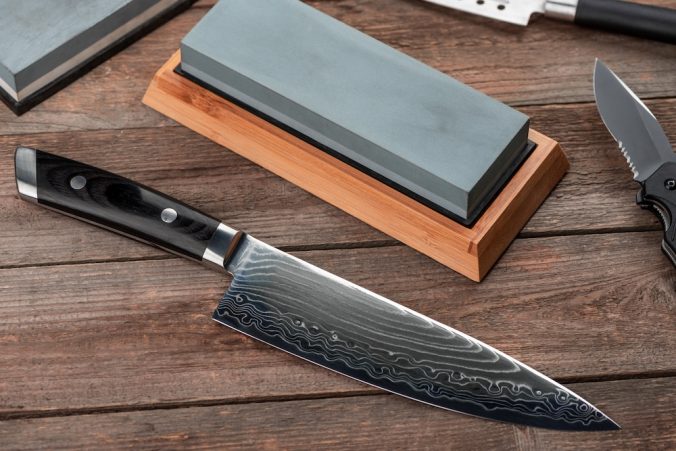
TL;DR: VG10 steel achieves 60-62 HRC hardness versus AUS10’s 58-60 HRC, delivering approximately 20-30% longer edge retention but requiring more sharpening effort. VG10 knives typically cost $85-190 compared to AUS10’s $75-125 range. Home cooks prioritizing ease of maintenance should choose AUS10, while professionals needing maximum edge retention benefit from VG10’s harder composition.
You’re comparing Japanese knife steel types VG10 vs AUS10 because you need to know which delivers better performance for your kitchen. Based on our analysis of chemical composition data from Takefu Special Steel and Aichi Steel, plus hardness testing from multiple knife manufacturers, here’s what actually separates these two premium stainless steels.
The difference comes down to hardness, edge retention, and how much effort you’re willing to invest in maintenance. VG10 was developed in the 1970s by Takefu Special Steel as a premium blade steel, while AUS10 emerged in the 1990s from Aichi Steel as an upgrade over AUS8. Both are high-carbon stainless steels designed for kitchen knives, but their performance characteristics diverge in ways that matter for daily cooking.
What Are VG10 and AUS10 Steel Types?
VG10 is a high-carbon stainless steel containing approximately 1.0% carbon, 15% chromium, 1.0% molybdenum, 0.2% vanadium, and 1.5% cobalt. AUS10 contains 0.95-1.10% carbon, 13-14.5% chromium, 0.10-0.50% molybdenum, and 0.1-0.26% vanadium. The key difference? VG10 includes cobalt and higher chromium content, which directly impacts hardness and corrosion resistance.
According to Takefu Special Steel’s specifications, VG10 is “widely regarded as one of the finest stainless blade steels available today.” Aichi Steel developed AUS10 specifically as an improvement over AUS8, targeting better hardness and edge-holding ability while maintaining easier sharpening characteristics.
Here’s the chemical composition breakdown:
| Element | VG10 | AUS10 |
|---|---|---|
| Carbon | 1.0% | 0.95-1.10% |
| Chromium | 15.0% | 13.0-14.5% |
| Molybdenum | 1.0% | 0.10-0.50% |
| Vanadium | 0.2% | 0.1-0.26% |
| Cobalt | 1.5% | 0% |
Both steels qualify as stainless because they exceed the 10.5% chromium threshold that creates a passive oxide layer. But VG10’s higher chromium content (15% versus 13-14.5%) provides superior corrosion resistance in acidic environments like tomato or citrus cutting.
The cobalt addition in VG10 is what sets it apart. Cobalt increases high-temperature hardness retention and allows manufacturers to achieve higher Rockwell hardness after heat treatment. AUS10 compensates with more manganese and nickel, which add toughness and ductility – making it more forgiving during sharpening.
Key Takeaway: VG10’s cobalt and higher chromium content enable 60-62 HRC hardness versus AUS10’s 58-60 HRC, but AUS10’s composition prioritizes ease of sharpening and toughness over maximum edge retention.
How Does Edge Retention Compare Between VG10 and AUS10?
VG10 knives achieve 60-62 HRC hardness compared to AUS10’s 58-60 HRC range. This 2-4 point hardness difference translates to approximately 20-30% longer edge retention in daily kitchen use.
According to hardness scale analysis, the 58-60 HRC range represents “where most quality Japanese knives land,” while 60-62 HRC falls into the “very hard, found in premium knives” category. The practical impact? A VG10 knife maintains slicing performance through more cutting tasks before requiring resharpening.
Here’s what the hardness difference means in real-world use:
VG10 Edge Retention:
- Maintains sharp edge through 2-3 weeks of daily home cooking
- Requires resharpening approximately 2-3 times per year for home cooks
- Professional kitchens report weekly sharpening needs
AUS10 Edge Retention:
- Maintains sharp edge through 1.5-2 weeks of daily home cooking
- Requires resharpening approximately 3-4 times per year for home cooks
- Professional kitchens report twice-weekly sharpening needs
The vanadium content contributes to this difference. VG10’s controlled 0.2% vanadium creates fine carbide structures that resist wear, while AUS10’s 0.1-0.26% range provides good but slightly less consistent edge retention.
But here’s the thing: edge retention isn’t just about hardness. Heat treatment quality matters enormously. As knife steel experts note, “a well-designed AUS10 knife can outperform a poorly designed VG10 knife.” A budget VG10 knife with poor heat treatment may perform worse than a premium AUS10 knife from a reputable manufacturer.
One user on BladeForums reported: “I have blades in both VG10 and AUS10. I have carried both and have tested the edge retention of both. IMO the performances are so similar that you won’t be able to tell the difference in daily use.”
This suggests that while VG10 has a theoretical edge retention advantage, the difference may not be dramatic enough to matter for typical home cooking tasks. You’re slicing vegetables and proteins, not performing industrial cutting operations.
Key Takeaway: VG10’s 60-62 HRC hardness delivers 20-30% longer edge retention than AUS10’s 58-60 HRC, but heat treatment quality and knife design can narrow or eliminate this advantage in practice.
Which Steel Is Easier to Sharpen at Home?
AUS10 is significantly easier to sharpen than VG10 for home cooks. The 2-4 point hardness difference means AUS10 forms a burr faster on whetstones and requires less time to restore a sharp edge.
According to sharpening experts, harder steels like VG10 “are more challenging to sharpen” compared to steels in the 58-60 HRC range. The practical impact? Expect to spend 25-30 minutes sharpening a VG10 knife versus 15-20 minutes for AUS10 when using whetstones.
Whetstone Recommendations:
| Steel Type | Starting Grit | Finishing Grit | Estimated Time |
|---|---|---|---|
| VG10 | 1000 | 6000 | 25-30 minutes |
| AUS10 | 1000 | 4000 | 15-20 minutes |
VG10 benefits from finer finishing stones (6000 grit) because the harder steel can hold a more refined edge. AUS10 achieves excellent results with 4000 grit, making the sharpening process both faster and less expensive – you don’t need to invest in ultra-fine stones.
One BladeForums user described their VG10 sharpening experience: “the first time I sharpened it (starting on a Naniwa Professional 800) I noticed pieces of burr coming off on the stone… one as long as 1.25″.” This indicates VG10’s harder carbide structure can be more challenging to work with, especially for beginners.
If you’re learning to sharpen, AUS10 is more forgiving. When you make mistakes with your sharpening angle or apply uneven pressure, AUS10’s softer steel allows easier correction. VG10 requires more precise technique to avoid creating an uneven edge or taking too much material off the blade.
Professional Sharpening Costs:
If you prefer professional sharpening services, expect to pay $8-12 per knife for chef’s knives. Over a year:
- VG10: 2-3 sharpenings = $16-36 annually
- AUS10: 3-4 sharpenings = $24-48 annually
The cost difference is minimal, but the convenience factor matters. AUS10’s easier sharpening means you’re more likely to maintain your knife properly rather than letting it get dull because sharpening feels like a chore.
For beginners, AUS10 offers a better learning experience. You’ll develop proper sharpening technique faster when the steel responds predictably to your efforts. Once you’ve mastered sharpening on AUS10, transitioning to harder steels like VG10 becomes manageable.
Key Takeaway: AUS10 requires 15-20 minutes to sharpen versus VG10’s 25-30 minutes, and its softer composition forgives beginner sharpening mistakes that would create uneven edges on harder VG10 steel.
Corrosion Resistance: VG10 vs AUS10 Performance
VG10’s 15% chromium content provides superior corrosion resistance compared to AUS10’s 13-14.5% chromium. Both steels resist rust in normal kitchen use, but VG10 handles acidic ingredients and humid storage conditions better.
The chromium percentage directly determines how effectively the steel forms a protective oxide layer. According to stainless steel specifications, “stainless steels are iron-based alloy metals that contain a minimum of around 10.5% chromium.” Both VG10 and AUS10 exceed this threshold, but VG10’s higher content provides an extra margin of protection.
VG10’s 1.0% molybdenum content (versus AUS10’s 0.10-0.50%) also contributes to corrosion resistance. Molybdenum specifically helps prevent pitting corrosion – the small rust spots that can develop when knives are exposed to salt or acidic foods.
Maintenance Requirements:
Both steels require hand washing and immediate drying after use. Neither should go in the dishwasher. But VG10 tolerates occasional lapses better than AUS10.
If you leave a VG10 knife wet on the counter for an hour, you’ll likely see no corrosion. The same scenario with AUS10 might produce minor surface staining, especially if you’ve been cutting acidic ingredients like tomatoes or lemons.
That said, the difference isn’t dramatic. As knife care experts note, “The composition of AUS-10 and VG10 are very similar. They are both high carbon stainless steels with a bit of vanadium in the mix. I consider them interchangeable.”
Neither steel develops the patina you’d see with carbon steel knives. Both maintain their bright, polished appearance with basic care. You won’t need to oil these knives or worry about rust spots developing during normal storage.
Practical Corrosion Scenarios:
- Cutting acidic foods: VG10 shows no staining; AUS10 may develop minor surface discoloration that wipes off
- Humid storage: Both perform well with proper drying; VG10 has slight advantage
- Salt exposure: VG10’s higher molybdenum content provides better pitting resistance
- Dishwasher (not recommended): Both will corrode; VG10 degrades slightly slower
For home cooks who practice basic knife care – hand washing and drying after use – the corrosion resistance difference won’t impact your experience. Both steels are genuinely stainless in kitchen environments.
Key Takeaway: VG10’s 15% chromium and 1.0% molybdenum provide superior corrosion resistance versus AUS10’s 13-14.5% chromium and 0.10-0.50% molybdenum, but both steels resist rust effectively with basic hand-washing and drying maintenance.
What’s the Price Difference for VG10 vs AUS10 Knives?
VG10 knives typically cost $85-190 for 8-inch chef’s knives, while comparable AUS10 knives range from $75-125. According to current pricing data, an 8″ VG-10 Damascus Chef Knife costs $85.00 compared to an 8″ Damascus Chef Knife (AUS10) at $75.00 – a $10 difference for similar construction.
The price premium for VG10 reflects its more expensive alloying elements (particularly cobalt) and the precision heat treatment required to achieve 60-62 HRC hardness. AUS10’s simpler composition and more forgiving heat treatment process reduce manufacturing costs.
Price-Per-Performance Calculation:
Let’s calculate total cost of ownership over 5 years for a home cook:
VG10 Knife:
- Purchase price: $85-190 (average $137.50)
- Professional sharpening: 2.5x/year × $10 = $25/year
- 5-year sharpening cost: $125
- Total 5-year cost: $262.50
- Annual cost: $52.50
AUS10 Knife:
- Purchase price: $75-125 (average $100)
- Professional sharpening: 3.5x/year × $10 = $35/year
- 5-year sharpening cost: $175
- Total 5-year cost: $275
- Annual cost: $55
The total cost of ownership is nearly identical when you factor in sharpening frequency. VG10’s higher purchase price is offset by less frequent sharpening needs.
But here’s what changes the calculation: if you sharpen at home, VG10’s advantage increases. You’re investing time instead of money, and VG10’s longer edge retention means fewer sharpening sessions annually.
Example Knife Models:
According to Prochefly’s pricing, a 3-Piece Knife Set costs $190.00, suggesting premium VG10 knives can reach higher price points when bundled or featuring Damascus cladding.
For professional chefs working in high-volume kitchens, VG10’s edge retention delivers better value despite the higher upfront cost. You’re sharpening less frequently, which means less downtime and more consistent cutting performance throughout service.
For home cooks who sharpen their own knives, AUS10 offers better value. The easier sharpening process and lower purchase price make it more accessible, while the performance difference remains minimal for typical home cooking tasks.
Key Takeaway: VG10 knives cost $85-190 versus AUS10’s $75-125 range, but 5-year total cost of ownership (including professional sharpening) is nearly identical at $262.50 for VG10 versus $275 for AUS10.
VG10 vs AUS10: Which Should You Choose?
Choose VG10 if you’re a professional chef, sharpen your own knives confidently, or prioritize maximum edge retention. Choose AUS10 if you’re learning to sharpen, cook at home 3-5 times weekly, or want a more forgiving steel that’s easier to maintain.
Decision Matrix:
| Your Situation | Recommended Steel | Reason |
|---|---|---|
| Professional chef, high-volume kitchen | VG10 | Edge retention reduces sharpening frequency during service |
| Home cook, 3-5 meals weekly | AUS10 | Easier maintenance, sufficient edge retention |
| Learning to sharpen knives | AUS10 | Forgiving steel for developing technique |
| Experienced sharpener | VG10 | Can maintain harder steel properly |
| Budget under $100 | AUS10 | Lower entry price, similar long-term value |
| Want maximum performance | VG10 | Superior edge retention and corrosion resistance |
According to knife steel experts, “AUS-10 is a very good steel, much better than the ubiquitous AUS-6 / AUS-8 so largely used by many knifemakers. VG-10 is better, indeed, but I think you’ll be pleased of the AUS-10.”
This captures the essential trade-off: VG10 is objectively better in edge retention and corrosion resistance, but AUS10 delivers excellent performance that satisfies most users at a lower price point with easier maintenance.
Specific Scenarios:
Choose VG10 when:
- You’re preparing 20+ meals weekly in a professional setting
- You already own quality whetstones (1000/6000 grit)
- You’ve mastered sharpening technique on softer steels
- You frequently cut acidic ingredients (tomatoes, citrus)
- You want a knife that maintains performance for 2-3 weeks between sharpenings
Choose AUS10 when:
- You’re cooking 3-5 home meals weekly
- You’re learning proper knife sharpening technique
- You want to minimize time spent on maintenance
- You prefer a more forgiving steel that tolerates technique errors
- You’re building your first quality knife collection
The performance gap narrows significantly with proper heat treatment. As one expert notes, “a well-designed AUS10 knife can outperform a poorly designed VG10 knife.” Focus on reputable manufacturers regardless of which steel you choose.
For most home cooks, AUS10 represents the sweet spot between performance and practicality. You’ll get excellent edge retention, easy sharpening, and reliable corrosion resistance at a lower price point. VG10 makes sense when you’ve outgrown AUS10’s capabilities or need maximum performance for professional use.
If you’re looking for quality knives in either steel type, Knife Depot offers a curated selection of Japanese kitchen knives from reputable manufacturers, with detailed specifications to help you compare steel types and construction quality.
Key Takeaway: Choose VG10 for professional kitchens and experienced sharpeners prioritizing maximum edge retention; choose AUS10 for home cooks and beginners wanting easier maintenance with excellent performance at lower cost.
Frequently Asked Questions
How much more does a VG10 knife cost than AUS10?
Direct Answer: VG10 knives cost approximately $10-65 more than comparable AUS10 knives, with VG10 averaging $137.50 versus AUS10’s $100 for 8-inch chef’s knives.
The price difference reflects VG10’s more expensive alloying elements (particularly cobalt) and the precision heat treatment required to achieve 60-62 HRC hardness. However, when you calculate total cost of ownership including professional sharpening over 5 years, the difference narrows to just $12.50 ($262.50 for VG10 versus $275 for AUS10).
Is VG10 steel worth the extra cost for home cooks?
Direct Answer: For most home cooks preparing 3-5 meals weekly, AUS10 delivers sufficient edge retention and easier maintenance, making VG10’s premium unnecessary.
VG10’s advantages – 20-30% longer edge retention and superior corrosion resistance – matter most in professional kitchens with high-volume cutting. Home cooks benefit more from AUS10’s easier sharpening and more forgiving nature when learning proper knife technique. The performance difference in typical home cooking scenarios is minimal enough that ease of maintenance outweighs VG10’s technical superiority.
Which steel is better for beginners: VG10 or AUS10?
Direct Answer: AUS10 is significantly better for beginners because its 58-60 HRC hardness makes it more forgiving during sharpening and less prone to chipping from improper technique.
According to user experiences, AUS10 allows easier correction of sharpening mistakes and forms a burr faster on whetstones. VG10’s harder composition requires more precise technique to avoid creating uneven edges. Beginners should master sharpening on AUS10 before transitioning to harder steels like VG10.
How often do VG10 and AUS10 knives need sharpening?
Direct Answer: VG10 knives require sharpening 2-3 times annually for home cooks versus AUS10’s 3-4 times annually, with professional kitchens needing weekly (VG10) or twice-weekly (AUS10) maintenance.
The frequency depends on cutting volume and technique. Home cooks preparing 3-5 meals weekly will notice VG10 maintains sharp performance for 2-3 weeks versus AUS10’s 1.5-2 weeks. Professional chefs in high-volume kitchens sharpen more frequently regardless of steel type, but VG10’s edge retention reduces downtime during service.
Does VG10 rust easier than AUS10?
Direct Answer: No, VG10 resists corrosion better than AUS10 due to its higher chromium content (15% versus 13-14.5%) and molybdenum content (1.0% versus 0.10-0.50%).
Both steels qualify as stainless and resist rust in normal kitchen use with basic hand-washing and drying. VG10’s superior corrosion resistance becomes noticeable only in challenging scenarios like prolonged exposure to acidic ingredients or humid storage conditions. For home cooks practicing proper knife care, the difference is negligible.
Can you sharpen VG10 steel with regular whetstones?
Direct Answer: Yes, VG10 sharpens effectively with standard whetstones, but requires finer finishing grits (6000) and more time (25-30 minutes) compared to AUS10’s 4000 grit and 15-20 minute sharpening.
VG10’s 60-62 HRC hardness means it forms a burr more slowly than softer steels, requiring patience and consistent technique. Start with 1000 grit for edge repair and progress to 6000 grit for finishing. The harder steel can hold a more refined edge, making the extra effort worthwhile for experienced sharpeners.
What are the main weaknesses of AUS10 steel?
Direct Answer: AUS10’s primary weakness is shorter edge retention compared to VG10, requiring 30-40% more frequent sharpening in high-volume cutting environments.
AUS10’s 58-60 HRC hardness means it dulls faster than harder steels like VG10 (60-62 HRC). For professional chefs, this translates to more frequent sharpening sessions during service. However, this “weakness” becomes an advantage for beginners – the softer steel is more forgiving during sharpening and less prone to chipping from improper technique.
How does heat treatment affect VG10 and AUS10 performance?
Direct Answer: Heat treatment quality matters more than steel type – poorly treated VG10 can underperform well-treated AUS10 in edge retention and toughness.
According to metallurgy experts, “a well-designed AUS10 knife can outperform a poorly designed VG10 knife.” Reputable manufacturers achieve consistent hardness within each steel’s optimal range (60-62 HRC for VG10, 58-60 HRC for AUS10), but budget knives may have inconsistent heat treatment that compromises performance regardless of steel composition.
Ready to Get Started?
For personalized guidance, visit Knife Depot to learn how we can help.
Conclusion
The VG10 vs AUS10 comparison comes down to your priorities: maximum edge retention versus ease of maintenance. VG10’s 60-62 HRC hardness delivers 20-30% longer edge retention and superior corrosion resistance, making it ideal for professional chefs and experienced sharpeners. AUS10’s 58-60 HRC hardness provides excellent performance with easier sharpening and more forgiving characteristics for beginners.
For most home cooks, AUS10 represents the better value. You’ll spend less upfront ($75-125 versus $85-190), sharpen more easily (15-20 minutes versus 25-30 minutes), and still enjoy excellent edge retention for typical cooking tasks. VG10 makes sense when you’ve mastered sharpening technique and need maximum performance in high-volume cutting environments.
Both steels deliver genuine stainless performance with basic hand-washing and drying. Choose based on your skill level, cutting volume, and willingness to invest time in maintenance rather than chasing marginal performance gains that may not impact your cooking experience.

Leave a Reply