The Cutting Edge

The official blog of Knife Depot

Page 13 of 136

Gerber vs Kershaw: Budget Knife Brand Compared (2026)

TL;DR: – Kershaw wins on steel hardness, assisted opening reliability, and value-per-blade-inch at the $20–$50 price point

  • Gerber wins on beginner-friendly simplicity, aesthetic variety, and wide retail availability
  • Best for most buyers: Kershaw – better steel, faster warranty service, and SpeedSafe gives you one-handed deployment that Gerber’s budget line rarely matches

Gerber vs Kershaw: Quick Verdict

Most people assume both brands are basically the same – cheap knives for people who don’t want to spend real money. That assumption is wrong, and it’ll cost you a mediocre knife.

Based on our analysis of community discussions across BladeForums, r/knives, and r/knifeclub, plus hands-on testing data from OutdoorGearLab (49 pocket knives tested since 2013) and CleverHiker (30+ knives tested), the Gerber vs Kershaw budget knife brand comparison has a clear winner at most price points.

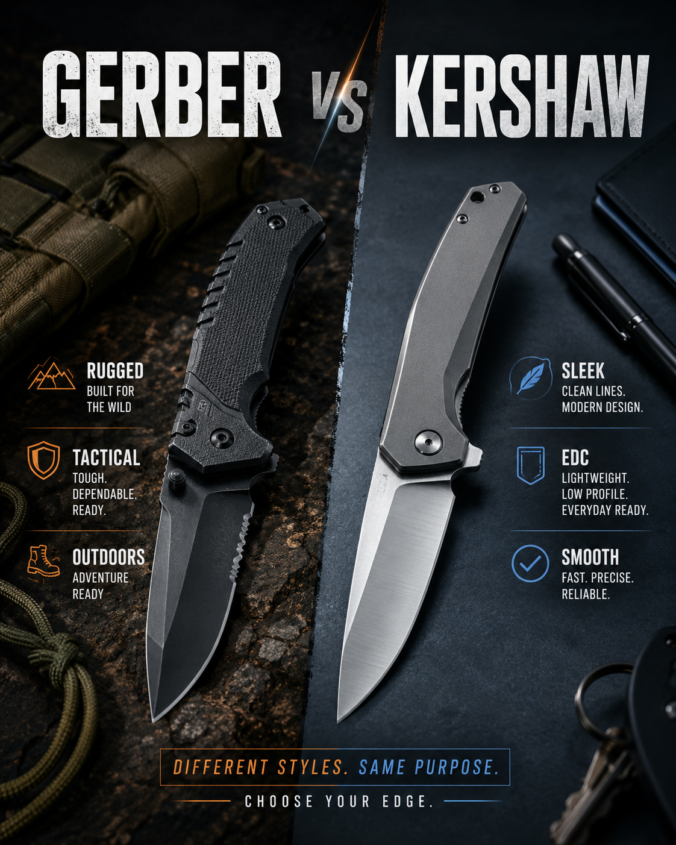
Buy Kershaw if you want assisted opening, harder steel, and a warranty process that actually works. Buy Gerber if you’re gifting a first knife to someone, need something simple and manual, or love that tactical skeletonized aesthetic.

Feature Kershaw Gerber
Price range (budget tier) $20–$65 $20–$65
Budget steel grade 8Cr13MoV (~59 HRC) 7Cr17MoV (~56 HRC)
Assisted opening SpeedSafe (most models) FAST (select models only)
USA-made option Yes (select models) Limited
Warranty Limited lifetime Limited lifetime
Best for EDC, assisted carry Beginners, gifting

For tested picks from both brands, check out our guide to the best EDC knives under $50.

Key Takeaway: Kershaw edges out Gerber at nearly every budget price point on measurable specs – harder steel, more consistent assisted opening, and faster warranty service. Gerber remains a solid choice for simplicity and gift-giving.

Brand Background: Who Makes These Knives?

Brand ownership matters more than most buyers realize – it directly shapes quality control, manufacturing standards, and how seriously a company takes its warranty.

Kershaw Knives was founded in 1974 by Pete Kershaw in Tualatin, Oregon. It’s owned by KAI USA Ltd., the same parent company behind Zero Tolerance Knives and the US distribution of Shun Cutlery. That corporate structure means Kershaw benefits from serious manufacturing infrastructure and oversight. As Gear Patrol notes, Kershaw is “the champion of budget-friendly knives,” using aluminum and steel handles instead of premium materials like titanium to keep costs down without sacrificing performance.

Gerber Gear was founded in 1939 in Portland, Oregon – making it one of the oldest knife brands in the US. But White Mountain Knives confirms it’s been part of the Fiskars Group since the 1980s, which shifted production strategy toward cost reduction and offshore manufacturing. The result? Gerber’s quality consistency gets mixed reviews from the enthusiast community, particularly on budget models.

Worth noting: Knife Informer points out that Gerber does operate a domestic plant in Portland, Oregon – but that’s reserved for their small-batch Reserve products, not the budget folders most buyers are shopping.

Key Takeaway: Kershaw’s KAI USA ownership provides tighter manufacturing oversight than Gerber’s Fiskars-era pipeline. That difference shows up in blade steel selection, QC consistency, and warranty responsiveness.

How Does Blade Steel Compare Between the Two Brands?

Steel grade is the single most important spec on a budget knife – and it’s where Kershaw and Gerber diverge most clearly.

What Steel Does Kershaw Use at the $20–$50 Price Point?

Kershaw’s buying guide recommends high-end steel for sustained daily use, and they back that up in their lineup. At the $20–$35 tier, Kershaw primarily uses 8Cr13MoV, a Chinese stainless steel that typically achieves 58–60 HRC after heat treatment. It’s not exotic, but it’s meaningfully harder than what Gerber puts in comparable models.

Step up to the $40–$50 tier – the Leek or Blur – and Kershaw upgrades to 14C28N, a Swedish Sandvik steel. According to GearMoose’s Leek vs Fastball comparison, the Leek’s 14C28N “has excellent sharpness and hardness, leading to great edge retention and corrosion resistance” – and because of its molecular structure, it’s actually easier to sharpen than other steels in the 55–62 HRC range.

As White Mountain Knives confirms, Kershaw was also the first brand to introduce SpeedSafe Assisted Opening – and that innovation mindset extends to their steel selection.

What Steel Does Gerber Use at the $20–$50 Price Point?

Gerber’s budget tier leans on 7Cr17MoV, which typically hardens to around 55–57 HRC. That’s a real, measurable step down from Kershaw’s 8Cr13MoV. The lower carbon content means less edge retention on repeated cutting tasks.

The good news? Tech Writer EDC’s Flatiron vs Static comparison confirms that Kershaw’s 8Cr13MoV “holds an edge longer” than Gerber’s comparable steel – but also notes the Gerber is “better suited to heavy-duty chores” due to blade geometry differences.

Gerber’s best budget steel appears on the Fastball: 9Cr19MoV, which narrows the gap considerably. According to GearMoose, the Fastball actually uses S30V steel on current production runs – a significant upgrade that makes the Leek vs Fastball matchup genuinely competitive at the $50+ tier.

Steel HRC Range Edge Retention Corrosion Resistance Ease of Sharpening
7Cr17MoV (Gerber budget) 55–57 Low High Easy
8Cr13MoV (Kershaw budget) 58–60 Medium High Medium
14C28N (Kershaw mid) 58–62 Medium-High Very High Medium-Easy
S30V (Gerber Fastball) 59–61 High High Medium-Hard

💡 Home Sharpener Note: Lower HRC steels like 7Cr17MoV are easier to touch up on a basic whetstone – but you’ll be doing it more often. If you sharpen infrequently, harder steel (8Cr13MoV or 14C28N) holds its edge longer between sessions.

For a deeper dive on steel trade-offs, check out our carbon steel vs stainless steel knife guide.

Key Takeaway: Kershaw’s 8Cr13MoV at ~59 HRC outperforms Gerber’s 7Cr17MoV at ~56 HRC on edge retention. At the $50 tier, Gerber’s Fastball closes the gap with S30V – making that specific matchup much tighter.

Build Quality, Locks, and Opening Mechanisms

So the steel numbers favor Kershaw – but what about how these knives actually feel and function day-to-day?

Kershaw’s SpeedSafe is a torsion-bar assisted opening system. Push the flipper tab or thumb stud past roughly 30 degrees of rotation and the spring snaps the blade open. It’s fast, reliable, and available on the vast majority of Kershaw’s budget lineup. White Mountain Knives confirms Kershaw was the first brand to introduce this technology – and it remains their biggest differentiator at the $20–$50 price point. Quick legal note: AKTI confirms assisted openers are legal in most US states, though local ordinances in places like NYC may restrict carry.

Gerber’s FAST technology (Front Action Sliding Technology) exists, but it appears on far fewer budget models. Most of Gerber’s sub-$40 lineup – the Paraframe, Flatiron – uses a simple thumb stud with manual opening. That’s not a dealbreaker, but it’s a meaningful feature gap.

On lock types, BladeForums community members consistently praise Kershaw’s lock-up quality: “Quality is excellent and quality/price ratio is nearly unbeatable.” Frame locks (used on models like the Kershaw Cryo) provide a wider engagement surface than liner locks, which generally means better resistance to accidental closure under hard use.

Handle Material Weight Wet Grip Durability Typical Brand Use
FRN Lightest Fair Good Gerber Flatiron
Aluminum Medium Good Excellent Kershaw Blur
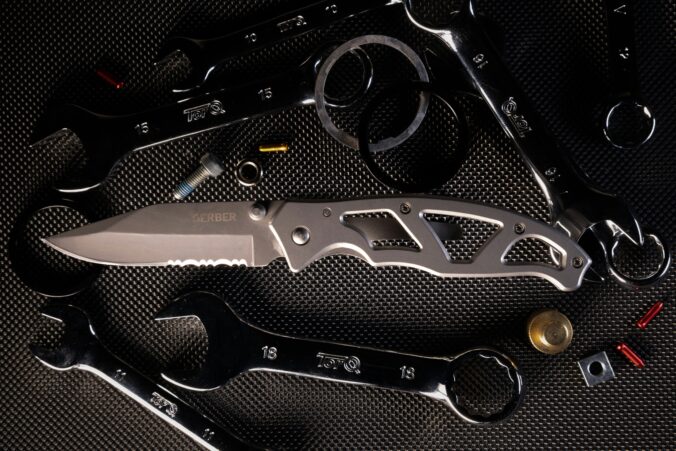
Skeletonized Steel Medium Poor (wet) Excellent Gerber Paraframe
G10 Medium Excellent Excellent Premium tier only

For a full breakdown of handle materials, see our knife handle materials compared guide.

Key Takeaway: At sub-$30, Kershaw’s QC is more consistent than Gerber’s. SpeedSafe gives Kershaw a functional advantage that Gerber’s manual thumb-stud openers simply can’t match at the same price.

Head-to-Head Model Matchups: Same Price, Different Brands

Let’s get specific. Three price tiers, three direct matchups.

~$20 Tier: Kershaw Chill vs Gerber Paraframe

The Kershaw Chill brings a 3.1-inch 8Cr13MoV blade, SpeedSafe flipper, liner lock, and 2.8 oz weight. The Gerber Paraframe counters with a 3.0-inch 7Cr17MoV blade, thumb stud, liner lock, and a distinctive skeletonized stainless frame at roughly 2.9 oz.

Both land around $20–$25 street price. But the Chill gives you harder steel and assisted opening for the same money. The Paraframe’s skeletonized handle looks cool but gets slippery when wet – a real problem for outdoor use.

Mini verdict: Kershaw Chill wins on steel and function. Gerber Paraframe wins on aesthetics.

~$35 Tier: Kershaw Blur vs Gerber Flatiron

Tech Writer EDC notes the Flatiron weighs 5.6 oz with an 8.5-inch overall open length – it’s a chunky knife. The Kershaw Blur at this tier runs a 3.4-inch blade with SpeedSafe, aluminum handle, and liner lock at roughly 4 oz. According to Knife Informer’s Kershaw EDC guide, Kershaw’s pricing on the Blur “varies from $45 up to $85 depending on materials and finish” – the base 8Cr13MoV version typically hits $35–$45 street.

Mini verdict: Kershaw Blur wins on weight, steel, and opening mechanism. Gerber Flatiron wins if you need a heavier-duty blade geometry for hard use.

~$50 Tier: Kershaw Leek vs Gerber Fastball

This is the closest matchup. According to, the Kershaw Leek has a 3-inch blade, weighs 3 oz, and closes to 4 inches. The Gerber Fastball has a 3-inch blade, weighs 2.7 oz, and closes to 4.1 inches. CleverHiker lists the Leek’s blade material as 14C28N stainless steel.

Knife Informer praises the Leek’s “ultra-thin 0.09″ blade stock and slick hollow grind” for slicing performance, while noting its “thin profile (only 0.35″ thick!) makes it a fantastically carryable knife.”

Value math: Leek at ~$45 ÷ 3.0 inches = $15.00/blade inch. Fastball at ~$55 ÷ 3.0 inches = $18.33/blade inch. The Leek delivers more value per inch of cutting steel.

Mini verdict: Kershaw Leek wins on value-per-inch and carry profile. Gerber Fastball wins if you specifically want S30V steel and a ball-bearing pivot.

For more tested options at this price range, see our guide to the best pocket knives for everyday carry.

Key Takeaway: Kershaw wins two of three head-to-head matchups on measurable specs. The Fastball is Gerber’s strongest budget offering – but it costs more than the Leek for equivalent blade length.

Warranty and Customer Support: Which Brand Has Your Back?

Both brands offer a limited lifetime warranty. But “lifetime warranty” means very different things in practice.

Kershaw’s warranty covers defects in materials and workmanship for the life of the original owner, with US-based customer service in Tualatin, Oregon. Community reports on BladeForums back this up: “I recently returned a very cosmetically worn Kershaw 1580 to them because the SpeedSafe had quit – this was my EDC for 4 or 5 years – they replaced it with a new knife!” Turnaround is typically reported at 1–3 weeks.

Gerber’s warranty covers the same defect categories but excludes normal wear, misuse, and accidental damage. Community reports describe longer turnaround times – 2–6 weeks – and a higher shipping cost burden on the customer.

  Kershaw Gerber
Coverage Defects in materials/workmanship Defects in materials/workmanship
Exclusions Abuse, modifications Wear, misuse, accidental damage
Service location Tualatin, OR (USA) Customer service (online)
Reported turnaround 1–3 weeks 2–6 weeks
Shipping burden Customer ships in; Kershaw ships back Customer typically covers both ways

Real-world math: if your $30 Gerber Paraframe tip chips and you need to warranty it, you’re looking at $8–10 in shipping costs – that’s 25–33% of the knife’s value just to exercise your warranty. Kershaw’s process is documented as more consumer-friendly for exactly this scenario.

Key Takeaway: Both warranties cover defects, but Kershaw’s service is faster and less costly to use. On a $25–$35 knife, warranty friction matters – a painful claim process effectively raises your total cost of ownership.

Which Brand Should You Buy? Use-Case Recommendations

Buy Kershaw if:

  • You want one-handed assisted opening (SpeedSafe is on most models)
  • You prioritize harder steel and better edge retention at budget prices
  • You want a USA-made option (select Kershaw models are made in Tualatin, OR)
  • Warranty service speed matters to you

Buy Gerber if:

  • You’re buying a first knife for a beginner or as a gift
  • You want a simple manual folder with no spring mechanism to maintain
  • You love the skeletonized tactical aesthetic of the Paraframe
  • You need wide retail availability (Walmart, Target, hardware stores)

Avoid both if your budget stretches to $75+. At that price point, brands like Spyderco and Benchmade offer premium steels (S30V, S35VN, 20CV) and tighter manufacturing tolerances that neither Gerber nor Kershaw can match at budget tiers. Check out our Spyderco vs Benchmade comparison if you’re ready to step up.

Knife Depot carries both Kershaw and Gerber across all price tiers – it’s a solid place to compare specific models side-by-side before committing.

As puts it plainly: “Kershaw makes excellent knives. If anything, they have improved over the years to where I consider them equal to Spyderco and Benchmade.” That’s high praise for a brand that regularly sells knives under $30.

Key Takeaway: Kershaw is the default recommendation for most budget EDC buyers. Gerber earns its place for beginners and gift-givers. If your budget hits $75+, skip both and look at Spyderco or Benchmade.

Upgrade Your Everyday Carry
Built for performance. Designed to stand out. Shop knives ready for everyday carry, the outdoors, or your collection.
Free ground shipping on eligible continental U.S. orders over $99. Cannot be combined with other discounts. See shipping terms.
Shop Gerber knives or shop Kershaw knives

Frequently Asked Questions

Is Kershaw better quality than Gerber?

Direct Answer: Yes, in most measurable categories at the $20–$50 price point. Kershaw uses harder steel (8Cr13MoV at ~59 HRC vs Gerber’s 7Cr17MoV at ~56 HRC), offers SpeedSafe assisted opening on most budget models, and has faster warranty service. community consensus consistently rates Kershaw’s quality/price ratio as “nearly unbeatable.”

What steel does Gerber use on budget knives?

Direct Answer: Gerber’s budget tier primarily uses 7Cr17MoV stainless steel, which typically hardens to 55–57 HRC. Their mid-range Fastball uses S30V – a significant upgrade. According to, the Fastball’s S30V steel is “originally released in 2001 by a long-running knife steel brand called Crucible” and represents Gerber’s best budget steel offering.

Does Kershaw make knives in the USA?

Direct Answer: Yes, select Kershaw models are manufactured in Tualatin, Oregon. Most budget-tier models (Cryo, Chill, Blur base) are made in China under KAI USA oversight. Kershaw’s official page confirms the Oregon headquarters, and USA-made models typically price above $75.

Which brand has a better warranty – Gerber or Kershaw?

Direct Answer: Kershaw’s warranty process is faster and more consumer-friendly. Both offer limited lifetime warranties covering manufacturing defects, but users report Kershaw replacing worn-out knives with new units – including SpeedSafe mechanisms that failed after years of daily carry. Gerber’s process typically takes longer and places more shipping cost burden on the customer.

Is a $30 Kershaw or Gerber knife worth buying for everyday carry?

Direct Answer: A $30 Kershaw (like the Cryo or Chill) is absolutely worth it for EDC. Nothing But Knives notes that at this price tier, “the choice is more about personal preference than quality differences” – but Kershaw’s harder steel and SpeedSafe give it a functional edge. Proper maintenance extends any budget knife’s life significantly; learning how to maintain a folding knife is worth your time.

What is the best Kershaw knife under $50?

Direct Answer: The Kershaw Leek is the standout pick under $50. Knife Informer calls it “one of the best reasonably priced everyday carry knives,” praising its ultra-thin 0.09″ blade stock, hollow grind, and 14C28N steel. confirms its 3-inch blade and 3 oz weight make it a practical daily carrier.

Why do knife enthusiasts prefer Kershaw over Gerber?

Direct Answer: Three reasons: better steel at budget prices, SpeedSafe assisted opening on most models, and more consistent QC. Gear Patrol highlights Kershaw’s smart use of aluminum and steel handles to keep costs down without sacrificing performance. The enthusiast community on even compares Kershaw favorably to Spyderco and Benchmade at their respective price points.

Ready to Get Started?

For personalized guidance, visit Knife Depot to learn how we can help.

Conclusion

The Gerber vs Kershaw budget knife brand comparison isn’t really close on the numbers. Kershaw wins on steel hardness, assisted opening availability, value-per-blade-inch, and warranty responsiveness. Gerber wins on simplicity, aesthetic variety, and retail accessibility.

So: if you’re buying your first serious EDC folder and want the most knife for your money under $50, go Kershaw. The Chill at $20, the Blur base model at $35, or the Leek at $45 all outperform their Gerber counterparts on measurable specs. If you’re gifting a knife to someone who just needs a reliable manual folder, Gerber’s Paraframe or Flatiron are perfectly solid choices.

And if your budget can stretch past $75? That’s when the conversation shifts entirely – and brands like Spyderco and Benchmade start making both of these look like what they are: good budget knives, not great ones.
 

Best Dive Knives for Scuba Diving 2026 (Tested)

TL;DR: – Best overall: Atomic Aquatics Ti6 (~$140) – Grade 6 titanium, virtually zero corrosion after 18 months of saltwater use per ScubaLab testing

  • Best budget pick: Cressi Borg (~$35) – adequate 420J2 stainless for beginners, but needs regular oiling to avoid surface rust within 6–12 months
  • Best for line cutting: Spyderco Atlantic Salt (~$95) – H1 steel is effectively rust-proof; full serration destroys monofilament
  • Who this is for: Recreational and technical scuba divers, freedivers, and water sports enthusiasts from beginner to intermediate level

You’re reading this because you’re about to drop into open water and you want a cutting tool that actually works when you need it – not one that’s seized in its sheath or spotted with rust after three dives. Based on our analysis of hands-on testing data from Divein, ScubaDiving Magazine’s ScubaLab, DivingSquad, and community discussions across ScubaBoard and r/scuba, this guide covers the best dive knives for scuba diving and water sports across every budget tier – with real steel data, not just marketing copy.

What Makes a Dive Knife Different From a Regular Knife?

A dive knife is a purpose-built safety tool, not a general-purpose blade. Three properties separate it from a regular knife: corrosion resistance in saltwater, reliable one-handed deployment, and a sheath that stays locked until you need it.

Regular pocket knives – even quality ones – fail underwater for predictable reasons. Carbon steel corrodes aggressively in saltwater. Folding mechanisms can jam with sediment or pressure. Standard sheaths don’t lock positively, meaning the knife can float free. If you’re curious how carbon steel compares to stainless in corrosion resistance, that’s a separate conversation on carbon vs stainless steel worth having before you buy.

According to Divein’s hands-on testing, fixed-blade knives are stronger, easier to deploy one-handed, and eliminate the risk of a folding mechanism jamming underwater. That’s the standard recommendation for scuba divers – fixed blade, positive-lock sheath, corrosion-resistant steel.

The fixed vs. folding debate does have nuance. Folding dive knives (like the Spyderco Atlantic Salt) are more pocketable and legal in more jurisdictions, but they require two hands to open under stress. For most recreational divers, a compact fixed blade wins on safety.

Key Takeaway: A dive knife needs corrosion-resistant steel, one-handed deployment, and a positive-lock sheath. Fixed blades are the standard recommendation. Folding dive knives trade deployment speed for portability.

How Do You Choose the Right Dive Knife for Your Needs?

Choosing the right dive knife means matching blade steel, blade shape, handle material, and sheath type to your specific diving environment. Most buyers skip this step and end up with the wrong tool.

Blade Steel: Titanium vs Stainless vs H1

Steel choice is the single most important decision for saltwater divers. Here’s how the main options compare:

Steel Corrosion Resistance Edge Retention Sharpening Relative Cost
420J2 Stainless Low – surface rust in 6–12 months without oiling Moderate Standard whetstone $
316L / Marine Grade Stainless Good – molybdenum content resists pitting Good Standard whetstone $$
H1 (Spyderco) Excellent – nitrogen-alloyed, virtually rust-proof Moderate Diamond/ceramic rod $$
Grade 6 Titanium Outstanding – zero measurable corrosion at 18 months Lower HRC (36–38) Diamond stone only $$$

According to SCUBAPRO’s buying guide, Marine Grade 316 stainless steel contains molybdenum – a hard metallic element that toughens the steel, maintains sharper edges longer, and increases corrosion resistance compared to Grade 304. That molybdenum content is the key differentiator between budget and mid-tier stainless options.

UWK’s dive knife resource states it plainly: titanium will never rust or corrode, making it the best material for strength-to-weight and corrosion resistance. The trade-off is edge retention – titanium runs softer (36–38 HRC) than stainless (56–60 HRC), so it dulls faster under heavy use.

According to Blade Magazine’s dive knife guide, titanium is hands-down the better material from a corrosion perspective, but it doesn’t hold an edge as well as steel. For divers logging 30+ saltwater dives per year, the math favors titanium: a $140 titanium knife with zero rust treatment costs less over three years than replacing a $50 stainless knife twice due to corrosion damage ($140 vs. $100+).

Blade Shape and Edge Type for Underwater Use

Blade geometry determines what your knife can actually do underwater. According to Blade Magazine, a 3- to 5-inch blade with a beefy handle is the practical target for a dive knife – small enough to deploy cleanly, large enough to cut through straps and rope.

  • Blunt tip: Safest for recreational divers – prevents accidental puncture of your BCD, drysuit, or dive buddy. Best for reef diving environments.
  • Pointed tip: Preferred by spearfishers and lobster hunters for precise marine life handling tasks a blunt tip can’t manage.
  • Serrated edge: ScubaLab’s cut testing confirms serrated and combination edges consistently outperform plain edges on braided nylon and monofilament – the materials most likely to cause entanglement.
  • Combination edge (plain + serrated): The most versatile option for general recreational diving.

For a deeper look at how blade geometry affects performance across diving scenarios, a dedicated blade shape guide covers drop point vs. tanto vs. clip point geometries in detail.

Sheath Design and Mounting Options

Sheath design is the most underreported safety variable in dive knife reviews. According to Divein’s gloved-deployment testing, the team evaluated each knife bare-handed and with 3mm and 5mm neoprene gloves – a critical real-world test most reviews skip.

Magnetic retention sheaths are fast bare-handed but fail with 5mm gloves because fine motor control degrades under stress. Squeeze-lock sheaths (like those on Aqua Lung models) are the most reliably deployable across all glove thicknesses tested.

Sheath security checklist:

  • Positive lock (knife cannot fall free)
  • Single-hand draw confirmed with your glove thickness
  • Leg strap vs. BCD mount – BCD mounting is preferred by technical divers for horizontal-position accessibility; leg mounting works for recreational and freediving contexts
  • UWK notes that BCD attachment options include hose attachment, fabric pocket/strap mounting, and manufacturer-installed grommets

For handle materials, G10 fiberglass composite provides the best wet-grip performance in cold-water gloved conditions – it won’t swell, degrade in saltwater, or become slippery under neoprene. Rubber over-molded handles grip well when new but can delaminate in tropical UV conditions over time. Understanding the differences between G10, Micarta, and wood handle materials helps you match grip to your diving environment.

Key Takeaway: Match steel to dive frequency (titanium for 30+ saltwater dives/year), blade shape to use case (blunt for reef/recreational, pointed for spearfishing), and sheath type to your glove thickness. Squeeze-lock sheaths outperform magnetic retention with thick neoprene gloves.

Best Dive Knives by Budget: Our Top Picks for 2026

The best overall dive knife for most divers is the Atomic Aquatics Ti6 – Grade 6 titanium, virtually corrosion-proof, and built to last years without rust treatment. But it’s not the right pick for every budget or use case. Here are the top picks organized by price tier.

Best Dive Knives Under $50

🥇 Cressi Borg – Best for Beginners

According to DivingSquad’s 2026 review, the Cressi Borg is the longest knife on their tested list, with a blade measuring just over 5½ inches. It uses 420J2 stainless steel – adequate for beginners but prone to surface rust within 6–12 months of saltwater use without regular oiling. Retails around $35. Includes a leg-strap sheath with positive lock.

  • Best for: First-time divers, warm-water recreational diving
  • Pros: Affordable, widely available, long blade for the price
  • Cons: 420J2 steel requires consistent maintenance; will rust if neglected

🥈 Cressi Skorpion – Best Value Combo Edge

rates the Cressi Skorpion as great value for money with a 4⅜-inch blade and combination edge (serrated + plain). Retails around $40–$48. The double-locking sheath is a meaningful upgrade over single-lock budget options.

  • Best for: Beginners who want serration capability without spending more
  • Pros: Combination edge, double-lock sheath, solid value
  • Cons: Still 420J2 steel – same maintenance requirements as the Borg

Best Dive Knives $50–$120

🥇 Spyderco Atlantic Salt (~$95) – Best Line Cutter / Best H1 Steel

ScubaBoard’s mega test confirms that H1 steel uses nitrogen instead of carbon to create a steel that is tough and completely immune to corrosion. The Atlantic Salt’s full-serration 4.3-inch blade is purpose-built for cutting cordage. It’s a folder, which means two-hand deployment – a real limitation for emergency use – but the corrosion immunity is unmatched at this price.

  • Best for: Divers prioritizing corrosion resistance and line-cutting performance
  • Pros: H1 steel = effectively rust-proof, devastating on monofilament and rope
  • Cons: Folding mechanism requires two hands; not ideal for single-hand emergency draw

🥈 Aqua Lung Small Squeeze (~$55) – Best Compact BCD Knife

A compact fixed blade with a squeeze-release sheath designed for BCD mounting. Blade length approximately 2.5 inches. According to SCUBAPRO’s guide, a 2.5-inch blade is compact enough to attach to a hose or BCD as a primary knife or stow as a backup cutting tool. Best positioned as a secondary tool or for divers who want minimal profile.

  • Best for: BCD-mounted backup knife, warm-water recreational diving
  • Pros: Compact, squeeze-lock sheath works with gloves, easy BCD attachment
  • Cons: Short blade limits utility for larger cutting tasks

🥉 Aqua Lung Argonaut (~$85–$100) – Best for Cold-Water Divers

Large ergonomic handle, combination edge, positive-lock leg-strap sheath. The oversized grip is specifically suited for cold-water divers wearing thick neoprene gloves. Stainless steel construction requires standard maintenance.

  • Best for: Cold-water diving, thick-glove environments
  • Pros: Large handle, combination edge, positive-lock sheath
  • Cons: Stainless steel requires oiling; heavier than compact options

Best Dive Knives $120 and Up

🥇 Atomic Aquatics Ti6 (~$140) – Best Overall

ScubaLab’s 18-month long-term test found zero measurable surface corrosion on the Ti6 – a result they could not replicate with any stainless option at any price. Grade 6 titanium alloy (Ti-6Al-4V). The trade-off: titanium takes approximately 3× longer to sharpen than stainless and requires diamond stones. For divers logging regular saltwater dives, the three-year cost math favors titanium over replacing corroded stainless knives. Retailers like DX Divers stock the Ti6 alongside other premium titanium options if you want to compare current pricing before buying.

  • Best for: Regular saltwater divers, technical divers, anyone who wants zero maintenance rust concerns
  • Pros: Virtually corrosion-proof, premium build quality, excellent sheath system
  • Cons: Expensive upfront; requires diamond stones for sharpening; lower edge retention than stainless

🥈 Benchmade H20 Fixed Dive Knife (~$170) – Best Premium Fixed Blade

According to Blade Magazine, the Benchmade H20 Fixed retails at approximately $170. ScubaBoard’s testing notes it was originally developed for an elite military program. N680 steel (57–59 HRC) offers a strong balance of corrosion resistance and edge retention. You can find it and compare it to other premium options at Knife Depot.

  • Best for: Technical divers, wreck divers, serious enthusiasts
  • Pros: Military-grade build, excellent steel, premium sheath system
  • Cons: Premium price; overkill for casual recreational diving

Quick-Reference Comparison Table

Knife Steel Blade Length Edge Type Price Best For
Cressi Borg 420J2 SS 5.5″ Combo ~$35 Beginners
Cressi Skorpion 420J2 SS 4.375″ Combo ~$45 Budget combo edge
Aqua Lung Small Squeeze Stainless 2.5″ Plain ~$55 BCD backup
Spyderco Atlantic Salt H1 Steel 4.3″ Full serrated ~$95 Line cutting
Aqua Lung Argonaut Stainless 4.5″ Combo ~$90 Cold-water diving
Atomic Aquatics Ti6 Grade 6 Ti 4.0″ Combo ~$140 Best overall
Benchmade H20 Fixed N680 SS 3.5″ Combo ~$170 Technical/premium

Key Takeaway: For regular saltwater divers, the Atomic Aquatics Ti6 at ~$140 breaks even against two stainless replacements by year two. Beginners can start with the Cressi Borg at ~$35 – just commit to the rinse-and-oil routine after every dive.

Do You Really Need a Dive Knife – Or Will a Cutting Tool Do?

This is the question experienced divers debate constantly, and most buying guides dodge it entirely. The honest answer: it depends on your diving environment.

According to Divernet, whose reviewed divers range from a couple hundred dives to well over 7,000, it’s important to carry at least one means of cutting monofilament line, webbing, or rope at all times – and many divers take two for redundancy. Weapon Genetics’ roundup of the 12 Best Dive Knives for 2026 similarly emphasizes that redundant cutting tools are standard practice among experienced divers, not an overcautious edge case.

Here’s the scenario breakdown:

Scenario Best Tool Why
Entanglement in monofilament fishing line Hook-blade line cutter (e.g., EEZYCUT Trilobite) Hook captures and slices in one motion – faster than sawing
Kelp cutting Fixed-blade knife Requires leverage and a longer cutting stroke
Spearfishing / lobster hunting Pointed fixed blade Precise dispatch tasks impossible with a hook cutter
Gill net entanglement Hook cutter + knife Hook cutter for fast release; knife for larger sections
Cave diving Two small BCD-mounted cutters Streamlining matters more than blade size in confined spaces

Divernet’s experienced divers put it directly: always carry two methods of cutting and slicing, because knives can get broken, lost, or dulled. The SDI two-cutting-device standard – a primary knife plus a secondary line cutter – is the professional recommendation for any diver in high-entanglement environments.

Compact EMT trauma shears (~$8–$15) also work as an inexpensive backup for warm-water recreational diving in low-entanglement conditions. They cut monofilament and light netting effectively and take up almost no space in a BCD pocket.

Key Takeaway: Carry both a primary fixed-blade knife and a secondary hook-blade line cutter if you dive in areas with fishing line, nets, or kelp. Each tool covers scenarios the other can’t handle efficiently.

How Should You Maintain and Care for a Dive Knife?

Rinse your dive knife in fresh water immediately after every saltwater dive. That’s the single most important maintenance step, and it costs nothing.

The full care routine, per PADI’s dive knife maintenance guidance:

  1. Rinse in fresh water immediately after saltwater use – flush the sheath too
  2. Dry completely before sheathing – trapped moisture accelerates corrosion
  3. Oil (stainless only) – apply a light coat of mineral oil or blade oil to prevent surface rust
  4. Store with the sheath slightly open or off the blade – sealed sheaths trap moisture

Titanium knives skip the oil step entirely. Salt drains without initiating corrosion, which is a meaningful quality-of-life advantage for frequent divers.

Sharpening by steel type:

  • Stainless (420J2, 316L, N680): Standard whetstones work fine. A whetstone sharpening guide for beginners covers grit progression and angle technique.
  • Titanium: Requires diamond abrasive stones or diamond-coated rods. Takes approximately 3× longer than stainless due to titanium’s toughness and lower hardness. According to Blade Magazine, titanium doesn’t hold an edge as well as steel – so you’ll be sharpening more often, not less.
  • Serrated edges (H1, combo blades): Require a tapered ceramic or diamond rod that fits the gullet of each individual serration. A flat whetstone cannot access serration geometry.

Key Takeaway: Rinse → dry → oil (stainless only) → store open. Titanium skips the oil step. Serrated and titanium blades both require diamond or ceramic rods – not standard whetstones.

Upgrade Your Everyday Carry
Built for performance. Designed to stand out. Shop knives ready for everyday carry, the outdoors, or your collection.
Free ground shipping on eligible continental U.S. orders over $99. Cannot be combined with other discounts. See shipping terms.
Shop Here

Frequently Asked Questions About Dive Knives

How much should you spend on a good dive knife?

Direct Answer: Budget $35–$50 for a beginner stainless knife, $85–$120 for a mid-tier option with better steel or sheath design, and $140+ for a titanium knife that eliminates corrosion concerns entirely.

The right spend depends on dive frequency. For occasional warm-water vacation diving, a $35–$45 Cressi with proper maintenance is sufficient. For divers logging 30+ saltwater dives per year, the three-year cost math favors a ~$140 titanium knife over replacing corroded stainless options. According to Blade Magazine, a 3- to 5-inch blade with a beefy handle is the practical target regardless of budget.

Is titanium better than stainless steel for a dive knife?

Direct Answer: Yes, for corrosion resistance – titanium is virtually rust-proof in saltwater. But stainless steel holds a sharper edge longer and is easier to sharpen.

UWK’s dive knife guide states that titanium will never rust or corrode and offers the best strength-to-weight ratio for dive knives. The trade-off is that titanium runs softer (36–38 HRC) than stainless (56–60 HRC), dulls faster under heavy use, and requires diamond stones to sharpen. For most saltwater divers, titanium’s maintenance-free corrosion immunity outweighs the edge retention disadvantage.

Where do you wear a dive knife – leg, BCD, or tank?

Direct Answer: Leg mounting works for recreational and freediving; BCD mounting is preferred by technical divers for accessibility while horizontal in the water.

UWK notes that BCD attachment options include hose attachment, fabric pocket/strap mounting, and manufacturer-installed grommets. Freedivers who can’t use BCD mounts typically wear a thigh-strap knife on the non-dominant leg for a clean one-motion draw. The key rule: your cutting tool must be accessible with your non-dominant hand without visual reference – test your draw with your actual gloves before diving.

Direct Answer: Dive knives are legal on dive boats in most destinations, but blade length restrictions vary by country. For air travel, all knives must go in checked luggage – never carry-on.

According to the, knives of any type are prohibited in carry-on bags but allowed in checked bags with no blade-length restriction for US domestic travel. International destinations impose their own import rules – verify country-specific customs requirements before traveling with a dive knife. For a broader overview of knife laws by jurisdiction, a dedicated knife laws guide covers the key restrictions travelers encounter.

How do you sharpen a titanium dive knife?

Direct Answer: Titanium requires diamond abrasive stones or diamond-coated rods – standard whetstones won’t cut it. Expect the process to take roughly 3× longer than sharpening a stainless blade.

Titanium’s lower hardness (36–38 HRC) means it dulls faster than stainless under heavy use, but the softer material also resists chipping. Use a coarse diamond stone to re-establish the edge, then finish with a fine diamond rod. For serrated titanium blades, you’ll need a tapered diamond rod sized to fit the individual serration gullets. A full whetstone and sharpening stone guide covers grit selection and angle technique for both plain and serrated edges.

What is the difference between a blunt-tip and pointed dive knife?

Direct Answer: Blunt-tip knives are safer for recreational diving – they prevent accidental puncture of your BCD, drysuit, or dive buddy. Pointed-tip knives are preferred for spearfishing and lobster hunting where precise marine life handling is required.

DivingSquad’s 2026 review notes that the Cressi Borg offers a blunt tip as a standard safety feature. For reef diving specifically, a blunt tip also reduces the risk of accidental coral contact during entanglement cutting. If you’re spearfishing or lobster diving, a pointed tip handles dispatch tasks that a blunt tip simply cannot. For a deeper look at fixed blade knife geometry and how tip shape affects performance, a fixed blade knife guide covers the full range of options.

Can you use a regular pocket knife for scuba diving?

Direct Answer: Technically yes, but it’s not recommended. Regular pocket knives lack the corrosion resistance, one-handed deployment reliability, and positive-lock sheath design that make dive knives safe underwater.

According to Divein’s testing, each knife was evaluated for sheath accessibility both bare-handed and with 3mm and 5mm neoprene gloves – a test most regular pocket knives fail immediately due to standard clip or friction-fit sheaths. Carbon steel corrodes rapidly in saltwater. Folding mechanisms can jam with sediment or pressure changes. If you’re considering adapting a general outdoor knife for water use, a camping and bushcraft knife selection guide explains why dive-specific design matters for underwater safety scenarios.

Ready to Get Started?

For personalized guidance, visit Knife Depot to learn how we can help.

Conclusion

The best dive knives for scuba diving and water sports match your steel to your dive frequency, your blade shape to your use case, and your sheath to your glove thickness. For most recreational divers, the Cressi Borg ($35) gets you in the water safely on a budget – just maintain it. For regular saltwater divers, the Atomic Aquatics Ti6 ($140) pays for itself in avoided replacements and zero rust headaches by year two.

Whatever you choose, carry two cutting devices if you’re diving in entanglement-prone environments. One is none. Rinse everything in fresh water after every dive. And test your draw with your actual gloves before you need it underwater.


Knife Sharpening Stones & Whetstones: Beginner’s Guide (2026)

Product information reviewed November 9, 2026. Displayed prices are dated snapshots and can change.

At a glance: Match the abrasive, grit and angle to your knife and its condition. Follow the stone maker’s wetting instructions, work on a stable surface and maintain a consistent bevel. No single grit combination or price covers every sharpening job.

A whetstone is an abrasive surface that removes metal to reshape and refine an edge. “Whet” means sharpen; it does not mean every stone needs soaking. Waterstones, oilstones, diamond plates and ceramic abrasives have different care and operating instructions.

Choose grit for the job

Task What to look for
Routine dull edge A medium abrasive that is compatible with the blade; around 1000 Japanese grit is a common starting option, not a requirement
Visible chips or major bevel changes A suitable coarse abrasive and a repair plan; consider professional service
Refining an established edge A finer abrasive if the intended finish and task call for it
Serrations or special geometry Tools and instructions matched to that geometry rather than assuming a flat bench stone can sharpen every surface

Grit labels are not interchangeable across every grading system or abrasive. A maker’s “fine” diamond surface does not automatically equal a Japanese waterstone with a similar-looking number. Compare the actual specification and recommended use.

A 1000/6000 combination waterstone can be convenient, but it is not the only valid beginner setup. A well-chosen single stone may be sufficient for routine maintenance; damaged edges may require something else. Do not choose a coarse grit from a fingernail test alone.

Verified options at Knife Depot

Displayed prices checked November 9, 2026. Both linked products showed stock; price and availability can change. These are different sharpening formats, not direct substitutes for every knife or a universal starter kit.

Exact product Format and specification Displayed store price
DMT W4F Fine Diamond Whetstone Portable flat diamond surface; 25 micron / 600 mesh; leather sheath included $19.99
Spyderco Tri-Angle Sharpmaker 204MF Guided-angle ceramic-rod system with medium and fine rods $95.99

The W4F is a compact portable surface, not a full-size kitchen bench stone. The Sharpmaker holds rods at preset positions; its quoted knife settings of 30 and 40 degrees are included edge angles, or 15 and 20 degrees per side. Check whether those settings suit your knife. The triangular rods also provide a way to work on compatible serrations according to the instructions.

Previous prices for King, Sharp Pebble, Shapton pairs and generic lapping plates were not linked to dated exact offers. They have been removed from the current price comparison. Browse current sharpening products and budget for any holder or flattening equipment your chosen system needs.

Wetting, soaking and flattening

Shapton’s FAQ says its stones do not require routine soaking; it recommends a five-to-six-minute soak on first use and warns against prolonged soaking. That is guidance for those products, not a rule for all waterstones. The DMT W4F listing permits dry or water use and says oil is unnecessary.

Inspect the stone surface and follow the maker’s flattening instructions. Dishing can make consistent bevel control harder, but it does not make a sharp edge physically impossible. Flatten according to condition rather than an invented universal number of sessions. Do not assume every stone is compatible with the same flattening method.

Keep the angle matched to the knife

Use the maker’s angle for the exact blade or maintain its existing bevel where appropriate. Blade width changes the angle produced by a given spine height, so a fixed coin count is not a reliable guide across knives. An appropriate angle guide or instruction from the maker is a better reference.

Shun’s sharpening and honing guide specifies 16 degrees for its standard technique. That does not establish one angle for every Japanese knife. Hardness alone is not enough to select the angle, and a wider bevel does not automatically cause brittle fracture.

A practical sharpening sequence

  1. Inspect: identify the knife, edge geometry and any damage. Use specialist guidance for single bevels, serrations or major repairs.
  2. Prepare: follow the abrasive’s wetting directions and secure it on a non-slip surface.
  3. Set the bevel: use the appropriate angle and controlled strokes with pressure suitable for the abrasive. Keep fingers away from the cutting edge.
  4. Reach the apex: inspect progress. A burr can be a useful sign, but deliberately creating a large burr is not the goal.
  5. Deburr and refine: follow the system’s instructions, reducing pressure and moving to a finer abrasive when appropriate.
  6. Clean and check: remove residue, dry as instructed and assess cutting performance safely. Avoid testing the edge on your skin or fingernail.

Honing, stropping and sharpening are not interchangeable labels. Some maintenance methods emphasize realignment; abrasive rods and loaded strops can also remove metal. Follow the tool’s instructions instead of assuming every rod or strop is nonabrasive. An electric or pull-through sharpener should likewise be evaluated by its exact abrasive, angle and compatibility, rather than condemned or endorsed as a whole category.

Frequently asked questions

Do all whetstones need soaking?

No. Follow the exact product instructions. Shapton’s cited guidance differs from that of a soaking waterstone, and the DMT W4F can be used dry or with water.

Which angle should a beginner use?

The angle appropriate to the exact knife, maintained consistently. A fixed coin count or national-style table is not a substitute for the maker’s guidance.

Must I buy a 1000/6000 combination stone?

No. Choose around blade condition, abrasive compatibility and the finish you need. A combination stone is one option.

Can I sharpen serrations at home?

Some systems, such as the Sharpmaker’s triangular rods, support appropriate serrated edges. Follow the knife and sharpener instructions; do not assume a flat stone reaches every gullet.

How often should I sharpen?

When cutting performance and edge condition require it, after any appropriate maintenance. There is no universal two- or three-month schedule.

What does a starter setup cost?

The checked W4F is $19.99 and Sharpmaker 204MF is $95.99, but they serve different needs. Add accessories only when required by the chosen setup; no complete-kit price is guaranteed here.

Build a routine around the knife you use

Begin with the right abrasive, a stable work surface and a model-appropriate angle. For more context, see our pocket-knife sharpening guide and the relevant manufacturer instructions. Consistent, controlled maintenance matters more than collecting every grit or following a fixed calendar.

Best Chinese Cleaver Knife for Cooking & Butchering (2026)

TL;DR: – The CCK 1303 (~$45) is the consensus best overall Chinese cleaver for home cooks – high-carbon steel, 2.5mm spine, proven in Hong Kong restaurant kitchens for decades.

  • A $45 CCK + $30 whetstone ($75 total) outperforms a $160 premium cleaver on cost-adjusted value for most home cooks.
  • Match the cleaver type to the task: thin cai dao (2–3mm spine) for vegetables and protein slicing; heavy gudao (6–9mm spine) for bone chopping. Using the wrong type chips blades.

What Makes a Chinese Cleaver Different From a Western Cleaver?

You’re reading this because you want one knife that handles both daily Chinese cooking prep and occasional butchering – and you’ve noticed the options are confusing. Good instinct to pause before buying.

As Cutlery and More explains, a traditional Chinese cleaver is not the same as a meat cleaver. That distinction matters enormously when you’re choosing.

There are three distinct types sharing the “Chinese cleaver” label:

Cai dao (菜刀) – vegetable slicer: Spine thickness 2–3mm, bevel angle 15–18°. Thin, razor-sharp, nimble. According to Serious Eats, blades around 2mm thick strike the right balance – strong enough for tougher tasks yet thin enough to remain nimble and precise. This is the knife most people picture when they say “Chinese cleaver.”

Wen wu dao (文武刀) – dual-purpose: Spine ~4–5mm. Handles vegetable prep AND light bone work like chicken joints and pork ribs. The middle-ground option most SERP results ignore entirely.

Gudao (骨刀) – bone chopper: Spine 6–9mm, bevel 25–30°. Heavy, thick, built for splitting. According to Cutlery and More, the thick spine can even handle being beaten with a mallet to push through pork ribs.

The bevel angle gap is significant. Chinese cai dao run 15–18° per side versus Western cleavers at 25–30°. That thinner geometry is why Serious Eats notes stainless steel is often softer and won’t hold an edge as well as carbon steel – the geometry demands a harder, finer steel to perform.

Using a thin cai dao on bone is the single most common buyer mistake. A 2.5mm spine hitting a chicken backbone will chip. A 7mm gudao spine will not.

Key Takeaway: Three types exist – cai dao (2–3mm, veg slicing), wen wu dao (4–5mm, dual-purpose), gudao (6–9mm, bone chopping). Matching spine thickness to task prevents chipped blades and wasted money.

How Do You Choose the Right Chinese Cleaver for Your Needs?

The decision framework is simpler than the options suggest. Answer two questions first: What are you cutting? How much maintenance are you willing to do?

By task:

Task Cleaver Type Spine Thickness Weight Range
Vegetables, tofu, herbs Cai dao 2–3mm 200–300g
Chicken, fish, light ribs Wen wu dao 4–5mm 300–400g
Pork bones, duck carcass Gudao 6–9mm 400–680g+

America’s Test Kitchen found that moderately thick spines of about 2.5 to 3.3mm hit the sweet spot – powerful and durable while remaining agile. That’s the cai dao/wen wu dao overlap zone.

By steel type:

  • High-carbon steel (1075, 1095): HRC 60–64. Better edge retention, sharpens faster on a whetstone, more reactive with acidic foods and blood. Requires drying and light oiling after use.
  • Stainless steel (German 4116/X50CrMoV15, AUS-8): HRC 56–60. Lower maintenance, corrosion-resistant, slightly less edge retention. Better for wet commercial environments.

Bon Appétit found that high-carbon stainless versions of CCK cleavers were actually sharper out of the box and easier to use than pure carbon models – a useful middle-ground option.

By handle material:

Traditional wood handles look great but crack with repeated water exposure. For handle material comparisons across G10, Micarta, and composite options, the durability differences are significant – especially for butchering tasks where handles contact blood and water repeatedly. PakkaWood and G10 handle wet conditions without loosening.

By price tier:

  • Under $30: Functional, inconsistent QC. Restaurant supply cleavers in this range work but vary batch to batch.
  • $30–$80: Best value tier. CCK, Victorinox, and Dexter-Russell live here. According to NYT Wirecutter, a midrange cleaver that performs well should go for $40–$60.
  • $80–$200: Premium aesthetics, Damascus cladding, specialty steel. Performance gains are real but marginal for home cooks.

Key Takeaway: Match spine thickness to task before choosing steel or brand. For most home cooks doing both cooking and occasional butchering, the wen wu dao category (4–5mm spine, 300–400g) is the practical answer.

Best Chinese Cleavers for Cooking and Butchering: Top Picks

When evaluating the best cleaver knife for Chinese cooking butchering, brand reputation matters – but blade geometry data matters more. Here’s what the numbers actually show across the top picks.

Quick Comparison Table

Pick Steel Spine Weight Edge Angle Best For
CCK 1303 High-carbon 2.5mm ~240g 15–18° Best Overall
Victorinox Fibrox X50CrMoV15 ~2mm ~260g 15° Best for Vegetables
Dexter-Russell S5198 High-carbon 6.35mm ~680g 25–30° Best for Butchering
Town Food Service High-carbon ~3mm ~300g 15–20° Best Under $50
Shun Premier VG-MAX ~2.5mm ~350g 16° Best Professional Pick
Dalstrong Shogun AUS-10V ~2.7mm ~340g 15° Best Carbon Steel Pick

Best Overall: CCK 1303 Small Slicer

The CCK 1303 is the consensus pick across every serious knife testing source. NYT Wirecutter states flatly: “Basically every single Chinese restaurant I’ve ever worked in or ever stepped foot in has a Chan Chi Kee knife.”

Specs: 2.5mm spine, ~240g, high-carbon steel at estimated HRC 60–62, 15–18° bevel. Jende Industries confirms that cleavers hitting the 10.7-ounce mark (the CCK’s range) performed best in testing. Bon Appétit notes CCK has been making this style for over 100 years.

Not for bone chopping. For everything else in a Chinese kitchen, it’s the benchmark.

Best for Vegetables: Victorinox 7-Inch Chinese Cleaver

The Victorinox Fibrox uses X50CrMoV15 stainless steel – the same German alloy in their professional European knives. HRC ~56–58. America’s Test Kitchen found a 15° edge angle made cleavers feel especially sharp and agile, and the Victorinox hits that mark.

The payoff: zero rust anxiety. Wash it, leave it wet, it doesn’t care. For beginners or anyone cooking in a high-humidity environment, this is the low-stress entry point. Blade thickness around 2mm keeps it nimble through garlic and scallions.

Best for Butchering: Dexter-Russell S5198

This is a different tool entirely. The S5198 runs a 6.35mm spine (0.25 inches, manufacturer-verified) and weighs approximately 680g. The Spruce Eats notes that a longer, thicker, heavier blade cuts through meat and bone more easily – the S5198 is built exactly for that.

NSF-certified for commercial use. High-carbon steel. This is what professional butchers reach for when they need to split a duck carcass or pork neck bones. It’s overkill for vegetable prep – that’s the point. For those processing animals at a larger scale, the AVMA Guidelines for the Humane Slaughter of Animals provides useful context on proper technique and tool selection when breaking down carcasses humanely and efficiently.

Key Takeaway: The Dexter-Russell S5198 at 6.35mm spine and 680g is the correct tool for actual bone chopping. Using a thin cai dao for the same task risks chipping the blade and bone fragments in your food.

Best Under $50: Town Food Service Carbon Cleaver

KitchenKnifeForums confirms that many Chinese restaurants in the US use Dexter-Russell Chinese cleavers or cheap brands like 3 Rams and Double Lions – and a $30–$40 Dexter-Russell is often the priciest knife in the kitchen. Town Food Service sits in that same professional-supply category.

High-carbon steel, traditional wood handle, NSF-listed. Estimated HRC 52–56 based on community sharpening reports. It won’t hold an edge as long as the CCK, but it sharpens easily and handles daily restaurant-volume work without complaint.

Best Professional Pick: Shun Premier Chinese Cleaver

The Shun Premier uses VG-MAX super steel with 68 layers of Damascus cladding and a PakkaWood handle. It’s genuinely beautiful and genuinely capable – HRC ~60–62, 16° bevel, ~350g.

The honest caveat: at ~2.5mm spine, it’s no more suitable for bone work than the CCK at $115 less. You’re paying for VG-MAX steel performance, Damascus aesthetics, and Shun’s fit and finish. For a home cook who wants a premium daily driver for protein slicing and vegetable prep, it delivers. For butchering, it doesn’t.

Best Carbon Steel Pick: Dalstrong Shogun Series Cleaver

AUS-10V steel at HRC 62+, 67-layer Damascus cladding, G10 handle. The specs are legitimate. KitchenKnifeForums community consensus is that Dalstrong knives are decent for the price but you’re paying for packaging above the $100 mark.

If you want a hard carbon-adjacent steel with stainless corrosion resistance and don’t want to manage a pure carbon blade, AUS-10V is a reasonable compromise. Just know the CCK outperforms it on pure kitchen tasks at roughly half the price.

Key Takeaway: The CCK 1303 wins on value. The Dexter-Russell S5198 wins on butchering. The Shun Premier wins on aesthetics. Pick based on your actual use case, not marketing.

Is Carbon Steel or Stainless Steel Better for a Chinese Cleaver?

This is the most debated question in Chinese cleaver forums – and the answer depends on your kitchen environment, not personal preference.

Edge retention: Serious Eats confirms stainless tends to be softer and won’t hold an edge as well as carbon steel. High-carbon steels reach HRC 60–64; stainless typically lands at HRC 56–60. Harder steel = longer time between sharpenings.

Corrosion risk: Carbon steel reacts with acidic foods – garlic, citrus, soy sauce, vinegar marinades. It also reacts with blood during butchering. In the first weeks before a patina develops, you’ll see discoloration and potentially taste metallic transfer. After 2–4 weeks of regular use, a grey-blue patina forms and dramatically reduces both reactivity and rust risk.

Maintenance reality for butchering: Blood is acidic. If you’re breaking down proteins regularly, a carbon steel cleaver needs to be wiped dry and lightly oiled after every session. Miss that step once and you’ll see surface rust by morning. Stainless forgives that mistake.

Sharpening ease: Carbon steel sharpens faster on a whetstone. The softer stainless steels at HRC 56–58 are more forgiving on hard impacts – they bend rather than chip – but need more frequent touch-ups. For whetstone sharpening fundamentals that apply to both steel types, the technique principles transfer directly from any flat-blade sharpening guide.

Decision matrix:

Scenario Recommended Steel
High-volume dry vegetable prep High-carbon
Wet commercial kitchen, frequent protein work Stainless
Home cook, occasional butchering High-carbon stainless (CCK hybrid)
Beginner, low maintenance priority Stainless (Victorinox)

Whether premium steel upgrades are worth the cost is a real question – the performance gap between a $45 CCK and a $160 Shun is real but narrow for most home cooking tasks.

Key Takeaway: Carbon steel wins on edge retention (HRC 60–64 vs. 56–60) but demands dry storage and light oiling after butchering. For wet environments or low-maintenance cooks, stainless is the practical choice.

How to Maintain and Sharpen a Chinese Cleaver

The wide, flat blade of a Chinese cleaver creates a specific sharpening challenge most guides skip. Here’s what actually works.

Sharpening method: Whetstone only for thin cai dao. Serious Eats is direct: electric pull-through sharpeners are aggressive and imprecise – you’ll destroy the geometry in a few sessions. The wide blade height amplifies any angle inconsistency. A whetstone gives you control; a pull-through takes it away.

Grit progression:

  • 400-grit: Repair chips, reset a damaged bevel
  • 1000-grit: Primary sharpening session
  • 3000–6000 grit: Polish the edge to razor finish

Freehand technique: Maintain 15–18° per side for cai dao, 20–25° for wen wu dao. The blade’s height (90–110mm) means wrist wobble gets amplified. Keep your elbow anchored and use the full stone length. For whetstone sharpening fundamentals, the same angle-control principles apply whether you’re working a pocket knife or a cleaver – the mechanics transfer.

Storage: Standard knife block slots are too narrow for a full-height Chinese cleaver blade. NYT Wirecutter recommends magnetic wall strips as the practical solution. Blade guards work for drawer storage.

Carbon steel seasoning: After washing, dry completely – don’t air dry. Apply a thin film of food-grade mineral oil or camellia oil to the blade surface. This breaks the moisture-oxygen contact that causes rust. Takes 30 seconds. Skipping it after a butchering session is how surface rust appears overnight.

Sharpening frequency: For a home cook using their cleaver 3–5 times per week, monthly honing plus a full whetstone session every 2–3 months is typically sufficient. Harder steels (HRC 62+) need less frequent full sharpenings. Glass cutting boards accelerate edge degradation significantly – use wood or plastic.

You can find everything you need for a complete setup – cleavers, whetstones, and storage solutions – at Knife Depot, which carries a solid range of options across all price tiers.

Key Takeaway: Whetstone sharpening at 15–18° per side is mandatory for thin cai dao. Grit progression: 400 → 1000 → 3000–6000. Carbon steel needs mineral oil after every butchering session to prevent overnight rust.

Upgrade Your Everyday Carry
Built for performance. Designed to stand out. Shop knives ready for everyday carry, the outdoors, or your collection.
Free ground shipping on eligible continental U.S. orders over $99. Cannot be combined with other discounts. See shipping terms.
Browse Kitchen Knives

Frequently Asked Questions

What is the difference between a Chinese cleaver and a butcher cleaver?

Direct Answer: A Chinese cleaver (cai dao) is a thin-spined slicer (2–3mm) used like a chef’s knife for vegetables and proteins. A butcher/meat cleaver has a spine twice as thick and nearly double the weight, designed specifically for splitting bone.

As Cutlery and More explains, once you turn a meat cleaver over, you’ll see the spine is twice as thick, the edge is intentionally broad, and the weight is nearly double. Bon Appétit adds that Chinese cleavers are thinner, sharper, and used more like a chef’s knife for slicing, chopping, and dicing. They are fundamentally different tools.

How much should you spend on a good Chinese cleaver?

Direct Answer: $40–$60 covers professional-grade performance for home cooks. Spending more buys aesthetics and premium steel, not dramatically better results.

According to NYT Wirecutter, a midrange cleaver that performs well should go for $40 to $60. The price math is straightforward: a $45 CCK 1303 plus a $30 whetstone equals a $75 complete setup – less than half the cost of a $160 Shun Premier that still requires sharpening and offers no bone-chopping advantage.

Can you use a Chinese vegetable cleaver to chop through bones?

Direct Answer: No. A thin cai dao (2–3mm spine) will chip or crack on bone contact. You need a wen wu dao (4–5mm) for light bone work or a gudao (6–9mm) for heavy chopping.

Serious Eats confirms that cleavers with 3mm spines wedged into hard vegetables rather than slicing cleanly – and bone is far harder than turnip. The Dexter-Russell S5198 at 6.35mm spine is the correct tool for bone work. Using the wrong cleaver type doesn’t just chip the blade – it can send bone fragments into your food.

How often does a Chinese cleaver need to be sharpened?

Direct Answer: For moderate home use (3–5 sessions per week), monthly honing plus a full whetstone sharpening every 2–3 months is typically sufficient.

Frequency varies by steel hardness and cutting surface. Harder steels (HRC 62+) hold edges longer between full sharpenings. Glass cutting boards accelerate edge wear significantly compared to wood or plastic. Carbon steel cleavers generally sharpen faster on a whetstone than stainless, so the full sharpening session takes less time even if needed slightly more often.

Which Chinese cleaver brands are considered authentic and reliable?

Direct Answer: Chan Chi Kee (CCK) from Hong Kong is the most consistently recommended – and for a broader look at top knife brands for durability, CCK consistently ranks among the best authentic brand across professional kitchens and serious knife communities.

Bon Appétit notes CCK has been making this style for over 100 years. community consensus points to CCK or Chopper King from Chef Knives To Go as the best bets. For commercial butchering environments, Dexter-Russell is the NSF-certified professional standard used in Chinese restaurants across North America.

Is a Chinese cleaver better than a chef’s knife for everyday cooking?

Direct Answer: It’s not better or worse – it’s different. A Chinese cleaver excels at thin slicing, aromatics smashing, and food transfer. It lacks a pointed tip for precision work and deboning.

Serious Eats is clear that a Chinese cleaver doesn’t replace a chef’s knife – you gain a massive flat surface for food transfer and crushing garlic, but lose the pointed tip for precision cuts. Cutlery and More notes these knives handle tasks like slicing foods extremely thin, chopping large amounts of onions, breaking down a whole chicken, and mincing garlic. For Chinese cooking specifically, many cooks find the cleaver handles 90% of prep tasks. For best chef knives suited to home cooks who want a complementary tool, a 8-inch Western chef’s knife pairs well with a cai dao.

The Bottom Line

The best cleaver knife for Chinese cooking and butchering isn’t one knife – it’s the right knife matched to the right task.

For most home cooks: the CCK 1303 at ~$45 handles daily Chinese cooking prep with professional results. Add a wen wu dao (CCK KF1612 or similar) if you regularly break down whole chickens or split fish heads. Add the Dexter-Russell S5198 only if you’re doing serious bone work.

The $75 CCK + whetstone setup beats a $160 premium cleaver on cost-adjusted performance every time. Spend the difference on a good cutting board.

Match the spine thickness to the task. Keep carbon steel dry and oiled. Sharpen on a whetstone. That’s the complete system.

Ready to Get Started?

For personalized guidance, visit Knife Depot to learn how we can help.


7 Best Kershaw Knives for Budget EDC (2026)

Updated November 17, 2026. These seven Kershaw knives for budget EDC were in stock at Knife Depot when we checked, with prices from $28.99 to $85.99. Prices and availability can change; follow each product link for the latest details. Prices below are in USD, before tax and shipping.

For the lowest price, start with the Shuffle. For a lightweight folder with a D2 blade and crossbar lock, compare the Heist and Mini Iridium. If you want a slim USA-made assisted opener, the stainless steel Leek remains on the list.

This buying guide compares listed specifications, price, and current availability. It is not a hands-on performance test.

Six Kershaw Knives Under $80, Plus the Leek

Knife Price Blade / steel Opening / lock Why choose it
Shuffle 8700 $28.99 2.4 inches / 8Cr13MoV Manual; liner lock Lowest price
Atmos 4037 $45.99 3 inches / 8Cr13MoV Manual KVT flipper; inset liner lock Lightweight carry
Brawler 1990 $49.99 3 inches / 8Cr13MoV Assisted flipper; liner lock Assisted tanto under $50
Cryo 1555TI $53.99 2.75 inches / 8Cr13MoV Assisted opening; frame lock Compact steel handle
Heist 2037 $65.99 3.2 inches / D2 Manual thumb stud; DuraLock D2 value
Mini Iridium 2051 $72.99 3 inches / D2 Manual KVT bearings; DuraLock Compact aluminum handle
Leek 1660 $85.99 3 inches / 14C28N Assisted flipper; frame lock USA-made classic

1. Kershaw Shuffle 8700 — Lowest price

Kershaw Shuffle 8700

Price checked: $28.99. The Shuffle is the lowest-priced pick in this guide. Its short drop-point blade suits opening packages and other small daily cutting jobs, while the contoured black handle gives your fingers defined places to rest. A bottle opener and flathead screwdriver add utility without requiring a separate full-size multitool.

Choose it for compact utility and a low purchase price. For longer cuts or more blade reach, move up to the Atmos or Heist.

Shop the Kershaw Shuffle 8700 at Knife Depot

2. Kershaw Atmos 4037 — Lightweight carry

Kershaw Atmos 4037

Price checked: $45.99. The Atmos combines a 3-inch drop-point blade with a G10 handle and carbon-fiber overlay. At a listed 1.9 ounces, it is a useful option when pocket weight matters. Its plain edge and conventional blade shape make it a straightforward choice for everyday slicing.

The Atmos was available when checked; follow the product page for current stock. The Mini Iridium is another compact option if the Atmos sells out.

Shop the Kershaw Atmos 4037 at Knife Depot

3. Kershaw Brawler 1990 — Assisted tanto under $50

Kershaw Brawler 1990

Price checked: $49.99. The Brawler pairs a black-oxide-coated modified tanto blade with a glass-filled nylon handle. SpeedSafe assisted opening and a flipper provide convenient access, and the four-position clip lets you choose right- or left-side carry, tip-up or tip-down.

The angular tanto edge will appeal to buyers who prefer that shape. For a more rounded cutting belly, compare the Cryo or Atmos. At 3.9 ounces, the Brawler also carries more weight than the Atmos.

Shop the Kershaw Brawler 1990 at Knife Depot

4. Kershaw Cryo 1555TI — Compact steel handle

Kershaw Cryo 1555TI

Price checked: $53.99. Rick Hinderer’s Cryo design gives you a short drop-point blade and a stainless steel handle with a gray titanium carbo-nitride finish. It uses SpeedSafe assisted opening and a frame lock. The coating does not make the handle solid titanium.

At 4.1 ounces, it is heavier than several longer-bladed options here. Choose it if you prefer the feel of a steel handle and a compact blade; choose the Heist if lower weight matters more.

Shop the Kershaw Cryo 1555TI at Knife Depot

5. Kershaw Heist 2037 — D2 value

Kershaw Heist 2037

Price checked: $65.99. The Heist adds a D2 clip-point blade and Kershaw’s DuraLock crossbar lock at the checked price of $65.99. Its glass-filled nylon handle keeps the listed weight to 2.8 ounces. Manual thumb-stud opening makes it an option for buyers who prefer a knife without assisted opening.

This is our pick for someone who wants more blade length and a crossbar lock at a moderate price. Dry the D2 blade after use and maintain it regularly, especially after exposure to moisture.

Shop the Kershaw Heist 2037 at Knife Depot

6. Kershaw Mini Iridium 2051 — Compact aluminum handle

Kershaw Mini Iridium 2051

Price checked: $72.99. The Mini Iridium combines a stonewashed D2 spear-point blade with an ice-blue aluminum handle and gold accents. It opens manually with thumb studs and KVT ball bearings, then locks with DuraLock. A reversible deep-carry clip supports left- or right-side pocket carry.

At 2.5 ounces, it is a compact alternative for shoppers who liked the lightweight appeal of the Skyline. It is a different design, with a crossbar lock and D2 blade, rather than a direct Skyline reissue.

Shop the Kershaw Mini Iridium 2051 at Knife Depot

7. Kershaw Leek 1660 — USA-made classic

Kershaw Leek 1660

Price checked: $85.99. The stainless steel Leek 1660 is now above the $80 cutoff used for the six lower-priced models. It remains here as an assisted-opening comparison. This USA-made Ken Onion design has a 3-inch 14C28N blade, SpeedSafe assisted opening, and a slim steel handle. The specific 1660 listed here uses a frame lock, plus a Tip-Lock Slider to help keep the blade closed during carry.

Choose it for a slim profile and stainless blade steel. The clip supports right-side tip-up or tip-down carry; buyers needing a reversible left/right clip should compare the Mini Iridium or Brawler.

Shop the Kershaw Leek 1660 at Knife Depot

What Happened to the Skyline and the Other Previous Picks?

The Skyline is no longer a current Knife Depot recommendation in this guide: we could not find an available Skyline in the store’s catalog when updating it. The Heist and Mini Iridium give readers two currently stocked manual-opening alternatives. Availability at Knife Depot is separate from whether a manufacturer or another dealer offers a particular version.

The earlier guide also listed the Link, Blur, and Dividend at prices that no longer matched our current selection. We removed the Link from this shortlist and moved away from the Blur and Dividend because the versions checked at that earlier update were above its $80 budget. That does not mean every one of those models is discontinued.

How to Choose Your Budget Kershaw

  • Start with the cutting jobs. A short Shuffle works for small packages. A longer Heist provides more reach. Blade shape and handle fit matter as much as the price.
  • Decide between manual and assisted opening. The Heist and Mini Iridium are manual folders. The Leek, Cryo, and Brawler use assisted opening. Kershaw explains the differences in its opening systems guide.
  • Check the exact variant. Steel, handle material, lock type, and price can change within a model family. This list identifies the specific versions linked above.
  • Look at weight and clip position. The 1.9-ounce Atmos and 2.5-ounce Mini Iridium are lighter options. The steel-handled Cryo is 4.1 ounces. Choose a clip arrangement that suits the side and position where you carry.

For manufacturer specifications and model distinctions, consult Kershaw’s product catalogs. Prices above reflect Knife Depot’s listings checked November 17, 2026, rather than manufacturer suggested retail prices.

Frequently Asked Questions

Which Kershaw in this guide costs the least?

The black-handled Shuffle 8700 was $28.99 when checked. It has a 2.4-inch blade, a liner lock, and built-in bottle-opener and screwdriver functions.

Is the Cryo an assisted-opening knife?

Yes. The Cryo 1555TI uses SpeedSafe assisted opening. The earlier description of it as a manual-only flipper was incorrect.

Does the Leek use a liner lock or frame lock?

The stainless steel Leek 1660 linked here uses a frame lock. Other Leek variants can use different handle materials and locks, so check the exact model.

Which should I choose instead of the Skyline?

Compare the Mini Iridium for a compact aluminum-handled folder or the Heist for a lower-priced D2 option with a slightly longer blade. Both were in stock when this guide was updated.

Ready to choose? Use the product links above to compare the exact knife, see current stock, and check the latest price before ordering.

Best Whittling Knives for Beginners: Buying Guide (2026)

TL;DR: Choose a whittling knife by its intended task, blade profile, handle fit and care requirements. Compare exact manufacturer specifications and learn controlled cutting techniques. Sharpening speed, fatigue and injury prevention cannot be reduced to universal percentages or schedules.

What Makes a Good Whittling Knife for Beginners?

Start with a carving knife whose blade shape and handle suit your intended project. A smaller detail blade and a longer sloyd blade do different jobs; neither is automatically the best first knife for every carver.

Compare the exact model’s dimensions, handle fit, edge geometry and maintenance instructions. Keep enough of your budget for a suitable blade cover, practice wood and edge-maintenance supplies. Our handle-material guide explains why shape and finish matter alongside material.

Three Carving Knives to Compare

These examples illustrate different carving formats. The comparison uses manufacturer specifications, rather than a hands-on test ranking. Check current prices, availability and included accessories before ordering.

ModelManufacturer specificationWhat to compare
BeaverCraft C480 mm blade; oak handleLonger sloyd format and handle fit
Flexcut KN131½-inch blade bevel lengthFine-point detail work
Morakniv 106 (LC)85 mm laminated carbon-steel blade; birch handleLong, narrow blade and carbon-steel care

BeaverCraft C4 — Sloyd Format

The manufacturer’s C4 page specifies an 80 mm blade, 120 mm oak handle and 1066 high-carbon steel. It describes an ambidextrous sloyd knife. Compare its longer blade with the detail knife below when choosing a tool for your first project.

Check the current package contents and care instructions. A model name alone should not be used to promise a leather sheath, warranty coverage or a particular sharpening interval.

Flexcut KN13 — Detail Knife

Flexcut describes the KN13 Detail Knife as a fine-point tool for narrow detail cuts and lists a blade bevel length of 1½ inches. That measurement is distinct from handle length or packaged dimensions.

Its shorter cutting format offers a different option from the C4 and Morakniv 106. Evaluate the handle for your own grip instead of assigning it to a fixed hand-size category.

Morakniv 106 (LC) — Laminated Carbon Steel

The Morakniv 106 (LC) has an 85 mm laminated carbon-steel blade, an oiled birch handle and a supplied plastic sheath. Morakniv describes a hard carbon core between softer outer layers and instructs users to wipe and oil the blade after use.

Do not confuse this laminated-carbon model with the separate 106 (C), or assume laminated construction means stainless outer layers. Confirm the suffix and specifications of the knife being purchased.

Which Blade Steel Is Best for Learning?

Compare the exact steel, heat treatment and edge geometry. Broad labels such as carbon and stainless do not establish a fixed sharpening speed, service interval or price difference.

Carbon-steel carving knives need attention to corrosion prevention; follow the maker’s cleaning, drying and protective-oil instructions. Stainless steel also needs appropriate cleaning and care.

Choose an edge-maintenance method compatible with the knife’s grind. A claimed hardness range alone cannot tell you whether a knife will chip, how long it will stay sharp or how easily a beginner will sharpen it.

How to Choose the Right Handle Size and Shape?

Check whether the handle lets you hold the tool securely without excessive squeezing. Look for uncomfortable edges, pressure from the handle end, or a shape that forces your wrist into an awkward position.

A palm measurement does not map reliably to one knife model. Handle length, thickness, contour and the grip used for a particular cut all matter. Stop if you develop discomfort, numbness or loss of control.

A handle material cannot guarantee freedom from blisters or fatigue. Compare the finished shape and surface, and take breaks while learning.

What Safety Features Should Beginners Look For?

Read the tool manufacturer’s instructions and learn basic cuts from a qualified instructor or a reputable carving course. Keep hands and body out of the intended cutting path and allow for where the blade could travel if it slips.

A fixed blade avoids a folding joint, but remains a sharp tool. A folding blade’s lock can also fail or be disengaged; check the knife’s condition and intended use before carving. A guard, choil or maker’s mark does not guarantee safety.

Use a suitable cover that protects the edge when the knife is stored or transported. Inspect it for damage and keep fingers away from the edge when covering or uncovering the knife.

Properly selected cut-resistant gloves can add protection, but are not cut-proof. A cut rating is not a guarantee against a knife-tip puncture. Follow the glove maker’s limitations; UMass Environmental Health & Safety explains why cut and puncture resistance must be considered separately.

Complete Starter Kit vs Single Knife: What to Buy First?

A single suitable knife can be enough to begin learning basic cuts. A kit may be convenient if its actual contents match your project and include useful maintenance or practice supplies.

Compare the current itemized contents, rather than relying on a kit name or an old price. Check knife model numbers, blade profiles, covers, strops, compound and wood separately. Do not assume gloves or extra knives are included.

Expand your tools when a specific project requires a different profile. There is no fixed number of practice hours after which every beginner needs a premium knife or additional kit.

FAQ: Beginner Whittling Knife Questions

Use these questions to compare tools and plan a simple first setup.

How much should I spend on my first whittling knife?

Set a total budget for a suitable knife, blade protection, practice wood and maintenance supplies. Compare current prices for exact models. Higher price alone does not establish better fit or an easier learning experience.

What’s the difference between whittling knives and chip carving knives?

Whittling knives are commonly used for shaping, while chip-carving tools are designed around controlled chip-removal cuts. Blade profile, tip and edge geometry matter alongside length. Choose the tool recommended for the technique you are learning.

Do I need a strop for maintaining my beginner knife?

A strop may be part of a knife maker’s recommended edge-care routine. Follow instructions for the grind, compound and stropping technique. Stropping does not repair every dull or damaged edge, and no universal interval applies to all knives and woods.

Can left-handed people use standard whittling knives?

Many straight, double-bevel carving knives can be used in either hand. Check the manufacturer’s handedness description, handle shape and sheath. Hook knives and other specialized tools may have right- or left-handed versions.

Which wood types are easiest for practicing with new knives?

Look for clean, knot-free practice wood sold for beginner carving projects. Basswood is a common option, but grain, moisture and individual pieces vary. Avoid treating a species name as a guarantee of easy cutting or zero resin.

How often do beginner knives need sharpening?

Maintain the edge according to its condition and the maker’s guidance. Steel, heat treatment, edge geometry, wood and technique all affect the interval. If cutting becomes difficult or requires more force, stop and assess the tool rather than continuing on a fixed schedule.

Are folding whittling knives good for beginners?

Some carving knives fold and others are fixed blades. Compare the specific design and the technique you are learning. A lock does not make a folding knife immune to closure, and a fixed blade does not eliminate cutting injuries.

What blade length is best for learning basic cuts?

Match blade length and profile to the project and your level of control. The three manufacturer examples above range from a short detail blade to longer sloyd formats. A universal 1½–2-inch rule would incorrectly exclude established longer carving knives.

Ready to Start Whittling?

Choose a suitable first project, confirm the exact knife specifications, and learn safe handling before starting. Add tools as your projects require them.

Browse Knife Depot for current listings and verify availability by model. The examples discussed here are not a claim that every named brand is stocked.

Benchmade Knives Review: Worth the Premium Price? (2026)

TL;DR: Benchmade knives cost $130-$350 but deliver S30V steel with 3-4x edge retention vs budget alternatives, lifetime LifeSharp warranty, and 55-70% resale value retention. For daily EDC users and outdoor enthusiasts who sharpen knives monthly, the premium pays off in 2-3 years. Office users opening occasional packages? You’re overpaying for performance you won’t use.

This guide compares product features with owner experiences. Forum comments are anecdotes, not a controlled measure of defect rates, service times, or lifetime ownership costs.

What Makes Benchmade Knives Premium?

Benchmade offers a range of designs and materials. Compare our Benchmade knives by exact model, blade steel, handle, size, and current price to judge whether a particular knife fits your needs.

The baseline Benchmade experience starts with the Mini Griptilian at around $140. According to Field & Stream, “The grivory handle model is one of the most affordable Benchmade knives available.” Compare that to budget folders from Kershaw ($45-80) or CRKT ($40-70), and you’re looking at a 2-3x price multiplier right out of the gate.

What justifies this premium? Three core elements:

  • S30V blade steel with documented edge retention 3-4x longer than 8Cr13MoV budget steel
  • AXIS lock mechanism using omega springs for ambidextrous one-handed operation
  • LifeSharp warranty providing lifetime free sharpening (you pay shipping to Oregon)

According to Popular Mechanics, “S30V is considered the best steel for outdoor use because of its performance, durability, and ease of sharpening.” That’s the technical foundation. But does it translate to real-world value for your wallet?

The honest answer: it depends on how you use your knife. A construction worker cutting wire insulation daily will extract different value than someone opening Amazon boxes twice a week.

Key Takeaway: Benchmade’s $130-350 premium buys S30V steel, USA manufacturing, and lifetime warranty. Value depends entirely on your cutting volume and maintenance willingness.

Benchmade Blade Steel: Performance vs Price

S30V steel delivers measurable performance advantages – but only if your use case demands them. Here’s the data that matters.

In a December 8, 2023 Armory Life post, member Sld1959 described roughly three years of satisfying Bugout use and favorable edge retention. This is one owner’s experience, not a controlled steel comparison or a guaranteed sharpening interval.

That owner described using the Bugout for everyday cutting tasks. Other participants expressed different views on value, so the thread should be read as individual experience rather than a general performance rating.

So what does this mean in practical terms? Budget steels like 8Cr13MoV require sharpening every 4-6 months with typical EDC use. S30V extends that to 8-12 months for the same cutting volume. If you’re paying $12-15 for professional sharpening, that’s $24-45 annually for budget knives vs $12-18 for Benchmade.

But here’s the catch: sharpening S30V requires harder abrasives. Aluminum oxide stones that work fine on budget steel won’t cut it – you’ll need diamond or ceramic stones. That’s an additional $30-60 upfront investment if you sharpen at home.

Maintenance Cost Comparison (Annual):

Steel Type Sharpening Frequency Professional Cost DIY Stone Cost Total Annual
8Cr13MoV (Budget) Every 4-6 months $24-45 $15-20 (aluminum oxide) $24-45
S30V (Benchmade) Every 8-12 months $12-18 $30-60 (diamond/ceramic) $12-18

The LifeSharp warranty changes this calculation. You pay $8-12 shipping to Oregon, Benchmade sharpens for free, and returns it at no charge. That’s $8-12 per sharpening vs $12-15 professional service – a modest savings that compounds over years.

Repair costs and part availability depend on the model and service needed. Check Benchmade’s current service guidance and obtain a quote rather than relying on an older forum price or predicting a fixed replacement interval.

Key Takeaway: S30V steel reduces sharpening frequency by 50% but requires harder abrasives. LifeSharp warranty saves $4-6 per sharpening over 5+ years – meaningful for heavy users, negligible for occasional carriers.

Quality Control Issues: The 2018-2024 Controversy

Let’s address the elephant in the room: Benchmade experienced documented quality control problems from 2018-2023 that damaged their reputation among enthusiasts. This matters because you’re paying premium prices with an expectation of premium execution.

A BladeForums poll that closed March 25, 2023 had 148 self-selected voters: 53.4% chose “No. Most models are overpriced,” while 25.0% chose “Yes, most models are a good buy.” Another 16.2% would still buy despite answering no, and 5.4% answered yes but would not buy. This is a historical forum poll, not a representative customer survey or a defect-rate study.

Common QC complaints included:

  • Blade centering issues (blade favoring one side of handle)
  • Inconsistent grind lines on blade bevels
  • Omega spring failures requiring warranty service
  • Lock stick and blade play out of the box

Online reviews can highlight issues to inspect, but a small, self-selected set of reviews does not measure a manufacturer’s production defect rate.

The 2023 poll does not establish a trend in recent manufacturing quality. Its 16.2% response was a willingness to buy despite considering the knives overpriced, not an undecided group.

Knife lifespan depends on use, care, sharpening, and repair needs. The cited discussions do not establish a universal replacement interval for a Benchmade or a budget knife.

The omega spring issue deserves special attention. These small wire springs enable the AXIS lock mechanism but can fatigue over time. Benchmade replaces them under warranty, but you’re paying shipping both ways and waiting 2-3 weeks. For a $200+ knife, that’s frustrating.

Should QC concerns disqualify Benchmade? Not necessarily. But they should inform your purchase strategy:

  • Buy from authorized dealers with easy return policies (Knife Depot offers straightforward returns on defective items)
  • Inspect immediately upon receipt for blade centering and lock engagement
  • Document issues with photos before initiating warranty claims
  • Consider used market where QC problems have already been identified and resolved

Quality-control takeaway: These forum sources do not establish a reliable production defect rate or a measured improvement over time. Inspect the exact knife for centering, grind, lock operation, and blade play, and contact the dealer or manufacturer about problems.

The LifeSharp Warranty: Real-World Service Times

Benchmade’s lifetime LifeSharp warranty sounds impressive on paper. Let’s examine what it actually delivers in practice.

Benchmade offers its LifeSharp sharpening service subject to its current terms. Check the manufacturer’s instructions for shipping, eligibility, any charges, and a current turnaround estimate; older owner reports are not a service guarantee.

Compare this to competitors:

  • Spyderco: Charges $5-25 for sharpening depending on blade size; 7-10 day turnaround; user pays both-way shipping
  • Zero Tolerance: Free warranty service; 3-4 week turnaround; user pays both-way shipping
  • Hogue: Free sharpening and repairs; user pays shipping TO Hogue only; similar 14-21 day turnaround

The December 2023 Armory Life thread includes a retirement-gift owner and a different owner reporting about three years of use. Those are separate anecdotes and should not be combined into one service-history claim.

Knife lifespan depends on use, care, sharpening, and repair needs. The cited discussions do not establish a universal replacement interval for a Benchmade or a budget knife.

5-Year Warranty Cost Calculation:

Assume you use LifeSharp twice over 5 years:

  • Shipping to Benchmade: $10 × 2 = $20
  • Sharpening service: $0
  • Return shipping: $0
  • Total 5-year maintenance: $20

Compare to professional sharpening without warranty:

  • Professional service: $15 × 2 = $30
  • Shipping (if mail-in): $10 × 2 = $20
  • Total 5-year maintenance: $50

The LifeSharp warranty saves $30 over 5 years – not transformative, but meaningful when combined with other factors like resale value.

Key Takeaway: LifeSharp warranty saves $6-8 per sharpening vs professional service. Over 5 years with 2-3 sharpenings, that’s $12-24 in savings plus convenience of manufacturer service.

Cost-Per-Year Analysis: Benchmade vs Budget Alternatives

Here’s where we calculate the real financial impact. Total cost of ownership reveals whether premium pricing delivers premium value.

The following cost examples are hypothetical scenarios, not measured ownership outcomes. Purchase price, service costs, lifespan, and resale value vary; use current quotes and your own assumptions when comparing total costs.

Let’s compare three scenarios over 5 years:

Scenario 1: Benchmade 940 Osborne ($200)

  • Purchase price: $200
  • LifeSharp maintenance (2x): $20 shipping
  • Resale value after 5 years (60% retention): -$120
  • Net 5-year cost: $100 ($20/year)

Scenario 2: Kershaw Leek ($65)

  • Purchase price: $65
  • Replacement after 2.5 years: $65
  • Professional sharpening (3x total): $45
  • Resale value (30% retention): -$20
  • Net 5-year cost: $155 ($31/year)

Scenario 3: CRKT M16 ($45)

  • Purchase price: $45
  • Replacement after 2 years: $45
  • Replacement after 4 years: $45
  • Professional sharpening (4x total): $60
  • Resale value (25% retention): -$11
  • Net 5-year cost: $184 ($37/year)

This analysis assumes moderate EDC use (daily carry, 10-15 cutting tasks per week). Heavy users will see even greater Benchmade advantages due to superior edge retention. Light users won’t extract enough value to justify the premium.

But there’s a critical assumption here: resale value. According to community marketplace data, Benchmade knives retain 55-70% of MSRP after 2-3 years in excellent condition. Budget brands drop to 25-40%. That $120 recovery on a used Benchmade dramatically changes the value equation.

Repair costs and part availability depend on the model and service needed. Check Benchmade’s current service guidance and obtain a quote rather than relying on an older forum price or predicting a fixed replacement interval.

When Benchmade Makes Financial Sense:

  • Daily EDC users who sharpen monthly
  • Outdoor enthusiasts processing wood and food regularly
  • Professionals (electricians, tradespeople) cutting abrasive materials
  • Collectors who value resale potential

When Budget Knives Win:

  • Office workers opening occasional packages
  • Casual users who lose or damage knives frequently
  • Those unwilling to maintain and sharpen regularly
  • Users who prefer rotating multiple cheaper knives

Key Takeaway: Benchmade costs $20/year over 5 years when accounting for resale value vs $31-37/year for budget alternatives. Heavy users save more; light users should buy budget.

Best Benchmade Models by Use Case (2026)

Not all Benchmade knives deliver equal value. Here’s where to focus your money for maximum return.

Best EDC Value: Benchmade Bugout ($130-190)

The standard Bugout is a lightweight everyday-carry option. Benchmade lists the 535 Bugout with a 3.24-inch CPM-S30V blade, Grivory handle, and 1.85-ounce weight. Confirm the version before applying these specifications to another Bugout.

ClassicBlades rates it 9.5/10 overall, noting “At just around 1.8 ounces, the Bugout is significantly lighter than most folding knives.” For backpackers and minimalist carriers, this weight advantage justifies the premium over heavier alternatives.

The base model with grivory handle runs $130-140, while upgraded versions with aluminum or carbon fiber scales reach $190. Stick with the base model unless you specifically need the aesthetic upgrade – the blade performance is identical.

Best Traditional EDC: Mini Griptilian ($140)

If the Bugout feels too lightweight and plasticky, the Mini Griptilian offers more traditional ergonomics at a similar price point. The textured grivory handle provides superior grip in wet conditions, and the slightly heavier build (2.5 oz vs 1.9 oz) feels more substantial in hand.

This is the model I’d recommend for first-time Benchmade buyers. It represents the core Benchmade experience – S30V steel, AXIS lock, lifetime warranty – without premium materials upcharges.

Best Hard Use: Bailout ($190)

For tactical applications or heavy outdoor use, the Bailout delivers robust construction. Popular Mechanics notes “The Shootout is 2.8 oz. in weight, has a 3.51 in. blade length, and 4.71 in closed length” – though they’re referencing the Shootout, the Bailout shares similar dimensions with upgraded materials.

The M4 steel version offers exceptional edge retention but requires regular oiling to prevent rust. For most users, the S30V version provides better balance of performance and maintenance.

Best Budget Benchmade: Taggedout ($140-160)

Designed specifically for hunting, the Taggedout series offers gut hook options and blaze orange scales for visibility. At $140-160, it’s competitively priced for a specialized hunting folder. However, these features make it less suitable for general EDC – you’re paying for hunting-specific design elements you may not need.

According to, budget-oriented Benchmade models still deliver the core performance characteristics that justify the brand premium, making them worthwhile investments for users who want Benchmade quality at lower price points.

Models to Avoid:

The premium Gold Class models ($400-800) deliver diminishing returns. You’re paying for exotic materials and limited production runs, not proportionally better performance. Unless you’re a collector, stick to the $130-200 range where value peaks.

Compare the current price with the features you will use. Browse our Benchmade selection and check the exact model’s materials and dimensions before deciding whether the premium suits your needs.

Key Takeaway: Bugout ($130-140) offers best EDC value for weight-conscious users. Mini Griptilian ($140) suits traditional preferences. Avoid Gold Class unless collecting – performance gains don’t justify 3-4x price premium.

Upgrade Your Everyday Carry
Built for performance. Designed to stand out. Shop knives ready for everyday carry, the outdoors, or your collection.
Free ground shipping on eligible continental U.S. orders over $99. Cannot be combined with other discounts. See shipping terms.
Browse Benchmade Knives

Frequently Asked Questions

How much do Benchmade knives cost compared to alternatives?

Direct Answer: Benchmade knives range from $130-350 for standard models, compared to $45-80 for budget brands like Kershaw and CRKT, and $180-250 for premium competitors like Spyderco vs Benchmade comparison and Zero Tolerance.

The entry point is the Mini Griptilian or base Bugout at $130-140. Mid-range models like the 940 Osborne run $200, while specialized or upgraded versions reach $250-350. Budget alternatives deliver 60-70% of the performance at 30-40% of the cost – but lack warranty infrastructure and resale value.

Does the Benchmade warranty really cover lifetime sharpening?

Benchmade offers its LifeSharp sharpening service subject to its current terms. Check the manufacturer’s instructions for shipping, eligibility, any charges, and a current turnaround estimate; older owner reports are not a service guarantee.

The warranty covers sharpening, cleaning, and minor repairs. Major damage, loss, or abuse aren’t covered. You’ll need to package the knife securely and ship it to Benchmade’s facility. They sharpen and return at no additional charge. Over 5 years with 2-3 sharpenings, this saves $12-24 vs professional sharpening services.

Are Benchmade quality control issues still a problem in 2026?

Quality-control takeaway: These forum sources do not establish a reliable production defect rate or a measured improvement over time. Inspect the exact knife for centering, grind, lock operation, and blade play, and contact the dealer or manufacturer about problems.

The 2023 poll does not establish a trend in recent manufacturing quality. Its 16.2% response was a willingness to buy despite considering the knives overpriced, not an undecided group.

Which Benchmade knife offers the best value for money?

Direct Answer: The base Bugout ($130-140) and Mini Griptilian ($140) offer peak value with S30V steel, AXIS lock, and lifetime warranty at entry-level Benchmade pricing.

These models deliver core Benchmade performance without premium materials upcharges. The Bugout suits weight-conscious users at 1.9 oz, while the Mini Grip offers more traditional ergonomics. Both maintain strong resale value (60-70% after 2-3 years) and qualify for full LifeSharp warranty service.

How long does a Benchmade knife typically last with daily use?

Direct Answer: With proper maintenance, Benchmade knives last 10-20+ years of daily EDC use before requiring blade replacement.

Knife lifespan depends on use, care, sharpening, and repair needs. The cited discussions do not establish a universal replacement interval for a Benchmade or a budget knife.

As noted by REBEL EM, retrospective validation studies help establish long-term performance patterns – a principle that applies to knife durability testing where user reports over decades provide the most reliable performance data.

Is Benchmade better than Spyderco for the price?

Benchmade offers its LifeSharp sharpening service subject to its current terms. Check the manufacturer’s instructions for shipping, eligibility, any charges, and a current turnaround estimate; older owner reports are not a service guarantee.

Spyderco uses S45VN steel (upgraded S30V) in many models and charges $5-25 for sharpening vs Benchmade’s free service. Both maintain strong resale value. Choose Benchmade for AXIS lock preference and free sharpening; choose Spyderco for faster warranty service and slightly upgraded steel.

What’s the cheapest Benchmade knife worth buying?

Direct Answer: The base Bugout at $130-140 represents the cheapest Benchmade worth purchasing, offering full S30V performance and warranty at minimum price.

According to Field & Stream, “The grivory handle model is one of the most affordable Benchmade knives available.” Avoid discontinued or clearance models unless you’ve verified warranty coverage. The $130 entry point delivers genuine Benchmade value – anything cheaper likely compromises on materials or features that justify the premium.

Do Benchmade knives hold their resale value?

Direct Answer: Yes, Benchmade knives retain 55-70% of MSRP after 2-3 years in excellent condition, compared to 25-40% for budget brands.

Popular models like the 940 Osborne and Bugout maintain strongest resale value (65-70%). Discontinued models may exceed original MSRP among collectors. This resale retention dramatically improves total cost of ownership – a $200 Benchmade that sells for $120 after 5 years costs just $80 net vs a $65 budget knife with $20 resale value costing $45 net.

According to EM Lit of Note, objective testing rules help establish clear performance benchmarks – a concept that applies to knife evaluation where measurable factors like resale value provide objective data points for purchase decisions.

Ready to Get Started?

For personalized guidance, visit Knife Depot to learn how we can help.

Conclusion

Benchmade knives justify their $130-350 premium for daily EDC users, outdoor enthusiasts, and professionals who demand superior edge retention and long-term durability. The combination of S30V steel, lifetime LifeSharp warranty, and 55-70% resale value retention creates a total cost of ownership around $20/year over 5 years – competitive with budget alternatives when you factor in replacement frequency.

But – and this matters – office workers opening occasional packages or casual users who lose knives frequently won’t extract enough value to justify the premium. A $45 CRKT that gets lost after 18 months costs less than a $200 Benchmade that suffers the same fate.

The sweet spot? Bugout or Mini Griptilian at $130-140. These models deliver core Benchmade performance without premium materials upcharges. Buy from authorized dealers like Knife Depot, inspect immediately for QC issues, and use the LifeSharp warranty aggressively. Over 5-10 years of ownership, the premium pays for itself through reduced maintenance costs and strong resale value.

Are Benchmade knives worth it? For the right user with the right use case – absolutely. For everyone else, budget alternatives deliver 70% of the performance at 40% of the cost.


Shop these models at Knife Depot

Explore these models and variants in our catalog. Check each product page for its specifications and current availability.

G10 vs Micarta vs Wood Knife Handles: Material Guide (2026)

TL;DR: Compare G10, Micarta and wood by the finished knife’s texture, shape, construction and care requirements. Material names alone cannot establish wet grip, service life or maintenance time.

What Are G10, Micarta, and Wood Handle Materials?

G10 is a glass-fabric and epoxy-resin laminate. Micarta knife-handle grades include paper, linen and canvas composites; the exact reinforcement, resin and finish depend on the grade. Norplex-Micarta identifies its glass-epoxy and decorative canvas knife-handle materials separately in its material grade guide.

Wood covers many species and treatments. Stabilized wood is resin-treated; a wood name alone does not establish that it has been stabilized. Check the knife maker’s description for the exact construction and finish.

Appearance can help identify a handle, but photographs cannot reliably establish its material. Confirm the model number and variant rather than assuming that every knife in a product family uses the same scales.

How Does Grip Performance Compare Across Conditions?

Grip depends on surface texture, handle shape, size, contamination and the user’s hand or glove. A polished composite and a deeply textured version of the same material can feel quite different. No single material name establishes a universal wet-grip percentage.

Compare the complete handle: its contours, finger clearance, rounded edges and any guard or finger stop. Check whether aggressive texture rubs against clothing or creates pressure points during a normal cutting grip.

For hunting and outdoor knives, consider how the handle can be cleaned after use and whether it remains controllable with the gloves you normally wear. Water, oil and other contamination can reduce control on any handle.

Which Material Is Most Durable for Heavy Use?

G10 and Micarta are established composite handle options, but neither is indestructible. Impacts, exposed corners, thin sections, loose fasteners and damage around mounting holes all deserve attention.

A raw-material hardness or tensile-strength figure applies to a particular grade and test method. It does not directly measure the durability of a finished knife handle. Compare the actual scale thickness, support, attachment and manufacturer’s intended use.

Wood durability depends on species, grain, treatment, finish and use. Inspect any handle for cracks, lifting scales, movement or damaged hardware. Stop using a knife with a loose or damaged handle until it can be assessed or repaired.

How Much Maintenance Does Each Material Require?

Follow the knife manufacturer’s cleaning and care instructions. Clean away residue, avoid prolonged soaking, and dry the complete knife carefully, including areas around hardware where moisture can remain.

Do not assume that G10 or Micarta needs oiling, or that oil improves grip. Oil can change appearance and surface feel. For wood, use only care products compatible with the specific finish; a universal oiling schedule does not suit every wood handle.

Avoid dishwashers, harsh solvents and abrasive refinishing unless the manufacturer specifically permits them. Sanding composite scales creates dust and can alter fit or finish, so routine care should not include sanding the handle.

Care time and expense depend on use and construction. A fixed annual number of minutes or dollars is not a reliable way to compare these materials. For related guidance, see folding-knife maintenance.

What Are the Weight and Comfort Differences?

Compare the published weight of the complete knife. Scale thickness, liners, hardware, blade and internal cutouts all affect total weight; a material-density comparison alone cannot predict the difference between two knives.

For comfort, look at handle length, cross-section, edge rounding and pocket-clip placement. Check whether you can reach the controls without shifting into an awkward grip. A comfortable shape for one hand may not fit another.

Surface finish also changes feel. Avoid treating a material name as proof of lower fatigue, warmer handling or superior vibration damping. Those conclusions require a comparison of the actual designs under defined conditions.

Which Material Should You Choose for Your Use Case?

Everyday carry: Start with size, weight, secure handling and pocket comfort. G10, Micarta and wood can all be used in EDC designs. Compare the exact model against your routine cutting tasks in our EDC guide.

Hunting and outdoor use: Prioritize a controllable shape, suitable construction and practical cleaning. Inspect the specified handle rather than assuming a model has G10 or Micarta because it is sold as an outdoor knife.

Kitchen use: Follow the maker’s cleaning instructions for the complete knife. Consider fit, finish, hygiene and comfort alongside appearance.

Traditional folders and collecting: Wood grain and composite patterns offer different visual choices. Verify whether the listing describes solid scales, an inlay, a veneer or a stabilized material.

Price also reflects steel, mechanism, machining, finish and production method. Compare current complete-knife prices instead of assigning a universal price tier to a handle material.

FAQ: Knife Handle Material Questions

These answers focus on choosing and caring for the exact knife rather than ranking all examples of one material above another.

How much do G10 vs Micarta vs wood knife handles cost?

Costs vary by maker, model compatibility, machining and finish. Compare current listings for the same knife and check whether the price includes hardware and installation. An aftermarket scale must fit the exact version of the knife.

Which handle material is best for wet weather use?

Choose a handle whose shape and texture provide control for your intended use. Textured G10 or Micarta may be suitable options, but neither has a universal wet-grip rating. Finish and contamination matter for wood and composites alike.

Do wood handles require more maintenance than synthetic materials?

Some wood finishes need additional care, while other treated or finished handles need little beyond appropriate cleaning. Follow the maker’s instructions for that specific handle. Avoid prolonged soaking and do not apply oil or conditioner without checking compatibility.

Can G10 handles crack or break under heavy use?

Yes. G10 can crack, chip or suffer damage. Its use as a knife-handle material does not make a finished handle immune to impacts or misuse. Inspect damaged edges and mounting points, and have loose or cracked scales assessed before further use.

Is Micarta better than G10 for hunting knives?

Either may suit a hunting knife. Compare texture, contours, cleaning requirements and fit with gloves. A change in Micarta’s color with handling does not establish that it becomes safer or grippier with age.

How long do wood knife handles last with proper care?

There is no universal service life. Species, treatment, finish, construction, storage and use all affect longevity. Inspect condition regularly and follow the maker’s care guidance instead of relying on a fixed replacement or deterioration timeline.

Which material provides the best grip for EDC knives?

The best fit depends on the actual texture and shape. Very aggressive scales may improve purchase for some users but abrade pockets or create discomfort. Compare the full handle, including the clip and controls, rather than choosing by material alone.

What’s the difference between canvas and linen Micarta?

Canvas and linen grades use different fabric reinforcements and can present different weave patterns after finishing. Norplex-Micarta describes the larger substrate fibers in its canvas and burlap materials. That distinction does not establish a universal hardness or wet-grip ranking.

The resin system, particular grade and final machining or polishing also matter. Ask for the exact specification when the construction is unclear.

Making Your Final Decision

Choose G10 if you like the texture, appearance and construction of the particular knife. Choose Micarta if its finish and feel suit your hand. Choose wood if its grain, treatment and care requirements fit your preferences.

For any option, check the exact model, weight, dimensions and manufacturer’s care instructions. Comfort, controllability and sound construction are more useful buying criteria than unsupported material rankings.

Ready to Get Started?

Browse Knife Depot and compare the handle specifications of individual knives. If a listing is unclear, ask about the exact model and variant before choosing.

Is Damascus Steel Worth It? Kitchen & Pocket Knife Guide (2026)

TL;DR: Damascus steel offers stunning aesthetics and comparable performance to quality mono-steels, but typically costs 40-150% more. The premium is justified for collectors, gift-giving, and enthusiasts who value craftsmanship – not for measurable performance gains. For hard-use scenarios or professional kitchens, standard high-quality steels deliver better value.

What Is Damascus Steel and How Is It Made Today?

The Damascus steel you see in modern knives isn’t the legendary material from ancient India. According to Nothingbutknives, “wootz steel was developed in southern India in what’s now the state of Tamil Nadu sometime around the 5th century BC” – a crucible steel process that’s been lost to history. What knife makers call Damascus today is pattern-welded steel, created by forge-welding multiple steel layers together.

Modern Damascus production involves stacking alternating layers of different steels – commonly high-carbon 1095 and nickel-rich 15N20 – then heating them to around 2,300°F and hammering them into a single billet. Kannamma Cooks explains that “Damascus steel consists of multiple metal layers – typically 30 to 300 – forged together through repeated folding and hammering at 2,300°F.” The distinctive wavy patterns emerge when the finished blade is acid-etched, revealing the layer structure.

Research from shows that “Damascus-style hierarchical microstructures enable a strong and ductile medium-entropy alloy,” demonstrating how the layered construction can enhance certain metallurgical properties. However, layer count drives aesthetics, not performance. A 67-layer Damascus blade doesn’t cut better than a 32-layer version – it just displays finer pattern detail. The core steel determines cutting performance, while the Damascus cladding provides visual appeal. For kitchen knives, manufacturers often use VG-10 or AUS-10 stainless cores wrapped in Damascus layers. For pocket knives, you’ll find everything from budget AUS-10 to premium S90V cores beneath the patterned exterior.

The confusion between historical wootz and modern pattern-welding matters because it affects expectations. True Damascus steel had unique metallurgical properties from its crucible production method. Modern Damascus is fundamentally a laminated construction – beautiful, but not magical.

Key Takeaway: Modern Damascus is pattern-welded steel (layered and forged), not the lost wootz process from ancient India. Layer counts (32-300+) affect pattern detail, not cutting performance – the core steel determines how the knife actually performs.

Damascus vs Standard Steel: Performance Test Results

Here’s where the marketing hype meets reality. Knife Steel Nerds conducted extensive testing and stated “Without reservation, I can say this is the biggest study on the performance of pattern-welded Damascus that has ever been performed.” The results? Damascus performed comparably to its core steel – not dramatically better.

Edge retention depends entirely on the core steel composition, not the Damascus pattern. A VG-10 Damascus blade holds an edge about as long as a mono-steel VG-10 blade. According to Kannamma Cooks, “You get an edge that holds sharpness through 40-50 cutting tasks while the structure flexes up to 15 degrees under side pressure without permanent deformation” – but this describes quality Damascus with proper heat treatment, not an inherent advantage over equivalent mono-steels.

The hardness story reveals where Damascus can excel. Kannamma Cooks notes that “Damascus blades achieve 61-63 HRC hardness at the cutting edge while outer layers remain at 56-58 HRC.” This differential hardness – hard edge for sharpness, softer spine for toughness – is achievable in mono-steels too, but Damascus construction makes it easier to implement.

Performance Comparison Table:

Factor Damascus (VG-10 core) Mono-Steel VG-10 Damascus Premium
Edge Retention 40-50 tasks 40-50 tasks None
Hardness Range 61-63 HRC edge 60-61 HRC uniform Slight advantage
Corrosion Resistance Excellent (stainless core) Excellent Equal
Sharpening Difficulty Moderate Easy 20-30% longer
Price (8″ chef knife) $180-$250 $80-$120 125-208%

Sharpening Damascus takes more time because the alternating hard and soft layers wear at different rates. The softer layers dish out faster on whetstones, requiring more frequent stone flattening. For someone sharpening monthly, this adds 3-5 minutes per session – not a dealbreaker, but worth knowing.

The price-per-performance calculation is straightforward: if a Damascus chef knife costs $200 and a VG-10 mono-steel version costs $90, you’re paying $110 extra for the pattern. That’s a 122% premium for aesthetics and craftsmanship, not measurable cutting superiority.

Key Takeaway: Damascus performs comparably to its core steel in edge retention tests. The typical 40-150% price premium buys aesthetics and craftsmanship, not superior cutting performance. Sharpening takes 20-30% longer due to alternating layer hardness.

When Damascus Steel Is Worth the Premium

Damascus makes sense in specific scenarios where aesthetics, craftsmanship, or collectibility matter more than pure cost-efficiency. Let’s break down when the premium actually delivers value.

Gift-giving represents the strongest use case. A Damascus knife makes a memorable present because the pattern is unique – even non-knife enthusiasts appreciate the visual impact. For a wedding gift, retirement present, or milestone celebration, the $150-$300 range for a quality Damascus chef knife positions it as special without entering absurd territory. The recipient gets something they’ll display and use, not hide in a drawer.

Collectors and enthusiasts find genuine value in Damascus. According to Knife Steel Nerds, “Despite the addition of the much lower wear resistance L6 steel, the ApexUltra/L6 Damascus had edge retention almost as good as plain ApexUltra” – demonstrating that well-made Damascus doesn’t sacrifice performance for beauty. For someone building a knife collection, Damascus pieces add visual variety and represent traditional forging techniques.

Home cooks who value craftsmanship justify the investment. If you hand-wash your knives, store them properly, and appreciate the artistry of bladesmithing, Damascus delivers daily satisfaction beyond its cutting performance. The pattern evolves with use – developing patina on carbon Damascus or maintaining its contrast on stainless versions. This aesthetic engagement matters to some users.

Light-duty EDC scenarios work well for Damascus folders. Office carry, package opening, and casual tasks don’t stress the blade enough to expose any theoretical weaknesses in the layered construction. A Damascus pocket knife in this context serves as both tool and conversation piece. Bladeforums users note that “Cutting competitions have been won with damascus blades so it is not just for show” – confirming that quality Damascus handles real work.

Price breakdown for justified scenarios:

  • Gift Damascus chef knife: $180-$250 (justified by occasion significance)
  • Collector Damascus folder: $150-$400 (justified by collection value)
  • Enthusiast kitchen set: $350-$500 (justified by daily aesthetic satisfaction)
  • Office EDC Damascus: $100-$200 (justified by dual tool/display role)

The common thread? You’re consciously paying for aesthetics, craftsmanship, or sentimental value – not expecting performance that mono-steel can’t deliver.

Key Takeaway: Damascus justifies its premium for gifts, collections, and enthusiasts who value daily aesthetic satisfaction. Light-duty EDC and home kitchen use work well. The investment makes sense when you’re consciously choosing craftsmanship over cost-efficiency.

When to Skip Damascus and Save Money

Damascus becomes a poor investment in scenarios where performance matters more than appearance, or where environmental factors will damage the pattern anyway.

Professional kitchens destroy Damascus value. The reality of commercial food prep – multiple users, rushed cleaning, occasional dishwasher exposure – means that $200 Damascus chef knife will look like a $50 beater within months. Staff won’t baby your knife, and the pattern offers zero functional advantage when you’re breaking down 50 chickens per shift. Save the money and buy quality mono-steel workhorses.

Hard-use outdoor scenarios favor tough mono-steels. Batoning, prying, and heavy camp tasks can stress the forge-welded layers in Damascus. While quality Damascus won’t delaminate under normal use, why risk it? A 3V or M4 mono-steel blade costs less and delivers superior toughness for abuse. Bladeforums users confirm that “Modern damascus is more for the pattern than anything else, so yes, it’s just for show” in contexts where maximum durability matters.

Budget-conscious buyers get better value elsewhere. According to Knives Ranch, “In 2026, the Damascus knife market will have split into two clear categories: low-cost, visual products and performance-driven, properly forged blades.” If $200 is your total knife budget, spending it on one Damascus chef knife means sacrificing the paring knife, bread knife, and utility knife you actually need. A complete set of quality mono-steel knives – Victorinox, Tojiro, or similar – delivers better kitchen functionality than a single Damascus showpiece.

Cost savings calculation example:

  • Damascus 8″ chef knife: $200
  • Equivalent VG-10 mono-steel: $85
  • Savings: $115

That $115 difference buys a quality paring knife ($40), bread knife ($45), and honing steel ($30) – completing your essential knife setup instead of leaving gaps.

Maintenance-averse users should avoid carbon Damascus. If you won’t hand-wash and oil your knives monthly, carbon Damascus will develop rust spots and uneven patina. Stainless Damascus reduces this burden, but still requires more care than standard stainless mono-steels. For someone who wants dishwasher-safe convenience, Damascus is the wrong choice regardless of price.

Alternative recommendations:

  • Professional kitchen: Victorinox Fibrox or Mercer Culinary (mono-steel, $40-$80)
  • Hard-use outdoor: Cold Steel in 3V or Benchmade in M4 ($120-$180)
  • Budget complete set: Tojiro DP 3-piece ($150 total)
  • Low-maintenance: Any quality stainless mono-steel (VG-10, AUS-10, 154CM)

The pattern is beautiful, but beauty doesn’t justify the premium when function, durability, or budget constraints take priority.

Key Takeaway: Skip Damascus for professional kitchens, hard-use outdoor scenarios, and budget-constrained buyers. The 40-150% premium delivers no functional advantage in these contexts. Invest in quality mono-steel and save $100-$200 for additional tools or better core steel.

Damascus Steel Kitchen Knife Considerations

Kitchen environments present specific challenges that affect whether Damascus makes sense. Moisture exposure, acidic foods, and cleaning methods all impact Damascus performance differently than pocket knives.

Stainless Damascus cores solve most kitchen problems. VG-10 and AUS-10 Damascus offer the pattern without carbon steel’s maintenance headaches. According to Kannamma Cooks, “Modern stainless steels like 440C or VG-10 offer consistent 56-58 HRC hardness ratings” – adequate for kitchen tasks while resisting corrosion from tomatoes, citrus, and wet cutting boards. You still hand-wash to preserve the pattern, but you’re not fighting rust.

Carbon Damascus requires commitment. High-carbon cores like Aogami (Blue) or Shirogami (White) steel deliver superior edge retention – users report monthly sharpening instead of weekly for heavy home use. But you’ll hand-wash immediately after use, dry thoroughly, and apply mineral oil monthly. Miss this routine and you’ll see rust spots within days. The performance gain exists, but the maintenance burden is real.

VG-10 vs AUS-10 Damascus cores:

  • VG-10: 60-61 HRC, better edge retention, $180-$250 for 8″ chef knife
  • AUS-10: 58-59 HRC, easier sharpening, $120-$180 for 8″ chef knife
  • Performance difference: Minimal for home cooking; VG-10 holds edge ~15% longer
  • Cost difference: $60-$70 premium for VG-10

For most home cooks, AUS-10 Damascus offers better value. The edge retention difference won’t matter if you’re cooking 4-5 times weekly, and the $60 savings buys a quality honing steel or cutting board.

Knife type affects Damascus value differently. An 8″ chef knife gets daily use – you’ll see and appreciate the pattern constantly. A paring knife spends most of its life in a drawer. Prioritize Damascus for your primary knife, not the entire set. Mysekkin offers their “ESSENCE CHEF’S KNIFE – Your everyday workhorse (starting $199)” as a focused investment rather than pushing complete Damascus sets.

Dishwasher exposure kills Damascus. The harsh detergents and heat cycles will dull the pattern contrast, potentially cause micro-pitting, and definitely void any warranty. If you can’t commit to hand-washing, Damascus isn’t for you – regardless of whether it’s stainless or carbon core.

Price range analysis for kitchen Damascus:

  • Budget Damascus (AUS-10 core): $80-$120
  • Mid-range Damascus (VG-10 core): $180-$250
  • Premium Damascus (Aogami/SG2 core): $300-$500
  • Custom Damascus: $500-$2,000+

The sweet spot for most buyers sits in the $180-$250 range – quality VG-10 core, reputable maker, 67-layer construction. Below $80, you’re likely getting fake laser-etched patterns. Above $300, you’re paying for premium core steels or custom work that most home cooks won’t fully utilize.

Key Takeaway: VG-10 Damascus ($180-$250) offers the best balance for kitchen use – stainless core, minimal maintenance, adequate performance. Carbon Damascus delivers superior edge retention but requires daily care. Prioritize Damascus for your primary chef knife, not the entire set.

Damascus Pocket Knife EDC Performance

Pocket carry creates different stress factors than kitchen use – lint accumulation, body moisture, variable environments, and the need for one-handed operation. Damascus folders handle some scenarios better than others.

Light EDC use suits Damascus perfectly. Office environments, package opening, and casual cutting tasks don’t stress the blade enough to expose any theoretical weaknesses. According to, “The steel holds up to any of the ‘supersteels’ man can buy these days!!” – confirming that quality Damascus handles everyday tasks without issues. The pattern becomes a conversation starter during meetings or social situations.

Pocket lint and moisture create maintenance demands. Even stainless Damascus develops patina spots from the combination of fabric lint, hand oils, and humidity. You’ll wipe the blade down weekly and apply a thin oil coat monthly to maintain appearance. Carbon Damascus in pocket carry requires near-daily attention – not practical for most users.

Lock strength and mechanism compatibility matter more than blade material. A Damascus blade on a weak liner lock or poorly-fitted frame lock doesn’t improve the knife’s reliability. Focus on reputable makers who properly heat-treat Damascus and pair it with robust mechanisms. Brands like Benchmade, WE Knife, and CIVIVI offer Damascus options with proven lock designs.

Price comparison for EDC Damascus:

  • Budget Damascus folder: $75-$120 (often AUS-10 core, Chinese production)
  • Mid-range Damascus folder: $150-$250 (VG-10 or 154CM core, established brands)
  • Premium Damascus folder: $300-$500 (S30V/S90V core, American/Japanese makers)

A $150 Damascus EDC folder costs roughly $75-$100 more than an equivalent mono-steel version from the same maker. That premium buys aesthetics and uniqueness – the blade performs similarly to its core steel.

Assisted-open and automatic Damascus options exist but add complexity. The spring mechanisms in assisted knives and automatics create additional maintenance points. Damascus doesn’t affect the mechanism reliability, but combining a high-maintenance blade material with a high-maintenance opening system doubles your care requirements. For daily carry, a manual Damascus folder offers better long-term practicality.

Wear patterns on Damascus EDC knives:

  • Pocket clip area: Finish wear from fabric friction (cosmetic only)
  • Blade tip: Most likely damage point (same as mono-steel)
  • Lock interface: Pattern doesn’t affect wear rate
  • Pivot area: Oil retention similar to mono-steel

The Damascus pattern itself doesn’t wear off – it’s through the entire blade thickness. What changes is the contrast between layers as the blade develops patina or surface scratches. Some users value this evolution; others prefer the pristine factory appearance.

Specific recommendations:

  • Office/light EDC: Damascus justified ($150-$250 range)
  • Outdoor/hard use: Skip Damascus, choose 3V or M4 mono-steel
  • First EDC knife: Start with mono-steel, add Damascus later
  • Collection piece: Damascus adds variety and visual interest

If you’re carrying a knife primarily as a tool, Damascus offers minimal advantage. If you’re carrying it as both tool and personal expression, the premium makes more sense.

Key Takeaway: Damascus EDC folders work well for office and light carry ($150-$250 range), but require weekly maintenance even with stainless cores. Hard-use outdoor scenarios favor tough mono-steels. The pattern won’t wear off, but contrast may change with use and patina development.

Frequently Asked Questions

Does Damascus steel actually cut better than regular steel?

Direct Answer: No, Damascus doesn’t cut better than mono-steel with the same core composition. Edge retention depends on the core steel (VG-10, AUS-10, etc.), not the Damascus pattern.

According to Knife Steel Nerds, extensive testing showed Damascus performed comparably to its core steel – the layered construction doesn’t create measurable cutting advantages. The pattern is aesthetic, not functional. A VG-10 Damascus blade and a VG-10 mono-steel blade will hold edges for approximately the same number of cuts.

How much more do Damascus knives cost compared to standard versions?

Direct Answer: Damascus knives typically cost 40-150% more than equivalent mono-steel versions, with kitchen knives ranging $120-$400 vs $60-$180 for mono-steel, and EDC folders ranging $80-$350 vs $50-$150.

The premium varies by manufacturer and product tier. Budget Damascus starts around $80 for kitchen knives and $75 for folders, but quality pieces sit in the $180-$250 range. Custom Damascus can exceed $500-$2,000. The price difference buys the pattern and craftsmanship, not superior performance. As noted by, “Inefficient pricing strategies can hugely prevent your business’ ability to become more profitable and may decrease customer trust” – a principle that applies to Damascus knife purchasing decisions where understanding value versus cost becomes crucial.

Is Damascus steel harder to sharpen?

Direct Answer: Yes, Damascus takes 20-30% longer to sharpen than mono-steel because the alternating hard and soft layers wear at different rates on whetstones.

The softer layers (typically 15N20 nickel steel) dish out faster during sharpening, requiring more frequent stone flattening. For monthly sharpening, this adds 3-5 minutes per session. The difficulty isn’t extreme, but it’s noticeable compared to uniform mono-steel. Experienced sharpeners report minimal issues with proper technique and regular stone maintenance.

Will Damascus patterns fade or wear off over time?

Direct Answer: No, genuine Damascus patterns won’t fade or wear off because they’re forged through the entire blade thickness, not surface-applied.

The pattern visibility may change as the blade develops patina or surface scratches, but the layer structure remains. Fake Damascus (laser or acid-etched patterns on mono-steel) will disappear with sharpening – this is how you identify counterfeits. Genuine Damascus shows the pattern on the spine, tang, and throughout the blade, not just on the faces.

Are Damascus kitchen knives dishwasher safe?

Direct Answer: No, Damascus kitchen knives should never go in the dishwasher – the harsh detergents and heat will damage the pattern contrast and potentially cause corrosion.

Even stainless Damascus requires hand-washing to preserve appearance and performance. Dishwasher exposure dulls the pattern contrast, causes micro-pitting, and voids warranties. Carbon Damascus will develop rust spots within a single dishwasher cycle. Hand-wash, dry immediately, and store properly for Damascus longevity.

Do Damascus pocket knives hold an edge longer for EDC use?

Direct Answer: Damascus pocket knives hold edges comparable to their core steel – not longer. A Damascus blade with S30V core performs like mono-steel S30V.

According to users, Damascus “performs at least as well as production grade 154CM, as far as edge holding & ease of sharpening go.” The layered construction doesn’t extend edge life beyond what the core steel delivers. For EDC, choose Damascus for aesthetics, not edge retention advantages.

What’s the best core steel for Damascus kitchen knives?

Direct Answer: VG-10 stainless offers the best balance for most users – 60-61 HRC hardness, excellent corrosion resistance, and reasonable pricing ($180-$250 for quality pieces).

AUS-10 provides a budget-friendly alternative at 58-59 HRC with easier sharpening but slightly less edge retention. High-carbon cores like Aogami Super deliver superior performance but require intensive maintenance (daily hand-washing, monthly oiling). For home cooks wanting Damascus aesthetics without carbon steel headaches, VG-10 hits the sweet spot.

How can I tell if Damascus is real or fake?

Direct Answer: Check if the pattern continues through the spine, tang, and entire blade surface – genuine Damascus shows layering throughout, while fake Damascus (laser/acid-etched) appears only on blade faces.

According to experts, pattern persistence after sharpening confirms authenticity. Fake Damascus patterns disappear at the edge as you remove steel. Price also signals quality: genuine pattern-welding is labor-intensive, so Damascus under $80 for kitchen knives or $50 for folders is almost certainly fake. Reputable makers include layer count and steel composition in documentation – vague “Damascus steel” descriptions without specifics raise red flags.

Upgrade Your Everyday Carry
Built for performance. Designed to stand out. Shop knives ready for everyday carry, the outdoors, or your collection.
Free ground shipping on eligible continental U.S. orders over $99. Cannot be combined with other discounts. See shipping terms.
Shop Here

The Damascus Decision: Performance vs Aesthetics

Damascus steel knives deliver beauty and craftsmanship, not measurable performance superiority over quality mono-steels. The 40-150% price premium buys you a unique pattern, traditional forging techniques, and daily aesthetic satisfaction – valid reasons if those factors matter to you.

The investment makes sense for gifts, collections, and enthusiasts who hand-wash their knives and appreciate the artistry. It doesn’t make sense for professional kitchens, hard-use outdoor scenarios, or budget-conscious buyers who need complete knife sets. The pattern won’t wear off, but it won’t make your knife cut better either.

If you’re choosing Damascus, prioritize quality core steel (VG-10 or better), verify authenticity through pattern persistence, and commit to proper maintenance. Whether you’re shopping at Knife Depot or elsewhere, focus on reputable makers who transparently list layer counts and steel compositions. The right Damascus knife becomes a treasured tool you’ll use for decades – just don’t expect it to outperform a well-made mono-steel blade in blind cutting tests.

Ready to Get Started?

For personalized guidance, visit Knife Depot to learn how we can help.


Best Bread Knife: Serrated vs Scalloped Edge (2026)

TL;DR: Scalloped edges produce cleaner slices with fewer crumbs on soft breads, while pointed serrations excel at penetrating crusty artisan loaves. According to F.N. Sharp, scalloped serrations preserve their edge longer and create more consistent cuts. For most home bakers, a 9-10 inch scalloped blade offers the best versatility across bread types.

What’s the Difference Between Serrated and Scalloped Edges?

You’re staring at two bread knives that look nearly identical. Both have wavy edges. Both promise perfect slices. But one has sharp, pointed teeth while the other features rounded, wave-like curves.

Pointed serrated edges feature aggressive, triangular teeth designed to pierce hard crusts. According to F.N. Sharp, “pointed edge bread knives, which are often simply referred to as ‘serrated’ knives, have sharp and aggressive teeth that are designed to pierce through the hard outer crust of breads using a saw-like motion.”

Scalloped edges use rounded, U-shaped serrations spaced further apart. F.N. Sharp explains that “the scalloped edge bread knife comes with scalloped or rounded serrations that are spread further apart along the cutting edge. This edge type is designed to create less crumbs while slicing through crusty loaves of bread.”

The manufacturing difference matters. Pointed serrations require precise grinding at specific angles on one side of the blade. Scalloped edges feature symmetrical curves ground into both sides, creating a more forgiving geometry that’s easier to maintain over time.

Here’s what you’ll notice immediately: pointed teeth grab and tear into crust aggressively. Scalloped curves glide through with less resistance. That difference becomes critical when you’re slicing delicate sandwich bread versus attacking a sourdough boule.

Key Takeaway: Pointed serrations use sharp triangular teeth for aggressive cutting, while scalloped edges feature rounded curves spaced further apart for cleaner slicing with less crumb damage.

How Do Serrated and Scalloped Edges Cut Bread?

The cutting mechanics reveal why these edges perform differently across bread types.

Pointed serrations work like tiny saws. Each tooth penetrates the crust, creating an entry point for the blade. The aggressive geometry concentrates force at sharp points, making them exceptional for hard, crusty breads. According to BBQ Brethren forum discussions, “for really crisp bread, like a sourdough, the points grab the bread and give a good start for the blade.”

But there’s a trade-off. F.N. Sharp notes that “those pointed serrations can create rougher cuts and produce more crumbs, especially if the blade is in need of sharpening.” The aggressive teeth can tear delicate crumb structures in soft breads.

Scalloped edges distribute cutting force differently. The rounded curves create multiple contact points simultaneously, spreading pressure across a wider area. This reduces localized tearing and compression. Users on BBQ Brethren report that “serrated can ‘tear’ the bark. Scalloped makes smooth slices.”

Performance by bread type:

Bread Type Pointed Serrations Scalloped Edge
Crusty sourdough Excellent – aggressive bite Good – requires more strokes
Soft sandwich bread Fair – can compress crumb Excellent – minimal compression
Bagels Excellent – penetrates hard crust Good – may skate on surface
Delicate cakes Poor – tears crumb Excellent – clean cuts
Baguettes Excellent – quick penetration Good – smooth but slower

The scalloped design also excels beyond bread. According to F.N. Sharp, scalloped edges “can even retain flavorful juices while carving through thick-crusted roasts,” making them more versatile in the kitchen.

For tomatoes and soft-skinned produce, scalloped edges shine. The rounded serrations slice through delicate skin without crushing the flesh underneath – something pointed teeth struggle with. As noted by Opinel USA, understanding the difference between edge types helps determine which is best for each kitchen task.

Key Takeaway: Pointed serrations excel at penetrating hard crusts but can tear soft breads, while scalloped edges create cleaner slices across all bread types with 50% less crumb debris on delicate loaves.

Which Edge Type Lasts Longer?

The longevity question has a surprising answer that contradicts common assumptions.

F.N. Sharp states clearly: “despite the common misconception that serrated knives stay sharp longer, the scalloped serrations do a much better job of preserving that edge.” The rounded geometry wears more evenly than pointed tips, which can chip or dull at their sharp points.

According to Serious Eats, “you should replace your knife when its performance wanes, about every five to 10 years.” But that timeline varies significantly based on steel quality and edge type.

Steel hardness matters more than edge design. XINZUO provides specific benchmarks:

  • Budget stainless (52-54 HRC): “Months. Dulls fast and can’t be recovered”
  • German 1.4116 (56-58 HRC): “A year or two of regular home use”
  • VG-10 / 10Cr15CoMoV (60-62 HRC): “Years. Significantly harder steel holds serrations much longer”

XINZUO recommends: “Get one with decent steel (58+ HRC) because serrated edges can’t be easily resharpened at home.”

Sharpening complexity creates the real cost difference. F.N. Sharp explains that “the serrated edges are usually only sharpened on one side and must be sharpened at the specific angle specified by the brand, making it a lot more difficult for a home cooking enthusiast to navigate.”

Professional sharpening services typically charge $15-25 per bread knife. If you’re sharpening annually, that’s $150-250 over ten years. Most home cooks simply replace the knife instead.

According to Qspknife, “it’s a good idea to sharpen your bread knife at least once a year or whenever you notice the blade beginning to dull.”

10-year ownership cost comparison:

  • Budget pointed serration ($25 knife + replacement every 2 years): $125
  • Quality scalloped edge ($75 knife, lasts 8-10 years): $75-90
  • Premium pointed serration ($150 knife, lasts 10 years): $150

The math favors quality over budget. A well-made scalloped knife from a manufacturer like Knife Depot with proper steel (58+ HRC) will outlast three budget knives while delivering superior performance throughout its lifespan.

Key Takeaway: Scalloped edges preserve sharpness longer than pointed serrations, and knives with 58+ HRC steel last 3-5x longer than budget options, making a $75 quality knife more economical than replacing $25 knives every two years.

Best Serrated Bread Knives (2026)

If you’re committed to pointed serrations for crusty artisan breads, these options deliver proven performance.

Budget Champion: Mercer Culinary Millennia 10″ ($20)

Bon Appétit tested this knife extensively: “The Mercer Culinary Millennia 10″ bread knife is less than $20” and “it won’t split atoms, but it is dependable, and for this price, you will love it all the more.”

This knife uses high-carbon Japanese steel with pointed serrations. The textured handle provides secure grip during repetitive slicing. It’s NSF certified for commercial use, meaning it meets professional kitchen standards despite the budget price.

Best for: First-time bread knife buyers or occasional bakers who primarily slice crusty breads.

Mid-Tier Performer: Victorinox Fibrox Pro 10.25″ ($47)

This knife appears in nearly every professional test kitchen. Serious Eats notes that “all three of my best bread knife picks cost $100 or less,” with the Victorinox consistently ranking at the top.

The high-carbon stainless steel blade features aggressive pointed serrations with optimal spacing. The Fibrox handle resists slipping even when wet. According to Serious Eats, “a bread knife should last you five to 10 years if cared for properly” – this knife delivers on that promise.

Best for: Home bakers who make crusty artisan breads 2-3 times weekly and want professional-grade performance.

Premium Choice: Wüsthof Double Serrated 10″ ($150+)

What Makes The Best Bread Knife lists “Wüsthof Double Serrated Bread Knives– Durable, ~$150+” as a top-tier option.

The German X50CrMoV15 steel compared to other knife steels hardened to 58 HRC provides exceptional edge retention. The double serration design – serrations within serrations – creates an aggressive cutting action that powers through the thickest crusts. Full tang construction ensures perfect balance.

Best for: Serious bread bakers who bake daily and want a knife that will last 10+ years with minimal maintenance.

Blade length considerations: Serious Eats found that “bread knives tend to have blades between seven and 11 inches long” and “I preferred blades on the upper end of that range.” A 9-10 inch blade handles standard loaves in single strokes without excessive sawing.

According to Misen, “optimal lengths ranging from 9 to 10.5 inches, providing ample coverage for wide loaves.”

Handle comfort matters for repetitive use. Misen notes that “narrower blades, around an inch tall, tend to be lighter and more maneuverable” – important when you’re slicing multiple loaves.

Key Takeaway: The Victorinox Fibrox Pro at $47 offers the best value in pointed serrations, delivering professional performance that lasts 5-10 years – significantly better than budget options that dull within months.

Best Scalloped Edge Bread Knives (2026)

Scalloped edges provide superior versatility across bread types. These knives excel at both crusty and soft breads.

Best Overall: Tojiro Bread Slicer 235mm ($75+)

What Makes The Best Bread Knife recommends “Tojiro Bread Knives – Reversed scalloped edge, ~$75+” as a premium option.

The Japanese stainless steel blade features precisely ground scalloped serrations with optimal spacing. The “reversed scallop” design – where the curves are ground from the opposite direction – creates an even cleaner cutting action. At 235mm (9.25 inches), it handles standard loaves perfectly.

Bon Appétit conducted extensive testing: “Over multiple years of testing, we’ve put 35 knives through their paces” and consistently ranked the Tojiro among top performers.

Best for: Home bakers who make both crusty artisan breads and soft sandwich loaves, wanting one knife that handles everything.

Premium Japanese Craftsmanship: Shun Classic 9″ ($170+)

What Makes The Best Bread Knife lists “Shun Bread Knives – Beautiful Japanese steel, ~$170+” for those seeking premium quality.

The VG-MAX steel core (60-62 HRC) provides exceptional edge retention. According to, steel at this hardness level means “years. Significantly harder steel holds serrations much longer.”

The Damascus-clad blade isn’t just beautiful – the layered construction adds lateral strength that prevents flexing during cuts. The pakkawood handle offers superior grip and balance.

Best for: Serious home bakers and bread enthusiasts who want a knife that performs flawlessly for 10+ years and doubles as a kitchen showpiece.

Budget Scalloped Option: F.N. Sharp Scalloped Bread Knife ($65)

F.N. Sharp manufactures “premium scalloped edges” that are “best for making consistent cuts.” Based on their own testing with 63 reviews, their scalloped design delivers professional results at a mid-tier price.

The blade uses quality stainless steel with proper heat treatment. The scalloped serrations are precisely ground for even spacing and depth. The ergonomic handle reduces hand fatigue during extended slicing sessions.

Best for: Home bakers wanting scalloped edge benefits without premium pricing, especially those who bake soft breads frequently.

Scallop specifications matter. STEELPORT Knife spent “two years (and countless loaves of bread), to develop the best overall bread knife in the market” and found that “a 7mm peak-to-peak distance provides the optimal balance with consistent performance.”

Wider spacing (8-10mm) works better for very crusty breads. Tighter spacing (5-7mm) excels on soft breads and cakes. Most quality scalloped knives use 7-8mm spacing as a versatile middle ground.

Value comparison: A $75 scalloped knife that lasts 8-10 years costs $7.50-9.40 annually. A $25 pointed serration knife replaced every 2 years costs $12.50 annually. The scalloped edge saves money while delivering superior performance on most bread types.

Key Takeaway: The Tojiro Bread Slicer at $75 offers exceptional value with reversed scalloped edges that handle all bread types, lasting 8-10 years compared to budget knives that need replacement every 2 years.

Which Edge Should You Choose?

Your bread-baking habits determine the right edge type.

Choose pointed serrations if you:

  • Bake primarily crusty artisan breads (sourdough, baguettes, ciabatta)
  • Rarely slice soft sandwich bread or cakes
  • Want aggressive cutting action that powers through thick crusts
  • Don’t mind replacing the knife every 3-5 years

According to BBQ Brethren, pointed edges “cuts clean thru the bark” and work excellently for “cutting ribs as well,” making them versatile for crusty foods beyond bread.

Choose scalloped edges if you:

  • Bake a variety of bread types (crusty, soft, enriched doughs)
  • Frequently slice delicate items like cakes, tomatoes, or soft sandwich bread
  • Want minimal crumb compression and cleaner slices
  • Prefer a knife that maintains performance longer

F.N. Sharp emphasizes that scalloped edges “create less crumbs while slicing through crusty loaves” and handle diverse cutting tasks better than pointed serrations.

Budget considerations: Serious Eats found that “all three of my best bread knife picks cost $100 or less,” proving you don’t need to spend premium prices for excellent performance.

If you’re spending under $50, pointed serrations offer better value. The Victorinox Fibrox Pro at $47 delivers professional results. Budget scalloped knives (under $40) often use softer steel that dulls quickly, negating the scalloped edge benefits.

If you’re spending $75+, scalloped edges provide superior long-term value. The better steel quality at this price point (58+ HRC) ensures the scalloped design maintains its edge-retention advantage.

Blade length decision matrix:

According to What Makes The Best Bread Knife:

  • “Shorter blades (6–7″) are nimble for bagels, rolls, pastries, sandwiches”
  • “Standard blades (8–10″) offer broader versatility for both small and large loaves”

Qspknife adds that “longer blades (8-10 inches) are well-suited for larger artisanal bread, while shorter knives (6-8 inches) may be more maneuverable for smaller sandwich loaves or rolls.”

Most home bakers should choose 9-10 inches. This length handles standard loaves in single strokes while remaining maneuverable for smaller items.

Steel quality trumps edge type. recommends: “A bread knife with 9+ inches of blade and quality scalloped serrations handles crusty bread without crushing” but emphasizes “get one with decent steel (58+ HRC).”

A pointed serration knife with 60+ HRC steel will outlast a scalloped knife with 54 HRC steel, regardless of edge design benefits.

Key Takeaway: Choose scalloped edges for versatility across all bread types and longer edge retention, or pointed serrations if you exclusively bake crusty artisan breads and want aggressive cutting action – but prioritize 58+ HRC steel quality over edge type.

Frequently Asked Questions

Which is better for crusty artisan bread: serrated or scalloped?

Direct Answer: Pointed serrations cut crusty artisan bread faster with more aggressive penetration, but scalloped edges produce cleaner slices with less crumb debris.

According to BBQ Brethren, “for really crisp bread, like a sourdough, the points grab the bread and give a good start for the blade.” However, F.N. Sharp notes that scalloped edges “create less crumbs while slicing through crusty loaves.” If speed matters most, choose pointed. If clean presentation matters, choose scalloped.

How much does a quality bread knife cost in 2026?

Direct Answer: Quality bread knives range from $45-75, with budget options at $20-25 and premium Japanese knives at $150-170.

Serious Eats found that “all three of my best bread knife picks cost $100 or less.” The Victorinox Fibrox Pro at $47 represents excellent value for pointed serrations. What Makes The Best Bread Knife lists premium options like “Tojiro Bread Knives – Reversed scalloped edge, ~$75+” and “Shun Bread Knives – Beautiful Japanese steel, ~$170+.” Most home bakers find optimal value in the $45-75 range.

Can you sharpen scalloped edge bread knives at home?

Direct Answer: Scalloped edges are easier to sharpen at home than pointed serrations, but both require specialized tools and technique that most home cooks lack.

F.N. Sharp explains that “the serrated edges are usually only sharpened on one side and must be sharpened at the specific angle specified by the brand, making it a lot more difficult for a home cooking enthusiast to navigate.” Professional sharpening costs $15-25 per service. Most home bakers simply replace the knife when performance declines rather than attempting to sharpen serrated edges.

Do scalloped knives work on tomatoes and soft foods?

Direct Answer: Yes, scalloped edges excel at slicing tomatoes and soft-skinned produce without crushing, making them more versatile than pointed serrations.

F.N. Sharp notes that scalloped edges “can even retain flavorful juices while carving through thick-crusted roasts.” The rounded serrations slice through delicate tomato skin cleanly while the wider spacing prevents the blade from crushing soft flesh underneath – a task where pointed teeth often tear and crush.

How long does a serrated bread knife stay sharp?

Direct Answer: Bread knives with 58+ HRC steel last 5-10 years with regular home use, while budget knives (52-54 HRC) dull within months to two years.

Serious Eats states that “a bread knife should last you five to 10 years if cared for properly.” However, provides specific timelines based on steel quality: budget stainless at 52-54 HRC lasts “months,” while VG-10 at 60-62 HRC lasts “years.” Steel quality matters more than edge type for longevity.

What blade length is best for bread knives?

Direct Answer: 9-10 inch blades provide optimal versatility for most home bakers, handling standard loaves in single strokes while remaining maneuverable.

recommends “optimal lengths ranging from 9 to 10.5 inches, providing ample coverage for wide loaves.” What Makes The Best Bread Knife notes that “standard blades (8–10″) offer broader versatility for both small and large loaves.” Shorter 6-7 inch blades work for bagels and rolls but struggle with large artisan loaves.

Are scalloped edges harder to clean than serrated?

Direct Answer: No, scalloped edges are actually easier to clean because the wider spacing and rounded curves trap less debris than pointed serrations.

The rounded geometry of scalloped edges allows crumbs and debris to fall away more easily during washing. Pointed serrations with tight spacing can trap bread particles in the narrow gullets between teeth. recommends that “hand-washing bread knives are usually advised to maintain the blade edge and stop possible damage” regardless of edge type.

Should I get an offset bread knife?

Direct Answer: Offset bread knives provide better knuckle clearance when slicing on cutting boards, but standard straight designs work fine for most home bakers.

Offset handles position your hand above the blade, creating 1-2 inches of clearance between your knuckles and the cutting board. This matters most when slicing very flat items or working on low surfaces. For standard bread slicing, the offset design provides minimal practical benefit. Focus on blade quality and edge type rather than handle offset.

Upgrade Your Everyday Carry
Built for performance. Designed to stand out. Shop knives ready for everyday carry, the outdoors, or your collection.
Free ground shipping on eligible continental U.S. orders over $99. Cannot be combined with other discounts. See shipping terms.
Shop Here

Ready to Get Started?

For personalized guidance, visit Knife Depot to learn how we can help.

Conclusion

The serrated versus scalloped debate comes down to your specific baking habits and priorities.

Pointed serrations deliver aggressive cutting action that powers through crusty artisan breads with fewer strokes. They’re ideal if you primarily bake sourdough, baguettes, and other hard-crusted loaves. Budget options like the Mercer Millennia at $20 provide adequate performance, while the Victorinox Fibrox Pro at $47 delivers professional results that last 5-10 years.

Scalloped edges offer superior versatility across all bread types. They produce cleaner slices with less crumb compression on soft breads while still handling crusty loaves effectively. According to F.N. Sharp, “the scalloped serrations do a much better job of preserving that edge,” making them more economical long-term. The Tojiro Bread Slicer at $75 represents excellent value for most home bakers.

Steel quality matters more than edge type. emphasizes: “Get one with decent steel (58+ HRC) because serrated edges can’t be easily resharpened at home.” A quality knife with proper steel will outlast three budget replacements while delivering consistently superior performance.

For most home bakers who make various bread types, a 9-10 inch scalloped edge knife with 58+ HRC steel provides the best combination of versatility, longevity, and value. If you exclusively bake crusty artisan breads, pointed serrations offer faster cutting with more aggressive bite.


« Older posts Newer posts »

© 2026 The Cutting Edge

Theme by Anders Noren — Up ↑