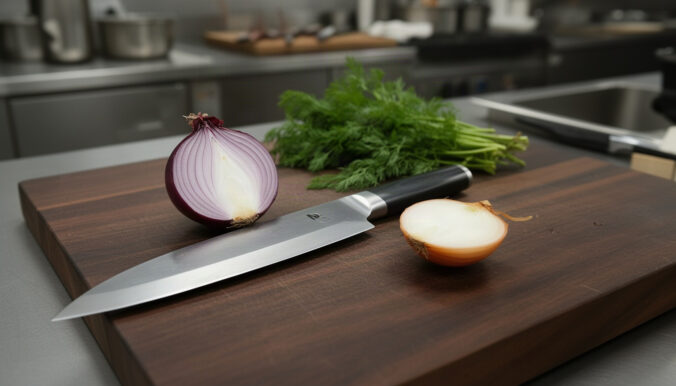
TL;DR: – Japanese knives rated 60–67 HRC outperform German knives (56–58 HRC) with thinner 9.5–12° edge angles that hold through high-volume service
- VG-10 stainless steel at ~60 HRC represents the professional kitchen sweet spot for corrosion resistance and edge retention
- Entry-level gyuto knives ($100–$200) like the Tojiro DP offer professional-grade performance; mid-range ($300–$600) knives from Misono or Yoshihiro suit career-long investment
- DIY whetstone sharpening (~$80 one-time) vs. professional sharpening ($15–$20/session × 12/year) represents the dominant maintenance cost decision
Why Professional Chefs Choose Japanese Knives
If you're running a professional kitchen, your knife is the difference between precise brunoise and mangled vegetables during service. That's where Japanese knives separate themselves from Western alternatives.
Japanese knives are typically harder, rating 60 to 67 on the Rockwell scale, compared to 56 to 58 for German knives. That hardness means your blade holds a sharper edge longer, which translates to cleaner cuts, less oxidation on exposed surfaces, and fewer re-sharpenings during a busy service.
The trade-off: that hardness comes with brittleness. A 65 HRC blade will chip on frozen proteins or hard squash. German knives, softer at 56–58 HRC, forgive lateral twisting and careless contact – more durable in chaotic kitchens, but they don't hold an edge as precisely.
Every knife that ships out the door is treated to the three-stage "honbazuke" honing process that gives Japanese blades their exceptional sharpness, with edge angles of 9.5° to 12°. Compare that to your average factory edge angle of 15° or more. For professional kitchens processing 200+ covers per service, that efficiency compounds across an entire shift.
What Steel Type Should You Use in a Professional Kitchen?
Japanese steels typically range from 58 to 68 HRC, significantly higher than European knives which range from 52 to 58 HRC. But hardness alone doesn't tell you if a knife will survive your kitchen. You need to know corrosion resistance, edge retention, and maintenance demands.
| Steel Type | Hardness (HRC) | Corrosion Resistance | Edge Retention | Best For | Maintenance |
|---|---|---|---|---|---|
| VG-10 | 59–60 | Excellent (15% Cr) | Very Good | High-acid kitchens, citrus stations | Hand wash, occasional drying |
| White Steel #1 | 61–64 | Poor (carbon steel) | Exceptional | Dry-aging stations, sushi prep | Immediate drying, camellia oil required |
| Blue Steel #2 | 62–65 | Poor (carbon steel) | Exceptional | Specialty prep, Japanese cuisine | Immediate drying, camellia oil required |
| SG2/R2 Powder | 63–64 | Good | Exceptional | Premium professional kitchens | Hand wash, occasional drying |
VG-10 stainless steel contains 1% carbon, 14.5-15.5% chromium, 0.9-1.2% molybdenum, 1.3-1.5% cobalt, 0.5% manganese, and 0.03% phosphorus. That chromium content is your insurance policy in a kitchen where your knife touches lemon juice, vinegar, and tomato acid daily.
Carbon steel (White #1, Blue #2) sharpens to a finer edge and holds it longer, but Shirogami #1 (White Steel #1) contains high carbon content (1.2-1.4%) plus 0.25% manganese, with hardness ranging from 61-64 HRC – and zero corrosion resistance. In a high-acid professional kitchen, you're looking at rust spots within hours of citrus contact unless you're wiping and oiling constantly.
VG-10 has 15–16% Cr, 59–60 HRC, giving you a blade that holds an edge through 200+ covers while staying corrosion-resistant. If your kitchen is a dry-aging station or sushi prep area with minimal acid exposure, carbon steel makes sense – but you're committing to immediate drying and camellia oil application after every use.
Which Knife Style Do You Actually Need?
Gyuto (Chef's Knife, 210–270mm)
This is your workhorse. The Gyuto's versatile shape handles approximately 90% of kitchen tasks with ease. The dimensions of Gyuto knives range between 150-390mm, but the most frequent ones are between 210-270mm long. Most professionals start with 210mm; if you're doing a lot of vegetable brunoise or fish fabrication, 240mm gives you more surface area for rock-chopping motions.
Yanagiba (Sashimi/Sushi, 240–330mm)
Single-bevel, long, thin. If you're running a sushi counter or doing sashimi service, you need this. If not, skip it – the learning curve is steep.
Deba (Fish Butchery, 150–210mm)
Heavy spine, thick blade for breaking down whole fish and cutting through small bones. Not a general-purpose knife.
Nakiri vs Usuba (Vegetable Prep)
The nakiri is double-bevel and easier for Western-trained cooks. The usuba is single-bevel and traditional – harder to master but capable of finer cuts. For a professional garde manger station, nakiri is the practical choice unless your team is trained in Japanese technique.
Petty (Utility/Paring, 120–180mm)
Useful for detail work, peeling, and small cuts.
Decision Matrix:
- Sauté station: 210–240mm gyuto
- Garde manger: 210mm gyuto + nakiri for high-volume prep
- Sushi/sashimi counter: Yanagiba (240–270mm) + deba for fish breakdown
- Butchery/protein prep: 210–240mm gyuto + deba if breaking down whole fish
- Pastry/plating: Petty (150mm) for detail work
Top Japanese Chef Knife Brands for Professional Use
Entry-Level Picks ($80–$180)
Tojiro DP Gyuto (VG-10, ~$90) is the most consistently recommended entry knife in professional communities. Factory-consistent, which means if you order five of them, they'll all perform identically – critical when outfitting a kitchen.
MAC Professional Series (MAC MBK-85, ~$145–$165) uses MAC's proprietary high-carbon stainless steel and is a staple in culinary schools. The blade is thin, takes a sharp edge, and is more forgiving than pure carbon steel.
Global has been the working chef's Japanese knife since 1985. One-piece stainless steel, dishwasher-safe, and incredibly durable. Not the sharpest, but reliable workhorses.
Professional-Grade Picks ($200–$600+)
Misono UX10 (~$200–$250) uses Swedish Stain-resistant steel with Japanese geometry and edge angle – giving you the best of both worlds for corrosion resistance. A longtime professional kitchen favorite.
Shun Classic series uses VG-MAX steel (Kai's proprietary improvement on VG-10) with 68-layer Damascus cladding; priced $150–$200 for gyuto. Shun offers US-based sharpening service – relevant for professional warranty coverage.
Sakai City has a forging tradition spanning 600 years. Brands like Yoshihiro and Sakai Takayuki represent premium artisan production ($200–$600+), but handmade knives can vary between pieces. For outfitting a full brigade, factory-consistent brands like Tojiro and MAC are more practical.
Miyabi Koh Chef Knife (SG2 steel, ~$250–$400) bridges artisan craft and production consistency. Miyabi's factory edges are honed to roughly 9.5–12 degrees, giving you professional-grade sharpness out of the box.
How Should You Maintain a Japanese Chef Knife in a Commercial Kitchen?
Sharpening: Angle and Frequency
For most home cooks, sharpening once or twice a year is sufficient. Professional kitchens need monthly sharpening, sometimes more. Shun blades are sharpened to a 16-degree angle per side; traditional Japanese knives run 10–15 degrees per side.
DIY vs Professional Sharpening
Professional sharpening runs $10–$20 per knife per session. A quality whetstone set costs $60–$120. Sharpening monthly (12 sessions/year) costs $120–$240 in professional fees – a whetstone pays for itself in the first year. But DIY sharpening requires skill to maintain consistent angle and pressure. Professional sharpening is worth the investment if it keeps your cooks focused on cooking.
What to Avoid
Hand wash immediately with warm water and mild dish soap. Never put Japanese knives in a dishwasher – thermal cycling warps handles, alkaline detergents corrode the blade, and contact with other utensils causes chips. Never use a European honing steel on a Japanese knife above 60 HRC; use a ceramic rod or leather strop instead. Store on a magnetic strip ($20–$50) or in a knife roll ($30–$80).
Carbon Steel Patina
If you're using carbon steel, develop a patina by rubbing the blade with citrus or placing it in contact with mustard. The acid reacts with the steel to create a stable oxide layer that reduces ongoing rust risk.
What Should You Spend on a Japanese Knife for Professional Use?
Entry-Level Japanese Chef Knives price range: $300 USD or less. Mid-Range Japanese Chef Knives price range: $300 – $600 USD. High-End Japanese Chef Knives price range: $1000+ USD.
The ROI math: a $250 gyuto with proper care lasting 10 years = $25/year. A $80 Western knife replaced every 2–3 years = $27–$40/year. You're not spending more – you're spending smarter.
Red Flags When Buying
Vague steel labeling ("high carbon" without a grade) is a red flag – legitimate Japanese knives specify VG-10, White #1, Blue #2, or SG2. No country of origin is suspicious; legitimate Japanese knives say "Made in Japan" or specify the prefecture. Real VG-10 knives start around $80–$100; $40 "VG-10" listings are not VG-10.
Buy from authorized dealers like Knife Depot for verified products, warranty support, and return policies.
Frequently Asked Questions
What is the difference between a gyuto and a Western chef's knife?
A gyuto is thinner, harder (60–67 HRC vs 56–58 HRC), and sharpened to a more acute angle (9.5–12° vs 15°+), producing finer cuts but requiring more careful handling. Japanese knives are known for being thin, lightweight, and precise. They're typically half-tang knives – meaning the blade only extends halfway into the handle. German knives have weight and heft, with a thick blade that usually extends all the way through the handle – known as a full-tang knife.
Are Japanese knives too fragile for a busy commercial kitchen?
No, if you use them correctly. Avoid frozen proteins, hard squash, and lateral twisting. If your kitchen follows proper technique, a Japanese knife will outlast a German knife in edge retention and cutting precision.
What Japanese knife steel is best for high-acid or wet kitchen environments?
VG-10 stainless steel at 59–60 HRC is the professional kitchen standard. Stainless steel contains at least 12% chromium, providing corrosion-resistant properties. Carbon steels (White #1, Blue #2) offer superior sharpness but will rust within hours of acid or moisture exposure without immediate drying and camellia oil treatment.
Can you put Japanese chef knives in a commercial dishwasher?
No. Never. Hand wash immediately with warm water and mild dish soap. Heat cycles warp handles, alkaline detergents corrode the blade, and contact with other utensils causes chips and nicks.
Which Japanese knife brand is best for a culinary student on a budget?
Tojiro DP Gyuto (VG-10, ~$90) or MAC Professional Series (MAC MBK-85, ~$145–$165) offer professional-grade performance without the premium price tag. Most home cooks find a 210mm or 240mm gyuto covers nearly everything they need. Start with one of these, learn proper technique and maintenance, then invest in specialty knives as your career develops.
Ready to Get Started?
For personalized guidance, visit Knife Depot to learn how we can help.
Conclusion
Choosing a Japanese chef knife for professional use is about matching steel properties to your kitchen environment, selecting the right blade style for your station, and committing to proper maintenance.
Start with a 210–240mm gyuto in VG-10 stainless steel at $100–$250. Learn to sharpen it properly or budget for monthly professional sharpening. Hand wash immediately, store on a magnetic strip, and avoid the common mistakes that destroy Japanese knives – dishwashers, steel honing rods, lateral twisting.
Over a 10-year career, a well-maintained Japanese knife costs less per year than replacing German knives every 2–3 years – and it cuts better. When you're ready to upgrade or expand your knife collection, Knife Depot offers verified Japanese knives from trusted brands with warranty support and authentic sourcing.
Leave a Reply