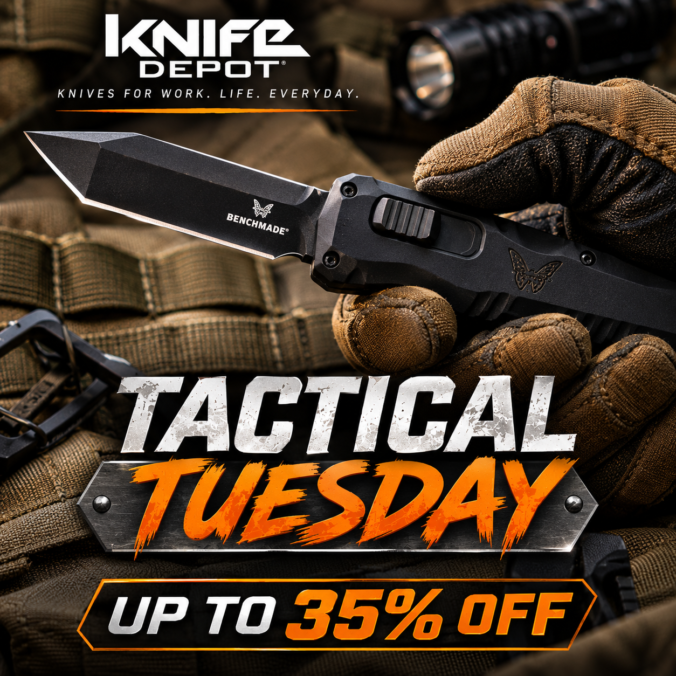
Not all automatic knives are built the same. Some feature compact designs that fit comfortably into a pocket, while others have larger handles, different blade profiles, and distinctive construction details that appeal to experienced collectors.
If you’re exploring automatic knives, choosing the right model involves more than finding an attractive design. Blade steel, handle materials, dimensions, locking systems, and overall construction all contribute to the knife’s quality and suitability.
Side-opening automatic knives are particularly interesting because they combine traditional folding-knife construction with a spring-powered opening mechanism.
Whether you’re expanding a collection or researching your first automatic folding knife, understanding the features behind these designs can help you make a more informed purchase. Also you can now purchase these on special offer at Tactical Tuesday sale!
Here’s what to consider before choosing one.
What Is a Side-Opening Automatic Knife?
A side-opening automatic knife is a folding knife that uses a spring-powered mechanism to move the blade from its closed position into its open position when its release mechanism is activated.
Unlike a manual folding knife, which requires the user to move the blade through its opening arc, an automatic knife uses stored mechanical energy to deploy the blade.
In a traditional side-opening design, the blade swings outward from the side of the handle.
This distinguishes it from an OTF (out-the-front) knife, where the blade travels forward through the front of the handle rather than rotating outward.
Both designs belong to the automatic knife category, but their construction and overall form are different.
If you’re interested in exploring these styles, Knife Depot offers a dedicated Automatic Knives Collection.
1. Pay Attention to Blade Steel
Blade steel is one of the most important considerations when comparing automatic folding knives.
Different steels offer different combinations of hardness, toughness, corrosion resistance, and edge retention.
Understanding these characteristics helps explain why two knives with similar designs can have different maintenance requirements and price points.
Here are some commonly encountered blade steels.
D2 Steel
D2 is a popular high-carbon tool steel used in many folding knives.
It is known for good wear resistance and edge retention. However, it is not completely stainless, so proper cleaning and maintenance are important to help prevent corrosion.
154CM Steel
154CM is a stainless steel valued for its combination of edge retention, corrosion resistance, and overall performance.
It appears in several established knife manufacturers’ product lines and is worth considering when comparing mid-range and premium models.
S30V Steel
CPM-S30V is a premium stainless steel developed for knife applications.
It offers a balance of wear resistance, edge retention, and corrosion resistance, making it a popular choice in higher-end folding knives.
Stainless Steel Options
Other stainless steels are also widely used in automatic knives.
Their performance varies depending on composition, heat treatment, and manufacturing quality.
The important thing is to compare the actual steel specification rather than assuming that a higher price automatically means better performance.
2. Consider the Handle Material
The handle affects more than the knife’s appearance. It contributes to overall weight, durability, grip comfort, and the way the knife feels in the hand.
Some common handle materials include:
Aluminum: Aluminum handles are popular because they offer a relatively lightweight construction with a clean, modern appearance. Anodized finishes are also available in different colors.
G10: G10 is a fiberglass-based laminate known for its strength and resistance to moisture. Its textured surface can also provide a secure grip.
Grivory: This engineered thermoplastic material is used in several modern knife designs. It can help reduce overall weight while providing a durable handle construction.
Stainless steel: Stainless steel handles offer a solid feel and a distinctive appearance, although they can add more weight than some alternative materials.
When comparing handle materials, consider comfort, weight, finish, and how the knife will be stored.
3. Understand the Blade Profile
Blade shape influences the appearance and intended cutting characteristics of a knife.
Side-opening automatic knives are available with several blade profiles, each offering different design characteristics.
Drop Point
Drop-point blades feature a spine that slopes gradually toward the tip.
This creates a versatile profile commonly found in folding knives.
Tanto
Tanto blades feature a distinctive angular point and a relatively straight primary edge.
Their geometric appearance makes them popular among enthusiasts who prefer modern and tactical-inspired designs.
Spear Point
Spear-point blades have a symmetrical appearance, with the spine and edge generally tapering toward the tip.
The design is recognizable across several folding knife categories.
Clip Point
Clip-point blades feature a concave or straight cutout along the spine near the tip.
This creates a distinctive profile that appears in many traditional and modern knife designs.
When comparing blade profiles, pay attention to the manufacturer’s specifications and intended applications rather than selecting a knife based on appearance alone.
4. Look at the Locking Mechanism
A locking mechanism is an important part of folding-knife construction.
It helps keep the blade secured in its open position during intended use.
Automatic folding knives may use different locking arrangements depending on their design and manufacturer.
When researching a model, check:
- The type of locking system.
- The manufacturer’s explanation of how it functions.
- Whether the locking components are accessible for inspection and maintenance.
- The quality of construction and overall fit.
- Any maintenance instructions provided by the manufacturer.
A well-designed locking system is an important consideration when evaluating the overall quality of a folding knife.
Never assume that all automatic knives use the same mechanism simply because they share a similar opening style.
5. Compare Overall Size and Weight
Size can make a significant difference when comparing automatic folding knives.
A compact model may appeal to someone who prefers smaller equipment, while a larger design may be more attractive to collectors who appreciate substantial handles and distinctive blade proportions.
Before choosing a model, review the following specifications:
Overall length: The complete measurement of the knife in its open configuration.
Blade length: The manufacturer’s listed blade measurement. Measurement conventions may vary, so check the product specifications carefully.
Closed length: The measurement of the folded knife, which helps determine its storage dimensions.
Weight: An important factor when comparing different handle materials and overall constructions.
Handle dimensions: These help provide a better understanding of the knife’s overall proportions.
Avoid assuming that a larger knife is necessarily better. The right dimensions depend on personal preference, intended utility, and applicable legal restrictions.
6. Explore Established Automatic Knife Brands
Brand reputation and manufacturing consistency can be useful starting points when researching automatic knives.
Knife Depot carries automatic knives from several recognized manufacturers.
Some brands worth exploring include:
Benchmade
Benchmade offers premium automatic knife designs featuring different blade steels, handle materials, and construction styles.
Kershaw
Kershaw has a broad selection of folding knives, including automatic models from its Launch series.
CobraTec
CobraTec offers automatic knife designs in different configurations, finishes, and handle styles.
Hogue
Hogue manufactures folding and automatic knives with a focus on materials, engineering, and product design.
Boker
Boker offers several folding knife designs, including automatic models with different blade and handle configurations.
Rather than choosing a manufacturer based on name recognition alone, compare individual models and their specifications.
You can explore these manufacturers through the Knife Depot brand selection.
7. Side-Opening Automatic Knives vs. OTF Knives
One common question among knife enthusiasts is whether a side-opening automatic knife or an OTF design is the better choice.
The biggest difference comes down to construction.
A side-opening automatic knife features a folding blade that rotates outward from the handle.
An OTF knife features a blade that travels through an opening at the front of the handle.
Here are some of the main differences:
| Feature | Side-opening automatic | OTF automatic |
| Blade movement | Rotates outward | Travels through the handle |
| Handle design | Traditional folding format | Enclosed handle design |
| Blade storage | Folds into handle | Retracts into handle |
| Construction | Folding mechanism | Internal sliding mechanism |
| Appearance | Similar to traditional folders | Distinctive out-the-front design |
Neither style is automatically the better option.
Collectors may prefer one design over another based on aesthetics, construction, brand preference, and the particular models available.
If you’d like to understand the OTF category in more detail, explore Knife Depot’s OTF Knives Collection.
8. Check the Legal Requirements Before Purchasing
Automatic knife regulations are an important consideration, particularly for shoppers purchasing online.
Laws can differ between states and local jurisdictions. Restrictions may cover ownership, possession, blade length, transportation, sales, and carrying.
Federal law also addresses certain aspects of automatic knife commerce.
For example, the Federal Switchblade Act defines switchblades under 15 U.S.C. § 1241, while § 1244 identifies specific exceptions, including an exception covering qualifying assisted-opening knives.
These provisions should not be interpreted as a complete guide to state or local knife laws.
Before purchasing an automatic knife, review the regulations that apply to your location and the destination where the product will be shipped.
You can consult the American Knife and Tool Institute’s legal resources and the relevant federal statutes.
9. What Should You Check Before Buying Online?
Product photographs can make two knives look remarkably similar. That’s why reviewing the complete product description is important.
Before completing your purchase, consider these details:
- Manufacturer: Confirm the brand and model.
- Blade steel: Check the exact material rather than relying on generic descriptions.
- Handle construction: Compare material, finish, and dimensions.
- Blade measurements: Review the listed specifications.
- Opening mechanism: Confirm whether the product is a side-opening automatic or another type of folding knife.
- Locking system: Understand the manufacturer’s description.
- Warranty: Review the manufacturer’s warranty terms.
- Shipping and returns: Understand delivery conditions and the retailer’s return policy.
- Legal restrictions: Verify that the knife can legally be purchased and shipped to your location.
Taking a few minutes to compare these details can help prevent confusion and make online shopping more straightforward.
Find Automatic Folding Knives at Knife Depot
A good automatic folding knife should be evaluated on its construction, materials, design, and specifications rather than its appearance alone.
From premium stainless steel blades to aluminum handles and distinctive folding designs, there are plenty of details worth comparing before making a decision.
Knife Depot features a selection of automatic knives from established manufacturers, including Benchmade, Kershaw, CobraTec, Hogue, and Boker.
Whether you’re researching your options or adding another piece to your collection, take time to explore the available models and compare their specifications.
Ready to explore? Visit the Knife Depot Automatic Knives Collection to discover available designs and find a model that matches your preferences.
Frequently Asked Questions
1. What is a side-opening automatic knife?
A side-opening automatic knife is a folding knife that uses a spring-powered mechanism to move its blade outward from the side of the handle when its release mechanism is activated.
2. What is the difference between an automatic knife and an assisted-opening knife?
An automatic knife uses a release mechanism to activate spring-powered blade deployment. An assisted-opening knife requires the user to begin moving the blade manually before the spring mechanism assists with the opening process.
3. What blade steel is commonly used in automatic knives?
Common options include D2, 154CM, S30V, and other stainless steels. Each offers different characteristics relating to edge retention, corrosion resistance, toughness, and maintenance.
4. Are side-opening automatic knives the same as OTF knives?
No. Side-opening automatic knives rotate their blades outward from the handle, while OTF knives deploy their blades through an opening at the front of the handle.
5. Which brands make automatic folding knives?
Several recognized manufacturers offer automatic folding knives, including Benchmade, Kershaw, Hogue, Boker, and CobraTec.
6. Are automatic knives legal in the United States?
Automatic knife laws vary by state and locality. Federal law also regulates certain aspects of interstate commerce. Buyers should review applicable federal, state, and local requirements before purchasing.
7. What should I consider when buying an automatic knife online?
Compare blade steel, handle material, dimensions, locking system, manufacturer specifications, warranty coverage, shipping conditions, and applicable legal restrictions.
8. Where can I find automatic knives online?
Knife Depot offers a dedicated automatic knife collection featuring different brands, styles, and specifications. Visit its website to explore available products.
#KnifeDepot #AutomaticKnives #FoldingKnives #SideOpeningKnife #KnifeEnthusiast #EDCKnives #KnifeCollection #KnifeGuide #BladeSteel #KnifeCommunity

Leave a Reply