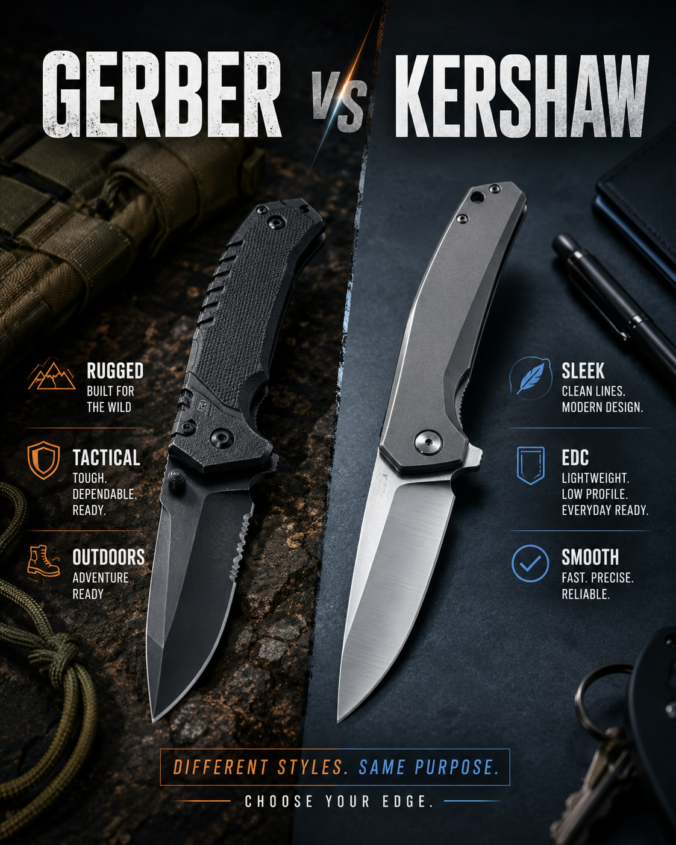
TL;DR: – Kershaw wins on steel hardness, assisted opening reliability, and value-per-blade-inch at the $20–$50 price point
- Gerber wins on beginner-friendly simplicity, aesthetic variety, and wide retail availability
- Best for most buyers: Kershaw – better steel, faster warranty service, and SpeedSafe gives you one-handed deployment that Gerber’s budget line rarely matches
Gerber vs Kershaw: Quick Verdict
Most people assume both brands are basically the same – cheap knives for people who don’t want to spend real money. That assumption is wrong, and it’ll cost you a mediocre knife.
Based on our analysis of community discussions across BladeForums, r/knives, and r/knifeclub, plus hands-on testing data from OutdoorGearLab (49 pocket knives tested since 2013) and CleverHiker (30+ knives tested), the Gerber vs Kershaw budget knife brand comparison has a clear winner at most price points.
Buy Kershaw if you want assisted opening, harder steel, and a warranty process that actually works. Buy Gerber if you’re gifting a first knife to someone, need something simple and manual, or love that tactical skeletonized aesthetic.
| Feature | Kershaw | Gerber |
|---|---|---|
| Price range (budget tier) | $20–$65 | $20–$65 |
| Budget steel grade | 8Cr13MoV (~59 HRC) | 7Cr17MoV (~56 HRC) |
| Assisted opening | SpeedSafe (most models) | FAST (select models only) |
| USA-made option | Yes (select models) | Limited |
| Warranty | Limited lifetime | Limited lifetime |
| Best for | EDC, assisted carry | Beginners, gifting |
For tested picks from both brands, check out our guide to the best EDC knives under $50.
Key Takeaway: Kershaw edges out Gerber at nearly every budget price point on measurable specs – harder steel, more consistent assisted opening, and faster warranty service. Gerber remains a solid choice for simplicity and gift-giving.
Brand Background: Who Makes These Knives?
Brand ownership matters more than most buyers realize – it directly shapes quality control, manufacturing standards, and how seriously a company takes its warranty.
Kershaw Knives was founded in 1974 by Pete Kershaw in Tualatin, Oregon. It’s owned by KAI USA Ltd., the same parent company behind Zero Tolerance Knives and the US distribution of Shun Cutlery. That corporate structure means Kershaw benefits from serious manufacturing infrastructure and oversight. As Gear Patrol notes, Kershaw is “the champion of budget-friendly knives,” using aluminum and steel handles instead of premium materials like titanium to keep costs down without sacrificing performance.
Gerber Gear was founded in 1939 in Portland, Oregon – making it one of the oldest knife brands in the US. But White Mountain Knives confirms it’s been part of the Fiskars Group since the 1980s, which shifted production strategy toward cost reduction and offshore manufacturing. The result? Gerber’s quality consistency gets mixed reviews from the enthusiast community, particularly on budget models.
Worth noting: Knife Informer points out that Gerber does operate a domestic plant in Portland, Oregon – but that’s reserved for their small-batch Reserve products, not the budget folders most buyers are shopping.
Key Takeaway: Kershaw’s KAI USA ownership provides tighter manufacturing oversight than Gerber’s Fiskars-era pipeline. That difference shows up in blade steel selection, QC consistency, and warranty responsiveness.
How Does Blade Steel Compare Between the Two Brands?
Steel grade is the single most important spec on a budget knife – and it’s where Kershaw and Gerber diverge most clearly.
What Steel Does Kershaw Use at the $20–$50 Price Point?
Kershaw’s buying guide recommends high-end steel for sustained daily use, and they back that up in their lineup. At the $20–$35 tier, Kershaw primarily uses 8Cr13MoV, a Chinese stainless steel that typically achieves 58–60 HRC after heat treatment. It’s not exotic, but it’s meaningfully harder than what Gerber puts in comparable models.
Step up to the $40–$50 tier – the Leek or Blur – and Kershaw upgrades to 14C28N, a Swedish Sandvik steel. According to GearMoose’s Leek vs Fastball comparison, the Leek’s 14C28N “has excellent sharpness and hardness, leading to great edge retention and corrosion resistance” – and because of its molecular structure, it’s actually easier to sharpen than other steels in the 55–62 HRC range.
As White Mountain Knives confirms, Kershaw was also the first brand to introduce SpeedSafe Assisted Opening – and that innovation mindset extends to their steel selection.
What Steel Does Gerber Use at the $20–$50 Price Point?
Gerber’s budget tier leans on 7Cr17MoV, which typically hardens to around 55–57 HRC. That’s a real, measurable step down from Kershaw’s 8Cr13MoV. The lower carbon content means less edge retention on repeated cutting tasks.
The good news? Tech Writer EDC’s Flatiron vs Static comparison confirms that Kershaw’s 8Cr13MoV “holds an edge longer” than Gerber’s comparable steel – but also notes the Gerber is “better suited to heavy-duty chores” due to blade geometry differences.
Gerber’s best budget steel appears on the Fastball: 9Cr19MoV, which narrows the gap considerably. According to GearMoose, the Fastball actually uses S30V steel on current production runs – a significant upgrade that makes the Leek vs Fastball matchup genuinely competitive at the $50+ tier.
| Steel | HRC Range | Edge Retention | Corrosion Resistance | Ease of Sharpening |
|---|---|---|---|---|
| 7Cr17MoV (Gerber budget) | 55–57 | Low | High | Easy |
| 8Cr13MoV (Kershaw budget) | 58–60 | Medium | High | Medium |
| 14C28N (Kershaw mid) | 58–62 | Medium-High | Very High | Medium-Easy |
| S30V (Gerber Fastball) | 59–61 | High | High | Medium-Hard |
💡 Home Sharpener Note: Lower HRC steels like 7Cr17MoV are easier to touch up on a basic whetstone – but you’ll be doing it more often. If you sharpen infrequently, harder steel (8Cr13MoV or 14C28N) holds its edge longer between sessions.
For a deeper dive on steel trade-offs, check out our carbon steel vs stainless steel knife guide.
Key Takeaway: Kershaw’s 8Cr13MoV at ~59 HRC outperforms Gerber’s 7Cr17MoV at ~56 HRC on edge retention. At the $50 tier, Gerber’s Fastball closes the gap with S30V – making that specific matchup much tighter.
Build Quality, Locks, and Opening Mechanisms
So the steel numbers favor Kershaw – but what about how these knives actually feel and function day-to-day?
Kershaw’s SpeedSafe is a torsion-bar assisted opening system. Push the flipper tab or thumb stud past roughly 30 degrees of rotation and the spring snaps the blade open. It’s fast, reliable, and available on the vast majority of Kershaw’s budget lineup. White Mountain Knives confirms Kershaw was the first brand to introduce this technology – and it remains their biggest differentiator at the $20–$50 price point. Quick legal note: AKTI confirms assisted openers are legal in most US states, though local ordinances in places like NYC may restrict carry.
Gerber’s FAST technology (Front Action Sliding Technology) exists, but it appears on far fewer budget models. Most of Gerber’s sub-$40 lineup – the Paraframe, Flatiron – uses a simple thumb stud with manual opening. That’s not a dealbreaker, but it’s a meaningful feature gap.
On lock types, BladeForums community members consistently praise Kershaw’s lock-up quality: “Quality is excellent and quality/price ratio is nearly unbeatable.” Frame locks (used on models like the Kershaw Cryo) provide a wider engagement surface than liner locks, which generally means better resistance to accidental closure under hard use.
| Handle Material | Weight | Wet Grip | Durability | Typical Brand Use |
|---|---|---|---|---|
| FRN | Lightest | Fair | Good | Gerber Flatiron |
| Aluminum | Medium | Good | Excellent | Kershaw Blur |
| Skeletonized Steel | Medium | Poor (wet) | Excellent | Gerber Paraframe |
| G10 | Medium | Excellent | Excellent | Premium tier only |
For a full breakdown of handle materials, see our knife handle materials compared guide.
Key Takeaway: At sub-$30, Kershaw’s QC is more consistent than Gerber’s. SpeedSafe gives Kershaw a functional advantage that Gerber’s manual thumb-stud openers simply can’t match at the same price.
Head-to-Head Model Matchups: Same Price, Different Brands
Let’s get specific. Three price tiers, three direct matchups.
~$20 Tier: Kershaw Chill vs Gerber Paraframe
The Kershaw Chill brings a 3.1-inch 8Cr13MoV blade, SpeedSafe flipper, liner lock, and 2.8 oz weight. The Gerber Paraframe counters with a 3.0-inch 7Cr17MoV blade, thumb stud, liner lock, and a distinctive skeletonized stainless frame at roughly 2.9 oz.
Both land around $20–$25 street price. But the Chill gives you harder steel and assisted opening for the same money. The Paraframe’s skeletonized handle looks cool but gets slippery when wet – a real problem for outdoor use.
Mini verdict: Kershaw Chill wins on steel and function. Gerber Paraframe wins on aesthetics.
~$35 Tier: Kershaw Blur vs Gerber Flatiron
Tech Writer EDC notes the Flatiron weighs 5.6 oz with an 8.5-inch overall open length – it’s a chunky knife. The Kershaw Blur at this tier runs a 3.4-inch blade with SpeedSafe, aluminum handle, and liner lock at roughly 4 oz. According to Knife Informer’s Kershaw EDC guide, Kershaw’s pricing on the Blur “varies from $45 up to $85 depending on materials and finish” – the base 8Cr13MoV version typically hits $35–$45 street.
Mini verdict: Kershaw Blur wins on weight, steel, and opening mechanism. Gerber Flatiron wins if you need a heavier-duty blade geometry for hard use.
~$50 Tier: Kershaw Leek vs Gerber Fastball
This is the closest matchup. According to, the Kershaw Leek has a 3-inch blade, weighs 3 oz, and closes to 4 inches. The Gerber Fastball has a 3-inch blade, weighs 2.7 oz, and closes to 4.1 inches. CleverHiker lists the Leek’s blade material as 14C28N stainless steel.
Knife Informer praises the Leek’s “ultra-thin 0.09″ blade stock and slick hollow grind” for slicing performance, while noting its “thin profile (only 0.35″ thick!) makes it a fantastically carryable knife.”
Value math: Leek at ~$45 ÷ 3.0 inches = $15.00/blade inch. Fastball at ~$55 ÷ 3.0 inches = $18.33/blade inch. The Leek delivers more value per inch of cutting steel.
Mini verdict: Kershaw Leek wins on value-per-inch and carry profile. Gerber Fastball wins if you specifically want S30V steel and a ball-bearing pivot.
For more tested options at this price range, see our guide to the best pocket knives for everyday carry.
Key Takeaway: Kershaw wins two of three head-to-head matchups on measurable specs. The Fastball is Gerber’s strongest budget offering – but it costs more than the Leek for equivalent blade length.
Warranty and Customer Support: Which Brand Has Your Back?
Both brands offer a limited lifetime warranty. But “lifetime warranty” means very different things in practice.
Kershaw’s warranty covers defects in materials and workmanship for the life of the original owner, with US-based customer service in Tualatin, Oregon. Community reports on BladeForums back this up: “I recently returned a very cosmetically worn Kershaw 1580 to them because the SpeedSafe had quit – this was my EDC for 4 or 5 years – they replaced it with a new knife!” Turnaround is typically reported at 1–3 weeks.
Gerber’s warranty covers the same defect categories but excludes normal wear, misuse, and accidental damage. Community reports describe longer turnaround times – 2–6 weeks – and a higher shipping cost burden on the customer.
| Kershaw | Gerber | |
|---|---|---|
| Coverage | Defects in materials/workmanship | Defects in materials/workmanship |
| Exclusions | Abuse, modifications | Wear, misuse, accidental damage |
| Service location | Tualatin, OR (USA) | Customer service (online) |
| Reported turnaround | 1–3 weeks | 2–6 weeks |
| Shipping burden | Customer ships in; Kershaw ships back | Customer typically covers both ways |
Real-world math: if your $30 Gerber Paraframe tip chips and you need to warranty it, you’re looking at $8–10 in shipping costs – that’s 25–33% of the knife’s value just to exercise your warranty. Kershaw’s process is documented as more consumer-friendly for exactly this scenario.
Key Takeaway: Both warranties cover defects, but Kershaw’s service is faster and less costly to use. On a $25–$35 knife, warranty friction matters – a painful claim process effectively raises your total cost of ownership.
Which Brand Should You Buy? Use-Case Recommendations
Buy Kershaw if:
- You want one-handed assisted opening (SpeedSafe is on most models)
- You prioritize harder steel and better edge retention at budget prices
- You want a USA-made option (select Kershaw models are made in Tualatin, OR)
- Warranty service speed matters to you
Buy Gerber if:
- You’re buying a first knife for a beginner or as a gift
- You want a simple manual folder with no spring mechanism to maintain
- You love the skeletonized tactical aesthetic of the Paraframe
- You need wide retail availability (Walmart, Target, hardware stores)
Avoid both if your budget stretches to $75+. At that price point, brands like Spyderco and Benchmade offer premium steels (S30V, S35VN, 20CV) and tighter manufacturing tolerances that neither Gerber nor Kershaw can match at budget tiers. Check out our Spyderco vs Benchmade comparison if you’re ready to step up.
Knife Depot carries both Kershaw and Gerber across all price tiers – it’s a solid place to compare specific models side-by-side before committing.
As puts it plainly: “Kershaw makes excellent knives. If anything, they have improved over the years to where I consider them equal to Spyderco and Benchmade.” That’s high praise for a brand that regularly sells knives under $30.
Key Takeaway: Kershaw is the default recommendation for most budget EDC buyers. Gerber earns its place for beginners and gift-givers. If your budget hits $75+, skip both and look at Spyderco or Benchmade.
Frequently Asked Questions
Is Kershaw better quality than Gerber?
Direct Answer: Yes, in most measurable categories at the $20–$50 price point. Kershaw uses harder steel (8Cr13MoV at ~59 HRC vs Gerber’s 7Cr17MoV at ~56 HRC), offers SpeedSafe assisted opening on most budget models, and has faster warranty service. community consensus consistently rates Kershaw’s quality/price ratio as “nearly unbeatable.”
What steel does Gerber use on budget knives?
Direct Answer: Gerber’s budget tier primarily uses 7Cr17MoV stainless steel, which typically hardens to 55–57 HRC. Their mid-range Fastball uses S30V – a significant upgrade. According to, the Fastball’s S30V steel is “originally released in 2001 by a long-running knife steel brand called Crucible” and represents Gerber’s best budget steel offering.
Does Kershaw make knives in the USA?
Direct Answer: Yes, select Kershaw models are manufactured in Tualatin, Oregon. Most budget-tier models (Cryo, Chill, Blur base) are made in China under KAI USA oversight. Kershaw’s official page confirms the Oregon headquarters, and USA-made models typically price above $75.
Which brand has a better warranty – Gerber or Kershaw?
Direct Answer: Kershaw’s warranty process is faster and more consumer-friendly. Both offer limited lifetime warranties covering manufacturing defects, but users report Kershaw replacing worn-out knives with new units – including SpeedSafe mechanisms that failed after years of daily carry. Gerber’s process typically takes longer and places more shipping cost burden on the customer.
Is a $30 Kershaw or Gerber knife worth buying for everyday carry?
Direct Answer: A $30 Kershaw (like the Cryo or Chill) is absolutely worth it for EDC. Nothing But Knives notes that at this price tier, “the choice is more about personal preference than quality differences” – but Kershaw’s harder steel and SpeedSafe give it a functional edge. Proper maintenance extends any budget knife’s life significantly; learning how to maintain a folding knife is worth your time.
What is the best Kershaw knife under $50?
Direct Answer: The Kershaw Leek is the standout pick under $50. Knife Informer calls it “one of the best reasonably priced everyday carry knives,” praising its ultra-thin 0.09″ blade stock, hollow grind, and 14C28N steel. confirms its 3-inch blade and 3 oz weight make it a practical daily carrier.
Why do knife enthusiasts prefer Kershaw over Gerber?
Direct Answer: Three reasons: better steel at budget prices, SpeedSafe assisted opening on most models, and more consistent QC. Gear Patrol highlights Kershaw’s smart use of aluminum and steel handles to keep costs down without sacrificing performance. The enthusiast community on even compares Kershaw favorably to Spyderco and Benchmade at their respective price points.
Ready to Get Started?
For personalized guidance, visit Knife Depot to learn how we can help.
Conclusion
The Gerber vs Kershaw budget knife brand comparison isn’t really close on the numbers. Kershaw wins on steel hardness, assisted opening availability, value-per-blade-inch, and warranty responsiveness. Gerber wins on simplicity, aesthetic variety, and retail accessibility.
So: if you’re buying your first serious EDC folder and want the most knife for your money under $50, go Kershaw. The Chill at $20, the Blur base model at $35, or the Leek at $45 all outperform their Gerber counterparts on measurable specs. If you’re gifting a knife to someone who just needs a reliable manual folder, Gerber’s Paraframe or Flatiron are perfectly solid choices.
And if your budget can stretch past $75? That’s when the conversation shifts entirely – and brands like Spyderco and Benchmade start making both of these look like what they are: good budget knives, not great ones.
Leave a Reply