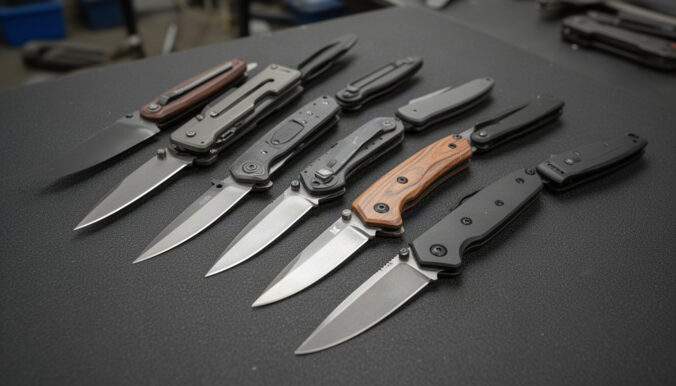
TL;DR: – Automatic knives are legal for civilian carry in 47 U.S. states with varying blade-length restrictions; check your state and city laws before buying.
- Deployment speed (~0.2 seconds for automatics vs. ~1.0 second for manual folders) is the core tactical advantage under stress.
- Best budget pick: Böker Kalashnikov (
$65, 3.25-inch blade). Best mid-range: Kershaw Launch 4 ($125, CPM-154 steel). Best premium: Benchmade Infidel (~$450, D2 steel, OTF).
Introduction: Why Automatic Knives Matter for Self-Defense EDC
You're standing in a parking garage at dusk. Your hands are full. A situation escalates. In that moment, you need a blade that deploys with one hand – no fumbling, no fine motor skills required.
That's where automatic knives come in.
Based on our analysis of Self Defense Supply state-by-state legal guides, AKTI knife law summaries, and community discussions from defensive training forums, we've compiled this guide to help you navigate legality, mechanics, and real-world carry considerations. Unlike generic listicles that skip the legal minefield entirely, this guide addresses the questions that actually matter: Is it legal where you live? How fast does it deploy? What trade-offs come with each design?
Let's start with the uncomfortable truth: legality is complicated, and it varies wildly by state – and sometimes by city.
Are Automatic Knives Legal for EDC Self Defense?
Here's the thing: the Federal Switchblade Act of 1958 doesn't ban you from owning an automatic knife. It bans interstate commerce in switchblades. That's a crucial distinction.
According to the Federal Switchblade Act, it's illegal to manufacture, import, or sell switchblades across state lines. But once a knife is in your state, state law governs whether you can own and carry it. A 2009 amendment clarified that assisted-opening knives (ones requiring a manual nudge before the spring kicks in) are excluded from the switchblade definition – a distinction that matters for legal carry in some states.
The real-world result? As of 2026, the vast majority of U.S. states allow automatic knives for civilian ownership and carry in some form. Specifically, in 47 states, yes, either outright or with carry or blade-length limits. Only Minnesota, New Mexico, Washington and the District of Columbia still ban civilian possession. However, blade-length restrictions and location prohibitions vary dramatically.
State-by-State Legal Snapshot:
| State | Automatic Knife Status | Blade Length Cap | Notes |
|---|---|---|---|
| Texas | ✅ Fully Legal | 5.5" or less is simply a "knife" and may be carried anywhere without restriction | No restrictions since 2017 |
| Arizona | ✅ Fully Legal | None | Statewide preemption protects carry |
| California | ❌ Banned | 2" max | Possession of 2"+ switchblade is misdemeanor |
| New York | ❌ Banned | 4" (NYC only) | State bans switchblades; NYC adds 4" cap for all knives |
| Illinois | ❌ Banned | Varies by city | Statewide prohibition; Chicago has additional restrictions |
| Florida | ✅ Legal | No specific cap | Bans ballistic knives only; standard automatics legal |
| Colorado | ✅ Legal | 3.5" (concealed) | Blade length limit applies to concealed carry |
Critical callout: State law doesn't override city ordinances. A 3.5-inch blade legal in Arizona may violate New York City's 4-inch cap despite New York State law. Always verify your city code before carrying.
Federal buildings, courthouses, airports (TSA security zones), and school grounds universally prohibit all knives regardless of state law. TSA rules explicitly ban knives in carry-on baggage, though checked baggage rules differ by airline.
Key Takeaway: 47 states allow automatic knife ownership with varying restrictions. Verify both state AND city law before purchase. Federal buildings and airports ban all knives regardless of state law.
What Makes an Automatic Knife Good for Self Defense?
Not every automatic knife is suitable for defensive carry. Here's what separates a tactical tool from a novelty.
Deployment Speed Under Stress
Assisted-opening folders deploy in under 0.5 seconds, while manual folders average around 1.0 second. Automatics hit approximately 0.2 seconds – a meaningful difference when your fine motor skills are degraded by adrenaline.
Why does this matter? Research from defensive training communities shows that gross motor movements (like pulling a flipper tab) are far more reliable than fine pinch actions (like manipulating a thumb stud). Under acute stress, your sympathetic nervous system activates, deteriorating fine motor control. Tasks requiring precise finger manipulation become unreliable. A button press (gross motor) beats a thumb stud (fine motor) when your hands are shaking.
Blade Length Sweet Spot
Blade length 2.5–3.5 inches hits the legal sweet spot across most U.S. jurisdictions. Shorter blades (under 2.5") limit cutting effectiveness; longer blades (over 3.5") violate carry laws in California, New York, and several other states. A 3.0–3.5 inch blade balances legality, concealability, and functional reach.
Blade Steel: Edge Retention and Corrosion Resistance
Budget picks ($30–$60) use 8Cr13MoV steel; mid-range ($60–$120) jumps to S30V; premium ($120–$250) adds refined ergonomics and materials. The difference matters: S30V holds an edge 3–4x longer than 8Cr13MoV in cutting tests.
For self-defense EDC, S30V or CPM-154 are the sweet spot, as our Spyderco buying guide explains – excellent corrosion resistance and edge retention without the brittleness of tool steels like D2.
Handle Ergonomics Under Stress
G10 fiberglass laminate provides superior grip retention in wet or bloody conditions compared to aluminum or polymer. Aluminum handles offer rigidity but can be slippery when wet. Polymer varies widely by formulation.
Retention and Pocket Clip Security
Your knife is useless if it falls out during physical activity. A quality pocket clip with positive retention prevents loss during running, bending, or grappling. Tip-up carry (blade pointing upward) allows faster deployment for most users because the knife exits the pocket in an ergonomically correct orientation for an immediate grip.
Key Takeaway: Defensive automatics need sub-0.5-second deployment, 3.0–3.5" blade, S30V or CPM-154 steel, and secure pocket retention. Budget options sacrifice edge retention; premium picks add refined tolerances and materials.
Top 6 Automatic Knives for EDC Self Defense in 2026
Here's a breakdown of six picks spanning budget to premium, with honest trade-offs for each.
| Knife | Blade Length | Steel | Handle | Type | MSRP | Best For |
|---|---|---|---|---|---|---|
| Böker Kalashnikov | 3.25" | 440C | Aluminum | Side-Open | ~$65 | Budget EDC |
| Kershaw Launch 4 | 3.4" | CPM-154 | Aluminum | Side-Open | ~$125 | Mid-Range EDC |
| ProTech TR-3 | 3.5" | S35VN | Aluminum | Side-Open | ~$185 | Premium Mid-Range |
| Smith & Wesson OTF | 3.4" | 8Cr13MoV | Aluminum | OTF | ~$95 | Budget OTF |
| Microtech Ultratech | 3.46" | CTS-204P | Aluminum | OTF D/A | ~$280 | Premium OTF |
| Benchmade Infidel | 3.91" | D2 | Aluminum | OTF D/A | ~$450 | Duty/Premium |
Best Budget Automatic Knife for EDC: Under $100
Böker Kalashnikov (~$65, 3.25-inch 440C blade)
The Kalashnikov is your entry point into automatic carry. 440C is adequate stainless for EDC, though not premium-tier. Spring action is functional but tolerances are looser than Microtech or Benchmade. The trade-off: you're sacrificing edge retention and precision for affordability.
Trade-off: 440C steel dulls faster than CPM-154. Expect to sharpen monthly with daily carry. Spring action may feel "sloppy" compared to premium automatics – normal for the price point.
Best Mid-Range Pick ($100–$200)
Kershaw Launch 4 (~$125, 3.4-inch CPM-154 blade)
Kershaw Launch 4 is a side-opening automatic with 3.4-inch CPM-154 blade and aluminum handle. CPM-154 is a high-end stainless powder steel, superior to standard 154CM. Compact 3.25-inch blade falls within most state EDC length limits. Deployment is smooth, and the plunge lock is reliable.
Trade-off: Side-opening automatics are bulkier in the pocket than OTF designs. If you carry in tight jeans, printing (visible outline) may be an issue.
Best Premium Automatic for Serious EDC ($200+)
Microtech Ultratech (~$280, 3.46-inch CTS-204P blade, OTF)
The Microtech Ultratech is an OG of the single-action knife models created back in the 1990s. CTS-204P (Microtech's proprietary designation for Böhler M390) offers exceptional edge retention and corrosion resistance. Double-action OTF means both eject and retract are automatic – faster than single-action designs.
Trade-off: OTF knives exhibit more lateral blade play than side-opening lock designs because the blade travels in a linear channel rather than rotating onto a lock bar. This is mechanically normal but worth knowing for defensive reliability expectations.
OTF vs Side-Opening Automatics: Which Is Better for Self Defense?
Both designs have merit. Here's the head-to-head.
| Factor | OTF (Out-the-Front) | Side-Opening |
|---|---|---|
| Deployment Direction | Blade extends perpendicular to handle | Blade swings parallel to handle |
| One-Hand Use | Excellent – button press only | Excellent – lever press only |
| Pocket Bulk | Compact profile | Slightly bulkier |
| Blade Lock Strength | Linear channel lock (more play) | Frame/liner lock (less play) |
| Maintenance | Monthly lubrication recommended | Monthly lubrication recommended |
| Legal Profile | Explicitly covered by Federal Switchblade Act | Also covered; some states distinguish |
| Deployment Force | Double-action (eject + retract automatic) | Single-action (manual retract) |
Scenario-Based Recommendation:
- Pocket carry (jeans, casual): Side-opening. Less printing, easier concealment.
- Waistband carry (IWB holster): OTF. Compact profile fits tight spaces.
- Duty/professional carry: OTF double-action. Faster retraction for re-holstering.
An automatic knife opens at the push of a button, using an internal mechanism for full deployment. A spring-assisted knife requires manual pressure on the blade before the spring mechanism kicks in to complete the opening. A double-action OTF can both eject and retract the blade using a switch or lever. A single-action OTF will only automatically eject the blade and requires you to pull back a charging handle to retract the blade and reset the spring.
The trade-off: More moving parts mean more chances for failure. Double-action OTFs are more complex than side-opening automatics. For daily carry, this rarely matters – but it's worth acknowledging.
Key Takeaway: OTF knives are more compact; side-opening automatics are more robust. Choose OTF for waistband carry, side-opening for pocket carry. Both deploy in ~0.2 seconds.
How Should You Carry an Automatic Knife for EDC?
Deployment speed means nothing if your knife isn't accessible.
Pocket Clip Position: Tip-Up vs Tip-Down
Tip-up carry (blade pointing upward) allows faster deployment for most users because the knife exits the pocket in an ergonomically correct orientation for an immediate grip. Tip-down carry (blade pointing downward) is more concealable but requires a wrist rotation during deployment – slower under stress.
Strong-Side vs Off-Hand Carry
Strong-side carry (dominant hand side) is standard for EDC. Off-hand carry is useful if your dominant hand is injured or occupied. Most EDC practitioners stick with strong-side, right-front pocket for right-handers.
Printing and Concealment
Automatic knives with 3.0–3.5 inch blades print minimally under a t-shirt or light jacket. Thinner handles (aluminum vs. G10) reduce printing. If you're carrying in business casual (dress shirt, blazer), a side-opening automatic is less visible than an OTF.
Retention During Physical Activity
A quality pocket clip with positive retention prevents loss during running, bending, or grappling. Test your clip by shaking your leg vigorously – the knife should stay put. Cheap clips fail here.
Maintenance Cadence: Lubrication Schedule
Monthly lubrication of automatic knife mechanisms (OTF and side-open) is recommended for daily carry to prevent spring fatigue and debris accumulation causing deployment failure. Use Nano-Oil or Sentry Solutions – quality lubricants cost ~$10 and last 12+ months at once-monthly application.
Key Takeaway: Carry tip-up, strong-side, front pocket. Test pocket clip retention before relying on it. Lubricate monthly to prevent spring fatigue. Budget $10/year for maintenance.
Frequently Asked Questions About Automatic Knives for EDC
Are automatic knives legal to carry for self defense in most states?
Direct Answer: Yes, in 47 U.S. states. As of 2026, the vast majority of U.S. states allow automatic knives for civilian ownership and carry in some form. However, blade-length restrictions and location prohibitions (schools, federal buildings, airports) apply universally. Always verify your specific state and city ordinances before carrying.
How much should I spend on an automatic knife for EDC self defense?
Direct Answer: Budget $65–$125 for reliable EDC; $180–$300 for premium carry. Budget picks ($30–$60) use 8Cr13MoV steel; mid-range ($60–$120) jumps to S30V; premium ($120–$250) adds refined ergonomics and materials. The jump from $65 to $125 buys you CPM-154 steel (better edge retention). The jump from $125 to $280 buys you refined tolerances and premium materials – nice but not essential for EDC.
Is an OTF knife or a side-opening automatic better for self defense?
Direct Answer: Both deploy equally fast (~0.2 seconds). OTF knives are more compact for waistband carry; side-opening automatics are more robust and less prone to blade play. Choose based on your carry method, not defensive capability. A double-action OTF can both eject and retract the blade using a switch or lever, while side-opening automatics require manual retraction.
Can an automatic knife be used effectively for self defense with no training?
Direct Answer: Deployment is intuitive, but defensive effectiveness requires training. Under extreme stress, fine motor skills degrade significantly due to sympathetic nervous system activation. An automatic knife's button-press deployment is more reliable than manual folders under stress, but using any knife defensively requires understanding distance, angles, and legal liability. Consider taking a defensive knife course before carrying.
What blade length is best for a self defense EDC automatic knife?
Direct Answer: 3.0–3.5 inches. Blade length 2.5–3.5 inches hits the legal sweet spot across most U.S. jurisdictions. Shorter blades (under 2.5") limit cutting effectiveness; longer blades (over 3.5") violate carry laws in California, New York, and several other states. A 3.25-inch blade is the practical sweet spot.
How often do automatic knife mechanisms fail, and does that matter for self defense?
Direct Answer: Failure is rare with quality brands (Microtech, Benchmade, Kershaw). More moving parts mean more chances for failure, but modern automatics are engineered for reliability. Monthly lubrication prevents most failures. Budget brands (under $50) have higher failure rates; mid-range and premium picks are reliable for daily carry.
Are there restrictions on automatic knives in airports or federal buildings?
Direct Answer: Yes, absolute prohibition. TSA rules explicitly ban knives in carry-on baggage, though checked baggage rules differ by airline. Federal buildings, courthouses, and schools universally prohibit all knives regardless of state law. Never attempt to carry an automatic knife through airport security or into federal facilities.
Conclusion: Making Your Choice
Automatic knives for self-defense EDC aren't a magic solution – they're a tool optimized for one specific scenario: one-handed deployment under extreme stress. They excel at that job.
But legality is your first filter. Check your state and city laws before buying. Then choose between OTF (compact, faster retraction) and side-opening (robust, less blade play) based on your carry method. Budget $65–$125 for reliable carry; spend more only if you want premium materials and refined tolerances.
Knife Depot carries a full range of automatic knives across all price points and designs. Whether you're looking for a budget Böker Kalashnikov or a premium Microtech Ultratech, you'll find detailed specs, legal summaries by state, and expert guidance to help you make an informed decision.
The bottom line: an automatic knife is only as good as your understanding of local law and your commitment to training. Get both right, and you've got a reliable defensive tool. Skip either one, and you've got a liability.
Leave a Reply