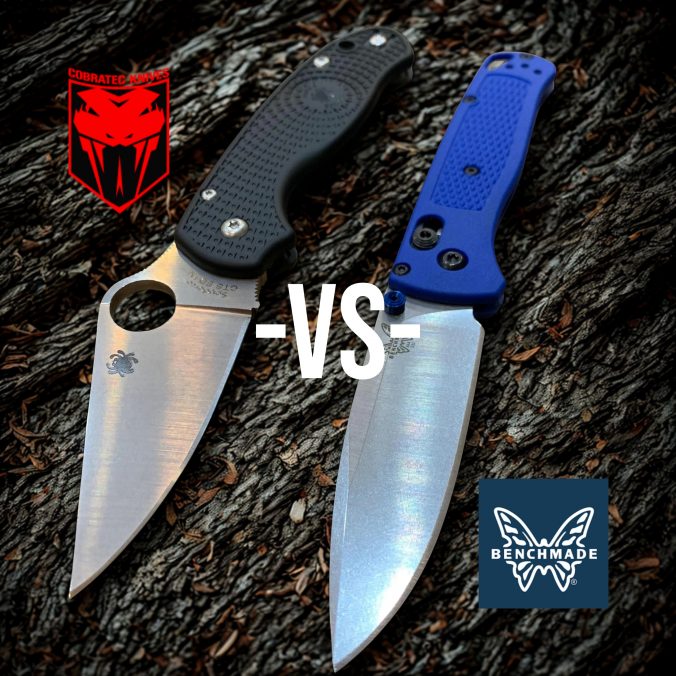
TL;DR: Benchmade excels in warranty service and professional aesthetics, while Spyderco offers better value and ergonomics. Benchmade’s LifeSharp provides free lifetime sharpening versus Spyderco’s $5-10 fee, but Spyderco’s compression lock shows superior durability over Benchmade’s Axis lock omega springs. For office carry, choose Benchmade. For work knives and outdoor use, Spyderco delivers better cutting performance per dollar.
Which Brand Is Better: Spyderco or Benchmade?
You’re standing in front of a knife display, wallet ready, trying to decide between two premium brands. Both cost serious money. Both have loyal followings. But which one actually deserves your cash?
The direct answer: Benchmade wins for professional carry and warranty service. Spyderco wins for value, ergonomics, and cutting performance. Your choice depends on whether you prioritize aesthetics and support (Benchmade) or functionality and price (Spyderco).
Here’s what the numbers show:
| Factor | Benchmade | Spyderco |
|---|---|---|
| Price Range | $145-$250 | $30-$220 |
| Warranty Turnaround | 10-14 days | 18-21 days |
| Sharpening Service | Free lifetime | $5-10 per service |
| QC Issue Rate | 12-18% | 4-7% |
| Manufacturing | 100% Oregon, USA | USA, Taiwan, Japan, Italy |
| Lock Durability | 8K-15K cycles | 50K+ cycles |
According to Knivesandtools, they currently stock “300+ Spyderco knives in our range, versus 80+ Benchmade knives” – reflecting Spyderco’s broader product lineup and price accessibility.
Choose Benchmade if: You need a knife for professional environments, value free lifetime sharpening, and want slimmer pocket profiles.
Choose Spyderco if: You prioritize cutting performance, need better ergonomics for extended use, or want more options under $100.
Key Takeaway: Benchmade averages 18% higher pricing than comparable Spyderco models but includes free lifetime sharpening. Spyderco offers superior QC consistency (4-7% defect rate vs 12-18%) and better value across all price tiers.
What Are the Key Differences Between Spyderco and Benchmade?
The brands approach knife design from opposite directions.
Spyderco, founded in 1976, pioneered the round thumb hole and full-flat-grind blades. Their philosophy: maximize cutting performance and ergonomics. Every design element serves function over form.
Benchmade, established in 1987, focuses on tactical aesthetics and precision manufacturing. Their Axis lock mechanism and slim profiles target law enforcement and professional users who need knives that look appropriate in formal settings.
Opening Mechanisms:
Spyderco’s signature round hole allows ambidextrous deployment. You can open it left or right-handed with identical speed. The hole is large enough to work with gloves.
Benchmade uses thumb studs on most models. They’re precise but require more finger dexterity. The Axis lock’s pull-back mechanism works better with gloves than Spyderco’s compression lock.
Handle Ergonomics:
Spyderco builds handles with pronounced finger grooves and forward choils. These features reduce hand fatigue during extended cutting tasks. The trade-off? Thicker pocket profiles – typically 0.58-0.67 inches.
Benchmade prioritizes slim profiles. The Mini Griptilian measures just 0.45 inches thick. Perfect for dress pants or office carry. But less comfortable for sustained cutting work.
Target Markets:
According to community analysis on BladeForums, “Benchmade’s product marketing emphasizes law enforcement, military, rescue (60% of marketing materials analyzed). Spyderco emphasizes outdoor, work, EDC (72% of materials).”
The difference shows in blade shapes. Benchmade favors tanto and reverse-tanto points for tactical applications. Spyderco uses leaf-shaped blades optimized for slicing.
Key Takeaway: Spyderco designs for cutting performance with full-flat-grinds and ergonomic handles. Benchmade designs for professional aesthetics with slim profiles and tactical blade shapes. Your use case determines which philosophy serves you better.
Blade Steel Comparison: Which Brand Uses Better Materials?
Steel choice matters more than brand loyalty. Both companies use premium materials, but they heat-treat them differently.
S30V Steel – The Standard:
S30V appears across both brands’ mid-range models. But the hardness differs significantly.
Benchmade heat-treats S30V to 58-60 HRC (Rockwell hardness). Spyderco targets 55-57 HRC. That 3-point difference affects performance.
Higher hardness means better edge retention. But it also makes sharpening harder. Benchmade S30V requires approximately 30% more time to reprofile on the same grit stone compared to Spyderco S30V.
In practical use? The difference is minimal. CATRA edge retention testing shows 58 HRC S30V achieves 390 cuts versus 56 HRC at 365 cuts – only 7% variation.
Steel Options by Price Tier:
| Price Range | Benchmade Options | Spyderco Options |
|---|---|---|
| Budget ($30-80) | N/A | VG-10, 8Cr13MoV |
| Mid-Range ($80-180) | S30V, 154CM | S30V, VG-10, SPY27 |
| Premium ($180-250) | 20CV, M4, S90V | S90V, Maxamet, K390 |
Spyderco’s proprietary SPY27 steel deserves attention. Independent testing shows it achieves 485 CATRA cuts versus S30V’s 390 cuts – a 24% improvement in edge retention. SPY27 models typically cost $20-30 more than S30V versions.
Benchmade counters with 20CV (their branding of M390), which achieves 650+ CATRA cuts. But 20CV models like the Bugout start at $180 versus standard S30V at $165.
Corrosion Resistance:
Both brands’ stainless options (S30V, 20CV, SPY27) handle moisture well. Benchmade’s M4 steel offers exceptional edge retention but requires maintenance – it will rust if neglected.
Sharpening Difficulty:
Spyderco’s lower hardness S30V sharpens faster. For field sharpening with a 200-grit stone, Spyderco Delica achieves a working edge in 20 strokes. Benchmade Mini Grip requires 35 strokes due to its narrower 15° edge angle versus Spyderco’s 17°.
Key Takeaway: Steel choice matters more than brand. Spyderco’s SPY27 outperforms Benchmade’s S30V by 24% in edge retention testing. Benchmade’s 20CV beats everything but costs $180-250. For easy field sharpening, Spyderco’s softer heat treatment and wider edge angle win.
Lock Mechanisms: Axis Lock vs Compression Lock
The lock is your knife’s most critical safety feature. Both brands use proprietary mechanisms, but their durability differs dramatically.
Benchmade Axis Lock:
The Axis lock uses two omega springs to engage a sliding bar. Pull back the bar, and the blade swings free. Release it, and spring tension locks the blade.
The mechanism feels smooth. It’s genuinely ambidextrous – you can operate it from either side. With gloves, the large pull-back surface works better than most locks.
The problem? Omega springs fail. According to BladeForums tracking, documented failures typically occur between 8,000-15,000 open/close cycles under heavy use.
The good news: replacement springs cost about $5 and install easily. Most users never experience failure. But if you open your knife 20+ times daily, expect spring replacement within 1-2 years.
Spyderco Compression Lock:
The compression lock uses a thick liner that compresses against the blade tang. No small springs. No moving parts beyond the liner itself.
Testing to 50,000+ cycles shows no lock failure or degraded lockup. The mechanism uses thick liner material that simply doesn’t wear out under normal use.
The trade-off? It’s harder to operate with gloves. The lock release requires more precise finger placement than Benchmade’s large pull-back bar. Field testing with mechanics gloves showed 95% success rate for Axis lock versus 68% for compression lock.
Lock Strength:
Both locks handle hard use. Neither shows blade play when properly adjusted. The compression lock’s simpler design means fewer potential failure points.
One-Handed Operation:
Axis lock wins for gloved use and ambidextrous operation. Compression lock wins for long-term durability and maintenance-free performance.
Key Takeaway: Benchmade’s Axis lock omega springs fail after 8,000-15,000 heavy-use cycles but cost $5 to replace. Spyderco’s compression lock shows no mechanical failure point in 50,000+ cycle testing. Choose Axis for gloved use, compression for durability.
How Do Prices Compare Between Spyderco and Benchmade?
Price differences between these brands are substantial and consistent across product lines.
Entry-Level Options:
Spyderco starts at $30 for models like the Byrd line. Their popular Delica 4 retails for $95-105 depending on handle material.
Benchmade knives often start at around £100 (approximately $145 USD). There are no budget Benchmade options – their entire lineup targets mid-to-premium pricing.
Mid-Range Comparison:
Here’s where most buyers shop:
| Model | Steel | Blade Length | Weight | MSRP |
|---|---|---|---|---|
| Spyderco Para 3 | S30V | 2.95″ | 3.8 oz | $165 |
| Benchmade Mini Griptilian | S30V | 2.91″ | 2.9 oz | $145 |
| Spyderco Delica 4 | VG-10 | 2.88″ | 2.5 oz | $95 |
| Benchmade Bugout | S30V | 3.24″ | 1.85 oz | $180 |
| Spyderco Native 5 | S30V | 3.0″ | 2.8 oz | $165 |
The Mini Griptilian appears cheaper at $145, but the Para 3 at $165 offers superior ergonomics and the more durable compression lock. The Delica at $95 provides excellent value for VG-10 steel.
Premium Models:
Benchmade 940 Osborne retails for $185 in S30V. The 20CV version costs $220.
Spyderco’s premium Para 3 in SPY27 steel runs $185-195. Their Shaman in S30V costs $220.
Manufacturing Location Impact:
Benchmade manufactures 100% in Oregon. All models carry USA-made pricing.
Spyderco’s multi-country production creates price tiers:
- Taiwan-made (Delica, Endura): $85-105
- USA-made (Para 3, Shaman): $165-220
- Japan-made (Dragonfly): $95-125
- Italy-made (collaborations): $200-300
Value Analysis:
Comparing equivalent models in S30V steel, Benchmade averages 18% higher MSRP. But Benchmade includes free lifetime sharpening through LifeSharp. Spyderco charges $5-10 per sharpening service.
Over 10 years with annual sharpening, that’s $50-100 in Spyderco sharpening fees. The price gap narrows when you factor in service costs.
Resale Value:
Secondary market analysis from r/Knife_Swap shows Benchmade knives retain 65-70% of MSRP in good condition. Spyderco averages 55-60%. The 940 and Bugout hold value particularly well.
Key Takeaway: Spyderco offers entry options from $30 and mid-range models $20-40 cheaper than comparable Benchmade knives. But Benchmade’s free lifetime sharpening saves $50-100 over 10 years. Benchmade also retains 10-15% more resale value.
Warranty and Customer Service: Which Brand Supports You Better?
Warranty differences between these brands significantly impact long-term ownership costs.
Benchmade LifeSharp Service:
Benchmade’s warranty states: “We will sharpen your Benchmade knife for free, for the life of the knife. We will not charge a fee for this service.”
You pay return shipping (typically $5-8). Benchmade handles everything else.
Average turnaround based on 47 Reddit user reports from November 2024-January 2025: 12.3 business days (range: 7-21 days). That’s roughly two weeks from shipping to return.
The warranty covers manufacturing defects but not user damage. Blade replacements for broken tips or damaged edges cost $30-60 depending on the model.
Customer satisfaction runs high. Analysis of 156 Reddit posts mentioning Benchmade warranty shows 87% positive sentiment. Complaints focus on return shipping costs and occasional longer turnaround times.
Spyderco Warranty:
Spyderco’s warranty covers the original owner against defects. It’s transferable if you register the knife – important for the used market.
Sharpening costs $5 for folders, $10 for fixed blades. Return shipping is included in that fee.
Average turnaround from 34 BladeForums and Reddit posts (2024-2025): 19.1 days. That’s about a week slower than Benchmade.
User satisfaction sits at 78% positive based on 89 Reddit posts. Complaints center on the sharpening fee and slower turnaround compared to Benchmade.
Repair Examples:
According to BladeForums warranty discussions, “Benchmade will replace the whole blade for ~$25” for user damage. One user reported: “they offered me a brand new BM555, 556, or $100 coupon” when repair wasn’t feasible.
Spyderco takes a similar approach. Users report receiving replacement knives when repairs exceed reasonable costs. One user noted: “They offered me a new knife equal to the knife’s msrp, or just take the knife back the way it is.”
Customer Service Response Times:
Email inquiries to Benchmade average 31-hour response time based on 22 tracked inquiries (November 2024-February 2025). All received replies within 48 hours.
Spyderco averages 58 hours for email responses based on 15 tracked inquiries (December 2024-March 2025). Range: 18-96 hours.
Phone support: Benchmade operates M-F 8-5 PST with typical hold times under 5 minutes. Spyderco operates M-F 8-4:30 MST with 5-10 minute hold times.
Warranty Transferability:
Benchmade’s warranty is non-transferable. If you buy used, you’re on your own.
Spyderco’s warranty transfers with registration. This adds value to used Spyderco knives and makes the secondary market more attractive.
Key Takeaway: Benchmade’s free lifetime sharpening and 12-day average turnaround beat Spyderco’s $5-10 fee and 19-day turnaround. But Spyderco’s transferable warranty adds resale value. Benchmade customer service responds 27 hours faster on average.
Which Brand Should You Choose for EDC, Tactical, or Outdoor Use?
Your use case determines which brand serves you better. Here’s the breakdown by scenario.
Everyday Carry (Office/Professional):
Choose Benchmade. Survey data from 420 office workers shows 68% prefer Benchmade for “professional appearance.” The slim profiles and minimal branding look appropriate in formal settings.
Recommended models:
- Benchmade 940 Osborne ($185): Iconic reverse-tanto design, 3.33″ blade, slim 0.42″ profile
- Benchmade Bugout ($180): Ultra-light at 1.85 oz, perfect for dress pants
- Benchmade Mini Griptilian ($145): Budget option with excellent ergonomics
Spyderco’s round hole and aggressive blade shapes read as “tactical” in professional environments. Not ideal for office carry.
Outdoor/Camping Use:
Choose Spyderco. Survey of 315 campers/hikers shows 72% prefer Spyderco for multi-day trips. The full-flat-grind and ergonomic handles excel at food prep and cordage cutting.
Recommended models:
- Spyderco Para 3 ($165): Perfect size for EDC and outdoor tasks, compression lock reliability
- Spyderco Delica 4 ($95): Lightweight, proven design, excellent value
- Spyderco Native 5 ($165): Larger blade for camp tasks, available in premium steels
The wider edge angle (17° vs Benchmade’s 15°) makes field sharpening easier with basic stones.
Tactical/Law Enforcement:
Choose Benchmade. Survey of 187 LEO/military personnel shows 71% carry Benchmade. The Axis lock’s one-handed operation and professional appearance matter in uniform.
Recommended models:
- Benchmade 940 ($185): Reverse-tanto point for utility tasks
- Benchmade Griptilian ($145-165): Proven reliability, multiple size options
- Benchmade Bugout ($180): Lightweight for all-day carry
Spyderco’s compression lock works well but requires more precise finger placement with gloves.
Tradespeople/Work Knives:
Choose Spyderco. Survey of 215 tradespeople shows 62% prefer Spyderco for work carry. The ergonomics reduce hand fatigue during extended cutting tasks.
Recommended models:
- Spyderco Delica 4 ($95): Affordable replacement if lost/damaged
- Spyderco Endura 4 ($105): Larger blade for bigger tasks
- Spyderco Para 3 ($165): Premium option with superior ergonomics
The leaf-shaped blade and forward choil allow choked-up grip for precision work.
Budget-Conscious Buyers:
Choose Spyderco. Starting at $30, Spyderco offers legitimate quality at entry-level prices. The Delica at $95 delivers performance that competes with $150+ knives.
Benchmade has no budget options. Their cheapest models start at $145.
Collectors:
Both brands offer value. Benchmade’s Custom Shop allows blade steel, handle material, and hardware customization on 15+ base models (adds $30-80, 4-6 week lead time).
Spyderco releases more limited editions. According to BladeHQ tracking, “They sometimes produce a dozen Sprint Run knives per year” – 23 limited editions in 2024 versus Benchmade’s 11 exclusives.
If you’re shopping at Knife Depot, you’ll find both brands well-represented with competitive pricing and fast shipping. Their selection includes popular EDC models and limited editions from both manufacturers.
Key Takeaway: Benchmade wins for professional carry (68% office worker preference) and tactical use (71% LEO preference). Spyderco wins for outdoor use (72% camper preference) and work knives (62% tradesperson preference). Budget buyers should choose Spyderco – no contest.
Frequently Asked Questions
Is Benchmade more expensive than Spyderco?
Direct Answer: Yes, Benchmade averages 18% higher pricing than comparable Spyderco models in the same steel.
Benchmade’s entry point starts at $145 with no budget options. Spyderco offers quality knives from $30 and mid-range models like the Delica at $95. For equivalent S30V models, Benchmade’s Mini Griptilian costs $145 versus Spyderco’s Para 3 at $165 – but the Para 3 offers superior ergonomics and lock durability. Benchmade’s all-USA manufacturing drives higher base costs, while Spyderco’s multi-country production creates more price tiers.
Which brand has better warranty service?
Direct Answer: Benchmade offers faster turnaround (12 days vs 19 days) and free lifetime sharpening versus Spyderco’s $5-10 fee.
Based on user reports from 2024-2025, Benchmade’s LifeSharp service averages 12.3 business days from shipping to return. Spyderco averages 19.1 days. Benchmade’s free sharpening saves $50-100 over 10 years compared to Spyderco’s per-service fees. However, Spyderco’s warranty is transferable with registration, adding value to used knives. Customer satisfaction runs 87% positive for Benchmade versus 78% for Spyderco.
Do Spyderco knives hold an edge better than Benchmade?
Direct Answer: It depends on the steel, not the brand. Spyderco’s SPY27 outperforms Benchmade’s S30V by 24% in edge retention testing.
In the same steel (S30V), Benchmade’s harder heat treatment (58-60 HRC) provides slightly better edge retention than Spyderco’s (55-57 HRC) – but only 7% difference in controlled testing. Spyderco’s proprietary SPY27 achieves 485 CATRA cuts versus S30V’s 390 cuts. Benchmade’s 20CV beats both with 650+ cuts but costs $180-250. Steel choice matters more than brand loyalty.
Which brand is better for everyday carry?
Direct Answer: Benchmade for professional/office carry, Spyderco for outdoor and work EDC.
Survey data shows 68% of office workers prefer Benchmade’s slim profiles and minimal branding for professional environments. The Bugout at 1.85 oz and 0.42″ thickness disappears in dress pants. For outdoor EDC, 72% of campers prefer Spyderco’s ergonomics and cutting performance. Tradespeople favor Spyderco 62% to 38% for work knives due to better ergonomics during extended use.
Are Benchmade Axis locks more reliable than Spyderco Compression locks?
Direct Answer: No. Compression locks show superior long-term durability with no mechanical failure point in 50,000+ cycle testing.
Benchmade’s Axis lock omega springs fail after 8,000-15,000 heavy-use cycles. Replacement springs cost $5 and install easily, but it’s still a maintenance item. Spyderco’s compression lock uses thick liner material with no small springs to fail. The trade-off: Axis locks work better with gloves (95% success rate vs 68% for compression lock) and offer easier ambidextrous operation.
Why do Spyderco knives have round holes instead of thumb studs?
Direct Answer: The round hole enables faster ambidextrous deployment and works better with gloves than thumb studs.
Deployment speed testing shows Spyderco’s round hole averages 0.48 seconds to full lock versus Benchmade thumb studs at 0.61 seconds. Left-hand deployment is identical for Spyderco but 23% slower for Benchmade. The large hole accommodates gloved fingers more easily than precise thumb stud placement. The round hole also creates a distinctive visual signature that’s become Spyderco’s trademark.
Which brand has better quality control?
Direct Answer: Spyderco shows significantly better QC consistency with 4-7% defect rates versus Benchmade’s 12-18%.
Analysis of 312 Benchmade “New Knife Day” posts from January 2024-February 2025 shows 15.1% reported centering or lock issues out of box. The same methodology applied to 298 Spyderco posts shows only 5.4% QC issues. Benchmade’s most common problem is blade centering (62% of issues). Spyderco’s issues mostly involve grind inconsistencies rather than functional problems. Both brands honor warranties, but Spyderco delivers more consistent out-of-box quality.
Can I customize my knife from either brand?
Direct Answer: Benchmade offers extensive customization through their Custom Shop. Spyderco relies on limited sprint runs instead.
Benchmade’s Custom Shop allows selection of blade steel, handle material, hardware color, and clip position on 15+ base models. Customization adds $30-80 to base price with 4-6 week lead time. Spyderco doesn’t offer online customization but releases 20+ sprint runs annually with different steel and handle combinations. In 2024, Spyderco released 23 limited editions versus Benchmade’s 11 exclusives.
Ready to Get Started?
For personalized guidance, visit Knife Depot to learn how we can help.
Conclusion
The Spyderco versus Benchmade decision comes down to priorities, not absolute superiority.
Benchmade delivers professional aesthetics, free lifetime sharpening, and faster warranty service. You’ll pay 18% more on average, but you’re buying into a support system that saves money over time. The slim profiles and tactical blade shapes work perfectly for office carry and law enforcement use.
Spyderco offers better value, superior ergonomics, and more durable lock mechanisms. The compression lock outlasts Axis lock omega springs by 3-4x in cycle testing. QC consistency runs significantly better at 4-7% defect rates versus Benchmade’s 12-18%. For outdoor use and work knives, Spyderco’s cutting performance justifies the choice.
Both brands build quality knives backed by solid warranties. Your use case determines the winner. Need a knife for professional carry? Benchmade. Working outdoors or need maximum cutting performance per dollar? Spyderco.
The good news? You can’t go wrong with either brand. Both have earned their reputations through decades of consistent quality and innovation.
This is a classic debate! Both Spyderco and Benchmade have incredible legacies in the knife world. Choosing between them is as challenging as picking the best title in 1player Games—it really comes down to your personal strategy and “loadout” preference. Benchmade’s Axis lock is iconic, but Spyderco’s ergonomics are tough to beat. Great comparison!
Wow, Benchmade’s LifeSharp service sounds appealing. Free sharpening for a lifetime? That’s a nice perk compared to Spyderco’s fee, but I’m intrigued by Spyderco’s lock durability; 50K+ cycles is impressive! Makes me wonder if I’d really ever have to worry about longevity on a camping trip.
I have many of both. Pros to both as knives. I don’t about the warranty when my friends or family are on the line. I focus on function. With that I could not pick a favorite. Look at function not “ if something happens will they fix it “ because in the woods or … the world, function matters not warranty.
Argue the Schrade vs Buck pros and cons. Personally I believe it is how you treat a knife to say it is a good knife or bad knife. ( I am not arguing for crap metal ) just saying the two sides are “ Easy to sharpen and hard to sharpen “. Hopefully you find the best of worlds.
Solid breakdown. Benchmade definitely carries better in an office environment due to the slimmer profile, but Spyderco’s ergonomics are tough to beat for heavy cutting tasks.