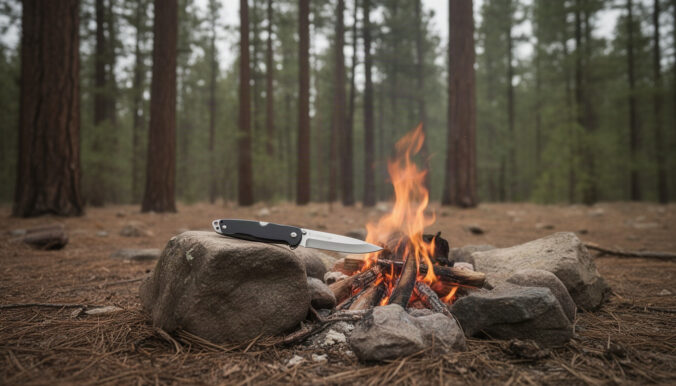
TL;DR: Choose a camp knife around the cutting jobs you expect, its grip and carry system, and the weight you will actually pack. The Companion S is a straightforward 12C27 option; an F1 Elmax is a compact convex-ground fixed blade; an ESEE-5 is much heavier. No model is a substitute for a well-planned outdoor kit.
Prices checked November 17, 2026. Knife Depot prices are USD before tax and shipping. Manufacturer links provide separate model references; configurations, offers, and availability can change.
What Makes a Survival Knife Good for Camping and Hiking?
A good camping knife earns its place while opening food, cutting cord, carving, and making small repairs. Start with those tasks instead of treating the longest blade or thickest stock as automatically better. A comfortable handle and secure sheath matter just as much as the steel.
For general camp work, a moderate blade length is a practical starting point. Try the grip with the gloves you use, check control near the edge, and consider whether the sheath can be secured where you want it. Compare the complete system, not the bare knife alone.
Full tang means the blade steel continues through the handle. It can be a useful construction choice, but it does not make every knife suitable for prying, chopping, or impact use. Follow the specific maker’s instructions. Choose a saw or other appropriate tool when the job calls for one.
How Do Blade Steel Types Affect Survival Knife Performance?
Steel is one part of performance. Knife Steel Nerds’ metallurgy explanation shows why broad carbon-versus-stainless labels are insufficient. Heat treatment and blade geometry also matter. Stainless is corrosion resistant, not immune to rust; carbon blades generally require more attention to moisture.
Steel or model category
Practical buying consideration
12C27 / Companion S
Stainless option for routine cutting; follow its Scandi-edge care instructions
1095 / ESEE-5 and TOPS BROS-01
Dry after use and maintain exposed steel; coatings do not protect the edge completely
Elmax / current F1 model
Confirm this exact version; older F1 specifications do not transfer automatically
Premium stainless folders
Compare the exact SKU and intended use, not an assumed brand-wide edge life
Top 7 Best Survival Knives for Camping and Hiking (2026)
Knife or version
Product details
Why compare it
Price or buying reference
Morakniv Companion S
12C27 stainless; 104 mm blade; standard tang; Scandi grind
The Companion S is not a 1095 or 420HC knife. Morakniv lists 12C27 stainless steel and a standard tang. Carbon Companion variants are separate products. The F1 entry here is specifically the Elmax version, not an older laminated VG-10 model.
The TOPS specification table distinguishes total blade length from cutting edge. The ESEE-5’s 16-ounce knife-only weight is particularly important if you are hiking: its sheath adds more. Neither is an ultralight choice simply because its blade is around five inches long.
For the PM2 and Bushcrafter, match the actual model number before comparing price, steel, weight, or sheath. Older editions, special steels, and newer configurations should not be combined into a single product description. Check our survival knife selection for current offers.
Knife Depot availability checked November 17, 2026: the linked StrongArm 30-001058 was $109.99 and the Para Military 2 C81GPBK2 was $224.99. An additional available fixed-blade option was the Fällkniven F1af VG10 — $161.36. The linked F1af is a different steel configuration from the F1 Elmax in the comparison table. Prices are USD before tax and shipping and may change.
Fixed Blade vs. Folding Knife: Which Should You Choose for Camping?
Carry choice
Advantages to consider
What to check
Folding knife
Compact storage for food, cord and small repairs
Lock operation, grip, permitted use and cleaning access
Fixed blade
No folding joint; straightforward deployment
Knife plus sheath weight, retention and intended cutting tasks
A folder can be enough for a day hike. A suitable fixed blade may fit a trip focused on camp carving or food preparation. Trip duration alone does not determine which you need, and neither design guarantees freedom from failure.
How to Maintain Your Survival Knife in the Field
Clean and dry the blade after use, including stainless blades. Remove grit from the handle, pivot, and sheath; use only cleaning products and lubricants the maker permits. If the knife touches food, use an appropriate food-contact lubricant. Store it dry and inspect the carry system before each trip.
Sharpen when cutting performance calls for it, using the maker’s recommended angle and suitable abrasives. Edge damage, geometry, steel, and technique affect the work required, so a steel name does not set a fixed number of minutes or days between sharpenings. A strop can refine an edge but does not replace sharpening a worn or damaged bevel.
Frequently Asked Questions About Survival Knives for Camping
How much should I spend?
Set a budget for the knife, sheath, maintenance and carry accessories. The manufacturer links provide model references, not Knife Depot price quotes or proof of a performance tier.
What blade length is best?
Choose a length you can control for your actual tasks. There is no blade length that covers a measured percentage of all camping jobs or establishes legal carry everywhere.
Is an ESEE-5 a lightweight hiking knife?
No. ESEE lists the knife alone at 16 ounces. Include the sheath when assessing the carry weight.
Does stainless steel need care?
Yes. Clean and dry it, especially after salt or acidic food exposure. Follow the maker’s instructions for the exact alloy and finish.
How quickly can I sharpen it in the field?
There is no universal time. Pack a compatible sharpener and practice before your trip instead of relying on a fixed three-minute or twelve-minute claim.
Check the rules for the place you will carry the knife, including state and local law, park regulations, and building restrictions. Blade length alone does not establish legal carry. For flights, consult TSA’s current knife guidance and the rules at your destination; do not assume a pocket knife can travel in a carry-on.
Conclusion
Start with your cutting tasks, then compare the exact version’s dimensions, grip, sheath and total weight. Browse survival knives at Knife Depot or our camping knife comparison to narrow the choices. A manageable knife you can maintain is more useful than a specification you do not need.
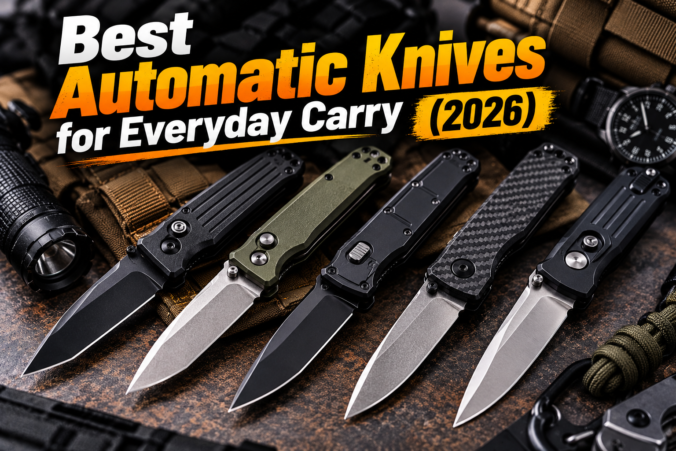
TL;DR: The best automatic knife for everyday carry depends on the cutting tasks, size, controls, and maintenance you prefer, plus the laws that apply to you. Start by distinguishing a side-opening automatic from an out-the-front (OTF) automatic. Then compare the exact model rather than treating every knife in a family as identical.
Compact side-opening option: Kershaw Launch 4 7500BLK, with a 1.9-inch CPM-154 blade and 1.8-ounce weight.
OTF option: Kershaw Livewire 9000BLK, with a 3.3-inch CPM MagnaCut blade and double-action operation.
Check before buying: Current price, availability, configuration, warranty, and applicable possession and carry rules.
Introduction
An everyday carry knife should suit ordinary cutting tasks and fit comfortably in your pocket. Automatic opening adds a powered mechanism, but it does not determine the best blade size or guarantee lawful carry. This guide focuses on carry considerations and accurately identified examples. For current shopping options, browse automatic knives.
What Makes an Automatic Knife Good for Everyday Carry?
An automatic knife deploys its blade through a powered mechanism operated by a button, slider, lever, or similar control. Side-opening automatics rotate around a pivot; OTF automatics move the blade through the front of the handle. A fixed blade has no opening mechanism and is not an automatic.
Blade: Match length, shape, edge type, and geometry to your cutting tasks and applicable restrictions.
Pocket fit: Compare weight, closed length, thickness, and clip placement. There is no universal comfort threshold.
Controls: Check switch position, operation, and any safety features. Follow the manufacturer’s handling instructions.
Support: Read the actual maintenance and warranty terms for the exact model.
An assisted-opening knife requires the user to begin opening the blade before its spring assists. Do not infer a model’s opening method or legal status from the presence of a lock bar or button alone.
Are Automatic Knives Legal to Carry Every Day?
There is no nationwide blade length that guarantees lawful automatic knife carry. State and local rules may distinguish possession, sale, concealed carry, transport, age, and restricted locations. Federal rules can also affect shipment and transport. A 1.9-inch blade does not make an automatic legal everywhere.
Consult the American Knife & Tool Institute summaries as a starting point, then verify current official law for your circumstances. This article provides general product information, not legal advice.
Automatic Knife Picks for Everyday Carry in 2026
These examples illustrate different carry formats. They are not a hands-on performance ranking, and prices and availability can change.
Compact Side-Opening Option: Kershaw Launch 4
The Launch 4 7500BLK has a 1.9-inch CPM-154 blade, a 6061-T6 aluminum handle, and a manufacturer-listed weight of 1.8 ounces. It opens with a push button and uses a push-button lock release. Kershaw lists its clip as single-position, right-hand tip-up. Do not assume a factory deep-carry clip or reversible carry arrangement.
Its short blade and 3.2-inch closed length make it an option when compact dimensions matter. Compare the usable cutting edge and handle fit with your intended tasks; a small knife is not automatically the best choice for every user.
Budget Options: Verify the Exact Model
The Boker Mini Strike is a side-opening automatic, not an OTF. Check the exact SKU before relying on a blade length, steel, weight, or price. The previous generic figures did not identify a configuration clearly enough to serve as a buying specification.
Choose a budget based on current listings, then compare materials and manufacturer support. Price alone does not establish heat treatment, tolerances, reliability, or expected life.
Premium Options: Compare Configuration and Carry Format
The Benchmade CLA is a side-opening automatic family. Its materials vary by configuration; the earlier S30V/aluminum specification should not be applied to the entire family. Verify the complete model number before comparing it with another automatic.
For an OTF alternative, the Kershaw Livewire 9000BLK has a 3.3-inch CPM MagnaCut blade with a black PVD finish, a 6061-T6 aluminum handle, and a listed weight of 3.1 ounces. Its slider both deploys and retracts the blade.
Comparison Table: Two Different Carry Formats
Model
Opening
Blade
Steel
Weight
Launch 4 7500BLK
Side-opening automatic
1.9 inches
CPM-154
1.8 oz
Livewire 9000BLK
Double-action OTF
3.3 inches
CPM MagnaCut
3.1 oz
Both configurations use aluminum handles. Check current product listings and applicable law before purchase. An unspecified Smith & Wesson OTF or SOG “Spec-XR” is not a sufficiently identified configuration for a verified comparison table.
Additional Premium Picks
Microtech Ultratech and Benchmade Infidel models are also worth comparing by exact configuration. The full-size Infidel 3300 is double-action, so its switch operates opening and retraction. Do not assume that every Ultratech generation or Infidel variant shares the same blade steel, dimensions, weight, or price.
How Do You Choose the Right Blade Steel for Daily Use?
Evaluate steel alongside heat treatment, edge geometry, and the tasks you perform. Edge retention, corrosion resistance, toughness, and ease of sharpening involve trade-offs. A steel name or price tier alone cannot establish the best blade for every user.
CPM-154 and conventional 154CM are distinct materials. The verified Launch 4 configuration uses CPM-154. D2 requires attention to corrosion prevention, but “dry climates only” is too absolute: maintenance and exposure matter. Follow the manufacturer’s cleaning and storage guidance for any steel.
What Should You Know Before Buying an Automatic EDC Knife?
Compare actual dimensions: Include closed size, weight, handle shape, and clip placement.
Confirm configuration: Match the SKU, blade, finish, steel, and handle material with the listing.
Read service terms: Warranty coverage and exclusions vary; do not infer lifetime coverage from price.
Handle weight depends on the complete design. Titanium is not automatically lighter than aluminum in an otherwise comparable handle, and material labels do not support a fixed weight or price difference.
Frequently Asked Questions About Automatic EDC Knives
Are automatic knives legal to carry in every state?
No universal permission applies to every user and location. A short blade does not guarantee legal possession or carry. Verify current law and any relevant exceptions.
What is the difference between an automatic knife and a spring-assisted knife?
An automatic uses a control to initiate powered deployment. An assisted opener requires the user to start moving the blade before the assist engages. Verify the exact design and local rules for either type.
How much should you spend on an automatic EDC knife?
Set a budget and compare current products against your needs. There is no universal price range that guarantees better steel, reliable deployment, or a particular warranty.
What blade length is best for everyday carry use?
Choose a lawful size that suits your cutting tasks and grip. Also compare the closed dimensions and weight; no one length guarantees comfort or legal carry.
Can you take an automatic knife on a plane?
Do not put an automatic knife in carry-on baggage. Before travel, check current TSA knife guidance, airline policies, and the laws along your route and at your destination. Checked-baggage screening rules do not override possession or transport restrictions. Pack any permitted sharp item securely to protect handlers.
How do you maintain an automatic knife for reliable daily deployment?
Follow the exact model’s instructions for removing debris and applying the recommended lubricant. Different mechanisms can need different care. Routine OTF maintenance need not require disassembly. If cleaning does not resolve a malfunction, contact the manufacturer rather than adjusting springs without approved instructions.
Conclusion
Choose an automatic by its verified configuration, carry format, pocket fit, maintenance requirements, and lawful use. Browse automatic knives for current options and compare the exact SKU before ordering.
Historical promotion — October 20, 2026. This article records a past campaign. The savings, member prices, minimum spend and references to “this week” below are historical, not a current offer. Visit the linked product or collection pages for present availability and pricing; historical discounts should not be assumed to apply.
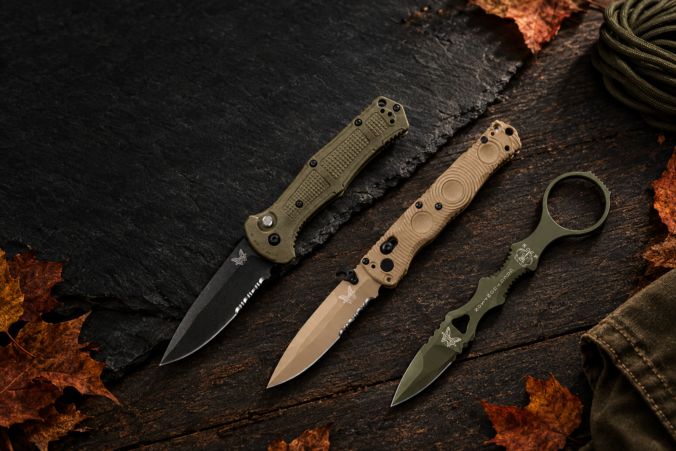
Three new Benchmades. Three ways to carry. One fall color palette.
Ranger Green, Desert Tan and OD Green Benchmades just landed at Knife Depot, each built for a different spot on your gear. All three are new to Knife Depot.
A LITTLE HISTORY
Les de Asis started building butterfly knives in a California garage in 1979. In 1988 the company became Benchmade, named for knives finished at the bench. Today Benchmade builds its knives in Oregon City, Oregon, home of the AXIS lock since 1999.
THE BUTTON: CLAYMORE 9070SBK-03
One of our top-selling knives of 2022, now in Ranger Green. A 3.6-inch partially serrated 154CM blade, a Grivory handle that handles rain and grime, and an integrated safety.
THE AXIS: MINI SOCP 393SSN-01
Greg Thompson’s SOCP shape in a folder: a 3.76-inch partially serrated S30V blade in Flat Earth Cerakote, Desert Tan G10 scales, a finger ring and an ambidextrous AXIS lock.
THE FIXED BLADE: MINI SOCP 177GN
Skeletonized 440C in OD Green Cerakote at 1.81 ounces, with a tan molded sheath for pocket or MOLLE carry.
THE MEMBER OFFER
Members get a special offer on all three this week. Add one to your cart to see your member price. Not on the list yet? Join the Knife Depot email list to see it too.
Automatic knives ship only where legal. Check your local laws.
Shop the lineup: knife-depot.com/collections/knife-of-the-week-offers
TL;DR: – A 2.5–3.5 inch folding knife with a drop-point blade and assisted opening hits the legal and practical sweet spot for dual-purpose EDC across most U.S. jurisdictions
Budget picks ($30–$60) use 8Cr13MoV steel; mid-range ($60–$120) jumps to S30V; premium ($120–$250) adds refined ergonomics
Always verify local blade-length laws before purchasing – NYC and California have dramatically different thresholds than Texas or most other states
What Makes an EDC Knife Good for Both Defense and Utility?
Here’s the thing: not every knife that looks tactical actually works for both cutting tasks and defensive scenarios. (Texas.gov) (Ca.gov) You need to understand what separates a pure utility blade from one that can handle both jobs.
Based on our analysis of Knife Depot’s EDC guide and tactical knife resources, the ideal dual-purpose EDC knife has three core traits: a blade length between 2.5 and 3.5 inches, a geometry that balances tip strength with slicing belly, and a deployment mechanism you can operate under stress.
Blade length matters more than you think. [A blade between 2 and 3.5 inches is both legally defensible in most U.S. jurisdictions and long enough for effective defensive use]. Anything shorter and you lose utility reach; anything longer and you’re breaking laws in dozens of cities.
Blade geometry is where utility and defense diverge. Drop-point blades give you the best of both worlds – a strong tip for piercing, a curved belly for slicing, and versatility across cutting tasks. [Tanto blades feature a strong, angular tip ideal for piercing and tactical applications] but sacrifice the belly curve you need for opening packages or food prep. If you’re choosing between the two for EDC, drop-point wins for dual-purpose work.
Deployment speed matters under pressure. [Assisted-opening folders deploy in under 0.5 seconds], which is critical if you ever need the knife defensively. Here’s why: [under adrenaline, your fine motor skills degrade dramatically]. A flipper tab or wave-style opener is more reliable than a small thumb stud when your hands are shaking or gloved.
Key Takeaway: Target a 2.5–3.5 inch drop-point blade with assisted opening or flipper deployment. This geometry handles most utility tasks while remaining legal and deployable under stress.
How Do Blade Steel and Edge Type Affect EDC Performance?
Steel choice is where most people get confused – and where your budget directly impacts real-world performance.
The steel spectrum for EDC knives breaks down into four tiers. Budget picks ($30–$60) use 8Cr13MoV steel; mid-range ($60–$120) jumps to S30V; premium ($120–$250) adds refined ergonomics and materials. That price jump isn’t just marketing – it’s the difference between sharpening your knife every 3 weeks versus every 2 months.
8Cr13MoV is a Chinese stainless steel that works fine for occasional utility tasks but requires frequent sharpening. It’s adequate for EDC if your budget is tight, but expect to touch up the edge every 2–3 weeks if you use the knife daily.
S30V is the workhorse of mid-range and premium EDC knives. It holds an edge significantly longer than 8Cr13MoV and resists corrosion well. The tradeoff? It’s harder to sharpen and slightly more brittle under lateral stress – meaning if you pry with it, the tip can chip more easily than a tougher steel.
D2 tool steel offers excellent edge retention and corrosion resistance. Tough blade materials like D2 or SK-5 steel offer excellent edge retention and corrosion resistance. It’s popular in budget tactical knives but less ideal for true EDC where you might forget to wipe the blade down in humid environments.
Edge type changes how the knife performs. Plain edges excel at push-cutting and fine work – opening packages, food prep, clean slicing. Serrated edges cut rope, webbing, and seatbelts faster but leave rough cuts on thin materials. A combo edge offers both but is harder to sharpen and often leaves unclean cuts on delicate tasks.
For dual-purpose EDC, plain edge wins. You’ll use it most of the time for utility, and defensive cuts don’t require serration.
Key Takeaway: S30V steel at $80–$120 offers the best balance of edge retention and corrosion resistance for daily EDC. Budget 8Cr13MoV requires sharpening every 2–3 weeks; S30V stretches that to 6–8 weeks with daily use.
Top EDC Knives for Self Defense and Utility in 2026
You want specific recommendations, not theory. Here are the knives that score highest on both utility and defensive criteria, organized by budget tier.
The Cryo is the most commonly recommended budget EDC under $50. At roughly $35–$40 street price, it gives you assisted opening (deploys in under 0.5 seconds), a stainless steel handle that won’t rust, and a blade short enough to be legal everywhere – including NYC. The 8Cr13MoV steel won’t hold an edge as long as premium options, but for occasional utility tasks and defensive carry, it’s solid.
The catch: you’ll sharpen it more often. If you use it 5 times a day for cutting tasks, expect to touch up the edge every 2–3 weeks.
The Delica 4 is the most recommended mid-range EDC across independent reviews. It’s a drop-point blade in VG-10 steel (roughly equivalent to 154CM in performance), with a four-way clip and full-flat grind. The blade length at 2.90 inches keeps it legal everywhere, and the ergonomics are excellent for extended carry.
VG-10 holds an edge significantly longer than 8Cr13MoV – you’re looking at 4–6 weeks of daily utility use before needing a touch-up. The Delica 4 is also lighter than many competitors, making it comfortable for all-day carry.
If you want the best-in-class EDC and can justify the price, the Griptilian 551 is it. The 3.45-inch CPM-S30V blade holds an edge for 6–8 weeks of daily use, and the AXIS lock is bilateral and ambidextrous – one of the most reliable locking mechanisms in production knives. The blade length is legal in most U.S. states but check your local laws before carrying.
The Griptilian’s ergonomics are refined, and the Noryl GTX handle is durable and comfortable. This is the knife you buy once and carry for years.
Best for Pure Utility Tasks
CRKT Drifter (2.87-inch 8Cr13MoV, ~$30)
If your primary use is utility – opening packages, cutting rope, food prep – the CRKT Drifter is the most practical choice. At roughly $30, it’s affordable enough to not worry about, and the blade geometry is optimized for slicing and general cutting rather than defensive geometry. The 2.87-inch blade is legal everywhere, and the assisted opening is reliable.
You’re sacrificing some defensive capability for pure utility performance, but if you’re carrying a knife primarily for everyday tasks, this is the best value.
The Recon 1’s reinforced tanto blade is specifically designed for defensive use – the angular tip penetrates effectively, and the blade geometry prioritizes strength over slicing belly. CTS-XHP steel is a high-carbide stainless comparable to S30V in edge retention.
The tradeoff: the 3.5-inch blade exceeds legal limits in several jurisdictions (check your local laws), and the tanto geometry is less versatile for utility tasks. If you’re carrying primarily for self-defense with utility as secondary, this is your pick.
Key Takeaway: Spyderco Delica 4 ($90) is the best all-around EDC for most people – legal everywhere, excellent steel, proven ergonomics. Benchmale Griptilian 551 ($165) is the premium choice if you want maximum edge retention and refined handling.
Legal Carry Rules You Must Know Before Choosing an EDC Knife
Here’s where most people make a mistake: they buy a knife based on reviews, then discover it’s illegal to carry where they live.
Blade-length laws vary dramatically by state and municipality. Many states allow folding knives of any length, while others limit blade length to 3 or 4 inches for concealed carry. But it gets more granular than that.
New York State restricts gravity knives and switchblades but permits folding knives – except NYC enforcement has historically targeted pocket clips, creating a de facto environment where visible carry is risky. California defines a switchblade as any blade 2+ inches that opens automatically, but assisted-opening knives with a bias toward closure (thumb stud + detent) are generally NOT switchblades under CA law. Texas, by contrast, removed blade-length limits on most knives in 2017, making it one of the most permissive states.
Before you buy, ask yourself three questions:
What’s the blade-length limit in your state? (Most common thresholds: 3 inches, 3.5 inches, 4 inches, or unlimited)
Are assisted-opening knives legal where you live? ([Quick deployment mechanisms such as flippers or thumbstuds allow for rapid access], and these are generally legal federally, but some states restrict them)
Is concealed carry legal, or do you need a visible clip? (Affects whether you can carry in a pocket without the clip showing)
One critical note on defensive use: Using a knife defensively is considered a use of deadly force in virtually all U.S. jurisdictions. This is justified only when facing imminent threat of death or serious bodily harm. Carrying a knife for self-defense creates significant legal liability – it’s a last resort, not a primary defense tool.
Key Takeaway: Verify your local blade-length limit and assisted-opening legality before purchasing. A 2.75–3-inch blade is legal in nearly all U.S. jurisdictions; anything over 3.5 inches requires local verification.
How to Maintain Your EDC Knife for Reliable Performance
A dull knife is a useless knife – and a useless defensive tool is worse than no tool at all.
Sharpening cadence depends on use frequency. If you use your EDC knife 5 times daily for utility tasks (box cutting, food prep, cord cutting), you’ll reach a dull threshold in approximately 2–4 weeks depending on steel hardness. A purely defensive carry knife used rarely may need sharpening only 1–2 times per year.
The paper-slice test is your go-to sharpness check: a sharp knife will cleanly slice printer paper with minimal effort. If the blade tears or snags, it needs sharpening.
Maintenance checklist for EDC knives:
Wipe the blade after use – removes moisture and debris that cause corrosion
Lubricate the pivot monthly – use thin oils like Tuf-Glide or Nano-Oil; avoid WD-40 (too thin, evaporates)
Check the lock face – ensure the lock engages fully and doesn’t rattle
Sharpen when the paper test fails – don’t wait until the blade is completely dull
Inspect the clip – make sure it’s not bent or loose
When to retire a blade: if the tip is chipped beyond repair, the edge won’t hold after sharpening, or the lock is worn and unreliable, it’s time to replace the knife.
Key Takeaway: Touch up your EDC knife’s edge every 2–4 weeks if used daily for utility; sharpen fully every 2–3 months. A defensive carry knife used rarely needs sharpening only 1–2 times yearly.
Frequently Asked Questions About EDC Knives for Defense and Utility
Is it legal to carry an EDC knife for self defense?
Direct Answer: Carrying a knife for self-defense is legal in most U.S. states, but blade-length limits and carry restrictions vary significantly by jurisdiction. Using a knife defensively is considered deadly force and is justified only when facing imminent threat of death or serious bodily harm.
Verify your local blade-length limit and assisted-opening legality before purchasing. Many states allow folding knives of any length, while others limit blade length to 3 or 4 inches. NYC has a de facto 2-inch enforcement threshold; California restricts automatic blades but permits most assisted-opening knives. Always consult local counsel before carrying any knife for defensive purposes.
What blade length is best for both utility and self defense?
Direct Answer: [A blade between 2 and 3.5 inches is both legally defensible in most U.S. jurisdictions and long enough for effective defensive use]. The 2.75–3-inch range is ideal because it’s legal everywhere, including restrictive cities.
Anything shorter than 2.5 inches loses utility reach; anything longer than 3.5 inches exceeds legal limits in many jurisdictions. The sweet spot balances legal carry, utility versatility, and defensive capability.
How much should you spend on an EDC self defense knife?
Direct Answer: Budget $40–$90 for a reliable EDC knife that handles both utility and defensive tasks. Premium options at $150–$200 offer better steel and ergonomics but aren’t necessary for most users.
Budget picks ($30–$60) use 8Cr13MoV steel; mid-range ($60–$120) jumps to S30V; premium ($120–$250) adds refined ergonomics and materials. A $90 Spyderco Delica 4 outperforms a $40 budget knife in edge retention and reliability. Spending more than $200 is diminishing returns unless you’re a collector.
How does an EDC knife compare to pepper spray for personal defense?
Direct Answer: An EDC knife is a last-resort defensive tool; pepper spray is a primary deterrent. Knives require close proximity and carry legal liability as deadly force, while pepper spray can be deployed from distance and is legal in most jurisdictions.
If you’re choosing between a knife and pepper spray for self-defense, pepper spray is the better primary option. A knife is best carried as a utility tool that can serve defensively if needed, not as your primary self-defense strategy.
Do you need a serrated blade for an EDC self defense knife?
Direct Answer: No. Plain edges outperform serrated edges for most utility tasks and defensive use. Serrated edges cut rope and webbing faster but leave rough cuts on thin materials and are harder to sharpen.
For dual-purpose EDC, plain edge wins. You’ll use it most of the time for utility cutting, and defensive cuts don’t require serration. A combo edge is a compromise but sacrifices performance in both categories.
How often should you sharpen an EDC knife used for daily utility?
Direct Answer: If you use your EDC knife 5 times daily for utility tasks, expect to touch up the edge every 2–3 weeks depending on steel hardness. A defensive carry knife used rarely may need sharpening only 1–2 times per year.
The paper-slice test is your indicator: if the blade tears or snags printer paper, it needs sharpening. Don’t wait until the edge is completely dull – regular maintenance keeps the knife reliable.
Ready to Carry Confidently?
An EDC knife that handles both utility and defensive scenarios isn’t about choosing between two separate tools – it’s about finding the right balance. You want a blade long enough for real cutting work, steel that holds an edge through daily use, and a deployment mechanism you can operate under stress.
The Spyderco Delica 4 at $90 is the benchmark for most people: legal everywhere, excellent steel, proven ergonomics. If you want premium performance and can justify the cost, the Benchmade Griptilian 551 at $165 is the best-in-class option. And if you’re on a tight budget, the Kershaw Cryo at $35 is the most reliable sub-$50 pick.
Before you buy, verify your local blade-length laws. A 2.75–3-inch blade is legal in nearly all U.S. jurisdictions, but check your specific state and city. And remember: a knife is a utility tool first, a defensive option last. Carry it responsibly, maintain it regularly, and you’ll have a reliable companion for years.
Looking for your next EDC knife? Knife Depot carries a curated selection of proven EDC models across all budget tiers, with detailed specs and community reviews to help you choose the right blade for your needs.
Upgrade Your Everyday Carry
Built for performance. Designed to stand out. Shop knives ready for everyday carry, the outdoors, or your collection.
Free ground shipping on eligible continental U.S. orders over $99. Cannot be combined with other discounts. See shipping terms.
TL;DR: – Professional-grade chef knives are defined by HRC 57–62 hardness, full-tang construction, and NSF-certified handles – not brand prestige.
German steel (X50CrMoV15 at 56–58 HRC) chips less under bone stress; Japanese steel (VG-10 at 60–62 HRC) holds an edge 3× longer between sharpenings.
Best value: Victorinox Fibrox Pro ($45, NSF-certified); mid-tier: Wüsthof Classic ($160); elite: Shun Premier (~$200).
Maintenance determines lifespan more than initial quality – neglect honing and monthly sharpening, and a $300 knife degrades to $50 performance within 18 months.
What Makes a Chef Knife “Professional Quality”?
You’re standing in a commercial kitchen evaluating two 8-inch chef knives. One costs $45; the other costs $300. The difference isn’t marketing – it’s measurable metallurgy and construction standards that directly impact your workflow.
For professional use, compare blade dimensions, handle comfort, maintenance needs, and the exact model’s specifications. Our chef knife selection provides a starting point for matching a knife to your prep tasks and budget.
Blade Steel: The Single Biggest Quality Factor
Steel hardness, measured on the Rockwell Hardness Scale (HRC), determines how long your knife stays sharp and how difficult it is to resharpen. According to The Cooking Guild, “For kitchen knives the useful window is narrow: 54–57 HRC is soft, very tough, dulls quickly; 57–59 HRC is the German sweet spot; 59–62 HRC is the Japanese sweet spot; 62+ HRC is specialist territory.”
Here’s what this means in practice:
German steel (X50CrMoV15) at 56–58 HRC: Tougher, more forgiving under lateral stress (like hitting bone), but requires sharpening every 2–3 weeks with heavy use.
Japanese steel (VG-10, AUS-10) at 59–62 HRC: Holds an edge significantly longer between sharpenings, but chips more easily if twisted or used on frozen items.
The Cooking Guild clarifies the trade-off: “Harder steel holds an edge longer but is more brittle; tougher steel forgives a careless twist but dulls sooner.”
Construction Standards: Full Tang, Bolster, and Handle Materials
Full-tang construction – where the steel runs the entire length of the handle – distributes weight evenly and prevents handle loosening after months of heavy use. Cozzini Bros notes that “with proper care, forged knives will last a lifetime,” but this assumes full-tang construction and appropriate materials.
NSF/ANSI Standard 2 certification is non-negotiable for commercial kitchens. Wood handles fail this standard because they absorb bacteria and moisture. Victorinox Fibrox Pro handles are NSF-certified, making them appropriate for use in commercial foodservice environments. Polypropylene and composite handles meet food safety requirements that wood cannot.
Key Takeaway: Professional knives require HRC 57–62 hardness, full-tang construction, and NSF-certified handles. German steel suits high-volume protein prep; Japanese steel suits precision vegetable work. Handle material matters more than blade aesthetics in commercial settings.
German vs Japanese Chef Knives: Which Is Right for Your Kitchen?
The German vs. Japanese knife debate isn’t about tradition – it’s about operational fit. Your choice depends on what you’re cutting, how often you sharpen, and whether your line cooks have access to professional sharpening services.
German-style knives (Wüsthof, Henckels) use lower hardness steel (56–58 HRC) with a 14° edge angle per side. They’re forgiving under stress and require less frequent sharpening. Japanese-style knives (MAC, Shun, Global) use harder steel (59–62 HRC) with a 15° edge angle or less, producing a more acute, sharper edge that dulls faster but cuts more cleanly.
Factor
German (Wüsthof, Henckels)
Japanese (MAC, Shun, Global)
Steel Hardness
56–58 HRC
59–62 HRC
Edge Angle
14° per side
15° per side
Edge Retention
2–3 weeks (heavy use)
4–6 weeks (heavy use)
Chip Resistance
High (forgiving)
Moderate (requires care)
Sharpening Frequency
Monthly
Every 4–6 weeks
Best For
Bone work, high-volume prep
Precision vegetable work, fine dining
Maintenance Difficulty
Low
Moderate
When German-Style Knives Win in Professional Settings
High-volume protein stations demand durability over edge retention. If your line cooks are breaking down 200 chickens per shift, a German knife’s toughness prevents chips and handle stress. Cozzini Bros emphasizes that “a Chef’s Knife will work great for meats, fish, vegetables and fruit, whether you’re chopping, mincing, slicing or dicing,” but German construction excels under repetitive bone contact.
German knives also tolerate inconsistent sharpening. If your kitchen lacks a professional sharpening service, a German knife at 56–58 HRC remains serviceable longer than a Japanese knife that chips when neglected.
When Japanese-Style Knives Are Worth the Investment
For a concrete Japanese chef-knife example, MAC’s MTH-80 specifications list a 7.88-inch blade, 2.5 mm thickness, and 6.5-ounce weight. Compare the whole blade design rather than treating nationality or one degree of edge angle as proof of better slicing.
Japanese knives also reduce fatigue on long shifts. Lighter weight and sharper edges mean less force required per cut – critical for preventing repetitive strain injuries.
Key Takeaway: German knives suit high-volume protein prep and inconsistent maintenance; Japanese knives suit precision work and kitchens with professional sharpening access. Choose based on your primary task, not tradition.
Top High Quality Chef Knives by Price Tier (2026)
Professional knife selection isn’t about finding the “best” – it’s about matching your budget to realistic durability and performance expectations. Here’s how to evaluate each tier.
$80–$150: Best Value Professional Chef Knives
Victorinox Fibrox Pro 8-inch (~$45–$50)
The Victorinox Fibrox Pro is one option to compare for routine kitchen prep. Check current availability and pricing against our chef knives, and verify the exact model’s blade dimensions, handle, and certification instead of relying on a review ranking.
Stamped construction (not forged) means lower hardness (~56 HRC) and softer steel, requiring more frequent honing. But the NSF-certified Fibrox handle meets commercial food safety standards, and the cost-per-year calculation is unbeatable: $45 ÷ 5 years = $9/year.
Mercer Culinary Genesis 8-inch (~$40–$55)
Cozzini Bros identifies Mercer as the primary supplier to US culinary schools. The Genesis features German X50CrMoV15 steel in a forged construction with full tang and NSF-certified Santoprene handle – appropriate for commercial compliance.
$150–$250: Mid-Tier Knives Used in Professional Kitchens
Wüsthof Classic 8-inch (~$160–$175)
Tech Gear Lab’s testing found that “the Wusthof Classic 8″ offers the best balance of cutting performance, practicality, and build quality.” Their lab measured the hardness of its X50CrMoV15 steel at 54 HRC (note: manufacturer specs vary slightly).
The Classic features a full bolster, triple-riveted handle, and precision-ground edge. Cost-per-year: $160 ÷ 5 years = $32/year. The higher cost reflects superior steel and construction that reduces sharpening labor costs over time.
MAC Professional Series MTH-80 (~$145–$165)
Bon Appétit identifies MAC as a top performer: “After years of testing this knife against other models, it’s continually come out on top.” The MTH-80 features high-carbon steel at approximately 59–61 HRC with a 15° edge angle and comfortable handle.
$250–$400+: Elite Chef Knives for Serious Professionals
Shun Premier 8-inch (~$180–$210)
The Shun Premier uses VG-MAX steel core (evolution of VG-10) at approximately 60–61 HRC clad in 68 layers of Damascus stainless. This is a Japanese precision knife for kitchens with professional sharpening access and fine-dining standards.
Miyabi Birchwood SG2 8-inch (~$300–$380)
Miyabi Birchwood knives feature SG2 micro-carbide powder steel core hardened to 63 HRC, surrounded by 100 layers of flower Damascus steel. This is specialist territory – SG2 requires diamond whetstones for field sharpening, making it impractical for most line cooks during service. Reserve this for head chefs or dedicated prep stations with professional sharpening infrastructure.
Key Takeaway: Victorinox Fibrox Pro ($45, 5-year cost = $9/yr) dominates culinary schools; Wüsthof Classic ($160, $32/yr) balances durability and cost; Shun Premier ($200) suits fine-dining precision work. Choose based on sharpening access and primary task, not prestige.
How Do You Maintain a Professional Chef Knife to Last 10+ Years?
Here’s the uncomfortable truth: maintenance determines lifespan more than initial quality. A $300 knife neglected for 18 months performs worse than a $50 knife maintained weekly.
Professional knife maintenance requires two distinct practices: honing (realigning the edge) and sharpening (removing steel to create a new edge). Most cooks conflate these, leading to under-sharpening and over-honing.
Honing vs Sharpening: What Professional Kitchens Actually Do
Honing realigns a bent edge without removing metal. Sharpening removes metal to create a new edge geometry. For a line cook using a knife 6 hours/day, the schedule is:
Before every shift: 2-minute honing on a honing rod (realigns edge)
Monthly: Whetstone sharpening session (creates new edge)
Quarterly: Professional sharpening service (if available)
Serious Eats’ guidance emphasizes: “For professional use, hone before each shift on a honing rod to maintain alignment. A whetstone sharpening session every 4-6 weeks is appropriate for daily professional use.”
The whetstone grit progression for professional maintenance:
220–400 grit: Chipped edge repair
1000 grit: Routine sharpening
3000–6000 grit: Refinement
8000+ grit: Polishing (fine-dining prep work)
Professional Knife Storage That Protects Your Investment
Storage method directly impacts blade longevity and kitchen safety. Food & Wine’s guidance identifies three professional approaches:
Knife rolls: Ideal for cooks moving between stations or kitchens. Protects blade and handle during transport.
Magnetic strips: Preferred for fixed workstations. Requires non-ferromagnetic wall surface.
Blade guards: Essential for transport and shared storage spaces. Prevents edge damage and cuts.
Never store knives loose in drawers – this dulls edges and creates injury hazards.
Key Takeaway: Hone before every shift (2 min); sharpen monthly on whetstones; use professional sharpening quarterly if available. Storage method (knife roll vs. magnetic strip) matters less than consistency. Neglect maintenance, and a $300 knife becomes a $50 performer within 18 months.
What Should You Look for When Buying a Chef Knife for a Commercial Kitchen?
Professional procurement differs from home cook shopping. You’re evaluating compliance, durability under high-volume use, and total cost of ownership – not aesthetics.
Your professional knife buying checklist:
NSF/ANSI 2 certification: Verify the handle is NSF-certified. Wood handles fail commercial kitchen health inspections. Polypropylene and composite handles meet food safety standards.
Full-tang construction: Ensures weight distribution and prevents handle loosening after months of heavy use. Avoid partial-tang or rat-tail designs.
Steel hardness (HRC rating): Confirm the blade is 56–62 HRC. Below 56 HRC dulls too quickly; above 62 HRC requires diamond whetstones most line cooks lack access to.
Edge angle: German knives (14° per side) suit high-volume protein work; Japanese knives (15° per side) suit precision vegetable work. Verify the angle matches your primary task.
Weight and balance: Compare the knife’s listed dimensions and weight with your grip and cutting board. MAC lists the MTH-80 at 6.5 ounces with a 7.88-inch blade; use exact model specifications as a comparison point rather than assuming every 8-inch knife handles the same way.
Handle ergonomics: OSHA identifies repetitive motion injuries as a top occupational hazard in food preparation. Ergonomic handle design reduces cumulative injury risk over long shifts.
Sharpening accessibility: Can your kitchen sharpen this steel in-house? SG2 powder steel (63 HRC) requires diamond whetstones; German steel (56–58 HRC) works with standard water stones.
Warranty and support: Professional knives should include a warranty covering manufacturing defects. Verify the manufacturer offers replacement or repair services.
Key Takeaway: Prioritize NSF certification, full-tang construction, and HRC 57–62 hardness. Match edge angle to your primary task (German for protein, Japanese for vegetables). Verify your kitchen can sharpen the steel in-house. Compliance and maintainability matter more than brand prestige.
Frequently Asked Questions
How much should a professional chef knife cost?
Direct Answer: Budget $45–$160 for a professional-grade knife that will last 5+ years with proper maintenance. Elite knives ($250–$400+) offer marginal performance gains unless you have professional sharpening access and fine-dining precision requirements.
The cost-per-year calculation reveals the true value. A Victorinox Fibrox Pro at $45 costs $9/year over 5 years; a Wüsthof Classic at $160 costs $32/year. The Wüsthof’s superior steel reduces sharpening labor costs, but for most commercial kitchens, the Victorinox delivers strong performance at a significantly lower cost.
What is the difference between a German and Japanese chef knife?
Direct Answer: German knives (56–58 HRC, 14° edge angle) are tougher and more forgiving under stress; Japanese knives (59–62 HRC, 15° edge angle) hold an edge longer but chip more easily. Choose German for high-volume protein prep; choose Japanese for precision vegetable work.
The Cooking Guild clarifies: “Harder steel holds an edge longer but is more brittle; tougher steel forgives a careless twist but dulls sooner.” German knives require sharpening every 2–3 weeks with heavy use; Japanese knives require sharpening every 4–6 weeks.
Which chef knife steel is best for professional kitchen use?
Direct Answer: German X50CrMoV15 (56–58 HRC) for high-volume protein stations; Japanese VG-10 or AUS-10 (59–62 HRC) for precision vegetable work. Avoid SG2 powder steel (63 HRC) unless your kitchen has professional diamond whetstone sharpening access.
The Cooking Guild recommends: “For most home cooks, a Japanese stainless steel in the 59–61 HRC range such as AUS-10 or 10Cr15CoMoV gives the best balance of sharpness, edge retention and low maintenance.” This guidance applies equally to professional kitchens with consistent sharpening access.
How often should a professional chef sharpen their knife?
Direct Answer: Hone before every shift (2 minutes); sharpen on whetstones monthly; use professional sharpening quarterly if available. Neglecting this schedule degrades even elite knives within 18 months.
The honing-vs-sharpening distinction is critical. Honing realigns the edge without removing steel; sharpening removes steel to create a new edge. Most cooks hone too often and sharpen too rarely, leading to premature dulling.
Are expensive chef knives worth it for home cooks?
Direct Answer: No. Home cooks use knives 2–3 hours per week; professionals use them 6+ hours per day. A $50 Victorinox Fibrox Pro meets home cook needs indefinitely. Spend $150+ only if you’re sharpening monthly and using the knife professionally.
A higher-priced knife can suit a home cook who values its design and will maintain it. Shun’s use-and-care guidance explains appropriate cutting technique, surfaces, and care. Choose according to your actual prep work and maintenance routine.
What chef knife brands do professional chefs actually use?
Direct Answer: Victorinox Fibrox Pro (culinary schools), Wüsthof Classic (high-volume kitchens), MAC Professional (fine-dining precision work), and Mercer Culinary (commercial training). Brand prestige matters less than NSF certification and steel hardness.
Compare brands by their specific models and your kitchen’s needs. Our chef knife collection lets you compare available options by price, blade dimensions, materials, and handle design; confirm any required certification on the exact product.
Can you put a high quality chef knife in the dishwasher?
Direct Answer: No. Never put any chef knife in the dishwasher. High heat, harsh detergents, and vibration damage the blade edge, dull the edge permanently, and loosen handle rivets. Hand wash immediately after use and dry with a cloth.
Dishwasher damage is irreversible and voids manufacturer warranties. This applies equally to $50 and $300 knives.
Conclusion
Professional-grade chef knives aren’t defined by brand prestige or price – they’re defined by measurable standards: HRC 57–62 hardness, full-tang construction, NSF-certified handles, and edge angles matched to your primary task.
The Victorinox Fibrox Pro at $45 delivers strong performance for a fraction of the cost of a $300 Shun Premier. The Wüsthof Classic at $160 balances durability and cost-per-year value. Elite knives ($250–$400+) offer marginal gains only if your kitchen has professional sharpening access and fine-dining precision requirements.
Maintenance determines lifespan more than initial quality. Hone before every shift, sharpen monthly on whetstones, and use professional sharpening quarterly. Neglect this schedule, and even a $300 knife degrades to $50 performance within 18 months.
Ready to upgrade your kitchen? Knife Depot offers professional-grade chef knives across all price tiers, with NSF-certified handles and verified steel specifications. Start with a Victorinox Fibrox Pro if you’re testing the waters, or invest in a Wüsthof Classic if you’re committing to professional-level maintenance.
Explore Professional Chef Knives
Discover our full selection of professional-grade chef knives, from budget-friendly Victorinox to premium Wüsthof and Japanese precision blades. NSF-certified handles and verified steel specifications for serious cooks.
Premium knives in stock now.
Free ground shipping on eligible continental U.S. orders over $99. Cannot be combined with other discounts. See shipping terms.
Product information reviewed November 9, 2026. Displayed prices are dated snapshots and can change.
At a glance: Choose a kitchen knife by its exact blade, size, handle and care requirements. Japanese origin alone does not establish hardness, edge angle or superior performance. Budget for storage and maintenance as well as the knife.
For home cooking, the useful question is how a knife fits your prep. Can you control it comfortably? Does the blade suit the ingredients and board space you use? Will you follow its care instructions? A well-matched knife is more useful than a national-style label or a speculative steel ranking.
Verified Japanese kitchen-knife examples
These two MAC models offer a concrete size and price comparison. Prices are from the linked manufacturer product pages on November 9, 2026; they are not Knife Depot offers. The maker’s SK-65 product name says 6½ inches, while its specification block lists a 6.75-inch blade. We preserve that distinction rather than treating the name as a precise measurement.
The SK-65 is the shorter, lighter comparison here. The MTH-80 has a bolster and dimples; its page lists a 2.5 mm blade thickness. Compare those features with your grip and prep work. Neither model is a universal winner for every home cook.
Earlier budget headings and other recommendations mixed unverified prices, steel assignments and handle descriptions. Those entries have been removed from the current comparison. In particular, do not assume that a family name such as Tojiro DP, Fujiwara FKM or Masamoto VG establishes an exact SKU’s alloy, weight or handle shape.
Choose a blade profile around your meals
Profile
What to compare
Buying question
Gyuto / chef’s knife
Blade length, height, curve and balance
Can I control this length on my cutting board?
Santoku
Flatter cutting profile, length and knuckle clearance
Does it suit my preferred slicing and push-cutting motion?
Nakiri
Straight vegetable-oriented profile and blade height
Do I want a dedicated vegetable knife alongside my all-purpose knife?
A profile name is a starting point. A shorter knife is not automatically better for small hands, and a longer knife is not reserved for professionals. Grip and board space matter alongside overall weight. Use a task-specific tool for bones or other hard materials rather than assuming a Western chef’s knife can safely handle them.
Compare the whole blade, not a country-wide hardness table
Alloy, heat treatment, geometry and edge finish work together. Hardness alone cannot rank all Japanese and Western knives for sharpness, retention or resistance to damage. Check the exact maker’s specifications, and keep decorative blade cladding separate from handle material.
Stainless steel still needs cleaning and drying. Reactive carbon steel requires particular attention to corrosion, but there is no universal number of wet minutes that predicts pitting. Similarly, a steel name does not establish a fixed sharpening interval or require diamond stones in every case. Choose an abrasive appropriate to the blade and task.
Care that follows the maker’s instructions
Shun’s use-and-care guidance is a useful manufacturer example: it calls for hand washing and prompt towel drying and cautions against bones, frozen foods and twisting a stuck blade. Follow the instructions for your own model, including the recommended cutting surface and storage.
Protect the edge during storage with a suitable rack, block or sheath arrangement. A drawer can be used with appropriate edge protection; loose contact with utensils is the problem. Inspect cutting performance and edge condition rather than promising a complete year of maintenance in a fixed number of minutes.
Shun’s sharpening and honing guide distinguishes maintenance from restoring a worn edge. Its standard technique specifies 16 degrees per side; that is maker guidance for the relevant knives, not a rule for every Japanese blade. Use the recommended technique and seek professional help for damage you cannot assess.
Frequently asked questions
How much should I budget?
Use a dated price for an exact model and add any storage, sharpening supplies or professional service you need. In this comparison MAC displays $100 for SK-65 and $190 for MTH-80; those are manufacturer prices, not a promise of local selling prices.
Is the SK-65 under $100?
The checked manufacturer page displays $100, so it should not be labeled an under-$100 manufacturer offer.
Do all Japanese knives have the same hardness and angle?
No. Verify the exact model. Country of origin is not enough to fill a specification table.
How often should I sharpen?
According to use, edge condition and the maker’s maintenance guidance. A universal 3–6 month schedule or 40-minute annual total is not established here.
Can I use the dishwasher?
Follow the maker’s instructions; hand washing and prompt drying are the guidance cited here. Do not leave an exposed knife loose in the sink.
Shop by exact specifications
Browse chef knives at Knife Depot and confirm each product’s origin, steel, size, price and stock. The collection includes different styles and origins; it should not be represented as an all-Japanese selection. Check current shipping and discount terms on the store rather than relying on an old promotional threshold.
Historical promotion — October 13, 2026. This article records a past campaign. The savings, member prices, minimum spend and references to “this week” below are historical, not a current offer. Visit the linked product or collection pages for present availability and pricing; historical discounts should not be assumed to apply.
New to Knife Depot. Legendary since 1884.
Our new Victorinox Swiss Army Knife collection just landed: nearly 40 models, from key-ring classics to 33-function flagships.
A LITTLE HISTORY
Karl Elsener opened his cutler’s workshop in Ibach, Switzerland, in 1884. In 1897 he patented the Swiss Officer’s and Sports Knife, the knife the world now calls the Swiss Army Knife. The brand name blends his mother’s name, Victoria, with “inox,” for stainless steel.
THE EVERYDAY CLASSICS
The Tinker (12 functions) and Huntsman (15 functions) are the 91mm sweet spot for pockets, glove boxes and gift lists. Prefer walnut? The Spartan Wood and Huntsman Wood dress the classics up.
ALOX FOR COLLECTORS
Ribbed aluminum scales, slim profiles and a serious following. Look for the Pioneer, Pioneer X, Farmer and Electrician Alox.
THE BIG TOOLS
The SwissChamp packs 33 functions, including pliers, saws and a magnifying glass. The WorkChamp brings 21 functions and a locking main blade.
ONE FOR THE CASE
A discontinued Wounded Warrior Project special edition of the Tinker in black. When it’s gone, it’s gone.
THE MEMBER DEAL
For 7 days, members save on orders of $129 or more. Your secret member savings are revealed automatically in your cart. No coupon hunting. Not a member yet? Join the Knife Depot list to unlock it.
TL;DR: – The Morakniv Companion at 4.1 oz with sheath is the best weight-per-dollar ratio for lightweight survival camping.
Blade thickness of 3+ mm is the functional floor for batoning; anything thinner risks lateral fracture under stress.
Fixed blades dominate survival contexts over folders – no locking mechanism to fail, simpler deployment, proven reliability in emergencies.
Lightweight Camping Knives for Wilderness Survival (2026)
You’re standing at a trailhead with your pack already pushing 18 pounds. Every ounce matters. But you also know that a survival knife isn’t optional – the knife is the single most important survival tool. The tension is real: you need capability without sacrificing pack weight.
Based on our analysis of manufacturer specifications, outdoor retailer reviews, and wilderness community discussions collected through October 2026, we’ve identified the weight thresholds, steel choices, and real-world trade-offs that separate genuinely useful lightweight survival knives from gear-store compromises.
Here’s what you need to know: a lightweight survival knife isn’t about finding the smallest blade. It’s about finding the right blade-to-weight ratio for your specific trip length and terrain. A 2.9 oz ultralight knife performs differently than a 4.1 oz mid-weight option – and both outperform a 1.2 oz skeletonized titanium blade when you actually need to process firewood.
What Makes a Camping Knife Truly Lightweight?
Let’s define the categories first, because “lightweight” means different things depending on your baseline.
Ultralight: Under 2 oz (blade only, no sheath). These are specialized tools – often skeletonized handles or partial tangs – designed for minimalist backpackers who prioritize ounces above all else.
Lightweight: 2–4 oz (including sheath). This is the sweet spot for most wilderness campers. You get full-tang durability and reasonable blade geometry without sacrificing pack weight.
Standard: 4–8 oz (with sheath). These are your traditional camp knives – robust, capable, but heavier. They’re ideal for base camps or multi-week expeditions where weight matters less than reliability.
The variables that determine weight are straightforward: blade material (steel density), handle material (titanium vs. G10 vs. leather), and tang construction (full tang adds weight but increases durability). A proper survival knife needs a full tang construction, high-carbon steel and a blade length of 10-15 centimetres for maximum reliability, according to bushcraft experts. But full tang doesn’t have to mean heavy – it’s about material selection and blade geometry.
The Morakniv Companion exemplifies this balance. At 4.1 oz total with sheath, it carries a 3.2 mm spine (critical for batoning), uses 1095 carbon steel (easy to sharpen in the field), and costs $20–$25. That’s your baseline for what “lightweight” actually delivers.
Key Takeaway: Lightweight knives (2–4 oz) offer full-tang durability and functional blade geometry. Ultralight options under 2 oz sacrifice batoning capability; standard knives over 4 oz add weight without proportional performance gains for most camping scenarios.
How Do Lightweight Knives Perform for Survival Tasks?
Here’s the concern everyone has: does lighter mean weaker?
Not necessarily. But it does mean trade-offs. A 2 oz blade struggles with tasks that a 4 oz blade handles easily. The question is whether those tasks matter for your trip.
This is where lightweight knives reveal their limits. Batoning – using your knife spine as a wedge to split wood – requires a thick spine and full tang. A survival knife needs a thicker spine, typically .140″ or above, to handle the twisting, prying, and hard impacts that come with emergency use.
Ultralight blades under 2 oz typically have spines around 2–2.5 mm. They’ll split kindling, but hardwood? You’re risking a lateral fracture. Lightweight knives at 3–4 oz usually feature 3–3.5 mm spines, which is the functional floor for reliable batoning.
The geometry matters too. Blades under 3.5 inches are typically legal for hiking and camping in most regions, but they also limit your leverage on thick wood. A 4-inch blade gives you reach and force multiplication without crossing into illegality in most U.S. jurisdictions.
Food Prep and Foraging
This is where lightweight knives shine. Camping knives usually feature shorter blades with slimmer profiles, allowing for precise cutting and better control during food preparation and light carving. A 2–3 oz knife with a drop-point or clip-point blade handles mushroom foraging, fish cleaning, and vegetable prep with precision that heavier blades can’t match.
Key Takeaway: Lightweight knives excel at food prep and carving; they struggle with hardwood batoning. A 3+ mm spine and 4-inch blade length are the functional minimums for reliable camp tasks. Steel choice determines field-sharpening speed – 1095 carbon is fastest, S30V holds edge longest.
Top 8 Lightweight Camping Knives for Wilderness Survival (2026)
Here’s the practical breakdown. We’ve organized these by price tier and weight, with honest trade-offs for each.
Knife
Weight
Blade Length
Steel
Price
Best For
Morakniv Companion (Carbon)
4.1 oz
4.1″
1095 Carbon
$22–$25
Budget ultralight, food prep
Morakniv Companion (Stainless)
3.4 oz
4.1″
14C28N
$20–$22
Wet climates, minimal maintenance
ESEE Izula II
5.3 oz (with scales)
2.6″
1095 Carbon
$99
Ultralight full-tang, removable scales
Condor Bushlore
5.5 oz
4.3″
1075 Carbon
$45–$55
Budget full-tang, bushcraft
Fallkniven F1
3.5 oz
3.9″
Laminated VG-10
$150–$170
Premium lightweight, military-grade
Spyderco Puukko
3.5 oz
4.0″
CPM S30V
$220
Premium sub-4 oz, edge retention
Benchmade Bushcrafter
5.0 oz
4.4″
CPM S30V
$180–$200
Premium mid-weight, corrosion resistance
RUIKE P801-SF
3.0 oz
3.5″
14C28N
$35–$45
Lightweight stainless, compact
Best Budget Lightweight Pick (Under $50)
The Morakniv Companion is the reference point for value. At $22–$25, you’re getting a full-tang 1095 carbon blade with a 3.2 mm spine, included polymer sheath, and proven field performance across decades of use. The carbon version requires occasional maintenance (wipe it dry after wet conditions), but that’s the trade-off for a blade that resharpens in minutes on any stone.
The stainless variant (14C28N steel) costs roughly the same but weighs 3.4 oz with sheath – lighter and corrosion-resistant. If you’re hiking in wet climates, the stainless version saves you maintenance headaches without sacrificing capability.
The ESEE Izula II at $99 is a full-tang 1095 carbon blade that weighs just 2.9 oz (blade only). With G10 handle scales, it hits 5.3 oz – still in the lightweight category. The unique feature: scales are removable. Strip them off and you’re carrying a 2.9 oz full-tang blade with a bare tang for grip. This is the ultralight configuration that serious backpackers use.
The trade-off: bare tang reduces grip security in wet or cold conditions. But if you’re on a 3-day trip in dry weather, this configuration saves nearly 2.5 oz compared to the scaled version. That’s equivalent to dropping a full aluminum water bottle cap from your pack.
The Fallkniven F1 at $150–$170 weighs 3.5 oz with its included Zytel sheath. It uses laminated VG-10 steel – a Japanese stainless that holds an edge longer than 1095 carbon while remaining field-sharpenable. The 3.9-inch blade is Scandi-ground, which means a flat spine and convex edge geometry optimized for carving and slicing.
This knife is trusted by Swedish armed forces. That’s not marketing – it’s a functional endorsement. If you’re on a multi-week expedition where edge retention matters and you can’t resharpen frequently, the VG-10 steel justifies the premium.
The Spyderco Puukko at $220 is another premium option at 3.5 oz with sheath. It uses CPM S30V steel, which holds an edge 2–3x longer than 1095 carbon. For thru-hikers or expedition campers, the extended edge life and corrosion resistance offset the higher cost.
The RUIKE P801-SF at $35–$45 weighs just 3.0 oz and uses 14C28N stainless steel with a 3.5-inch blade. This knife bridges the gap between ultralight and mid-range options. It’s compact enough for minimalist packs but robust enough for genuine camp tasks. The stainless steel resists corrosion in wet environments, making it ideal for humid climates or extended water-based trips. At this price point and weight, it’s an excellent alternative to the Morakniv Companion if you prioritize corrosion resistance over field-sharpening speed.
Key Takeaway: Budget picks ($20–$50) deliver full-tang reliability and field-sharpenability; mid-range ($50–$120) adds ultralight configurations and specialized geometry; premium ($120+) prioritizes edge retention and corrosion resistance for extended trips.
What Blade Steel Should a Lightweight Survival Knife Use?
Steel choice is where most people get confused. You’ll hear debates about hardness ratings (HRC), carbide content, and edge retention. But for a lightweight survival knife, the practical question is simpler: how easy is it to sharpen in the field?
Here’s the breakdown:
1095 High Carbon Steel: Easy to sharpen on any stone. Rusts if wet. Resharpens in 2–3 minutes. Best for: budget knives, multi-week trips where you’ll sharpen frequently, dry climates.
14C28N (Sandvik): Moderate corrosion resistance. Sharpens on basic stones but slower than 1095. Resharpens in 5–7 minutes. Best for: wet climates, minimal maintenance, good edge retention.
VG-10 (Japanese Stainless): Excellent corrosion resistance. Requires finer abrasives (ceramic or leather strop). Resharpens in 8–10 minutes. Best for: humid environments, extended trips, premium knives.
CPM S30V: Exceptional edge retention and corrosion resistance. Requires diamond or ceramic abrasives. Resharpens in 10–15 minutes. Best for: premium knives, thru-hikers, high-consequence trips where edge failure isn’t an option.
The trade-off is real. S30V holds an edge 2–3x longer than 1095 carbon, but you need better sharpening equipment to maintain it. On a 3-day trip, 1095 carbon is faster and simpler. On a 30-day expedition, S30V’s edge retention saves you time and frustration.
One often-overlooked detail: blade geometry affects sharpening too. A Scandi grind (flat spine, convex edge) is easier to sharpen than a hollow grind because you’re working with a larger surface area. If you’re planning field sharpening, geometry matters as much as steel type.
Key Takeaway: 1095 carbon resharpens fastest (2–3 min) but rusts; 14C28N balances corrosion resistance and field-sharpenability; S30V holds edge 2–3x longer but requires diamond abrasives. Choose based on trip length and climate, not just hardness ratings.
How to Choose the Right Lightweight Survival Knife for Your Trip
This is where the decision tree matters. Weight isn’t the only variable – trip length, terrain, and your skill level all factor in.
Weekend trips (2–3 days): A 3–4 oz lightweight knife is overkill. You could carry a 2 oz ultralight blade or even a folding knife. The risk of needing serious batoning capability is low. Prioritize food prep and fire prep.
Multi-week expeditions (14+ days): A 4–5 oz mid-weight knife with a robust spine and full tang is worth the extra ounce. You’ll process more firewood, build more shelter, and need reliability over extended use.
Emergency-only carry: If you’re carrying a knife purely as a backup tool, weight matters less than accessibility. A 2–3 oz blade on your belt loop is better than a 5 oz knife left in your pack.
Here’s a practical weight calculation: if your base pack weight is 15 pounds (240 oz), a 3 oz knife represents 1.25% of total pack weight. Swapping from an 8 oz knife to a 3 oz knife saves 5 oz – roughly 2% of your base weight. That’s meaningful on a thru-hike but negligible on a weekend trip.
For genuine wilderness survival scenarios, fixed blades are the community consensus. No locking mechanism to fail under stress, no pivot to corrode, simpler one-handed deployment. A folder is great for food prep on a casual hike. A fixed blade is what you want if conditions deteriorate and you need reliability.
Key Takeaway: Weekend trips justify ultralight (2–3 oz); multi-week expeditions warrant mid-weight (4–5 oz) for batoning reliability. Account for sheath and carry system weight – often 30–60% of advertised blade weight. Fixed blades dominate survival contexts; folders excel at multi-purpose utility.
Frequently Asked Questions About Lightweight Survival Knives
How much does a good lightweight survival knife cost?
Direct Answer: Budget lightweight knives start at $20–$25 (Morakniv Companion); mid-range options run $50–$120 (ESEE Izula II, Condor Bushlore); premium lightweight knives cost $150–$220 (Fallkniven F1, Spyderco Puukko).
The Morakniv Companion at $22–$25 is genuinely adequate for most camping scenarios. It’s a full-tang blade with proven field performance. If you’re on a tight budget, this is your answer. Mid-range knives ($50–$120) add specialized geometry, better steel, or ultralight configurations. Premium options ($150+) prioritize edge retention and corrosion resistance for extended expeditions.
What is the lightest fixed blade knife for wilderness survival?
Direct Answer: The ESEE Izula II blade-only weighs 2.9 oz; the RUIKE P801-SF weighs 3.0 oz; the Fallkniven F1 with sheath weighs 3.5 oz.
The Izula II is exceptional because it’s a full-tang blade at ultralight weight. Removing the G10 scales drops it to 2.9 oz, making it one of the lightest full-tang options available. The trade-off: bare tang reduces grip security. For dry-weather trips, this configuration is ideal. For wet or cold conditions, the scaled version (5.3 oz) is more practical.
Is a folding knife or fixed blade better for wilderness survival?
Direct Answer: Fixed blades are superior for survival contexts due to no lock-failure risk, simpler operation under stress, and proven reliability in emergencies.
Folders are excellent for multi-purpose utility and legal carry in restrictive jurisdictions. But in a genuine survival scenario – building shelter, processing firewood, emergency first aid – a fixed blade’s simplicity and durability are unmatched. There’s no locking mechanism to fail, no pivot to corrode, and no fine motor skills required to deploy it under stress or cold conditions.
Can an ultralight knife handle batoning and heavy camp tasks?
Direct Answer: Ultralight knives under 2 oz struggle with hardwood batoning due to thin spines (typically 2–2.5 mm). They excel at food prep and carving but risk lateral fracture under repeated impact.
A survival knife needs a thicker spine, typically .140″ or above, to handle the twisting, prying, and hard impacts that come with emergency use. Ultralight blades prioritize weight savings over batoning capability. If hardwood processing is part of your trip, a 3–4 oz lightweight knife with a 3+ mm spine is the practical minimum.
What are the limitations of knives under 2 oz for survival use?
Direct Answer: Ultralight knives under 2 oz have thin spines (2–2.5 mm), limited leverage for batoning, and reduced durability under repeated impact. They’re specialized tools for minimalist backpackers, not general-purpose survival knives.
These knives excel at food prep, carving, and light tasks. But if your 3-day trip becomes 6 days due to weather, and you need to process firewood for shelter or warmth, an ultralight blade becomes a liability. The spine is too thin to absorb lateral stress. You’re risking fracture. For genuine wilderness survival capability, a 3–4 oz lightweight knife with a robust spine is the practical floor.
How do I sharpen a lightweight camping knife in the field?
Direct Answer: 1095 carbon steel resharpens in 2–3 minutes on any stone; 14C28N requires 5–7 minutes with a ceramic rod; S30V requires 10–15 minutes with diamond abrasives.
Carry a basic whetstone or ceramic rod. For 1095 carbon, even a smooth river stone works in a pinch. The key is a 90-degree spine if you’re using a ferro rod for fire prep – many modern knives have rounded spines that won’t generate adequate sparks. The Morakniv Companion’s carbon version has a usable 90-degree spine; the stainless version has a slightly rounded spine.
Does blade length matter for lightweight survival knives?
Direct Answer: Yes. 3–4 inches is the sweet spot for versatility. Shorter blades (under 3 inches) sacrifice leverage and reach; longer blades (over 5 inches) add weight without proportional performance gains for camping tasks.
A lightweight survival knife isn’t about finding the smallest blade. It’s about finding the right balance between weight, capability, and reliability for your specific trip.
The Morakniv Companion at 4.1 oz with sheath is the reference point – proven, affordable, and genuinely capable. If you’re starting out or on a tight budget, this is your answer. For ultralight backpackers willing to trade some grip security for ounces, the ESEE Izula II with scales removed is exceptional. For extended expeditions where edge retention matters, the Fallkniven F1 or Spyderco Puukko justify their premium pricing.
The key variables are blade thickness (3+ mm for batoning), steel choice (1095 for field-sharpenability, S30V for edge retention), and tang construction (full tang for reliability). Weight matters, but not at the expense of functional capability.
Ready to upgrade your camp kit? Knife Depot carries all the lightweight options discussed here, with detailed specs and community reviews to help you make the right choice for your next trip.
Upgrade Your Everyday Carry
Built for performance. Designed to stand out. Shop knives ready for everyday carry, the outdoors, or your collection.
Free ground shipping on eligible continental U.S. orders over $99. Cannot be combined with other discounts. See shipping terms.
Reviewed November 9, 2026. This guide explains how to evaluate a custom knife and its quoted price; it does not forecast resale returns.
At a glance: Verify the maker and exact knife, understand what is included, and get commission terms in writing. Materials, labor, design and condition all affect price. A certification, steel name or country of origin does not guarantee appreciation.
A custom knife can be appealing because of its design, construction, finish or the relationship with its maker. Those qualities deserve a close look on their own. Buying a knife you enjoy and can afford is a sounder collecting decision than relying on an article’s promised resale profit.
What does “custom” mean for this particular knife?
Ask who designed and made the knife, which operations were performed by the maker or workshop, and whether the piece is individually built, customized from a production platform or produced in a limited run. Labels such as custom, mid-tech and semi-custom are used inconsistently. The seller should explain the actual work rather than relying on the label.
Request a model or project description, steel, heat-treatment information where available, dimensions, handle materials, included sheath or accessories, and clear photos. Record any modifications, sharpening or repairs. For a used piece, provenance and condition should be documented rather than inferred from a maker’s mark alone.
How to assess a maker’s credentials
The American Bladesmith Society’s Master Smith tests assess forged-blade performance and workmanship. That is a meaningful credential within its scope, not a universal requirement for all custom folders or stock-removal makers. Verify a claimed rating with ABS and evaluate the maker’s relevant work directly.
Compare several examples from the maker, ask for customer references and confirm contact information. Community discussions can help identify questions to ask, but anecdotes do not authenticate a specific knife or establish its market value. Lack of a particular guild credential does not by itself prove poor work.
Replace universal price tiers with an itemized quote
There is no verified market-wide price schedule in this guide. Get a dated quote for the exact build and compare genuinely similar work. Torus CNC’s pricing discussion usefully separates materials, labor, shop overhead and advanced work. It does not establish a fixed retail premium for a steel or handle material.
Quote component
What to verify
Blade and construction
Exact alloy, size, geometry, finish and any special construction
Handle and fittings
Material, source, customization and the work included
Sheath or accessories
Whether included, optional or supplied by another maker
Commission terms
Deposit, cancellation/refund terms, delivery estimate and change process
Complete cost
Shipping, applicable taxes, payment fees and service charges
Do not assume that every maker takes a 25–50% deposit or delivers within 3–18 months. Ask how delays, design changes and material substitutions are handled. A nonrefundable deposit can be part of an agreed commission; its presence alone does not establish fraud. Understand the terms before paying.
Materials and mechanisms need context
A steel name describes an alloy, not the complete blade. Heat treatment, geometry and intended use affect performance. Pattern-welded Damascus has no automatic performance advantage from the visible pattern; ask about its constituent steels and construction. Likewise, a high hardness number is not a universal ranking of toughness or cutting ability.
Choose handle material for appearance, grip, maintenance and the actual design. Carbon fiber, G-10, Micarta, wood and titanium do not have fixed percentage premiums across makers. For folders, evaluate the specific lock, fit and condition rather than assuming every frame lock is stronger than every liner lock.
Condition and resale
If resale matters, look for recent completed transactions for the same maker, model and comparable condition. Asking prices are not proof of realized value. Include seller fees, shipping and other transaction costs when comparing outcomes. Scarcity or an ABS rating does not guarantee a buyer at a higher price.
There is no support here for a universal condition discount or a rule that one country’s knives appreciate while another’s depreciate. A scratched or modified knife may appeal differently to different buyers. Photograph and disclose condition rather than forcing it into an invented percentage table.
Store and care for the actual materials
Follow the maker’s instructions for the blade, finish, handle and sheath. Keep the knife clean and dry, inspect it after handling and avoid prolonged damp storage. Ask whether a particular oil or wax is compatible with all materials before applying it. A protective coating is not a universal guarantee against corrosion, fading or other damage.
Do not assume leather is safe for long-term storage merely because of its tanning method. Store according to the maker’s guidance and inspect for moisture or corrosion. Sharpen when use or damage makes it necessary; an unused display knife does not need annual sharpening simply because a calendar says so.
Frequently asked questions
How much does a first custom knife cost?
Request a dated quote for the exact piece. This guide does not establish universal entry-level, Journeyman or Master Smith price bands.
Does a custom knife always hold its value?
No. Future demand, condition, transaction costs and the particular maker and model matter. Appreciation is not guaranteed.
Is ABS certification required for a good custom knife?
No. ABS credentials concern forged blades within the organization’s testing system. Evaluate the relevant maker and construction directly.
How often should I oil or sharpen a display knife?
Inspect it and follow material-specific care instructions. There is no universal monthly/quarterly oiling schedule, and display alone does not create a sharpening need.
What should a commission agreement include?
The exact build, included items, complete quoted cost, payment and cancellation terms, estimated completion and arrangements for changes or delays.
Buy the knife, with clear expectations
Compare the collector knives at Knife Depot by their actual descriptions. A collector category can contain production pieces as well as other constructions; it does not certify every item as a handmade custom. Keep the quote, photos and provenance records with your purchase.
Historical promotion — October 8, 2026. This article records a past campaign. The savings, member prices, minimum spend and references to “this week” below are historical, not a current offer. Visit the linked product or collection pages for present availability and pricing; historical discounts should not be assumed to apply.
The After-Prime Knife Drop: Collectibles, Automatics & Halloween Picks
Prime Days may be over, but the deal-hunting mood is still alive.
So this week, instead of featuring just one Knife of the Week, we pulled together a broader Knife Depot Member Drop built around three very different kinds of knives: unusual collectibles, premium automatics, and Halloween-themed traditional knives.
The common thread is simple: these are knives with personality.
Rare & Remarkable
Some knives stand out because of the steel. Others because of the design. A few manage to do both.
This week’s collectible group includes the Spyderco Stovepipe, Spyderco Native Chief 15V, and Cold Steel Recon Scout 3V.
The Stovepipe brings one of Spyderco’s most distinctive profiles. The Native Chief 15V is the kind of variation that catches the attention of serious Spyderco collectors and steel enthusiasts. And the Recon Scout 3V delivers a very different kind of appeal — a substantial fixed blade with classic Bowie character and premium CPM 3V steel.
Three knives, three personalities, and plenty of collector interest.
Automatic Attitude
For something smaller, faster, and more mechanical, we’re also featuring two versions of the Hogue Micro Counterstrike OTF.
Available in Slate Blue and Olive Drab Green, both pair Hogue’s compact OTF design with CPM MagnaCut.
They’re compact, premium, and just unusual enough to make them interesting beyond the standard automatic-knife crowd.
Halloween Has an Edge
October also gives us an excuse to have a little fun.
Bear & Son’s Samhain Halloween Collection takes traditional knife patterns and gives them a seasonal treatment without turning them into novelty pieces.
The lineup includes a Baby Barlow, Lockback, Mini Trapper, and Slimline Trapper — familiar forms with enough Halloween character to appeal to seasonal collectors and traditional-knife fans alike.
This Week’s Member Offer
Knife Depot members can save $35 on orders over $129 during this limited-time drop.
Your member savings are revealed automatically in the cart.
That means you can mix and match across the collection — collectible Spydercos, premium Hogue automatics, Halloween knives, or whatever catches your eye.
Spend $129. Save $35. Members only. Limited time.
If Prime Days left you in the mood to hunt for something interesting, this week’s drop gives knife people a much better place to look.