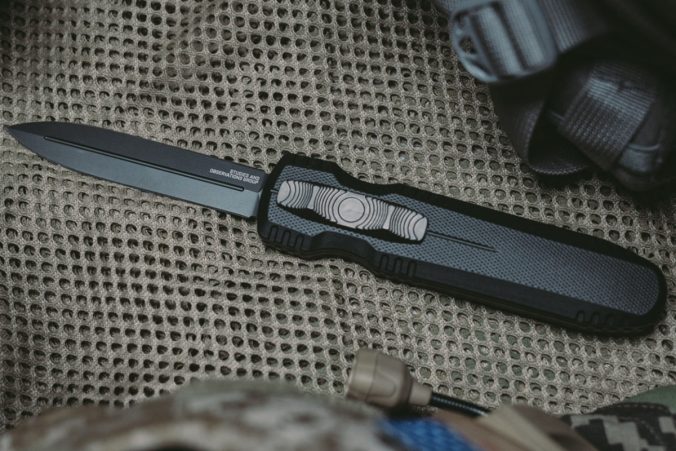
TL;DR: OTF means “out-the-front”: the blade moves through the front of the handle. OTF describes the blade path, not necessarily automatic operation. A manual OTF is moved by the user; a single-action automatic powers opening and uses a separate reset; a double-action automatic powers both opening and retraction.
What Is an OTF Knife?
An OTF knife stores its blade along the handle and extends it through a front opening. That differs from a folding knife, whose blade rotates around a pivot. The controls and internal construction vary by model, so a slider does not by itself establish that a knife is automatic.
For example, the Kershaw Kapsule 1190 uses a manual sliding button. The Kershaw Livewire 9000BLK is a double-action automatic. Understanding that distinction is the first step in comparing products.
This page explains types and ownership considerations. For current model recommendations, see our OTF buying guide or browse the OTF collection.
How Do Double-Action OTF Knives Work?
In a double-action automatic OTF, moving the operating switch deploys the blade, and moving it in the reverse direction retracts it. The mechanism guides the blade through the handle and locks it at its intended open or closed position.
The spring arrangement, locking components, control force, and reset procedure are specific to the design. There is no universal activation-force figure or deployment-time specification for every OTF. Compare manufacturer information for the exact model rather than relying on category-wide numbers.
A malfunctioning blade may fail to engage its track or lock. Follow the manufacturer’s reset instructions and keep the blade path clear. Do not treat an interrupted deployment feature as permission to point or fire the knife at a person.
Single-Action vs Double-Action: Which OTF Is Right for You?
| Type | Opening | Retraction | What to verify |
|---|---|---|---|
| Manual OTF | User moves the blade with the control | User-operated | Lock and control operation |
| Single-action automatic | Powered | Separate manual reset or charging mechanism | Model-specific reset procedure |
| Double-action automatic | Powered | Powered using the operating switch | Control direction, force, and care instructions |
The practical advantage of double-action operation is powered retraction through the same control. That does not prove that it is universally safer, more reliable, or more expensive. A single-action design should be reset using its intended mechanism; do not push the exposed edge or point against your hand or a surface as a generic closing method.
Choose the format you can operate comfortably and maintain according to the maker’s instructions. Spring count alone does not support a failure-rate comparison or an expected replacement date.
Are OTF Knives Legal in Your State?
Check current official rules for the actual knife and your circumstances. Ownership, sale, shipment, transport, open carry, concealed carry, blade length, age, and restricted locations may be treated differently. Manual and automatic mechanisms may also be classified differently.
A short blade or a “California-legal” product label is not blanket permission for every location or manner of carry. Likewise, “legal” does not mean unrestricted. Federal switchblade rules have definitions, restrictions, and exceptions that should not be reduced to a universal statement that interstate shipping or transport is always allowed or always prohibited.
Use current statutes and qualified guidance when needed. This product guide is general information, not legal advice, and does not provide a state-by-state legal determination.
OTF Brands and Model Identification
Identify a real OTF model before comparing brands. Microtech Ultratech, Benchmade Infidel, and Kershaw Livewire are automatic OTF families. A maker can also sell manual folders, side-opening automatics, and fixed blades, so its name alone does not establish an OTF mechanism.
Compare the exact SKU and generation. For instance, the Livewire 9000BLK uses a 3.3-inch CPM MagnaCut blade with a black PVD finish and an aluminum handle. The documented full-size Infidel 3300 uses a 3.91-inch D2 blade and double-action operation. Other versions may differ.
For additional examples, our original ten-model roundup identifies current linked versions and distinguishes historical comparisons. Prices and availability should be checked on the current product pages.
Steel and Service Comparisons
Consider corrosion resistance, toughness, edge retention, and sharpening needs alongside heat treatment and blade geometry. No steel guarantees a fixed number of weeks between sharpenings. Cutting material, edge angle, and use all affect the result.
Warranty coverage, sharpening services, and paid maintenance are different offerings. Read each manufacturer’s current terms, including exclusions and shipping or service charges. Do not assume a specific warranty period or free spring replacement from a brand or price category.
How to Choose Your First OTF Knife
- Check applicable law: Verify the rules for buying, receiving, owning, transporting, and carrying the exact type.
- Choose operation: Compare manual, single-action, and double-action formats.
- Match cutting needs: Consider blade shape, edge configuration, dimensions, and handle fit.
- Check carry details: Compare weight, closed length, thickness, clip position, and control placement.
- Plan care and service: Read the manual and confirm the manufacturer’s support route.
- Compare current listings: Verify the complete SKU, price, stock, and included accessories.
There is no universal budget threshold that guarantees reliability, and a lower-priced knife does not have a predetermined replacement date. Avoid relying on unverified cycle-life or edge-retention multipliers.
Common OTF Knife Problems and How to Fix Them
Weak or Slow Deployment
Lint, cutting residue, and inappropriate or excessive lubricant can interfere with operation. Follow the maker’s basic cleaning procedure. Microtech’s maintenance guide recommends clearing debris with compressed air, applying an appropriate light oil sparingly, and removing excess. Use guidance for your actual model.
Blade Play or Wobble
Do not assume that all movement indicates a defect or that every OTF should have identical lock-up. Compare with the manufacturer’s specification and ask for service guidance if movement changes, affects function, or raises concern. Do not adjust internal parts without approved instructions.
Blade Fails to Lock When Deployed
A blade that has not locked should not be used for cutting. Follow the model’s reset procedure. If basic care and an approved reset do not restore normal function, contact the manufacturer.
Slider Sticks or Binds
Do not force a jammed switch or continue operating a damaged mechanism. Clean only as instructed and seek service if the fault persists. Benchmade recommends professional service rather than user disassembly when basic cleaning does not resolve a problem.
Frequently Asked Questions
Are OTF knives good for everyday carry?
They can suit some cutting tasks and carry preferences where lawful. Compare the exact blade, handle, controls, and maintenance requirements with other knife formats.
What’s the difference between OTF and switchblade knives?
OTF describes the blade’s path through the front of the handle. Switchblade or automatic describes powered opening and may have a specific legal definition. A manual OTF is not automatically a switchblade merely because its blade moves out the front.
How often do OTF knife springs need replacement?
There is no universal schedule. Use the manufacturer’s service guidance; this article does not substantiate a two-, four-, or six-year spring-life promise.
Which OTF knife brand is most reliable?
A broad ranking requires comparable test data. Evaluate documented information for the actual models, maintenance needs, and service support rather than treating brand reputation as a guarantee.
Do OTF knives require special maintenance?
Follow model-specific instructions. Routine care may be possible without disassembly, and cleaning frequency depends on exposure and use. A universal weekly cleaning or oiling schedule is not appropriate for every design.
Can you carry an OTF knife on an airplane?
Do not pack an automatic OTF in carry-on baggage. Check current TSA guidance, airline policies, and possession and transport laws along your route. Checked-baggage screening rules do not create permission to possess or transport a prohibited knife.
What blade length is best for EDC OTF knives?
Choose a lawful blade and handle size suited to your tasks. No single length establishes comfort, utility, or legal carry for everyone.
Conclusion
Begin with the operating type, verify the exact configuration, and match the knife to lawful use and practical cutting tasks. For current choices, consult our OTF buying guide and OTF collection.
Manufacturer References
- Kershaw catalog: manual Kapsule 1190
- Kershaw catalog: Livewire 9000BLK
- Benchmade catalog: Infidel 3300 double-action mechanism
- Microtech maintenance quick guide
- Benchmade use and care
Leave a Reply