The Cutting Edge

The official blog of Knife Depot

Page 9 of 136

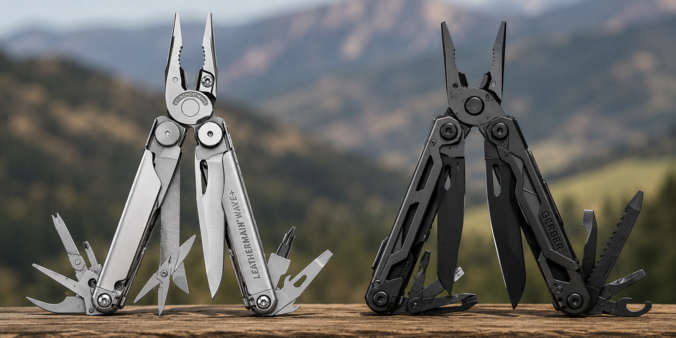
Best Multi-Tool with Knife: Leatherman vs Gerber (2026)

TL;DR: – Leatherman Wave+ ($120) dominates for blade accessibility and warranty coverage – 25-year protection beats Gerber’s limited lifetime

What Makes a Multi-Tool Knife Actually Useful?

Before you pick between these two brands, let’s define what separates a usable blade from a gimmick. You’re not looking for a knife that technically cuts – you want one that deploys without fumbling, holds an edge through real work, and doesn’t feel like an afterthought bolted onto pliers.

Here’s what matters: blade steel grade, blade length, and deployment method. A 2-inch blade that requires two hands to open isn’t practical for quick cuts. Steel matters too. According to Gear Junkie’s testing, the difference between 420HC stainless and premium grades shows up after 50+ cuts through rope or cardboard – edge retention drops noticeably on softer steel.

Deployment is the hidden factor most people overlook. Some multi-tools bury the blade inside the handle, forcing you to open the pliers first. Others have outside-accessible blades with thumb studs or finger tabs. For EDC, outside access wins every time.

Key Takeaway: A usable multi-tool blade needs outside accessibility, 2.5+ inches of length, and steel that holds an edge past 50 cuts. Anything less becomes a novelty.

Leatherman vs Gerber: How Do They Compare Overall?

Both brands dominate the market, but they approach design and warranty differently. Leatherman has been making multi-tools since 1983, building a reputation for durability that shows in their warranty terms. Gerber’s multi-tools feature 12 tools in the design, while Leatherman tools come with a 25-year warranty – a critical distinction.

The warranty difference is real. Leatherman’s 25-year coverage includes manufacturing defects and normal wear. Gerber’s Limited Lifetime warranty covers defects only, excluding damage from misuse or wear. If you’re using this tool daily, that distinction matters.

Price tiers overlap, but the steel grades don’t. At the $45–$85 range, both brands use budget stainless. At $100–$150, Leatherman upgrades to better steel while Gerber stays with mid-grade options. At $150+, Leatherman introduces premium alloys.

Manufacturing origin varies. Leatherman manufactures in Portland, Oregon. Gerber manufactures many models overseas, which affects both price and quality control consistency.

Key Takeaway: Leatherman’s 25-year warranty and US manufacturing justify a $20–30 premium over Gerber at comparable price points. Gerber wins on blade length and one-hand plier access, but at the cost of lower steel grades.

Top 3 Leatherman Multi-Tools with the Best Knife Blade

Leatherman Wave+ ($109)

This is the bestseller for a reason. The Leatherman Wave+ is a worldwide bestselling multitool, and the blade is a major part of why. You get both a plain and serrated blade, both outside-accessible without opening the pliers first. That’s rare in the Leatherman lineup.

The blade is 2.9 inches of 420HC stainless steel – not premium, but reliable. The Wave has been around for over 20 years, and the design is proven. Weight is 8.5 oz, which feels substantial without being burdensome for 8-hour carry.

The Leatherman Wave has a substantial tool assortment, including three screwdrivers and separate straight and serrated knife blades, along with a diamond-coated file, saw, scissors and bottle/can opener. That’s 18 tools total. The pliers open smoothly, and the locking mechanism is tight.

Real-world feedback from Blade Forums users consistently shows the Wave outlasting Gerber equivalents under heavy use. One user reported: “I have an original Leatherman that has been used and abused for something like 8 or nine years now and is still going strong.”

Key Takeaway: Wave+ offers outside-accessible dual blades, 18 tools, and proven durability at $109. Best all-around choice for EDC and light trade work.

Leatherman Skeletool ($85)

Want to cut weight? The Skeletool strips away tools you don’t use and focuses on what matters: a sharp blade, solid pliers, and a bottle opener. Closed dimensions: 4.13 by 25 by 0.5 inches; Weight: 5.2 ounces. That’s 3.3 oz lighter than the Wave+.

The blade is 2.63 inches of 420HC steel, outside-accessible with a finger tab. For EDC, this weight difference is noticeable over an 8-hour shift. Leatherman Bond weighs 5.8 oz, so the Skeletool is among the lightest full-featured options.

The trade-off: you lose the serrated blade, file, and scissors. If you’re cutting rope, cardboard, or packaging, the single plain blade handles it. If you need precision work, you’ll miss the file.

The Leatherman Skeletool CX has a 25-year warranty, same as the Wave+. The CX variant upgrades to S30V steel, but costs $150 – a $65 jump for edge retention that matters only if you cut dozens of times daily.

Key Takeaway: Skeletool at 5.2 oz is ideal for weight-conscious EDC. Single blade and minimal tool count trade versatility for portability.

Leatherman Charge+ TTi ($179)

This is where Leatherman’s blade game peaks. The Charge+ TTi uses 154CM stainless steel – a meaningful upgrade from 420HC. You’ll notice the difference after 100+ cuts: the edge stays sharper longer, and the blade resists corrosion better in humid environments.

Titanium handles reduce weight to 6.5 oz despite the larger tool count (19 tools). The blade is 2.8 inches, outside-accessible. The locking mechanism is tight, and the overall feel is premium.

The price jump from Wave+ ($109) to Charge+ TTi ($179) is $70. You’re paying for better steel, titanium construction, and one additional tool. If you use the blade daily for cutting tasks, that steel upgrade pays for itself in edge retention over 2–3 years.

Both blades are made of decent 420HC stainless steel, which is corrosion resistant and fairly easy to sharpen. The Charge+ TTi steps above this baseline with 154CM, which is harder and holds an edge longer.

Key Takeaway: Charge+ TTi at $179 justifies the premium for frequent cutters. 154CM steel + titanium handles + 19 tools = best blade performance in Leatherman’s lineup.

Top 3 Gerber Multi-Tools with the Best Knife Blade

Gerber Center-Drive ($120)

Gerber’s flagship competes directly with the Wave+ on price, but takes a different approach. The Center-Drive features a full-size, outside-accessible blade – 3.25 inches of 420HC stainless steel. The Gerber Center Drive has what I consider to be the best blade out of these three multitools. It’s a solid 3.25-inch blade – the longest of the three, and well above average for multitools in general.

The blade is longer than Leatherman’s flagship options, which matters for cutting tasks. You get more leverage and a wider cutting surface.

The mechanical differentiator is the center-axis bit driver. Pliers you can easily open with one hand. By pressing a button on the side of the tool you can easily make the pliers appear from the handle. This is a practical advantage if you’re working in gloves or with one hand occupied.

The catch: The wire cutters on the Leatherman are made from steel, those on the Gerber are made from tungsten carbide. Harder than steel, which means they retain their sharpness longer. Gerber’s cutters are tougher, but the blade itself uses the same 420HC as Leatherman’s entry-level tools.

Weight is 8.2 oz – comparable to the Wave+. Tool count is 12, fewer than Leatherman’s 18.

Key Takeaway: Center-Drive wins on blade length (3.25″) and one-hand plier access. 420HC steel matches Wave+, but tool count is lower at 12 vs 18.

Gerber Suspension NXT ($45)

This is the budget pick that doesn’t feel cheap. Suspension-NXT features spring-loaded pliers, a 7Cr17MoV steel blade, and butterfly opening. At $45, you’re getting a functional multi-tool, not a toy.

The blade is 2.6 inches of 7Cr17MoV – a lower-tier Chinese stainless that’s softer than 420HC. It sharpens easily but doesn’t hold an edge as long. For occasional use, this is fine. For daily cutting, you’ll notice the edge dulling faster.

Spring-loaded pliers deploy with a satisfying snap. The butterfly opening (both handles swing out) is intuitive. Tool count is 11, covering the basics: pliers, knife, file, screwdrivers, bottle opener.

The trade-off is obvious: you’re saving $65 vs the Center-Drive, but losing blade steel quality and tool count. If you’re testing whether you’ll actually use a multi-tool, this is the entry point.

Key Takeaway: Suspension NXT at $45 is the budget entry point. 7Cr17MoV blade dulls faster than 420HC, but spring-loaded pliers and 11 tools justify the price for occasional use.

Gerber Armbar Drive ($45)

This is closer to a pocket knife with tools than a full multi-tool. The Armbar Drive packs a knife blade, bit driver, awl, and bottle opener into a slim format – 2.5 oz, designed for minimalist EDC.

The blade is outside-accessible with a thumb stud. Deployment is smooth. The bit driver operates on-center, giving you real torque for screwdriving. The awl is useful for puncturing and prying.

The limitation: this is a single-tool focus. You’re not getting pliers, scissors, or a file. If your primary need is a blade with a few utility tools, this works. If you need pliers, keep looking.

Blade steel isn’t specified on the product page, which is a red flag. Assume it’s 7Cr17MoV or similar budget stainless.

Key Takeaway: Armbar Drive at $45 is a pocket knife alternative, not a full multi-tool. Best for minimalist EDC where blade + bit driver + awl cover your needs.

Which Brand Should You Choose for Your Use Case?

EDC (Everyday Carry)

Pick Leatherman Wave+ ($109). Outside-accessible dual blades, 18 tools, and 8.5 oz weight hit the sweet spot. You’ll use the blade 3–5 times daily (opening packages, cutting rope, trimming loose threads), and the serrated blade handles tasks the plain blade struggles with.

If weight is critical (you’re carrying 12+ hours), go Skeletool ($85) at 5.2 oz. You lose the serrated blade and file, but the plain blade covers 90% of EDC cutting tasks.

Trade/Contractor Work

Gerber Center-Drive ($120) edges ahead here. The 3.25-inch blade gives you more cutting surface for heavy-duty tasks. The one-hand plier deployment is practical when you’re wearing gloves or holding material with your other hand. The tungsten carbide cutters outlast steel under repeated use.

If you need premium blade steel, jump to Leatherman Charge+ TTi ($179). The 154CM blade holds an edge longer under constant cutting, and the 19-tool count covers more scenarios on a job site.

Camping/Outdoor

Wave+ again. The dual blades handle camp tasks: cutting rope, preparing kindling, opening food packaging. The file is useful for sharpening other tools. The 25-year warranty means you’re covered if something breaks in the field.

For ultralight backpacking, Skeletool ($85) saves 3.3 oz – meaningful over a multi-day trip. The single blade is sufficient for camp tasks.

Gifting

Wave+ ($109) is the safe choice. It’s the bestseller, proven reliable, and the 25-year warranty shows you’re giving something built to last. Most recipients will use it and appreciate the quality.

For someone who already has a multi-tool, Charge+ TTi ($179) is the upgrade gift – better steel, titanium handles, premium feel.

Key Takeaway: Wave+ is the universal choice for EDC and gifting. Center-Drive wins for trade work. Skeletool wins for weight-conscious carry. Charge+ TTi wins for frequent cutters.

How Do You Maintain the Knife Blade on a Multi-Tool?

Your multi-tool blade will dull with use. Here’s how to keep it sharp without sending it back to the manufacturer.

Cleaning: After use, wipe the blade with a dry cloth. If it’s been cutting wet material, dry it immediately to prevent corrosion. For stubborn residue, use warm soapy water and a soft brush. Don’t soak the tool – water can seep into the pivot and cause rust.

Sharpening angle: Multi-tool blades are typically sharpened at 20–25 degrees per side. This is a general-purpose angle that balances edge retention and ease of sharpening. Use a whetstone or pull-through sharpener at this angle. If you’re unsure, start at 20 degrees and adjust based on results.

Lubrication: The pivot point is critical. Every 2–3 months of regular use, apply a light machine oil (3-in-1 oil works) to the blade pivot. Work the blade open and closed 10 times to distribute the oil. Don’t over-oil – excess oil attracts dirt.

When to replace vs. sharpen: If the blade is chipped or bent, replacement is your only option. Both Leatherman and Gerber sell replacement blades, though they’re pricey ($15–25). If the edge is just dull, sharpening works. A blade that’s been sharpened 5+ times will eventually need replacement. Knowing when a tool has reached the end of its useful life – rather than continuing to patch it – is a sound maintenance principle that applies equally well to gear care decisions.

Storage: Keep the tool dry. If you’re storing it for months, apply a light coat of oil to the blade to prevent corrosion. Store in a dry location, not a damp garage or basement.

Key Takeaway: Sharpen at 20–25° every 3–6 months of regular use. Oil the pivot every 2–3 months. Replace only if chipped or bent. Proper maintenance extends blade life 2–3 years.

FAQ: Leatherman vs Gerber Multi-Tool Questions

Is Leatherman or Gerber better quality for everyday carry?

Direct Answer: Leatherman is better for EDC. The Wave+ offers outside-accessible dual blades, 18 tools, and a 25-year warranty that covers normal wear – not just defects.

Gerber’s Center-Drive is competitive on blade length and one-hand plier access, but the Limited Lifetime warranty excludes wear damage. For daily carry over years, Leatherman’s warranty protection and blade accessibility win. One user reported: “I use to like the Gerber, but when I got my Wave, the Gerber is collecting dust.”

Which multi-tool has the best knife blade steel?

Direct Answer: Leatherman Charge+ TTi uses 154CM steel, the best in either brand’s lineup. It holds an edge longer than 420HC under comparable cutting tasks.

Gerber’s Center-Drive uses 420HC, same as Leatherman’s Wave+. If you cut frequently (50+ cuts daily), the 154CM upgrade in the Charge+ TTi ($179) justifies the $70 premium over the Wave+ ($109). For occasional cutting, 420HC is sufficient.

How much should you spend on a multi-tool with a good knife?

Direct Answer: $85–$120 covers the practical range. Below $85, you’re compromising on blade steel or tool count. Above $150, you’re paying for premium materials (titanium, S30V steel) that matter only if you use the blade daily.

The Leatherman multitool features 14 tools included in its design at the Wave+ price point ($109). That’s the value sweet spot. If you cut frequently, jump to Charge+ TTi ($179). If you’re testing whether you’ll use it, start with Skeletool ($85).

Can you take a Leatherman or Gerber multi-tool on a plane?

Direct Answer: No. Both brands’ multi-tools with knife blades are prohibited in carry-on luggage by the TSA. They must be checked.

If you travel frequently, Leatherman makes the Style PS – a blade-free multi-tool that’s TSA-approved for carry-on. It has pliers, scissors, and tools, but no knife. Check TSA.gov for current rules before flying.

What is the difference between the Leatherman Wave+ and the Gerber Center-Drive?

Direct Answer: Wave+ ($109) has dual blades (plain + serrated), 18 tools, and outside-accessible blade design. Center-Drive ($120) has a single 3.25-inch blade, 12 tools, and one-hand plier deployment via center-axis bit driver.

Wave+ is better for versatility and blade options. Center-Drive is better for blade length and one-hand plier access. Both blades are made of decent 420HC stainless steel, which is corrosion resistant and fairly easy to sharpen. The warranty differs: Leatherman covers wear; Gerber covers defects only.

Are Gerber multi-tools made in the USA?

Direct Answer: No. Gerber manufactures most multi-tools overseas, primarily in China. Leatherman manufactures in Portland, Oregon.

This affects price and quality consistency. Leatherman’s US manufacturing justifies a $20–30 premium. Gerber’s overseas production allows lower pricing but with variable quality control. If US manufacturing is important to you, Leatherman is the choice.

How do you sharpen the knife blade on a multi-tool?

Direct Answer: Use a whetstone or pull-through sharpener at 20–25 degrees per side. Work the blade across the stone 5–10 times per side until the edge is sharp. Test on paper – it should cut cleanly without tearing.

For field sharpening, a ceramic stick or small whetstone works. For home maintenance, a full whetstone gives better results. Avoid electric sharpeners – they remove too much metal too quickly. If the blade is chipped, replacement is your only option.

Conclusion

The choice between Leatherman and Gerber comes down to your priorities. Leatherman has been making multi-tools since 1983, and that experience shows in design and warranty. The Wave+ is the safe, proven choice for EDC. The Charge+ TTi is the upgrade for frequent cutters.

Gerber’s Center-Drive competes on blade length and one-hand plier access, but at the cost of lower blade steel grades and a limited warranty. It’s the choice if you prioritize blade size and mechanical innovation over long-term durability.

For most people, the Leatherman Wave+ at $109 is the answer. It’s the bestseller for a reason: dual blades, 18 tools, outside accessibility, and a 25-year warranty that actually covers wear. You’ll use it 3–5 times daily and appreciate the quality for years.

Ready to upgrade your EDC? Browse Knife Depot’s current multitool selection with competitive pricing and fast shipping. Whether you’re choosing Wave+, Skeletool, or Center-Drive, you’ll find detailed specs and user reviews to guide your decision.
Upgrade Your Everyday Carry
Built for performance. Designed to stand out. Shop knives ready for everyday carry, the outdoors, or your collection.
Free ground shipping on eligible continental U.S. orders over $99. Cannot be combined with other discounts. See shipping terms.
Browse Multitools

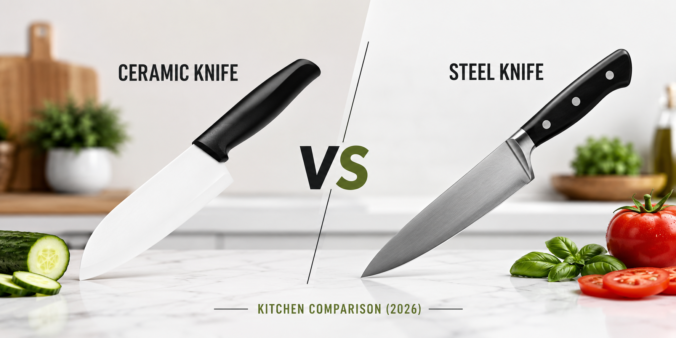
Ceramic Knife vs Steel Knife: Kitchen Comparison (2026)

TL;DR: – Ceramic knives arrive sharper and stay sharp longer than steel, but shatter on hard foods and tile drops

  • Steel knives cost less upfront and last decades; ceramic requires expensive professional sharpening ($10–$20 per service)
  • Best setup for home cooks: one ceramic slicer for soft produce + one versatile steel chef’s knife for home cooking for everything else

You’re Deciding Between Two Very Different Kitchen Tools

You’re standing in the kitchen knife aisle, and the choice feels simple: ceramic or steel? But here’s the thing – these aren’t just different versions of the same tool. They’re fundamentally different materials with opposite strengths and weaknesses.

Based on our analysis of kitchen knife testing data from Knives and Tools (December 2014), Serious Eats, and Cook’s Illustrated (2023), we’ve mapped out exactly how these blades perform across seven measurable criteria. This guide cuts through the marketing noise and shows you which knife actually fits your cooking style – and your budget.

The decision matters because you’ll use this knife hundreds of times. Get it wrong, and you’re either replacing it constantly or struggling with a tool that doesn’t match your needs.

What Is the Core Difference Between Ceramic and Steel Knives?

Ceramic knives are made from zirconia oxide – a material second only to diamonds in hardness. Steel knives use iron-based alloys that are softer but far more flexible.

This one material difference cascades into everything else. Ceramic is harder. Steel is tougher. That’s the whole story, but it changes everything about how you use each knife.

Hardness vs. Toughness: The Critical Distinction

Think of hardness as resistance to scratching. Think of toughness as resistance to breaking. Ceramic is the second hardest material, right after diamonds, but more hardness means more fragility. Steel is softer but bends instead of shattering.

Quick Comparison Table

Property Ceramic Steel
Hardness (HRC) ~80–85 52–64
Bevel Angle 15° 20–25°
Weight 30–50% lighter Standard
Edge Type Micro-sharp, brittle Durable, rollable
Corrosion Risk None Stainless resists; carbon rusts

The bevel angle matters more than you’d think. Ceramic knives are typically sharpened to a 15-degree angle per side, compared to 20–25 degrees for most European-style steel knives. That acute angle is why ceramic feels sharper out of the box.

Key Takeaway: Ceramic is harder and sharper; steel is tougher and more forgiving. Neither is universally “better” – they’re tools for different jobs.

How Do Ceramic and Steel Knives Compare on Sharpness and Edge Retention?

Ceramic wins the sharpness battle. Steel wins the longevity war.

Out-of-the-Box Sharpness

When tested for sharpness, Kyocera ceramic knives are delivered very sharp – comparable to steel knives and in some cases even better. That 15-degree bevel angle creates a thinner, more acute edge. You’ll feel the difference immediately when slicing tomatoes or herbs.

Edge Retention: The Real Story

In testing, ceramic knives perform considerably better than steel knives, staying sharp for a longer amount of time. But ceramic knives chipped noticeably faster than steel when used on glass and ceramic boards. That micro-chipping negates the edge retention advantage if you’re not using a plastic cutting board.

The practical takeaway: ceramic’s edge retention advantage only applies under ideal conditions – soft foods, plastic boards, no pressure. Real kitchens are messier.

Why the Difference?

Steel edges roll and bend. Honing realigns the microscopic edge without removing metal, preserving the acute angle critical for clean cutting. Ceramic edges don’t bend – they chip. You actually need a diamond stone (not a rod) to sharpen a ceramic knife. There’s no equivalent to honing for ceramic, which means it’s functionally dull between professional sharpening sessions in a way steel isn’t.

Key Takeaway: Ceramic stays sharper longer on soft foods, but micro-chips on hard boards. Steel requires more frequent sharpening but can be honed between sessions at zero cost.

Durability and Brittleness: Where Each Blade Type Wins and Loses

This is where ceramic’s limitations become obvious.

The Drop Test Reality

Drop a ceramic knife from counter height onto tile. It shatters. Drop a steel knife the same way. It survives with minor edge damage. Ceramic is such a hard material it can only be sharpened by diamond, and that same hardness means zero flex tolerance.

What Ceramic Cannot Do

Ceramic knives aren’t meant to cut hard food such as frozen foods, bones, or anything that isn’t easily sliced. Don’t use ceramic for:

  • Frozen items
  • Bones or cartilage
  • Hard squash or root vegetables
  • Bread (requires a serrated edge)
  • Any prying or twisting motion

They are very lightweight when compared to a similar steel knife, which some cooks find fatiguing during extended prep work because you lose the momentum that helps steel knives cut.

What Steel Handles

Steel knives are workhorses. They bend, they recover, they survive abuse. You can pry, twist, and cut frozen food. They last decades with basic care.

The Brittleness Trade-off

More hardness means more fragility. You’re trading durability for sharpness. For most home cooks, that’s a bad trade.

Key Takeaway: Ceramic shatters on hard foods and tile drops; steel survives the same abuse. Ceramic is a specialty tool, not a workhorse.

Maintenance, Sharpening, and Long-Term Care Compared

This is where the total cost of ownership diverges dramatically.

Sharpening: The Ceramic Problem

You actually need a diamond stone (not a rod) to sharpen a ceramic knife. Standard whetstones won’t work. Most local sharpening services refuse ceramic blades because they require specialized equipment.

When you do find a service, expect to pay $10–$20 per knife. At twice yearly sharpening, that’s $40–$80 annually per ceramic knife.

Steel Sharpening: DIY or Professional

A quality whetstone costs $30–$60 as a one-time investment (see our beginner’s guide to sharpening stones). You can sharpen your steel knives at home, or pay $5–$15 per knife at a professional service. Bozeman charges $2.00 per inch (of the blade), plus a $5 handling charge for each order. KySharp’s Signature Service costs $12 and includes sharpening at 15 degrees, mirror polish bevel, and repairs.

Corrosion and Rust

Ceramic material is not very porous. This keeps the blade from transferring odours from one food ingredient to another. Ceramic is also fully corrosion-proof – no rust, no staining, no maintenance beyond sharpening.

Steel varies. Stainless steel resists rust but requires hand-washing and drying. Carbon steel requires immediate drying and periodic oiling to prevent rust – if you’re weighing those trade-offs, our carbon steel vs stainless steel comparison goes deeper. Neither is as low-maintenance as ceramic.

Honing: The Hidden Cost

Steel knives benefit from regular honing with a honing rod ($10–$20, one-time). Ceramic cannot be honed. This means ceramic edges degrade faster between sharpenings in real kitchen use.

Key Takeaway: Ceramic sharpening costs $40–$80 annually; steel sharpening costs $30–$60 one-time for a whetstone. Ceramic requires professional service; steel can be DIY.

Price, Value, and Cost Over Time: Which Is the Smarter Buy?

The sticker price is deceptive. Total cost of ownership tells the real story.

Entry-Level Pricing

Ceramic knives start around $25–$40 for basic models. Steel knives start around $35–$50 for equivalent quality. The gap is small.

Mid-Range Pricing

Quality ceramic knives run $60–$120. Quality steel knives run $50–$150. Steel has more options at every price point.

5-Year Total Cost of Ownership

Let’s calculate:

Ceramic Setup:

  • Mid-range ceramic knife: $75
  • Professional sharpening: $15/service × 2 per year × 5 years = $150
  • Total: $225

Steel Setup:

  • Mid-range steel knife: $80
  • Whetstone (one-time): $45
  • Optional professional sharpening: $0–$50 over 5 years
  • Total: $125–$175

Steel is cheaper over time. But there’s another factor: replacement rate.

Lifespan Reality

A well-maintained steel chef’s knife will outlast almost any home cook. Budget ceramic knives have a practical lifespan of 3–7 years before chipping becomes excessive or the handle adhesive fails. Quality steel knives last 20–50 years.

If you replace a ceramic knife every 5 years, you’re spending $225 per cycle. A steel knife bought once lasts a lifetime.

Key Takeaway: Ceramic costs $225 over 5 years; steel costs $125–$175. Steel wins on total cost of ownership and lifespan.

Which Tasks Should You Use Each Knife For?

Stop thinking of this as “which knife is better.” Think of it as “which knife for which job.” Matching the right tool to the right task – much like prioritizing work by urgency and importance – is what separates efficient cooks from frustrated ones.

Ceramic Excels At:

  • Slicing soft vegetables (tomatoes, cucumbers, peppers)
  • Boneless proteins (chicken breast, fish fillets)
  • Herbs and leafy greens
  • Sushi-grade fish
  • Any task where you want a razor-sharp edge on soft food

Steel Excels At:

  • Butternut squash and hard vegetables
  • Bread (with a serrated edge – see our plain vs serrated vs combo edge guide)
  • Frozen items
  • Butchering and breaking down meat
  • Prying and heavy-duty tasks
  • General-purpose kitchen work

Never Use Ceramic For:

  • Frozen food
  • Bones or cartilage
  • Hard squash
  • Bread (unless serrated)
  • Any twisting or prying motion

The Recommended Setup

If you want to add a ceramic knife to your kitchen, think of it as a specialty tool for slicing fruits, boneless proteins, and herbs – not a replacement for your chef’s knife. Pair one ceramic slicer (6–7 inches) with one all-purpose steel chef’s knife (8 inches). This covers most home cooking tasks.

Key Takeaway: Use ceramic for soft produce and proteins; use steel for everything else. The optimal home kitchen has both, not either/or.

Frequently Asked Questions: Ceramic Knife vs Steel Knife

Are ceramic knives actually sharper than steel knives?

Direct Answer: Ceramic knives arrive sharper out of the box due to their 15-degree bevel angle versus steel’s 20–25 degrees. However, this sharpness advantage only persists on soft foods and plastic cutting boards.

When tested for sharpness, Kyocera ceramic knives are delivered very sharp – comparable to steel knives and in some cases even better. The difference is measurable but conditional. On glass or ceramic boards, ceramic micro-chips faster than steel, negating the edge retention advantage within weeks of regular use.

Why do ceramic knives break or chip so easily?

Direct Answer: Ceramic is extremely hard but brittle. Hardness and brittleness are linked – the same property that makes ceramic sharper makes it fragile.

More hardness means more fragility. Steel is softer, so it bends and recovers. Ceramic cannot bend – it shatters. Drop a ceramic knife from counter height, and it breaks. Drop a steel knife the same way, and it survives.

Can you sharpen a ceramic knife at home?

Direct Answer: No. Ceramic requires diamond-wheel sharpening, which is not practical for home use.

Sharpening a ceramic knife at home is largely impossible. Standard whetstones are too soft to abrade zirconia. Most home cooks must use professional sharpening services, which cost $10–$20 per knife and are difficult to find.

Which type of knife is safer for beginner cooks?

Direct Answer: Steel knives are safer for beginners because they’re more forgiving of mistakes and misuse.

Ceramic knives require careful handling – no dropping, no hard foods, no twisting. Steel knives tolerate abuse. A beginner will inevitably drop a knife, cut frozen food, or use it for tasks it wasn’t designed for. Steel survives these mistakes. Ceramic shatters.

How much does a good ceramic knife cost compared to steel?

Direct Answer: Entry-level ceramic and steel knives cost roughly the same ($25–$50), but total cost of ownership favors steel by 40–50% over five years.

A mid-range ceramic knife costs $60–$120 plus $40–$80 annually in professional sharpening. A mid-range steel knife costs $50–$150 plus $30–$60 one-time for a whetstone. Steel is cheaper upfront and dramatically cheaper over time.

Can ceramic knives cut meat or only vegetables?

Direct Answer: Ceramic knives can cut boneless meat (chicken breast, fish fillets) but cannot cut bones, cartilage, or frozen meat.

Ceramic knives aren’t meant to cut hard food such as frozen foods, bones, or anything that isn’t easily sliced. For general meat preparation, steel is the better choice. Ceramic works for slicing cooked, boneless proteins.

Do professional chefs use ceramic knives?

Direct Answer: Professional chefs rarely use ceramic knives as primary tools. Ceramic is used as a specialty slicer in limited professional contexts.

Most professional cooks keep a ceramic knife in the drawer for delicate tasks but would never reach for it as their go-to blade. The fragility and maintenance requirements make ceramic impractical for high-volume kitchen work. Steel dominates professional kitchens.

The Bottom Line: Which Knife Should You Actually Buy?

If you cook frequently and want a workhorse knife that lasts decades, buy steel. If you want a specialty slicer for soft produce and boneless proteins, buy ceramic. Better yet, buy both.

The ceramic-versus-steel debate is really a false choice. They’re not competitors – they’re complementary tools. A 6-inch ceramic slicer and an 8-inch steel chef’s knife cover virtually every home cooking task. The ceramic handles delicate slicing where sharpness matters most. The steel handles everything else.

For most home cooks, the steel knife will get most of the use. The ceramic knife will sit in the drawer, waiting for tomatoes and herbs. That’s fine. It’s still worth having, because when you need that razor-sharp edge on soft food, ceramic excels.

The real decision isn’t ceramic or steel. It’s whether you want a specialty tool alongside your workhorse blade. If you do, you’ve found your answer.

Explore Kitchen Knives
Ready to add the right blade to your kitchen? Whether you’re looking for a precision ceramic slicer or a versatile steel chef’s knife, Knife Depot carries premium options across both categories. Browse tested, reliable knives built for real cooking.
Quality blades in stock now.
Free ground shipping on eligible continental U.S. orders over $99. Cannot be combined with other discounts. See shipping terms.
Browse kitchen knives

The Lucky 7: Seven Benchmade Knives Worth a Closer Look

Feeling lucky?

This week, we handpicked seven standout Benchmade knives that deserve a closer look.

From premium everyday carry options to distinctive collector-worthy designs, this curated lineup brings together seven sharp picks from one of the most respected names in knives.

Whether you’re looking to upgrade your carry, add something new to the collection, or finally grab the Benchmade you’ve had your eye on, your lucky number might just be seven.

Seven Benchmade knives. One featured collection. Which one gets your vote?

Shop the Lucky 7

How to Choose Durable Gear for Backcountry Adventures

durable gear for backcountry adventures

Source

Gear fails at the worst possible moments: a torn tent seam in a rainstorm, a backpack strap delaminating three miles from the trailhead, a sleeping pad deflating overnight at altitude. Choosing durable gear for backcountry camping means understanding what actually holds up under real conditions, not just what looks sturdy on a shelf or sounds impressive in a product description.

True durability comes down to four interconnected factors: materials, construction quality, repairability, and design that suits the specific demands of a trip. A quick way to evaluate any piece of gear is to check fabric strength and denier ratings, inspect seams for reinforcement and taping, look at hardware like buckles and zippers, and research whether the design has been field-tested over time.

This applies across every category, from a backpack and shelter to a sleeping bag and sleeping pad. Ultralight gear adds another layer of complexity, since weight savings often involve trade-offs that only become visible after repeated use, exposure to moisture, abrasion, and sustained load. The sections ahead break down how to read those trade-offs clearly.

What Durable Backcountry Gear Really Looks Like

When evaluating any piece of gear, a few markers stand out immediately. Fabric strength, reinforced seams, reliable hardware, and a field-tested design are the fastest indicators of whether something will hold up. Beyond that first pass, durability is really about how well gear performs across repeated use, moisture exposure, abrasion, and load, not just how tough it feels in a store.

It helps to keep a short checklist in mind:

  • Fabric strength and denier rating relative to the gear category
  • Reinforced seams with taping or bar-tack stitching at stress points
  • Reliable hardware, including buckles, zippers, and pole connections
  • Field-tested design with a track record across real backcountry conditions
  • Repairability, meaning whether the gear can be fixed in the field or serviced afterward

Marketing language like “rugged” or “heavy-duty” without supporting build details is worth treating with skepticism. The rest of this article explains how to look past those labels and evaluate gear on its actual construction.

How to Spot Quality in Materials and Build

Reading a product spec sheet is a skill worth developing. Knowing what fabric terms, denier ratings, and construction callouts actually mean helps separate genuinely durable gear from products that simply sound durable. Buyers in other gear-heavy categories apply the same logic: for example, those looking for cheap bulk ammo by the case rely on clear product specifications rather than vague marketing claims to judge consistency and value. The same principle applies here.

Materials That Hold Up on Rough Trips

Not every durable material is a heavy one. Denier measures thread thickness in synthetic fabrics, and while higher denier generally means more abrasion resistance, context matters a great deal. A 70D ripstop nylon floor on a Big Agnes tent is intentionally lighter than a 150D base, but the ripstop weave compensates by distributing tear forces across a grid pattern rather than concentrating them in a single thread.

Face fabric and coatings work together, so evaluating one without the other misses the full picture. A DWR coating on rain gear determines how well water beads off the outer shell, while the membrane underneath handles breathability. For a backpack, the relevant question is abrasion resistance at the base and contact points. For a tent, it shifts toward waterproof ratings and floor puncture resistance.

Category shapes every material judgment. Osprey and MSR engineer their products for different stress profiles, and a denier threshold that signals quality on a backpack means very little when applied to a tent fly or a stove carry case.

Construction Details That Signal Longevity

Seams, stitching, and hardware reveal more about a product’s lifespan than fabric specs alone. Bar-tack stitching at high-load points, such as shoulder strap attachments and lid buckles, reinforces exactly where stress concentrates during a loaded carry. YKK zippers are a widely recognized indicator of pull quality and long-term reliability across rain gear, packs, and shelters.

Specific callouts like reinforced corners, taped seams, or welded attachment points give something concrete to evaluate, while vague language like “rugged” or “heavy-duty” without supporting build details is a flag worth noticing.

durable gear for backcountry adventures

Source

Match Durability to the Abuse Your Trip Adds

Durability is not a fixed quality; it shifts depending on what a trip actually demands. A shelter that holds up perfectly on a forested three-season weekend may degrade quickly on an exposed ridge with freeze-thaw cycles, persistent moisture, and high UV at elevation.

Route type, terrain, and season each change which failure risks matter most. Scrambling on talus puts very different pressure on footwear than soft trail hiking does, and bushwhacking through dense brush abrades pack fabric in ways that groomed trails never would.

It helps to think in specific stressors before buying:

  • Abrasion from rock, brush, and repeated pack loading affects the base of a backpack and the outsole of footwear first
  • UV exposure over multi-day trips degrades coatings on shelter fabrics and rain gear faster than single-night use
  • Moisture cycling and mud accelerate wear on zippers, buckles, and filter membranes
  • Freeze-thaw shifts stress tent poles, tent floor laminates, and adhesive seam tape over time
  • Pack weight amplifies stress at every contact point, from hip belt stitching to shoulder straps

Backcountry camping rarely delivers one type of abuse cleanly. Most trips combine several of these stressors at once, which is why identifying the highest failure risks for a specific route before buying leads to better decisions than defaulting to whatever is marketed as tough.

Where to Spend for Toughness and Where to Cut

Durability is best treated as a selective investment rather than a blanket standard applied equally across every gear category. Some items face far more stress than others, and that difference should guide where the budget goes.

Gear That Deserves Your Durability Budget

Some categories earn a higher durability investment because failure carries real consequences for safety, comfort, and completing a trip.

A backpack absorbs constant load stress across hundreds of flexion cycles per day. A tent takes wind, moisture, and ground abrasion on every outing. A sleeping bag and sleeping pad determine whether rest is actually restorative. Footwear handles the combined weight of the hiker and their pack across uneven terrain for hours at a stretch. A stove takes repeated heat cycling and handling in conditions that accelerate wear on joints and valves.

These are the categories where spending more on proven construction pays back across many trips rather than just one.

When Lighter Gear Is Still the Smart Pick

Ultralight gear is not automatically a compromise. For shorter trips, well-maintained trails, and experienced hikers with precise pack weight discipline, lower-margin materials perform reliably within their intended range.

The relevant factors are trip length, terrain type, and how much abuse the gear will realistically absorb. A thru-hiker who replaces gear seasonally may find ultralight options cost-effective overall, while a beginner on a week-long remote route generally benefits from the extra margin that heavier, more forgiving construction provides.

The goal is gear that is durable enough for the specific trip, not simply the heaviest available option in each category.

How to Judge the Key Gear Categories

Durability shows up differently depending on the category, so the same evaluation criteria do not apply uniformly across a full kit. Breaking things down by gear type makes comparisons more practical.

Backpack, Shelter, and Sleep System

A well-fitted backpack distributes load through a frame that flexes without buckling, so checking hip belt construction, shoulder strap attachment points, and base fabric reinforcement tells more about longevity than brand name alone. High-wear zones at the base and side compression areas show wear first, and quality models from REI or Osprey use heavier denier fabric specifically in those spots.

For tents and shelters, pole material and diameter, seam taping, floor fabric weight, and guyline attachment points are the details worth comparing directly. A tent floor faces abrasion from both the ground and packed gravel underneath.

Sleeping systems require looking at shell fabric durability alongside insulation protection and pad construction. Sleeping pad R-value reflects thermal resistance, and the ASTM R-value standard gives that number a consistent, testable meaning. Therm-a-Rest pads are rated under this standard, making comparisons across brands more reliable.

Footwear, Water, and Cooking Essentials

Footwear wears at the outsole first, particularly under the ball of the foot and heel, so sole thickness and rubber compound matter beyond upper construction.

Water filters clog or crack at the membrane under repeated freezing and heavy sediment loads, making maintenance access a practical buying criterion. Stoves wear at burner jets and valve threads, and models with replaceable parts extend usable life considerably compared to sealed units.

Maintenance Habits That Make Gear Last Longer

How gear gets treated between trips affects how long it performs on them. Dirt, moisture, and improper storage quietly break down materials long before the trail does.

Cleaning and drying gear before putting it away prevents coating breakdown and mildew. Rain gear that goes back into a stuff sack while still damp loses its DWR performance faster. A sleeping bag stored compressed loses loft over time, so hanging or storing it loosely in a large sack preserves insulation fill.

Tents should be dried fully before storage, and sleeping pads benefit from being left unrolled to relieve valve and foam stress. Small field repairs, such as patching a torn seam, swapping a tent pole section, or addressing footwear delamination before the next outing, keep minor damage from becoming a trip-ending problem.

Carrying a basic repair kit that includes knives built for wilderness survival expands what is fixable in the field. Pairing that with blades suited for camping and survival covers a wider range of cutting and repair tasks without adding significant weight.

Choose for the Long Haul, Not Just the Next Trip

Durable gear for backcountry camping is not about buying the heaviest or most technical option available. It comes down to matching build quality to terrain, frequency of use, and the category-specific stress a trip actually creates.

The best decisions balance construction quality, weight, and repairability against realistic needs. A thoughtful purchase, paired with consistent maintenance, will outperform a tougher-looking option that gets stored carelessly, overloaded, or mismatched to the route. Managing pack weight thoughtfully and choosing ultralight options within their intended range rounds out a framework that holds up across many seasons.

Knife Gift Ideas for Men: Holiday & Birthday Guide 2026

Knife Gift Ideas for Men: Holiday & Birthday Guide 2026

TL;DR:

  • Budget EDC knives ($30–$75) like the Kershaw Leek and CIVIVI Elementum are the highest-volume gift tier for non-knife-owners
  • Kitchen knife gifts split into two tiers: Victorinox Fibrox Pro (~$40) for beginners, premium forged options for serious cooks
  • Outdoor/hunting knives ($60–$110) like the Buck 119 and ESEE-4 suit adventurers; pair with a sharpening stone for thoughtfulness
  • Premium collector knives ($150+) from Benchmade and Spyderco reward enthusiasts with better steel and lifetime warranties
  • Adding accessories (whetstones, sheaths, maintenance kits) elevates any knife gift and shows genuine care

Introduction: Finding the Right Knife for Your Guy

Picking a knife as a gift feels risky. You’re not sure if he already owns one. You don’t know if he prefers folding or fixed blade. And you’re definitely unsure whether a $40 pocket knife or a $150 premium folder is the move.

Here’s the thing: knives are one of the most practical gifts you can give. Unlike gadgets that become obsolete, a quality knife stays useful for decades. But the knife world has its own language – blade steels, lock types, tang construction – that can feel overwhelming if you’re new to it.

Based on our analysis of knife enthusiast communities, retailer gift guides, and manufacturer recommendations collected through 2026, we’ve mapped out exactly which knives work best for different types of guys, at every price point. Whether you’re shopping for someone who’s never carried a knife or a collector with a dozen already, this guide cuts through the noise.

How to Pick the Right Knife Gift for Any Man

Before you land on a specific model, match the knife type to how your guy actually lives.

The Quick Match Table:

Recipient Type Best Knife Category Price Range
Never carried a knife EDC pocket knife (folding) $30–$75
Cooks regularly Kitchen chef knife or santoku $40–$160
Hunts or camps Fixed blade (bushcraft or hunting) $35–$110
Serious enthusiast Premium folder or collector piece $100–$300+
Outdoorsman who does everything Multi-tool or fixed blade + accessories $60–$150

EDC vs. Kitchen vs. Outdoor vs. Collectible

An EDC (everyday carry) pocket knife is small, folds, and lives in a pocket. It’s for opening packages, cutting rope, or general utility. Kitchen knives are fixed, larger, and designed for food prep. Outdoor/hunting knives are fixed blades built for hard use in the field. Collector knives prioritize premium materials and craftsmanship over pure utility.

The biggest mistake gift-givers make? Buying a kitchen knife for someone who doesn’t cook, or an outdoor knife for someone who never leaves the city. Match the knife to the lifestyle.

One Legal Note: Automatic (switchblade) knives are restricted in multiple U.S. states, and blade length limits for folding knives vary by jurisdiction. Before gifting anything with a blade longer than 3 inches or any automatic mechanism, check your recipient’s state laws. Knife Rights Foundation maintains a state-by-state guide.

Key Takeaway: Match knife type to lifestyle first – EDC for daily carry, kitchen for cooks, fixed blade for outdoors, premium for collectors. Check local blade length laws before gifting automatics or large fixed blades.

What Are the Best EDC Pocket Knife Gift Ideas Under $75?

This is the sweet spot for most gift-givers. A pocket knife under $75 is affordable enough to feel like a thoughtful gift without breaking the bank, yet quality enough that the recipient will actually use it.

The best budget EDC knives share three traits: reliable blade steel that holds an edge without constant maintenance, a secure lock mechanism, and a design that’s proven across thousands of users. You’re not paying for exotic materials here – you’re paying for reliability.

Best Budget EDC Knife Gifts Under $50

Kershaw Leek (~$45)

According to Knife Depot, the Kershaw Leek has a ComboEdge stainless steel blade that is four inches long. It features SpeedSafe assisted opening and a liner lock. The 8Cr13MoV steel is a workhorse – it doesn’t hold an edge quite as long as premium steels, but it’s easy to sharpen and resists corrosion well. This is the knife for someone who wants something reliable without overthinking it.

CIVIVI Elementum (~$40)

The Elementum is available with D2 or 9Cr18MoV blade steel, offering meaningful edge retention at a budget price. At under $45, it’s one of the best value propositions in the EDC space. The design is clean, the action is smooth, and it feels more expensive than it costs.

Spyderco Tenacious (~$55)

The Tenacious uses 8Cr13MoV steel and a liner lock, and it’s consistently recommended in knife communities as an excellent first serious folding knife. It’s slightly larger than the Leek, which some guys prefer. The distinctive Spyderco hole for one-handed opening is a nice touch.

Model Blade Steel Lock Type Blade Length Price
Kershaw Leek 8Cr13MoV Liner Lock 3″ ~$45
CIVIVI Elementum D2/9Cr18MoV Liner Lock 3.2″ ~$40
Spyderco Tenacious 8Cr13MoV Liner Lock 3.4″ ~$55

Best Mid-Range EDC Knife Gifts $50–$75

Benchmade Griptilian (~$70)

Stepping up to $70 gets you into American-made territory. The Griptilian uses 154CM stainless steel (better edge retention than budget steels) and Benchmade’s proven AXIS lock. It’s heavier than budget options but feels more substantial in hand. Benchmade also offers lifetime sharpening and warranty service, which adds real value.

Spyderco Para 3 (~$75)

If your guy is willing to spend closer to $75, the Para 3 is a step up. It uses CPM-S30V steel, which holds an edge significantly longer than 8Cr13MoV. The compression lock is Spyderco-exclusive and highly regarded. This is the knife for someone who appreciates quality and will use it enough to justify the investment.

Key Takeaway: Under $50, the Kershaw Leek and CIVIVI Elementum offer the best value. At $50–$75, Benchmade and Spyderco models introduce better steel and American manufacturing – worth the jump if your recipient is a serious user.

Best Kitchen Knife Gift Ideas for Men Who Cook

Kitchen knives are a different beast. A guy who cooks regularly will use a chef’s knife almost daily, so quality matters more than with an EDC knife he might use once a week.

The kitchen knife market splits cleanly into two tiers: budget options that work great for casual cooks, and premium forged knives for people who take cooking seriously.

Victorinox Fibrox Pro 8-inch Chef’s Knife (~$40)

According to Knife Depot, the Victorinox Swiss Army Trekker includes 11 other useful tools. But for kitchen work, focus on Victorinox’s chef’s knife line. The Fibrox Pro is used in culinary schools worldwide. At $40, it’s the best value kitchen knife you can buy. The blade is stainless steel (easy to maintain), the handle is NSF-certified, and it actually performs well against knives costing 3x as much.

Wüsthof Classic 8-inch Chef’s Knife (~$160)

If your guy is a serious cook – someone who owns multiple pans, reads recipes carefully, and actually sharpens his knives – the Wüsthof Classic is worth the investment. It’s forged German steel (X50CrMoV15), which means the blade is shaped from a single piece of steel rather than stamped. Forged blades are heavier, more durable, and hold an edge longer. The Wüsthof comes with a lifetime warranty and feels like a professional tool.

Japanese vs. German Steel (One-Sentence Version)

Japanese kitchen knives tend to be harder and hold a sharper edge but are more brittle and require more careful maintenance. German knives are softer, more forgiving, and easier to sharpen – better for home cooks.

Bonus: Steak Knife Sets

If your guy grills or entertains, a set of 4–6 quality steak knives ($80–$120 from Victorinox or Zwilling) is more useful than cheap sets that dull after two dinners. Cheap steak knives are a waste – spend the extra money.

Gifting Tip: Add a whetstone (~$25–$40) to any kitchen knife gift. A King KW-65 whetstone (1000/6000 grit) is widely available and well-regarded. This signals that you understand knives need maintenance and shows real thoughtfulness.

Key Takeaway: Victorinox Fibrox Pro ($40) for casual cooks; Wüsthof Classic ($160) for serious home chefs. Pair either with a $25–$40 whetstone to show you understand knife care.

Best Outdoor, Hunting & Camping Knife Gift Ideas

Outdoor knives are where fixed blades shine. A folding knife is great for EDC, but when you’re in the field – camping, hunting, bushcrafting – you want a fixed blade that won’t fold on you under pressure.

Mora Companion Fixed Blade (~$15–$20)

According to Knife Depot, the Mora Companion is consistently recommended as the best entry-level outdoor knife. At $15–$20, it’s almost criminally cheap. The blade is either carbon or stainless steel (stainless is better for low-maintenance users). Mora is a Swedish company with 125 years of history. Bushcrafters love this knife because it’s light, sharp, and reliable.

Buck 119 Special (~$60)

According to Knife Depot, the Buck 119 has a 6-inch 420HC stainless blade and phenolic handle with a genuine leather sheath included. Buck is an American company that’s been making knives since the early 1900s. The 119 is a classic hunting knife – it’s been used by hunters for decades. 420HC is a solid mid-grade stainless steel that responds well to sharpening. Buck offers a lifetime warranty.

ESEE-4 Fixed Blade (~$110)

The ESEE-4 is a premium hard-use outdoor knife with full tang construction (the blade steel runs the entire length of the handle, providing maximum strength). It uses 1095 high carbon steel, which takes a razor-sharp edge but requires oiling to prevent rust. This is the knife for someone who camps seriously or does bushcraft regularly. Made in the USA.

Full Tang Matters for Hard Use

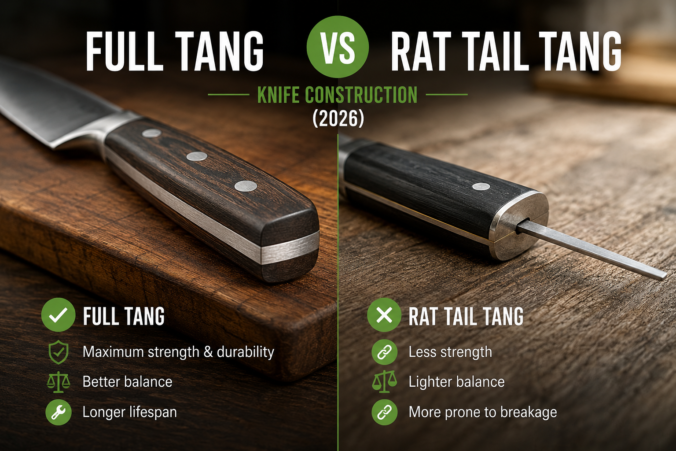
A full tang knife has the blade steel running the complete length of the handle, providing maximum strength. A rat-tail tang (where the steel tapers to a thin point) is prone to failure under hard use. For outdoor gifts, always choose full tang.

Model Blade Steel Tang Best Use Price
Mora Companion Carbon/Stainless Full Bushcraft, entry-level ~$18
Buck 119 420HC Stainless Full Hunting, general outdoor ~$60
ESEE-4 1095 Carbon Full Hard use, bushcraft ~$110

Accessory Bundle Idea: ESEE-4 ($110) + Fallkniven DC4 sharpening stone ($30) = ~$140 total. This is a thoughtful outdoor gift bundle that shows you understand field maintenance.

Key Takeaway: Mora Companion ($18) for budget outdoor gifts; Buck 119 ($60) for hunters; ESEE-4 (~$110) for serious bushcrafters. Always choose full tang for hard use. Pair with a portable sharpener for a complete gift.

Best Premium & Collector Knife Gift Ideas ($100–$300+)

At this price point, you’re buying for someone who either already owns several knives or is a serious enthusiast. Premium knives justify their cost through better blade steel, superior manufacturing, and often lifetime warranties.

Benchmade Bugout (~$150)

The Bugout is one of Benchmade’s most popular everyday carry knives. It features a 3.24-inch S30V blade, the proprietary AXIS lock, and weighs just 2.15 oz – one of the lightest premium EDC options available. S30V steel holds an edge significantly longer than budget steels and resists corrosion exceptionally well. Benchmade’s LifeSharp service means your recipient can send it back anytime for free sharpening and nominal-fee warranty repairs.

Spyderco Para 3 (~$140)

The Para 3 uses CPM-S30V steel with Spyderco’s compression lock. It’s slightly smaller than the Bugout but equally refined. Spyderco has a cult following among knife enthusiasts, and the Para 3 is one of their most respected designs.

Custom or Handmade Options ($150–$500+)

If your guy is a serious collector, consider a custom knife from a known bladesmith. Montana Knife Company has earned recognition for their designs. Custom knives are one-of-a-kind and feel like a genuinely special gift. As noted by TF VooDoo’s 2025-2026 Gift Guide, purpose-built tools from specialist makers carry a different kind of weight as gifts – they signal that you understand what the recipient actually values, not just what looks impressive on a shelf.

Damascus Steel Knives

Damascus steel looks stunning – the layered pattern is visually striking. But here’s the truth: the pattern is purely aesthetic. Performance depends entirely on the base steels used. If you’re buying Damascus, make sure it’s from a reputable brand where you know the steel composition. Unknown Damascus from marketplace resellers is often overpriced for mediocre performance.

What Makes These Worth the Price

Premium knives use better blade steels (S30V, M390, CPM-S35VN) that hold edges longer and resist corrosion better. They’re made in the USA or precision-manufactured in Taiwan with proper heat treatment. The fit and finish are noticeably better – no blade play, smooth action, tight tolerances. And they come with warranties and services (like Benchmade’s LifeSharp) that budget knives don’t offer.

Gifting Tip: Include a knife maintenance kit (~$20–$40) with premium gifts. A small bottle of pivot lube, a microfiber cloth, and a sharpening stone signal that you understand these are tools meant to be cared for.

Key Takeaway: Benchmade Bugout ($150) and Spyderco Para 3 ($140) are the gold standard premium EDC knives. S30V steel and AXIS/compression locks justify the price. Add a maintenance kit to show genuine care.

Knife Gift Add-Ons and Accessories That Impress

Here’s where most gift-givers miss an opportunity. You spend $50 on a knife, but adding $20–$30 in accessories transforms it from a good gift into a thoughtful, complete gift.

Whetstone or Sharpening Stone (~$25–$40)

A quality whetstone is the single best accessory for any knife gift. A King KW-65 whetstone (1000/6000 grit) retails around $30–$40 and is widely available. For outdoor knives, a Fallkniven DC4 dual-compound stone (~$30) is portable and excellent for field sharpening.

Leather Sheath (~$20–$50)

If you’re gifting a fixed blade, a quality leather sheath is essential. It protects the blade and makes the knife feel complete. Custom leather sheaths can run $50+, but basic quality options are $20–$30.

Pivot Lube and Maintenance Kit (~$10–$20)

A small bottle of knife pivot lube keeps folding knives operating smoothly. Benchmade and Spyderco both make their own. Pair it with a microfiber cloth and you’ve got a maintenance kit that shows you understand knives are tools that need care.

Knife Roll or Storage Pouch (~$30–$60)

For someone with multiple knives, a canvas or leather knife roll is both practical and impressive. It signals that you recognize they’re a serious collector.

Personalized Engraving (~$15–$30)

Most major retailers and brands offer custom laser engraving. Benchmade charges $25 for engraving on select models. BladeHQ offers third-party engraving starting at $15. A name or initials on the blade or handle adds a personal touch.

The Accessory Bundle Strategy

Spent $50 on the knife? Spend $20 more on a sharpening stone. This shows you’ve thought beyond just the blade itself. It’s the difference between a gift and a considered gift.

Key Takeaway: Add a $25–$40 whetstone to any knife gift. Pair premium knives with maintenance kits. Personalized engraving (~$20) adds a personal touch. Accessories transform a good gift into a thoughtful one.

Frequently Asked Questions About Knife Gifts for Men

Is it bad luck to gift a knife?

Direct Answer: The superstition that a knife gift “severs friendship” is a common folk belief, but it’s easily neutralized – have the recipient give you a penny in exchange, which traditionally reverses the bad luck.

This is an old European and American tradition with no real basis. Many people gift knives without incident. If your recipient is superstitious, the penny exchange is a fun, lighthearted way to address it. Most knife enthusiasts don’t worry about this at all.

What is a good budget for a knife gift?

Direct Answer: $40–$75 is the sweet spot for most gift-givers – enough to get a quality, reliable knife without overspending. Budget under $40 for casual users; $100–$150 for serious enthusiasts.

A $40 Kershaw Leek or CIVIVI Elementum is a genuinely useful gift that won’t disappoint. If your recipient is a known knife enthusiast or serious cook, $100–$150 opens up premium options like Benchmade or Spyderco. Anything under $30 risks feeling cheap; anything over $200 should be reserved for collectors or major milestones.

Can I engrave or personalize a knife gift?

Direct Answer: Yes. Most major brands and retailers offer custom laser engraving for $15–$30, adding initials or a name to the blade or handle.

Benchmade offers custom engraving for $25 on select models. BladeHQ and other retailers offer third-party engraving services. Engraving adds a personal touch that makes the gift feel more special, though it’s optional – many recipients prefer an unmarked blade.

What type of knife is most practical as a gift – pocket knife or kitchen knife?

Direct Answer: It depends on the recipient’s lifestyle. A pocket knife (EDC) is more universally useful; a kitchen knife is better for someone who cooks regularly.

If you’re unsure, go with an EDC pocket knife. Almost everyone can use a reliable folding knife for opening packages, cutting rope, or general utility. Kitchen knives are more specialized – only gift one if you know the person cooks. Outdoor/hunting knives are even more niche.

Are there any knives I should NOT give as a gift?

Direct Answer: Avoid cheap steak knife sets (they dull immediately), unknown Damascus knives (often overpriced for mediocre steel), and automatic knives unless you’ve verified they’re legal in the recipient’s state.

Also skip novelty knives with gimmicky designs or poor reviews. A $20 “tactical” knife from an unknown brand will disappoint. Stick with established brands like Kershaw, Spyderco, Benchmade, or Victorinox. And always check local blade length laws before gifting anything with a blade longer than 3 inches or any automatic mechanism.

What knife brands are most respected by enthusiasts?

Direct Answer: Benchmade, Spyderco, Kershaw, CRKT, and Victorinox are the most consistently recommended brands across knife communities and publications.

Case is one of the most collected knife brands in the world, with a history dating to the late 19th century. For outdoor knives, Mora (Swedish), Buck (American), and ESEE (American) have strong reputations. For kitchen knives, Victorinox and Wüsthof are the gold standards. These brands have proven track records and strong warranties.

Conclusion: The Right Knife Matters

A quality knife is one of the few gifts that actually improves with age. Unlike gadgets that become obsolete or clothes that wear out, a well-made knife becomes more familiar, more useful, and more valuable to its owner over time.

The key is matching the knife to the person. An EDC pocket knife for someone who never carries one. A kitchen knife for someone who cooks. A fixed blade for the outdoorsman. And if you’re buying for a serious enthusiast, a premium option with better steel and a warranty.

Start with the price tier that fits your budget, then use the recipient’s lifestyle to narrow down the category. Add an accessory – a whetstone, a sheath, or a maintenance kit – to show you understand knives are tools meant to be cared for. And if you’re still unsure, Knife Depot carries over 10,000 knives and their staff can help you find the right fit.

A good knife is a gift that keeps giving. Make it count.

  • Best Kershaw EDC Knives
  • Liner Lock vs. Frame Lock: Knife Mechanism Comparison
  • Full Tang vs. Rat Tail: Why Construction Matters
  • Blade Steel Guide: S30V vs. 8Cr13MoV vs. M390
Upgrade Your Everyday Carry
Built for performance. Designed to stand out. Shop knives ready for everyday carry, the outdoors, or your collection.
Free ground shipping on eligible continental U.S. orders over $99. Cannot be combined with other discounts. See shipping terms.
Shop Here

Best Hunting Knife for Skinning & Field Dressing (2026)

Updated September 24, 2026. All seven knives below were in stock at Knife Depot when checked. Prices are in USD before tax and shipping; availability and prices can change. Follow the product links for current details.

The best hunting knife for skinning and field dressing depends on the work you expect it to do. For a compact dedicated fixed blade, start with the CRKT Hunt’N Fisch. For a low-cost option, consider the Cold Steel Pendleton Lite Hunter. The Outdoor Edge SwingBlaze adds a dedicated gutting blade, while the RazorLite lets you replace a dull blade.

These recommendations compare product specifications, intended use, price, and current availability. They are not claims of hands-on testing or a guaranteed number of animals processed between sharpenings.

Seven Hunting Knives Available at Knife Depot

Knife Price Blade length Best fit
CRKT Hunt’N Fisch 2861 $79.99 About 3 inches Compact fixed blade
Cold Steel Pendleton Lite Hunter 20SPH $18.99 3.63 inches Budget fixed blade
Kershaw Deschutes Caper 1882 $42.99 3.3 inches Caping and detail work
Outdoor Edge SwingBlaze SZ-20NC $64.99 3.6-inch skinner / 3.2-inch gutting blade Skinning and dedicated gutting blade
Outdoor Edge RazorLite RL10C $44.99 3.5 inches Replaceable-blade option
ESEE-4P-MB $147.95 4.5 inches Hunting and general camp use
Kershaw Oso Sweet 1830BLU $27.99 3 inches Budget folding backup

1. CRKT Hunt’N Fisch 2861 — Compact fixed blade

CRKT Hunt’N Fisch 2861

Price checked: $79.99. The Hunt’N Fisch pairs a compact drop-point blade with a contoured G10 handle and friction grooves along the spine. Its fixed-blade construction and included leather sheath make it a practical starting point for hunters who want a small dedicated field knife.

Choose it for controlled cutting and a compact belt-carried design. Despite the wording in the store page title, the 2861 is a fixed blade, not a folding knife.

Shop the CRKT Hunt’N Fisch 2861

2. Cold Steel Pendleton Lite Hunter 20SPH — Budget fixed blade

Cold Steel Pendleton Lite Hunter 20SPH

Price checked: $18.99. The Pendleton Lite Hunter is the lowest-priced knife in this selection. It has a 4116 stainless steel drop-point blade, a black polypropylene handle, and a Cor-Ex sheath. The listed weight is 2.7 ounces, keeping the knife itself light for a fixed blade of this size.

This is our budget choice for someone buying a dedicated hunting knife. Its straightforward design puts the money into a useful blade and handle rather than a folding mechanism or interchangeable-blade system.

Shop the Cold Steel Pendleton Lite Hunter 20SPH

3. Kershaw Deschutes Caper 1882 — Caping and detail work

Kershaw Deschutes Caper 1882

Price checked: $42.99. The Deschutes Caper is a full-tang fixed blade designed for precise work around the head and neck. Its D2 blade has a full-flat grind, while a contoured polypropylene handle with an olive rubber overlay, finger choil, and thumb ramp provides several ways to position your hand.

Choose it for detailed hide separation and caping. The molded sheath includes drainage and attachment options. Keep the D2 blade clean and dry after use. Stock was limited when we checked.

Shop the Kershaw Deschutes Caper 1882

4. Outdoor Edge SwingBlaze SZ-20NC — Skinning and dedicated gutting blade

Outdoor Edge SwingBlaze SZ-20NC

Price checked: $64.99. The SwingBlaze combines an AUS-8 skinning blade with a separate blunt-tipped gutting blade in one rotating design. A lock button lets you switch between the two cutting profiles. The orange handle and included nylon sheath make it a hunting-focused option.

This replaces the earlier guide’s misleading “best gut hook” recommendation for the Piranta Edge. The SwingBlaze provides a dedicated gutting blade; it is not a conventional hooked notch in the spine. Keep the rotating mechanism clean and follow the maker’s locking instructions.

Shop the Outdoor Edge SwingBlaze SZ-20NC

5. Outdoor Edge RazorLite RL10C — Replaceable-blade option

Outdoor Edge RazorLite RL10C

Price checked: $44.99. This black-handled RazorLite is the RL10C, with a 3.5-inch replaceable blade, TPR handle, thumb-stud opening, and nylon sheath. It is a useful choice for hunters who prefer carrying spare blades to touching up an edge during a processing session.

The RL10C is different from the 2.5-inch RazorLite EDC. Match replacement blades to the exact model and check the product listing for package contents. Thin replaceable blades are for cutting, not twisting or levering against bone.

Shop the Outdoor Edge RazorLite RL10C

6. ESEE-4P-MB — Hunting and general camp use

ESEE-4P-MB

Price checked: $147.95. The ESEE-4P-MB brings a full-tang 1095 carbon steel blade, black powder coating, and Micarta handle. This configuration includes a molded sheath, clip plate, and MOLLE back. It is made in the USA.

Choose it when one knife also needs to cover general outdoor cutting tasks. It is a larger all-purpose field knife rather than a specialist caping tool. Carbon steel needs careful drying and maintenance; the coating does not protect the exposed cutting edge from corrosion.

Shop the ESEE-4P-MB

7. Kershaw Oso Sweet 1830BLU — Budget folding backup

Kershaw Oso Sweet 1830BLU

Price checked: $27.99. The blue Oso Sweet has a 3-inch 8Cr13MoV drop-point blade, glass-filled nylon handle, assisted flipper opening, and a liner lock. Its listed weight is 2.8 ounces. This corrects the previous article’s 3.5-inch blade and stainless-steel-handle description.

Treat this everyday pocketknife as a compact backup rather than the first choice for repeated game processing. The pivot and lock add areas that need cleaning. The blue version was available in limited quantity when checked.

Shop the Kershaw Oso Sweet 1830BLU

What Makes a Good Skinning and Field-Dressing Knife?

Look for a blade you can control, a handle that fits your hand, and a shape suited to your cuts. A drop point provides a useful combination of tip control and curved cutting edge. A compact caping blade helps with finer work; a dedicated gutting blade serves a different purpose from a skinning edge.

Length alone does not determine suitability. Compare the handle, cutting edge, blade geometry, and sheath as a whole. A larger knife may also suit camp chores, but it does not automatically make detailed processing easier.

Fixed Blade, Folder, or Replaceable Blade?

  • Fixed blade: The Hunt’N Fisch, Pendleton Lite Hunter, Deschutes Caper, and ESEE-4 avoid a folding pivot and are straightforward options for a dedicated field knife.
  • Folder: The Oso Sweet is convenient for pocket carry, but the pivot and lock require attention during cleanup.
  • Replaceable blade: The RazorLite allows a fresh edge without sharpening the blade in the field. Carry compatible spares and use the manufacturer’s blade-changing procedure.
  • Rotating dual blade: The SwingBlaze combines skinning and gutting profiles. Its mechanism also needs cleaning and proper engagement before use.

Which Blade Steel Should You Choose?

The Pendleton Lite Hunter uses 4116 stainless, the SwingBlaze uses AUS-8, and the Oso Sweet uses 8Cr13MoV. The Deschutes Caper uses D2, while this ESEE-4 configuration uses 1095 carbon steel. Steel is only part of the comparison: blade geometry, heat treatment, edge condition, and the material being cut also affect performance.

Avoid choosing by a promised sharpening interval. Touch up a reusable blade when its cutting performance declines. With a replaceable-blade knife, check compatibility and the cost of spares for the exact model rather than assuming every blade system costs the same.

Cleaning and Care After Use

Follow the knife maker’s cleaning instructions. Remove residue from the blade and handle, paying attention to pivots, locks, and removable-blade holders. Dry the knife thoroughly before storing it, and maintain corrosion-prone steel as directed by the manufacturer. Use a food-contact-appropriate protectant when applicable.

Use knives for controlled cutting. Avoid the earlier guide’s suggestion to use a blade for heavy prying or pelvic splitting; use an appropriate dedicated tool for those tasks. Store used replaceable blades safely so exposed edges cannot injure someone handling your gear.

Frequently Asked Questions

What is the lowest-priced hunting knife in this guide?

The Pendleton Lite Hunter was $18.99 when checked. It offers a fixed drop-point blade and included sheath at the lowest price in this selection.

Which option is best for caping?

The Deschutes Caper is purpose-built for detail work around the head and neck. The compact Hunt’N Fisch is another option to compare for controlled cuts.

Is the RazorLite a 2.5-inch knife?

Some RazorLite EDC versions use 2.5-inch blades. The RL10C recommended here uses a 3.5-inch blade and was $44.99 when checked. Always match specifications and replacement blades to the exact model.

Do I need a gut hook?

A dedicated gutting tool is an optional addition, not a substitute for a skinning edge. If you want both profiles in one tool, compare the SwingBlaze’s skinning and blunt-tipped gutting blades.

Why did the recommendations change?

The previous Buck 110 Slim Pro, Morakniv Companion Heavy Duty, Havalon Piranta Edge, and Benchmade Steep Country recommendations were replaced because matching available products were not found in Knife Depot’s catalog during this update. That is an availability decision, not a claim that every model is discontinued.

Choose by the task: compare the Hunt’N Fisch for a compact fixed blade, Pendleton Lite Hunter for budget value, Deschutes Caper for fine work, SwingBlaze for two cutting profiles, RazorLite for replaceable blades, ESEE-4 for broader outdoor use, or Oso Sweet for a folding backup. Use the direct product links above to check current stock before ordering.

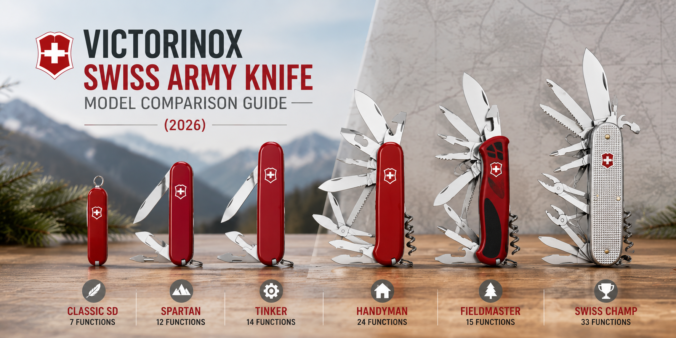
Victorinox Swiss Army Knife Model Comparison Guide (2026)

TL;DR: Choose the functions you need, then compare the exact model number and carry weight. Tinker has a Phillips driver; Spartan has a corkscrew. Huntsman adds scissors and a wood saw to its tool mix and weighs 97 grams. Jetsetter is bladeless, but no model name guarantees passage through an airport checkpoint.

Specifications and prices checked November 9, 2026. Dollar amounts below are Victorinox’s displayed US manufacturer prices before tax, not Knife Depot offers or guaranteed MSRP. Follow the exact product link for the configuration; other colors and editions may differ. Weights use the manufacturer’s displayed units.

Introduction

Two red Swiss Army Knives can look almost identical while carrying different tools. The useful question is simple: do you need scissors, a saw, pliers, a corkscrew, or a Phillips driver? Paying for more functions also means carrying the extra layers.

Use Victorinox’s official catalog to identify the exact product. Function counts include multiple uses of a combined tool; fifteen functions do not mean fifteen separate folding implements. Compare the tool list as well as the number.

What Are the Main Victorinox Swiss Army Knife Size Classes?

Size / format Examples How to use the category
58 mm Classic SD and Jetsetter Small keychain tools; check blade presence
74 mm Executive 0.6603 Distinct older model; verify availability
84 mm Cadet Alox Slim Alox format
91 mm Tinker, Spartan, Climber, Camper, Hiker, Huntsman, Fieldmaster, Swiss Champ Compare specific tools and layer thickness
93 mm Farmer Alox, Pioneer X Alox Not the same platform as the 84 mm Cadet
111 mm family One-hand Trekker / Trailfinder versions Larger knife format; check lock and exact model
Swiss Tool Spirit X Plier-based multi-tool; compare pouch and tool version

Size normally refers to closed body length, not blade length. Alox is an aluminum scale construction; it is not a promise that every Alox knife weighs less than every Cellidor model. Compare actual weights and functions.

Victorinox Model Comparison: 58mm & 74mm Compact Models

Model Functions Weight Important distinction Manufacturer US price
Classic SD 0.6223 7 0.8 oz Includes small blade, scissors and nail file/screwdriver $24
Jetsetter 0.6263 7 0.8 oz No knife blade; scissors and bottle-opener/Phillips combination tool $24
Executive 0.6603 10 45 g 74 mm; orange peeler and nail file; no pen in this tool list No US price quoted

Jetsetter’s tools are scissors, bottle opener, magnetic Phillips screwdriver, wire stripper, key ring, tweezers and toothpick. It does not have the nail file listed in the earlier comparison. Executive’s name is not evidence of a pen: consult the exact tool list rather than borrowing features from another compact model.

Victorinox 91mm Model Comparison: The Core Lineup

Model Functions Weight Tools that help distinguish it Manufacturer US price
Tinker 1.4603 12 2.2 oz Phillips driver; no corkscrew, saw or scissors $34
Spartan 1.3603 12 2.1 oz Corkscrew; no wood saw or scissors $34
Climber 1.3703 14 82 g Scissors and corkscrew; no wood saw Check US offer
Camper 1.3613 13 2.6 oz Wood saw and corkscrew; no scissors $39
Hiker 1.4613 13 2.7 oz Wood saw and Phillips driver; no scissors $39
Huntsman 1.3713 15 97 g Scissors, one wood saw and corkscrew $52
Fieldmaster 1.4713 15 3.5 oz Scissors, wood saw and Phillips driver $52
Swiss Champ 1.6795 33 6.5 oz Pliers, scissors, magnifier and more layers $115

Tinker versus Spartan is principally a Phillips-driver versus corkscrew decision within this pair. Tinker does not have a wood saw. For a saw with a Phillips driver, compare Hiker; for a saw with a corkscrew, compare Camper. Both have can and bottle openers.

For scissors without a wood saw, Climber is the relevant comparison. Huntsman and Fieldmaster both have scissors and a wood saw, with different rear-tool choices. Huntsman does not add a second saw, and its 97-gram weight should not be replaced with the weight of a slimmer knife.

Swiss Champ’s 33 functions offer breadth, but the extra thickness and 6.5-ounce listed weight are worth considering before choosing it for a pocket. There is no verified global bestseller ranking in this guide; choose by the tools you will use.

Alox alternatives

Model Functions Weight Useful distinction Manufacturer US price
Cadet Alox 0.2601.26 9 1.6 oz 84 mm; nail file and nail cleaner $45
Farmer Alox 0.8241.26 9 3 oz 93 mm; wood saw and reamer $60
Pioneer X Alox 0.8231.26 9 94 g 93 mm; scissors; see exact manufacturer specifications Check current offer

The Pioneer X manufacturer page provides its metric dimensions and weight. Do not confuse Pioneer X with a smaller Cadet or assume Farmer belongs to the 84 mm platform.

How Do the Large-Format and SwissTool Models Compare?

Exact product Functions Weight Key distinction Manufacturer US price
Trailfinder MW 0.8463.MW3, linked from the former Trekker listing 12 4.6 oz Large one-hand model with liner lock; not a 91 mm / 75 g knife $68
Swiss Tool Spirit X 3.0224.L 24 7.4 oz Plier-based tool with lockable blade; leather-pouch configuration $145

Trekker names, edges and regional listings can vary. The referenced product now appears as Trailfinder MW, so compare the model number rather than treating every one-hand version as identical. A Swiss Tool Spirit X is also not interchangeable with a Spirit MX or a package containing extra accessories.

Ranger and Ranger Grip models form another large-format group. Check the specific model’s tool list, body dimensions and carry weight in the official catalog; the name alone is insufficient to assign one shared weight or tool count.

Which Victorinox Model Should You Buy? Use-Case Decision Matrix

You want… Start by comparing… Decision to make
A small backup Classic SD or Jetsetter Do you need a knife blade?
A straightforward everyday tool Tinker or Spartan Phillips driver or corkscrew?
A wood saw without scissors Hiker or Camper Phillips driver or corkscrew?
Scissors and a wood saw Fieldmaster or Huntsman Rear tools and grip preference
Alox scales Cadet, Farmer or Pioneer X Nail file, saw or scissors; compare sizes
Pliers and workshop tools Swiss Champ or Spirit X Knife-centered versus plier-centered layout

These are starting points, not guarantees that one knife covers a measured percentage of everyone’s tasks. Check Knife Depot’s Victorinox selection for current availability and selling prices. We do not assume the entire manufacturer catalog is in stock.

How to Maintain Any Victorinox Model You Choose

Follow Victorinox’s official care instructions for the exact tool, including models with special scales or electronics. Clean and dry the tool, lubricate moving joints as directed, and keep the edge maintained. Do not impose a fixed annual oiling schedule or promise that a honing steel repairs every dull blade.

Review the warranty linked from the model’s manufacturer page for coverage and exclusions. A lifetime warranty does not mean ordinary wear, misuse, every repair, or every accessory is covered without conditions.

Frequently Asked Questions About Victorinox Swiss Army Knife Models

What is the difference between Tinker and Spartan?

The listed 91 mm Tinker has a Phillips screwdriver; Spartan has a corkscrew. Neither of these exact models has a wood saw or scissors.

Does Huntsman have two saws?

No. The referenced Huntsman has one wood saw, scissors, and 15 functions. Its manufacturer-listed weight is 97 grams.

How much do these knives cost?

At the November 9 check, manufacturer US prices included $34 for Tinker, $52 for Huntsman and $115 for Swiss Champ. These are not Knife Depot quotes; check the live store offer for the exact version.

Does Jetsetter have five functions and a nail file?

No. The referenced Jetsetter has seven functions, including scissors, a bottle opener and magnetic Phillips screwdriver. It has no knife blade and no nail file.

Can I take one on a plane?

Consult current TSA and destination rules. Do not pack a blade-equipped model in a carry-on. A bladeless model still needs to satisfy the rules for every tool it contains, and screening staff make the final checkpoint decision.

Does Executive include a pen?

Not the referenced 74 mm Executive 0.6603. Its ten-function tool list includes an orange peeler, two blades, scissors and a nail file, but no pen.

Is a bigger tool count always better?

No. Extra layers can add weight and bulk. Choose the tools you need and compare the actual handle dimensions.

Before flying, read TSA’s multi-tool guidance and knife guidance. Rules in other countries and at other checkpoints may differ.

Shop these exact models at Knife Depot

For the Phillips-driver configuration, compare the Victorinox Tinker 1.4603. For silver Alox scales and scissors, see the Pioneer X Alox 0.8231.26. Both were in stock when checked November 18, 2026. Use these product pages for current Knife Depot prices and availability; the manufacturer prices in the comparison tables are separate reference figures.

Conclusion

Choose the functions first, the exact model second, and then compare price and carry weight. For background and owner perspective, the Knives Illustrated Victorinox guide remains useful; current model specifications and travel rules should come from the manufacturer and relevant authorities.

Browse Victorinox knives at Knife Depot for the versions available now.

Best Neck Knives for EDC: Lightweight Picks (2026)

TL;DR

Best overall: Knife Depot’s curated selection of lightweight neck knives, led by the CRKT Minimalist at 1.4 oz with a 2.125-inch blade – the weight benchmark for true lightweight EDC under $30. Best mid-range: ESEE Candiru (1.9 oz, 1095 steel, lifetime warranty) at $79 for field-sharpenable edges. Best premium: Benchmade Hidden Canyon (2.9 oz, CPM-S30V stainless) at ~$140 for superior corrosion resistance against skin contact. Neck knives beat folding alternatives for instant deployment, but legal carry varies dramatically by state – California bans concealed fixed blades entirely, while Texas allows sub-5.5-inch models outside restricted locations.

What Makes a Neck Knife Good for EDC?

A neck knife is a small fixed-blade knife worn on a cord around your neck, designed for quick access and discreet carry. Unlike folding knives, fixed-blade designs eliminate hinges and locks that can fail, making them inherently more reliable for emergency cutting tasks.

The best EDC neck knives share five core traits. Weight is paramount – anything under 3 ounces won’t create noticeable bulk under a shirt. Blade length typically ranges from 1.75 to 3 inches; longer blades cut better but invite legal scrutiny in restrictive states. Sheath retention determines whether your knife stays put during movement or tumbles out during a draw. Steel grade affects how often you’ll maintain the blade, especially when worn against skin where sweat accelerates corrosion. Concealability means the knife disappears under a t-shirt without printing (showing an outline).

According to testing data, the lightest production neck knives weigh around 1.28 ounces, setting the floor for what “lightweight” truly means. Most quality options land between 1.4 and 2.9 ounces – a range where you’ll forget you’re wearing the knife until you need it.

Key Takeaway: A true lightweight EDC neck knife weighs under 3 oz, uses stainless or semi-stainless steel to resist sweat corrosion, and comes with a Kydex or leather sheath that holds the blade inverted without falling.

Top 7 Lightweight Neck Knives for EDC (2026)

Here’s a side-by-side comparison of the most-recommended models across budget, mid-range, and premium tiers:

Model Blade Length Weight (oz) Steel Sheath Price Best For
CRKT Minimalist 2.125″ 1.4 8Cr13MoV Nylon ~$28 Budget carry, minimal bulk
Böker Gnome 1.77″ 1.83 D2 Kydex ~$45 Compact, premium steel
Cold Steel Safe Maker I 4.0″ 2.3 AUS-8A Kydex ~$35 Larger blade, mid-budget
ESEE Candiru 2.18″ 1.9 1095 Leather ~$79 Field sharpening, warranty
Spyderco Ronin 2 2.84″ 3.1 VG-10 Kydex ~$130 Corrosion resistance, premium
Benchmade Hidden Canyon 2.67″ 2.9 CPM-S30V Leather ~$140 Best stainless, skin contact
Ka-Bar Becker BK11 3.25″ 4.0 1095 Cro-Van Nylon ~$47 Utility, heavier duty

Best Budget Pick Under $40

The CRKT Minimalist dominates the sub-$30 category for a reason: it delivers genuine utility without the bulk. At 1.4 ounces with a 2.125-inch blade, you’ll forget it’s there. The 8Cr13MoV steel is a Chinese stainless equivalent to AUS-8 – serviceable for budget knives with decent edge retention, though not premium-tier corrosion resistance.

The trade-off? The stock nylon sheath lacks the retention confidence of Kydex. Many owners upgrade to aftermarket Kydex options, adding $15–$25 to the total cost. Still, at only $20 for the knife alone, you’re getting exceptional value.

Carry comfort rating: ★★★★★ (nearly undetectable weight) Sheath retention score: ★★★☆☆ (nylon snaps work but lack positive lock)

Best Mid-Range Pick ($40–$80)

The ESEE Candiru splits the difference between budget and premium. At 1.9 ounces with a 2.18-inch blade, it’s slightly heavier than the Minimalist but carries a lifetime warranty and uses 1095 high-carbon steel – a field-sharpenable edge that you can touch up with a rock or steel in the wilderness.

The catch: 1095 rusts readily under skin-contact conditions. If you’re wearing this under a sweaty shirt in humid climates, you’ll need to oil it weekly. The leather sheath adds roughly 1 ounce compared to Kydex, pushing total carry weight to around 2.9 ounces with cord.

Carry comfort rating: ★★★★☆ (noticeable but not burdensome) Sheath retention score: ★★★★☆ (leather molds to blade, solid passive retention)

Best Premium Pick ($80–$150)

The Benchmade Hidden Canyon Hunter sits at 2.9 ounces – just under the 3-ounce threshold – with a 2.67-inch CPM-S30V blade. S30V is a premium powder-metallurgy stainless with exceptional corrosion resistance and edge retention, making it the best choice for knives worn directly against skin where sweat exposure is constant.

The leather sheath is hand-stitched and includes a breakaway lanyard, addressing the strangulation risk that fixed cords create. At ~$140, this is an investment, but the steel quality and warranty justify the cost for serious EDC users.

Carry comfort rating: ★★★★☆ (weight is present but balanced) Sheath retention score: ★★★★★ (leather retention is excellent, breakaway adds safety)

How Do Blade Steel Grades Affect Your Choice?

Steel choice determines maintenance burden and corrosion risk – critical factors when your knife lives against your skin.

Steel HRC Corrosion Resistance Edge Retention Sharpenability Best For
8Cr13MoV 58–60 ★★★☆☆ ★★★☆☆ ★★★★☆ Budget carry, dry climates
AUS-8A 58–59 ★★★☆☆ ★★★☆☆ ★★★★☆ Mid-budget, moderate humidity
D2 60–61 ★★★☆☆ ★★★★☆ ★★★☆☆ Compact knives, semi-stainless
1095 56–58 ★☆☆☆☆ ★★★★☆ ★★★★★ Field sharpening, dry carry
VG-10 60–62 ★★★★☆ ★★★★☆ ★★★☆☆ Humid climates, premium carry
CPM-S30V 59–61 ★★★★★ ★★★★★ ★★☆☆☆ Skin contact, saltwater, premium

The practical recommendation: If you live in a humid climate or plan to wear the knife against bare skin, choose stainless or semi-stainless (VG-10, AUS-8, D2). If you’re in a dry climate and willing to oil weekly, 1095 carbon steel offers the easiest field sharpening – a genuine advantage if you’re hiking or camping far from whetstones.

The 1095 vs. stainless trade-off is real. 1095 high-carbon steel is highly susceptible to rust from sweat and body moisture – a unique risk for knives carried under clothing against skin. VG-10 and CPM-S30V eliminate this worry entirely, though they’re harder to sharpen in the field without proper equipment.

Key Takeaway: Budget stainless (8Cr13MoV, AUS-8) requires monthly oiling; carbon steel (1095) needs weekly oiling under skin contact; premium stainless (VG-10, S30V) needs oiling every 4–6 weeks and resists sweat corrosion entirely.

What Sheath Features Matter Most for Daily Neck Carry?

The sheath is half the equation. A poor sheath ruins even an excellent blade.

Kydex vs. Leather vs. Nylon: Kydex is the lightest option at 0.5–0.8 ounces for a typical neck knife sheath, with superior moisture resistance and adjustable retention. Leather runs 0.9–1.2 ounces and molds to the blade over time, creating a custom fit – but it absorbs sweat and requires occasional conditioning. Nylon is comparable to leather in weight but offers snap-based retention that’s less reliable than passive Kydex molding.

Retention testing: A properly molded Kydex sheath holds a knife inverted without falling – the gold standard for EDC. Nylon sheaths with snaps frequently fail this test, especially after months of wear when snaps loosen. Leather retention depends on how tightly the maker molded the sheath; quality leather sheaths rival Kydex, but cheap ones don’t.

Carry orientation matters. Tip-up carry (handle down, blade tip up) is fastest for a one-handed draw but risks the blade catching on clothing during re-sheathing. Tip-down (handle up, blade tip down) is safer for re-sheathing but slightly slower to deploy. Horizontal chest carry distributes weight evenly but requires a wider sheath.

Breakaway vs. fixed cords: A fixed loop creates strangulation risk if snagged on equipment or a vehicle seat belt. Breakaway lanyards release under pressure – typically 7–10 pounds of force – preventing this hazard. Most quality neck knife sheaths now include breakaway beads; verify this before purchasing.

Key Takeaway: Kydex sheaths are lightest (0.5–0.8 oz) with best retention; leather adds 0.4–0.4 oz but molds to your blade; always choose a breakaway lanyard to eliminate strangulation risk.

This is where neck knife carry gets complicated. Legality varies wildly by state and even by city.

California: Penal Code 21310 prohibits carrying any concealed dirk or dagger regardless of blade length. A neck knife worn under a shirt is concealed carry. This is a criminal offense in California, period. Open carry of fixed blades is also restricted in many CA cities. If you live in California, neck knives are effectively off-limits.

New York: Penal Law 265.01 makes it illegal to possess a dirk, dagger, or dangerous knife with intent to use unlawfully. NYC administrative code additionally restricts knives with blades over 4 inches for open carry. Concealed fixed-blade carry is effectively barred. New York is another no-go for neck knives.

Texas: Penal Code 46.02 prohibits carrying location-restricted knives in certain venues – schools, polling places, courts, bars. Fixed blades over 5.5 inches are location-restricted. Most neck knives fall under 5.5 inches and are legal to carry openly or concealed outside restricted locations. Texas is generally permissive.

General rule: Most states restrict concealed fixed blades to 2.5–3 inches. Many states allow open carry of fixed blades under 4 inches without restriction. Knife Rights Foundation tracks state-by-state knife legality and is the most current resource for your specific location.

Critical disclaimer: This is general guidance, not legal advice. Knife laws change frequently and vary by county and city. Check your local ordinances before purchasing. When in doubt, contact a local attorney or your state’s attorney general office.

Key Takeaway: California and New York ban concealed fixed-blade carry entirely; Texas allows sub-5.5-inch models outside restricted venues; check Knife Rights Foundation for your state before buying.

How to Carry and Maintain a Neck Knife Properly

Once you’ve chosen your knife, proper carry and maintenance extend its life and ensure reliable performance.

Adjusting cord length: Position the handle at mid-sternum for fastest one-handed draw. A cord set too long buries the knife at your waistline, requiring two hands to retrieve. Test the draw position before wearing the knife daily – you should be able to grip and deploy with one hand in under two seconds.

Safe re-sheathing: This is where most cuts happen. Never re-sheath while looking away or distracted. Keep your off-hand fingers clear of the blade path. If using a tip-down sheath, angle the blade slightly away from your body as you insert it. Tip-up sheaths are safer for re-sheathing because the blade naturally angles away from your torso.

Cleaning routine: Rinse the blade after exposure to sweat or saltwater. Dry it immediately before resheathing – moisture trapped in the sheath accelerates corrosion. For carbon steel (1095), wipe the blade with a light oil weekly if worn against skin in humid conditions. Stainless steel needs oiling every 2–4 weeks under normal carry.

Maintenance schedule: Inspect the cord monthly for fraying or wear. Replace the lanyard if it shows signs of degradation – a broken cord means a lost knife. Check the sheath retention quarterly; if snaps loosen or Kydex retention decreases, contact the maker for adjustment or replacement.

Key Takeaway: Position the knife at mid-chest for fastest draw, dry the blade before resheathing, oil carbon steel weekly and stainless every 2–4 weeks, and inspect the cord monthly for wear.

Frequently Asked Questions About EDC Neck Knives

How much should you spend on a good EDC neck knife?

Direct Answer: Budget $25–$50 for a reliable daily-carry neck knife; premium options run $80–$150 but offer better steel and warranty coverage.

The CRKT Minimalist at ~$28 is genuinely competent for most users. If you want better corrosion resistance or a lifetime warranty, the ESEE Candiru at $79 is worth the jump. Premium options like the Benchmade Hidden Canyon ($140) justify their cost only if you’re wearing the knife against skin in humid climates where corrosion is a real concern. Don’t overspend on a neck knife you’ll rarely use.

Are neck knives comfortable to wear all day?

Direct Answer: Yes, if you choose a model under 2.5 ounces and adjust the cord length to mid-sternum.

Testing shows that knives under 1.5 ounces are nearly undetectable during daily wear. Even at 2.9 ounces (the Benchmade Hidden Canyon), most users report forgetting the knife is there after a few days of adjustment. The key is cord positioning – too long and the weight pulls downward, creating discomfort; too short and the handle digs into your collarbone. Experiment with cord length before committing to daily carry.

What blade length is best for a neck knife?

Direct Answer: 2–2.5 inches is the sweet spot for utility and legal carry in most states.

Blades under 2 inches (like the Böker Gnome at 1.77″) are legal everywhere but sacrifice cutting power. Blades over 3 inches (like the Cold Steel Safe Maker at 4.0″) cut better but exceed legal limits in restrictive states. A 2–2.5-inch blade handles most EDC cutting tasks – opening packages, cutting rope, food prep – while staying legal in most jurisdictions.

Is a neck knife better than a folding knife for EDC?

Direct Answer: Neck knives are faster to deploy and more reliable (no hinges to fail), but folding knives are more discreet and legal in more places.

Fixed-blade designs eliminate hinges and locks that can break, making them inherently more reliable. A neck knife is ready to cut in under one second; a folding knife requires two hands and 2–3 seconds. However, folding knives are easier to carry in professional settings (offices, courtrooms) where visible blades raise eyebrows. Choose a neck knife if speed and reliability matter; choose a folder if discretion is paramount.

Can you fly with a neck knife in checked luggage?

Direct Answer: Yes. TSA regulations permit fixed-blade knives in checked baggage but prohibit them in carry-on baggage.

Pack your neck knife in your checked suitcase, not your carry-on. Declare it if asked during check-in. Carry-on is a hard no – TSA will confiscate any knife, regardless of blade length.

What is the lightest neck knife available for EDC?

Direct Answer: The WE Knives OSS Dagger weighs 1.28 ounces – the lightest production neck knife tested.

If absolute minimum weight is your priority, the WE Knives OSS is the benchmark. However, it’s a specialty model with limited availability. The CRKT Minimalist at 1.4 ounces is more accessible and nearly as light, making it the practical choice for most users.

Do neck knives pass metal detectors?

Direct Answer: No. Metal detectors will detect any steel blade, regardless of size.

If you’re entering a courthouse, airport, or secure facility, you cannot bring a neck knife through metal detectors. Remove it before entering security checkpoints. Some workplaces (hospitals, schools, government buildings) prohibit knives entirely, even in parking lots – check your employer’s policy.

Conclusion

The best neck knife for EDC depends on three variables: your climate (dry vs. humid), your legal jurisdiction, and your tolerance for maintenance. If you live in California or New York, neck knives are off-limits – choose a folding knife for everyday carry instead. If you’re in a permissive state and wear the knife against skin, invest in stainless steel (VG-10 or CPM-S30V) to eliminate rust risk.

For most users, the CRKT Minimalist at 1.4 ounces and $28 is the starting point. It’s light, affordable, and genuinely useful. If you want better steel and a warranty, the ESEE Candiru at $79 is the next logical step. And if corrosion resistance is non-negotiable, the Benchmade Hidden Canyon at $140 with CPM-S30V steel is the best-in-class option.

Neck knives are faster and more reliable than folding knives – no hinges to fail, no locks to jam. But they’re also more visible and legally restricted in more places. Choose accordingly. And remember: Knife Depot carries most of these models with detailed specs and customer reviews to help you decide.

Upgrade Your Everyday Carry
Built for performance. Designed to stand out. Shop knives ready for everyday carry, the outdoors, or your collection.
Free ground shipping on eligible continental U.S. orders over $99. Cannot be combined with other discounts. See shipping terms.
Browse Neck Knives

SIG SAUER ROSE Knife: Historical $10 Member Offer

Historical promotion — July 8, 2026. This article records a past campaign. The savings, member prices, minimum spend and references to “this week” below are historical, not a current offer. Visit the linked product or collection pages for present availability and pricing; historical discounts should not be assumed to apply.

Sleek enough to gift. Practical enough to carry.

The SIG SAUER ROSE RS-5BB Assisted Opening Knife brings together a sharp black-and-rose look with real everyday carry utility.

It features a 2.93″ Nitro V stainless steel blade, black PVD coating, G10 handle, smooth ceramic ball-bearing deployment, liner lock, and an integrated emergency window breaker.

Compact, capable, and easy to keep close — this is a standout EDC for SIG SAUER fans, knife collectors, and anyone who appreciates gear with a little extra confidence built in.

Regular Price: $99.99
Members-Only Offer: Save $10

Shop it now at Knife Depot:
https://knife-depot.com/products/sig-rs-5bb-rose-2-93-blk-rose

#KnifeDepot #SIGSAUER #EverydayCarry #EDCKnife #PocketKnife #KnifeCollector #GearForLife #UsefulGifts #BladeCommunity #KnivesOfInstagram

Full Tang vs Rat Tail Tang Knife Construction (2026)

TL;DR: – Full tang extends steel the entire length and width of the handle – the strongest construction for heavy-duty tasks like batoning and survival work

  • Rat tail tang is a narrow steel rod threaded through the handle, 70–100g lighter, and the traditional choice for Japanese kitchen knives
  • For bushcraft, hunting, or prying: full tang is non-negotiable. For precision culinary work: rat tail is often the correct engineering choice, not a compromise
  • At budget price points ($40–80), steel quality matters more than tang type; above $100, tang construction becomes a meaningful durability differentiator

What Is a Knife Tang? (The 30-Second Version)

A knife tang is the unsharpened part of the metal blade that reaches back into the handle. Think of it as the structural backbone connecting your blade to the grip. Without a tang, your knife would be just a floating piece of steel with nothing to hold onto.

The tang matters because the weakest point on any knife is where the tang meets the handle. How that transition is engineered – whether the steel runs the full length of the handle or tapers to a narrow rod – determines how much stress the knife can handle before failing.

There are roughly five common tang types: full tang, partial tang, rat tail (stick) tang, hidden tang, and integral tang. This article focuses on the two you’ll encounter most often: full tang and rat tail. Understanding the difference between them will help you choose the right knife for your actual use case – not just what marketing claims sound impressive.

Key Takeaway: The tang is the steel extension running into your handle. Where it’s engineered to be strongest or lightest determines whether your knife survives batoning or excels at precision slicing.

How Does Full Tang Construction Work?

A full tang extends the entire length and width of the handle. The steel doesn’t taper or narrow – it runs from the blade tip all the way through to the butt of the handle, typically sandwiched between two handle scales (the side pieces) that are glued and riveted in place.

This design distributes stress evenly. When you apply force to the blade – whether you’re chopping, prying, or batoning – that stress travels across the entire width and length of the steel. A full tang is the strongest tang construction because there’s no abrupt narrowing where stress can concentrate and cause failure.

The manufacturing process: A full tang blank is forged or stamped as one piece. Handle scales are then attached using epoxy, rivets, or pins that pass through both the tang and the scales. This creates a monolithic structure – one integrated unit rather than a blade glued to a separate handle rod.

Weight trade-off: A full tang knife is relatively heavy because the knife has been enhanced with more steel to give it its solidity. A typical 9-inch fixed blade with full tang construction weighs 6–10 oz, depending on blade thickness and handle material. That extra steel adds durability but also adds heft.

Where full tang excels: Bushcraft, survival, hunting, heavy-duty kitchen work, and any task involving lateral stress like prying or batoning. If a knife is used in lifesaving operations or survival situations, a full tang knife is highly recommended.

Knife Depot’s fixed-blade survival knives are built with full tang construction as the standard. It’s the industry standard for tools that need to survive hard use.

Full Tang Variations: Skeletonized, Tapered, and Encapsulated

Full tang isn’t monolithic – there are three main variants:

Skeletonized full tang: Holes or cutouts are drilled into the tang steel to reduce weight while maintaining structural integrity. The steel still runs the full length and width, but material is removed strategically. Common in tactical and survival knives where weight matters.

Tapered full tang: The steel narrows slightly from the blade spine toward the butt, shifting the balance point rearward. This reduces weight while keeping the stress-distribution advantage of a full tang.

Encapsulated full tang: The handle material is molded or wrapped completely around the tang steel, with no visible metal edges. Provides a seamless look and can improve ergonomics, though it’s harder to inspect for damage.

Key Takeaway: Full tang variants exist to balance weight, cost, and durability. Skeletonized saves 1–2 oz; tapered shifts balance; encapsulated improves aesthetics. All remain stronger than rat tail.

How Does Rat Tail Tang Construction Work?

A stick tang is also called a rat tang, because it resembles a rat tail coming from the knife. Instead of the steel extending the full width of the handle, it tapers to a narrow rod – typically 3/8 to 1/2 inch in diameter – that’s threaded through the handle material and secured with epoxy, a nut, or both.

The handle material (wood, G10, Micarta, or other composites) surrounds this narrow rod. The rod itself provides minimal structural support; most of the handle’s rigidity comes from the surrounding material and the epoxy bond.

Why manufacturers use rat tail tang: Cost and weight. Compared to full tang, rat tang knives are cheaper and lighter. Rat tail tang knives use less steel in the handle zone, reducing both material cost and final weight.

Weight advantage: One of the advantages of a stick tang is that it is often lighter than a comparable knife with a different construction. A 240mm Japanese gyuto with a wa handle typically weighs 140–175g, while a comparable Western full-tang chef’s knife weighs 180–220g. That’s a 1–3 oz savings – meaningful for precision culinary work where fatigue matters.

Where rat tail actually excels: Traditional Japanese kitchen knives (gyuto, nakiri, yanagiba) almost always use rat tail construction with wooden wa handles. This isn’t a budget compromise – it’s the correct engineering choice for those knives. The lighter handle and forward balance point suit chopping and slicing tasks. One of the advantages of a stick tang is that it is often lighter than a comparable knife with a different construction, which is intentional for culinary precision.

The failure mode: When steel narrows abruptly from blade to tang rod, stress concentrates at that transition point. Lateral stress – prying, batoning, or twisting – can snap the narrow rod or cause the handle to loosen as epoxy fails over time.

Key Takeaway: Rat tail tang saves 1–3 oz and reduces manufacturing cost. It’s the traditional choice for Japanese kitchen knives, not a sign of cheapness. But it concentrates stress at the transition point.

Full Tang vs Rat Tail Tang: Side-by-Side Comparison

Factor Full Tang Rat Tail Tang
Strength Distributes stress across entire handle surface Concentrates stress at narrow rod transition
Weight 6–10 oz (9-inch blade) 4–7 oz (9-inch blade)
Balance Point Neutral to handle-heavy Blade-heavy (forward)
Best For Batoning, prying, survival, hunting Precision culinary, Japanese knives, light tasks
Failure Risk Low under lateral stress High under prying/batoning
Repairability Handle can be re-scaled; tang damage is catastrophic Handle can be replaced; tang damage is catastrophic
Cost $15–30 more at mid-range price points Lower manufacturing cost

Strength: A full tang incorporates the most amount of steel into the handle, meaning it’s less likely to bend or fail while in use. The stress distribution is superior. Rat tail tang concentrates force at a single narrow point, making it vulnerable to lateral loads.

Weight and balance: Rat tail saves 1–3 oz. That lighter handle shifts the balance point forward, toward the blade tip – ideal for chopping motions in culinary work. Full tang’s extra weight shifts balance rearward, giving you more control during prying or sustained cutting.

Real-world failure scenario: Batoning a 4-inch diameter log puts roughly 3x more lateral stress on a tang than normal cutting. A rat tail tang knife is significantly more likely to fail under this load. A full tang distributes that stress across the entire handle, making failure unlikely unless the handle material itself delaminates.

Repairability: Both can be re-handled if the handle breaks. But if the tang itself cracks or snaps, the knife is done. Full tang damage is rare; rat tail damage is more common under hard use.

Key Takeaway: Full tang wins on durability and stress handling. Rat tail wins on weight and balance for precision tasks. Choose based on your actual use case, not marketing claims.

Which Tang Type Should You Actually Choose?

Here’s the decision framework mapped to real use cases:

Bushcraft, survival, camping: Full tang is non-negotiable. You’ll be batoning, prying, and using your knife as a tool, not just a blade. If a knife is used in lifesaving operations or survival situations, a full tang knife is highly recommended.

Japanese kitchen knives (gyuto, nakiri, wa-handle styles): Rat tail is the correct choice. This is traditional construction optimized for precision slicing and chopping. A premium Yoshihiro or Tojiro gyuto with a wa handle uses rat tail construction – and that’s intentional engineering, not cost-cutting.

Western kitchen knives (chef knives, carving knives, boning knives): Full tang is preferred for longevity. Western knives see more lateral stress (carving, breaking down poultry) than Japanese knives. Full-tang knives are a must-have when working with thick skins or tough cuts of meat.

Hunting and field dressing: Full tang strongly preferred. You’ll be applying lateral force, and the knife needs to survive impact and stress without failing.

Budget buyers ($40–80 price range): Rat tail vs full tang matters less than steel quality and edge geometry. At this price point, steel quality and grind geometry matter far more than tang construction. A $45 rat tail camp knife with good steel can outperform a $45 full tang with mediocre steel.

Premium buyers ($100+): Tang type becomes a meaningful differentiator. At this price point, you’re paying for durability and hard-use capability. Full tang makes sense for outdoor/tactical knives; rat tail makes sense for high-end Japanese culinary knives.

EDC pocket knives: Tang type is less critical because folding mechanisms distribute stress differently than fixed blades. Focus on blade steel and lock strength instead.

Key Takeaway: Match tang type to task. Batoning = full tang. Precision slicing = rat tail. Budget = steel matters more. Premium = tang construction matters more.

Does Tang Type Affect Knife Price and Resale Value?

Full tang construction uses more raw steel. A full tang incorporates the most amount of steel into the handle, which increases material cost. At mid-range price points, this translates to a $15–30 retail price difference between a full tang and rat tail knife with identical blade steel and handle material.

Mid-range market impact: A $60 rat tail fixed blade might cost $75–90 in full tang. A $120 full tang might cost $90–105 as rat tail. The percentage difference shrinks as price increases.

Collector value: Full tang knives generally hold resale value better in tactical and outdoor categories. A used full tang fixed blade retains 60–70% of retail value; a comparable rat tail might retain 50–60%.

Kitchen knife exception: High-end Japanese knives with rat tail wa-handles command premium prices and retain value well. A $300 Yoshihiro gyuto with rat tail construction holds its value because collectors and chefs specifically seek that construction for its culinary performance.

Counterfeit identification: Be skeptical of “full tang” claims on budget knives. On a full tang knife, you’ll typically see the steel running along the spine edge of the handle scales. If the handle appears seamless with no visible metal edge, it’s likely a hidden or partial tang mislabeled as full tang.

Key Takeaway: Full tang adds $15–30 to production cost at mid-range prices. Resale value favors full tang in outdoor/tactical categories; Japanese rat tail knives hold value in culinary markets.

Frequently Asked Questions About Knife Tang Construction

Is a full tang knife always stronger than a rat tail tang knife?

Direct Answer: Full tang is structurally stronger for lateral stress and impact. But “stronger” depends on context – a premium rat tail Japanese knife outperforms a budget full tang in precision tasks.

Full tang distributes stress across the entire handle, making it superior for batoning, prying, and survival use. Rat tail concentrates stress at a narrow rod, making it vulnerable to lateral loads. However, improved manufacturing techniques and better epoxies have led to an array of well-made partial tang knives and a general change of opinion. A well-made rat tail with quality epoxy can handle moderate use without failure. The question is: what’s your actual use case?

Why do Japanese kitchen knives use rat tail tangs?

Direct Answer: Rat tail construction is traditional and functionally correct for Japanese knives – it reduces weight, shifts balance forward for chopping, and allows handle replacement when worn.

Japanese knives are optimized for precision slicing and chopping, not prying or batoning. The lighter handle and forward balance point suit these tasks. Additionally, one of the advantages of a stick tang is that it is often lighter than a comparable knife with a different construction, which reduces hand fatigue during long prep sessions. The wa handle can be replaced when it wears, extending the knife’s life indefinitely – a feature full tang handles don’t offer.

How can you tell if a knife is truly full tang without disassembling it?

Direct Answer: Look for visible steel running along the top and bottom edges of the handle scales. Genuine full tang knives show a steel line; hidden or partial tang knives appear seamless.

On a full tang knife, you’ll typically see the steel running along the spine edge of the handle scales. Rivets or pins pass through both the tang and the scales to secure them. If you see no metal edge and the handle looks like one continuous piece, it’s likely a hidden tang mislabeled as full tang. Check the manufacturer’s spec sheet – reputable brands clearly state tang type.

Does tang type affect how you sharpen or maintain a knife?

Direct Answer: Tang type doesn’t affect sharpening technique. Both full and rat tail knives sharpen the same way – the tang is unsharpened steel inside the handle.

Maintenance differs slightly: full tang knives can be cleaned more aggressively since the entire handle is steel. Rat tail knives with wooden wa handles require gentler care – avoid prolonged soaking and dry immediately after washing. The USDA recommends sanitizing knives between tasks regardless of tang type, so follow standard food safety protocols for both.

Are rat tail tang knives safe for camping and outdoor use?

Direct Answer: Rat tail tang knives can handle light to moderate outdoor tasks, but they’re not ideal for batoning or prying – the primary stress points in survival use.

Rat tang knives are generally suitable for light to moderate tasks in indoor, outdoor, and survival settings due to their lightweight and versatile nature. However, they may not offer the same level of durability and strength as full tang knives, particularly in more demanding conditions. If you’re planning serious bushcraft or survival work, full tang is the safer choice. For car camping or day hikes where you’re mostly cutting food and cordage, a quality rat tail knife works fine.

How much more does full tang construction add to a knife’s price?

Direct Answer: Full tang typically adds $15–30 to the retail price at mid-range price points ($50–150 range).

The difference shrinks as a percentage at higher price points. A $300 full tang might only cost $20–30 more than the same knife in rat tail. At budget price points ($30–50), the difference is smaller in absolute terms but larger as a percentage. Premium Japanese rat tail knives ($200+) often cost more than comparable Western full tang knives because of blade steel quality and craftsmanship, not tang type.

Can a rat tail tang knife be re-handled if the handle breaks?

Direct Answer: Yes. The handle slides off the narrow tang rod, allowing you to install a new handle without affecting the blade – a major advantage of rat tail construction.

This is why Japanese knives are designed for rat tail: the handle is replaceable. A bladesmith or skilled user can remove the old handle, clean the tang, and install a new one. Full tang handles can also be replaced, but it requires more work – the old scales must be removed and new ones fitted and riveted. For traditional Japanese knives, handle replacement is a feature, not a repair.

Key Takeaway: Full tang is stronger for hard use. Rat tail is lighter and allows handle replacement. Neither is universally “better” – context determines the right choice.

Conclusion

Full tang and rat tail tang represent two different engineering philosophies. Full tang prioritizes durability and stress distribution – essential for survival, hunting, and heavy-duty work. Rat tail prioritizes weight reduction and balance – intentional for precision culinary tasks and traditional Japanese knife design.

The mistake most buyers make is treating rat tail as universally inferior. It’s not. A premium Japanese gyuto with rat tail construction outperforms a budget full tang in its intended use case. Conversely, a full tang survival knife outperforms a rat tail in batoning and prying.

Match the tang type to your actual use case. If you’re batoning wood or prying, full tang is non-negotiable. If you’re slicing vegetables or fish with a Japanese knife, rat tail is the correct choice. At budget price points, steel quality matters more than tang type. At premium price points, tang construction becomes a meaningful durability differentiator.

When you’re ready to upgrade your knife collection, Knife Depot carries both full tang and rat tail options across multiple categories – from bushcraft fixed blades to Japanese kitchen knives. Their product pages clearly state tang type and construction details, so you can make an informed decision based on your actual needs.

Explore these guides to deepen your knife knowledge:

  • Fixed blade knife types and their applications
  • Best camping knives for bushcraft and survival
  • Japanese nakiri knives for vegetable chopping
  • Carving knives for roasts and turkey
  • Knife blade shapes guide: drop point vs tanto vs clip
Upgrade Your Everyday Carry
Built for performance. Designed to stand out. Shop knives ready for everyday carry, the outdoors, or your collection.
Free ground shipping on eligible continental U.S. orders over $99. Cannot be combined with other discounts. See shipping terms.
Shop Here
« Older posts Newer posts »

© 2026 The Cutting Edge

Theme by Anders Noren — Up ↑