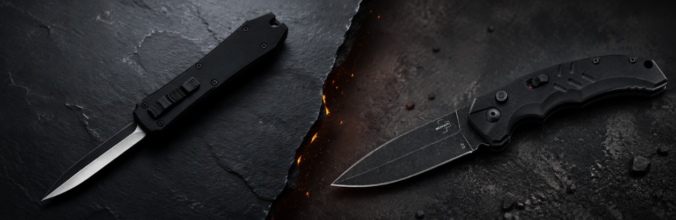
TL;DR: Stilettos feature narrow, needle-like blades (3-7mm wide) with triangular cross-sections designed for armor penetration, while daggers have broader, symmetrical double-edged blades (15-40mm) built for versatile combat. The key difference lies in blade geometry – stilettos sacrifice cutting ability for maximum thrusting power, while daggers balance both functions. Legal classifications also diverge: stilettos face automatic mechanism restrictions, daggers face blade-design prohibitions.
You’re reading this because you’ve seen both terms thrown around and you’re wondering: what actually makes a stiletto different from a dagger? The confusion is real – especially since modern knife makers use “stiletto” to describe everything from Italian switchblades to tactical folders.
Here’s the thing: these are fundamentally different weapons with distinct purposes, blade geometries, and legal classifications. According to Wikipedia, the stiletto dates from the late 15th century as a specialized armor-piercing weapon. Meanwhile, Artisan Cutlery notes that “a dagger is a double-edged, pointed stabbing blade featuring a full tang handle design” that predates stilettos by centuries.
The distinction matters beyond historical trivia. If you’re a collector, understanding these differences helps you identify authentic pieces. If you’re concerned about legal carry, the classification determines which laws apply. And if you’re just curious about blade design, the engineering behind each type reveals fascinating trade-offs between penetration, cutting ability, and structural integrity.
What Is a Stiletto Knife?
A stiletto is a specialized thrusting weapon characterized by an extremely narrow blade – typically 3-7mm wide – with a triangular or diamond-shaped cross-section. According to Fire and Steel, “the stiletto dagger is a short-bladed weapon primarily designed for thrusting, with its history tracing back to the late 15th century during the Roman Empire.”
The defining feature? That needle-like profile. Knives Deal explains that “the professional manufacturers of this knife recommend that the ideal length of this knife is supposed to be somewhere between 7 inches to 12 inches.” But it’s not about overall length – it’s about the blade’s cross-sectional geometry.
Historical stilettos featured minimal or no sharpened edges. The entire design focused on one job: punching through armor gaps. The triangular cross-section provided maximum rigidity for the blade width, preventing flex when striking hard surfaces like plate steel or bone. Some later examples incorporated hollow-ground flutes to reduce weight without sacrificing penetration capability.
Modern “stiletto” knives create confusion. Wikipedia notes that “during the 1950s, large numbers of folding switchblade or automatic opening knives with locking blades were imported from Italy to the United States.” These Italian switchblades borrowed the stiletto name for their needle-point blade profile, but they’re functionally different weapons – featuring automatic mechanisms and often including utilitarian cutting edges.
The blade geometry tells the real story. True stilettos concentrate all force on a minimal point. There’s no primary cutting edge because adding one would widen the blade and reduce penetration efficiency. The cross-section – whether triangular, diamond, or hollow-ground – maximizes structural rigidity while minimizing width.
Key Takeaway: Stilettos feature 3-7mm wide blades with triangular cross-sections designed exclusively for armor penetration. Modern automatic “stilettos” borrow the name but represent a different weapon category with folding mechanisms and utility edges.
What Is a Dagger?
A dagger is a double-edged stabbing weapon with a symmetrical blade profile, typically 15-40mm wide. Artisan Cutlery defines it clearly: “Unlike knives, daggers lack a primary cutting edge and usually feature a symmetrical, needle-like point for piercing armor, clothing, and flesh.”
Wait – that description sounds contradictory. Daggers do have cutting edges, but they don’t have a primary cutting edge the way a chef’s knife or hunting knife does. Both edges are equally sharp, creating symmetry. According to Everest Forge, “a dagger always features a double-edged symmetrical blade that tapers to a fine point.”
The historical record shows incredible variety. Medieval daggers evolved into specialized types:
- Rondel daggers: Disc-shaped guards and pommels, popular 14th-15th centuries
- Ballock daggers: Distinctive testicular-shaped pommels at grip base
- Misericorde: Narrow “mercy daggers” for delivering coup de grâce through armor gaps
- Kidney daggers: Kidney-shaped pommels, common in Germanic regions
Noblie Custom Knives provides specific measurements: “This guide treats ‘dagger-length’ as a 5–45 cm blade; 46–60 cm sits in the overlap zone with dirks and short swords.” They also note that “for one-hand builds, 80–450 g is the practical carry envelope.”
The blade cross-section typically features a lenticular (lens-shaped) or flattened diamond profile. This geometry supports strong cutting edges while maintaining structural integrity for thrusting. Unlike stilettos, daggers needed to perform multiple functions – cutting through clothing, slashing at exposed flesh, and delivering thrusts when opportunities arose.
Construction methods varied. Artisan Cutlery explains that “the handle of a dagger typically employs a full tang design, where the blade material seamlessly extends through the entire handle, forming a single, solid piece.” This full-tang construction provided durability while allowing ergonomic handle materials like wood, bone, or leather wrapping.
The versatility made daggers ubiquitous. Knights carried them as sidearms. Civilians used them for self-defense. Soldiers employed them when swords became impractical in close-quarters grappling. That multi-purpose design philosophy fundamentally separates daggers from the specialized stiletto.
Key Takeaway: Daggers feature 15-40mm wide, double-edged symmetrical blades with lenticular cross-sections. Full-tang construction and balanced geometry enabled versatile combat applications – cutting, slashing, and thrusting – unlike the stiletto’s single-purpose design.
How Do Blade Designs Differ?
The cross-section reveals everything. Hold a stiletto blade tip-up and look down the length – you’ll see a sharp triangular or diamond profile with pronounced ridges. A dagger blade shows a smooth, lens-shaped curve with symmetrical edges.
Here’s the engineering trade-off: blade width versus penetration power. Noblie Custom Knives specifies that “treat a ‘dagger-pointed’ tip as one with an included tip angle of 25–40°. Below 25° the point becomes fragile under hard thrusts; above 40° penetration falls off in dense targets.”
Stilettos pushed that envelope. By narrowing the blade to 3-7mm and using a triangular cross-section, they achieved tip angles below 25° while maintaining structural integrity through geometry rather than mass. The triangular profile creates three load-bearing ridges that resist bending in all directions.
Daggers took a different approach. The broader blade (15-40mm) required a different cross-section to maintain edge retention. The lenticular profile distributes force across the cutting edges while keeping enough spine thickness for thrusting. Noblie Custom Knives recommends “spine thickness at 10 mm behind the tip at ≥ 2.0–3.0 mm; under 2.0 mm, point deformation and chipping become the dominant failure mode.”
| Feature | Stiletto | Dagger |
|---|---|---|
| Blade Width | 3-7mm | 15-40mm |
| Cross-Section | Triangular/diamond with ridges | Lenticular/smooth lens |
| Edge Count | 0-1 (minimal or none) | 2 (symmetrical double-edge) |
| Tip Angle | <25° (acute) | 25-40° (moderate) |
| Primary Function | Armor penetration | Versatile combat |
| Spine Thickness | Minimal (rigidity from geometry) | 2.0-3.0mm at 10mm from tip |
The edge geometry creates functional consequences. Stilettos with no sharpened edges can’t cut rope, slice fabric, or perform utility tasks. They’re pure thrusting weapons. Daggers with symmetrical double edges can slash, cut, and thrust – but that versatility comes at the cost of penetration efficiency.
Point geometry matters too. The stiletto’s needle-like tip concentrates force on a microscopic area, ideal for slipping between armor plates or mail rings. The dagger’s broader point distributes force across a larger area, better for penetrating unarmored flesh without the tip breaking.
Material distribution differs significantly. Stilettos achieve rigidity through geometric efficiency – the triangular cross-section inherently resists bending. Daggers rely on mass – thicker spines and broader blades provide structural support. That’s why stilettos could maintain effectiveness at narrower widths while daggers needed substantial blade stock.
The hollow-ground variation adds complexity. Some historical stilettos featured flutes (grooves) running along the blade faces. These reduced weight without compromising the load-bearing ridges. Daggers rarely used this technique because removing material from the blade faces would weaken the cutting edges.
Key Takeaway: Stiletto triangular cross-sections (3-7mm wide) maximize penetration through geometric rigidity, while dagger lenticular profiles (15-40mm) balance cutting edges with thrusting capability. The 5x width difference reflects fundamentally different tactical priorities – specialized armor penetration versus versatile combat.
What Are the Historical Differences?
Medieval daggers emerged first. Artisan Cutlery notes that “knives are one of humanity’s oldest tools, emerging in the Paleolithic Era with the advent of blade technology.” Daggers evolved as specialized combat versions – double-edged, symmetrical, optimized for close-quarters fighting.
By the 12th-13th centuries, knights carried daggers as standard sidearms. When sword combat devolved into grappling, the dagger became the finishing weapon. Rondel daggers, ballock daggers, and kidney daggers proliferated across Europe, each regional variation reflecting local fighting styles and armor types.
Then armor improved. Plate armor became more sophisticated in the 14th-15th centuries, covering more of the body with fewer gaps. Traditional daggers struggled against these defenses – their broader blades couldn’t slip through narrow openings between plates.
Enter the stiletto. Knives Deal states that “this knife is somewhat around 500 years old,” placing its origin in the early 1500s. Fire and Steel provides context: “during the Renaissance period (14th–16th century), the stiletto dagger bore a close resemblance to the poignard, a French-style dagger that was popular among European nobility and knights.”
The tactical purpose drove the design evolution. Stilettos weren’t meant to replace daggers – they supplemented them. A knight might carry both: a traditional dagger for general combat and a stiletto specifically for defeating armored opponents. The stiletto’s narrow profile could penetrate:
- Gaps between breastplate and pauldron (shoulder armor)
- Visor slots in helmets
- Spaces between mail rings
- Joints in plate armor (elbows, knees, armpits)
Fire and Steel explains the grim reality: “the stiletto dagger was known in French as miséricorde or ‘the mercy dagger’ – a weapon used to deliver the final blow to a defeated foe.” Wounded knights in full armor couldn’t be easily killed with conventional weapons. The stiletto solved that problem.
Military adoption followed. Fire and Steel notes that “the French Lebel M1886 rifle even came equipped with a triangular bayonet that resembled a stiletto dagger, specifically designed for close-quarters combat.” The geometry proved effective enough to influence bayonet design centuries later.
But stilettos also gained a darker reputation. records that “in New Orleans, USA, the stiletto dagger was associated with numerous murders, prompting the city to enact a ban on its sale and public display in 1879.” The weapon’s association with assassination and street violence led to legal restrictions long before modern knife laws.
The 20th century brought confusion. documents that “in late 1940, the famed British hand-to-hand combat instructors William E. Fairbairn and Eric A. Sykes designed the Fairbairn–Sykes fighting knife.” This commando dagger featured a narrow, double-edged blade – technically a dagger, but often called a “stiletto” due to its slender profile.
Then came the Italian switchblades. Post-WWII Italian knife makers produced automatic-opening knives with stiletto-style blade profiles. These modern “stilettos” borrowed the historical name but represented a completely different weapon category – folding knives with spring-assisted mechanisms rather than fixed-blade thrusting weapons.
Key Takeaway: Daggers emerged in medieval times (1200s-1400s) as versatile combat weapons, while stilettos developed in Renaissance Italy (1450s-1600s) specifically to defeat improved plate armor. The 200+ year gap reflects evolving battlefield technology – stilettos solved the tactical problem of armored opponents that traditional daggers couldn’t address.
Are Stilettos and Daggers Legally Different?
Yes – and the distinction matters more than you might think. The legal frameworks classify these weapons based on different characteristics: blade design versus deployment mechanism.
Federal law focuses on automatic mechanisms. The Switchblade Knife Act of 1958 restricts automatic-opening knives regardless of blade type. This means a modern automatic “stiletto” knife faces federal restrictions based on its spring-assisted mechanism, not its blade geometry. The law doesn’t care whether the blade is needle-like or broad – it cares how the knife opens.
State laws take a different approach with daggers. Blade Forums provides California’s definition: “a knife or other instrument with or without a handguard that is capable of ready use as a stabbing weapon that may inflict great bodily injury or death.” The focus is entirely on blade characteristics – double-edged, designed for stabbing, symmetrical profile.
This creates overlapping restrictions. An automatic knife with a dagger-style blade could face:
- Federal automatic mechanism restrictions
- State dagger blade design prohibitions
- Local concealed carry laws
- Blade length limitations
Everest Forge explains the practical impact: “In most countries, knives are classified as tools and legal to own, though restrictions may apply to blade length or public carry. Daggers are considered weapons in many regions and may require permits or be restricted entirely.”
The blade length thresholds vary dramatically by state. Some jurisdictions prohibit daggers over 3 inches. Others set limits at 4 or 5 inches. A few states ban double-edged blades entirely regardless of length. And these restrictions often apply differently to concealed carry versus open carry.
Here’s where it gets complicated: the term “stiletto” appears in some state statutes, but the legal definition rarely matches the historical one. Some states use “stiletto” to mean any automatic knife with a pointed blade. Others define it as any narrow, double-edged weapon. The terminology confusion creates legal ambiguity.
Blade Forums notes an important caveat: “A nonlocking folding knife, a folding knife that is not prohibited by Section 653k, or a pocketknife is capable of ready use as a stabbing weapon that may inflict great bodily injury or death only if the blade of the knife is exposed and locked into position.” This means folding daggers face different restrictions than fixed-blade daggers in some jurisdictions.
The practical implications for collectors and carriers:
- Historical stilettos (fixed-blade, manual opening): Face dagger-style blade restrictions in many states
- Modern automatic stilettos: Face both federal automatic restrictions AND state blade design laws
- Traditional daggers: Face state blade design prohibitions but not federal automatic laws
- Folding daggers: May have different legal status than fixed-blade versions
Enforcement varies wildly. Some jurisdictions actively prosecute dagger possession. Others focus enforcement on criminal use rather than mere possession. And some states have preempted local restrictions, creating uniform statewide standards.
The safest approach? Research your specific state and local laws before purchasing. Don’t rely on retailer descriptions – “tactical folder” and “stiletto knife” are marketing terms that may not align with legal definitions. Check blade length, edge count, opening mechanism, and intended carry method against applicable statutes.
Key Takeaway: Federal law restricts automatic stilettos by mechanism (Switchblade Act), while state laws prohibit daggers by blade design (double-edged, stabbing-optimized). A weapon may face both restrictions simultaneously. Blade length thresholds vary from 2.5-5+ inches depending on jurisdiction, with some states banning double-edged blades entirely.
Which Should You Choose: Stiletto or Dagger?
Neither – at least not for practical everyday carry. But if you’re collecting historical reproductions or studying blade design, the choice depends on what interests you.
For collectors, historical daggers offer more variety. The medieval and Renaissance periods produced dozens of distinct dagger types – rondel, ballock, kidney, ear, quillon, and more. Each regional variation reflects different fighting styles and cultural aesthetics. Reproduction quality daggers from reputable makers typically range $150-$400 depending on materials and historical accuracy.
Historical stilettos represent a narrower collecting category. The design remained relatively consistent – narrow blade, minimal guard, simple handle. But authentic reproductions require precise geometry to capture the original’s penetration characteristics. Expect similar pricing to quality daggers, with premium examples reaching $500+ for museum-quality reproductions.
Modern automatic “stilettos” occupy a different niche entirely. These Italian-style switchblades range from $80-$300 for quality examples from manufacturers like Microtech, ProTech, or traditional Italian makers. But remember – these are modern folding knives that borrowed the stiletto name, not historical reproductions.
Legal compliance should drive your decision more than preference. Before purchasing either type:
- Check state dagger laws: Does your state prohibit double-edged blades? What’s the blade length limit?
- Verify automatic knife laws: If considering a modern automatic stiletto, is possession legal in your jurisdiction?
- Review carry restrictions: Even if ownership is legal, concealed or open carry may face additional limitations
- Consider local ordinances: Some cities impose stricter restrictions than state law
For display and historical interest, daggers offer richer context. You can explore how blade geometry evolved across centuries and regions. The variety of guard styles, pommel shapes, and blade profiles provides endless collecting opportunities. Plus, historical treatises and fighting manuals documented dagger techniques extensively, adding educational value.
Stilettos appeal to those interested in specialized engineering. The blade geometry represents an elegant solution to a specific tactical problem – how to defeat armor with minimal material. The cross-sectional profiles demonstrate sophisticated understanding of structural mechanics centuries before modern engineering principles.
Budget considerations matter. Quality reproductions of either type require skilled craftsmanship. Cheap replicas often miss the crucial details – incorrect blade geometry, wrong cross-sections, inappropriate materials. If you’re serious about collecting, save for fewer high-quality pieces rather than accumulating inaccurate reproductions.
Authentication becomes critical in the antique market. Genuine historical pieces command premium prices, but reproductions and fakes abound. Unless you have expertise in metallurgy, construction methods, and period-appropriate materials, stick with reputable reproduction makers or work with established dealers who guarantee authenticity.
The practical reality? Neither weapon type serves modern self-defense needs. Better options exist – legal folding knives, fixed-blade utility knives, or purpose-built defensive tools. Historical daggers and stilettos belong in collections, not pockets.
If you’re drawn to the blade geometry and engineering, consider modern interpretations. Some knife makers produce legal, single-edged designs inspired by historical profiles. You get the aesthetic and mechanical interest without the legal complications of true double-edged daggers.
Key Takeaway: Choose daggers for collecting variety (dozens of historical types, $150-$400 range) or stilettos for specialized engineering interest. Legal compliance determines viability more than preference – verify state dagger prohibitions and automatic knife laws before purchasing. Neither serves practical modern carry purposes; both belong in collections or historical study.
FAQ: Stiletto vs Dagger Questions
Is a stiletto considered a dagger?
Direct Answer: Historically, stilettos are a specialized subset of daggers, but modern usage separates them – stilettos emphasize narrow, armor-piercing geometry while daggers represent broader double-edged weapons.
The classification depends on context. In historical arms catalogs, stilettos appear as a dagger subcategory alongside rondels, ballocks, and other types. But the specialized design – that 3-7mm narrow blade with triangular cross-section – sets stilettos apart functionally. Fire and Steel refers to “the stiletto dagger,” acknowledging the overlap while recognizing the distinct characteristics.
Modern knife terminology muddies the waters further. When someone says “stiletto” today, they might mean a historical thrusting weapon OR an Italian-style automatic knife with a pointed blade. The dual meaning creates confusion that didn’t exist in the Renaissance.
What makes a stiletto different from other knives?
Direct Answer: The defining difference is the extremely narrow blade (3-7mm) with a triangular or diamond cross-section designed exclusively for penetration, sacrificing all cutting ability for maximum thrusting power.
Cutlery Wholesaler notes that stilettos feature “an acute angle of 45 degrees” at the point, creating exceptional penetration characteristics. The cross-sectional geometry provides rigidity without requiring broad blade stock – a engineering solution that predates modern materials science by centuries.
Most knives balance multiple functions – cutting, slicing, chopping, thrusting. Stilettos abandoned that versatility entirely. The result is a weapon that excels at one specific task: punching through resistant materials with minimal force.
Are daggers illegal in the United States?
Direct Answer: Federal law doesn’t prohibit daggers, but many states restrict or ban double-edged knives based on blade design, length, and carry method – legality varies dramatically by jurisdiction.
Everest Forge explains that “daggers are considered weapons in many regions and may require permits or be restricted entirely.” California, New York, Massachusetts, and other states impose specific restrictions on double-edged blades. Some prohibit concealed carry regardless of length. Others set blade length thresholds (typically 2.5-5 inches).
The patchwork of state laws creates complexity. A dagger legal in Texas might be prohibited in California. Always research your specific state statutes and local ordinances before purchasing or carrying.
Can you carry a stiletto knife legally?
Direct Answer: Legality depends on whether you mean a historical fixed-blade stiletto (subject to state dagger laws) or a modern automatic stiletto (subject to federal Switchblade Act plus state laws) – both face significant restrictions.
Modern automatic stilettos encounter federal interstate commerce restrictions under the Switchblade Knife Act. Even in states that legalized automatic knives, federal law complicates purchasing and shipping. Historical fixed-blade stilettos face the same state-level restrictions as daggers – double-edged blade prohibitions, length limits, and carry method restrictions.
The safest assumption? Stilettos of either type face legal barriers in most jurisdictions. Verify specific laws before purchasing, and never assume retailer descriptions reflect legal classifications.
What is the point of a stiletto blade design?
Direct Answer: The narrow, rigid blade geometry concentrates maximum force on a minimal point, enabling penetration through armor gaps, mail rings, and resistant materials that broader blades cannot defeat.
Cutlery Wholesaler notes the historical context: stilettos emerged “dating back to 11th century Rome” (though most historians place development in the 15th century). The design solved a specific tactical problem – how to kill an armored opponent when conventional weapons couldn’t penetrate improved plate armor.
The triangular cross-section provides structural rigidity without requiring blade width. This geometric efficiency meant a 4mm stiletto blade could withstand thrusting forces that would bend or break a conventional knife blade of similar dimensions.
How do you identify a true dagger vs a knife?
Direct Answer: True daggers feature symmetrical, double-edged blades with points optimized for stabbing, while knives have a primary cutting edge with a spine or false edge – symmetry is the key identifier.
Everest Forge provides the clearest distinction: “a dagger always features a double-edged symmetrical blade that tapers to a fine point.” If you can draw a centerline down the blade and both sides mirror each other, it’s a dagger. If one side is clearly the “cutting edge” and the other is a spine or back, it’s a knife.
The handle construction offers additional clues. Artisan Cutlery notes that daggers typically employ “full tang design, where the blade material seamlessly extends through the entire handle.” This construction supports the forces generated by two-handed thrusting.
Are automatic stilettos more restricted than manual daggers?
Direct Answer: Yes – automatic stilettos face both federal Switchblade Act restrictions on the opening mechanism AND state-level dagger blade design prohibitions, creating dual legal barriers.
The federal Switchblade Knife Act prohibits interstate commerce in automatic knives regardless of blade type. This means even in states that legalized automatic knives, purchasing and shipping face federal complications. Manual daggers avoid federal restrictions but still encounter state-level prohibitions based on blade design.
The result? An automatic knife with a dagger-style blade faces the most restrictive legal environment – federal mechanism laws plus state blade design laws plus local carry restrictions. Manual daggers face fewer barriers, though state-level prohibitions can still be severe.
Ready to Get Started?
For personalized guidance, visit Knife Depot to learn how we can help.
Conclusion
The stiletto versus dagger distinction comes down to specialized engineering versus versatile design. Stilettos sacrificed everything – cutting ability, utility, multi-purpose functionality – for maximum penetration through a 3-7mm needle-like blade. Daggers balanced double-edged cutting with thrusting capability through broader, symmetrical geometry.
Understanding these differences matters beyond historical curiosity. Legal classifications diverge based on blade design versus deployment mechanism. Collectors need to recognize authentic characteristics versus modern marketing terminology. And anyone interested in blade engineering can appreciate how Renaissance craftsmen solved tactical problems through geometric innovation.
For modern purposes, neither weapon type serves practical carry needs. But as historical artifacts or reproduction collectibles, both categories offer fascinating insights into how form follows function – and how battlefield technology drove centuries of design evolution.
If you’re exploring knife options for everyday carry, Knife Depot offers modern folders and fixed blades that deliver practical utility without the legal complications of historical dagger designs.


Leave a Reply