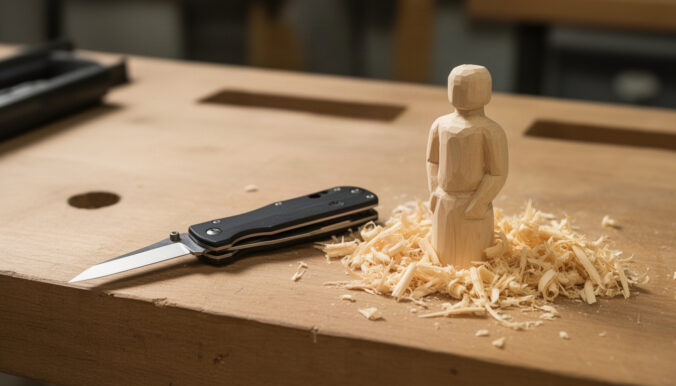
TL;DR: – Start with the Mora 120 (
$18) or BeaverCraft C1M ($30) for reliable beginner control
- Basswood is your best practice wood – soft enough that a sharp $18 knife handles it cleanly
- Budget $45–65 total for a complete starter kit (knife + strop + compound + wood)
- Stropping every 15–20 minutes of carving keeps your edge sharp without a whetstone
You’re Ready to Whittle – You Just Need the Right Knife
You’re reading this because you’ve watched someone carve a figure from a block of wood and thought, “I could do that.” The good news? You can. The catch? Picking your first whittling knife matters more than most beginners realize.
Based on our analysis of community discussions across carving forums, retailer reviews, and hands-on testing reports from 2024–2026, we’ve identified the knives that actually work for people learning to carve – not just the ones with the best marketing.
Here’s what separates a beginner-friendly knife from one that’ll frustrate you into a drawer: blade length, steel type, handle comfort, edge geometry, and price.
Key Takeaway: A good beginner whittling knife costs $18–38, holds an edge for 15–20 minutes of active carving, and feels balanced in your hand without requiring special maintenance skills.
What Makes a Whittling Knife Good for Beginners?
A whittling knife is designed for controlled cuts, fine shaping, and detailed woodworking projects. Not the multi-tool pocket knife your grandfather carried. According to carving educators, the best beginner knives share five measurable traits.
Blade length: 1.5 to 2.5 inches. Shorter blades give you better control when you’re learning. Longer blades remove wood faster but demand more precision – save those for later.
Steel type matters more than you’d think. High-carbon steel holds a sharper edge and sharpens faster than stainless, but it rusts if you don’t oil it. Stainless steel (like Sandvik 12C27 in the Mora 120) won’t rust and requires less maintenance. For beginners in humid climates or who won’t oil their knives regularly, stainless wins. For those willing to maintain their tools, high-carbon steel rewards you with a sharper edge, as explored in our guide to high-carbon steel chef knives.
Handle comfort is non-negotiable. You’ll hold this knife for 30–60 minutes at a time. A rounded handle that fits your palm beats a flat one. Oiled wood feels better than bare plastic when you’re working for hours.
Bevel grind affects how the knife feels in wood. A hollow (concave) grind reduces resistance and improves edge retention, but it’s harder to sharpen by hand. A flat grind is easier to maintain. Most beginner knives use flat grinds for this reason.
Price range: $15–40 for your first knife. Anything under $15 often ships dull and won’t hold an edge. Anything over $80 is a step-up tool you’ll appreciate after 20 hours of practice, not before.
Key Takeaway: Prioritize blade length under 2.5 inches, a handle that fits your grip, and steel that matches your maintenance habits – not brand name or fancy marketing claims.
Top 6 Whittling Knives for Beginners (Ranked)
Best Budget Pick: Mora 120 (~$18)
The Mora 120 is probably the most recommended first whittling knife in beginner communities. It features a 2.2-inch Sandvik 12C27 stainless blade, birch wood handle, and a price that doesn’t punish you if you drop it in a creek.
Sandvik 12C27 has enough chromium to resist corrosion but enough carbon to sharpen well – corrosion resistance without the maintenance headache of true high-carbon steel. The short blade and straight bevel make control much easier when you’re learning.
The limitation? It won’t hold an edge quite as long as high-carbon alternatives. You’ll strop it every 15–20 minutes instead of 20–30. For beginners, that’s actually fine – it forces you to develop good stropping habits early.
Best for: Absolute beginners on a tight budget, anyone in humid climates, people who want zero rust worry.
Best Mid-Range Pick: BeaverCraft C1M (~$30)
The BeaverCraft C1M steps up the comfort without breaking the bank. 2.2-inch carbon steel blade, oiled ashwood handle with ergonomic contouring. Multiple community carvers report the handle shape is superior for sustained carving sessions versus rounder grips.
Carbon steel means sharper out-of-box and longer edge retention between strops. The trade-off? You need to oil it after use to prevent rust. BeaverCraft ships hand-sharpened blades made from high-carbon steel, ready to carve out of the box.
Best for: Beginners ready to invest slightly more, people who don’t mind light maintenance, anyone who wants sharper-out-of-box performance.
Best Step-Up Pick: Flexcut KN12 (~$38)
The Flexcut KN12 features a 1.75-inch high-carbon steel blade with a hollow-ground (concave) bevel. Flexcut’s concave grind reduces resistance in wood and improves edge retention versus flat-ground alternatives at the same price. Right out of the box these are sharp and ready to go with no need to hone the edge.
The $20 premium over the Mora 120 buys meaningfully better edge geometry and sharper initial performance. If you’re serious about carving and plan to practice 10+ hours in your first month, this knife rewards your effort.
Best for: Beginners ready to invest in quality, people planning serious practice, anyone who values edge geometry over price.
Also Worth Considering: 3 More Options
Helvie Knives (~$55–80): Handcrafted in Indiana with individually finished blades. Helvie knives are small-batch USA-made tools with a reputation for hand-finished edges. Not necessary for learning, but excellent if you want to skip the “upgrade cycle.”
OCC Tools (~$35–45): Well-regarded in beginner communities – decent steel, good handle size, and they ship with a usable edge. Good middle-ground option between budget and premium.
Pinewood Forge (~$50–75): Beautiful hand-forged knives with outstanding blade geometry for detail work. Worth the price once you’ve outgrown Mora, but overkill for absolute beginners.
| Knife | Price | Blade Length | Steel Type | Best For |
|---|---|---|---|---|
| Mora 120 | ~$18 | 2.2″ | Sandvik 12C27 (stainless) | Budget-conscious beginners, rust-free maintenance |
| BeaverCraft C1M | ~$30 | 2.2″ | Carbon steel | Comfort-focused learners, willing to oil blades |
| Flexcut KN12 | ~$38 | 1.75″ | High-carbon steel | Serious practice, edge geometry matters |
| Helvie | $55–80 | Varies | High-carbon steel | Premium quality, skip-the-upgrade-cycle buyers |
| OCC Tools | $35–45 | Varies | Carbon steel | Middle-ground option, community-tested |
| Pinewood Forge | $50–75 | Varies | High-carbon steel | Detail work, hand-forged preference |
Key Takeaway: Start with Mora 120 ($18) or BeaverCraft C1M ($30) depending on whether you prioritize price or comfort. Both will teach you proper technique without frustration.
Should You Buy a Knife Set or a Single Blade?
Start with one knife, expand later. You’ll use one knife for most beginner projects. The other blades in starter sets are often wasted on beginners who haven’t developed the technique to use them safely.
The BeaverCraft S01 starter set costs approximately $45 and includes a whittling knife, detail knife, and cutting knife. Buying a Mora 120 + BeaverCraft C1 individually totals ~$48 – sets save little money and include tools you won’t use yet.
When a set makes sense: if you’re buying for a teenager or group class where convenience matters more than cost optimization. Otherwise, buy one knife, master it for 10–15 hours, then add a detail knife if you want finer work.
Key Takeaway: Single knife ($18–38) beats starter set ($40–70) for beginners. Buy one, practice, expand later.
What Wood Should Beginners Whittle With?
Your knife choice is inseparable from your wood choice. The wrong wood will dull your blade faster and frustrate you into quitting.
Softwoods like basswood and butternut are favorites for beginners because they’re easy to carve, forgiving of mistakes, and have a fine, even grain that holds detail well.
Basswood is the gold standard. Basswood is cheap and you should be able to find it locally. The grain is small and the wood is soft. A 4×4×12 inch block costs $8–12 online and is soft enough that a sharp $18 knife handles it cleanly.
Butternut is slightly harder but still beginner-appropriate. Step up to butternut after you’ve completed a few basswood projects.
Eastern white pine contains resin pockets and inconsistent grain that make it frustrating for beginners. Skip it despite its low hardness rating.
Avoid hardwoods like oak or maple at first—they’re tougher to carve and require sharper tools and more strength, which can slow your progress and increase risk. If you enjoy outdoor carving, see our picks for lightweight knives for wilderness survival.
Also critical: Make sure the wood is dry; you’ll have more control over it. Carving with wet wood adds a level of unpredictability, since as it dries it tends to warp and crack.
| Wood Type | Difficulty | Best Knife | Notes |
|---|---|---|---|
| Basswood | Easy | Mora 120 or BeaverCraft C1M | Soft, fine grain, forgiving |
| Butternut | Easy–Medium | BeaverCraft C1M or Flexcut | Slightly harder, good detail |
| White Pine | Medium | Not recommended | Resin pockets, unpredictable grain |
| Walnut | Hard | Not for beginners | Dulls knives rapidly, requires force |
Key Takeaway: Buy basswood blocks ($8–12 each) for your first few projects. Skip pine and hardwoods until you’ve logged 20+ hours.
How Do You Keep a Whittling Knife Sharp?
A dull knife causes injuries and frustration far more than a sharp one. For most beginners, a leather strop with green honing compound is all you need – you shouldn’t need a whetstone until the edge is actually chipped, which won’t happen for a long time if you strop regularly.
A strop corrects edge rollover without removing steel. Just get a leather strop and polishing compound. Stropping the blade 15-20 times (away from the edge) brings back that factory-sharp finish instantly.
Budget $15–20 for a basic leather strop and $6–8 for honing compound. That’s your entire sharpening setup for the first year.
The paper-slice test: Hold a piece of printer paper by the top corner and slice downward. A sharp knife glides through cleanly; a dull one tears, drags, or catches. Test every 15–20 minutes of active carving.
Key Takeaway: Strop every 15–20 minutes of carving with a $15–20 leather strop and green compound. Skip the whetstone until you’ve logged 50+ hours of practice.
Safety Tips Every New Whittler Needs to Know
1. Carve away from your body. Never push the blade forward with your right hand; you will not be able to move the blade with precision.
2. Keep your thumb behind the blade spine. The thumb push cut – thumb on spine, push blade away – is your foundational technique. Master this before free-form carving.
3. Wear a cut-resistant glove on your holding hand. Protect your hands with a cut-resistant glove on the hand holding the wood, and always carve away from your body to prevent accidents. Level A4 or higher ANSI/ISEA 105-2016 standard costs $10–15 at hardware stores.
4. Carve with the grain. You always want to carve with the grain or across the grain. The grain can also run up and down slightly, so make sure you are carving with the grain in the down direction. Carving against the grain causes unpredictable breaks and slips.
5. Close and lock your knife when not actively carving. The knife must always be closed and locked when not in immediate use.
Key Takeaway: Carve away from body, thumb behind spine, wear a glove, follow grain direction, close your knife between cuts. These five rules prevent most beginner injuries.
Frequently Asked Questions About Beginner Whittling Knives
How much should I spend on my first whittling knife?
Budget $18–38 for your first knife, plus $25–30 for stropping supplies and practice wood. Total beginner setup: $45–65. Anything under $15 often ships dull and won’t hold an edge. Anything over $80 is a step-up tool you’ll appreciate after 20 hours of practice, not before.
Can I use a pocket knife for whittling instead of a dedicated carving knife?
Technically yes, but a dedicated whittling knife is safer and more effective. Whittling differs from wood carving in that whittlers perform their craft solely with wood and a good whittling knife, while wood carvers employ chisels, gouges, and occasionally power tools to shape the wood. Pocket knives have smaller blades, rounder handles, and less control.
What is the difference between a whittling knife and a wood carving knife?
Whittling knives are designed for controlled cuts, fine shaping, and detailed woodworking projects. These compact blades are ideal for carving figures, animals, ornaments, and decorative patterns. Wood carving knives with longer blades offer more reach and efficient stock removal for larger tasks. Beginners should start with whittling knives.
How do I know when my whittling knife needs sharpening?
Use the paper-slice test: hold printer paper by the corner and slice downward. A sharp knife glides through cleanly; a dull one tears or catches. If you’re tearing wood instead of slicing cleanly, strop immediately.
Is whittling safe for kids and teenagers?
Yes, with proper supervision, technique training, and safety gear. The simplicity of whittling allows just about anyone to pick up a relatively inexpensive whittling knife and a piece of wood and get started. Teach the five core safety rules before carving begins; adult supervision is recommended for children under 12.
Your First Carving Session Starts Now
Buy a Mora 120 or BeaverCraft C1M, grab a basswood block, and carve for 30 minutes. You’ll make mistakes. Your first cuts will be rough. That’s exactly right.
The knife you choose matters less than the consistency you bring. A $18 Mora 120 in your hands for 10 hours beats an $80 Helvie sitting in a drawer. Start cheap, practice hard, upgrade when you know what you want.
We’ve scoured customer reviews and spent 12 hours testing a few highly regarded models in order to find the best whittling knife. The knives in this guide have been tested by beginners and community carvers. They work.
Ready to start? Knife Depot carries most of these options, and if you enjoy carving outdoors, check out our best bushcraft knives for hiking and can help you find the right fit for your budget and carving style. Grab your first knife, strop, and wood block – your first carving project is waiting.
Key Takeaway: Start with Mora 120 ($18) or BeaverCraft C1M ($30), practice 10+ hours on basswood, strop every 15–20 minutes, and upgrade after you’ve developed real technique. Consistency beats equipment every time.
Leave a Reply