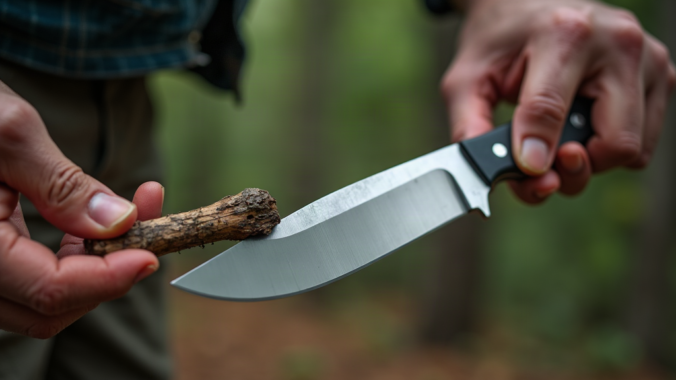
TL;DR: – Best overall value: Mora Garberg at ~$90 with 4.3-inch Sandvik 14C28N stainless blade, 4.9 oz, full tang – handles 90% of hiking tasks without the weight penalty.
- Best budget pick: Mora Companion at ~$20, only 3.0 oz, partial tang but proven durable for normal trail use.
- Best premium option: ESEE 4 at ~$130, 5.3 oz with modular sheath system worth $30 separately – ideal if you want carry flexibility and 1095 high-carbon steel that resharpens quickly.
What Makes a Bushcraft Knife Good for Hiking?
A bushcraft knife for hiking needs to balance four core criteria: blade length, steel type, tang construction, and handle ergonomics. You’re not just looking for a camp knife – you need something that handles food prep, fire starting, and light batoning without dragging down your pack.
Here’s the direct answer: aim for a 3.5–5 inch blade in either high-carbon steel (1095, 1075) or stainless-leaning steels like Sandvik 14C28N, full tang construction, and a weight under 5.5 oz total (blade + handle). That’s your sweet spot for day hikes and multi-day backpacking.
Why does hiking differ from pure camp use? Weight matters. A 6-inch blade adds 1.5–2 oz and zero measurable utility for most hikers. You’re also carrying the knife for 8+ hours, so ergonomics and sheath comfort become critical. A poorly designed handle or heavy sheath turns a great blade into dead weight.
Blade length math: According to bushcraft expert Mors Kochanski, a 4-inch blade is the sweet spot – long enough for batoning small-diameter wood, short enough for fine carving and food prep without excessive weight. Going beyond 5 inches adds weight with no measurable utility gain for day hikers.
Steel type is where most guides fall short. You need to understand the trade-off: high-carbon steels like 1095 resharpen in the field with a $8–$12 pocket diamond stone in under 3 minutes, but they rust if you don’t oil them. Stainless-leaning steels like Sandvik 14C28N resist corrosion but require ceramic or finer abrasives to sharpen on the trail.
Full tang vs. partial tang? Full tang is functionally superior for batoning and heavy wood processing. But Mora Companions with partial tangs survive years of normal trail use at 3 oz – the full-tang premium matters most above $80.
Key Takeaway: A hiking bushcraft knife should weigh under 5.5 oz total, feature a 4–4.5 inch blade, and use either easy-to-sharpen high-carbon steel or corrosion-resistant stainless-leaning steel depending on your climate.
How Do Different Steel Types Affect Performance on the Trail?
This is where most bushcraft guides leave you hanging. They list knives without explaining why steel choice matters for your specific hike.
Direct answer: For hiking, choose between 1095 high-carbon steel (57–58 HRC) if you’re willing to maintain it, or Sandvik 14C28N stainless (58–62 HRC) if you want zero rust worry. D2 semi-stainless (60–61 HRC) splits the difference but requires ceramic sharpening tools on the trail.
Here’s the steel comparison that matters:
| Steel | Hardness (HRC) | Edge Retention | Corrosion Resistance | Field Sharpening | Best For |
|---|---|---|---|---|---|
| 1095 High Carbon | 57–58 | Good | Poor (requires oiling) | Easy (diamond stone, 3 min) | Budget hikers, dry climates |
| D2 Semi-Stainless | 60–61 | Excellent | Good (~12% chromium) | Moderate (ceramic rod needed) | Mixed climates, longer trips |
| Sandvik 14C28N Stainless | 58–62 | Good | Excellent | Easy (flat stone, scandi grind) | Wet climates, low-maintenance |
| A2 Tool Steel | 60–61 | Excellent | Moderate (requires oiling) | Moderate (ceramic) | Heavy batoning, premium knives |
| S30V Stainless | 58–60 | Excellent | Excellent | Hard (diamond only) | Premium, minimal maintenance |
1095 high-carbon steel is the classic bushcraft choice. According to KnifeInformer, 1095 is a simple high-carbon steel that’s easy to sharpen and tough enough for hard use. The catch? It rusts in wet conditions without oiling. If you’re hiking in the Pacific Northwest or Southeast, you’ll need to oil your blade daily or accept surface rust.
Sandvik 14C28N stainless is optimized for knife applications with enhanced nitrogen content providing improved corrosion resistance compared to older 12C27 stainless. This is what Mora uses in their Garberg. You get excellent rust resistance, easy field sharpening (flat stone, scandi grind), and a blade that handles 90% of hiking tasks without fussing.
D2 semi-stainless contains approximately 11–12% chromium, giving it semi-stainless properties and far better moisture resistance than plain carbon steels. The trade-off? D2 at 60–61 HRC requires a ceramic rod or coarser abrasive to sharpen in the field. You won’t get a razor edge with a pocket diamond stone.
When to choose stainless vs. high-carbon:
- High-carbon (1095, 1075): Dry climates, day hikes, you don’t mind daily maintenance, you want sub-$100 pricing.
- Stainless-leaning (14C28N, D2): Wet climates, multi-day trips, you want minimal fussing, you’re willing to spend $90+.
Key Takeaway: 1095 high-carbon resharpens in 3 minutes with a pocket stone but rusts without oiling. Sandvik 14C28N stainless resists corrosion and sharpens easily but costs $20–$30 more. Choose based on your climate and maintenance tolerance.
Top 7 Best Bushcraft Knives for Hiking (2026 Picks)
Here’s the reality: you don’t need to spend $300 to get a reliable hiking knife. But you also shouldn’t cheap out on blade geometry or steel quality. Let’s break this into three budget tiers so you know exactly what you gain and lose at each price point.
Best Under $60: Mora Garberg vs. Mora Companion
Mora Companion – The Ultralight Choice
- Blade: 4.1 inches, 12C27 stainless or high-carbon steel
- Weight: 3.0 oz (blade + handle only)
- Steel: 12C27 stainless or carbon
- Tang: Partial tang
- Handle: Rubber
- Street price: ~$20–$25
- Best for: Ultralight backpackers, budget-conscious hikers, day trips
The Companion is the gateway bushcraft knife. At 3.0 oz, it’s lighter than most folding knives and costs less than a decent lunch. The partial tang is a genuine structural limitation – you shouldn’t baton thick hardwood or use it as a pry bar. But for food prep, fire starting, and light carving? It’s proven itself on thousands of trails.
Trade-off: Partial tang means less leverage for heavy tasks. But Mora’s design has survived years of normal use. If you’re a day hiker or ultralight backpacker, this is your knife.
Mora Garberg – The Balanced Pick
- Blade: 4.3 inches, Sandvik 14C28N stainless
- Weight: 4.9 oz
- Steel: Sandvik 14C28N (58–62 HRC)
- Tang: Full tang
- Handle: Polypropylene
- Street price: ~$90–$95
- Best for: Most hikers, multi-day trips, wet climates
The Garberg is the knife that made Mora relevant to serious bushcrafters. Full tang construction, Sandvik 14C28N stainless steel, and a scandi grind that sharpens flat on any whetstone. At 4.9 oz, it’s only 1.9 oz heavier than the Companion but gives you full-tang durability and stainless corrosion resistance.
Trade-off: The polypropylene handle isn’t as comfortable as wood or Micarta for extended use. But it’s durable, lightweight, and you won’t worry about it cracking in cold weather.
Garberg vs. Companion: Weight difference is only 1.9 oz. You gain full tang, stainless steel, and a scandi grind. For most hikers, the Garberg is worth the $70 premium.
Best $60–$150: Benchmade Bushcrafter, Condor Bushlore, ESEE 4
Condor Bushlore – The Budget Full-Tang
- Blade: 4.3 inches, 1075 high-carbon steel
- Weight: 5.4 oz
- Steel: 1075 high-carbon (~56–58 HRC)
- Tang: Full tang
- Handle: Walnut
- Street price: ~$50–$60
- Best for: Budget hikers who want full tang, dry climates
The Bushlore is a full-tang knife at Mora Companion pricing. 1075 is slightly softer than 1095 (~56–58 HRC vs. 57–58 HRC), meaning it resharpens even easier but holds an edge slightly less long. The walnut handle is comfortable and warm in your hand – a real upgrade from polypropylene.
Trade-off: 1075 steel requires oiling in wet conditions, just like 1095. You’re paying for full tang and a nicer handle, not corrosion resistance. If you’re hiking in dry climates, this is a steal.
Benchmade Bushcrafter 162 – The Premium Stainless
- Blade: 4.43 inches, S30V stainless steel
- Weight: 7.2 oz
- Steel: S30V (58–60 HRC)
- Tang: Full tang
- Handle: Dymondwood
- Street price: ~$165–$180
- Best for: Hikers who want zero maintenance, premium feel
S30V is Benchmade’s signature steel – excellent edge retention, excellent corrosion resistance, and a premium price tag. At 7.2 oz, it’s heavier than the Garberg (4.9 oz) but the S30V steel and Dymondwood handle justify the weight for some hikers.
Trade-off: S30V requires diamond or ceramic sharpening tools. You won’t get a field-sharp edge with a pocket stone. If you’re willing to carry a ceramic rod or sharpen at home, this knife is bulletproof.
ESEE 4 – The Modular Choice
- Blade: 4.5 inches, 1095 high-carbon steel
- Weight: 5.3 oz (without sheath)
- Steel: 1095 high-carbon (57–58 HRC)
- Tang: Full tang
- Handle: Micarta
- Street price: ~$130–$140
- Best for: Hikers who want carry flexibility, 1095 steel
The ESEE 4 is famous for its modular Kydex sheath system compatible with MOLLE and various carry configurations. The blade is classic 1095 high-carbon – resharpens in 3 minutes with a pocket stone but requires oiling in wet conditions.
Trade-off: ESEE 4 vs. Mora Garberg: weight difference is only 0.4 oz (5.3 oz vs. 4.9 oz), but the ESEE offers a modular sheath system valued at ~$30 separately. If you need carry flexibility or prefer 1095 steel, the ESEE is worth it. If you want the lightest option, the Garberg wins.
Best $150+: Bark River Bravo 1, ESEE 5
Bark River Bravo 1 – The Toughness King
- Blade: 4.9 inches, A2 tool steel
- Weight: 6.5 oz
- Steel: A2 tool steel (60–61 HRC)
- Tang: Full tang
- Handle: Various (leather, canvas micarta)
- Street price: $250–$320
- Best for: Heavy batoning, premium craftsmanship, hikers who want toughness
A2 tool steel offers superior toughness (impact resistance) compared to D2 and S30V at similar hardness levels, making it preferred for heavy bushcraft use including batoning. The Bravo 1 uses a convex grind – more durable than a scandi grind for hard use.
Trade-off: A2 requires oiling in wet conditions and isn’t recommended for coastal/salt environments without maintenance. You’re paying for toughness and premium craftsmanship, not corrosion resistance.
ESEE 5 – The Heavy-Duty Option
- Blade: 5.25 inches, 1095 high-carbon steel
- Weight: 8.0 oz
- Steel: 1095 high-carbon (57–58 HRC)
- Tang: Full tang
- Handle: Micarta
- Street price: ~$150–$170
- Best for: Multi-day trips with heavy batoning, larger hikers
The ESEE 5 is the ESEE 4’s bigger sibling. At 5.25 inches, it handles large-diameter batoning better than the 4.5-inch ESEE 4. But here’s the weight math: 2.7 oz heavier (8.0 oz vs. 5.3 oz) for 0.75 extra inches of blade. That’s a meaningful penalty for day hikers. For multi-day trips where you’re processing firewood daily, the extra blade length is worth it.
Quick Comparison Table
| Knife | Blade | Steel | Weight | Tang | Price | Best For |
|---|---|---|---|---|---|---|
| Mora Companion | 4.1″ | 12C27 | 3.0 oz | Partial | $20 | Ultralight, budget |
| Mora Garberg | 4.3″ | 14C28N | 4.9 oz | Full | $90 | Most hikers, wet climates |
| Condor Bushlore | 4.3″ | 1075 | 5.4 oz | Full | $55 | Budget, dry climates |
| Benchmade 162 | 4.43″ | S30V | 7.2 oz | Full | $175 | Premium, zero maintenance |
| ESEE 4 | 4.5″ | 1095 | 5.3 oz | Full | $135 | Modular sheath, 1095 lovers |
| Bark River Bravo 1 | 4.9″ | A2 | 6.5 oz | Full | $280 | Heavy batoning, toughness |
| ESEE 5 | 5.25″ | 1095 | 8.0 oz | Full | $160 | Multi-day heavy use |
Key Takeaway: Mora Garberg at ~$90 is the best value – 4.3-inch blade, full tang, stainless steel, 4.9 oz. ESEE 4 at ~$135 adds modular sheath and 1095 steel if you want carry flexibility. Bark River Bravo 1 at ~$280 is for hikers who prioritize toughness over weight.
What Weight and Size Should a Hiking Bushcraft Knife Be?
This is where backpackers get it wrong. They obsess over blade length without understanding the task-to-weight trade-off.
Direct answer: For day hikes, aim for 3.5–4.5 inches and under 5 oz total. For multi-day trips, 4–5 inches and under 6 oz is acceptable. Going beyond 5 inches adds weight (typically 1–2 oz) with no measurable utility gain for most hikers.
Here’s the task-matched breakdown:
3–3.5 inches (2–3 oz): Food prep, fire starting, first aid. Not enough blade for batoning or heavy carving. Best for ultralight day hikers.
4–4.5 inches (4–5 oz): Food prep, fire starting, light batoning, basic carving. Handles 90% of hiking tasks. Sweet spot for most hikers.
5–5.5 inches (6–7 oz): Heavy batoning, large-diameter wood processing, extended camp use. Overkill for day hikes. Worth it for multi-day trips if you’re processing firewood daily.
6+ inches (7–9 oz): Specialized bushcraft or survival use. Too heavy for hiking unless you’re on a dedicated bushcraft expedition.
Sheath weight matters. Leather sheaths typically weigh 2–4 oz; Kydex sheaths 1.5–3 oz; nylon/cordura sheaths 1–2 oz. A 5 oz blade with a 3 oz leather sheath is 8 oz total – heavier than many full-size fixed blades. The ESEE 4’s Kydex sheath is lighter than leather alternatives, which is why the modular system adds value.
Blade length math: A 4.5-inch blade handles 90% of bushcraft tasks. Going to 6 inches adds 1.5 oz and zero measurable utility for day hikers. The ESEE 5 at 8.0 oz is 2.7 oz heavier than the ESEE 4 at 5.3 oz – a meaningful penalty unless you’re batoning large-diameter wood daily.
Key Takeaway: A 4–4.5 inch blade at 4–5 oz total (blade + handle) handles 90% of hiking tasks. Add 1.5–3 oz for sheath weight. Going beyond 5 inches adds weight with no utility gain for day hikers.
How to Maintain a Bushcraft Knife on a Multi-Day Hike
Field maintenance separates hikers who keep their knives sharp from those who end up hacking at wood with a dull blade.
Direct answer: 3-step field maintenance routine: (1) Wipe the blade dry after use, (2) Strop on leather or canvas daily to realign the edge, (3) Sharpen with a pocket stone every 2–3 days if needed.
Strop vs. whetstone – when each is practical on trail:
A strop (leather or canvas) realigns the edge without removing metal. Takes 30 seconds. Carry a small leather strop or use a piece of canvas from your pack. Do this daily after cooking or carving.
A whetstone or diamond stone removes metal and resharpens a dull edge. Takes 3–5 minutes. Carry a pocket diamond stone (cost: $8–$12) if you use 1095 high-carbon steel. If you use stainless like Sandvik 14C28N, a flat whetstone works – the scandi grind self-guides the angle at 17–22 degrees.
Rust prevention for high-carbon blades:
1095 and 1075 high-carbon steels rust without protection. On a multi-day hike:
- Oil your blade daily with a small bottle of mineral oil or gun oil (1 oz bottle weighs nothing).
- Wipe it dry before storing in your sheath.
- If you see surface rust, remove it with a pocket stone or fine steel wool.
Stainless steels like Sandvik 14C28N don’t require oiling. Rinse with water and dry. Done.
Scandi grind advantage: The flat primary bevel acts as its own angle guide when laid on a flat stone – no skill in finding the angle is needed. This is why Mora knives are so easy to sharpen in the field.
Key Takeaway: Strop daily (30 seconds), sharpen every 2–3 days with a pocket diamond stone ($8–$12). Oil high-carbon blades daily. Stainless steels require no oiling. Scandi grind knives self-guide sharpening angles.
Frequently Asked Questions
How much should I spend on a bushcraft knife for hiking?
Direct Answer: $20–$90 covers 95% of hiking needs. Spend $20 on a Mora Companion for ultralight day hikes, $90 on a Mora Garberg for multi-day trips, or $130+ only if you want premium steel or modular sheath systems.
Spending more than $150 buys premium materials and craftsmanship, not measurably better performance on the trail. A $20 Mora Companion handles 90% of hiking tasks. The difference between a $90 Garberg and a $280 Bark River Bravo 1 is toughness and premium feel, not utility for most hikers.
Is a fixed blade or folding knife better for bushcraft hiking?
Direct Answer: Fixed blades are superior for bushcraft hiking. They’re stronger for batoning, easier to maintain in the field, and lighter than equivalent folding knives.
A fixed blade like the Mora Garberg (4.9 oz) is lighter and more durable than a folding knife with equivalent blade length. Folding knives have a pivot point that can fail under stress, and they’re harder to sharpen in the field. Fixed blades are your best choice for bushcraft hiking.
What blade length is best for a hiking bushcraft knife?
Direct Answer: 4–4.5 inches is the sweet spot. It handles food prep, fire starting, light batoning, and carving without excessive weight.
A 3.5-inch blade is too short for batoning. A 5.5-inch blade adds 1–2 oz with no measurable utility gain for day hikers. The Mora Garberg at 4.3 inches and the ESEE 4 at 4.5 inches both hit this sweet spot.
Can I carry a bushcraft knife legally on hiking trails?
Direct Answer: TSA prohibits knives in carry-on baggage but permits them in checked baggage, regardless of blade length. State and local laws vary – fixed blades are generally legal open-carry in most U.S. states, but some cities and parks ban them.
National Parks generally allow knives as tools for food preparation and camp tasks. California restricts concealed carry of fixed blades, but open carry is generally legal statewide. Always verify local law before your trip.
Which is better for a hiking bushcraft knife: high-carbon or stainless steel?
Direct Answer: High-carbon steel (1095, 1075) resharpens faster in the field but requires daily oiling. Stainless-leaning steel like Sandvik 14C28N resists corrosion and requires no maintenance.
Choose high-carbon if you’re hiking in dry climates and don’t mind daily maintenance. Choose stainless if you’re hiking in wet climates or want zero fussing. For most hikers, stainless-leaning steel is the better choice because it eliminates daily oiling.
Do I need a full tang knife for bushcraft hiking?
Direct Answer: Full tang is functionally superior for batoning and heavy wood processing, but partial-tang knives like the Mora Companion survive years of normal trail use.
Full tang matters if you’re batoning thick hardwood or using your knife as a pry bar. For food prep, fire starting, and light carving, a partial-tang knife is fine. The Mora Companion at 3.0 oz is proof – it’s been used on thousands of trails without failure.
Conclusion
Choosing a bushcraft knife for hiking comes down to three variables: blade length (4–4.5 inches), steel type (high-carbon or stainless-leaning), and weight (under 5.5 oz total). You don’t need to spend $300 to get a reliable knife. A Mora Garberg at $90 handles 90% of hiking tasks with full-tang durability and stainless corrosion resistance.
If you’re ultralight backpacking, start with a Mora Companion at $20. If you want modular sheath flexibility or prefer 1095 high-carbon steel, the ESEE 4 at $130 is worth it. If you’re doing heavy batoning on multi-day trips, the ESEE 5 or Bark River Bravo 1 justify the extra weight.
The real differentiator isn’t brand or price – it’s understanding your specific use case and choosing steel type based on your climate. High-carbon steel resharpens faster but requires oiling. Stainless-leaning steel resists corrosion but requires ceramic sharpening tools. Pick the trade-off that matches your hiking style.
Ready to upgrade your trail setup? Knife Depot carries all the knives mentioned here with detailed specs and honest reviews from hikers who’ve tested them on real trails. Start with a Mora Garberg if you want the best value, or browse their full bushcraft collection to find your perfect match.
Great article!
I have a small collection of knives, not fully understanding all the ramifications
Of each type of knife.
Great article! This is a great wealth of information for my future purchases.