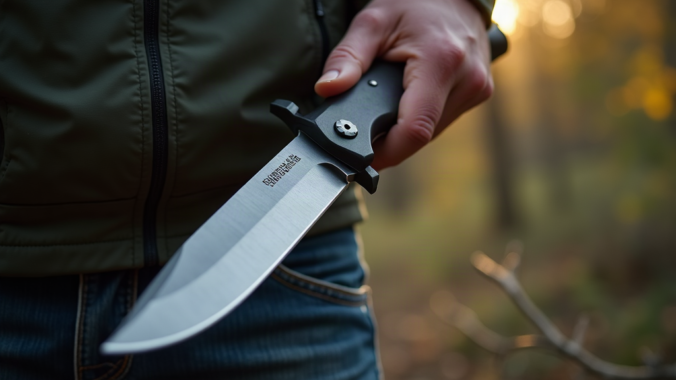
Quick answer: The best survival knife for wilderness camping is one that fits your camp tasks, your hand and your maintenance routine. The Morakniv Garberg is a useful full-tang option to compare with the ESEE-4 and other outdoor knives below. Choose the exact model and sheath configuration before comparing specifications or prices.
Availability update — October 2, 2026: Knife Depot expects Morakniv Garberg knives during the week of October 5, 2026. This is an expected arrival, not a statement of current stock. Model options and pricing will be confirmed when the knives arrive.
What Makes a Knife a Useful Wilderness Survival Knife?
For camping, start with the work you actually expect to do: preparing food, cutting cord, carving small items and maintaining equipment. A fixed blade avoids a folding mechanism and can be convenient for frequent camp use. A folding knife can also be useful for lighter cutting tasks. Neither design is a substitute for a saw or hatchet when those tools are better suited to the job.
- Construction: Full tang describes a blade whose steel extends through the handle. It is one design choice, not a guarantee that a knife cannot break. Other tang designs can also serve ordinary outdoor tasks.
- Blade size and geometry: Consider how the blade handles food, rope and carving rather than treating one length or spine thickness as a universal requirement.
- Grip and sheath: Look for a handle that fits comfortably and a sheath that securely retains and covers the blade.
- Intended use: Follow the manufacturer’s care and use instructions. Do not assume a thick spine makes a knife suitable for prying, striking or every wood-processing task.
For related outdoor considerations, see our wilderness bushcraft knives guide.
Which Blade Steel Should You Choose for Wilderness Camping?
Steel selection involves trade-offs among corrosion resistance, toughness, wear resistance and sharpening. Heat treatment, blade geometry, the cutting task and the condition of the edge also matter. A steel name alone cannot predict how many months an edge will last or how many minutes sharpening will take.
Carbon-steel models such as the Garberg BlackBlade (C) and the carbon-steel ESEE-4 need attention to moisture and corrosion. Stainless options can reduce maintenance demands, but stainless does not mean rust-proof. Clean and dry the knife after use and follow the manufacturer’s instructions for storage and protective treatment.
Carry a suitable sharpener and learn to use it before a trip. Do not rely on an improvised river stone or assume a particular hardness makes diamond the only usable abrasive. The right abrasive and technique depend on the steel, the edge and the amount of repair needed.
Survival Knives to Compare for Wilderness Camping in 2026
These models offer different construction, blade geometry and maintenance requirements. The descriptions identify the version being discussed; another knife with the same family name may have different steel, handles or included accessories. Manufacturer specifications are linked so you can check the exact configuration.
Morakniv Garberg: A Full-Tang Camping Option
For the Garberg BlackBlade (C), item 13716, Morakniv specifies a 4.3-inch blade, C100S carbon steel, a polyamide handle and a 3.2 mm spine. The manufacturer lists a weight of 209 g (7.37 oz) for that product configuration. Do not substitute these figures for a different Garberg version or assume every seller reports weight on the same basis.
The carbon-steel version needs cleaning, drying and corrosion protection. Its handle is polymer, so birch-handle maintenance advice does not apply. Consider the sheath configuration and total carried weight when choosing a version. Check Morakniv’s Garberg BlackBlade (C) specifications.
Garberg stock is expected at Knife Depot during the week of October 5. In the meantime, browse currently listed survival knives.
KA-BAR Becker BK2 Campanion: A Thicker Fixed Blade
The BK2 has a 5.25-inch blade, 1095 Cro-Van steel, a 0.25-inch spine and Ultramid handles. Its handles are not leather. KA-BAR supplies the standard BK2 with a hard plastic sheath; related packages can differ.
The substantial blade is a trade-off to consider when packing. A thicker blade may suit some camp work, while a thinner blade may be more convenient for slicing. Thickness does not make any knife indestructible or remove the need to follow its intended use. Check KA-BAR’s BK2 specifications.
Morakniv Companion (C): An All-Round Outdoor Knife
The Companion (C), item 11863, has a 4.1-inch C100S carbon-steel blade, a 2 mm spine and a polymer handle with a TPE friction grip. Morakniv identifies this as a standard-tang design. The manufacturer’s current listing gives 118.4 g (4.18 oz) as product weight; confirm the weight basis and included sheath when comparing your complete kit.
This is a different construction from the full-tang Garberg. Consider it for ordinary outdoor cutting tasks and follow its care instructions, including cleaning and oiling the carbon steel. Check Morakniv’s Companion (C) specifications.
Gerber StrongArm: A 420HC Option
The StrongArm Black, Plain Edge, product 30-001038N, has a 4.8-inch 420HC blade, full-tang construction and a rubberized diamond-texture grip. Gerber lists its weight as 7.2 oz.
The sheath supports several mounting arrangements. Compare how it fits your pack or other equipment, and follow the care instructions after exposure to moisture. Stainless steel and a blade coating do not make a knife immune to corrosion, including in saltwater conditions. Check Gerber’s StrongArm specifications.
ESEE-4: A Full-Tang General-Purpose Fixed Blade
ESEE lists the ESEE-4 at 4.5 inches of overall blade length, 4.1 inches of cutting edge, 0.188 inches of maximum thickness and 8.0 ounces for the knife alone. The carbon-steel version uses 1095 steel; other versions use different steels and handle materials.
Choose the specific handle and sheath package you want. The 8-ounce knife-only figure does not include the complete carrying setup. Carbon-steel models require corrosion care, and no full-tang construction is a promise against damage. Check ESEE’s specifications and model list.
Quick Comparison
| Model or version | Blade length | Steel | Handle / construction detail |
|---|---|---|---|
| Garberg BlackBlade (C), 13716 | 4.3 in | C100S carbon | Polyamide; full tang |
| Becker BK2 | 5.25 in | 1095 Cro-Van | Ultramid |
| Companion (C), 11863 | 4.1 in | C100S carbon | Polymer / TPE; standard tang |
| StrongArm, 30-001038N | 4.8 in | 420HC | Rubberized grip; full tang |
| ESEE-4, carbon-steel version | 4.5 in; 4.1-in cutting edge | 1095 carbon | Handle and sheath options vary |
Check the current product listing for price and availability. Prices are not guaranteed by this comparison, and the Garberg version described here does not identify the exact incoming Knife Depot assortment.
How Do You Match a Survival Knife to Your Camping Style?
For a backpacking trip, compare the weight of the complete knife-and-sheath setup and the tasks it adds to your existing kit. At a base camp, portability may matter less than comfort during repeated work. For food preparation, consider cutting geometry and how easily the knife can be cleaned.
Wet conditions make maintenance more important. Consider the steel, coating, handle texture and how you will dry the blade and sheath. No handle material guarantees a secure grip in every condition; fit and condition matter too.
Weight example: A 6-ounce knife is 2.5 ounces heavier than a 3.5-ounce knife. That remains a 2.5-ounce difference on every day of a five-day trip. It does not become 12.5 ounces of additional pack weight.
What Features Matter Most?
Prioritize comfortable handling, an appropriate edge, secure blade storage and a maintenance routine you can manage. Decorative features and higher prices do not establish suitability for your trip. Blade shape and grind are different characteristics: a drop point describes the profile, while flat, Scandi and convex refer to grind geometry.
Before packing, inspect the blade, handle and sheath. A knife with damage or a sheath that no longer retains it securely needs attention before use. Use adequate light when putting a fixed blade back into its sheath, and keep your hands clear of the edge.
How Much Should You Spend on a Wilderness Survival Knife?
Set a budget for the knife, sheath and maintenance supplies together. Compare actual materials, fit, warranty terms and intended use. An inexpensive knife is not automatically unreliable, and a premium steel or brand does not automatically make a knife the right choice.
Use cost-per-use calculations as examples rather than durability promises. A $120 knife used for 200 outings would cost $0.60 per outing, excluding maintenance and other costs. Whether any particular knife reaches that number depends on use and care.
Frequently Asked Questions
What is the best blade length for a wilderness survival knife?
There is no universal best length. Compare the tasks, handle fit, packed size and local restrictions. The knives above span different sizes; their suitability depends on the full design, not a single measurement.
Is a fixed blade or folding knife better for wilderness camping?
A fixed blade can be convenient for repeated camp tasks, while a folder can serve lighter everyday cutting. Use each within the manufacturer’s intended limits. A folding mechanism is not designed to make the knife a substitute for every wood-processing tool.
How do you maintain an edge in the field?
Bring a suitable portable sharpener and follow the knife and sharpener manufacturers’ instructions. Do not plan around an exact sharpening time or assume that any found stone is a suitable abrasive.
Are there legal restrictions on carrying a survival knife while camping?
Check the applicable laws and the rules of the specific park, campground and transport provider before travelling. Outdoor use does not itself establish permission to carry a particular knife. Ask the relevant land manager about location-specific rules, and obtain qualified legal advice if your situation is unclear.
What is the difference between a survival knife and a bushcraft knife?
These are overlapping product descriptions. Compare actual construction, geometry and intended uses rather than assuming that either label guarantees performance.
How do you maintain a carbon-steel knife?
Clean and dry it after use, keep the sheath dry, and apply an appropriate protective treatment according to the manufacturer’s instructions. For a blade used with food, choose a treatment suitable for that purpose. Inspect the edge and coating regularly.
Can a budget knife be good enough for camping?
Yes, if its design and condition suit the tasks and you use it within its limits. Compare the specific product and included sheath. Price alone cannot establish steel quality, durability or a guaranteed service life.
Ready to Compare Options?
Browse Knife Depot’s survival knives and check individual listings for current availability, specifications and included accessories.
Choosing Your Camping Knife
Match the knife to your tasks and maintenance habits. Garberg remains an option to consider as stock arrives; compare it with the ESEE-4, BK2, Companion and StrongArm using the exact model information above. A comfortable tool, secure sheath and realistic understanding of its limits matter more than broad claims about the best steel or an indestructible blade.
Specifications and factual corrections reviewed October 2, 2026. Prices and availability may change.

If it won’t make sparks with flint it’s useless for survival!!
The SRK-C from Cold Steel is actually the best budget option, hands down.