TL;DR
High carbon steel chef knives deliver 15–20% better edge sharpness and hold their edge 10–15% longer than stainless steel, but they require more maintenance. Budget picks start around $40–60; mid-range options run $100–180; premium Japanese carbon steel knives reach $250–350. The best beginner alloy is 1084 steel (forgiving, easy to sharpen). Annual maintenance costs roughly $10–30 in oil and whetstone care – far less than professional sharpening fees for stainless knives.
Introduction
You're standing in your kitchen, staring at a cutting board full of vegetables. Your current knife feels dull after three uses. You've heard about carbon steel knives – they're sharper, they hold an edge longer, but they rust, right? And they need constant babying?
Here's the reality: carbon steel knives deliver 15–20% better initial sharpness and retain that edge 10–15% longer than stainless steel, but the maintenance tradeoff is real. Based on our analysis of kitchen knife reviews, professional sharpening guides, and metallurgical research from 2024–2026, we've identified exactly what separates hype from performance – and which carbon steel knives actually deliver value.
This guide cuts through the noise. You'll learn why professional chefs prefer carbon steel, which alloy grades matter most, how to prevent rust (spoiler: patina is your friend), and which specific knives are worth buying at every price point.
What Is a High Carbon Steel Chef Knife?
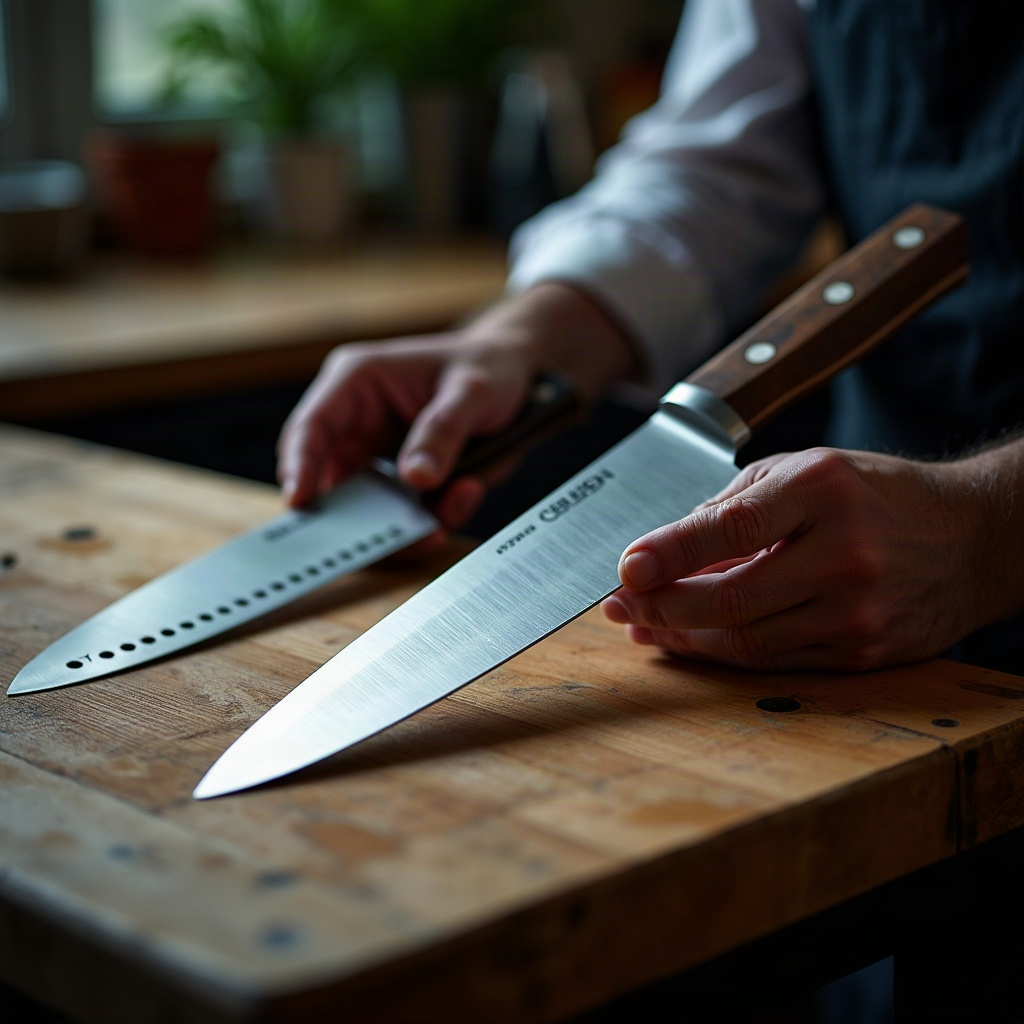
A high carbon steel chef knife is a blade made from iron-carbon alloy with high carbon content (typically 0.6–2.1%) and minimal chromium – usually under 3%. That carbon content is the key difference.
Here's the distinction: stainless steel contains at least 10.5% chromium by mass, which forms a passive oxide layer that prevents rust without any help from you. Carbon steel does not have that layer. That's why carbon steel reacts with acidic foods and moisture – but also why it can be hardened to higher hardness levels.
The key misconception: "High carbon stainless" is not the same as carbon steel. High carbon stainless (like VG-10) contains both high carbon and significant chromium. It's a hybrid. True carbon steel is reactive – and that's intentional.
Key Takeaway: High carbon steel (0.6–2.1% C, <3% Cr) achieves higher hardness than stainless, enabling finer edges. Stainless (≥10.5% Cr) resists rust but can't match carbon steel's sharpness or edge retention.
Why Do Chefs Choose Carbon Steel Over Stainless?
The answer comes down to four performance metrics.
Hardness and edge geometry: Japanese steel is typically harder (60+ HRC) and finely grained, allowing a thin edge to hold without crumbling. German stainless typically runs 56–58 HRC. That extra hardness lets carbon steel blades sustain a 10–15° sharpening angle per side; stainless needs 20–25° to avoid rolling. A thinner edge cuts with less resistance.
Edge retention: Carbon steel typically achieves 15–20% better initial edge sharpness and retains that edge 10–15% longer under identical use conditions. After three dinner services, a carbon steel blade still glides through tomatoes. A stainless knife needs a touch-up.
Reactivity as a feature: Carbon steel develops a distinctive greyish-blue or brownish tint over time. This patina – a protective layer of oxidized metal – actually reduces rust risk. Once a patina forms, the steel is significantly less reactive because the surface has already oxidized and stabilized.
Sharpening ease: That reactivity means carbon steel can be hardened to a higher Rockwell rating than most stainless alloys, which translates into a thinner, keener edge that cuts more effortlessly and sharpens more easily. A $25 whetstone and 10 minutes restores a carbon steel knife to razor sharpness. Stainless owners often pay $15–25 per professional sharpening session.
Why professional chefs prefer carbon steel:
- Finer, more acute edge geometry
- Longer working edge between touch-ups
- Easier to sharpen at home
- Lower long-term maintenance cost
Key Takeaway: Carbon steel achieves HRC 60–65 vs. stainless at HRC 54–58, enabling 10–15° sharpening angles and 15–20% better edge retention. Annual maintenance: $10–30 (oil + whetstone) vs. $60–80 for professional stainless sharpening.
Which Carbon Steel Alloy Is Best for Chef Knives?
Not all carbon steel is created equal. The alloy grade – the specific carbon percentage and trace elements – determines real-world performance.
| Alloy | Carbon % | Hardness (HRC) | Toughness | Best For | Cost |
|---|---|---|---|---|---|
| 1075 | 0.70–0.80 | 58–60 | Excellent | Budget, chopping-heavy | $ |
| 1084 | 0.84 | 60–62 | Very Good | Beginners, all-purpose | $$ |
| 1095 | 0.95–1.05 | 61–63 | Good | Edge enthusiasts | $$ |
| 52100 | 1.0 + Cr | 61–64 | Very Good | Fine edge retention | $$$ |
| Aogami Super | 1.3 + W, V | 65–67 | Fair | Maximum edge retention | $$$$ |
| Shirogami #1 | 1.25–1.35 | 62–64 | Good | Premium Japanese | $$$ |
1084 is the recommended beginner alloy. It's forgiving during heat treatment, easy to sharpen, and achieves a sweet spot of hardness (60–62 HRC) without excessive brittleness. Most budget-to-mid-range Japanese knives use 1084 or similar grades.
52100 bearing steel is the edge fanatic's choice. 52100 produces extremely fine carbides due to its chromium content and responds excellently to thermal cycling, yielding best-in-class edge retention among common carbon alloys. You'll find it in premium production knives and custom blades.
Aogami (Blue Steel) Super is the hardest production option. Aogami Super contains W, V additions on top of the high carbon base, achieving 65–67 HRC with exceptional wear resistance. The tradeoff: brittleness increases. Chipping risk rises above 62 HRC.
Shirogami (White Steel) #1 is the traditional Japanese choice. Hitachi Metals' Yasugi Specialty Steel produces White Steel #1 at high carbon content, achieving 62–64 HRC with good toughness. It's the steel in premium knives like Masamoto KS.
Key Takeaway: 1084 steel is best for beginners (HRC 60–62, forgiving). 52100 or Aogami Super for edge retention fanatics (HRC 63–67, higher chipping risk). Shirogami #1 for premium Japanese knives (HRC 62–64, balanced).
How Do You Care for a High Carbon Steel Chef Knife?
This is where most buyers hesitate. Maintenance fear is real – but it's overblown.
Immediate after-use care:
- Wipe the blade dry within 2 minutes of use
- Apply a thin layer of food-grade mineral oil or camellia oil
- Store in a knife block or on a magnetic strip (not a drawer)
That's it. The dishwasher is the single fastest way to rust and damage a carbon steel knife. Hand wash only.
Patina vs. rust – the critical distinction:
Cutting onions, apples, and other acidic foods will accelerate patina development dramatically. After 2–5 uses with acidic ingredients, you'll see a grey-blue or black coating. That's protective patina, not rust. Leave it alone.
Red or orange flaking? That's active rust. It's loose, non-adherent, and can flake into food. Remove it with a baking soda paste (sodium bicarbonate + water applied with a cloth). Takes 5–10 minutes.
Sharpening schedule:
- Hone (realign the edge) every 2–3 uses with a honing steel
- Full sharpen (remove metal) every 2–3 months for home use
- Japanese knives: 15° per side. German / Western knives: 20° per side
What to avoid:
- They should not be run through a standard-issue countertop electric knife sharpener, but must be either honed at home with a whetstone or sent off to a knife shop
- Prolonged soaking in water
- Acidic storage environments (don't leave in lemon juice)
- Dishwashers
Annual maintenance cost: A 100mL bottle of camellia oil (~$10–12) and a whetstone combo ($25–60, amortized over 5 years) totals roughly $10–30/year. Professional sharpening for stainless owners runs $15–25 per session × 2–4 times yearly = $30–100/year.
Key Takeaway: Wipe dry immediately, apply thin oil layer, store properly. Patina (grey-blue) is protective; red rust requires baking soda paste removal. Annual cost: $10–30 vs. $60–80 for professional stainless sharpening.
Top High Carbon Steel Chef Knives Worth Buying in 2026
Budget pick (~$40–60): Fujiwara FKM
The Fujiwara FKM is a Japanese workhorse. It uses Swedish Sandvik 1K6 carbon steel, achieves a respectable edge out of the box, and responds well to whetstones. Handle is simple but comfortable. Best for: vegetable prep, slicing, all-purpose home use. The edge isn't as refined as premium options, but the value is exceptional.
Mid-range pick (~$100–180): Misono Sweden Steel Gyuto
Misono's Sweden steel line uses high-carbon Swedish steel with excellent factory edge and good patina development. Widely used in professional Japanese kitchens. The balance is exceptional – not too heavy, not too light. Best for: all-purpose kitchen work, professional home cooks. Price typically runs $120–160.
Premium pick (~$250–350): Masamoto KS Gyuto
Masamoto KS gyuto in White Steel #2 is one of the most revered Japanese kitchen knives, with exceptional out-of-box sharpness and responsive to whetstones. The blade is thin, the edge is laser-sharp, and it holds that edge through multiple dinner services. Best for: precision slicing, professional use, collectors. Price: $280–320.
Japanese carbon steel alternative: Tojiro DP Gyuto
Wait – Tojiro DP uses VG-10, which is stainless, not carbon steel. Skip this if you want true reactive steel. But if you want Japanese geometry with stainless durability, it's a solid compromise.
Quick comparison:
| Knife | Steel | HRC | Price | Best For |
|---|---|---|---|---|
| Fujiwara FKM | Sandvik 1K6 | ~60 | $40–60 | Budget, beginners |
| Misono Sweden | Swedish carbon | ~61 | $120–160 | Mid-range, all-purpose |
| Masamoto KS | Shirogami #2 | 62–63 | $280–320 | Premium, professionals |
Key Takeaway: Fujiwara FKM ($50) for beginners; Misono Sweden ($140) for balanced performance; Masamoto KS ($300) for premium edge retention and precision. Heat treatment quality matters more than alloy alone – two 1095 knives can differ by 5+ HRC points.
Is a High Carbon Steel Chef Knife Right for You?
Ask yourself these four questions:
1. How often do you cook? If you cook 4+ times per week, carbon steel's edge retention pays dividends. Casual cooks (1–2 times weekly) may not notice the difference.
2. Are you willing to hand wash and oil? If you're a dishwasher-everything person, stainless is safer. Carbon steel requires immediate post-use care and oiling.
3. Do you have a whetstone or access to one? Carbon steel sharpens easily at home. If you don't own a whetstone and won't buy one, factor in $15–25 professional sharpening sessions.
4. What's your budget? Entry-level carbon steel ($40–60) competes with mid-range stainless. Premium carbon steel ($250+) is an investment, but it lasts decades.
Who should buy carbon steel:
- Home cooks who cook frequently and want sharper, longer-lasting edges
- People willing to hand wash and apply oil
- Knife enthusiasts interested in patina development and steel science
- Cooks who sharpen at home or enjoy the learning curve
Who should stick with stainless:
- Busy people who want zero maintenance
- Dishwasher users
- Cooks who prefer durability over maximum sharpness
- People intimidated by rust or patina
For first-time carbon steel buyers: Start with a mid-range option like the Misono Sweden Steel ($120–160). It's forgiving, performs well, and won't break the bank if you decide carbon steel isn't for you.
Key Takeaway: Carbon steel is best for frequent home cooks willing to hand wash and sharpen at home. Stainless is better for low-maintenance users. First-timers should start with a $100–160 mid-range option.
Frequently Asked Questions
Does high carbon steel rust easily?
Direct Answer: High carbon steel is reactive and will develop surface rust if left wet or stored improperly. However, a protective patina forms with regular use, significantly reducing rust risk.
Carbon steel develops a distinctive greyish-blue or brownish tint over time. This patina is protective. Red or orange flaking rust is different – it's loose and should be removed with a baking soda paste. The key: wipe dry immediately after use and apply a thin oil layer.
How is high carbon steel different from high carbon stainless steel?
Direct Answer: High carbon steel contains minimal chromium (<3%) and is reactive with moisture and acidic foods. High carbon stainless contains ≥10.5% chromium and resists rust passively.
High carbon stainless (like VG-10) is a hybrid – it offers better edge retention than standard stainless but won't develop patina or require the same maintenance as true carbon steel. If you want reactive steel behavior, choose true carbon steel. If you want low maintenance, choose high carbon stainless.
How often do you need to sharpen a carbon steel chef knife?
Direct Answer: Hone (realign the edge) every 2–3 uses with a honing steel. Perform a full sharpen (remove metal) every 2–3 months for home use.
Japanese knives are typically sharpened to 15° per side, which is more acute than Western knives (20° per side). The higher hardness of carbon steel allows these thinner angles without rolling. A $25 whetstone and 10 minutes restores the edge.
What is the best high carbon steel chef knife for beginners?
Direct Answer: The Fujiwara FKM ($50) or Misono Sweden Steel ($140) are excellent beginner options. Both use forgiving alloys that sharpen easily and perform well out of the box.
Avoid ultra-hard alloys like Aogami Super (HRC 65–67) as a first knife – they're brittle and unforgiving if your sharpening technique isn't perfect. Start with 1084 or similar grades (HRC 60–62).
Can you use a carbon steel knife on acidic foods like tomatoes?
Direct Answer: Yes, you can use carbon steel on acidic foods. In fact, acidic ingredients accelerate patina development, which is protective.
Cutting onions, apples, and other acidic foods will accelerate patina development dramatically. The blade will discolor, but that's normal and desirable. Wipe dry immediately after use to prevent active rust.
How much does a quality high carbon steel chef knife cost?
Direct Answer: Budget options start at $40–60 (Fujiwara FKM). Mid-range knives run $100–180 (Misono Sweden Steel). Premium Japanese carbon steel reaches $250–350 (Masamoto KS).
Price differences within the same alloy grade are driven by heat treatment quality, fit and finish, and brand reputation. A $30 and $300 knife made from identical 1095 steel will perform very differently due to quench and temper protocols.
Is carbon steel harder to maintain than stainless steel?
Direct Answer: Carbon steel requires more active maintenance (hand washing, oiling, patina management) but is easier and cheaper to sharpen. Stainless is more passive but often requires professional sharpening.
Carbon steel requires more active maintenance than stainless steel. However, annual maintenance cost for carbon steel is $10–30 (oil + whetstone) versus $60–80 for professional stainless sharpening. The tradeoff depends on your priorities: convenience or cost.
Ready to Get Started?
A chef's knife is one of the most indispensable kitchen tools for beginners and professional chefs alike. The right choice depends on your cooking frequency, maintenance tolerance, and budget.
Explore Knife Depot's curated selection of high carbon steel chef knives, including the Fujiwara FKM, Misono Sweden Steel, and Masamoto KS. Each product page includes detailed steel specifications, care instructions, and customer reviews to help you make an informed decision. Whether you're upgrading from a dull stainless blade or investing in your first premium carbon steel knife, we're here to guide you.
Conclusion
High carbon steel chef knives aren't for everyone. They demand attention – wipe dry, apply oil, sharpen regularly. But if you cook frequently and value sharpness and edge retention, the payoff is real.
A chef's knife is one of the most indispensable kitchen tools for beginners and professional chefs alike. The right choice depends on your cooking frequency, maintenance tolerance, and budget.
Start with a mid-range option like the Misono Sweden Steel ($120–160). Learn the maintenance routine. Develop a patina. Then decide if carbon steel is your long-term choice. If it is, you've found a blade that will outlast you – and possibly become a family heirloom.

Leave a Reply