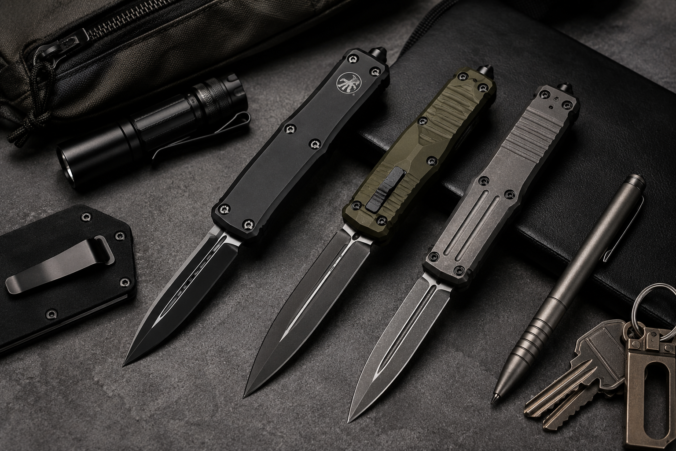
TL;DR: An automatic OTF moves the blade through the front of the handle. For everyday carry, compare the exact model’s cutting utility, grip, switch, clip, dimensions, care requirements, and applicable law. Double-action operation lets the same control deploy and retract the blade.
What Is an OTF Automatic Knife and Why Carry One?
The blade of an automatic OTF moves along a guided path within the handle. A spring-powered mechanism operates deployment; in a double-action design it also operates retraction. A single-action automatic uses a separate manual reset. Use the intended controls and follow the model’s instructions.
One-handed operation can be useful, but many manual folding knives also offer one-handed opening. OTF operation does not establish a universal speed advantage or a guarantee of reliable operation in gloves, darkness, or debris.
This guide focuses on daily carry suitability. For current recommendations across budgets, see our OTF buying guide. For operating types, read the OTF explainer.
Are OTF Knives Legal to Carry Every Day?
The answer depends on the actual knife, your circumstances, and current applicable law. Verify ownership, purchase, shipment, transport, carry method, age, and restricted locations separately. A short blade does not establish nationwide permission.
Do not rely on a state count or a blanket statement that federal rules regulate only commercial shipments. Federal switchblade provisions have definitions, jurisdictional rules, and exceptions. Likewise, a state described as permissive can still restrict certain locations or circumstances. Consult current official rules and qualified advice when needed. This article is general product information, not legal advice.
How Do You Choose the Right OTF Knife for Daily Carry?
Match the Blade to the Task
Compare usable cutting edge, blade shape, edge configuration, and grip. A small knife may suit light package cutting; a larger one may provide different reach or handle fit. Neither a 2.5–3.5-inch range nor any other range guarantees legal carry or suitability for every user.
Check Pocket Fit and Controls
Consider closed length, thickness, weight, switch location, and pocket clip. Confirm whether the clip is reversible and which orientation it supports. Aluminum or G10 alone does not establish the knife’s total weight or grip quality.
Compare the Complete Blade
Steel, heat treatment, geometry, and edge condition all affect cutting performance. CPM-154 and 154CM are distinct materials. Price tiers do not determine a universal steel grade, edge-retention ratio, or warranty.
Choose the Operating Type
Double-action OTFs provide powered deployment and retraction through the same control. Single-action models require the manufacturer’s separate reset procedure. Neither action type alone establishes price, service life, or relative safety. Keep the blade path clear and avoid operating by feel without first understanding the controls.
OTF Automatic Knives Worth Comparing in 2026
Use exact configurations as comparison points, rather than generic family specifications. The following are specification examples, not a hands-on ranking or a claim of current stock.
| Configuration | Blade | Steel | Operation | Carry consideration |
|---|---|---|---|---|
| Kershaw Livewire 9000BLK | 3.3 inches | CPM MagnaCut | Double-action OTF | 3.1 oz; reversible deep-carry clip |
| Benchmade Infidel 3300 | 3.91 inches | D2 | Double-action OTF | Larger, double-edge spear-point design |
The Livewire 9000BLK uses a black PVD-coated blade and aluminum handle. Check the listing for current price and availability. Other Livewire and Infidel versions can have different specifications.
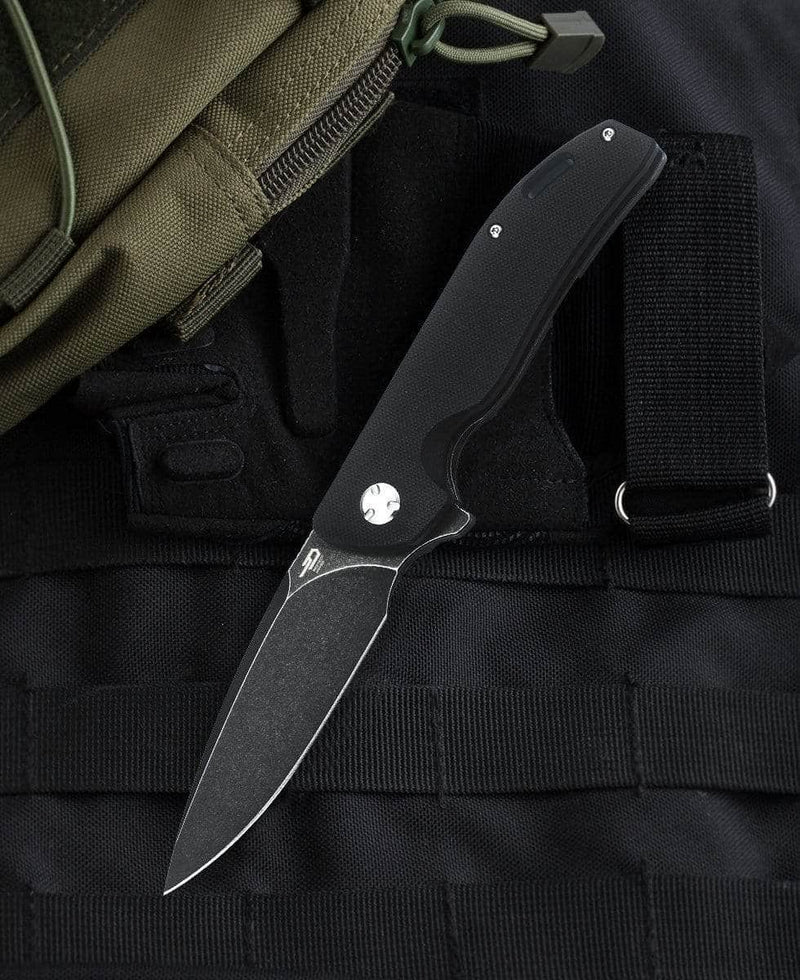
Category correction: Kershaw Launch models and the Boker Strike automatic are side-opening designs. They do not belong in an OTF recommendation table. The Infidel 3300 is double-action, not single-action. An unverified CobraTec “Speedway” configuration has also been removed from the specification comparison.
For the historical model roundup, see 10 Best OTF Knives. For products currently offered, browse the OTF collection.
How Do You Maintain an OTF Knife for Long-Term Carry?
Keep cutting residue off the blade before retracting it. Follow the manufacturer’s instructions for clearing debris and selecting lubricant. Microtech’s maintenance quick guide recommends compressed air, a small amount of appropriate light oil, and removal of excess. Routine care need not require disassembly.
Cleaning frequency depends on the design, use, and exposure. There is no universal sharpening interval, deployment-cycle rating, spring-replacement schedule, or repair price that applies to all OTFs. Sluggish deployment alone does not prove a fatigued spring.
If the blade fails to lock, the control jams, or operation changes unexpectedly, stop using it for cutting. Follow an approved reset or cleaning procedure and contact the manufacturer if the issue persists. Benchmade recommends service rather than user disassembly when basic cleaning does not resolve a problem.
OTF Knives vs. Folding Knives for EDC: Which Should You Choose?
Compare actual knives for your tasks. An OTF may appeal if you prefer linear blade travel and powered retraction. A folding knife may offer a blade geometry, handle, or control layout you prefer. Manual folders also require care, and their legal status must be checked rather than assumed.
There is no supported universal claim that a folder takes two hands or several seconds to open, that every OTF is faster, or that folding knives are legal everywhere. Choose based on documented features and lawful use.
Frequently Asked Questions About OTF Knives for EDC
Is the Launch 4 an OTF?
No. It is a side-opening automatic. The 7500BLK configuration has a 1.9-inch CPM-154 blade.
Is the Infidel single-action?
No. The full-size Infidel 3300 is a double-action OTF.
How much should I spend?
Set a budget and compare the exact models currently available. Price does not guarantee a particular performance percentage, steel, or warranty.
How long do OTF springs last?
There is no substantiated universal cycle or year figure in this guide. Follow the manufacturer’s service recommendations.
Can an OTF be repaired?
Contact its maker or an authorized service provider. Available repairs, coverage, cost, and turnaround depend on the model and condition.
Can I maintain one without disassembly?
Often basic care can be done without opening the handle. Use the specific maker’s instructions and seek service for unresolved faults.
Conclusion
Choose an OTF by its verified configuration and practical carry fit. Confirm applicable law, compare the blade and controls, and understand its care and support requirements. See our OTF buying guide or shop OTF knives for current options.
Manufacturer References
- Kershaw catalog: Livewire 9000BLK
- Benchmade catalog: Infidel 3300
- Microtech maintenance quick guide
- Benchmade use and care
OTF is out the front, not out the side. Not sure can trust review that doesn’t know what it is reviewing.
The boker is out the side auto..they all fall under the OTF category..seems you dont know what your speaking about
Dude, you are an idiot. If it doesn’t slide Out THE FRONT, it’s not and OTF.