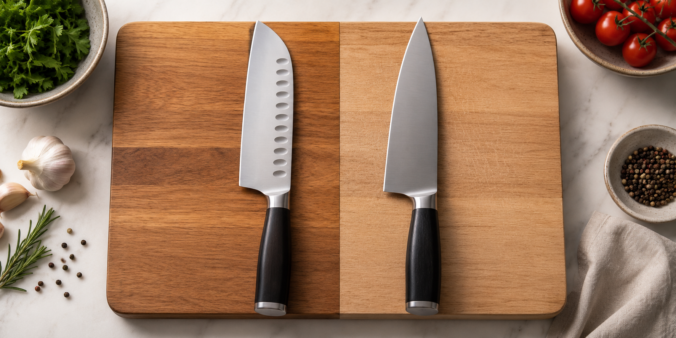
TL;DR: – The santoku wins for vegetable-dominant cooking, smaller hands, and compact prep spaces; the chef knife wins for mixed Western cuisine, whole proteins, and rocking-motion technique.
- A quality knife at $150 lasting 15 years costs ~$10/year vs. a $35 entry knife replaced every 2 years at ~$17.50/year – the math favors buying better once.
- Best for beginners: santoku. Best single all-purpose knife for most home cooks: chef knife.
You’re reading this because you’re standing at a decision point – one knife slot in your block, two very different blades competing for it. This best Santoku knife vs chef knife comparison guide cuts through the noise with scored data, a decision matrix, and direct recommendations by cook type.
What Is the Core Difference Between a Santoku and a Chef Knife?
The single most important difference is blade geometry. According to America’s Test Kitchen, “the blade of a chef’s knife is typically between 8 and 10 inches long, while the blade of a santoku is usually between 5 and 7 inches long.” That size gap drives everything else – technique, food compatibility, and fatigue.
Here’s the spec breakdown side by side:
| Spec | Santoku | Chef Knife |
|---|---|---|
| Blade Length | 5–7 inches | 8–10 inches |
| Edge Angle | 10–15° per side | 20–25° per side |
| Tip Shape | Rounded (sheep’s foot) | Pointed, tapered |
| Edge Profile | Flat to minimal curve | Pronounced curved belly |
| Weight | ~150–175g | ~200–250g |
| Steel Hardness | HRC 60–64 (typical) | HRC 56–58 (typical) |
For a detailed breakdown of chef and santoku knife differences including design origins and construction, the topic is worth exploring chef and santoku differences before committing to a purchase.
Blade Geometry: Flat Edge vs Curved Belly
Cutluxe describes it precisely: “The chef’s knife typically has a longer blade (usually 8–10 inches) with a curved edge that allows for a rocking motion,” while “the santoku, on the other hand, is shorter (usually around 7 inches) and features a flatter edge and sheepfold tip.”
That flat edge is the santoku’s defining functional trait. As Chubo Knives explains, santoku knives “have a flatter ‘belly’ than gyutou and can be used comfortably with an up and down chopping motion rather than a ‘rocking’ type cut.” The chef knife’s belly is engineered for the opposite – a continuous rocking arc that keeps the tip on the board.
Steel, Angle, and Edge Retention Differences
Edge angle is where maintenance reality diverges sharply. Sharp Edge Shop confirms: “Most chef’s knives have an edge angle between 20 and 25 degrees,” while “many santoku knives have an edge angle between 12 and 15 degrees.” A 15° edge is geometrically thinner – cleaner on delicate cuts, but more chip-prone on hard produce like butternut squash or frozen items.
All-Clad notes their chef knife uses “a precision-engineered 26-degree total cutting edge” that “achieves the ideal balance between razor-sharp performance and chip resistance.” The tradeoff is real: harder Japanese steel holds an edge longer but demands more careful technique.
Key Takeaway: Santoku = shorter, lighter, flatter edge at 12–15°. Chef knife = longer, heavier, curved belly at 20–25°. These aren’t style differences – they determine which cutting motions are physically possible with each blade.
How Does Each Knife Actually Cut? Techniques Compared
Cutting technique isn’t preference – it’s physics. The blade profile dictates what motions work efficiently, and using the wrong technique with either knife produces worse results and faster dulling.
The Rocking Motion: Where Chef Knives Excel
All-Clad describes the chef knife’s design as featuring “a signature curved edge and longer blade length, perfectly suited for the characteristic rocking motion during cutting.” In practice, this means the tip stays anchored on the board while the heel rises and falls – ideal for mincing herbs, rough-chopping onions, and breaking down larger proteins where leverage matters.
Life by Mike G adds that “a standard Chef’s knife features a broad curved edge leading up to a pointed tip. This makes it incredibly versatile in handling larger tasks, from slicing loaves of bread to tackling thick slabs of meat without losing any momentum during your cut.”
Push-Cutting and Chopping: The Santoku Advantage
Serious Eats is direct: “Santoku knives are everyday choppers. They’re great for slicing lean meats and cutting up produce.” The flat edge means the entire blade contacts the board simultaneously – a push-cut or straight-down chop rather than a rolling arc.
Most santoku knives above the entry tier include a Granton edge – hollow-ground scallops along the blade face. Cutluxe confirms: “Santoku knives often include a granton edge – those small divots along the blade – that help prevent food from sticking while slicing.” The air pockets created between blade and food are most effective on high-starch vegetables like potatoes and beets.
If you cook almost exclusively vegetables, the push-cut technique is also the foundation of the nakiri knife – a purpose-built vegetable blade worth considering as a third option for vegetable-focused cooks.
| Food Type | Recommended Knife | Best Technique |
|---|---|---|
| Herbs (mincing) | Chef Knife | Rock-chop |
| Whole chicken | Chef Knife | Rocking + leverage |
| Thin vegetable slices | Santoku | Push-cut |
| Fish fillets | Santoku | Draw slice |
| Bread | Chef Knife | Sawing motion |
| Boneless proteins | Either | Push-cut or slice |
| Root vegetables | Chef Knife | Rocking (less chip risk) |
Key Takeaway: Chef knife = rocking motion for herbs, proteins, and bread. Santoku = push-cut for vegetables, fish, and thin slices. Using a santoku for rocking wastes its flat-edge advantage entirely.
Which Foods Is Each Knife Best For?
The food-to-knife match is where most guides stay vague. Here’s the direct breakdown.
5 tasks the santoku handles better:
- Thin-slicing cucumbers, zucchini, and radishes
- Cutting fish fillets without tearing
- Dicing onions with precision (flat edge = cleaner contact)
- Slicing boneless chicken breast
- Prep work in tight spaces (7-inch blade fits a 12-inch cutting board comfortably)
5 tasks the chef knife handles better:
- Breaking down whole chickens (tip and belly provide leverage)
- Mincing large quantities of herbs (rocking motion is faster)
- Slicing bread loaves without compression
- Cutting hard squash (thicker edge angle resists chipping)
- Extended prep sessions (heavier blade reduces active effort on dense foods)
Size matters practically. Serious Eats confirms santoku blade length runs “five to 7.5 inches.” An 8-inch chef knife needs at least 15 inches of board length for a full rocking arc – a real constraint in small kitchens. The 7-inch santoku works adequately on a standard 12×9-inch board.
America’s Test Kitchen notes a nuance worth knowing: “in our santoku knife testing, we didn’t love the rounded tip, and preferred santoku knives that had tips that allowed them to function more like a chef’s knife.” If you want santoku versatility with more tip control, look for models with a less extreme sheep’s foot profile.
Key Takeaway: If you regularly break down whole chickens, the chef knife wins because the curved belly and pointed tip provide the leverage and precision that a flat-edged santoku physically cannot replicate.
Santoku vs Chef Knife: Scored Comparison Matrix
Asana’s decision matrix framework defines the tool as one that “helps you compare multiple options against a set of weighted criteria to identify the best choice” – and recommends “a scale of 1–5, with 5 as the best” for meaningful differentiation. Applied here across 8 criteria:
| Criterion | Santoku (1–5) | Chef Knife (1–5) | Notes |
|---|---|---|---|
| Overall Versatility | 3 | 5 | Chef knife handles more food types |
| Vegetable Prep | 5 | 3 | Flat edge + Granton = cleaner cuts |
| Protein Work | 3 | 5 | Rocking motion + tip = better leverage |
| Beginner Friendliness | 5 | 3 | Lighter, shorter, easier to control |
| Maintenance Ease | 3 | 4 | Santoku’s thinner edge chips more easily |
| Price-to-Quality | 4 | 4 | Comparable at each tier |
| Hand Fatigue | 5 | 3 | 25–40% lighter reduces fatigue |
| Sharpening Frequency | 3 | 4 | Harder steel = longer edge life but more care |
| TOTAL | 31 | 31 | Tie overall – context determines winner |
The tie is intentional and honest. The matrix diverges when you weight criteria by your actual cooking. If vegetable prep and beginner friendliness are your top two criteria, santoku scores 10 vs. chef knife’s 6 on those alone. If versatility and protein work dominate your kitchen, chef knife scores 10 vs. santoku’s 6.
Understanding why the scores differ on maintenance comes down to steel hardness. Japanese santoku steel typically rates HRC 60–64 vs. German chef knife steel at HRC 56–58 – harder steel holds a thinner edge longer but chips under lateral stress. For a full explanation of what those numbers mean practically, the Rockwell hardness scale for kitchen knives is worth a read before buying.
Decision rule: If your weighted score favors santoku by 3+ points on your priority criteria, buy the santoku. If chef knife leads by 3+, buy the chef knife. If it’s within 2 points either way, buy the chef knife – its broader versatility serves mixed cooking better as a single knife.
Key Takeaway: The matrix ties at 31–31 overall, but diverges sharply by use case. Vegetable-dominant cooks: santoku wins 10–6 on its top criteria. Omnivore home cooks: chef knife wins 10–6 on its top criteria.
How Much Should You Spend on a Santoku or Chef Knife?
Three tiers cover the realistic market. Avoid pricing tables – instead, here’s what each tier actually delivers.
Entry Tier ($30–$80) This is where most first-time buyers land. The Bamboo Guy confirms chef knives “typically weigh between 6–10 ounces” at this tier, with stamped rather than forged construction. The Victorinox Fibrox 8-inch chef knife sits around $45–50 and consistently outperforms its price point in independent testing. For santoku, entry options from Mercer and Victorinox run $35–60.
Mid Tier ($80–$180) This is where value peaks. Forged construction, better steel, and meaningful ergonomic improvements appear here. For chef knives, check out the best chef knives under $100 for tested options at this range. The Mac Professional Hollow Edge Santoku (MSK-65) at approximately $155 represents the top of this tier and earns consistent top rankings from independent testers.
Premium Tier ($180–$400+) Shun Classic, Wüsthof Ikon, and Global G-series live here. notes premium German steel like X50CrMoV15 at this tier. Japanese-Western hybrids like Shun use VG-MAX steel at HRC 60–61 with Damascus cladding – genuine performance gains, but diminishing returns for home cooks.
The cost-per-year math: A $150 knife lasting 15 years = $10/year. A $35 knife replaced every 2 years = $17.50/year. The cheaper option costs 75% more over time and delivers inferior performance throughout. Buying mid-tier once is the rational choice for most home cooks.
Japanese steel commands a price premium at every tier due to harder alloys and more labor-intensive grinding. At the mid tier, expect to pay $20–40 more for a Japanese santoku vs. a comparable German chef knife.
You can browse a wide range of both knife types at Knife Depot, which carries options across all three tiers without the markup of specialty kitchen stores.
Key Takeaway: Mid-tier ($80–$180) delivers the best value for home cooks. The $150 knife at $10/year beats the $35 knife at $17.50/year – and you cook better every day in between.
Who Should Buy Which Knife? A Decision Framework
Four reader profiles, four direct answers.
Small-handed cook or arthritis concerns: Buy the santoku. confirms “beginners often find santoku knives easier to control due to their shorter length and lighter weight.” The 25–40% weight reduction is measurable, not marketing.
Omnivore home cook (meat, veg, everything): Buy the chef knife. Mysekkin puts it plainly: “If you only have one knife in your kitchen, make it this one” – referring to the chef knife’s unmatched versatility across food types.
Vegetable-focused or Asian cuisine cook: Buy the santoku. Chubo Knives explains that santoku’s “three virtues are the knife’s ability to cut fish, meat and vegetables” – with the flat edge and taller blade profile specifically designed for the precision cuts central to Japanese and vegetable-forward cooking.
Professional or serious home cook: Own both. The chef knife handles proteins and bread; the santoku handles delicate vegetable and fish work. The combined investment at mid-tier runs $250–300 and covers every prep scenario.
Should you own both? Only if you cook seriously 4+ times per week. For casual home cooks, one quality knife used well beats two mediocre knives used poorly.
Maintenance note: Santoku’s 15° edge requires a ceramic or smooth honing rod – not the standard grooved steel rod that works fine for chef knives. Chubo Knives recommends all Japanese knives be “sharpened periodically on a whetstone.” For a full comparison of sharpening tools, the honing rod vs sharpening stone guide covers the practical differences.
Key Takeaway: One knife? Buy the chef knife for versatility. Small hands, vegetable focus, or beginner status? Buy the santoku. Serious cook? Own both – mid-tier versions of each cost less than one premium single knife.
Frequently Asked Questions
Is a santoku knife better than a chef knife for beginners?
Direct Answer: Yes, for most beginners. The santoku’s shorter blade and lighter weight make it easier to control, and the push-cut motion is more intuitive than the rocking technique required by a chef knife.
confirms “beginners often find santoku knives easier to control due to their shorter length and lighter weight.” That said, if you plan to cook a wide variety of proteins and cuisines, starting with a chef knife builds more transferable technique. For broader guidance, the best kitchen knife for beginners covers additional options worth considering.
Can a santoku knife replace a chef knife entirely?
Direct Answer: For vegetable-focused or Asian cuisine cooking, yes. For mixed Western cooking involving whole proteins, bread, and extended prep, no – the chef knife’s curved belly and pointed tip handle tasks the santoku physically cannot.
Serious Eats notes santoku knives are “great for slicing lean meats and cutting up produce” but stops short of calling them all-purpose replacements. The flat edge that makes santoku exceptional at vegetables makes it awkward for rocking-motion herb mincing and leverage-dependent protein work.
What is the ideal sharpening angle for a santoku vs a chef knife?
Direct Answer: Santoku: 10–15° per side. Chef knife: 20–25° per side. Using the wrong angle damages the edge geometry and reduces performance.
Sharp Edge Shop confirms these ranges directly. The practical implication: a 15° santoku edge is geometrically thinner than a 20° chef knife edge, which explains why it slices thin vegetables cleaner but chips faster on hard squash. Santoku edges also require a ceramic or smooth honing rod – the grooved steel rod standard for chef knives will damage the thinner Japanese edge. See the honing rod vs sharpening stone guide for full tool recommendations.
How much should you spend on a quality santoku or chef knife?
Direct Answer: Mid-tier ($80–$180) delivers the best value for home cooks. Entry-tier knives under $50 work but require more frequent replacement; premium knives above $200 offer diminishing returns for non-professional use.
The cost-per-year math is decisive: a $150 knife lasting 15 years costs $10/year. A $35 knife replaced every 2 years costs $17.50/year – 75% more for worse performance. Life by Mike G notes sharpening angle requirements vary “typically between 15–20 degrees depending on the individual blade design,” which affects long-term maintenance costs as well.
Which knife is easier to sharpen at home?
Direct Answer: The chef knife is easier to sharpen at home. Its 20–25° angle is more forgiving on standard whetstones and pull-through sharpeners, and it tolerates a grooved honing rod without edge damage.
The santoku’s 10–15° edge requires more precise angle control and a ceramic or smooth honing rod. Chubo Knives recommends all Japanese knives be “sharpened periodically on a whetstone” – pull-through sharpeners often set the wrong angle for Japanese steel and remove more metal than necessary.
What is the difference between a santoku knife and a nakiri knife?
Direct Answer: Both use push-cut technique, but the nakiri is purpose-built exclusively for vegetables – it has a fully rectangular blade, no tip, and a completely flat edge. The santoku is a multi-purpose knife that handles vegetables, fish, and boneless proteins.
describes the santoku’s design as representing “three virtues” – slicing, dicing, and chopping across multiple food types. The nakiri sacrifices that versatility for maximum vegetable performance. If your cooking is 80%+ vegetables, the nakiri is worth considering as a third option alongside or instead of the santoku.
Do professional chefs prefer santoku or chef knives?
Direct Answer: It depends entirely on the kitchen type. Western professional kitchens favor the chef knife for its versatility. Japanese professional kitchens use santoku for vegetable prep and gyuto (Japanese chef knife) for proteins – the Western chef knife is largely absent from Japanese professional tool kits.
Chubo Knives notes that Japanese gyutou are “typically lighter and thinner than a European knife, are made out of a harder steel and as a result, hold a better edge” – making the gyuto the professional Japanese equivalent of the Western chef knife, not the santoku. Home cooks don’t need to mirror professional preferences; they need the knife that matches their specific cooking habits.
Ready to Get Started?
For personalized guidance, visit Knife Depot to learn how we can help.
Conclusion
The best Santoku knife vs chef knife comparison guide answer isn’t one-size-fits-all – but it’s also not “it depends” without direction. The data points clearly: santoku wins for vegetable prep, smaller hands, and beginner control; chef knife wins for versatility, whole proteins, and mixed Western cooking.
Buy mid-tier. Do the cost-per-year math. Match the knife to your actual cooking, not the cooking you imagine doing. And if you’re still deciding between specific models, Knife Depot carries both knife types across all budget tiers – a practical starting point before committing to a blade you’ll use for the next decade.
Do the cost-per-year math. Match the knife to your actual cooking, not the cooking you imagine doing. And if you’re still deciding between specific models, Knife Depot carries both knife types across all budget tiers – a practical starting point before committing to a blade you’ll use for the next decade.
Great comparison! The Santoku and chef knife each have unique strengths, so explaining their differences in cutting style, blade shape, and versatility makes it much easier for readers to choose the right kitchen tool.