TL;DR:Best Overall: Benchmade Triage 917 – tungsten carbide glass breaker, integrated seatbelt cutter, SpeedSafe assisted open, 440C steel

  • Best Budget: Gerber EVO Rescue – full rescue feature set under $30 (7Cr stainless, functional for infrequent use)
  • Best Value Under $50: StatGear Surviv-All – serrated rescue blade + hook cutter + tungsten carbide glass breaker in one package
  • Who this is for: Commuters, first responders, and EDC carriers who want a blade that actually works in a vehicle emergency

Most Rescue Knives Miss the Point

Most "rescue knife" roundups hand you a product list and call it a day. No explanation of why a tungsten carbide tip matters over hardened steel. No mention that your glass breaker won't touch a windshield. No word on whether that assisted opener is even legal in your state.

This guide fixes that. Based on our analysis of manufacturer specifications, independent reviewer consensus across major knife retail platforms, and practitioner guidance from sources including and Off Grid Web, here's what actually separates a purpose-built rescue knife from a standard EDC blade – and which models are worth carrying in 2026.

According to an NHTSA study cited by Off Grid Web, approximately 384 people drown annually in submerged vehicles in the US. That's the number this category of tool exists to address.

What Makes a Rescue Knife Different from a Standard EDC Knife?

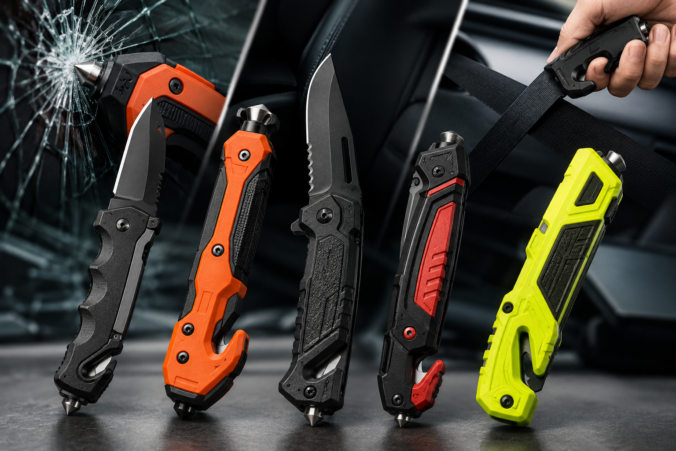
A rescue knife is defined by three non-negotiable features that standard best pocket knives for everyday carry simply don't include.

The three core features:

  • Seatbelt cutter – a recessed hook or integrated blade designed specifically for webbing
  • Glass breaker tip – hardened spike (ideally tungsten carbide) for fracturing tempered side windows
  • One-handed deployment – assisted open, thumb hole, or flipper that works under stress

As It's Just Sharp puts it: "the big things we look for in rescue tools really boil down to three main pieces: the knife itself, a seat belt cutter, and some form of glass punch."

Blade shape matters too. Sheepsfoot profiles (blunt tip, curved edge) are preferred for rescue work – the blunt tip eliminates puncture risk when sliding under a seatbelt near a trapped victim. Clip-point blades work fine for dual EDC/rescue use but carry more risk in confined cutting scenarios.

Blade steel hierarchy for rescue:

Steel Approx. HRC Edge Retention Corrosion Resistance Typical Price Tier
VG-10 60–62 Excellent Excellent Premium
440C 58–60 Good Good Mid-range
8Cr13MoV 57–58 Moderate Moderate Budget-mid
7Cr17MoV 55–57 Adequate Adequate Budget

According to Knife Steel Nerds, "toughness and edge retention are generally opposing properties" – meaning budget steels like 7Cr17MoV trade long-term sharpness for lower cost. For a rescue knife used infrequently, that's an acceptable trade-off. For a daily EDC blade that doubles as rescue, it isn't.

Key Takeaway: A true rescue knife requires all three features – seatbelt cutter, glass breaker, one-hand deployment. Missing any one of them means it's an EDC knife with rescue-adjacent features, not a purpose-built rescue tool.

How We Evaluate Rescue Knives

Our 5-point scoring rubric:

  1. Seatbelt cutter effectiveness – hook design vs. serrated blade; tension-assisted cutting speed
  2. Glass breaker tip hardness – tungsten carbide vs. hardened steel vs. ceramic
  3. One-hand deployment ease – tested with and without gloves
  4. Blade steel quality – HRC rating, corrosion resistance, edge retention
  5. Carry comfort – weight, clip design, handle texture

On seatbelt cutters specifically: It's Just Sharp notes that "when you slide a seatbelt that has tension on it into the belt cutter, you won't have to apply much force to get it to cut." Hook cutters use the belt's own tension – no sawing required. That's a critical advantage in a panic scenario.

On gloved-hand usability: NIH-indexed research on stress-induced fine motor degradation confirms that under acute stress, fine motor tasks become significantly harder due to vasoconstriction and adrenaline-induced tremors. Large thumb holes, assisted openers, and textured handles aren't luxury features – they're physiological necessities.

For flipper vs thumb stud deployment mechanisms, deployment speed and glove compatibility vary significantly – a factor weighted heavily in our evaluation.

Key Takeaway: Gloved-hand usability is the most underrated evaluation criterion. If a knife can't be deployed one-handed in nitrile gloves, it fails the core rescue use case.

Best Rescue Knives with Seatbelt Cutter and Glass Breaker (2026 Picks)

Model Blade Steel Blade Length Seatbelt Cutter Glass Breaker Deployment
Benchmade Triage 917 440C 3.56" Integrated hook Tungsten carbide SpeedSafe assisted
Gerber EVO Rescue 7Cr17MoV 3.5" Integrated hook Hardened tip Assisted open
SOG Escape FL AUS-8 3.4" Handle-mounted Glass breaker tip SOG-Assisted
Spyderco Rescue 79 VG-10 3.79" Seatbelt spike Glass breaker spike Thumb hole
StatGear Surviv-All 8Cr13MoV 3.75" Integrated hook Tungsten carbide Assisted open
Boker Plus Karakurt Stainless ~3.3" Integrated hook Glass breaker tip Assisted open
Kershaw Blur Glassbreaker D2 3.4" Serrated edge only Glass breaker SpeedSafe assisted

Best Overall: Benchmade Triage 917

The Triage 917 is the benchmark for purpose-built rescue folders. It combines a 3.56" partially-serrated 440C blade, SpeedSafe assisted opening, tungsten carbide glass breaker, and an integrated seatbelt cutter in a single package. Off Grid Web notes that the Auto Triage variant with automatic opening "is, however, over $100 more expensive than the original Triage" – making the standard 917 the smarter value play at its price point.

Limitation: 440C is solid but not exceptional steel. If edge retention is your priority for daily EDC use, the Spyderco Rescue 79's VG-10 edges it out.

Best Budget Under $30: Gerber EVO Rescue

The Gerber EVO Rescue delivers all three core rescue features – integrated seatbelt hook, glass breaker, and assisted opening – at a price point that makes it easy to keep one in the glove box and one on your person. The 7Cr17MoV blade is entry-level steel, but as It's Just Sharp points out, a dedicated seatbelt cutter "likely won't be dull from repeated use" since it's used for one specific task.

For a deeper look at how these two budget brands stack up, see our Gerber vs Kershaw comparison.

Limitation: 7Cr17MoV dulls faster than 440C under repeated use. Fine for an emergency-only tool; not ideal as a primary EDC blade.

Best Mid-Range: SOG Escape FL

According to Recoil Web, the SOG Escape features a "3.4-inch blade of AUS-8 stainless steel PVD coated black" with an integrated handle-mounted seatbelt/cord cutter and glass breaker tip. AUS-8 sits in a similar performance tier to 8Cr13MoV – better than 7Cr, not quite 440C. The SOG-Assisted Technology (SAT) deployment is fast and glove-friendly.

The Kershaw Blur Glassbreaker is worth mentioning here too – it carries a 4.8-star rating from 147 reviews and uses D2 tool steel, which offers excellent edge retention. Note: the Blur has a glass breaker and serrated edge but lacks a dedicated seatbelt hook cutter. For best Kershaw EDC knives, it's a strong pick – just know the limitation.

Limitation: Neither the SOG Escape nor the Kershaw Blur is a complete three-feature rescue knife without a dedicated seatbelt hook.

Best Premium: Spyderco Rescue 79

The Spyderco Rescue 79 uses VG-10 steel – rated approximately 60–62 HRC with excellent edge retention and corrosion resistance. The sheepsfoot blade profile with blunt tip is the safest option for cutting near trapped victims. Recoil Web notes the H-1 steel variant of Spyderco's rescue line "doesn't rust because it contains nitrogen instead of carbon" – relevant for coastal or marine carry.

Limitation: Thumb-hole deployment is slower than assisted open under stress. Not the fastest deployer in the category.

Best for First Responders: StatGear Surviv-All

The StatGear Surviv-All packs a partially serrated 3.75" 8Cr13MoV blade, integrated seatbelt hook cutter, tungsten carbide glass breaker, and a fire starter rod – making it one of the most feature-dense picks under $50. emphasizes that EMS personnel need knives that "deploy fully with one hand while wearing nitrile or leather gloves" – the Surviv-All's large thumb hole and textured handle meet that standard.

Limitation: 8Cr13MoV is mid-tier steel. Adequate for rescue use; not a premium EDC blade.

Best Compact: Boker Plus Karakurt

The Boker Plus Karakurt delivers integrated seatbelt hook cutter, glass breaker tip, and assisted opening in a compact form factor – roughly $40–55 street price. If pocket footprint is your primary constraint, this is the pick. You can find it and compare similar options at Knife Depot.

Limitation: Compact size means a shorter cutting edge. Not ideal for heavy-duty rescue cutting tasks.

Key Takeaway: The Benchmade Triage 917 is the clearest best-overall pick. For budget buyers, the Gerber EVO Rescue delivers all three core features under $30. For first responders, the StatGear Surviv-All's feature density at ~$45 is hard to beat.

What Type of Glass Breaker Works Best in a Vehicle Emergency?

This is where most roundups go completely silent. The type of glass breaker tip matters – a lot.

Type Hardness Force Required Durability Best For
Tungsten carbide ~2600 HV Low Excellent Primary rescue use
Hardened steel pommel ~700–900 HV Higher Good Budget/EDC hybrid
Ceramic tip Very high Low Brittle Avoid for EDC

According to Engineering Toolbox, tungsten carbide measures approximately 2600 Vickers hardness versus hardened tool steel at 700–900 HV. That hardness differential concentrates force at the tip, requiring significantly less striking energy to initiate a fracture in tempered glass. As Off Grid Knives notes, "the glass breaker tip is made from tungsten alloy… the same material used to make armor-piercing ammunition."

Critical safety fact: Your glass breaker will NOT work on the windshield.

Federal Motor Vehicle Safety Standard No. 205 (FMVSS 205) requires windshields to use laminated glass – two glass layers bonded with a PVB interlayer that holds shards together and resists penetration. Side and rear windows use tempered glass, which shatters into small pieces when struck at a stress point. A veteran firefighter on Garage Journal with over 25 years of vehicle extrication experience confirmed: "I have seen numerous examples of this tool fail to break a window on most attempts" – referring specifically to glass breakers used on laminated glass.

Striking technique matters. According to Fire Engineering:

Strike the lower corner of the side window – never the center. Tempered glass distributes stress toward the edges; a sharp strike at the corner initiates fracture most efficiently.

Key Takeaway: Tungsten carbide tips outperform hardened steel on tempered side glass. No glass breaker works on laminated windshields – always target side or rear windows.

Legality is the section most roundups skip entirely. Don't skip it.

Blade length restrictions vary significantly by state and municipality. Common thresholds in the US:

  • 2.5 inches – some California municipalities
  • 3 inches – various state statutes
  • 4 inches – federal property baseline

Assisted-opening mechanisms are the bigger issue. According to Knife Rights, states including Hawaii, Vermont, New York, and New Jersey have enacted laws restricting assisted-opening knives or treating them as prohibited switchblades depending on mechanism design and blade length. That covers SpeedSafe, LAWKS, and similar systems found in most rescue knives.

As Blade Forums users note, "spring loaded punches are ILLEGAL to possess in some states" – the same legal ambiguity applies to assisted-opening rescue knives in restrictive jurisdictions.

For a full breakdown of assisted opening knife laws and mechanisms, verify your state before EDC carry.

Glove box storage is a practical alternative in restrictive states. A rescue knife stored in your vehicle rather than on your person typically faces fewer carry restrictions – though state laws vary, so verify locally.

Key Takeaway: Assisted-opening rescue knives face legal restrictions in 8+ US states. Always verify local law before EDC carry. Glove box storage is a legal alternative in many jurisdictions.

How to Choose the Right Rescue Knife for Your Needs

Three questions to guide your decision:

1. What's your primary use – daily EDC or glove box only?

If you only drive and want a vehicle emergency tool: prioritize the glass breaker type (tungsten carbide) and seatbelt cutter design (hook over serrated) over blade length or steel quality. The Gerber EVO Rescue or StatGear Surviv-All covers this use case without overspending.

If you want dual EDC and rescue use: prioritize blade steel quality (440C minimum) and one-hand opening speed. The Benchmade Triage 917 or Spyderco Rescue 79 are the right tier.

2. What's your budget?

  • Under $30: Gerber EVO Rescue
  • $30–$80: StatGear Surviv-All, SOG Escape FL
  • $80+: Benchmade Triage 917, Spyderco Rescue 79

3. What deployment mechanism do you prefer?

Assisted open is fastest under stress but has legal restrictions. Manual thumb hole is universally legal but slower. Fixed blade is fastest of all but harder to carry legally in most states.

On handle materials: Knife Center's handle materials guide notes that G10 "maintains grip texture even when wet or oily," while rubber overmolds "can compress and become slippery under sustained pressure or cold temperatures." For a rescue knife – especially one stored in a vehicle where interior temperatures can exceed 130°F in summer – G10 is the more durable long-term choice. For more on G10 vs rubber handle materials for grip, the difference matters more than most buyers expect.

Key Takeaway: Match the knife to your actual use case. Glove box-only users don't need premium steel. Daily EDC carriers do. Deployment mechanism choice has legal implications – verify before you carry.

Upgrade Your Everyday Carry
Built for performance. Designed to stand out. Shop knives ready for everyday carry, the outdoors, or your collection.
Top models are selling out fast.
Free shipping available on most orders
Shop Here

Frequently Asked Questions About Rescue Knives

How much should I spend on a rescue knife with a seatbelt cutter and glass breaker?

Direct Answer: Budget $25–$50 for a dedicated vehicle emergency tool; $100–$175 if you want a premium daily EDC that doubles as a rescue knife.

The Gerber EVO Rescue covers all three core features under $30. The StatGear Surviv-All adds a tungsten carbide glass breaker and fire starter at ~$45. Above $100, you're paying for better blade steel (440C, VG-10) and more refined deployment mechanisms – worth it for daily carry, less critical for a glove box knife.

Can a rescue knife glass breaker break a car windshield?

Direct Answer: No. Glass breakers on rescue knives cannot fracture laminated windshields – they only work on tempered side and rear windows.

Federal safety standards (FMVSS 205) require windshields to use laminated glass with a PVB interlayer that holds shards together and resists penetration. As one experienced firefighter noted on Garage Journal, even professional glass breakers frequently fail on laminated glass. Always target side or rear windows in a vehicle emergency.

What is the difference between a hooked seatbelt cutter and a serrated blade for cutting belts?

Direct Answer: A hooked seatbelt cutter is faster and safer in an emergency – it uses the belt's own tension to cut without sawing.

According to It's Just Sharp, a dedicated seatbelt cutter "likely won't be dull from repeated use" and requires minimal force when the belt is under tension. A serrated blade can cut seatbelts but requires a sawing motion, more time, and more fine motor control – all of which degrade under stress.

Direct Answer: Not in all states. Assisted-opening mechanisms face legal restrictions in multiple US states under switchblade statutes.

According to Knife Rights, states including Hawaii, Vermont, New York, and New Jersey have laws that may classify assisted-opening knives as prohibited switchblades depending on mechanism and blade length. Always verify your local laws before EDC carry. Glove box storage is a legal alternative in many jurisdictions.

How do I maintain the seatbelt cutter hook on a rescue knife?

Direct Answer: Keep the hook cutter clean and free of debris; sharpen with a small curved file or send to the manufacturer if the edge dulls.

Hook cutters rarely dull under normal use since they're designed for a single task. The bigger maintenance concern for vehicle-stored knives is the pivot mechanism – NRDC research confirms interior vehicle temperatures can exceed 130°F in summer, which can degrade lubricants in folding knife pivots. Apply a drop of pivot oil annually if the knife lives in your car.

Which rescue knife is best for first responders and EMS workers?

Direct Answer: The StatGear Surviv-All ($45) or Benchmade Triage 917 ($170) are the top picks for first responders, depending on budget.

specifies that EMS rescue knives must "deploy fully with one hand while wearing nitrile or leather gloves" – both models meet this standard. The Triage 917 adds 440C steel and a more refined deployment mechanism. The Surviv-All wins on feature density per dollar. For EMS personnel who need a sheepsfoot profile to minimize victim puncture risk, the Spyderco Rescue 79 with VG-10 steel is the premium choice.

Is a dedicated rescue knife better than a multi-tool for vehicle emergencies?

Direct Answer: Yes, for speed. A dedicated rescue knife deploys faster and cuts more reliably under stress than a multi-tool in a vehicle emergency.

Multi-tools require two hands to open most attachments and add unnecessary complexity in a panic scenario. As Garage Journal contributors note, "the best tool is always the one you have with you" – but when seconds matter, a single-purpose rescue knife with an assisted opener beats fumbling through a multi-tool every time. The Victorinox Rescue Tool is a notable exception, as it includes a specialized saw capable of cutting laminated windshield glass – but it's bulkier than a standard folding rescue knife.

Bottom Line

The best rescue knives with seatbelt cutter and glass breaker aren't just knives with extra features bolted on. They're purpose-engineered tools where every design decision – blade profile, tip material, deployment mechanism, handle texture – exists to function under the worst conditions you'll ever face.

Pick the Benchmade Triage 917 if budget isn't a constraint. Pick the Gerber EVO Rescue or StatGear Surviv-All if it is. Either way, verify your local carry laws, keep the pivot lubricated if it lives in your car, and remember: your glass breaker only works on side windows.

The knife that saves your life is the one you actually have with you.

Ready to Get Started?

For personalized guidance, visit Knife Depot to learn how we can help.