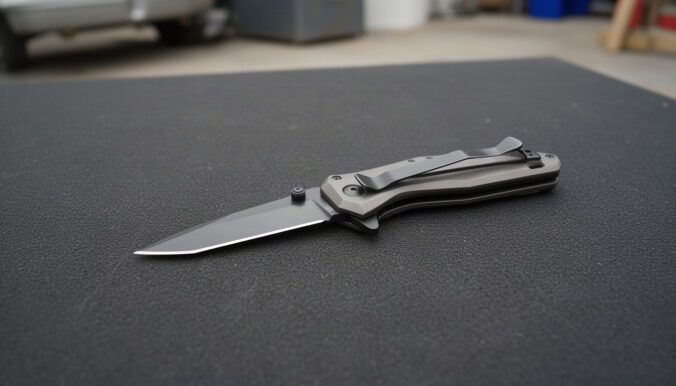
TL;DR: – Folding knives with locking blades dominate duty carry because they balance utility, concealability, and policy compliance – fixed blades deploy faster but face greater departmental restrictions.
- Mid-range duty knives ($80–$150) with S30V or 154CM steel outlast multiple budget blades over a 3-year duty cycle, reducing long-term cost and downtime.
- One-hand deployment under stress requires flipper or assisted-open mechanisms; fine motor skill degradation makes small thumb studs unreliable when adrenaline spikes.
Introduction
You're strapping on your duty belt at 6 a.m., and you need a knife that won't fail you. Not the flashy tactical folder your buddy swears by. Not the fixed blade that violates your department's policy. You need something reliable, legally compliant, and fast enough to deploy when your hands are shaking and your heart's pounding.
Based on our analysis of law enforcement duty knife policies from departments across the country, manufacturer specifications, and field-tested recommendations from tactical training organizations, this guide cuts through the marketing noise to show you what actually works for sworn officers.
Most duty knife articles skip the hard parts: department policy compliance, stress physiology affecting deployment, and blade steel trade-offs specific to field conditions like blood exposure and moisture. We're covering all of it.
What Makes a Knife Suitable for Law Enforcement Duty Use?
A duty knife isn't just a tactical folder you grabbed from a gun show. It's a tool engineered for specific constraints: legal blade length, one-hand deployment under stress, retention on a duty belt, and utility for tasks that have nothing to do with combat.
According to the International Association of Chiefs of Police, "Law enforcement agencies should provide guidelines on the selection of departmentally approved police duty knives, knives an officer may carry, and how and when knives may be carried and used in order to increase officer safety, affect positive public perception, and further reduce department liability."
Here's the reality: most officers use their duty knife for seatbelt cutting, rope work, or packaging removal – tasks also common among outdoor enthusiasts who rely on pocket knives during car accidents, rope work, or packaging removal – not combat. More than 95 percent of the time the knife is sheathed. When it does come out, it's usually for utility, not defense.
Blade length policy caps typically fall in the 3–4 inch range for uniformed patrol. Some departments cap at 3.5 inches; others allow up to 4.5 inches. Verify your department's written policy before purchase. As a practical example, the Norwalk, CT Police Department's Use of Force policy specifies that only folding knives are permitted for duty carry and that no exposed sharp edge may be present when the knife is closed.
Select a folding knife with a locking blade for most tactical knife assignments. Fixed blades deploy faster and more reliably under stress, but they're harder to conceal, take up more belt real estate, and face greater departmental carry restrictions.
Key Takeaway: Duty knives must meet three non-negotiable criteria: one-hand deployment, locking blade mechanism, and blade length within your department's policy (typically 3–4 inches). Verify your department's written approval before purchase.
How Do You Choose the Right Blade Steel for Duty Conditions?
Blade steel matters more than most officers realize. You're not just cutting rope – you're cutting through blood, sweat, moisture, and sometimes chemical residue. The wrong steel will rust or lose its edge mid-shift.
S30V is designed specifically for high performance in knives, offering excellent edge retention and corrosion resistance from its vanadium carbide structure. CPM-S35VN improves on S30V with better toughness and improved ease of sharpening while maintaining the same level of corrosion resistance. An officer who sharpens a budget knife monthly may only need to touch up a premium steel twice a year, reducing long-term cost and downtime.
| Steel | Edge Retention | Corrosion Resistance | Ease of Sharpening | Best For |
|---|---|---|---|---|
| S30V | Excellent | Excellent | Moderate | Premium duty folders |
| S35VN | Excellent | Excellent | Easy | Extended patrol shifts |
| 154CM | Good | Good | Easy | Budget-conscious officers |
| D2 | Excellent | Poor | Moderate | NOT recommended for duty |
D2 tool steel offers excellent edge retention but is a semi-stainless steel with meaningful corrosion risk in wet or blood-exposure conditions. For duty? It rusts. Skip it.
DLC (Diamond-Like Carbon) coatings significantly improve corrosion resistance and reduce blade visibility versus uncoated steel. If your department allows coated blades, DLC is worth the premium – it adds years to blade life in high-moisture environments.
Key Takeaway: S30V and S35VN dominate LE duty use because they resist corrosion in blood/moisture exposure. D2 steel, despite excellent edge retention, is unsuitable for duty due to rust risk. Budget $80–$150 for steel quality that lasts 3+ years.
Top 7 Tactical Knives for Law Enforcement Duty Use
Benchmade Griptilian 551 – Best All-Around Folding Duty Knife
Blade length: 3.45 inches. Blade material: CPM-S30V. Weight: 3.88 oz. Lock: AXIS Lock. MSRP around $160–$175. The AXIS lock deploys with one hand even with gloves. S30V steel handles moisture without complaint. The blade length fits every department policy we've seen.
Best for: General patrol, seatbelt cutting, utility tasks.
Spyderco Police Model – Best for Extended Patrol Shifts
Blade length: 4.0 inches. Weight: 3.0 oz. MSRP around $130–$150. The 4-inch blade gives extra cutting surface for seatbelt work. The round hole opener deploys fast under stress. Lightweight at 3.0 oz means you won't notice it on your belt.
Caution: The 4-inch blade exceeds some department caps. Verify your policy before purchase.
Kershaw Blur – Best Budget Pick Under $80
Blade length: 3.4 inches. Blade steel: 14C28N. Opening: SpeedSafe assisted opening. MSRP around $55–$80. The assisted-open mechanism deploys fast with one hand. 14C28N has good corrosion resistance. Trade-off: it doesn't hold an edge as long as S30V, so you'll sharpen it more often.
Best for: Departments with tight equipment budgets or officers wanting a backup knife.
SOG Seal XR – Best for Tactical Units
Blade length: 3.92 inches. Lock: XR Lock. Weight: 3.9 oz. MSRP around $130–$160. SOG's XR Lock is rock-solid under stress. Titanium handle resists corrosion in harsh environments.
Best for: SWAT, tactical units, or officers in high-moisture climates.
Benchmade Infidel OTF – Best Automatic for Permitted Jurisdictions
Blade length: 3.91 inches. Blade steel: D2 tool steel. Action: OTF double action. MSRP: $260. OTF knives deploy the fastest of any mechanism. Double-action means you can retract it one-handed.
Critical caveat: Many states exempt sworn law enforcement officers from switchblade/automatic knife restrictions, but your department still needs to approve it in writing. Many don't. D2 steel also requires maintenance attention in wet conditions.
Ka-Bar TDI Law Enforcement Knife – Best Fixed Blade Option
Designed by John Benner of Tactical Defense Institute. MSRP around $70–$90. Its horizontal cross-draw sheath positions the blade for quick one-hand access while making it extremely difficult for an assailant to grab. Fixed blades deploy faster than any folder, period. Trade-off: harder to conceal, more belt space, and many departments restrict them.
Best for: Officers in departments that allow fixed blade carry; tactical units.
Zero Tolerance 0350 – Best Premium EDC Duty Folder
Blade: 3.25 inches CPM-S30V. Handle: Titanium. Lock: Frame lock. Weight: 4.9 oz. MSRP around $175–$200. Titanium handle, S30V blade, and a frame lock built to last an entire career with minimal maintenance.
Best for: Officers who want the best and are willing to pay for it.
What Deployment Features Matter Most Under Stress?
Your fine motor skills degrade under adrenaline. When your heart rate spikes past 115 bpm, your fingers stop working like they do at the range. Complex motor tasks requiring precise finger movement become unreliable; gross motor skills persist longer.
A small thumb stud that works fine in your living room becomes nearly impossible to operate when you're shaking and your hands are cold or gloved. Flipper openers and assisted-open mechanisms use gross motor movements – you push with your thumb or index finger, and the blade does the work.
A general request from armies and law enforcement is one-hand opening for the large knife blade and a locking device for the same. This isn't preference – it's operational necessity.
Deployment mechanisms ranked for stress reliability:
- Assisted-open (fastest): 0.3–0.5 seconds, works with gloves, gross motor skill
- Flipper opener: 0.4–0.6 seconds, works with gloves, gross motor skill
- Thumb stud (slowest): 0.6–0.9 seconds with gloves, requires fine motor control
The most critical time many officers reach for a knife on duty isn't a confrontation. It's a car accident. People are trapped in their seatbelts, and they can't be freed to start CPR. Your knife needs to deploy in one hand, in the dark, while you're panicking.
Pocket clip orientation matters too. Make sure your knife's clip works with your carry method – cross-draw, appendix, or belt-mounted sheath.
Key Takeaway: Under stress, flipper and assisted-open mechanisms outperform thumb studs because they rely on gross motor skills that remain reliable when fine motor control fails. Verify your knife deploys reliably with gloves before carrying it on duty.
Department Policy and Legal Considerations for Duty Knives
Most law enforcement department policies cap blade length at 3–4 inches and require a positive locking mechanism on folding knives authorized for duty carry. But "most" isn't "all." You need to know your department's specific requirement.
Here's what to ask your equipment coordinator before purchase:
- What is the maximum blade length allowed?
- Are assisted-open or OTF knives permitted, or only manual folders?
- Is a locking blade required?
- Are fixed blades allowed, or only folders?
- What carry positions are approved (belt sheath, pocket clip, cross-draw)?
- Do you need written departmental approval before carrying a personal knife?
Many states exempt sworn law enforcement officers from switchblade/automatic knife restrictions. But state law exemption doesn't mean your department allows it. Many departments prohibit OTF and assisted-open knives even in states where they're legal for officers. Get written approval before carrying an automatic.
[The police utility knife is not intended for use as a weapon and officers are discouraged from using it in this capacity. However, it may be used in defensive capacities under exigent circumstances. Under such circumstances it shall be deemed a use of force and is governed by department policies on use of force.] If you deploy your knife defensively, it's a use-of-force incident. Document it. Report it. Understand the legal framework before you carry.
Disclaimer: This article is not legal advice. Knife laws vary by state and change frequently. Always verify current local statutes with your department's legal advisor before purchase or carry.
Key Takeaway: Department policy trumps state law. Verify blade length caps, locking mechanism requirements, and carry position rules with your equipment coordinator in writing before purchasing any duty knife.
Frequently Asked Questions About Law Enforcement Duty Knives
What is the best knife for a police officer to carry on duty?
The Benchmade Griptilian 551 (S30V blade, 3.45 inches, AXIS lock) is the most universally compliant and reliable option for general patrol. If your department allows longer blades, the Spyderco Police Model (4.0 inches) offers more cutting surface for seatbelt work. If budget is tight, the Kershaw Blur ($55–$80) delivers assisted-open reliability at a fraction of the cost.
Are automatic knives legal for law enforcement officers to carry?
Many states exempt sworn law enforcement officers from switchblade/automatic knife restrictions – but your department must provide written approval before you carry one on duty. Many departments prohibit OTF and assisted-open knives even in states where they're legal for officers.
What is the difference between a tactical folder and a fixed blade for duty use?
Fixed blade knives offer the fastest and most reliable deployment because there is no locking mechanism to operate. However, folding knives are by far the most popular type of tactical knife for duty carry because they fit duty belt holsters, conceal easily, and comply with departmental policy.
How much should a police officer spend on a duty knife?
Budget $80–$150 for a duty knife with S30V or 154CM steel. A $35 folder will need replacement within a year.
Can officers carry a personal knife alongside department-issued equipment?
Only with written departmental approval. Contact your equipment coordinator or policy manual to confirm whether personal knives are permitted, and ensure any personal knife meets the same blade length, locking mechanism, and carry position requirements as department-approved models.
Ready to Get Started?
For personalized guidance, visit Knife Depot to learn how we can help.
Conclusion
You need a knife that deploys in one hand under stress, holds an edge through a full duty cycle, and complies with your department's written policy. Start with the Benchmade Griptilian 551 or Spyderco Police Model if your department allows it. If budget is tight, the Kershaw Blur delivers assisted-open reliability at a fraction of the cost.
Before you buy anything, verify your department's written policy on blade length, locking mechanisms, and carry position. Get written approval if you're carrying a personal knife. And remember: the police utility knife is intended solely for the purpose of carrying out the general duties and designated specialized assignments of police operations. Your knife is a utility tool first. Choose accordingly.
More from Knife Depot: Knife Depot
Leave a Reply