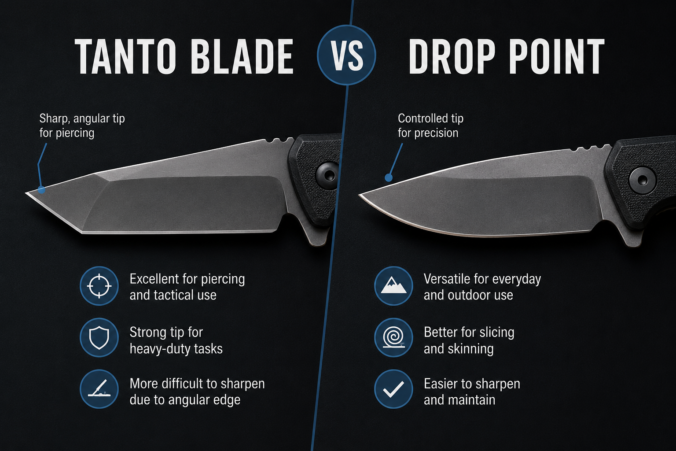
TL;DR: – Drop point wins overall versatility across slicing, food prep, and hunting tasks
- Tanto excels at piercing hard materials and resists lateral stress better
- Drop point requires one sharpening pass; tanto requires two separate angles
- Best for beginners and general EDC: drop point. Best for tactical/hard use: tanto
Introduction
Here’s the thing about blade shape: it matters way more than most casual knife buyers realize. You’re not just picking a knife – you’re choosing a tool optimized for specific cutting tasks. And when you’re deciding between tanto and drop point, you’re really asking: do I want a blade that slices everything reasonably well, or one that punches through hard materials like a champ?
Based on our analysis of community discussions across BladeForums, knife retailer guides, and materials science resources, we’ve mapped out exactly how these two blade shapes perform across six real-world cutting tasks. The verdict? Drop point is the more versatile choice for most users – but tanto dominates in specific scenarios where tip strength matters more than belly curve.
Let’s break down the geometry, the performance gaps, and who should actually choose each blade.
What Are Tanto and Drop Point Blades?
The drop point is straightforward: [the spine curves down in a convex arc from the handle to the point][S9-C2]. That continuous curve creates a long belly – the curved section of the edge – that’s perfect for slicing. Think of it as the blade equivalent of a chef’s knife profile, but tougher.
The tanto is the opposite geometry. [Its primary edge runs straight, then turns a hard corner up to a short secondary edge][S9-C3]. That angular transition is where the tanto gets its structural advantage: the reinforced tip can handle lateral stress and piercing that would snap a drop point.
Here’s the origin story: [the modern angular shape was created by American custom knifemaker Bob Lum in the late 1970s, then popularized by Lynn Thompson and Cold Steel in the early 1980s][S9-C1]. It wasn’t a direct copy of the Japanese tanto dagger – it was an American adaptation designed for one thing: pure structural integrity in a folding knife.
[The drop point has become a favorite among hunters, outdoor adventurers, and everyday users][S3-C5] because it handles the broadest range of tasks without compromise.
Key Takeaway: Drop point has one continuous curve; tanto has two straight edges meeting at an angle. This geometry difference drives everything else – sharpening difficulty, task performance, and carry practicality.
How Do They Perform Across Common Cutting Tasks?
Let’s get specific. Here’s how each blade handles the six tasks you actually care about:
| Task | Winner | Why |
|---|---|---|
| Slicing (food, rope, cardboard) | Drop Point | Long belly handles push cuts and draw cuts smoothly |
| Piercing hard materials | Tanto | Reinforced tip penetrates plastic, polymer, sheet metal |
| Skinning and field dressing | Drop Point | Controlled tip + belly curve prevents organ puncture |
| General EDC (packages, boxes) | Drop Point | Versatile belly works for most daily cuts |
| Prying and lateral stress | Tanto | Angular tip resists lateral force without bending |
| Defensive utility | Tanto | Aggressive tip geometry, reinforced structure |
Drop point wins 4 of 6 tasks. But that doesn’t mean tanto is weak – it’s just specialized. This kind of side-by-side evaluation mirrors what a decision matrix is designed to surface: [when you score options against predefined criteria, you minimize the influence of gut feelings or personal preferences][S4-C2].
Everyday Carry and General Use
You’re opening a package. You’re slicing through a zip tie. You’re cutting a piece of fruit. In these moments, [the drop point’s long belly allows the knife to ‘roll’ through the material][S8-C4], making the cut feel effortless.
The tanto? [Its primary edge runs straight, which means draw cuts – pulling the blade through material – are awkward][S2-C2]. You’re fighting the geometry. For EDC, that’s a real disadvantage.
That said, if you’re opening hard plastic clamshell packaging or puncturing a thick polymer bag, the tanto’s reinforced tip shines. [The sturdy design pierces easily through hard materials like wood, metal, or even bone][S3-C4].
Outdoor, Hunting, and Survival Tasks
This is where drop point dominates. Hunters and field dressing require precision and control. You’re running the blade along the abdominal wall of game, and you need a tip that won’t puncture the gut bag. The drop point’s controlled tip and belly curve prevent organ puncture during field dressing, while the belly does the actual skinning work.
Tanto can work for hunting, but it’s not ideal. The short secondary edge limits your slicing options, and that aggressive tip is overkill for game processing.
Tactical and Self-Defense Considerations
[The American Tanto is a modern invention designed for one thing: pure structural integrity][S8-C2]. In defensive scenarios where you need a blade that won’t fold under lateral stress, the tanto’s reinforced tip is genuinely superior.
That said: check your local laws. Tanto blades can trigger legal concerns in some jurisdictions due to their aggressive profile, even when the blade itself is legal to carry.
Key Takeaway: Drop point wins slicing, skinning, and general EDC (4 of 6 tasks). Tanto wins piercing and lateral stress resistance. Choose based on your primary use case.
Which Blade Is Easier to Sharpen and Maintain?
This is the gap most comparison articles skip – and it’s a real factor in long-term usability.
[A drop point has one continuous cutting edge. You set your angle, follow the curve from heel to tip in a single motion, and the belly forgives small inconsistencies because the curve blends them out][S9-C4]. Sharpening takes 5–10 minutes on a beginner-friendly whetstone. Any electric sharpener handles it fine.
The tanto? [A tanto has two separate straight edges that meet at the vertex. You sharpen the primary edge as one flat plane, then reset and sharpen the shorter secondary edge as its own plane, and you have to keep the corner crisp where they meet][S9-C5]. That’s two separate sharpening passes at different angles.
[The angular transition also gives you two distinct edges to sharpen instead of one continuous curve, which doubles your maintenance time][S2-C3]. Get the angle wrong, and you’ve weakened the blade’s defining strength advantage.
Drop points are easier to sharpen. This isn’t opinion – it’s geometry. If you’re new to knives or don’t want to spend 15+ minutes per sharpening session, drop point is the obvious choice.
Key Takeaway: Drop point sharpening: one continuous curve, 5–10 minutes, beginner-friendly. Tanto sharpening: two separate angles, 12–15 minutes, intermediate skill required.
Tanto vs Drop Point: EDC and Carry Practicality Compared
Typical EDC blade lengths run 3–3.75 inches for tanto, 3–4 inches for drop point. But here’s what matters: in a 3-inch folder, the tanto’s reduced belly becomes a real liability for everyday cuts. At that length, you lose most of what makes the tanto tolerable on a larger fixed blade.
[The drop point is the most common blade shape in modern EDC knives][S2-C1] for a reason. It pairs well with more handle styles and lock mechanisms. The drop point’s geometry works well with almost any handle – the weight stays toward the handle, which is what liner lock and frame lock designs are optimized for.
The tanto’s exposed angular tip can catch on soft sheath material or pocket clip edges – a minor but real carry consideration. It’s not a deal-breaker, but it’s one more friction point.
There’s also a social factor that matters more than knife enthusiasts like to admit: a tanto in an office setting draws uncomfortable glances in a way that a drop point doesn’t. The “tactical” aesthetic reads as threatening to non-knife people, even when the blade is legal. If you’re carrying in an urban environment or workplace, drop point is the path of least resistance.
Key Takeaway: Drop point pairs with more handle styles, carries cleaner in folders, and avoids social friction in urban EDC. Tanto’s exposed tip can snag and draws attention.
Who Should Choose Each Blade Shape?
Choose drop point if:
- You want one knife for varied daily tasks
- You do food prep, hunting, or field dressing
- You’re new to knives or don’t want sharpening headaches
- You carry in an office or urban environment
- You want the broadest task coverage
[For everyday carry across realistic daily tasks, the drop point is the more functional choice. The drop point earns its place in each design by performing better than alternatives across the realistic task profile of the intended user][S1-C3][S1-C4].
Choose tanto if:
- You prioritize tip strength and lateral stress resistance
- You work with hard materials (polymer, plastic, sheet metal)
- You’re in tactical or hard-use scenarios
- You’re willing to spend extra time sharpening
- You want an aggressive, specialized tool
[Tantos are usually used where there is lots of stabbing involved, or when you really need the toughest blade tip. In every other way a nice drop point will pretty much out perform a tanto][S6-C2][S6-C5].
Most knife collectors end up with both over time. They’re not competing – they’re complementary tools.
Key Takeaway: Drop point for versatility and ease of use. Tanto for specialized tip strength and hard material piercing. Most users benefit from starting with drop point.
Frequently Asked Questions
Is a tanto or drop point better for everyday carry?
Direct Answer: Drop point is better for everyday carry for most people. It handles slicing, food prep, and general cutting tasks more naturally, and it’s easier to sharpen.
Tanto excels at piercing hard materials, but that’s a specialized need. Unless you’re regularly puncturing thick polymer or working in tactical scenarios, the drop point’s versatility wins. [Slicing dominates everyday cutting tasks, and the drop point’s long belly handles slicing more efficiently than any other common profile][S1-C5].
Can a tanto blade be used for hunting and skinning?
Direct Answer: Yes, but it’s not ideal. The drop point is the preferred choice for field dressing and skinning.
Tanto can work for hunting, but the short secondary edge limits your slicing options during the skinning process. [The main difference between tanto vs. drop point blades is that the tanto is engineered for heavy-duty tasks like piercing tough materials while the drop point blade is ideal for slicing, carving, and other controlled tasks][S3-C2].
Why is the tanto blade harder to sharpen than a drop point?
Direct Answer: Tanto has two distinct edges meeting at an angle; drop point has one continuous curve. This means tanto requires two separate sharpening passes at different angles.
[The angular transition also gives you two distinct edges to sharpen instead of one continuous curve, which doubles your maintenance time][S2-C3]. Get the transition angle wrong, and you weaken the blade’s defining strength advantage.
Which blade shape is stronger at the tip?
Direct Answer: Tanto is stronger at the tip due to its reinforced angular geometry. However, steel selection matters – a tanto in brittle high-hardness steel can be more fragile than a drop point in tough steel.
[The sturdy design pierces easily through hard materials like wood, metal, or even bone][S3-C4]. But the angled tip, while great for piercing, can be fragile when subjected to excessive lateral force.
Does blade steel matter more than blade shape for versatility?
Direct Answer: Both matter, but steel toughness can override geometry advantages. A tough steel drop point can outperform a brittle steel tanto in real-world use.
[Contrary to popular belief, the tanto shape does not mean it will penetrate any better. A tanto can be ground with a thin and slender point, and a drop point can be ground thick and stout at the end][S6-C4]. Choose your steel based on your primary use case, then optimize blade shape around that.
What is the best tanto knife for EDC under $100?
Direct Answer: Look for tanto options from Kershaw or CRKT in the $50–$100 range. Both brands offer solid tanto folders with good edge retention and reliable deployment.
Kershaw’s Blur tanto and CRKT’s M16 tanto are canonical budget options. For more affordable picks, consider a drop point instead – you’ll get better versatility at the same price point from Knife Depot’s selection of budget EDC knives. You’re trading some refinement for affordability, but both are functional EDC options.
Are tanto blades legal to carry in most states?
Direct Answer: Yes, tanto blades are legal in most US states. However, check your local laws – some cities and jurisdictions restrict blade length, tip design, or automatic deployment mechanisms.
The aggressive visual profile can trigger social friction even when the blade is legal. If you’re carrying in an office or urban environment, a drop point avoids these concerns entirely.
Ready to Get Started?
For personalized guidance, visit Knife Depot to explore our full selection of tanto and drop point knives from trusted brands like Benchmade, Spyderco, and Kershaw.
Conclusion
So which blade wins? Drop point, for most people, most of the time. It slices better, it’s easier to sharpen, it pairs with more handle designs, and it handles the broadest range of cutting tasks without compromise.
But tanto isn’t a loser – it’s a specialist. If you need a blade that punches through hard materials and resists lateral stress, tanto is genuinely superior. The key is matching the blade to your actual use case, not your fantasy use case.
Most knife collections include both eventually. Start with drop point if you’re new. Add tanto later if you find yourself wishing for more tip strength. And when you’re ready to explore options, Knife Depot carries both blade shapes across major brands like Benchmade, Spyderco, and Kershaw – so you can handle both in person before committing.
The best knife is the one you’ll actually carry and use. Choose accordingly.
Leave a Reply