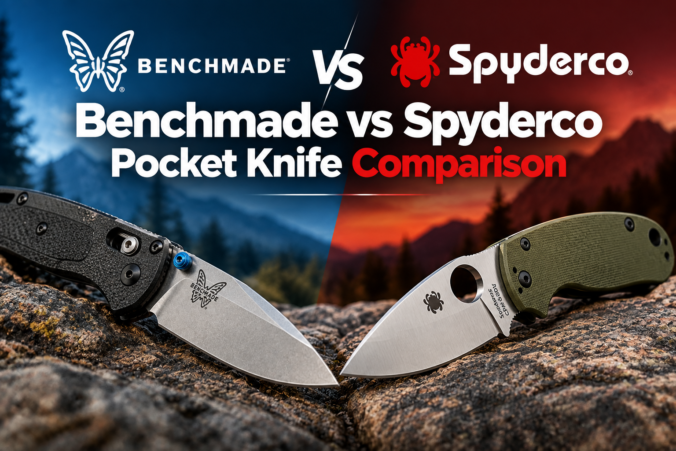
TL;DR: – Benchmade manufactures all knives in Oregon with the AXIS Lock; Spyderco produces globally with the Compression Lock and round hole opener
- At $150–200, both use CPM-S30V steel – real differentiation starts above $200
- Benchmade’s LifeSharp program offers free lifetime sharpening; Spyderco’s warranty covers defects only
- Best for EDC: Benchmade Bugout ($160, 1.85 oz) vs Spyderco Para 3 ($170, 3.0 oz) – choose Bugout for weight, Para 3 for grip
Introduction
You’re standing in front of two of the most respected pocket knife brands in the world. Both have cult followings. Both deliver premium steel and reliable locks. But they’re fundamentally different in philosophy, manufacturing, and what they’ll cost you over time.
Based on our analysis of community discussions across r/knives, BladeForums, and retailer data collected through October 2026, here’s what separates Benchmade and Spyderco in the pocket knife space.
This comparison cuts through the brand loyalty noise and focuses on six decision factors: brand DNA, blade steel, lock mechanisms, price-to-value, warranty, and real-world use cases. By the end, you’ll know exactly which brand matches your needs – and why.
Benchmade vs Spyderco: Quick Verdict
| Factor | Benchmade | Spyderco |
|---|---|---|
| Headquarters | Oregon City, OR (USA) | Golden, CO (USA) |
| Manufacturing | 100% USA-made | USA, Japan, Taiwan, Italy |
| Signature Lock | AXIS Lock (ambidextrous) | Compression Lock (spine-mounted) |
| Warranty | LifeSharp (free lifetime sharpening) | Limited lifetime (defects only) |
| Entry Price | ~$135 (Mini Griptilian) | ~$50 (Tenacious) |
| Best For | Ambidextrous carry, gloved use | One-hand close, blade variety |
Quick recommendations by buyer type:
- EDC carry: Benchmade Bugout wins on weight and ambidextrous lock; Spyderco Para 3 wins on grip and steel variety
- Outdoor/survival: Spyderco edges ahead with more steel options (H1 for saltwater, S110V for edge retention)
- Tactical/professional: Benchmade’s AXIS Lock is faster under pressure; Spyderco’s Compression Lock is safer one-handed
- Collectors: Spyderco’s Sprint Runs and steel variety create more collecting depth
- Budget-first: Spyderco Tenacious at $50 beats any Benchmade under $100
Ready to buy? Browse quality folding pocket knives at Knife Depot to compare models side-by-side.
Key Takeaway: Benchmade is the safer choice for ambidextrous, gloved use with lifetime sharpening included. Spyderco offers more steel variety and global production options at lower entry prices.
How Do Benchmade and Spyderco Differ in Brand Philosophy?
Benchmade and Spyderco were born from different visions. Understanding their DNA explains why they make different design choices today.
Benchmade’s approach: Benchmade’s roots date to 1979, originally as Bali-Song, producing butterfly knives, and was rebranded in 1988 (per True Shot Academy). The company pivoted to folding knives and built its identity around the AXIS Lock – a patented ambidextrous mechanism that lets you open and close with either thumb without crossing the blade. Every Benchmade knife is made in Oregon City, OR. This vertical integration means consistent quality control but higher prices.
Spyderco’s approach: Spyderco was founded in 1976 by Sal Glesser, who initially sold sharpeners before creating the C01 Worker folding knife in 1981 (per True Shot Academy). The company pioneered the round thumb hole opener – a trademark that defined the brand. Spyderco is based in Golden, Colorado, but manufactures globally. This distributed model lets Spyderco offer more steel varieties and price tiers.
Three key design DNA differences:
- Lock philosophy: Benchmade prioritizes ambidextrous operation; Spyderco prioritizes safe one-hand closing
- Steel strategy: Benchmade standardizes on proven steels (S30V, S90V, M4); Spyderco experiments with exotic options (H1, CTS-XHP, CPM-REX 45)
- Production: Benchmade = USA only; Spyderco = tiered quality by country (Golden CO > Japan > Taiwan > China)
Key Takeaway: Benchmade is a vertically integrated USA manufacturer focused on ambidextrous design. Spyderco is a distributed innovator prioritizing blade steel variety and global accessibility.
Blade Steel Comparison: Which Brand Uses Better Steel?
Steel choice is where the real differentiation happens. Both brands use identical steels at mid-range prices, but diverge above $200.
Benchmade’s steel lineup:
- CPM-S30V (~$150–200): The workhorse. Edge retention 8/10, corrosion resistance 9/10, sharpenability 8/10
- CPM-S90V (~$200–250): Harder, longer edge. Edge retention 9/10, corrosion resistance 9/10, sharpenability 6/10
- M4 (~$250+): Carbon steel, extreme edge retention. Edge retention 10/10, corrosion resistance 4/10, sharpenability 7/10
- CPM-20CV (~$250+): Balanced premium. Edge retention 8.5/10, corrosion resistance 9/10, sharpenability 7/10
Spyderco’s steel lineup:
- VG-10 (~$80–120): Japanese stainless, easy to sharpen. Edge retention 7/10, corrosion resistance 8/10, sharpenability 9/10
- CPM-S30V (~$150–200): Same as Benchmade – the benchmark
- S110V (~$200–280): Super steel, extreme edge. Edge retention 9.5/10, corrosion resistance 9/10, sharpenability 5/10
- CTS-XHP (~$180–220): American stainless, balanced. Edge retention 8/10, corrosion resistance 8/10, sharpenability 7/10
- H1 (Salt series, ~$150–200): Nitrogen-alloyed, rustproof. Edge retention 6/10, corrosion resistance 10/10, sharpenability 8/10
Steel comparison table:
| Steel | Brand | Edge Retention | Corrosion Resist. | Sharpenability | Best For |
|---|---|---|---|---|---|
| VG-10 | Spyderco | 7/10 | 8/10 | 9/10 | Budget users, frequent sharpening |
| S30V | Both | 8/10 | 9/10 | 8/10 | All-around sweet spot |
| S90V | Benchmade | 9/10 | 9/10 | 6/10 | Demanding users, less sharpening |
| S110V | Spyderco | 9.5/10 | 9/10 | 5/10 | Extreme edge retention, pro use |
| M4 | Benchmade | 10/10 | 4/10 | 7/10 | Collectors, dry climates only |
| H1 | Spyderco | 6/10 | 10/10 | 8/10 | Saltwater, maritime use |
The real story: At $150–200, both brands use CPM-S30V. The differentiation starts above $200. Benchmade leans toward proven steels (M4, 20CV); Spyderco experiments with exotic options (S110V, H1). Neither approach is objectively “better” – it depends on your use case.
Key Takeaway: CPM-S30V is the mid-range standard for both brands. Above $200, Benchmade offers M4 and 20CV; Spyderco offers S110V and H1. Choose based on edge retention needs vs. corrosion resistance trade-offs.
Lock Mechanisms: Axis Lock vs Compression Lock vs Others
This is where the brands diverge most visibly. Lock choice affects safety, ease of use, and real-world reliability.
Benchmade’s AXIS Lock:
The AXIS Lock consists of a hardened steel bar that rides forward and backward in a slot machined into both steel liners, making it truly ambidextrous. You engage it with your thumb or index finger from either side. It opens and closes one-handed without your fingers crossing the blade path.
Real-world advantages:
- Left-handed users can operate it naturally without retraining
- Gloved operation is intuitive – you don’t need dexterity
- Wet conditions: the bar mechanism is less prone to slip than a liner lock
- Fastest deployment under pressure
Real-world limitations:
- Omega springs can wear over 5+ years of heavy use (community reports)
- Slightly more complex to manufacture = higher cost
Spyderco’s Compression Lock:
The Compression Lock is located at the top of the handle and allows the blade to be closed with one hand without the fingers crossing the cutting edge. It’s a liner-lock variant where the locking spring sits at the spine rather than the side, creating a safer closing geometry.
Real-world advantages:
- Safest one-handed close – your fingers never enter the blade’s path
- Extremely robust under hard use (no moving parts to wear)
- Intuitive for right-handed users
- Lower manufacturing cost
Real-world limitations:
- Left-handed users must use two hands or retrain their thumb position
- Gloved operation requires more deliberate finger placement
- Slightly slower deployment than AXIS Lock
Spyderco’s Back Lock (older models like Endura):
The Back Lock requires two hands to disengage the lock safely, limiting one-hand close capability. It’s a classic, extremely robust design but less practical for modern EDC.
Lock comparison for specific conditions:
| Condition | AXIS Lock | Compression Lock | Back Lock |
|---|---|---|---|
| Gloved use | Excellent | Good | Fair |
| Wet hands | Excellent | Good | Fair |
| Left-handed | Excellent | Fair | Fair |
| One-hand close | Excellent | Excellent | Poor |
| Hard use durability | Good | Excellent | Excellent |
| Deployment speed | Fastest | Fast | Slow |
Key Takeaway: AXIS Lock wins for ambidextrous and gloved use. Compression Lock wins for safe one-handed closing and durability. Choose AXIS for versatility, Compression for safety-first operation.
Price Comparison: What Do You Actually Get at Each Budget?
Price-to-value is where most buyers get stuck. Let’s break it down by tier with specific models.
Under $100:
Spyderco Tenacious (~$50): 8Cr13MoV steel, Back Lock, made in China. Entry-level value. Edge retention is adequate for light cutting; sharpening is easy.
Spyderco Endura 4 (~$90): VG-10 steel, Back Lock, made in Japan. Better steel than Tenacious, easier to sharpen, but two-handed close.
Benchmade has no knives under $100. The company’s entry point is higher.
$100–$200 (the sweet spot):
Benchmade Mini Griptilian (~$135): CPM-S30V, AXIS Lock, 1.85 oz, made in USA. Smaller hands? This is your entry to AXIS Lock. Lighter than full-size Griptilian.
Benchmade Bugout (~$160): CPM-S30V, AXIS Lock, 1.85 oz, made in USA. The most popular Benchmade EDC knife. Featherweight, ambidextrous, proven design. Street price typically $155–165.
Spyderco Para 3 (~$170): CPM-S30V, Compression Lock, 3.0 oz, made in Golden, CO. Larger grip than Bugout, same steel, safer closing. Made in USA.
Value analysis at this tier: The Bugout costs significantly more than the Tenacious but delivers CPM-S30V (vs. 8Cr13MoV), AXIS Lock (vs. Back Lock), and 33% less weight. The Para 3 costs significantly more than the Tenacious but adds CPM-S30V and Compression Lock. Both are worth the premium if you carry daily.
$200–$350 (premium tier):
Benchmade 940 Osborne (~$250): CPM-20CV, AXIS Lock, 2.9 oz, made in USA. The designer’s knife. Larger blade, premium steel, cult following. Street price ~$230–250.
Spyderco Paramilitary 2 (~$200): CPM-S30V, Compression Lock, made in Golden, CO. A widely respected EDC knife with a massive aftermarket ecosystem (Flytanium scales, custom clips).
$350+ (collector tier):
Both brands offer limited runs, exotic steels (M4, S110V), and titanium scales. Prices range $300–600+. These are for collectors and professionals who demand specific steel properties.
USA-made consideration: Benchmade produces all knives in Oregon City, OR. Spyderco produces in multiple countries: Golden CO, Seki City Japan, Taichung Taiwan, and Maniago Italy depending on model. If USA-made is a priority, Benchmade is your only choice.
Warranty value: Benchmade’s LifeSharp provides free lifetime sharpening versus Spyderco’s $5-10 fee. Over 5 years, a twice-yearly user saves roughly $50–100 in sharpening costs with Benchmade.
Looking for mid-range options? Check out mid-range folding pocket knives at Knife Depot to compare current inventory.
Key Takeaway: Benchmade starts at $135; Spyderco at $50. At $150–200, both deliver CPM-S30V and excellent locks – choose based on weight (Bugout) vs. grip (Para 3). Above $250, you’re paying for steel variety and collector appeal.
Which Brand Should You Choose? Use-Case Breakdown
Stop trying to pick the “better” brand. Pick the brand that fits your actual use case.
EDC carry (office, urban, light cutting):
Recommendation: Benchmade Bugout
Why? At 1.85 oz, it’s the lightest premium EDC knife. The AXIS Lock is faster to deploy one-handed. CPM-S30V holds an edge through a week of light cutting without sharpening. LifeSharp means you’ll never pay for sharpening again.
Alternative: Spyderco Para 3 if you have larger hands or prefer a bigger grip.
Outdoor/survival (camping, hiking, field dressing):
Recommendation: Spyderco (model depends on environment)
Why? Spyderco offers superior QC consistency (4-7% defect rate vs 12-18%). More importantly, Spyderco’s steel variety lets you match the environment. Use S110V for extreme edge retention in dry climates. Use H1 for saltwater/maritime. Use VG-10 for easy field sharpening with a basic stone.
Specific model: Para Military 2 (all-around) or Endura 4 (lightweight, easy to sharpen).
Tactical/professional (law enforcement, security, military):
Recommendation: Benchmade AXIS Lock models
Why? The AXIS Lock is faster under stress. Ambidextrous operation means it works for left-handed operators. Benchmade typically runs premium stainless like CPM-S30V, S45VN or MagnaCut on newer models, all proven in field conditions.
Specific model: 940 Osborne or Mini Griptilian depending on hand size.
Looking for tactical options? Browse tactical folding pocket knives at Knife Depot.
Collectors and steel enthusiasts:
Recommendation: Spyderco
Why? Spyderco does this a little differently. They sometimes produce a dozen Sprint Run knives per year. Limited editions, exotic steels, and regional variants create collecting depth. Spyderco offers models in steels like S30V, S35VN, SPY27, MagnaCut, LC200N, and Cru-Wear. Benchmade’s lineup is more conservative.
Budget-first buyers:
Recommendation: Spyderco Tenacious or Endura 4
Why? Spyderco Tenacious at ~$50 and Endura 4 at ~$90 deliver proven designs at entry-level prices. Benchmade’s cheapest knife is the Mini Griptilian at $135 – $85 more expensive.
Key Takeaway: EDC = Benchmade Bugout. Outdoor = Spyderco (model varies). Tactical = Benchmade AXIS. Collectors = Spyderco. Budget = Spyderco Tenacious.
Frequently Asked Questions
Is Benchmade worth the higher price compared to Spyderco?
Direct Answer: Yes, if you value ambidextrous operation, lifetime sharpening, and USA manufacturing. No, if you prioritize blade steel variety and lower entry prices.
Benchmade averages 18% higher pricing than comparable Spyderco models but includes free lifetime sharpening. The LifeSharp program has quantifiable value – professional sharpening costs $20–40 per session. A twice-yearly user saves $200–400 over 5 years. For EDC users who sharpen regularly, Benchmade’s premium pays for itself.
Which brand has better warranty and customer service?
Direct Answer: Benchmade’s LifeSharp program is superior for maintenance; Spyderco’s warranty is more straightforward for defects.
Benchmade’s LifeSharp provides free lifetime sharpening versus Spyderco’s $5-10 fee. Benchmade also covers blade adjustments and cleaning. Spyderco’s limited lifetime warranty covers manufacturing defects only – no maintenance included. For long-term ownership, Benchmade’s proactive service model wins.
What is the best Benchmade knife for everyday carry?
Direct Answer: The Benchmade Bugout at ~$160. It’s the lightest premium EDC knife (1.85 oz), uses CPM-S30V steel, and features the ambidextrous AXIS Lock.
The Bugout weighs just 1.85 ounces. It disappears in your pocket. The AXIS Lock is intuitive for both hands. LifeSharp means you’ll never pay for sharpening. Alternative: Mini Griptilian ($135) if you have smaller hands or prefer a more compact profile.
Browse everyday carry folding knives at Knife Depot to compare the Bugout with other EDC options.
Does Spyderco make knives in the USA?
Direct Answer: Yes, but not all models. Many Spyderco knives, most even, are made in Golden, Colorado or Seki City, Japan. Entry-level models are made in Taiwan or China.
Spyderco produces in multiple countries: Golden CO, Seki City Japan, Taichung Taiwan, and Maniago Italy depending on model. If USA-made is a requirement, look for models marked “Made in Golden, CO” on the product page. Popular USA-made Spydercos: Para Military 2, Para 3, Manix 2.
Which is easier to sharpen: Benchmade or Spyderco blades?
Direct Answer: It depends on the steel. VG-10 (Spyderco) is easiest; S90V and S110V (both brands) are hardest.
Spyderco predominantly creates knives with a full-flat grind that starts at the spine and drops to the bevel. This type of grind is very strong, easy to resharpen, and can produce blades that are useful for everything from processing meat to working wood. Benchmade uses similar grinds. The steel hardness matters more than the brand. VG-10 sharpens with basic whetstones; S90V requires diamond or ceramic abrasives. For ease of sharpening, choose Spyderco’s VG-10 models (Endura 4, Delica 4).
What are the limitations of the Axis Lock vs Compression Lock?
Direct Answer: AXIS Lock can wear omega springs over 5+ years; Compression Lock requires two-handed closing for left-handed users.
The AXIS Lock is suitable for both left-handed and right-handed use, because you use your thumb and index finger. For the compression lock, you use your index finger. AXIS Lock’s complexity means slightly higher manufacturing cost and potential spring wear. Compression Lock’s simplicity means it’s more durable but less versatile for left-handed users. Neither is objectively “better” – choose based on your hand dominance and use intensity.
Conclusion
Benchmade and Spyderco aren’t competitors in the traditional sense. They’re different philosophies serving different needs.
Choose Benchmade if you want ambidextrous operation, lifetime sharpening, and guaranteed USA manufacturing. The AXIS Lock is faster under pressure. LifeSharp saves money over time. Every knife is made in Oregon.
Choose Spyderco if you want blade steel variety, lower entry prices, and global production options. The Compression Lock is safer for one-handed closing. Sprint Runs create collecting depth. You can find a Spyderco for any budget and environment.
At $150–200, both brands deliver CPM-S30V and excellent locks. The real differentiation starts above $200 (Benchmade’s M4 vs. Spyderco’s S110V) and below $100 (Spyderco’s Tenacious at $50 vs. Benchmade’s minimum at $135).
Your best move? Identify your primary use case – EDC, outdoor, tactical, or collecting – then pick the brand that dominates that category. You can’t go wrong with either. You’ll only regret picking the wrong one for your specific needs.
Ready to make a decision? Explore both brands at Knife Depot’s folding knife selection to compare current inventory, read verified reviews, and find the exact model that fits your carry style.
Leave a Reply