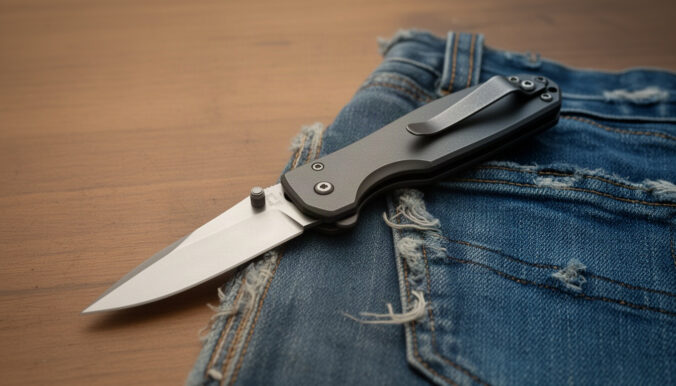
TL;DR: – Spring assisted knives are federally legal because they require manual initiation before the spring engages – unlike automatic switchblades
- Blade length under 3 inches is legal in most U.S. states; check local laws before carrying
- Budget picks ($30–$60) use 8Cr13MoV steel; mid-range ($60–$120) jumps to premium steels with better edge retention
- Best for EDC: 2.8–4.0 oz weight, 2.5–3.5 inch blade, G10 or aluminum handle for grip and durability
Introduction
You're standing in a gear shop, staring at a wall of folding knives. One catches your eye – it opens fast, feels solid in your hand, and the price tag doesn't make you wince. But you're wondering: Is this legal to carry? Will it actually hold up to daily use? And how does it compare to the manual folder next to it?
Based on our analysis of assisted opening knife reviews from Knife Informer, Blade Reviews, and state-by-state knife law resources collected in October 2026, we've built this guide to answer exactly those questions. Spring assisted folding knives occupy a unique legal and practical space in the EDC world – they're faster than manual folders, legal under federal law, and increasingly popular among everyday carry enthusiasts who want one-hand deployment without the legal complexity of automatics.
What Is a Spring Assisted Folding Knife?
A spring assisted folding knife is a blade that requires you to manually push or pull it partway open – typically via a flipper tab or thumb stud – before an internal spring mechanism takes over and completes the deployment. According to CRKT, "An assisted opening knife uses a spring mechanism to help deploy the blade once it's been partially opened manually. Assisted opening engages when the blade is opened to approximately 10-30 degrees, at which point the spring takes over."
This is the critical distinction from automatic switchblades. According to Knife Depot, "In 2009, the Federal Switchblade Act was revised specifically to clarify that assisted openers do not fall under the switchblade prohibition." The most recognized assisted system is Kershaw's SpeedSafe, which uses a torsion bar spring inside the handle. Once you flip or thumb the blade past the detent, the spring snaps the blade open. A well-tuned assisted opener from a quality manufacturer deploys in roughly 0.3 to 0.5 seconds from first contact to full lockup.
Key Takeaway: Spring assisted knives deploy in 0.3–0.5 seconds and are federally legal because they require manual initiation before the spring engages – unlike automatic switchblades.
Are Spring Assisted Knives Legal for Everyday Carry?
Federal Law
The Federal Switchblade Act of 1958 prohibits the manufacturing, interstate transportation, importation, and sale of switchblade knives in the US. But assisted opening knives are legal to own and carry under federal law in all 50 states because they require manual initiation.
State-Level Variation
Texas is permissive. Any knife with a blade of 5.5 inches or less is simply a 'knife' and may be carried anywhere in the state without restriction.
California is restrictive. A blade under 3 inches is legal in the vast majority of U.S. states, but many California municipalities impose concealed carry limits around 2.5 inches.
Connecticut restricts automatics specifically, permitting them only up to a 1.5-inch blade length. Spring assisted knives are not explicitly restricted, but verify locally.
Kansas has no blade length limit. The state has no statutory blade length limit at all, and a knife may be carried either concealed or openly regardless of length, though restrictions still apply at schools, jails, and juvenile correction facilities.
Knife laws in the United States are set almost entirely at the state and local level. Before you carry, check your state statute and local ordinances. This is general information, not legal advice.
Key Takeaway: Spring assisted knives are federally legal, but blade length limits vary by state from 2.5 inches (CA concealed) to unlimited (TX, KS). Always verify local law before carry.
How to Choose a Spring Assisted EDC Knife: 5 Key Criteria
1. Blade Length: The 2.5–3.5 Inch Sweet Spot
A blade between 2 and 3.5 inches is both legally defensible in most U.S. jurisdictions and long enough for effective defensive use. The 3-inch blade is the practical middle ground – shorter blades are universally legal but sacrifice utility; longer blades trigger restrictions in many states.
2. Blade Steel: Budget vs. Edge Retention
Budget picks use 8Cr13MoV (~55–58 HRC hardness). Mid-range knives use AUS-8 or D2 (better edge retention, easier sharpening). Premium tiers use S30V or S35VN (excellent edge retention, high corrosion resistance, but harder to sharpen). For most EDC users, mid-range steel is the sweet spot.
3. Handle Material: Weight and Grip
G10 fiberglass laminate is lighter, grips better when wet, and resists moisture. Stainless steel handles are durable but heavier and slippery when wet. Aluminum offers a middle ground. A target weight between 2.8 and 4.0 ounces (80 to 115 grams) provides enough structural rigidity for utility work without causing pants to sag or sway during movement.
4. Pocket Clip: Tip-Up vs. Tip-Down, Deep Carry
Tip-up clips allow faster deployment for most right-hand draw patterns. Tip-down clips are more discreet but slower to draw. Deep-carry clips reduce the visible profile above the pocket line.
5. Mechanism Reliability: Flipper vs. Thumb Stud
Research from defensive training communities shows that gross motor movements (like pulling a flipper tab) are far more reliable than fine pinch actions (like manipulating a thumb stud). If speed and reliability matter, choose a flipper.
| Criteria | Budget ($30–$60) | Mid-Range ($60–$120) | Performance ($120+) |
|---|---|---|---|
| Blade Steel | 8Cr13MoV | AUS-8 / D2 | S30V / S35VN |
| Handle | Stainless / Aluminum | G10 / Aluminum | G10 / Titanium |
| Weight | 3.5–4.5 oz | 2.8–3.8 oz | 2.5–3.5 oz |
| Detent Strength | Moderate | Strong | Excellent |
| Typical Brands | Smith & Wesson, Tac-Force | Kershaw, CRKT | Benchmade, Spyderco |
Key Takeaway: Target a 3-inch blade, 2.8–4.0 oz weight, G10 handle, and flipper tab for reliable one-hand EDC deployment. Mid-range ($60–$120) offers the best value for durability.
Best Spring Assisted Folding Knives for EDC in 2026
Best Budget Pick (Under $40)
Smith & Wesson Extreme Ops (SWA24S)
- Blade: 3.1 inches, partially serrated stainless steel
- Handle: Aluminum, ~3.2 oz
- Mechanism: Assisted opening with thumb stud
- Price: ~$20–$28 (verified Oct 2026)
Pros: Extremely affordable; partially serrated blade handles rope and cord well; lightweight for all-day carry.
Cons: Budget steel dulls faster; fit and finish not as refined as $60+ knives; thumb stud requires more dexterity than flipper.
Best for: First-time buyers, backup knife, or testing whether assisted opening suits your workflow.
Best Mid-Range Pick ($40–$80)
CRKT M16 Series (Various Models)
- Blade: 3.5–3.6 inches, AUS-8A steel
- Handle: G10 or aluminum, ~3.5 oz
- Mechanism: Assisted opening with flipper tab
- Price: ~$50–$75 (verified Oct 2026)
Pros: AutoLAWKS safety automatically engages a secondary lock when the blade is fully open; flipper tab is fast and intuitive; AUS-8A steel holds an edge significantly longer than budget steels.
Cons: Slightly heavier than ultralight competitors; blade length (3.5 in) may exceed concealed carry limits in some states.
Best for: Everyday utility and users who want a proven design without premium pricing.
Best Performance Pick ($80–$120)
Kershaw Blur (1670)
- Blade: 3.4 inches, 14C28N steel (Sandvik)
- Handle: G10, ~3.9 oz
- Mechanism: SpeedSafe assisted opening with flipper tab
- Price: ~$55–$70 (verified Oct 2026)
Pros: 14C28N steel is corrosion-resistant and takes a keen edge; SpeedSafe mechanism is the industry standard; excellent balance of weight and blade length.
Cons: Not quite premium-tier steel (S35VN); slightly thicker blade profile than some competitors.
Best for: Users who want a proven, fast-deploying knife that balances performance and affordability. This is the most popular assisted opener in the sub-$100 category.
Key Takeaway: Budget tier ($20–$40) works for testing; mid-range ($50–$75) offers reliability; Kershaw Blur (~$65) is the best overall value for EDC assisted openers.
How Do Spring Assisted Knives Hold Up for Daily Use?
Spring Fatigue and Cycle Life
Kershaw references SpeedSafe reliability across tens of thousands of open/close cycles. The consensus from the knife community is that well-made mechanisms (Kershaw, CRKT, Benchmade) easily handle 10,000+ cycles without degradation.
Lint, Debris, and Maintenance
The biggest threat to spring mechanisms isn't heavy use – it's pocket lint and debris working into the pivot and spring cavity. CRKT recommends regular cleaning and lubrication of the pivot and spring mechanism. Use dry lubricants (PTFE-based, like Tuf-Glide or Nano-Oil) rather than wet oils – dry lubes reduce lint accumulation. Clean every 2–4 weeks if you carry daily.
Signs Your Assist Is Weakening
- Slower deployment (should snap open in under 0.5 seconds)
- Blade doesn't lock fully open on first try
- Spring feels "mushy" or less responsive
- Detent is too loose (blade falls open in your pocket)
If you notice these, disassemble and clean the spring cavity. Often, lint removal alone restores performance. If the spring itself is damaged, most manufacturers offer replacement parts or repair services.
Key Takeaway: Quality spring mechanisms last 10,000+ cycles; clean every 2–4 weeks with dry lube to prevent lint buildup and maintain deployment speed.
Frequently Asked Questions
Are spring assisted knives the same as switchblades?
No. Spring assisted knives require manual initiation before the spring engages; switchblades open automatically with a button press. In 2009, the Federal Switchblade Act was revised specifically to clarify that assisted openers do not fall under the switchblade prohibition, making assisted openers federally legal in all 50 states.
Can you carry a spring assisted knife on an airplane?
No. The TSA prohibits all knives (including spring assisted folding knives) in carry-on baggage on commercial flights; they may be checked in luggage. The opening mechanism type is irrelevant – blade presence is the disqualifier.
How long does a spring assist mechanism last before wearing out?
Quality mechanisms last 10,000+ cycles under normal use. Lint accumulation and lack of maintenance are more common causes of degradation than spring fatigue. Clean every 2–4 weeks with dry lubricant and a well-made assisted opener will function reliably for years.
Are spring assisted knives good for self-defense?
Yes, but they're tools first. Assisted-opening folders deploy in under 0.5 seconds, faster than manual folders. Carry responsibly, understand your local self-defense laws, and prioritize de-escalation.
How do spring assisted knives compare to manual folding knives for EDC?
Assisted openers deploy faster (0.3–0.5 seconds vs. 1–2 seconds for manuals) but require more maintenance. Manual folders are simpler and require less maintenance but are slower to deploy.
Conclusion
Spring assisted folding knives occupy a practical middle ground in the EDC world – faster than manual folders, legal under federal law, and increasingly refined in design and materials. Start with your blade length limit (check your state statute), then choose a mechanism that suits your preference (flipper for speed, thumb stud for compactness). Budget $50–$75 for a reliable mid-tier option like the Kershaw Blur or CRKT M16. Maintain it every 2–4 weeks with dry lubricant, and it'll serve you for years.

Leave a Reply