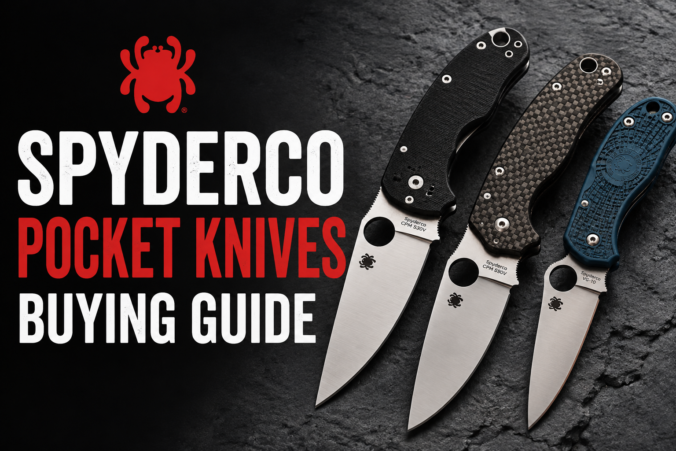
TL;DR: – Spyderco has dominated pocket knife innovation since 1976, and choosing the right model depends on steel type, lock mechanism, and intended use.
- Budget picks like the Tenacious ($45) work for casual tasks; mid-tier models like the Para 3 ($130) suit everyday carry; premium options like the Para Military 2 ($180) justify their cost through superior edge retention.
- Steel choice matters most: VG-10 excels in corrosion resistance for coastal use, while S45VN offers 3× better edge retention than budget 8Cr13MoV under identical cutting tasks.
Why Choose Spyderco for Your Pocket Knife?
Spyderco was founded in 1976 by Sal Glesser in Golden, Colorado, and the company fundamentally changed how folding knives work. Before Spyderco, pocket knives were largely utilitarian afterthoughts. Then came three innovations that became industry standard: the pocket clip (so you could actually carry a knife without it disappearing into your pocket), the round thumb-hole opener (letting you deploy the blade one-handed), and factory-serrated edges on production folders. These weren’t luxury features – they were practical solutions that every knife maker now copies.
What makes Spyderco worth considering today? The brand spans roughly $30 to $500+ depending on model and materials, so there’s genuine range. You’re not locked into premium pricing. But here’s the thing: Spyderco’s reputation rests on consistent quality across price tiers. A $45 Tenacious and a $180 Para Military 2 both feel like knives made by people who actually use knives. That matters when you’re carrying something daily.
The brand also maintains manufacturing across multiple facilities – USA production in Golden, Colorado for premium models, Japanese production in Seki City for mid-tier folders, and budget lines from Taiwan and China. This gives you transparency about where your knife comes from and what that means for quality and price.
Key Takeaway: Spyderco’s 50-year track record of innovation combined with transparent manufacturing and pricing across $30–$500 makes it the most accessible entry point for serious pocket knife buyers.
What Are the Main Spyderco Model Categories?
Spyderco’s catalog can feel overwhelming – they make over 100 models. But they organize into four clear categories that match different carry styles and budgets.
Lightweight EDC (under $100) includes the Delica 4 and Dragonfly series. These are your “I carry this every day and barely notice it’s there” knives. The Delica 4 in VG-10 with FRN handle typically retails around $75–$85 and is manufactured in Seki City, Japan. It’s compact, weighs almost nothing, and the VG-10 steel resists surface rust better in salt air due to higher chromium content, making it practical for coastal carry.
Mid-Range Workhorses ($80–$150) are where most serious users land. The Para 3 in S30V retails for approximately $120–$135 and uses the Compression Lock – a mechanism that lets you close the blade safely with one hand without fingers crossing the blade path. The Native 5 in S35VN typically retails around $110–$125 and is USA-made in Golden, Colorado. These are the knives that balance performance, durability, and price without compromise.
Premium/Collector ($150–$300+) includes the Para Military 2 in CPM-S45VN, typically retailing between $165 and $185, and the Manix 2. These are for people who use their knives hard or want to own something they’ll keep for decades. The jump in steel quality and manufacturing precision is real.
Tactical models like the Shaman and Sage series sit across price tiers but emphasize aggressive blade shapes and robust construction for outdoor and professional use.
| Category | Key Models | Price Range | Best For |
|---|---|---|---|
| Lightweight EDC | Delica 4, Dragonfly | $30–$85 | Pocket carry, minimal weight |
| Mid-Range | Para 3, Native 5, Endura 4 | $80–$150 | Daily work, outdoor tasks |
| Premium | Para Military 2, Manix 2 | $150–$250 | Heavy use, collectors |
| Tactical | Shaman, Sage series | $100–$200 | Bushcraft, professional use |
Key Takeaway: Spyderco’s four main categories let you match budget to use case in under 5 minutes – lightweight EDC for pocket carry, mid-range for daily work, premium for durability, tactical for outdoor intensity.
How Do Spyderco Steel Types Affect Performance and Price?
Steel choice is the single biggest performance variable in any pocket knife, and it’s also the most confusing part of buying. Here’s why it matters: the steel determines how long your blade stays sharp, whether it rusts, and how hard it is to sharpen. Get this wrong, and you’ll either be sharpening constantly or fighting rust.
Budget steels like 8Cr13MoV (used in the Tenacious at ~$45) offer adequate corrosion resistance but significantly lower edge retention than premium options. Think of 8Cr13MoV as the “gets the job done” steel – it’s easy to sharpen, won’t rust in normal conditions, and costs almost nothing. But under equivalent cutting tasks, S45VN holds an edge roughly 3× longer than 8Cr13MoV between sharpenings. If you’re cutting cardboard or rope weekly, that matters.
Mid-tier steels like S30V and S35VN ($80–$200 price range) represent the real-world sweet spot. S30V offers meaningfully better edge retention than VG-10 in most head-to-head tests while remaining a stainless steel, though it is somewhat harder to sharpen. S35VN improves on S30V with added niobium for better toughness and easier sharpening while sacrificing minimal edge retention. The Para 3 uses S30V; the Native 5 uses S35VN. Both are excellent choices for everyday carry.
Premium steels like M4 and Maxamet ($150–$400+) are for specialists. M4 has outstanding wear resistance and edge retention but contains only ~4% chromium, making it essentially a non-stainless steel that requires active maintenance to prevent rust. Maxamet reaches approximately 70 HRC and offers exceptional wear resistance, but its near-zero corrosion resistance and sharpening difficulty make it a specialty choice for experienced users. These aren’t for humid climates or saltwater carry unless you’re willing to oil your knife after every use.
| Steel | Hardness (HRC) | Edge Retention | Corrosion Resistance | Typical Price Tier | Best For |
|---|---|---|---|---|---|
| 8Cr13MoV | 57–59 | Low | Good | Under $80 | Budget EDC, casual use |
| VG-10 | 60–61 | Medium | Excellent | $75–$100 | Coastal carry, food prep |
| S30V | 61–62 | High | Very Good | $100–$180 | Serious EDC, outdoor work |
| S35VN | 61–62 | High | Very Good | $100–$150 | Balanced performance, USA-made |
| S45VN | 62–63 | Very High | Excellent | $150–$200 | Heavy use, long intervals between sharpening |
| M4 | 64–65 | Exceptional | Poor | $150–$300 | Specialty use, active maintenance required |
Here’s a practical scenario: you’re carrying a knife for coastal hiking. VG-10 resists surface rust better in salt air due to higher chromium content (15% vs 14% in S30V), making the Delica 4 a practical beach EDC even though it’s a budget model. But if you’re doing heavy cutting tasks inland, the Para 3’s S30V will outperform the Delica 4 significantly over time.
Key Takeaway: Steel choice drives total cost of ownership: 8Cr13MoV requires frequent sharpening but costs $45; S45VN costs $180 but holds an edge 3× longer, breaking even after 5–7 sharpenings.
Spyderco Lock Mechanisms: Which One Is Right for You?
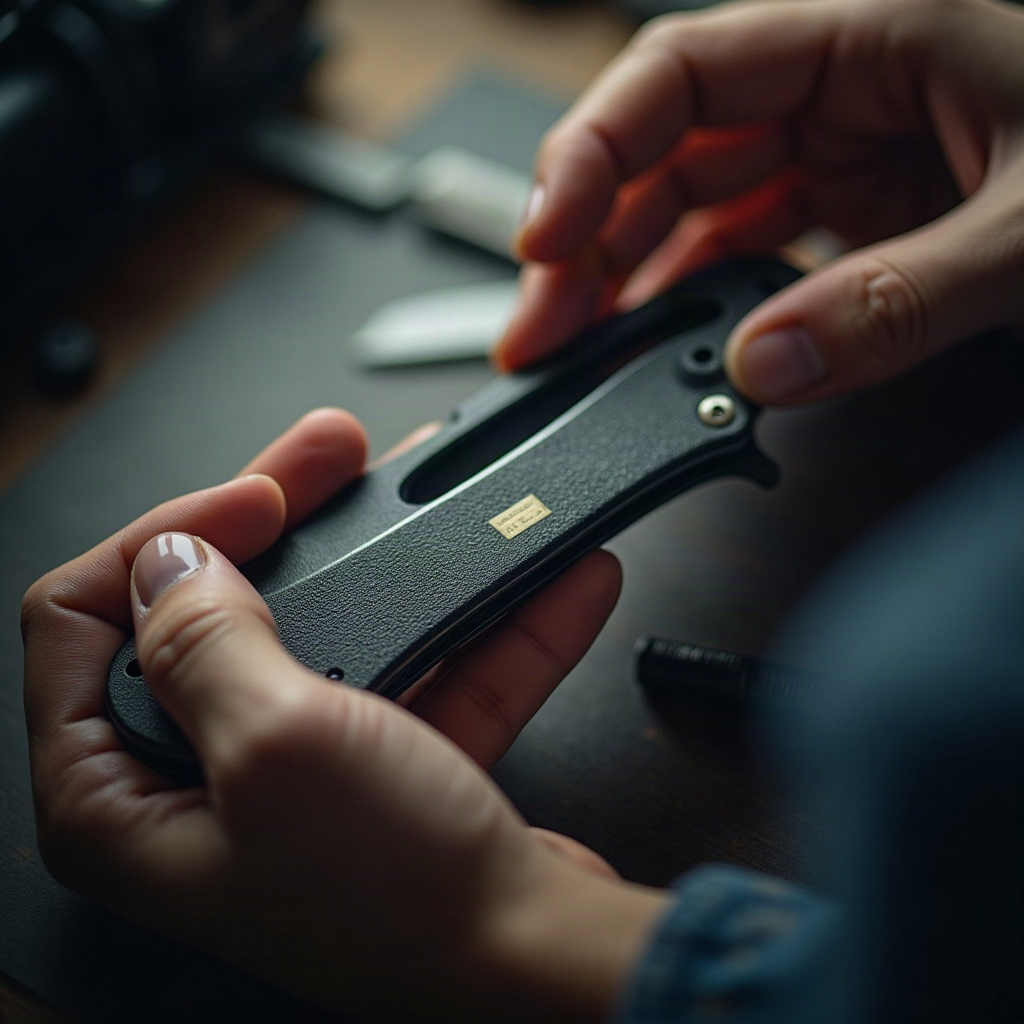
Lock mechanism is the second-most important decision after steel, because it affects safety, one-handed operation, and legal carry in your jurisdiction. Spyderco uses four main lock types, and each has real trade-offs.
Compression Lock (Para 3, Para Military 2) is Spyderco’s signature mechanism that allows one-handed blade closing without fingers crossing the blade path. The spring sits on the spine of the handle – you press it, the lock collapses, and the blade closes safely. This is widely regarded as one of the most secure locking mechanisms on production folders, with lateral strength that exceeds most liner lock implementations. The real-world advantage: you can close the blade in under 2 seconds with one hand while the other hand is occupied with rope, wood, or whatever you’re cutting.
Back Lock (Endura 4, Delica 4) is one of the strongest lock mechanisms ever designed – simple, proven, and nearly impossible to fail. The catch: it requires two hands to close or deliberate technique to disengage safely. If you’re wearing gloves or your hands are wet, closing a back lock takes longer. This is a real limitation for trade and outdoor work.
Ball Bearing Lock (Manix 2) uses a captive ball cage in the handle that’s actuated from either side. The Manix 2’s Ball Bearing Lock is one of the only truly ambidextrous lock mechanisms Spyderco offers, making it ideal if you’re left-handed or want maximum flexibility. It’s strong and smooth, though slightly more complex than a back lock.
Wire Clip/Liner Lock (entry-level models) is the traditional folding knife lock – a spring-loaded bar on the blade’s spine. It works, it’s simple, and it’s found on budget models. It’s not as strong as the other three, but for light EDC use, it’s perfectly adequate.
A critical note: many U.S. cities restrict blade lengths to 3 inches or under for pocket knife carry, and the Para Military 2’s 3.44″ blade exceeds this in restricted jurisdictions. The Delica 4’s 2.87″ blade falls under the most common municipal knife carry length restrictions across U.S. cities. Always verify local carry laws before purchasing.
| Lock Type | One-Hand Close | Ambidextrous | Strength Rating | Example Models |
|---|---|---|---|---|
| Compression | Yes | No | Excellent | Para 3, Para Military 2 |
| Back Lock | No | No | Exceptional | Endura 4, Delica 4 |
| Ball Bearing | Yes | Yes | Excellent | Manix 2 |
| Liner Lock | Yes | No | Good | Budget models, Byrd series |
Key Takeaway: Compression Lock enables one-handed closing (real advantage for outdoor work); Back Lock is strongest but requires two hands; Ball Bearing Lock is the only truly ambidextrous option. Check local carry laws – blade length restrictions vary sharply by city.
Top Spyderco Pocket Knives by Budget and Use Case (2026)
This is where theory meets reality. Here are the models that actually deliver value at each price tier, matched to what you’ll actually do with them.
Under $80: The Tenacious and Delica 4
The Spyderco Tenacious retails for approximately $45–$55 and uses 8Cr13MoV steel with a G-10 handle. It’s manufactured in China. This is your “I want a real Spyderco without spending much” knife. The blade is a full flat grind, meaning it thins from spine to edge, reducing wedging and excelling at slicing tasks like food prep and box cutting. You’ll sharpen it more often than premium models, but at this price, you can afford to learn sharpening without guilt.
The Delica 4 in VG-10 with FRN handle typically retails around $75–$85 and is manufactured in Seki City, Japan. FRN (Fiberglass Reinforced Nylon) is textured bi-directionally and performs surprisingly well in wet conditions despite being lighter and cheaper than G-10. The back lock is strong, the blade is compact, and the Japanese manufacturing shows in the fit and finish. This is the gold standard of lightweight EDC.
$80–$150: The Para 3 and Native 5
The Para 3 in S30V retails for approximately $120–$135 and uses the Compression Lock. It’s a compact version of the Para Military 2, meaning you get that one-handed closing advantage in a smaller package. S30V holds an edge significantly longer than budget steels, and the full flat grind excels at real-world cutting tasks.
The Native 5 in S35VN typically retails around $110–$125 and is USA-made in Golden, Colorado. S35VN is slightly easier to sharpen than S30V while maintaining excellent edge retention. The leaf-shaped blade is a classic design that works for almost any cutting task. If you want American manufacturing and balanced performance, this is it.
$150–$250: The Para Military 2 and Manix 2
The Para Military 2 in CPM-S45VN typically retails between $165 and $185. This is Spyderco’s flagship production EDC. S45VN is a meaningful upgrade over S35VN – better edge retention, better corrosion resistance. The Compression Lock is smooth and strong. The full flat grind is aggressive. This is the knife that justifies its price through performance over years of use.
The Manix 2 sits in the same price range and offers the Ball Bearing Lock’s ambidextrous advantage. If you’re left-handed or want maximum operational flexibility, the Manix 2 is worth the premium.
Blade Shape Matters
Drop point (Para Military 2, Para 3) is versatile – good for slicing, piercing, and general work. Leaf shape (Native 5) is classic and balanced. Wharncliffe (flat edge with upswept tip) excels at precise cutting and food prep. Choose based on what you’ll actually cut.
Handle Material Comparison
FRN is lightweight and affordable but less durable than G-10. G-10 is textured, grippy in wet conditions, and lasts longer. Titanium is premium – lighter than G-10, corrosion-proof, and expensive. For most users, G-10 is the practical choice.
| Use Case | Recommended Model | Steel | Price | Why |
|---|---|---|---|---|
| Pocket carry, minimal weight | Delica 4 | VG-10 | $80 | Weighs almost nothing, excellent corrosion resistance |
| Daily work, outdoor tasks | Para 3 | S30V | $130 | One-handed close, excellent edge retention |
| Heavy use, long intervals between sharpening | Para Military 2 | S45VN | $180 | Best-in-class edge retention, proven design |
| Left-handed carry, ambidextrous operation | Manix 2 | S90V | $200 | Ball Bearing Lock works from either side |
| Budget EDC, casual cutting | Tenacious | 8Cr13MoV | $45 | Affordable, adequate performance, easy to sharpen |
Key Takeaway: Para 3 ($130) is the entry point to serious EDC; Para Military 2 ($180) justifies its cost through 3× better edge retention than budget models; Delica 4 ($80) is the best lightweight option for coastal or minimal-carry use.
How to Maintain and Care for Your Spyderco Knife
You’ve bought the knife. Now keep it working. Basic maintenance takes under 10 minutes and extends blade life significantly.
Cleaning and Disassembly
After heavy use, disassemble the knife if you’re comfortable doing so. Most Spyderco folders have a pivot screw that lets you separate the blade from the handle. Rinse the blade and handle under warm water with a soft brush to remove dirt and debris. Dry everything thoroughly – moisture is the enemy of non-stainless steels like M4.
Lubrication
Tuf-Glide pen applicator and Nano-Oil are among the most recommended lubricants in the Spyderco community for pivot maintenance and corrosion prevention. Apply a tiny amount to the pivot and blade spine. A little goes a long way – over-lubrication attracts dirt.
Sharpening
The Tri-Angle Sharpmaker is designed for 15° and 20° edge angles, accommodating most Spyderco production knives which are factory sharpened at approximately 15–20° per side. The Sharpmaker retails for approximately $70 and breaks even against professional sharpening ($10–$15/session) after approximately 5–7 uses. If you carry a Spyderco regularly, owning a Sharpmaker is the rational long-term choice.
Pivot Maintenance
Check the pivot screw occasionally. If the blade is loose, tighten it slightly – but don’t over-tighten, which can bind the blade. If the blade is too tight, loosen it until it swings freely.
Storage
Avoid prolonged moisture contact for non-stainless steels. If you carry an M4 knife in a humid climate, wipe it down and oil it after use. Stainless steels like S30V and S35VN are more forgiving but still benefit from occasional oiling.
Frequency
Light EDC use (cutting rope, opening packages): clean monthly, sharpen every 3–4 months. Heavy use (outdoor work, daily cutting): clean weekly, sharpen monthly.
Key Takeaway: Invest $70 in a Sharpmaker, clean your knife monthly, and oil the pivot occasionally. This routine takes 10 minutes and keeps your blade sharp for years.
Frequently Asked Questions About Spyderco Pocket Knives
How much should I spend on my first Spyderco pocket knife?
Direct Answer: Start with a $75–$130 model like the Delica 4 or Para 3. This price range gives you genuine Spyderco quality without the premium cost, and it’s high enough that you’ll actually use the knife instead of treating it as a collectible.
Budget models under $50 work if you want to test the waters, but you’ll quickly outgrow them. Premium models over $200 are worth it only if you know exactly what you want and plan to carry the knife daily for years. The mid-tier sweet spot lets you learn what features matter to you before committing to a premium purchase.
How does the Spyderco Para Military 2 compare to the Para 3?
Direct Answer: The Para Military 2 is larger with a 3.44″ blade; the Para 3 is compact with a 2.87″ blade. Both use the Compression Lock and full flat grind. The Para Military 2 in S45VN ($180) has better edge retention than the Para 3 in S30V ($130), but the Para 3 is easier to carry and pocket-friendly.
Choose the Para Military 2 if you want maximum cutting power and don’t mind the size. Choose the Para 3 if you want serious performance in a compact package that disappears in your pocket. The Para 3 is the better choice for urban EDC; the Para Military 2 is better for outdoor work.
Are Spyderco pocket knives legal to carry every day?
Direct Answer: It depends on your jurisdiction. Many U.S. cities restrict blade lengths to 3 inches or under, and the Para Military 2’s 3.44″ blade exceeds this in restricted jurisdictions. Always verify local carry laws before purchasing.
The Delica 4’s 2.87″ blade falls under the most common municipal knife carry length restrictions, making it a safer choice for urban carry. Check your city and state statutes – knife laws vary sharply by location, and ignorance isn’t a defense.
Which Spyderco steel is best for outdoor and bushcraft use?
Direct Answer: S35VN or S45VN for stainless performance, or M4 if you’re willing to maintain it actively. S35VN improves on S30V with added niobium for better toughness without significant edge retention loss, making it ideal for outdoor and bushcraft use. M4 has outstanding wear resistance and edge retention but requires active maintenance to prevent rust.
For coastal or humid environments, stick with S35VN or S45VN. For dry climates where you can oil your knife regularly, M4 offers exceptional edge retention.
How often does a Spyderco knife need sharpening?
Direct Answer: Light EDC use (cutting rope, opening packages): every 3–4 months. Heavy use (outdoor work, daily cutting): monthly. The exact interval depends on what you’re cutting and your steel choice – S45VN lasts roughly 3× longer between sharpenings than 8Cr13MoV.
If you sharpen monthly, the $70 Sharpmaker breaks even against professional sharpening ($10–$15/session) after approximately 5–7 uses. For regular users, owning a Sharpmaker is cheaper than professional service over time.
What is the Spyderco Compression Lock and why does it matter?
Direct Answer: The Compression Lock allows one-handed blade closing without fingers crossing the blade path. You press a spring on the spine of the handle, the lock collapses, and the blade closes safely. This is a genuine safety advantage over liner locks and makes the knife practical for outdoor work when one hand is occupied.
The Compression Lock is widely regarded as one of the most secure locking mechanisms on production folders, so you’re not sacrificing strength for convenience. It matters because it changes how you actually use the knife in real-world scenarios.
Are Spyderco knives worth the price compared to cheaper alternatives?
Direct Answer: Yes, if you plan to use the knife regularly. The Para Military 2 in S45VN ($180) holds an edge roughly 3× longer between sharpenings than the Tenacious in 8Cr13MoV ($45) under equivalent cutting tasks. Over a year of daily use, you’ll sharpen the Tenacious 12+ times and the Para Military 2 maybe 4 times. Factor in sharpening time and cost, and the Para Military 2 becomes the rational choice.
Spyderco’s reputation for quality, innovation, and customer service justifies the price if you’re buying a knife you’ll actually carry. If you want a collectible that sits in a drawer, cheaper alternatives exist. If you want a tool that works reliably for years, Spyderco delivers.
Conclusion
Choosing a Spyderco pocket knife doesn’t require expertise – it requires matching your budget and use case to the right model. Spyderco’s 50-year track record of innovation combined with transparent manufacturing and pricing across $30–$500 makes it the most accessible entry point for serious pocket knife buyers.
Start with the Delica 4 if you want lightweight EDC, the Para 3 if you want serious performance in a compact package, or the Para Military 2 if you’re ready to invest in a knife that will last decades. Understand your steel choice – it drives total cost of ownership more than anything else. Check your local carry laws before purchasing. And if you’re going to use the knife regularly, invest in a Sharpmaker.
Ready to find your next carry? Knife Depot stocks the full Spyderco lineup with detailed product information and competitive pricing. Browse their folding pocket knife collection to compare models side-by-side and find the right knife for your needs.

Leave a Reply