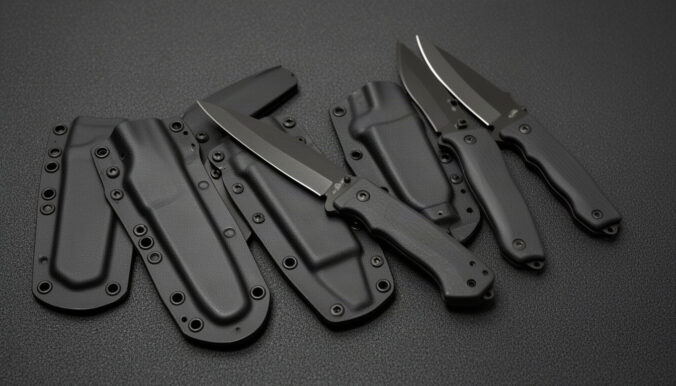
TL;DR: – Fixed blades eliminate deployment failures under stress – critical for LE backup weapon and rescue roles
- Blade length sweet spot: 3.5–5 inches balances utility and concealment for duty carry
- Budget math: $65–$75 knife + $20–$30 Kydex sheath = functional readiness of $150–$180 complete packages
- Best for duty: Benchmade 140 Nimravus (CPM-154, MOLLE sheath); best budget: ESEE-4 (1095 carbon, USA-made)
- Verify departmental policy before purchasing – carry restrictions vary significantly by agency
Why Law Enforcement Officers Carry Fixed Blade Knives
You're reading this because you need a knife that works when it matters most – and for law enforcement, that means a tool that deploys reliably under extreme stress. Fixed blade knives dominate LE backup-weapon and rescue scenarios precisely because they eliminate the mechanical failure modes that folding knives introduce. Check out Knife Depot's tactical folding knives for law enforcement for a comparison.
According to law enforcement training sources, adrenaline-induced fine motor skill degradation makes folding knife deployment unreliable in defensive encounters. A fixed blade removes that variable entirely – the blade is always ready.
The primary use cases for LE fixed blades fall into three categories:
Rescue and Utility: Officers routinely need to cut seatbelts in accident scenarios, remove entanglements from suspects or themselves, and access medical equipment – tasks requiring an immediately accessible, single-hand-operable blade.
Weapon Retention: The fixed blade knife is specifically recommended in weapon retention curricula because it can be deployed with one hand from ground positions where a firearm draw is impossible or compromised.
Concealment and Accessibility: Unlike a folding knife, a fixed blade can be drawn and used with one hand from a duty belt, vest, or ankle carry position.
Fixed blades sacrifice concealment and compactness for reliability and speed. Folding knives offer better plainclothes carry and off-duty flexibility, but they're slower to deploy and mechanically complex. For on-duty patrol carry, fixed blades win.
One critical caveat: departmental policies on fixed blade carry vary significantly; officers should verify with their department before purchasing. Many agencies have no written policy, while others restrict blade length to 3.5 inches or prohibit fixed blades entirely.
What Should Law Enforcement Look for in a Fixed Blade Knife?
Blade Length: The 3.5–5 Inch Sweet Spot
Most law enforcement instructors recommend a blade length between 3.5 and 5 inches for duty carry – long enough for rescue cutting tasks and effective if used defensively, short enough to conceal and comply with most department policies. A 4.5-inch blade is the practical center point.
Blade Steel: Corrosion Resistance vs. Edge Retention
| Steel Type | Hardness (HRC) | Edge Retention | Corrosion Resistance | Field Sharpening | Best For |
|---|---|---|---|---|---|
| AUS-8 | 57–59 | Moderate | Good | Easy | Budget carry, humid climates |
| 154CM / CPM-154 | 58–60 | Good | Very Good | Moderate | Balanced duty use |
| S35VN | 59–61 | Excellent | Excellent | Difficult | Premium duty, long-term carry |
AUS-8 is significantly easier to field-sharpen with pocket tools. S35VN holds an edge longer than AUS-8 in standardized testing, but its higher carbide volume makes it more resistant to quick field sharpening. 154CM offers a practical middle ground between AUS-8 corrosion resistance and S35VN edge retention for patrol use.
For coastal or high-humidity environments, avoid D2 tool steel. D2 is a semi-stainless tool steel with chromium content below the 13% threshold for full stainless classification and will corrode in coastal or high-humidity environments without regular oiling.
Sheath and Retention Systems
Kydex provides a positive 'click' retention that does not degrade with moisture or temperature cycling. Leather sheaths can swell, tighten, or crack under patrol conditions. For duty carry, Kydex is superior. Look for positive retention lock, one-hand re-holstering capability, MOLLE compatibility, and belt loop options.
Grip and Weight
A handle that does not absorb moisture is necessary so the material will not shrink or crack when wet. Synthetic handles (G10, Micarta, or injection-molded nylon) outperform leather or wood. A duty knife should weigh under 8 ounces with sheath.
Top 6 Tactical Fixed Blade Knives for Law Enforcement (2026)
Best Overall: Benchmade 140 Nimravus
Specs:
- Blade: 4.5 inches, CPM-154 stainless
- Weight: 7.1 oz with sheath
- Sheath: Boltaron with MOLLE, belt loop, and lash points
- MSRP: $200–$220
The Nimravus was designed with law enforcement and military in mind, featuring CPM-154 stainless steel and a Boltaron sheath with multiple mounting options for belt, vest, or MOLLE attachment. The sheath system is the standout – you can configure it for strong-side belt carry, cross-draw, ankle, or MOLLE vest mounting without purchasing additional sheaths. Benchmade offers Blue Force (LE/military) pricing program, making the effective cost lower for verified officers.
LE Verdict: The closest thing to a universal LE fixed blade – works for patrol, plainclothes, tactical, and off-duty carry with sheath reconfiguration.
Best Budget Pick (Under $80): ESEE-4
Specs:
- Blade: 4.5 inches, 1095 carbon steel
- Weight: 6.6 oz with sheath
- Sheath: Nylon (aftermarket Kydex recommended)
- MSRP: $68–$75
The ESEE-4 is built to military and law enforcement specifications, made in the USA, and priced under $80. Its 1095 carbon steel requires more maintenance than stainless but delivers superior toughness for impact and prying tasks.
Cost Math: ESEE-4 ($70) + aftermarket Kydex sheath from JRE Industries ($25) = $95 total for a system matching the functional readiness of $150–$180 complete packages. Requires weekly oiling in humid environments.
LE Verdict: Best value for patrol officers on a tight budget. The 1095 steel is tougher than CPM-154 for prying and impact tasks, making it ideal for rescue cutting.
Best for Covert/Plainclothes Carry: KA-BAR TDI Law Enforcement
Specs:
- Blade: 2.625 inches, 1095 carbon steel
- Weight: 2.8 oz with sheath
- Sheath: Kydex, designed for inside-waistband or belt carry
- MSRP: $50–$65
The TDI knife is designed by John Benner of the Tactical Defense Institute (TDI) as a comfortable, convenient, and concealable fixed blade. The 2.625-inch blade is too short for seatbelt cutting, but it's ideal for plainclothes detectives, undercover officers, or off-duty carry where a larger fixed blade would print under a concealment garment.
LE Verdict: Best for plainclothes or off-duty carry. Not suitable as a primary duty knife, but essential for officers who need a backup blade that won't compromise their cover.
Best Mid-Range Duty Option: SOG SEAL Pup Elite
Specs:
- Blade: 4.85 inches, AUS-8 stainless
- Weight: 5 oz (knife only)
- Sheath: Injection-molded nylon with built-in sharpener
- MSRP: $65–$75
The SEAL Pup Elite features a 4.85" AUS-8 stainless blade with SOG's hardcased treatment for enhanced surface hardness, full tang construction, and an injection-molded nylon sheath with built-in sharpener. The AUS-8 steel is easier to sharpen than CPM-154, and the built-in sharpener is a practical field maintenance tool.
LE Verdict: Solid mid-range option for officers who want stainless steel without the premium price tag.
Best American-Made Premium Option: Toor Knives Darter
Specs:
- Blade: 3.75 inches, CPM-154 stainless
- Weight: 4.2 oz with sheath
- Sheath: Kydex with MOLLE compatibility
- MSRP: $180–$210
The Darter is designed by Toor Knives, a veteran-owned company. Every blade & tool is made right here in San Diego, CA. The compact 3.75-inch blade is ideal for plainclothes or undercover carry without sacrificing utility.
LE Verdict: Best for officers who prioritize American manufacturing and want a premium blade from a veteran-owned company.
Best for Extreme Durability: Cold Steel SRK (Survival Rescue Knife)
Specs:
- Blade: 6 inches, SK-5 high carbon steel
- Weight: 8.3 oz with sheath
- Sheath: Nylon (aftermarket Kydex recommended)
- MSRP: $50–$65
The SRK in SK-5 is one of the toughest sub-$100 fixed blades available – SK-5 is a high-carbon tool steel that prioritizes impact toughness over edge retention, making it well suited for rescue tasks where prying may occur. The 6-inch blade is borderline long for concealed patrol carry but excels at seatbelt cutting and entanglement removal.
LE Verdict: Best for officers in rescue-heavy roles. Not ideal for plainclothes carry due to blade length.
How Do Tactical Fixed Blades Compare to Folding Knives for Officers?
| Factor | Fixed Blade | Folding Knife |
|---|---|---|
| Draw Speed | 0.8–1.2 sec (strong-side) | 1.5–2.5 sec (requires two hands) |
| One-Hand Operation | Yes (critical for LE) | Limited (most folders require two hands) |
| Concealment | Difficult (requires sheath) | Easy (pocket carry) |
| Maintenance | Simple (no moving parts) | Complex (hinges, locks, springs) |
| Reliability Under Stress | Excellent (no deployment mechanism) | Fair (fine motor skills required) |
| Rescue Cutting | Excellent (immediate access) | Good (slower deployment) |
Fixed blades dominate in scenarios where immediate, one-handed access is non-negotiable. In extreme close-quarter encounters where a suspect is attempting to take an officer's handgun, or an officer cannot access his or her handgun, the TDI knife is available as a 'last option' knife.
Folding knives excel for plainclothes and off-duty carry. For plainclothes officers, a tactical folding pocket knife offers the flexibility to carry a blade without printing under a concealment garment. Automatic knives, also known as "switchblades," are knives operated by the push of a button to open the blade. They are considered dangerous weapons by lawmakers and under constant scrutiny, making manual folders the only legal option for off-duty carry in some states.
Most LE officers carry both: a fixed blade on the duty belt for patrol, and a folder or compact fixed blade for plainclothes or off-duty carry.
How to Carry and Position a Fixed Blade on Duty
Strong-Side Belt Carry (3–4 o'clock position): Standard for duty carry. Draw speed averages 0.8–1.2 seconds under training conditions. The sheath should ride at a 15–20 degree forward cant for ergonomic draw.
Cross-Draw (10–11 o'clock position for right-handed officers): Slower (1.4–1.8 seconds), but accessible with your non-dominant hand if your gun hand is occupied. An officer pinned or in a ground struggle needs knife access from their non-dominant hand if their gun hand is occupied.
Vest MOLLE Carry: Ideal for tactical operations. Draw speed is 1.2–1.8 seconds but the knife is less likely to be lost during a struggle.
Ankle Carry: Backup position only. Draw speed is 2–3 seconds, making it unsuitable as a primary blade.
Your fixed blade sheath must not interfere with your firearm holster, magazine pouches, or radio. Most duty belts are 1.75–2 inches wide; ensure your sheath fits without overlapping adjacent gear. Test the full draw motion with all your gear in place. Before modifying your loadout, verify departmental policy and get written approval from your supervisor or equipment officer.
Maintenance and Legal Considerations
After any use involving blood or bodily fluids, clean the blade with warm soapy water and dry thoroughly. For carbon steel blades (1095, SK-5), apply a light coat of oil after cleaning. Test sharpness weekly with the paper test. For CPM-154 and S35VN, use a ceramic rod or professional sharpening service every 2–4 weeks. For AUS-8 and carbon steels, field sharpening with a pocket stone is sufficient.
Laws regarding knives are frequently found in weapons statutes, and certain knives, based on the type of mechanism, blade length, or undefined terms, may be classified as weapons. Federal, state, and local statutes almost universally prohibit carrying cutting tools on school grounds, inside university buildings, or on school buses. On-duty carry is typically exempt from civilian blade length restrictions, but off-duty carry is governed by civilian statutes. Keep a record of your knife's specifications and departmental approval for carry.
Frequently Asked Questions
What is the best fixed blade knife for law enforcement officers?
The Benchmade 140 Nimravus ($200–$220, CPM-154 steel, MOLLE sheath) is the most versatile LE fixed blade. For budget-conscious officers, the ESEE-4 ($70 + $25 Kydex sheath = $95) delivers equivalent functional readiness at 60% cost. Match the knife to your duty role: Nimravus for patrol versatility, Cold Steel SRK for rescue-heavy roles, KA-BAR TDI for plainclothes carry.
How much should a law enforcement officer spend on a tactical fixed blade knife?
Budget $75–$150 for a duty-grade fixed blade. A $70 ESEE-4 + $25 Kydex sheath ($95 total) provides equivalent functional readiness to a $180 Benchmade 140 Nimravus; the primary trade-off is steel grade (1095 carbon vs. CPM-154 stainless) and sheath versatility.
What blade length is legal for law enforcement to carry on duty?
On-duty carry is typically exempt from civilian blade length restrictions. Off-duty carry is governed by civilian statutes, which commonly set limits at 2.0, 3.0, 3.5, or 4.0 inches depending on state and locality. Federal, state, and local statutes almost universally prohibit carrying cutting tools on school grounds, inside university buildings, or on school buses.
What is the best blade steel for a police duty knife?
CPM-154 or S35VN stainless steel are the best choices. CPM-154 offers a practical balance of edge retention, corrosion resistance, and field sharpening ease. S35VN holds an edge longer than AUS-8 in standardized testing but is harder to sharpen in the field. AUS-8 is acceptable for budget-conscious officers. Avoid D2 in coastal or high-humidity environments.
Can plainclothes officers carry a tactical fixed blade knife?
Yes, but a compact fixed blade (2.5–3.75 inches) or compact tactical folding knife is more practical. The KA-BAR TDI (2.625 inches) is specifically designed for concealed carry without printing. Verify your state and local blade length laws for off-duty carry, as on-duty exemptions typically do not apply off-duty.
Conclusion
Selecting a tactical fixed blade knife for law enforcement duty is about matching the tool to your specific role, carry position, and departmental requirements. Start with the selection criteria outlined above: 3.5–5 inch blade length, CPM-154 or S35VN stainless steel, Kydex sheath with positive retention, and synthetic handle under 8 ounces. Verify your departmental policy before purchasing. If you're on a budget, the ESEE-4 + aftermarket Kydex sheath delivers functional duty readiness at 60% the cost of premium options. If you can spend $200+, the Benchmade 140 Nimravus's versatile MOLLE sheath system justifies the premium.
At Knife Depot, you'll find a curated selection of LE-grade fixed blades with detailed specifications and customer reviews from verified officers. Document your carry configuration, get written departmental approval, and test sharpness before every shift.
Leave a Reply