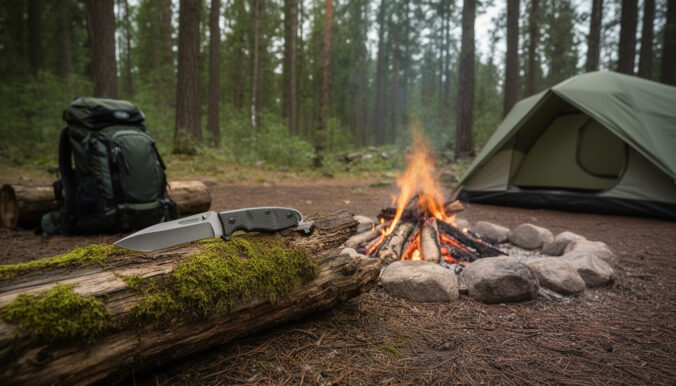
TL;DR: Choose a camp knife around the cutting jobs you expect, its grip and carry system, and the weight you will actually pack. The Companion S is a straightforward 12C27 option; an F1 Elmax is a compact convex-ground fixed blade; an ESEE-5 is much heavier. No model is a substitute for a well-planned outdoor kit.
Prices checked November 9, 2026. Knife Depot prices are USD before tax and shipping. Manufacturer list prices are labeled separately; configurations, offers, and availability can change.
What Makes a Survival Knife Good for Camping and Hiking?
A good camping knife earns its place while opening food, cutting cord, carving, and making small repairs. Start with those tasks instead of treating the longest blade or thickest stock as automatically better. A comfortable handle and secure sheath matter just as much as the steel.
For general camp work, a moderate blade length is a practical starting point. Try the grip with the gloves you use, check control near the edge, and consider whether the sheath can be secured where you want it. Compare the complete system, not the bare knife alone.
Full tang means the blade steel continues through the handle. It can be a useful construction choice, but it does not make every knife suitable for prying, chopping, or impact use. Follow the specific maker’s instructions. Choose a saw or other appropriate tool when the job calls for one.
How Do Blade Steel Types Affect Survival Knife Performance?
Steel is one part of performance. Knife Steel Nerds’ metallurgy explanation shows why broad carbon-versus-stainless labels are insufficient. Heat treatment and blade geometry also matter. Stainless is corrosion resistant, not immune to rust; carbon blades generally require more attention to moisture.
| Steel or model category | Practical buying consideration |
|---|---|
| 12C27 / Companion S | Stainless option for routine cutting; follow its Scandi-edge care instructions |
| 1095 / ESEE-5 and TOPS BROS-01 | Dry after use and maintain exposed steel; coatings do not protect the edge completely |
| Elmax / current F1 model | Confirm this exact version; older F1 specifications do not transfer automatically |
| Premium stainless folders | Compare the exact SKU and intended use, not an assumed brand-wide edge life |
Top 7 Best Survival Knives for Camping and Hiking (2026)
| Knife or version | Product details | Why compare it | Price or buying reference |
|---|---|---|---|
| Morakniv Companion S | 12C27 stainless; 104 mm blade; standard tang; Scandi grind | Light camp cutting and controlled carving | Manufacturer model details |
| Gerber StrongArm | 420HC; full tang; rubberized grip; 4.8-inch blade in the original configuration | A substantial general camp knife | Shop the coyote brown, plain-edge StrongArm (30-001058) |
| Fällkniven F1 Elmax | 98 mm blade; convex grind; 149 g knife-only weight | Compact fixed-blade carry | Elmax model specifications |
| TOPS Fieldcraft BROS-01 | 1095; 4.75-inch blade / 4.5-inch cutting edge; 9.6 oz knife | Woodworking-oriented camp setup | Manufacturer price $285 |
| ESEE-5 | 1095; 5.25-inch blade; 16 oz knife-only weight | Camp kits where substantial weight is acceptable | Manufacturer MSRP from $188 |
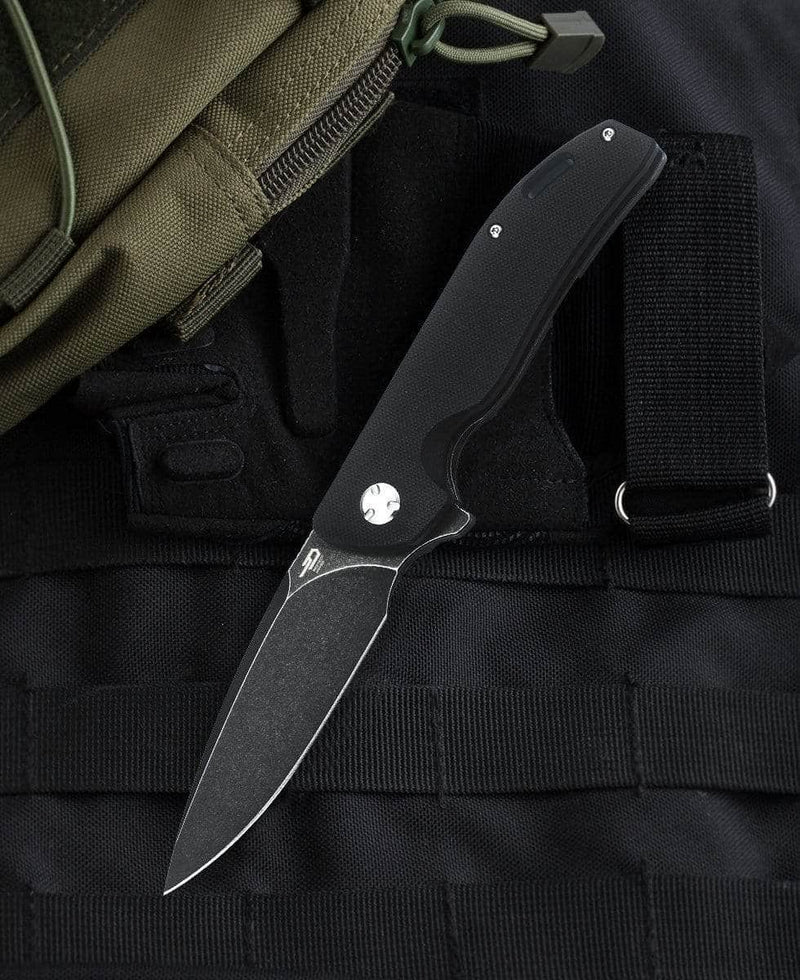
| Spyderco Para Military 2 | Compression Lock; steel and handle vary by SKU | Routine folding-knife cutting | Shop the black-blade, G-10 Para Military 2 (C81GPBK2) |
| Benchmade Bushcrafter | Model generations differ; match the model number, steel and sheath | Buyers comparing bushcraft-oriented fixed blades | Current Benchmade options |
The Companion S is not a 1095 or 420HC knife. Morakniv lists 12C27 stainless steel and a standard tang. Carbon Companion variants are separate products. The F1 entry here is specifically the Elmax version, not an older laminated VG-10 model.
The TOPS specification table distinguishes total blade length from cutting edge. The ESEE-5’s 16-ounce knife-only weight is particularly important if you are hiking: its sheath adds more. Neither is an ultralight choice simply because its blade is around five inches long.
For the PM2 and Bushcrafter, match the actual model number before comparing price, steel, weight, or sheath. Older editions, special steels, and newer configurations should not be combined into a single product description. Check our survival knife selection for current offers.
Fixed Blade vs. Folding Knife: Which Should You Choose for Camping?
| Carry choice | Advantages to consider | What to check |
|---|---|---|
| Folding knife | Compact storage for food, cord and small repairs | Lock operation, grip, permitted use and cleaning access |
| Fixed blade | No folding joint; straightforward deployment | Knife plus sheath weight, retention and intended cutting tasks |
A folder can be enough for a day hike. A suitable fixed blade may fit a trip focused on camp carving or food preparation. Trip duration alone does not determine which you need, and neither design guarantees freedom from failure.
How to Maintain Your Survival Knife in the Field
Clean and dry the blade after use, including stainless blades. Remove grit from the handle, pivot, and sheath; use only cleaning products and lubricants the maker permits. If the knife touches food, use an appropriate food-contact lubricant. Store it dry and inspect the carry system before each trip.
Sharpen when cutting performance calls for it, using the maker’s recommended angle and suitable abrasives. Edge damage, geometry, steel, and technique affect the work required, so a steel name does not set a fixed number of minutes or days between sharpenings. A strop can refine an edge but does not replace sharpening a worn or damaged bevel.
Frequently Asked Questions About Survival Knives for Camping
How much should I spend?
Set a budget for the knife, sheath, maintenance and carry accessories. The manufacturer prices in the table are reference points, not Knife Depot quotes or proof of a performance tier.
What blade length is best?
Choose a length you can control for your actual tasks. There is no blade length that covers a measured percentage of all camping jobs or establishes legal carry everywhere.
Is an ESEE-5 a lightweight hiking knife?
No. ESEE lists the knife alone at 16 ounces. Include the sheath when assessing the carry weight.
Does stainless steel need care?
Yes. Clean and dry it, especially after salt or acidic food exposure. Follow the maker’s instructions for the exact alloy and finish.
How quickly can I sharpen it in the field?
There is no universal time. Pack a compatible sharpener and practice before your trip instead of relying on a fixed three-minute or twelve-minute claim.
Check the rules for the place you will carry the knife, including state and local law, park regulations, and building restrictions. Blade length alone does not establish legal carry. For flights, consult TSA’s current knife guidance and the rules at your destination; do not assume a pocket knife can travel in a carry-on.
Conclusion
Start with your cutting tasks, then compare the exact version’s dimensions, grip, sheath and total weight. Browse survival knives at Knife Depot or our camping knife comparison to narrow the choices. A manageable knife you can maintain is more useful than a specification you do not need.
I have really liked knives that are 3 to 6 inches long., semi rough handle. Cost would range between $75.00-250. Thank You for your Information. Jay Roman.