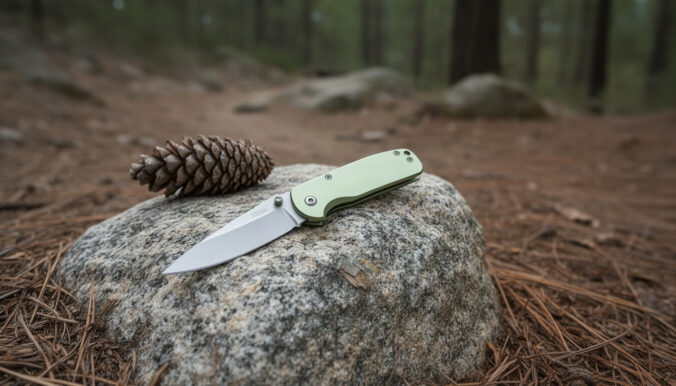
TL;DR: Start with the weight of everything you will carry, including sheath and accessories. The standard blue Bugout 535 is 1.85 ounces and $200.99 at Knife Depot at this check. The Pioneer X is 94 grams, about 3.32 ounces—not 2.47 ounces. A lower number is useful only if the knife still handles your planned cutting tasks.
Prices checked November 9, 2026. Knife Depot prices are USD before tax and shipping. Manufacturer list prices are labeled separately; configurations, offers, and availability can change.
Introduction: Why Weight Matters on the Trail
A backpacking knife has to earn its place alongside food, shelter and other equipment. For many trips the jobs are modest: opening packages, preparing food, cutting cord and making small repairs. Write down those tasks before deciding how much knife to carry.
Weight is easy to compare only when the figures use the same basis. A folder’s listed weight may include its clip, while a fixed blade’s listing may exclude its sheath. Optional scales, clips, lanyards and sharpeners can change the total.
What Makes a Knife Truly Lightweight for Backpacking?
There is no universal 1.5-ounce or two-percent-of-pack rule. Choose a personal weight budget, then test whether the knife’s grip and blade work for you. A small knife with poor control is not improved by being light; a heavier knife is not automatically more capable for the jobs you actually do.
| Compare | Why it matters |
|---|---|
| Knife-only weight | Useful for comparing the tool itself |
| Ready-to-carry weight | Includes sheath, attachment and optional handle parts |
| Maintenance kit | Add the actual sharpener and lubricant you pack |
| Blade and handle dimensions | Small weight differences are less useful if you cannot hold the tool securely |
Top 7 Lightweight Hiking Knives for Backpacking in 2026
| Knife / version | Details to compare | Weight basis | Price reference |
|---|---|---|---|
| Benchmade Bugout 535 | 3.24-inch S30V; blue Grivory; AXIS lock | 1.85 oz knife | $200.99 at Knife Depot |
| Spyderco Dragonfly 2 C28PBK2 | 2.28-inch VG-10; FRN; back lock | About 1.2 oz in the 2025 catalog | Check current SKU |
| ESEE Izula, standard carbon version | 2.63-inch 1095 blade; fixed blade | 2.0 oz knife only; sheath extra | Shop the black IZULA-B and check current price |
| Morakniv Companion S | 104 mm / 4.1-inch 12C27 blade; standard tang | Manufacturer product listing: 118.4 g / 4.18 oz; confirm package basis | Check current version |
| Victorinox Pioneer X Alox 0.8231.26 | 93 mm body; scissors; 9 functions | 94 g / about 3.32 oz | Check current version |
| Spyderco Ladybug 3 | Small back-lock folder; multiple steel and handle versions | Use exact SKU weight | Check current SKU |
| Opinel No.4 | Small folding format; verify the exact version and locking arrangement | Use exact version weight | Check current version |
The 2025 Spyderco product guide identifies the black FRN Dragonfly 2 configuration. Do not apply its weight or steel to every Dragonfly. Likewise, Ladybug versions should not share one price and specification without an exact SKU.
The official Pioneer X specifications are especially useful when comparing a multi-tool with a dedicated knife. Its scissors may save carrying another tool, but it is not an ultralight folder merely because its blade is compact.
For the Izula, ESEE’s weight excludes the sheath and optional handle scales. Morakniv’s Companion S listing uses a different product-weight presentation, so confirm exactly what is included before comparing complete carry systems. Avoid treating either number as blade-only weight.
Older Backpacking Light discussion of the Ultra Light Bushcrafter provides historical owner context. It is not a current Bark River price list or confirmation that every handle configuration has the same weight.
How Do You Choose the Right Backpacking Knife for Your Trip?
For a maintained trail and routine food or cord cutting, compare small folders first. If your trip includes sustained carving, compare a fixed blade with a comfortable full grip and a sheath you can secure. Choose around the work, weather, your skills, and the rest of your kit—not trip length alone.
Consider wet-hand control, cleaning access, and whether you can use the opening and closing controls safely. Ruike’s hiking-knife guide offers additional manufacturer context, while the exact model page remains the reference for specifications.
Fixed Blade vs Folding Knife: Which Is Better for Backpacking?
Fixed blades are not automatically lighter than folders. Compare actual ready-to-carry weights. A folder stores its edge inside the handle; a fixed blade needs a suitable sheath. Both can serve trail cutting tasks if the individual knife is appropriate and maintained.
No design establishes a universal failure rate. Follow the maker’s instructions and carry a suitable saw or other tool if the task calls for it. A knife’s presence does not replace navigation, first-aid supplies, communication or trip planning.
How to Maintain a Lightweight Hiking Knife on the Trail
Clean and dry the blade after use, including stainless blades. Remove grit from the handle, pivot, and sheath; use only cleaning products and lubricants the maker permits. If the knife touches food, use an appropriate food-contact lubricant. Store it dry and inspect the carry system before each trip.
Sharpen when cutting performance calls for it, using the maker’s recommended angle and suitable abrasives. Edge damage, geometry, steel, and technique affect the work required, so a steel name does not set a fixed number of minutes or days between sharpenings. A strop can refine an edge but does not replace sharpening a worn or damaged bevel.
Weigh the sharpening tool you actually pack. A 1.2-ounce rod is heavier than a 0.5-ounce stone; neither figure identifies which abrasive is right for every blade. Practice on your knife before leaving and protect the edge during transport.
For steel comparisons, Knife Steel Nerds’ metallurgy discussion is more useful than a promise of fixed sharpening times or a blanket claim that every carbon blade is tougher than stainless.
Frequently Asked Questions About Lightweight Backpacking Knives
Must a backpacking knife weigh under 1.5 ounces?
No. It is a preference, not a universal requirement. The Bugout 535 is 1.85 ounces; choose according to the cutting and grip you need.
How much does the Pioneer X weigh?
The referenced 0.8231.26 model is 94 grams, about 3.32 ounces. Include the weight of any pouch or accessories separately.
Does the Izula weight include the sheath?
No. ESEE lists the knife at 2.0 ounces without its sheath. Optional handle parts add weight too.
Is stainless steel maintenance-free?
No. Clean and dry it, especially after wet, salty or acidic exposure. Follow its manufacturer’s instructions.
What is the Bugout price in this guide?
The blue Grivory 535 was $200.99 at Knife Depot on November 9, 2026, before tax and shipping.
What is the best inexpensive option?
Compare the current Companion version and small folders against your budget and tasks. Check live prices rather than assuming an older $15–$20 offer is still available.
Conclusion: Your Lightweight Knife Awaits
Pick a knife you can control, maintain and carry comfortably. Compare current pocket knives and fixed-blade outdoor knives at Knife Depot, then weigh the complete system before packing.
Where can we Buy