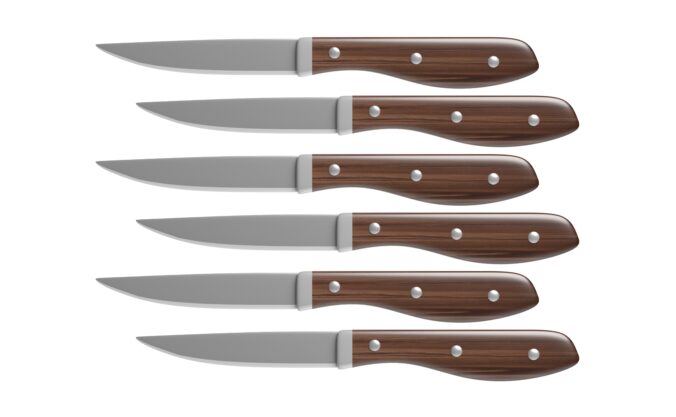
TL;DR: – The best steak knife gift sits in the $15–$30/knife range – below that, you’re getting budget stamped steel that won’t last
- Straight-edge knives cut cleaner and last longer with basic maintenance; serrated are lower-maintenance but eventually unrecoverable
- A 6-piece set in German stainless steel is the sweet spot for most home dining and gifting situations
What Makes a Great Steak Knife for Home Use?
Thinking about gifting a steak knife set – or finally upgrading your own? The options are overwhelming. So before you buy anything, here’s what actually matters.
Blade length. Most quality steak knives run 4–5 inches. That’s the sweet spot for cutting through a full steak in one or two strokes without awkward sawing. Anything shorter feels toy-like; anything longer is unwieldy at the dinner table.
Blade steel. This is where budget sets quietly fail you. Unspecified “stainless steel” on a $9.99 set tells you nothing useful. Look for German X50CrMoV15 steel in the mid-range – it’s corrosion-resistant, holds a solid edge, and can be resharpened at home. Japanese steels like VG-MAX run harder (HRC 60–61 vs. HRC 56–58 for German), which means longer edge retention but more brittleness – a real concern when knives are hitting ceramic dinner plates. You can dig deeper into the tradeoffs in a carbon steel vs stainless steel knives comparison if you want the full picture.
Handle material. This matters more for gifting than people realize. G-10 fiberglass handles are the most dishwasher-durable. Synthetic options like Fibrox hold up well too. Pakkawood and natural wood look beautiful but require hand washing and occasional oiling – a dealbreaker for households that run everything through the dishwasher. Check out our knife handle materials guide before committing to a wood-handled set as a gift.
Construction. Full-tang knives – where the blade steel runs the full length of the handle – are the durability baseline. Hollow-handle knives use adhesive bonds that can soften under heat or heavy use. Avoid them.
Set size. A 4-piece set works for couples or small families. Six pieces covers a family of four with occasional guests. Eight pieces is for regular entertainers. According to The Cooking Guild, most sets contain four to eight knives – so you’ve got options at every tier.
Key Takeaway: Full-tang construction, specified blade steel (X50CrMoV15 or better), and handle material matched to the recipient’s dishwasher habits are the three non-negotiables before you spend a dollar.
Serrated vs Straight Edge Steak Knives: Which Should You Buy?
This is the question that trips up almost every gift buyer. And most roundups give it a paragraph. It deserves more.
Here’s the honest breakdown:
| Factor | Serrated | Straight Edge |
|---|---|---|
| Out-of-box sharpness | High | High |
| Cut quality on meat | Tears slightly | Clean, minimal juice loss |
| Edge longevity (no maintenance) | Longer | Shorter |
| Home sharpenability | Very difficult | Easy (whetstone or honing rod) |
| Long-term lifespan | 3–5 years heavy use | 20+ years with care |
| Best for | Casual diners, low-maintenance households | Steak enthusiasts, gift recipients who’ll maintain |
According to Wirecutter, “even the least-impressive straight-edge knife sliced meat better than the best serrated knife.” That’s a strong statement – and it’s backed by physics. Straight edges don’t tear meat fibers; they slice through them. Less tearing means less juice loss, which means a better bite.
But here’s the real-world catch: straight-edge knives need maintenance. Cutluxe notes that “serrated blades may slice meat much more quickly out of the box and can make tougher cuts easily, but they also can dull much more rapidly than smooth blades.” The irony is that once a serrated knife dulls, you’re mostly stuck – sharpening serrated edges at home requires a tapered ceramic rod matched to each individual serration, which most people don’t own or bother with.
Cutluxe also points out that “a serrated blade is considerably more difficult to sharpen than a non serrated steak knife. Those who use an electric sharpener on serrated blades risk ruining the sharp edge.”
Straight-edge knives, by contrast, can be brought back to life with a basic whetstone – something covered in detail in our whetstone sharpening guide for beginners if you’re new to it.
The recommendation by use case:
- Casual home diner who won’t maintain knives: Serrated. Lower maintenance, stays functional longer without any effort.
- Steak enthusiast or home cook who cares about cut quality: Straight edge. Cleaner cuts, resharpenable, better long-term investment.
- Gift for someone whose habits you don’t know: Serrated from a reputable brand. It’s the safer default.
Key Takeaway: Straight-edge knives cut better and last longer with care. Serrated knives are more forgiving for low-maintenance households. When in doubt for gifting, go serrated from a quality brand.
Best Steak Knife Sets by Budget (2026 Picks)
Based on our analysis of testing data from Serious Eats, Wirecutter, Bon Appétit, and Consumer Reports, here’s how the market breaks down across budget tiers.
| Tier | Price Range | Best For | Gift Box? |
|---|---|---|---|
| Budget | Under $50 | Casual use, starter sets | Rarely |
| Mid-Range | $50–$150 | Most home diners | Sometimes |
| Premium | $150–$325 | Enthusiasts, special occasions | Usually |
| Luxury | $325+ | Collectors, milestone gifts | Always |
Best Budget Steak Knives Under $50
The honest truth about budget steak knives: you’re making tradeoffs. Steel grade is often unspecified, handles are lighter, and longevity is limited.
That said, Victorinox Swiss Classic serrated steak knives (4-piece, ~$44) are the standout exception. Multiple independent testers have flagged them as the best value at this price – sharp out of the box, Fibrox handles that are genuinely dishwasher-safe, and honest about what they are. At roughly $11/knife, they’re a solid starter set.
For the absolute floor, Amazon’s bestseller data shows options like the Home Hero 6-piece serrated set at $9.99 – but at $1.67/knife, you’re buying a temporary solution. Unspecified steel, hollow handles, and no sharpening path.
Who this suits: Renters, college households, or anyone who wants functional knives without a significant investment. Not ideal as a gift unless budget is genuinely tight.
Tradeoff: You’ll likely replace a sub-$30 set within 2–3 years. Run the math: three replacements over 10 years = $90+ versus one quality set at $120.
Best Mid-Range Steak Knives ($50–$150)
This is where the best steak knives for home dining gift guide territory gets genuinely interesting.
The ZWILLING TWIN Gourmet 4-piece set runs around $54.99 – German steel construction, riveted handles, and wide availability. At ~$13.75/knife, it’s a meaningful step up from budget options. Sur La Table also carries the Zwilling J.A. Henckels 8-piece Porterhouse set at $79.96 (1,225 reviews), which works out to $10/knife for a set that covers a full dinner party.
For straight-edge performance, recommends Material’s The Table Knives after “over 40 hours of research, interviews, and testing,” calling them the best value by far. The knives weigh around 62 grams each – a nice midpoint between heavier and lighter options – and come in packaging that’s presentable as a gift.
Steel grade callout: Look for X50CrMoV15 or equivalent German stainless at this tier. Messermeister uses “precision X50 fine-edge blades that effortlessly glide through any cut of meat” in their Avanta line – and positions it as a luxury gift at roughly one-third the price of their standard collection.
Gift suitability: Mid-range sets often come in decent retail packaging. The Zwilling sets at Sur La Table include gift-box options. This tier is the sweet spot for most gifting occasions.
Best Premium Steak Knives ($150 and Up)
“The presentation alone communicates quality before the knives are even used.” – Wüsthof, on their branded wooden gift box packaging
At the premium tier, you’re paying for steel quality, craftsmanship, and presentation. The Wüsthof Classic 4-piece set retails at $325 at Sur La Table – full-tang, triple-riveted handles, X50CrMoV15 steel sharpened to 14 degrees per side. It arrives in a branded wooden presentation box. That’s a gift that opens well.
For Japanese steel enthusiasts, Shun Classic steak knives feature VG-MAX steel core with Damascus cladding, sharpened to 16 degrees per side. The added gifting value: Shun offers a free lifetime sharpening service – owners mail in knives and receive them back razor-sharp. For a recipient who won’t maintain their own knives, that’s a meaningful differentiator.
Bon Appétit tested sets up to $300 for four knives, noting that “the full tang knives feel high quality, especially considering their $100 price tag (half or a third of what some other good sets cost)” – which gives you a useful benchmark for evaluating whether premium pricing is justified.
If you want to understand why premium steak knives are worth the investment as a long-term gift, the case comes down to resharpenability and construction quality. A $325 Wüsthof set, maintained properly, can outlast five generations of $30 replacements.
You can browse premium options at Knife Depot alongside a solid range of mid-tier sets – useful if you want to compare options across price points in one place.
Key Takeaway: The $50–$150 mid-range delivers the best value for most home dining gift situations. Premium sets ($150+) justify their price through gift presentation, steel quality, and longevity – especially with a lifetime sharpening service included.
How Do You Choose the Right Steak Knife Set as a Gift?
Most gift guides skip this entirely. They tell you what to buy but not how to match the set to the recipient. That’s where gift-givers actually get stuck.
The Decision Lab research on gift-giving behavior shows that “gift recipients were more likely to appreciate a gift when it was something they had explicitly requested” – which means the more you know about the recipient’s actual preferences, the better the gift lands.
Here’s a practical checklist:
Gift Checklist
- Cooking style: Do they cook steak regularly, or is this occasional? Enthusiasts want straight-edge; casual cooks want serrated.
- Dishwasher habits: If everything goes in the dishwasher, avoid wood handles. Fibrox or G-10 only.
- Existing knife collection: A serious home cook with good knives might prefer a premium 4-piece over a budget 8-piece.
- Set size: 4-piece for couples, 6-piece for families, 8-piece for entertainers.
- Presentation: Does the set arrive in a gift-ready box, or will you need to wrap a retail cardboard package?
On gift presentation: This matters more than most people think. Sur La Table carries multiple sets specifically packaged for gifting – the Zwilling 8-piece with box at $99.95 has 176 reviews and is explicitly positioned as a gift item. Wüsthof’s wooden presentation box does the heavy lifting before the recipient even touches a knife.
Gifting red flags to avoid:
- Hollow-handle sets – the blade-handle bond is a structural weak point
- Unbranded “Laguiole-style” sets from non-certified manufacturers (Laguiole is a style, not a protected brand – cheap imitations are everywhere online)
- Sets with unspecified steel grades
- Sub-$30 four-piece sets as a “nice gift” – at $7.50/knife, you’re giving something that needs replacing in two years
The cost framing that changes everything: A $120 set ÷ 6 knives = $20/knife. A $30 set ÷ 4 knives = $7.50/knife. But if the budget set needs replacing every two years, the 10-year cost hits $150. The $120 set, maintained properly, costs nothing more. Consumer Reports confirms that “in most cases, a higher price did seem to guarantee better performance” – the value math holds.
Key Takeaway: Match set size to household size, handle material to dishwasher habits, and edge type to maintenance willingness. Gift-box packaging adds perceived value without significant cost premium – prioritize it.
Steak Knife Care: Making Your Set Last for Years
A gift guide that skips maintenance is only half a guide. Here’s what actually extends the life of a steak knife set.
The dishwasher myth. Even sets labeled “dishwasher safe” degrade faster in the machine. notes you “could even put the Material knives in the dishwasher in a pinch – though we wouldn’t recommend doing this regularly, since the dishwasher will cause their blades to dull faster.” Alkaline detergents corrode edges; high heat cycles stress handle materials. Hand washing takes 30 seconds. It’s worth it.
Storage. Loose drawer storage is the fastest way to dull a straight-edge knife – blades knock against other metal and accumulate micro-chips. According to America’s Test Kitchen, a magnetic strip is the best option for preserving edge alignment. A knife block is acceptable. If you’re storing in a drawer, use blade guards.
Sharpening. Straight-edge steak knives can be maintained at home with a honing rod (for regular upkeep) or a whetstone (for full resharpening). A 1000-grit stone is enough to restore a near-factory edge. Check out a whetstone sharpening guide for beginners if you’re starting from scratch. Professional sharpening services run about $5/knife at retailers like Sur La Table – a reasonable annual investment.
Serrated knives are a different story. confirms that serrated blades require a ceramic sharpening rod matched to each serration – not something most home cooks own. Factor this into your gift decision.
Wood handle care. If you gift or receive wood-handled knives, apply food-grade mineral oil monthly and never soak them. Water absorption causes cracking and warping over time.
Key Takeaway: Hand wash, store on a magnetic strip or in a block, and hone straight-edge knives regularly. These three habits extend a quality set’s life from years to decades.
Frequently Asked Questions About Steak Knives
How much should you spend on a good steak knife set?
Direct Answer: Plan to spend $15–$30 per knife for a set that delivers real performance and longevity. That puts a quality 4-piece set at $60–$120 and a 6-piece at $90–$180.
Consumer Reports tested steak knives ranging from under $1 to nearly $100 per knife and found that “a higher price did seem to guarantee better performance, but there were decent knives on the less expensive side, too.” The sweet spot for most home diners is the mid-range – enough to get specified steel and full-tang construction without paying for pure aesthetics.
Are serrated or straight-edge steak knives better?
Direct Answer: Straight-edge knives cut cleaner and last longer with basic maintenance. Serrated knives are lower-maintenance but can’t be easily resharpened once dull.
found that “straight-edge knives can be easily sharpened to serve you well for years – less true for serrated ones.” adds that non-serrated knives “do a much better job helping you make a nice juicy steak” by reducing tearing and keeping fluid in the meat. For casual households that won’t maintain their knives, serrated is the practical default. For steak enthusiasts, straight-edge wins.
What steak knife sets come gift-ready with a box?
Direct Answer: Wüsthof Classic sets come in branded wooden presentation boxes. Zwilling J.A. Henckels offers boxed sets at Sur La Table. Shun and Laguiole en Aubrac (authentic) also include signature presentation packaging.
Sur La Table carries the Zwilling 8-piece with box at $99.95 and the Wüsthof Classic 4-piece at $325 – both explicitly gift-packaged. Most sub-$50 sets ship in plain retail cardboard. If presentation matters, budget at least $80–$100 for a set that arrives gift-ready. For best chef knives for home cooking to round out a gift, that’s a separate category worth exploring.
Can steak knives go in the dishwasher?
Direct Answer: Technically some can, but regular dishwasher use dulls edges faster and damages handles over time – even on “dishwasher-safe” sets.
specifically warns against regular dishwasher use even for their top pick, noting it causes blades to dull faster. Alkaline detergents corrode edges; high heat stresses handle materials. Wood and pakkawood handles are particularly vulnerable. Hand washing takes seconds and meaningfully extends knife lifespan.
How many steak knives do you need for home dining?
Direct Answer: A 4-piece set suits couples and small families. Six pieces covers a family of four with occasional guests. Eight pieces is right for regular entertainers.
The Cooking Guild confirms that “most sets contain four to eight knives” – the standard range across the market. If you regularly host dinner parties of six or more, a 4-piece set will leave you short. When gifting, consider the recipient’s household size and entertaining habits before defaulting to the most common 4-piece format.
What blade steel is best for steak knives?
Direct Answer: German X50CrMoV15 stainless steel is the best all-around choice for most home diners – corrosion-resistant, easy to resharpen, and available across the mid-range price tier.
Japanese steels like VG-MAX run harder (HRC 60–61) and hold an edge longer, but they’re more brittle – a real concern when knives are hitting ceramic dinner plates. Opinel USA notes that “stainless steel is the optimal alloy for crafting kitchen knives because of its corrosion resistance and longevity after many washes.” For most home dining situations, German stainless is the practical winner.
How do you sharpen steak knives at home?
Direct Answer: Straight-edge steak knives can be sharpened with a honing rod for regular maintenance or a 1000-grit whetstone for full resharpening. Serrated knives require a tapered ceramic rod and are much harder to maintain at home.
A whetstone sharpening guide for beginners covers the technique in detail – the basic approach is pulling the blade at 15–20 degrees per side. Professional sharpening services at retailers like Sur La Table run about $5 per knife if you’d rather outsource it. Pitmaster Club community members note that quality serrated sets like Cutco can go 10–30 years between sharpenings – but when they do need it, you’re sending them out.
The Bottom Line
The best steak knives for home dining gift guide comes down to three decisions: edge type, steel quality, and set size matched to the recipient.
For most gift situations, a 6-piece mid-range set in German stainless steel – serrated for low-maintenance households, straight-edge for enthusiasts – hits the right balance of performance, longevity, and value. Spend $15–$20 per knife, prioritize full-tang construction, and make sure the packaging is gift-worthy if presentation matters.
Skip the hollow-handle budget sets. Skip the unbranded “Laguiole-style” imports. And remember: a $120 set that lasts a decade beats a $30 set you replace three times.
That’s the gift worth giving.
Ready to Get Started?
For personalized guidance, visit Knife Depot to learn how we can help.


Have you considered including recommendations for eco-friendly options? That could resonate well with sustainability-minded readers. What do you think about that?