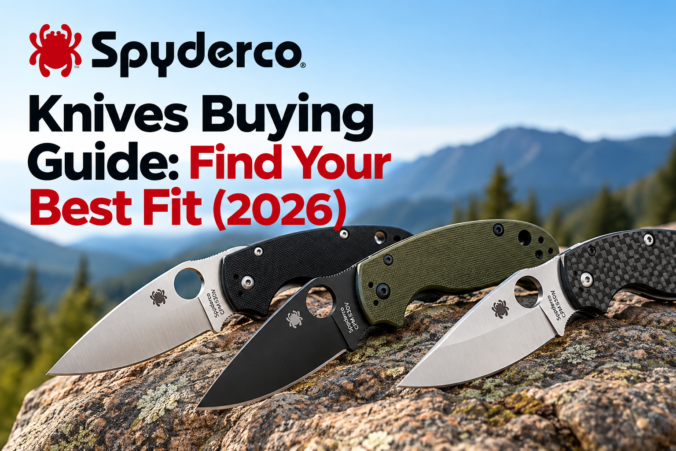
TL;DR: – Spyderco’s Delica 4 ($75–$85) and Para Military 2 ($165–$185) dominate the EDC market; [the Para Military 2 holds an edge roughly 3× longer than budget steels between sharpenings].
- Lock mechanism matters as much as steel: the Compression Lock (found on Para 3 and Para Military 2) is ambidextrous and stronger than traditional liner locks.
- Counterfeits are common – buy only from authorized Spyderco dealers to preserve warranty coverage.
What Makes Spyderco Different From Other Knife Brands?
Spyderco was founded in 1976 by Sal Glesser in Golden, Colorado, and the company has spent five decades redefining what a production folding knife can be. You’ve probably noticed the distinctive round hole on the blade spine – that’s Spyderco’s trademark opener, designed to let you deploy the blade one-handed without a nail nick. It’s a small detail that changed everything.
What separates Spyderco from competitors isn’t just innovation; it’s consistency. In 1981, Spyderco became the first manufacturer to add a pocket clip to a folding knife, and the company introduced three unprecedented features simultaneously: the pocket clip, one-handed opening, and serrated edge options. That combination became the template for modern EDC knives.
Today, [Spyderco is one of the largest and most famous knife brands in the world]. The brand manufactures knives across multiple price tiers – from the budget Tenacious to premium sprint runs in exotic steels – and maintains strict quality control across both U.S. and Japanese production facilities. Whether you’re a first-time buyer or a collector exploring premium pocket knives, understanding Spyderco’s lineup means understanding modern knife design itself.
Key Takeaway: Spyderco pioneered the modern EDC knife formula in 1981. Today, the brand spans $40 budget models to $300+ collector pieces, all built on the same design philosophy: functional, ambidextrous, and built to last.
How Do Spyderco’s Blade Steels Compare?
Steel choice is the single biggest factor determining how long your knife stays sharp between sharpenings and how well it resists rust. Spyderco uses a tiered steel strategy: budget options for casual users, mid-range steels for working professionals, and premium alloys for collectors and hard-use specialists.
Let’s break down what you’re actually getting at each tier.
Budget Steels: 8Cr13MoV and AUS-8
You’ll find 8Cr13MoV on the Tenacious and other entry-level Spydercos. This Chinese stainless steel is easy to sharpen – you can touch it up on a ceramic rod in under a minute – and it resists rust reasonably well. The tradeoff? Edge retention is modest. You’ll be sharpening more often than with mid-range steels, but the knife costs $40–$50, so the math works for casual users.
AUS-8, found on some budget models, offers slightly better corrosion resistance than 8Cr13MoV but performs similarly in cutting tasks. Both steels are forgiving for beginners because they sharpen quickly on basic stones.
Mid-Range Steels: VG-10 and BD1N
The Delica 4 in VG-10 with FRN handle typically retails around $75–$85 and represents the sweet spot for most EDC users. VG-10 is a Japanese stainless that’s been Spyderco’s signature steel for decades. It holds an edge noticeably longer than 8Cr13MoV, sharpens on ceramic or diamond stones without excessive effort, and resists corrosion well enough for daily carry in most climates.
BD1N, used in the Native 5 Lightweight, is a nitrogen-alloyed variant that offers a finer grain structure and sharper factory edge than standard BD1. If you want a lightweight knife that doesn’t sacrifice edge retention, BD1N delivers.
Premium Steels: S45VN, S30V, and CPM-20CV
This is where edge retention becomes genuinely impressive. The Para Military 2 in CPM-S45VN typically retails between $165 and $185, and [S45VN holds an edge roughly 3× longer than 8Cr13MoV between sharpenings under equivalent cutting tasks]. That’s not marketing – that’s the difference between a steel with high vanadium carbide content and a budget alloy.
S30V and CPM-20CV are near-identical premium stainless steels offering top-tier corrosion resistance and edge retention. They’re harder to sharpen than VG-10 (you’ll need diamond or ceramic stones), but they’ll hold a working edge through weeks of heavy use. If you carry daily and sharpen infrequently, premium steel pays for itself in convenience.
| Steel | Typical Price Tier | Edge Retention | Corrosion Resistance | Ease of Sharpening | Best For |
|---|---|---|---|---|---|
| 8Cr13MoV | Under $50 | Low | Good | Excellent | Casual users, learners |
| VG-10 | $75–$120 | Medium | Excellent | Good | Daily EDC, balanced use |
| BD1N | $100–$140 | Medium-High | Excellent | Good | Lightweight daily carry |
| S45VN | $150–$200 | High | Excellent | Moderate | Working professionals |
| S30V/CPM-20CV | $200+ | Very High | Excellent | Challenging | Collectors, hard use |
Key Takeaway: VG-10 ($75–$120 range) delivers most of premium steel performance at half the cost. If you sharpen monthly, it’s the best value. For infrequent sharpening, S45VN ($165–$185) justifies the premium.
Which Spyderco Lock Mechanism Should You Choose?
The lock mechanism determines how safely the blade stays open under load and how easily you can close it one-handed. This choice directly impacts your carry comfort and, in some jurisdictions, legality.
The Compression Lock is Spyderco’s signature innovation. It uses a spine-mounted leaf spring that engages from above the blade tang, creating a geometry that resists closing force far better than a traditional liner lock. The beauty? It’s ambidextrous – both left- and right-handed users get the same mechanical advantage. You’ll find the Compression Lock on the Para 3 and Para Military 2, and it’s become the gold standard for serious EDC knives.
The Back Lock (lockback) is the traditional mechanism you see on the Delica 4 and Endura 4. The lockback has been around for over a century and remains the mechanism of choice for traditional pocket knives. It’s simple, robust, and well-understood by most users. The tradeoff: it’s not ambidextrous – left-handed users have to reach across the blade to disengage it.
The Liner Lock, found on budget models like the Tenacious, is lightweight and inexpensive but offers less mechanical advantage than a Compression Lock. For light EDC use, it’s fine. For hard use or defensive carry, it’s a compromise.
The difference matters in real carry. If you’re left-handed and want one-handed closing, the Compression Lock is non-negotiable. If you prioritize simplicity and proven reliability, the Back Lock is timeless. If you’re budget-conscious, the Liner Lock works – just understand its limitations.
Key Takeaway: Choose Compression Lock for ambidextrous one-handed operation; Back Lock for traditional simplicity; Liner Lock for budget carry. Lock choice matters more than you’d think for daily comfort.
Spyderco Knife Models by Use Case and Price Tier
Here’s where theory meets practice. You need to know which model fits your actual carry scenario and budget.
Best Spyderco Knives Under $100
The Delica 4 in VG-10 with FRN handle typically retails around $75–$85. It’s the entry point for serious Spyderco users. The 2.9-inch blade is discreet in slim pockets, the Back Lock is bulletproof, and VG-10 steel holds an edge long enough that you won’t sharpen it weekly. Ambidextrous? No – but the simplicity is part of the appeal.
The Tenacious sits around $40–$50 and is worth considering for outdoor tasks and uses 8Cr13MoV steel. It’s larger (3.4-inch blade) and heavier, making it better for outdoor tasks than pocket carry. If you’re testing whether you like Spyderco’s design language before spending $150+, the Tenacious is the gateway drug.
Best Spyderco Knives $100–$200
The Para 3 in S30V retails for approximately $120–$135 and uses the Compression Lock. The 3-inch blade makes it compliant with most jurisdictional blade length limits (including New York City’s 3-inch folding knife restriction).
The Para Military 2 in CPM-S45VN typically retails between $165 and $185 and is the most popular EDC knife, with over 1 million units sold worldwide. The 3.42-inch blade is larger than the Para 3, the Compression Lock is rock-solid, and the full flat grind slices like a razor. Fair warning: it prints noticeably in slim pockets.
The Manix 2 is one of Spyderco’s many beloved full-size everyday carry workhorses, designed by Eric Glesser and made in Golden, Colorado. Its 3.375-inch MagnaMax blade rides on a full flat grind for low-friction cutting. It’s heavier than the Para Military 2 but offers a unique lock design and exceptional ergonomics for extended use.
Best Spyderco Knives $200 and Above
Sprint runs – limited production batches in exotic steels or handle materials – command premiums in this range. You might find a Para Military 2 sprint in M390 or Maxamet (a high-speed tool steel) for $250–$350. These aren’t better knives; they’re collectible variants with niche appeal.
The Sage series (Sage 1–5) showcases different lock mechanisms on the same blade, making it a collector’s progression. If you’re building a Spyderco collection, the Sage lineup teaches you what matters.
| Model | Steel | Blade Length | Lock | Street Price | Best For |
|---|---|---|---|---|---|
| Delica 4 | VG-10 | 2.9″ | Back Lock | $75–$85 | First Spyderco, discreet carry |
| Tenacious | 8Cr13MoV | 3.4″ | Liner Lock | $40–$50 | Budget outdoor use |
| Para 3 | S30V/S45VN | 3.0″ | Compression Lock | $120–$135 | NYC-legal EDC, ambidextrous |
| Para Military 2 | S45VN | 3.42″ | Compression Lock | $165–$185 | Flagship EDC, hard use |
| Manix 2 | S30V/S45VN | 3.375″ | Ball Bearing Lock | $160–$180 | Extended use, ergonomics |
Key Takeaway: $75–$150 delivers the best steel-to-price ratio. The Para 3 ($120–$135) is the safest choice for first-time buyers; the Para Military 2 ($165–$185) is the workhorse for daily professionals.
What Size and Blade Shape Fits Your Carry Style?
Blade length isn’t just about cutting performance – it’s about pocket comfort and, in some places, legality.
Blade Length Matters. A 2.9-inch blade (Delica 4) disappears in most pockets. A 3.4-inch blade (Para Military 2) prints noticeably in slim pants. A 4-inch blade is outdoor/tactical territory and won’t work for discreet EDC. If you carry in business casual or jeans, stay under 3.2 inches unless you’re using a belt sheath.
Blade Shape Affects Function. The drop point (used on Para Military 2 and Para 3) is versatile – good for slicing, piercing, and general work. The clip point (found on some Spydercos) is more aggressive for piercing tasks. The Wharncliffe (utility-focused) excels at detail work and cutting rope. If you’re unsure, drop point is the safe default.
Grind Geometry Matters Too. The MagnaMax blade rides on a full flat grind for low-friction cutting. A full flat grind (thin all the way from spine to edge) maximizes slicing performance but requires more steel removal during reprofiles. A hollow grind (concave) is easier to reprofile but sacrifices some slicing geometry. Most Spydercos use full flat grind; the Endura uses hollow grind.
Handle Material Affects Comfort and Weight. FRN (Fiberglass Reinforced Nylon) is lightweight and inexpensive – ideal for EDC. G-10 is stiffer, more textured, and preferred for hard use, though it adds weight and cost. Titanium scales are premium but heavy. For daily carry, FRN is the practical choice.
Key Takeaway: Under 3 inches for discreet carry; 3–3.5 inches for general work; 4+ inches for outdoor/tactical. Full flat grind slices better; hollow grind reprofiles easier. FRN handles are lighter; G-10 is more durable.
How to Spot Authentic Spyderco Knives and Avoid Fakes
Counterfeits are a documented problem in the knife world. Spyderco products purchased from unauthorized sources are not covered under our warranty. That’s not just a legal technicality – it means you lose recourse if the knife fails.
Buy from Authorized Dealers Only. Spyderco maintains an authorized dealer list. Check it before purchasing. If a retailer isn’t listed, don’t buy from them, no matter how good the price looks.
Price Red Flags. A Delica 4 listed under $40 claiming to be brand new is almost universally a counterfeit. The retail floor is $75–$85. A Para Military 2 under $100 is a fake. These price points are consistent across authorized retailers because of MAP (Minimum Advertised Price) enforcement.
Authentication Checkpoints. Examine the Round Hole – it should have tight tolerances with no slop. The blade finish should be consistent across the entire surface. The lockup should be rock-solid with no play. Counterfeits often show imprecise Round Hole tolerances, uneven blade grinds, and soft lockup.
Secondary Market Risk. Marketplaces like eBay and Amazon third-party sellers are common counterfeit sources. If the price seems too good to be true, it is. Stick with Knife Depot and other authorized retailers.
Key Takeaway: Counterfeits are common online. Buy only from authorized dealers. A Delica 4 under $50 is fake. A Para Military 2 under $120 is fake. Warranty coverage requires authorized purchase.
Frequently Asked Questions About Spyderco Knives
How much should you spend on a Spyderco knife for everyday carry?
Direct Answer: $75–$150 delivers the best balance of steel quality, lock reliability, and real-world performance. Below $75, you’re compromising on edge retention. Above $150, you’re paying for collector appeal or exotic steels, not functional improvement.
The Delica 4 at $75–$85 is the entry point. The Para 3 at $120–$135 adds ambidextrous locking. The Para Military 2 at $165–$185 is the flagship. All three are legitimate choices depending on your pocket space and use intensity.
Is the Spyderco Para Military 2 better than the Para 3?
Direct Answer: The Para Military 2 is larger and more capable; the Para 3 is more discreet and legally compliant in more jurisdictions. “Better” depends on your carry scenario.
[The Para Military 2’s 3.42-inch blade] exceeds New York City’s 3-inch folding knife legal limit. [The Para 3’s 3-inch blade] is NYC-legal. If you carry in a major city, the Para 3 is the practical choice. If you want maximum cutting performance and don’t care about blade length restrictions, the Para Military 2 is superior. Both use the Compression Lock and S45VN steel – the difference is size and legality, not quality.
Are Spyderco knives legal to carry in most states?
Direct Answer: Yes, in most U.S. states. But blade length limits vary sharply by jurisdiction, and some cities prohibit one-hand-opening knives entirely.
In New York City, no person shall carry a knife with a blade of three inches or more in length. [The Para Military 2 (3.42 inches)] is technically illegal there. [The Para 3 (3 inches)] is compliant. Before carrying any knife, verify your local statutes. Knife Rights tracks state-by-state laws and is a reliable secondary source for jurisdiction guidance.
How do you sharpen a Spyderco knife with a flat grind?
Direct Answer: Use a ceramic rod or diamond stone, maintaining the factory angle (typically 15–20 degrees per side). A full flat grind requires more steel removal during major reprofiles but sharpens quickly on basic stones.
For touch-ups, a ceramic rod works in under a minute. For major reprofiles, use a diamond stone or professional sharpening service. The flat grind geometry means you’re thinning the blade all the way from spine to edge – more work than a hollow grind, but superior slicing performance justifies it.
What is the Compression Lock and why does it matter?
Direct Answer: The Compression Lock is a spine-mounted leaf spring that engages from above the blade tang, creating superior closing resistance compared to liner locks. It’s ambidextrous – both left- and right-handed users get the same mechanical advantage.
This matters because it means left-handed users don’t have to reach across the blade to disengage the lock. It also means the knife won’t accidentally close under cutting load. Spyderco’s patented Ball Bearing Lock delivers rock-solid, ambidextrous lockup, and the Compression Lock is the closest competitor in terms of reliability and ease of use.
Which Spyderco models are best for outdoor and bushcraft use?
Direct Answer: The Para Military 2 and Manix 2 are the most capable for hard outdoor use, though dedicated wilderness bushcraft knives for hiking are worth comparing. For lighter bushcraft tasks, the Delica 4 or Native 5 work well if you’re willing to sharpen more frequently.
Outdoor use demands edge retention and lock reliability. The Para Military 2’s S45VN steel holds an edge roughly 3× longer than budget steels between sharpenings, and the Compression Lock is bulletproof under load. If you want a lighter option, the Native 5 in BD1N is a solid compromise – it’s half the weight of the Para Military 2 but still offers respectable edge retention.
How can you tell if a Spyderco knife is a counterfeit?
Direct Answer: Check the Round Hole tolerances (should be tight with no slop), blade finish consistency, and lockup quality. If the price is significantly below MAP, it’s almost certainly fake.
Spyderco products purchased from unauthorized sources are not covered under our warranty. Counterfeits often show imprecise Round Hole tolerances, uneven blade grinds, and soft lockup. Buy only from authorized dealers to guarantee authenticity and warranty coverage.
Final Thoughts: Making Your Choice
Choosing a Spyderco knife comes down to three questions: What’s your budget? How much pocket space do you have? How often will you sharpen?
If you’re under $100, the Delica 4 is the obvious choice – proven design, excellent steel, and timeless appeal. If you’re $100–$200, the Para 3 or Para Military 2 depend on whether you prioritize discreet carry (Para 3) or maximum capability (Para Military 2). If you’re above $200, you’re collecting or specializing – sprint runs, exotic steels, or niche designs.
The steel tier matters more than the model name. VG-10 at $75–$120 delivers most of premium steel performance. S45VN at $165–$185 justifies the premium if you sharpen infrequently. Budget steels under $50 are fine for casual users but require more maintenance.
Lock mechanism matters for ambidextrous use and legal compliance. The Compression Lock is superior for left-handed users and hard use. The Back Lock is traditional and proven. The Liner Lock is budget-friendly but compromised.
Finally, buy from authorized Spyderco dealers only. Counterfeits are common, and warranty coverage requires authorized purchase. Knife Depot is a trusted source for authentic Spyderco knives across all price tiers.
Leave a Reply