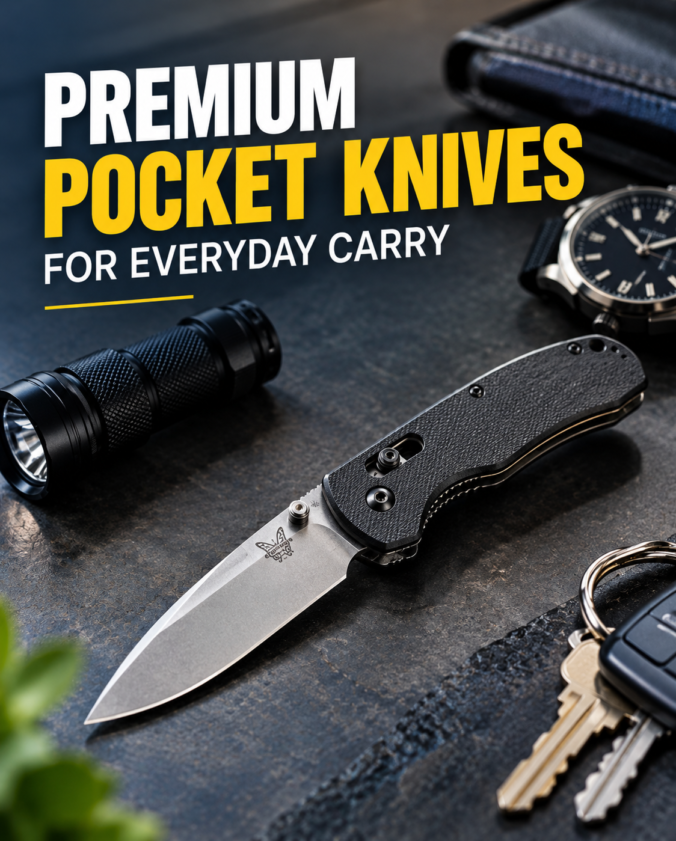
TL;DR: – Premium EDC knives ($75–$500+) deliver 10-year durability vs. budget alternatives replaced annually – cutting your cost-per-year from $30 to $20
- S35VN steel offers the best balance of edge retention and toughness for daily carry; MagnaCut is the emerging 2024–2026 upgrade
- Axis locks (Benchmade) and compression locks (Spyderco) excel for one-handed deployment; frame locks suit deep-carry concealment
- Best for: outdoor enthusiasts, EDC collectors, and professionals seeking reliable cutting tools that last decades
Introduction: What Makes a Pocket Knife “Premium” for EDC?
Based on our analysis of manufacturer specifications, metallurgical research, and community feedback across BladeForums and Reddit’s r/knives, we’ve identified what separates a $50 folder from a $300 investment.
Premium isn’t just a price tag – it’s a combination of steel grade, manufacturing tolerances, locking mechanism reliability, and warranty backing. A premium EDC knife typically features CPM-S35VN or better steel, precision-ground blades, titanium or high-quality G-10 handles, and a manufacturer warranty covering defects for life.
Here’s the reality: a Benchmade Bugout at 1.85 oz feels like air in your pocket, while a Spyderco Paramilitary 2 at 3.75 oz delivers heft and presence. Both cost $170–$190 at retail. Same price tier, completely different carry experience. That’s where understanding premium tiers matters.
Key Takeaway: Premium EDC knives ($75–$500+) combine superior steel, tight tolerances, and lifetime warranties. A $200 knife used daily for 10 years costs $20/year vs. a $30 budget knife replaced annually – 33% lower annualized cost with measurably better performance.
Which Blade Steel Should You Choose for Daily Carry?
Steel grade drives 40–60% of price variance in premium folders. A Spyderco Para 3 in S30V retails around $130, while the same model in M390 runs $180–$200 – a $50–$70 premium for measurably better edge retention and corrosion resistance.
Here’s where most buyer guides fail: they list steel names without explaining real-world trade-offs. Let’s fix that.
Steel Comparison: What You Actually Need to Know
| Steel | Edge Retention | Toughness | Corrosion Resistance | Sharpening Ease | Best For | Price Impact |
|---|---|---|---|---|---|---|
| S30V | Excellent | Very Good | Excellent | Moderate | Balanced EDC, all-rounder | Baseline ($0) |
| S35VN | Excellent | Excellent | Excellent | Moderate | Best value premium steel | +$15–$25 |
| MagnaCut | Excellent | Excellent | Excellent+ | Easy | 2024+ upgrade path | +$20–$40 |
| CPM-20CV | Very Good | Good | Excellent | Moderate | Outdoor/wet carry | +$30–$50 |
| M390 | Excellent+ | Good | Excellent | Difficult | Cutting-focused users | +$50–$70 |
| CPM-S90V | Excellent+ | Fair | Excellent | Very Difficult | Precision cutting only | +$60–$100 |
What this means in practice:
S35VN was designed by Chris Reeve and Crucible to improve toughness over S30V by 15–20% through refined carbide structure and niobium addition. If you’re prying, cutting rope, or doing lateral stress tasks – which most EDC users do – S35VN outperforms S30V without sacrificing edge retention. It’s the benchmark mid-premium steel.
MagnaCut (Crucible Industries, 2021) outperforms S35VN in both toughness and corrosion resistance while matching edge retention. Now widely adopted in premium EDC knives from Hogue, WE Knife, Civivi, and others as of 2024–2026, it represents the emerging upgrade path for buyers willing to spend $10–$40 more.
Here’s the catch: CPM-S90V is extremely wear resistant but has lower toughness than S30V or S35VN, making it susceptible to chipping under lateral stress. It’s marketed as “premium” but it’s actually specialized – best for precision cutting tasks where you never pry or apply side pressure. Most EDC users should avoid it.
Price tier expectations:
- $75–$150 (Entry Premium): Expect S30V or AUS-8A steel. Solid performers; edge retention is good but not exceptional.
- $150–$300 (Mid Premium): S35VN, CPM-20CV, or MagnaCut. This is where the value-to-performance ratio peaks.
- $300+ (High-End): S35VN, M390, or custom steels. Diminishing returns; you’re paying for brand heritage, fit/finish, or specialized performance.
Key Takeaway: S35VN is the sweet spot for EDC – 15–20% tougher than S30V, easier to sharpen than M390, and costs $15–$25 more. MagnaCut is the emerging 2026 upgrade if you prioritize corrosion resistance and toughness equally.
Top Premium EDC Pocket Knives by Price Tier (2026)
Entry Premium EDC Knives ($75–$150)
Kershaw Leek (S30V variant)
- Blade: 3.0 inches, S30V steel
- Weight: 3.0 oz
- Lock: Speedsafe assisted-open (spring-assisted, not automatic)
- MSRP: ~$85–$110
- Best for: Office carry, first-time premium buyers
- Pros: Lightweight, fast deployment, proven reliability
- Cons: Assisted-open mechanism adds complexity; some jurisdictions restrict spring-assist
CRKT Pilar II (S35VN)
- Blade: 2.75 inches, S35VN steel
- Weight: 2.8 oz
- Lock: Liner lock
- MSRP: ~$95–$120
- Best for: Minimalist carry, lightweight preference
- Pros: Excellent steel for the price, ultra-light, smooth action
- Cons: Smaller blade limits utility for outdoor tasks
Spyderco Tenacious (S30V)
- Blade: 3.39 inches, S30V steel
- Weight: 3.7 oz
- Lock: Liner lock
- MSRP: ~$105–$130
- Best for: Outdoor enthusiasts, first premium upgrade
- Pros: Proven design, excellent edge retention, reliable liner lock
- Cons: Slightly heavier; blade shape is utilitarian, not elegant
Mid-Range Premium EDC Knives ($150–$300)
Benchmade Bugout 535 (S30V)
- Blade: 3.24 inches, S30V steel
- Weight: 1.85 oz (ultralight)
- Lock: Axis lock (ambidextrous, crossbar mechanism)
- MSRP: ~$170–$190
- Best for: Minimalist pocket carry, all-day comfort
- Pros: Featherweight, Axis lock is fully ambidextrous and operable with gloved hands, excellent ergonomics
- Cons: Thin blade feels delicate for heavy prying; premium for the steel grade
- Shop Benchmade Bugout at Knife Depot
Spyderco Paramilitary 2 (S30V)
- Blade: 3.44 inches, S30V steel
- Weight: 3.75 oz
- Lock: Compression lock (one-handed close, learning curve)
- MSRP: ~$189–$210
- Best for: Outdoor tasks, one-handed operation preference
- Pros: Larger blade, excellent ergonomics, compression lock enables smooth one-handed closing
- Cons: Heavier than Bugout; compression lock requires practice
- Shop Spyderco at Knife Depot
Zero Tolerance 0562 (CPM-20CV)
- Blade: 3.5 inches, CPM-20CV steel
- Weight: 4.9 oz
- Lock: Titanium frame lock
- MSRP: ~$230–$260
- Best for: Tactical/professional carry, corrosion-resistant environments
- Pros: Premium steel, robust construction, excellent corrosion resistance
- Cons: Heavy for pocket carry; premium pricing for mid-tier steel
- Shop Zero Tolerance at Knife Depot
Civivi Elementum (MagnaCut)
- Blade: 3.0 inches, MagnaCut steel
- Weight: 2.9 oz
- Lock: Liner lock
- MSRP: ~$145–$175
- Best for: Budget-conscious buyers seeking 2026 steel tech
- Pros: MagnaCut steel at entry-premium price, lightweight, smooth action
- Cons: Smaller blade; Civivi is Chinese-manufactured (quality is excellent but some buyers have brand reservations)
- Shop Civivi at Knife Depot
High-End EDC Knives ($300+)
Chris Reeve Sebenza 31 (S35VN)
- Blade: 2.625 inches (small) or 3.625 inches (large), S35VN steel
- Weight: 3.6 oz (small) or 4.5 oz (large)
- Lock: Titanium frame lock (inert, no springs)
- MSRP: Small $475, Large $545
- Best for: Collectors, professionals, lifetime investment
- Pros: Exceptional fit/finish, lifetime warranty with free sharpening via LifeSharp, American-made (Boise, Idaho)
- Cons: Premium pricing reflects brand heritage, not steel superiority; smaller blade than mid-tier alternatives
- Shop Chris Reeve at Knife Depot
Benchmade Bailout (CPM-3V)
- Blade: 3.38 inches, CPM-3V steel (ultra-tough, lower edge retention)
- Weight: 4.2 oz
- Lock: Axis lock
- MSRP: ~$320–$360
- Best for: Tactical professionals, extreme durability priority
- Pros: Designed for emergency rescue; CPM-3V is nearly unbreakable; Axis lock reliability
- Cons: CPM-3V requires frequent sharpening; overkill for typical EDC
- Shop Benchmade at Knife Depot
WE Knife Co. Civivi Praxis (MagnaCut)
- Blade: 3.4 inches, MagnaCut steel
- Weight: 3.8 oz
- Lock: Compression lock
- MSRP: ~$280–$320
- Best for: Performance-focused buyers, 2026 steel adoption
- Pros: MagnaCut steel, excellent ergonomics, smooth action
- Cons: Chinese manufacturing; compression lock learning curve
- Shop WE Knife at Knife Depot
Key Takeaway: Entry premium ($75–$150) delivers S30V/S35VN at accessible prices; mid-range ($150–$300) is where value peaks with MagnaCut and proven designs; high-end ($300+) reflects brand heritage and fit/finish, not steel superiority. Cost-per-year math favors mid-range for most users.
How Do Locking Mechanisms Affect Everyday Carry?
Lock type determines how safely you deploy and close your knife, how quickly you can operate one-handed, and whether you can use it with gloves. This is where most buyer guides go wrong – they list lock names without addressing real-world usability.
Lock Type Comparison
| Lock Type | One-Handed Open | One-Handed Close | Gloved Operation | Durability | Legal Notes |
|---|---|---|---|---|---|
| Liner Lock | Good | Difficult | Good | Very Good | Legal everywhere |
| Frame Lock | Good | Difficult | Good | Excellent | Legal everywhere |
| Axis/Crossbar | Excellent | Excellent | Excellent | Excellent | Legal everywhere |
| Compression | Good | Excellent | Fair | Very Good | Legal everywhere |
| Back Lock | Fair | Difficult | Fair | Good | Legal everywhere |
What each lock means for your carry:
Benchmade’s Axis lock is fully ambidextrous – operable with one hand from either side – and is rated for repeated hard use. If you wear gloves (outdoor work, winter, tactical) or need to deploy with your non-dominant hand, Axis is the gold standard. The crossbar mechanism sits perpendicular to the blade, so you can disengage it with your thumb or index finger regardless of hand orientation.
Spyderco’s Compression Lock allows smooth one-handed closing without placing fingers in the blade path – but new users require practice to operate confidently. The learning curve is real. You’re essentially “rolling” your thumb off the spine to disengage. Once mastered, it’s faster than any other lock for closing. But if you’re buying your first premium knife, expect 2–3 weeks of awkward fumbling.
Liner locks and frame locks are the traditional workhorses. They’re legal everywhere, durable, and intuitive – you push a metal liner or frame toward the spine to disengage. The trade-off: one-handed closing requires you to use your other hand or your teeth (not recommended). They’re best for stationary carry where you’re not constantly deploying and closing.
Back locks (found on some traditional slip-joints and modern designs) are the least common in premium EDC. They’re reliable but slower to operate one-handed.
Legal carry context: All of these locks are legal in most US jurisdictions. The restriction is on automatic knives (spring-assisted opening), which are banned in some states. For more on automatic options, see our OTF automatic knife guide and cities. If you’re in California, Massachusetts, or New York, verify local ordinances before purchasing. Knife Rights Foundation provides a state-by-state guide.
Key Takeaway: Axis locks (Benchmade) excel for gloved, ambidextrous operation; compression locks (Spyderco) enable fastest one-handed closing but require practice. Liner/frame locks are intuitive and legal everywhere – best for stationary carry.
What Should You Look for in EDC Knife Ergonomics and Carry Features?
You’ll carry this knife 8–12 hours daily. If it’s uncomfortable, it won’t get used. Ergonomics matter more than specs.
Blade length and legal limits:
Most states allow 3–4 inch blades for concealed carry. California restricts concealed folding knives in many municipalities; Massachusetts restricts concealed carry to blades under 1.5 inches in certain contexts. Check your local ordinance before purchasing. A 3.5-inch blade is the practical sweet spot – long enough for utility tasks, short enough to carry discreetly.
Weight and pocket presence:
The Benchmade Bugout at 1.85 oz feels like air. The Spyderco Paramilitary 2 at 3.75 oz has noticeable heft. If you’re carrying in a front jeans pocket all day, under 3 oz is ideal. If you’re using a belt sheath or bag carry, 3–5 oz is acceptable. Anything over 5 oz becomes a burden.
Clip position and carry orientation:
Deep-carry clips keep the knife below the pocket line for concealment. Tip-up carry (blade pointing up) allows faster deployment for right-hand dominant users. Tip-down is less common but preferred by some for concealment. Most premium EDC knives offer tip-up, right-hand carry as standard. If you’re left-handed or prefer tip-down, verify the knife supports it before buying.
Handle materials:
- G-10 (fiberglass laminate): Textured, durable, affordable. Industry standard. Slightly heavier than alternatives.
- Titanium: Corrosion-immune, premium feel, adds weight. Best for wet/salty environments. Overkill for office carry.
- Carbon fiber: Lightweight, rigid, expensive. Balances weight reduction with durability. Preferred by minimalists.
- Aluminum: Lightweight, affordable, less durable than G-10. Common in budget-premium tier.
For most EDC users, G-10 is the sweet spot – proven durability, excellent grip, no maintenance. Titanium is worth the premium if you’re in coastal or wet environments.
Key Takeaway: Aim for 2.5–3.5 inch blades, under 3.5 oz for pocket carry, and G-10 handles for durability. Deep-carry clips and tip-up orientation suit most right-hand EDC users. Verify local blade length laws before purchasing.
How to Maintain a Premium EDC Knife So It Lasts Decades
A $200 knife lasts 10+ years with basic maintenance. A $30 budget knife replaced annually costs $300 over the same period. Here’s how to protect your investment.
Cleaning and lubrication:
Wipe your blade after each use – especially if you’ve cut anything acidic (citrus, tomato) or salty (ocean spray, sweat). A quick dry cloth prevents corrosion. Once monthly, apply a thin coat of Tuf-Glide or Nano-Oil to the pivot. These are thin-film lubricants safe for metal and composites. Avoid petroleum-based oils (WD-40, gun oil) – they can degrade G-10 scales over time.
Sharpening frequency and method:
Premium steels like S35VN+ hold an edge for 3–6 months of daily use. When the blade starts to dull, sharpen at 15–17° per side using a whetstone or honing steel. High-vanadium steels like S90V require diamond or CBN abrasives – aluminum oxide stones are too soft to efficiently cut through vanadium carbides. If you’re unsure, Benchmade’s LifeSharp service provides free sharpening for the lifetime of the knife – you pay return shipping, but the service is free.
Storage and humidity control:
Store your knife in a dry environment. Carbon-content steels (like S90V) can develop surface rust in high humidity. A silica gel packet in your knife drawer prevents moisture buildup. If you live in a humid climate, consider titanium-handled knives or stainless steels like S35VN, which resist corrosion naturally.
When to seek professional service:
If your blade chips, the lock becomes loose, or the pivot feels gritty after lubrication, send it to the manufacturer. Spyderco offers a lifetime warranty on manufacturing defects; non-warranty repairs are fee-based. Most repairs cost $15–$40 and take 2–3 weeks. It’s worth it to keep your knife in service for decades.
Key Takeaway: Monthly lubrication with Tuf-Glide, quarterly sharpening at 15–17°, and dry storage extend knife life to 10+ years. Manufacturer warranties cover defects; preventive maintenance costs nothing and pays dividends.
Frequently Asked Questions About Premium EDC Pocket Knives
How much should you spend on a premium EDC pocket knife?
Direct Answer: $150–$300 is the optimal range for most users. This tier delivers S35VN or MagnaCut steel, proven designs, and 10-year durability without premium brand markup.
Entry premium ($75–$150) works if you’re budget-conscious; you’ll get S30V steel and solid reliability. High-end ($300+) reflects brand heritage and fit/finish, not measurably better performance. A $475 Chris Reeve Sebenza isn’t twice as good as a $200 Spyderco Paramilitary 2 – it’s better, but the value-to-performance ratio peaks in the mid-range.
What is the best blade steel for everyday carry?
Direct Answer: S35VN is the best all-around choice – it offers 15–20% better toughness than S30V while maintaining comparable edge retention. MagnaCut is the emerging 2026 upgrade if you prioritize corrosion resistance and toughness equally.
Avoid S90V unless you’re doing precision cutting tasks where you never pry. It’s brittle and difficult to sharpen. S30V is solid but S35VN is worth the $15–$25 premium.
How does a premium EDC knife compare to a budget knife in real use?
Direct Answer: Premium knives hold an edge significantly longer than budget alternatives and are more comfortable to carry with better ergonomics and tighter tolerances. They’re backed by lifetime warranties.
The cost-per-year math is compelling: a $200 knife used daily for 10 years = $20/year. A $30 budget knife replaced annually = $300 total over 10 years. Premium wins on durability, performance, and total cost of ownership.
Are premium pocket knives legal to carry every day?
Direct Answer: Yes, in most US jurisdictions. Folding knives are legal; automatic knives (spring-assisted opening) are restricted in some states and cities. Check your local ordinance via Knife Rights Foundation’s state-by-state guide.
California, Massachusetts, and New York have stricter limits. Always verify before purchasing.
How often should you sharpen a premium EDC knife?
Direct Answer: Every 3–6 months of daily use, depending on what you cut. Premium steels hold an edge longer than budget alternatives. Sharpen at 15–17° per side using a whetstone or honing steel. If you’re unsure, use a manufacturer service – Benchmade’s LifeSharp is free for the lifetime of the knife.
What brands make the most reliable premium folding knives?
Direct Answer: Benchmade, Spyderco, Chris Reeve, and Zero Tolerance are the most reliable. All offer lifetime warranties and excellent customer service. Civivi and WE Knife offer excellent value at lower price points with comparable reliability.
Is a heavier handle material like titanium worth the price for EDC?
Direct Answer: Only if you’re in wet, salty, or corrosive environments. For typical office and outdoor carry, G-10 is the sweet spot – durable, textured, affordable. Titanium adds weight and cost without measurable benefit for most users. Carbon fiber is worth considering if you prioritize ultralight carry.
Conclusion: Your Next Step
Premium EDC knives aren’t luxury items – they’re tools that earn their cost through durability, reliability, and daily utility. The difference between a $50 folder and a $200 premium knife is the difference between replacing it annually and carrying it for a decade.
Start with the mid-range tier ($150–$300). A Spyderco Paramilitary 2 in S35VN or Benchmade Bugout will teach you what premium feels like without overcommitting. Once you know your preferences – blade length, weight, lock type – you can upgrade to a high-end piece or explore specialized designs.
Ready to browse current inventory? Knife Depot carries premium EDC pocket knives across all price tiers, with expert recommendations and fast shipping. Whether you’re upgrading from a budget folder or building your first premium carry, you’ll find proven designs backed by manufacturer warranties.
Your next great knife is waiting. Pick one that fits your hand, your pocket, and your budget – then use it for the next decade.
Leave a Reply