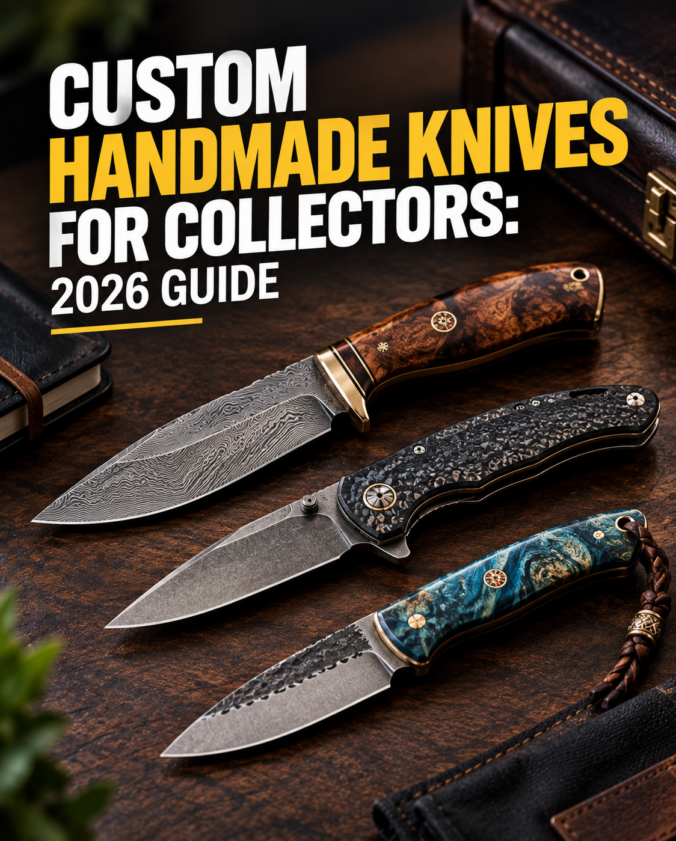
TL;DR: – Entry-level custom knives start at $200–$450; ABS Journeyman Smith damascus pieces run $800–$2,750; investment-grade Master Smith integrals reach $4,000–$12,000+
- ABS Master Smith designation (fewer than 130 smiths worldwide) is the most meaningful credential for evaluating quality and resale value
- Commission timelines average 3–18 months with 25–50% deposits; store pieces at 45–55% humidity to prevent cracking in natural handle materials
Introduction
So you’re thinking about buying your first custom handmade knife. (Si.edu) (Getty.edu) Maybe you’ve seen one at a show, or a friend’s collection caught your eye. Here’s the thing: the custom knife market can feel overwhelming if you don’t know what separates genuine craftsmanship from factory “custom shop” marketing.
Based on our analysis of maker directories and valuation guides across the custom knife community, we’ve pulled together what actually matters when you’re dropping serious money on a handmade blade. This guide covers what makes a knife truly custom, realistic pricing across skill levels, how to vet makers without getting burned, and what happens after you bring your piece home.
Let’s dig in.
What Makes a Knife Truly Custom and Handmade?
Here’s where most people get confused: the term “handmade” has no legal definition in the US knife industry. That means a CNC-ground blade finished by hand can legally be sold as handmade. So what actually separates a true custom from a factory piece?
According to Knife Depot’s custom handmade collector knives guide, an ABS Master Smith designation is the most meaningful credential for collectors evaluating quality. But let’s break down what you’re actually looking for.
Three hallmarks of genuine custom work:
- Hand-ground blade. The maker shaped the blade profile, spine, and edge geometry by hand – not CNC. You’ll see slight variations in grind lines that reflect the maker’s technique. This isn’t a flaw; it’s proof of individual craftsmanship.
- Maker’s mark. A legitimate custom knife bears the maker’s stamp or signature on the blade or tang. If there’s no mark, walk away. According to Jay Fisher, a professional full-time custom knifemaker since 1988, a handmade knife is generally described as one that is made offhand – meaning the maker controls every step.
- Documented provenance. You should receive paperwork: maker’s name, steel type, handle material, date completed. This matters for resale and insurance. As William Henry demonstrates through pieces like the Spearpoint ‘Independence Hall II’ featuring hand-sculpted stainless frames and hand-forged damascus blades, a well-documented piece is not only a functional item but a true collector’s artifact with traceable origins.
The credential tiers:
The American Bladesmith Society (ABS) offers three levels. Journeyman Smiths may use stock-removal methods (grinding pre-made steel blanks). Master Smiths must demonstrate forged blade construction – they heat steel and shape it by hammer. A Master Smith is the highest skill rating the ABS offers, and there are fewer than 130 worldwide.
This distinction matters enormously. A Journeyman Smith’s work can be excellent, but a Master Smith stamp signals that the maker has passed rigorous performance tests: chopping a free-hanging rope, bending the blade 90 degrees without breaking, and shaving hair cleanly.
Key Takeaway: Genuine custom knives have a maker’s mark, hand-ground blade geometry, and documented provenance. [ABS Master Smith designation (fewer than 130 smiths worldwide) is the most meaningful credential for collectors evaluating quality and resale potential.]
How Much Do Custom Handmade Collector Knives Cost?
Let’s talk money, because this is the question that stops most people cold.
Entry-level custom knives from emerging makers typically run $200–$450. Mid-tier ABS Journeyman Smith damascus pieces cost $800–$2,750, depending on handle material and complexity. Investment-grade Master Smith integrals (one-piece construction) reach $4,000–$12,000+.
What drives the cost?
- Steel type. High-carbon steels like 1084 and 1095 cost less than specialty powders like CPM-3V or CPM Magnacut. Damascus adds 30–50% to the base price.
- Handle material. Micarta or stabilized wood runs $100–$300. Mammoth ivory or exhibition-grade burl can double the knife’s base price.
- Maker reputation. A Journeyman Smith charges less than a Master Smith with a 12-month wait list.
- Engraving or inlay. Custom artwork adds $200–$1,000+.
- Commission vs. stock. Buying from a maker’s existing inventory costs less than commissioning a custom piece.
Real example: An ABS Journeyman Smith damascus drop-point hunter typically ranges $700–$1,100 depending on handle material. The same style in monosteel (single steel, no pattern) from the same maker might be $500–$750. That 30–50% damascus premium reflects genuine additional labor.
Commission deposits typically run 25–50% with 3–18 month timelines. Most makers want 50% upfront to hold your slot. If someone demands 100% upfront, that’s a red flag – it’s not standard industry practice.
Key Takeaway: Entry-level custom knives run $200–$450; mid-tier ABS Journeyman Smith damascus pieces cost $800–$2,750; investment-grade Master Smith integrals reach $4,000–$12,000+. Commission deposits typically run 25–50% with 3–18 month timelines.
Top Steel and Handle Materials Collectors Prioritize
Steel choice affects both how a knife performs and how it looks – which matters for collectors.
High-carbon steels (1084, 1095, 52100) are the traditional choice for custom work. They’re easier to forge, develop beautiful patinas over time, and can be differentially hardened to show a visible hamon (temper line). The trade-off: they rust if you don’t maintain them. Collectors who display their pieces accept this as part of the aesthetic.
Stainless and semi-stainless (440C, 154CM, CPM-3V) resist corrosion but are harder to forge and don’t develop the same visual character. CPM-3V is prized for working knives because it’s tougher than high-carbon steels – it resists chipping under hard use. But it won’t show a hamon, so display-focused collectors often skip it.
Specialty powders (CPM Magnacut, M390, S90V) offer extreme edge retention and corrosion resistance. They’re expensive and require specialized equipment to forge, so you’ll only see them from established makers. CPM Magnacut at 63 HRC can show up to 30–40% more cutting endurance on rope tests than the same steel at 60 HRC. Understanding why requires a basic grasp of metallurgy – the science and technology of metals and how their properties are affected by heat treatment, which directly governs how hardness and edge retention vary at different HRC ratings.
Damascus (pattern-welded steel) is forged from multiple steel layers, creating visible patterns. Genuine damascus shows layer lines throughout the blade cross-section. Fake damascus is plain steel with an acid-etched surface pattern – if you re-grind it, the pattern disappears. The damascus premium reflects the forge-welding labor and the metallurgical complexity of bonding dissimilar steels – a process that depends on achieving consistent layer adhesion and pattern integrity.
Handle materials matter for both aesthetics and durability.
Stabilized wood (burl, spalted maple) is affordable and beautiful. Micarta is durable and comes in many colors. Stag (deer antler) is traditional and collectible but requires careful humidity control – it can crack if stored too dry.
Mammoth ivory is rare and visually stunning. It commands premium prices and requires CITES documentation for international sale. Premium handle materials – mammoth ivory, stabilized exhibition burl – routinely command significant premiums versus a Micarta-handled equivalent.
Storage matters. Store pieces at 45–55% relative humidity to prevent cracking in natural handle materials. Avoid oak or chestnut display cases – they off-gas acetic acid that accelerates corrosion on carbon steel.
Key Takeaway: High-carbon steels (1084, 1095, 52100) are traditional for custom work and develop beautiful patinas; CPM-3V offers toughness for working knives; damascus commands premiums. Premium handle materials like mammoth ivory can significantly increase a knife’s base price.
How to Find and Vet a Custom Knife Maker
This is where most collectors either succeed or get burned.
Where to find makers:
The American Bladesmith Society directory lists all ABS members by credential level. This is your most reliable starting point. You can filter by location, skill level, and specialty.
[Blade Show Atlanta is the single largest annual event, attracting over 1,500 exhibitors and tens of thousands of collectors.] If you’re serious about collecting, attend. Many top-tier makers close their commission lists to the public and only accept new clients through in-person introductions at shows.
Instagram and maker websites are useful for seeing current work, but they’re not vetting tools. Anyone can post photos.
Your 5-point vetting checklist:
- Portfolio depth. Does the maker have 20+ finished pieces documented? Can you see their work over 3+ years? Consistency matters.
- Steel certifications. Ask for mill certs on specialty steels. Legitimate makers can provide documentation proving they’re using the steel they claim.
- Customer reviews. Search forums (Reddit r/knives, BladeForums) for mentions of this maker. Look for patterns – not one-off complaints, but consistent feedback.
- Return or satisfaction policy. What happens if the knife arrives and the grind is off, or the handle cracks? Legitimate makers stand behind their work.
- Lead times and communication. Do they respond to inquiries within 48 hours? Do they provide progress updates? Flaky communication is a red flag.
Red flags to walk away:
- No maker’s mark or signature
- Vague steel sourcing (“high-quality steel” instead of “1095 high-carbon”)
- Pressure to pay 100% upfront
- No portfolio or references
- Unwillingness to discuss materials or process
The commission process (typical timeline):
- Initial contact (1–2 weeks): You reach out, discuss design, agree on price and timeline.
- Deposit (immediate): You send 25–50% to hold your slot.
- Design approval (1–2 weeks): Maker sends sketches or photos; you approve or request changes.
- Build phase (3–12 months): Maker forges, grinds, heat-treats, and finishes the blade. You may receive progress photos.
- Final inspection (1–2 weeks): Maker does final sharpening, handle finishing, and quality checks.
- Delivery (1–2 weeks): You pay the balance, knife ships.
Total: 4–18 months depending on maker demand and complexity.
Key Takeaway: Vet makers through ABS directories, Blade Show attendance, and forum reputation. Require portfolio depth, steel certifications, and clear communication. Avoid makers demanding 100% upfront deposits or offering vague steel sourcing.
What Knife Styles Are Most Popular With Collectors?
Not all knife styles hold value equally. Some appreciate; others plateau.
Bowies are the classic collector knife. Large, dramatic, historically significant. Work by a maker producing 70–100 knives per year sells 30–60% above original price after 3–5 years, while ‘quasi‑custom’ factory limited editions are resold at a 10–20% discount after a couple of years. Bowies from established makers tend to be in that appreciating category.
Fighters (short, aggressive blade geometry) are highly collectible, especially presentation-grade pieces with ornate handles or damascus blades.
Hunters (drop-point or clip-point) are practical and collectible, but they appreciate more slowly than bowies or fighters. They’re popular with working collectors who actually use their pieces.
Art knives (daggers, friction folders, sculptural pieces) are the wildcard. They’re collectible if the maker is established and the design is distinctive. Resale is less predictable.
Japanese-style honyaki (single-material, differentially hardened) knives are among the most technically demanding and collectible globally. Western makers producing honyaki-style pieces command premium prices.
Regional traditions matter. Scandinavian Sami-style knives have a devoted collector base. Japanese forging traditions attract serious collectors. American Bowie and fighter traditions dominate the US market.
The safest bet for appreciation: buy from an ABS Master Smith, choose a classic style (Bowie, fighter, or hunter), and select a piece with distinctive handle material or damascus. These tend to hold or gain value over 5+ years.
Key Takeaway: Bowies and fighters from ABS Master Smiths appreciate significantly over 3–5 years; hunters appreciate more slowly; art knives are unpredictable. Choose classic styles with distinctive materials for the best resale potential.
How to Store, Display, and Protect Your Collection
You’ve invested serious money. Now protect it.
Storage for high-carbon steel:
High-carbon knives will rust if exposed to humidity above 60% or stored in acidic environments. Use Renaissance Wax (museum-standard protectant) on carbon steel pieces. Apply a thin coat and buff to clarity. Re-apply every 6–12 months for displayed pieces.
Store in a humidity-controlled case or cabinet. Target 45–55% relative humidity. Avoid oak or chestnut wood cases – they off-gas acetic acid that accelerates corrosion. Use powder-coated steel or anodized aluminum display cases.
For leather sheaths, ensure they’re vegetable-tanned and treated. Synthetic sheaths (Kydex) are safer for long-term storage because they don’t off-gas.
Display options:
Shadow boxes with UV-protective glass are ideal for high-value pieces. They protect from dust and light while allowing viewing. Wall-mounted racks work for active collections you rotate through.
Locked display cases are essential if you have pieces worth $1,000+. Theft is rare but happens.
Documentation:
Photograph the maker’s mark, handle, and blade from multiple angles. Keep maker invoices, certificates of authenticity, and any correspondence with the maker. This documentation is essential for insurance and resale.
If a piece is worth $500+, get a professional appraisal. Insurance companies require this for scheduled personal property riders.
Insurance:
Standard homeowner’s policies typically cap coverage for collectibles at $1,000–$2,500 total. A scheduled personal property rider covers individual items at appraised replacement value with no deductible. For a collection worth $5,000+, this is non-negotiable.
Key Takeaway: Store high-carbon steel at 45–55% humidity with Renaissance Wax protection. Use UV-protective shadow boxes for display. Document maker marks and obtain professional appraisals for pieces over $500. Add scheduled personal property riders to your insurance for collections over $5,000.
Frequently Asked Questions
How much should I pay for my first custom handmade collector knife?
Direct Answer: Start with $300–$600 from an emerging ABS Journeyman Smith. This gives you genuine handwork without the premium prices of established makers.
Entry-level custom knives from emerging makers typically run $200–$450. At this price point, you’re buying from makers building their reputation. The work is solid, but you’re not paying for a 12-month wait list. As you learn what you like, you can move up to mid-tier pieces ($800–$2,750) from established Journeyman Smiths.
What is the difference between a custom knife and a handmade knife?
Direct Answer: “Custom” means made to your specifications; “handmade” means made by hand (though this term has no legal definition). A knife can be custom but factory-made, or handmade but stock design.
True custom handmade knives combine both: a maker forges or grinds a blade specifically for you, to your design preferences. Factory “custom shop” knives are production runs with limited variations – not true customs. [A handmade knife is generally described as one that is made offhand, meaning the maker controls every step.]
Which steel holds its value best in a custom knife collection?
Direct Answer: High-carbon steels (1084, 1095, 52100) and damascus hold value best because they’re traditional, develop character over time, and are preferred by serious collectors.
Stainless steels are practical but don’t appreciate as quickly. Specialty powders (CPM-3V, CPM Magnacut) are durable but less collectible because fewer makers work with them. Damascus commands premiums because of the labor involved in pattern-welding. If you’re buying for appreciation, choose high-carbon or damascus from an established maker.
How long does it take to commission a custom knife from a maker?
Direct Answer: Typically 4–18 months from deposit to delivery, depending on maker demand and complexity.
Commission timelines average 3–18 months. Emerging makers might deliver in 3–6 months. Established ABS Journeyman Smiths often quote 6–12 months. Top-tier Master Smiths may have 12–24 month wait lists. Complex pieces (damascus, engraving, ornate handles) add 2–3 months.
Are custom handmade knives a good investment?
Direct Answer: Yes, but only if you buy from established makers and choose classic styles. Pieces from ABS Master Smiths appreciate 30–60% over 3–5 years.
Work by a maker producing 70–100 knives per year sells 30–60% above original price after 3–5 years. The key is buying the right maker and style. Bowies and fighters from Master Smiths tend to appreciate. Hunters appreciate more slowly. Factory “custom shop” pieces often resell at a loss. Treat it as a long-term hold (5+ years) rather than a quick flip.
How can I tell if a handmade knife is authentic and not a factory copy?
Direct Answer: Check for a maker’s mark, verify the maker through ABS directories, and inspect the blade grind for hand-work signatures (slight variations in grind lines).
Authentic custom knives have a maker’s stamp or signature on the blade or tang. Verify the maker’s name through the ABS directory or their official website. Examine the grind – hand-ground blades show subtle variations that reflect individual technique. Factory copies have uniform, machine-perfect grinds. Ask for documentation: maker’s name, steel type, date completed. Legitimate makers provide this.
What knife styles are easiest to resell in the collector market?
Direct Answer: Bowies and fighters from ABS Master Smiths resell fastest. Hunters and outdoor styles have a smaller but steady resale market.
Bowies are the classic collector knife with broad appeal. Fighters attract tactical and art knife collectors. Hunters appeal to working collectors but appreciate more slowly. Art knives and experimental styles are harder to resell unless the maker is very established. Stick with classic styles from recognized makers if resale is a priority.
Conclusion
Building a custom knife collection doesn’t require deep pockets or decades of experience. It requires knowing what separates genuine craftsmanship from marketing, understanding the price tiers, and vetting makers carefully.
Start with an entry-level piece from an emerging ABS Journeyman Smith. Learn what you like – steel, handle material, blade geometry. Attend Blade Show or a regional knife show. Meet makers in person. Build relationships. Then move up to mid-tier and investment-grade pieces as your knowledge and budget grow.
The custom knife market rewards patience and education. Buy from established makers with documented track records. Choose classic styles. Store your pieces properly. And remember: the best knife is the one you’ll actually use and enjoy for decades.
Ready to start your collection? Knife Depot specializes in connecting collectors with custom makers and providing resources for building meaningful collections. Whether you’re looking for your first piece or adding to an established collection, the community is welcoming and the craftsmanship is real.
Leave a Reply