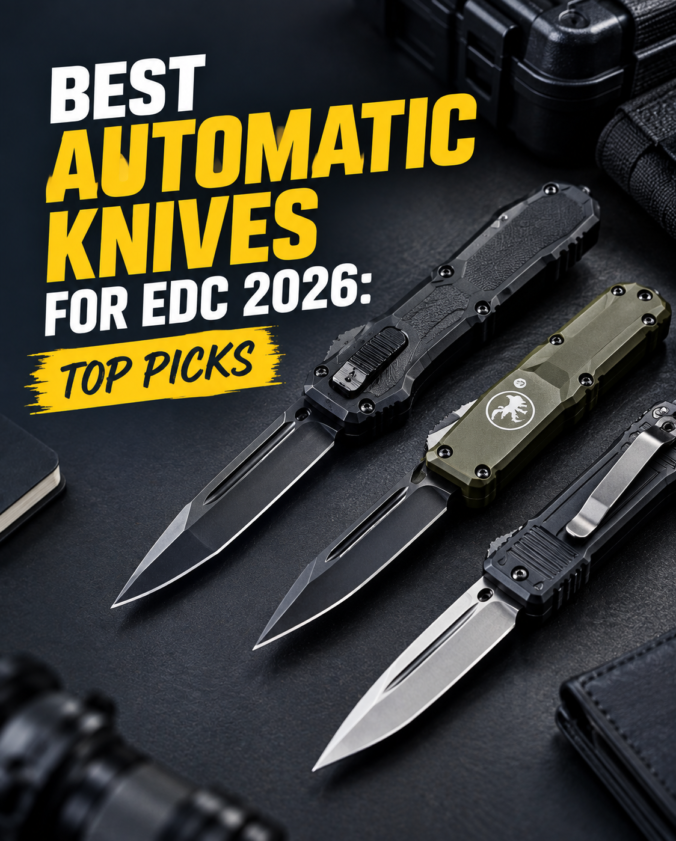
TL;DR: Choose an automatic EDC knife by working through four questions: Is the exact knife lawful for your circumstances? Does its blade and handle fit your daily tasks? Do you prefer side-opening or OTF operation? Can you maintain and service that model? Price and steel names alone do not answer those questions.
Introduction
Two automatic knives can have similar prices but very different blade sizes, controls, and pocket fit. This guide provides a decision framework, with model-specific examples, to help you compare them. For current product choices, browse our automatic knife collection. For a separate carry-format comparison, see automatic knives for everyday carry.
What Makes an Automatic Knife Good for EDC?
OTF vs. Side-Opening: The Mechanism Matters
A side-opening automatic swings its blade around a pivot. An automatic OTF moves its blade along the handle and out through the front. Double-action OTFs use a switch for both deployment and retraction; single-action models use a separate manual reset. The opening category alone does not establish speed, durability, or safety.
The Launch 4 is a side-opening automatic. The Livewire is an automatic OTF. Confusing those two formats can lead to buying a knife with the wrong controls or blade size.
Five EDC Criteria That Actually Matter
- Cutting tasks: Compare blade shape, edge configuration, usable edge, and handle fit.
- Carry dimensions: Check closed length, thickness, weight, and clip placement.
- Controls: Verify how the exact model opens, closes, and uses any safety features.
- Materials: Evaluate steel with heat treatment and blade geometry, plus the complete handle construction.
- Support: Read model-specific maintenance instructions and warranty terms.
No blade length or weight is a universal EDC baseline. A compact knife can suit light cutting; a larger handle or blade may fit other tasks. Neither automatically establishes lawful carry.
Are Automatic Knives Legal to Carry Every Day?
Verify current rules for ownership, purchase, shipping, transport, carry method, age, and restricted locations. State and local requirements and exceptions differ. A state count or a simple “legal/banned” label cannot describe every circumstance.
Federal switchblade rules also include specific definitions, restrictions, and exceptions. Do not interpret this article as blanket permission to own, ship, mail, or transport an automatic knife across state lines. Consult current official law and qualified guidance when necessary. A short blade does not create nationwide permission. This is general information, not legal advice.
Best Automatic Knives for EDC: Our 2026 Picks
The following configurations illustrate different size and mechanism choices. This is a specification comparison, not a report of controlled deployment or edge-retention testing. Check current prices and stock on the product pages.
Compact Side-Opening: Kershaw Launch 4 7500BLK
Kershaw specifies a 1.9-inch CPM-154 blade, 3.2-inch closed length, 1.8-ounce weight, and 6061-T6 aluminum handle for the 7500BLK. It uses push-button opening and a push-button lock release, with a single-position right-hand tip-up clip. It is not a 3.4-inch OTF and the cited configuration is not an 8Cr13MoV version.
Compare it when compact dimensions matter. Check whether the short usable edge and small handle suit your tasks before treating it as your main work knife.
Larger Side-Opening: Benchmade Claymore 9070
The documented 9070 configuration uses CPM-D2, a 3.6-inch blade, a 5-inch closed length, and a listed weight of 3.5 ounces. It is a side-opening push-button automatic with Grivory handles. These specifications correct the earlier S30V and 3.45-inch figures. Do not confuse the 9070 with the separate Claymore OTF models or apply its specifications to later Claymore generations.
Its larger size is a meaningful comparison with the Launch 4. Verify the exact suffix, edge configuration, and controls on the model you are considering.
Double-Action OTF: Kershaw Livewire 9000BLK
The Livewire 9000BLK has a 3.3-inch CPM MagnaCut blade with black PVD coating, a 4.8-inch closed length, a 6061-T6 aluminum handle, and a listed weight of 3.1 ounces. Its switch deploys and retracts the blade. The previous $60–$100/8Cr13MoV description did not match this configuration.
Its reversible deep-carry clip offers a different carry arrangement from the Launch 4. For current OTF recommendations, see our OTF buying guide.
Other Models to Compare by Exact Configuration
Microtech Ultratech and Gerber 06 Auto models can offer different blade and handle configurations. Verify the complete SKU before comparing steel, weight, dimensions, or price. A family name does not support one universal specification or a promise of trouble-free operation.
Comparison Table: Identified Configurations
| Model | Format | Blade | Steel | Weight |
|---|---|---|---|---|
| Launch 4 7500BLK | Side-opening auto | 1.9 inches | CPM-154 | 1.8 oz |
| Claymore 9070, documented configuration | Side-opening auto | 3.6 inches | CPM-D2 | 3.5 oz |
| Livewire 9000BLK | Double-action OTF | 3.3 inches | CPM MagnaCut | 3.1 oz |
How Much Should You Spend?
Set a budget, then compare actual current listings. Price alone does not guarantee a steel grade, heat treatment, tight tolerances, or warranty coverage. There is no substantiated universal claim here that one price tier provides two or three times the edge retention of another.
Include service availability and maintenance in the comparison. Read the warranty exclusions and any shipping or service costs rather than assuming that a premium price includes every future repair.
Carry and Maintenance Checklist
- Confirm the pocket clip position and whether it can be moved.
- Keep the blade’s opening path clear and follow the manufacturer’s handling instructions.
- Clean off cutting residue before closing or retracting the blade.
- Use the lubricant and cleaning method recommended for the exact model.
- If deployment becomes inconsistent, stop using the malfunctioning mechanism and contact the manufacturer.
Routine OTF care need not require disassembly. Avoid applying one maker’s cleaning instructions to every automatic knife.
Frequently Asked Questions
Is the Kershaw Launch 4 an OTF?
No. It is a side-opening automatic; the 7500BLK configuration has a 1.9-inch CPM-154 blade.
Does a more expensive automatic always hold an edge longer?
No. Steel, heat treatment, geometry, edge condition, and cutting material all affect performance. Compare evidence for the actual knives.
Can I choose an automatic by blade length alone?
No. Consider the applicable law, handle fit, closed dimensions, clip, mechanism, and intended tasks.
What is the practical advantage of a double-action OTF?
The same switch operates both powered deployment and retraction. Whether that is useful depends on your tasks and preference.
Conclusion
Identify the exact model, confirm lawful use, compare its physical fit and controls, then check current price and service support. Browse automatic knives or OTF knives to compare current configurations.
Sources
- Kershaw catalog: Launch 4 specifications
- Kershaw catalog: Livewire 9000BLK specifications
- Benchmade Claymore 9070 announcement published by AKTI
- Benchmade use and care
Leave a Reply