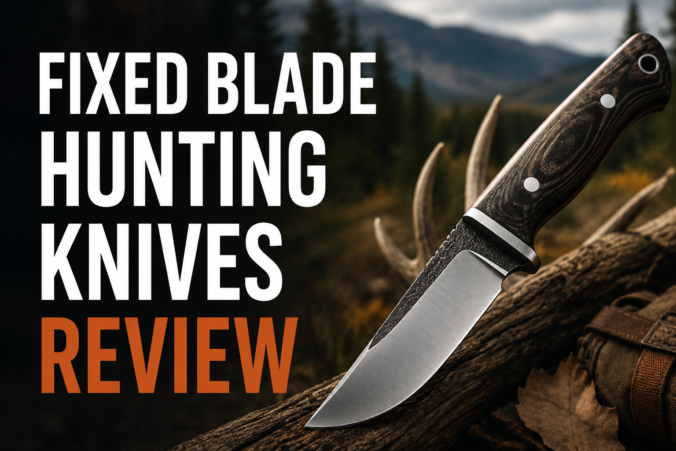
TL;DR: – Full-tang construction and blade steel grade are your two biggest purchase variables; VG-10 at 60–61 HRC holds an edge through 5–6 field dressing sessions vs. 1095 carbon requiring touch-up after 2–3.
- Budget picks ($50–$80) use 440C stainless; mid-tier ($150+) step up to D2 or VG-10 with noticeably better edge retention.
- Fixed blades outperform folders in field conditions because they lack the pivot mechanism that traps blood and weakens under torque.
What Makes a Fixed Blade Knife Worth Buying for Hunting?
You’re choosing a fixed blade because you need reliability when it matters most – when you’re field dressing game in cold, wet conditions where a folding knife’s pivot point becomes a liability. The right fixed blade combines four non-negotiable specs: full-tang construction, proven blade steel, handle material that grips when bloody, and a sheath that won’t fail under pack pressure.
Full-tang construction means the blade and tang are one continuous piece of steel, eliminating the weakest point of partial-tang designs. This matters because quartering an elk applies lateral torque that can snap a partial tang. You’re not just buying a blade – you’re buying structural integrity.
Blade steel grade determines edge retention and maintenance burden. According to Knife Steel Nerds, VG-10 stainless at 60–61 HRC outperforms 1095 carbon in edge retention testing, holding a usable edge through approximately 5–6 field dressing sessions before needing a strop, versus 1095 requiring touch-up after 2–3 sessions. The tradeoff: 1095 is easier to sharpen in camp with a stone, while VG-10 demands a strop or professional sharpening.
Handle material determines whether your knife stays in your hand when it’s coated in blood and rain. G10 and Micarta maintain grip when wet; wood becomes slippery and cracks with repeated moisture exposure without treatment. Rubber handles offer maximum wet grip but can degrade with petroleum-based product exposure.
Sheath quality is a co-equal component of field performance. Kydex sheaths retain the blade securely under pack pressure and draw silently, while leather sheaths expand when wet and can allow accidental draw. If your sheath fails, your knife becomes a liability.
Key Takeaway: Prioritize full tang, stainless or semi-stainless steel (VG-10, D2), G10/Micarta handles, and Kydex sheaths. These four specs eliminate 80% of low-quality options before you even compare brands.
How Do These Hunting Knives Compare? Full Specs Table
Here’s where most reviews fail you: scattered specs across different websites, no HRC hardness data, and no task-specific suitability ratings. Below is a centralized comparison of six production fixed blades with blade length, steel type, hardness, weight, and price range.
| Knife | Blade Steel | HRC | Blade Length | Overall Length | Weight (oz) | Price Range | Full Tang |
|---|---|---|---|---|---|---|---|
| Buck 119 Special | 420HC | 58 | 6″ | 10.75″ | 7.1 | $80–$120 | Yes |
| Benchmade Hidden Canyon Hunter | CPM-S30V | 59–60 | 2.67″ | 6.2″ | 2.7 | $150–$180 | Yes |
| ESEE-6 | 1095 Carbon | 55–57 | 6.5″ | 11.75″ | 9.9 | $120–$150 | Yes |
| Mora Companion HD | Carbon Steel | 56–58 | 4.1″ | 9.1″ | 4.1 | $20–$30 | Stick Tang |
| Ontario RAT-7 | 1095 Carbon | 55–57 | 7″ | 12.5″ | 11.5 | $60–$80 | Yes |
| Boker Arbolito El Heroe | DIN 1.4116 | 57–59 | 4.13″ | 8.5″ | 5.2 | $80–$120 | Yes |
Why HRC matters: Hardness directly correlates to edge retention in cold, wet hunting conditions. A blade at 57 HRC will dull faster on bone contact than one at 60 HRC, but it’s easier to sharpen in camp with a basic stone. Higher HRC (59–61) means fewer touch-ups in the field but requires a strop or professional sharpening.
The Mora Companion HD uses stick-tang construction (the handle is attached to a tang that doesn’t extend the full width), which is robust for its $20–$30 price tier but not equivalent to full tang under lateral stress during quartering.
Key Takeaway: The Buck 119 Special and Ontario RAT-7 offer the best full-tang value under $100. The Benchmade Hidden Canyon Hunter is the lightest option at 2.7 oz – ideal for backcountry where every ounce counts. The ESEE-6 is the heaviest at 9.9 oz but excels at hard camp tasks.
Top Fixed Blade Hunting Knives Reviewed (2026)
Best Overall: Buck 119 Special
The Buck 119 Special is the hunting knife that works for 90% of hunters because it doesn’t specialize – it generalizes. The 420HC stainless blade at 58 HRC is not premium-tier, but it holds an edge through 3–4 field dressing sessions before needing a strop. The 6-inch blade length is long enough for deer and elk but short enough to control in tight gutting cuts. Full tang, genuine leather sheath, and a price point under $100 make this the no-regrets choice if you’re buying your first fixed blade.
Best for: Deer and elk field dressing, general camp use, hunters who want simplicity over specialization.
Limitation: 420HC doesn’t match VG-10 or D2 in edge retention. You’ll strop more frequently than with premium steels.
Rating: ★★★★★ Field dressing | ★★★★☆ Skinning | ★★★★☆ Camp chores
Best Budget Pick (Under $80): Ontario RAT-7
At $60–$80, the Ontario RAT-7 is the best value hard-use hunting and camp knife. The 1095 carbon steel at 55–57 HRC trades some edge retention for toughness – it resists chipping on bone or rock better than higher-HRC blades. The 7-inch blade is long and heavy (11.5 oz total), optimized for camp processing and heavy-duty tasks like splitting kindling or quartering large game.
Best for: Hunters who process their own game, backcountry camp work, anyone who needs a knife that can handle abuse.
Limitation: 1095 corrodes rapidly when exposed to blood and moisture. You must oil and dry it immediately after use in wet conditions. Not ideal for wet-climate hunts without daily maintenance.
Rating: ★★★★☆ Field dressing | ★★★☆☆ Skinning | ★★★★★ Camp chores
Best for Skinning and Field Dressing: Benchmade Hidden Canyon Hunter
The Benchmade Hidden Canyon Hunter is a specialist’s knife. At 2.67 inches and 2.7 oz, it’s the lightest production fixed blade reviewed here. CPM-S30V steel at 59–60 HRC holds an edge exceptionally well – you’ll get 6–7 field dressing sessions before needing a strop. The short blade gives you surgical control when separating hide from muscle.
Best for: Upland bird hunting, small-game processing, backcountry hunts where weight matters, hunters who value precision over power.
Limitation: At 2.67 inches, this blade is insufficient for elk or large-game field dressing. You need leverage that only a 5+ inch blade provides. This is a specialist tool, not a general-purpose knife.
Rating: ★★★★★ Skinning | ★★★★☆ Field dressing (small game) | ★★☆☆☆ Camp chores
Best Heavy-Duty Camp and Hunt Combo: ESEE-6
The ESEE-6 is built for hunters who process their own game and spend weeks in the backcountry. The 1095 carbon steel at 55–57 HRC is intentionally softer than premium steels – this trades edge retention for toughness and ease of field sharpening. The 6.5-inch blade and 9.9 oz weight make it a serious tool for splitting wood, quartering elk, and camp chores.
Best for: Backcountry hunters, game processors, anyone who needs one knife to handle everything from field dressing to camp construction.
Limitation: At 9.9 oz, this is heavy for all-day carry. The 1095 steel requires daily oiling in wet conditions. Not ideal if you’re hiking 10+ miles daily.
Best Lightweight Option for Backcountry: Mora Companion HD
The Mora Companion HD costs $20–$30 and weighs 4.1 oz. It’s a stick-tang knife (not full tang), but the construction is robust for its price tier. The carbon steel blade at 56–58 HRC is easy to sharpen in camp with a basic stone. The 4.1-inch blade handles small-game field dressing and general camp tasks.
Best for: Budget-conscious hunters, backcountry trips where weight is critical, anyone who wants a functional knife without premium pricing.
Limitation: Stick-tang construction means lateral torque can fail the handle-to-blade connection. Not suitable for quartering large game. Carbon steel requires oiling after use in wet conditions.
Rating: ★★★★☆ Field dressing (small game) | ★★★☆☆ Skinning | ★★★★☆ Camp chores
Best Premium Pick (Over $200): Boker Arbolito El Heroe
The Boker Arbolito El Heroe is a mid-tier European production knife that punches above its weight. DIN 1.4116 stainless steel at 57–59 HRC is comparable to 440A/B – functional but not premium-tier edge retention. The 4.13-inch blade, full-tang construction, and olive wood handle scales make this a knife you’ll want to carry for aesthetics as much as performance.
Best for: Hunters who value craftsmanship and aesthetics, those who want a full-tang stainless without paying S30V prices, collectors who appreciate European blade design.
Limitation: DIN 1.4116 doesn’t match VG-10 or D2 in edge retention. You’ll strop more frequently than with premium steels. Price point ($80–$120) is higher than comparable performance from Buck or Ontario.
Rating: ★★★★☆ Field dressing | ★★★★☆ Skinning | ★★★★☆ Camp chores
Which Blade Steel Should You Choose for Hunting Conditions?
Your hunting environment determines whether you need stainless or carbon steel. This is the single biggest decision after full-tang construction.
Stainless steels (440C, VG-10, DIN 1.4116) are superior for wet and marine environments. VG-10 at 60–61 HRC offers excellent edge retention for a stainless steel and outperforms 1095 in edge retention testing. The tradeoff: stainless steels are harder to sharpen in the field and require a strop rather than a basic stone.
High-carbon steels (1095, D2) offer better edge retention in dry conditions but require oiling within hours of blood exposure to prevent surface oxidation. 1095 is very prone to rust and needs to be oiled and dried immediately after use in wet conditions. If you’re hunting in rain or near water, carbon steel becomes a maintenance burden.
D2 tool steel at 59–61 HRC offers superior edge retention to 440C and is easier to field-sharpen than S30V, making it a strong mid-tier hunting steel. D2 has excellent wear resistance and edge retention, better than 440C, but it’s semi-stainless (12% chromium) – still requiring more maintenance than full stainless in wet conditions.
Decision matrix:
- Wet/marine hunts (coastal, swamp, rain-heavy regions): Choose VG-10 or 440C stainless. Maintenance is minimal.
- Dry/camp hunts (desert, high elevation, drive-in camps): Choose 1095 or D2 carbon. Edge retention is superior, and you can sharpen with a basic stone.
- Mixed conditions (uncertain weather): Choose D2 as a compromise – better edge retention than 440C, more corrosion-resistant than 1095.
Key Takeaway: VG-10 stainless at 60–61 HRC is the best all-around hunting steel if you hunt in wet conditions. 1095 carbon is the best if you hunt dry and can maintain it daily. D2 splits the difference.
How to Choose the Right Fixed Blade Knife for Your Hunt Type
Blade length is a heuristic, not a law. A blade of 3–4 inches is appropriate for birds and small game; 4–5 inches for deer; 5+ inches for elk/bear processing, based on task geometry and leverage requirements. According to Field & Stream’s hunting knife guide, these dimensions align with professional field dressing standards.
Small-game hunts (upland birds, rabbits, squirrels): You need a short blade (2.5–3.5 inches) with surgical control. The Benchmale Hidden Canyon Hunter at 2.67 inches is ideal. Weight matters because you’re hiking all day. Stainless steel is preferred because you’ll encounter wet brush.
Deer hunts (whitetail, mule deer): A 4–5 inch blade gives you the leverage needed for deep cuts through hide and muscle without being unwieldy in tight gutting cuts. The Buck 119 Special at 6 inches is slightly long but still manageable. Carbon or semi-stainless steel works if you can maintain it.
Elk/bear hunts (big game processing): You need a 5+ inch blade for leverage through thick hide and muscle. The Ontario RAT-7 at 7 inches and ESEE-6 at 6.5 inches are appropriate. Weight becomes less critical because you’re processing at camp, not hiking all day. Carbon steel is acceptable because you’ll maintain it daily at camp.
Backcountry hunts (10+ mile pack-ins): Weight is critical. Every ounce matters over distance. The Mora Companion HD at 4.1 oz or Benchmale Hidden Canyon Hunter at 2.7 oz are appropriate. You sacrifice some camp utility for portability.
Handle material determines grip in field conditions. G10 and Micarta maintain texture when wet and bloody. Wood is traditional and aesthetically pleasing but becomes slippery when wet. Rubber offers maximum grip but can degrade with petroleum exposure.
Key Takeaway: Match blade length to game size: 3–4″ for birds, 4–5″ for deer, 5+ inches for elk. Choose stainless for wet hunts, carbon for dry hunts. Prioritize G10/Micarta handles if you process game in the field.
Frequently Asked Questions About Fixed Blade Hunting Knives
How much should I spend on a fixed blade hunting knife?
Direct Answer: Budget picks ($20–$80) use 440C or carbon steel and function adequately for casual hunters. Mid-tier knives ($150–$250) step up to D2 or VG-10 with noticeably better edge retention and full-tang construction.
Budget picks in the $50–$80 range use 440C stainless, which is a serviceable stainless steel but its edge retention is modest compared to better alloys. If you hunt 2–3 times per year and don’t process your own game, a $50 knife is sufficient. If you hunt frequently and field dress game, invest $150+ for D2 or VG-10 steel.
Are fixed blade knives better than folding knives for hunting?
Direct Answer: Yes. Fixed blades lack the pivot mechanism that traps blood and debris, and they don’t fail under lateral torque during quartering.
Fixed blades outperform folders in field conditions because the absence of a pivot point eliminates a structural weakness. Under lateral torque loads during quartering large game, locking folders can close on fingers – a documented safety concern. Fixed blades are also faster to deploy and cleaner to maintain in the field.
What blade length is best for deer field dressing?
Direct Answer: 4–5 inches. This length provides leverage for deep cuts through hide and muscle without being unwieldy in tight gutting cuts.
The Buck 119 Special at 6 inches is slightly long but still manageable. Anything shorter than 4 inches requires multiple passes; anything longer than 5 inches becomes difficult to control in confined spaces inside the body cavity.
How do I maintain and sharpen a fixed blade hunting knife?
Direct Answer: Carbon steel requires oiling immediately after use in wet conditions. Stainless steel requires minimal maintenance. All blades benefit from stropping (realigning the edge) after 3–4 field dressing sessions.
For field sharpening, carry a basic ceramic rod or leather strop. Carbon steel blades can be sharpened with a basic stone in camp. Stainless steel blades like VG-10 require a strop or professional sharpening because they’re harder and don’t respond well to field stones.
Is it legal to carry a fixed blade hunting knife while hunting?
Direct Answer: Yes, in most U.S. states during hunting season. However, regulations vary significantly by state and carry method.
California prohibits concealed carry of fixed blade knives regardless of length; Texas imposes no blade length restriction for hunting contexts. Always verify current local law before purchasing – statutes change and vary by county. This is general guidance, not legal advice.
What is the difference between a drop point and clip point blade for hunting?
Direct Answer: Drop point blades have a curved spine that curves downward to the tip, providing a larger cutting surface and better control during field dressing. Clip point blades have a straight spine with a clipped or curved section near the tip, offering a sharper point but less cutting surface.
Drop point is the standard for hunting knives because the curved spine gives you better control when separating hide from muscle. Clip point is more common in general-purpose or tactical knives.
Can I use a fixed blade hunting knife for camp chores and bushcraft tasks?
Direct Answer: Yes, but blade length and steel type determine suitability. A 6+ inch blade with carbon steel excels at camp tasks like splitting kindling and processing firewood. A 3–4 inch blade is limited to food prep and light cutting.
The ESEE-6 and Ontario RAT-7 are optimized for camp processing and heavy-duty tasks. The Benchmale Hidden Canyon Hunter is too short for camp work. Choose a knife that matches both your hunting task and your camp needs.
The Bottom Line
Choosing a fixed blade hunting knife comes down to matching steel type to your hunting environment, prioritizing full-tang construction, and selecting blade length based on game size. VG-10 at 60–61 HRC is the best all-around steel if you hunt in wet conditions. 1095 carbon is the best if you hunt dry and can maintain it daily. The Buck 119 Special offers the best balance of performance and price under $100. The Ontario RAT-7 is the best value for hard-use camp and hunt tasks. The Benchmale Hidden Canyon Hunter is the lightest option for backcountry hunts.
Don’t overthink this. A full-tang fixed blade with proven steel and a quality sheath will outlast you. If you’re ready to upgrade your hunting kit, Knife Depot carries a curated selection of fixed-blade hunting knives across all price tiers – from budget Mora knives to premium Benchmale and ESEE options. Their inventory includes detailed specs and real-world reviews from hunters who’ve actually used these knives in the field.
Your next hunt deserves a knife you trust. Choose full tang, proven steel, and a sheath that won’t fail. Everything else is refinement.
Leave a Reply