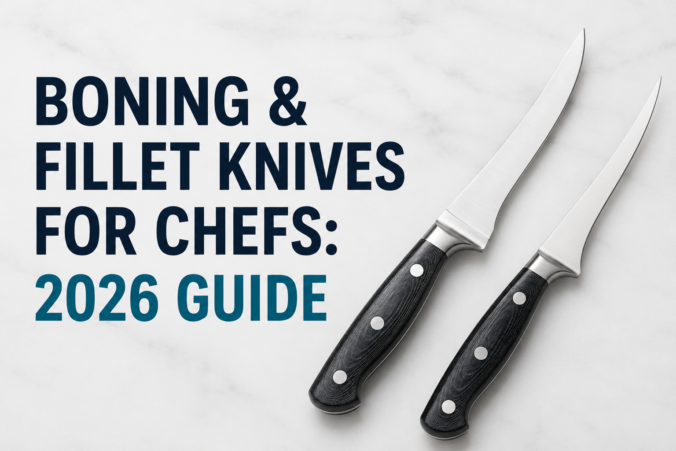
TL;DR: – A boning knife has a stiff or semi-flexible blade (2.5mm+ spine) for meat and poultry; a fillet knife is thinner and more flexible (≤1.5mm spine) for fish.
- German X50CrMoV15 steel (56–58 HRC) resists chipping on bone; Japanese VG-10 (60–62 HRC) holds a finer edge but is more brittle.
- Budget option: Victorinox Fibrox 6-inch boning knife (
$45); mid-range: Mercer Genesis ($50); premium: Wüsthof Classic (~$180).
Introduction
You’re standing at your prep station with a whole fish or a beef primal cut in front of you. Grab the wrong knife, and you’re wasting meat, dulling your blade faster, and fighting the tool instead of working with it. The difference between a boning knife and a fillet knife isn’t just marketing – it’s physics, metallurgy, and technique converging into one decision that affects your yield, your speed, and your food cost.
Based on our analysis of professional culinary training materials, manufacturer specifications, and metallurgical research, we’ve mapped out exactly which knife does what, which steel performs under commercial load, and how to keep these precision tools sharp enough to earn their place in your kit. This guide cuts through the noise and gives you the specs, the protein-specific use cases, and the real maintenance protocols that work in a busy kitchen.
What Are Boning and Fillet Knives?
A boning knife is designed for separating meat from bone with a stiff or semi-flexible blade; a fillet knife is designed for fish with a thinner, more flexible blade. The distinction matters because each knife’s geometry – blade length, spine thickness, edge angle, and flex profile – is optimized for a specific cutting environment.
Here’s the anatomical breakdown:
| Feature | Boning Knife | Fillet Knife |
|---|---|---|
| Blade Length | 5–6 inches | 6–9 inches |
| Spine Thickness | 2.5–3.5mm (stiff) or 2.0–2.5mm (semi-flex) | ≤1.5mm (fully flexible) |
| Edge Angle | 20–25° per side | 15–20° per side |
| Primary Use | Beef, pork, poultry, lamb | Fish, shellfish |
| Flex Profile | Minimal to moderate recovery | High recovery, follows contours |
Most boning knives run 5 to 6 inches, while fillet knives are usually 6 to 9 inches and sharpened to a more acute angle for clean fish cuts. The thinner spine of a fillet knife allows it to flex and conform to the natural curves of fish bones and skin, while a boning knife’s rigidity gives you the control and torque needed to work around dense bone structures in red meat and poultry.
A stiff boning knife won’t flex much – it’s built for leverage. A semi-flexible boning knife (sometimes called a “flexible boning knife”) splits the difference, offering some give while maintaining control. A fillet knife, by contrast, is almost willowy – it bends with your hand and recovers when you release pressure.
Key Takeaway: Boning knives (5–6 inches, 20–25° edge) handle meat and poultry; fillet knives (6–9 inches, 15–20° edge) are purpose-built for fish. Spine thickness – not brand – determines flex behavior.
Boning Knife vs Fillet Knife: Which Do You Need?
The answer depends on what you’re cutting. Use a stiff boning knife for large cuts like beef leg or pork shoulder where you need control around dense bone structures; flexible blades suit poultry and fish. But the real decision tree is protein-specific.
When to Use a Boning Knife
A boning knife excels when you’re working against resistance. Beef primals – chuck, rib, loin – have thick connective tissue and heavy bone. You need a blade that won’t flex under torque. A stiff boning knife (56–58 HRC German steel) lets you apply pressure without the blade bending away from the bone.
Pork butchery – breaking down a whole hog or working with bone-in cuts – also demands a stiff blade. The same applies to lamb and game birds where you’re separating joints and working through cartilage. A semi-flexible boning knife gives you slightly more finesse than a fully rigid blade while maintaining enough stiffness to handle the work.
Poultry is the gray zone. A flexible boning knife works well for breaking down whole chickens or ducks because you’re navigating joints rather than cutting through dense bone. But a semi-flex blade gives you more control if you’re processing high volume.
When a Fillet Knife Is the Better Choice
A fillet knife is non-negotiable for fish. The blade’s thinness and flex allow you to follow the lateral line, track the spine, and separate flesh from skin with minimal waste. A fully flexible fillet knife (spine ~1.5mm) recovers more flesh from flatfish than a semi-flex boning knife (~2.5mm spine) – estimated 15–20% more usable flesh when skinning flatfish, according to professional culinary practice.
Shellfish – lobster, crab, shrimp – also benefit from a fillet knife’s thin blade. You’re navigating tight spaces and delicate shells where a thicker blade would crush rather than cut.
The flex scale matters here: a fully flexible fillet knife (1.5mm spine) is ideal for flatfish like halibut, flounder, and sole. A semi-flex fillet knife (2.0–2.2mm spine) works for round fish like salmon, trout, and snapper. If you’re processing multiple species, a fully flexible blade is the safer bet – it adapts to all of them.
Key Takeaway: Beef, pork, and lamb = stiff boning knife. Poultry = semi-flex boning knife. Fish and shellfish = fillet knife. Protein determines tool, not preference.
What Blade Steel Should Chefs Look For?
Steel is where the real performance difference lives. Two knives with identical geometry but different steel will behave completely differently under commercial load.
German X50CrMoV15 steel (Wüsthof, Henckels) has a Rockwell hardness of 56–58 HRC; the lower hardness improves toughness, reducing chipping risk when the edge contacts bone. This is the workhorse steel for boning knives in professional kitchens. It’s forgiving – if your blade hits bone at an angle, it won’t shatter. It’s also easier to sharpen than harder steels.
Japanese VG-10 steel is typically hardened to around 60–61 HRC, enabling a finer edge angle (15°) but is more susceptible to micro-chipping under lateral bone stress. VG-10 is the standard for premium fillet knives (Shun, some Victorinox Fibrox models). It holds an edge longer than German steel, but it demands more careful technique – you can’t torque it against bone.
AUS-8 is a Japanese stainless steel hardened to 57–59 HRC. This is the sweet spot for mid-range fillet knives. You get decent edge life without the fragility of high-hardness Japanese steel.
Here’s the practical trade-off: In wet environments, high-carbon non-stainless steel requires rigorous drying after every use; stainless alloys are significantly more forgiving in commercial fish prep. If you’re processing fish all day, a stainless German or Japanese steel is non-negotiable. High-carbon carbon steel (like white steel or blue steel) will rust if you don’t dry it obsessively.
| Steel Type | HRC | Edge Retention | Corrosion Resistance | Sharpening Ease | Best For |
|---|---|---|---|---|---|
| X50CrMoV15 (German) | 56–58 | Good | Excellent | Easy | Boning knives, high-volume meat |
| VG-10 (Japanese) | 60–62 | Excellent | Good | Moderate | Premium fillet knives, fish |
| AUS-8 (Japanese) | 57–59 | Good | Excellent | Easy | Mid-range fillet knives |
| High-Carbon (Japanese) | 62–65 | Excellent | Poor | Moderate | Specialty knives (requires maintenance) |
Key Takeaway: German X50CrMoV15 (56–58 HRC) for boning knives; Japanese VG-10 (60–62 HRC) for premium fillet knives; AUS-8 (57–59 HRC) for budget-conscious fillet work. Stainless > high-carbon in wet fish environments.
Top Boning and Fillet Knives for Professional Kitchens (2026)
Best Boning Knives for Chefs
Victorinox Fibrox Pro 6-Inch Boning Knife (Stiff)
The Victorinox Fibrox Pro 6-Inch Boning Knife is a reliable, affordable option used widely in professional kitchens, priced around $45. The blade is X50CrMoV15 German stainless at 56 HRC – tough enough to handle beef primals without chipping. The Fibrox handle is NSF-certified polypropylene, meeting HACCP compliance standards for commercial kitchens. This is the knife you buy in bulk for a busy butcher shop or prep line.
Mercer Culinary Genesis 6-Inch Flexible Boning Knife
Mercer Culinary’s Genesis boning knife is a top culinary school pick, offering German steel blade at a student-accessible price point around $45. The blade is 1.4116 stainless at 56 HRC – slightly more flexible than the Victorinox, making it better for poultry and lamb. The handle is polypropylene, NSF-certified. This is the knife culinary schools recommend because it’s affordable, durable, and teaches proper technique without breaking the budget.
Wüsthof Classic 6-Inch Boning Knife
Wüsthof Classic boning knives are precision edge-tested and hardened to 58° Rockwell, available in curved or straight configurations. The steel is X50CrMoV15, and the blade is available in both stiff and semi-flexible profiles. Retail price: approximately $160–$185. This is the premium workhorse – if you’re processing 50+ beef primals per week, the edge retention and durability justify the cost. The curved blade is particularly useful for following the natural contours of large cuts.
Best Fillet Knives for Professional Use
Dexter-Russell 8-Inch Flexible Fillet Knife (S133-8)
Dexter-Russell fillet knives carry NSF certification and are standard equipment in commercial fishing and food processing environments. Retail price: $25–$35. The blade is stainless (55–56 HRC), and the handle is polypropylene. This is the budget option for high-volume fish processing. You’re not paying for edge retention – you’re paying for compliance and durability. Buy three and rotate them through the sharpening cycle.
Victorinox Fibrox Pro 7-Inch Flexible Fillet Knife
The Victorinox fillet knife uses the same X50CrMoV15 stainless as the boning knife but with a thinner, more flexible blade (approximately 1.5mm spine). Retail price: $50–$65. The 7-inch length is ideal for round fish (salmon, trout, snapper). The Fibrox handle is NSF-certified. This is the workhorse fillet knife for restaurants and catering operations.
Shun Classic 6-Inch Flexible Boning & Fillet Knife
Shun Classic knives feature VG-MAX steel, a proprietary alloy with higher vanadium content than VG-10, hardened to 61±1 HRC. The blade is thinner than a traditional boning knife but not as thin as a full fillet knife – it’s a hybrid. The handle is pakkawood (a wood-composite), which is not NSF-certified but offers superior ergonomics for extended use. Retail price: $180–$210. This is the premium choice if you’re doing both boning and filleting and want one knife to do both reasonably well.
Key Takeaway: Budget: Victorinox Fibrox (
$45 boning,$30). Premium: Wüsthof Classic ($60 fillet). Mid-range: Mercer Genesis ($45) or Dexter-Russell ($180) or Shun Classic ($200). NSF-certified handles (polypropylene, POM) required for HACCP compliance.
How Do You Sharpen and Maintain These Knives?
Sharpening frequency and angle are non-negotiable in a professional kitchen. Get this wrong, and your blade dulls faster, your yield drops, and your hand fatigue increases.
Fillet knives should be sharpened at 15–20 degrees per side for optimal slicing performance; boning knives, which face more torque, are best at 20–25 degrees. The finer angle on a fillet knife creates a thinner, sharper edge that glides through fish flesh. The steeper angle on a boning knife provides durability when you’re working against bone.
For sharpening method: a whetstone (1000–6000 grit progression) is the gold standard for thin blades. An electric sharpener can work for boning knives but tends to remove too much metal from a delicate fillet blade. A honing rod (ceramic or steel) is essential for daily maintenance – it realigns the edge without removing metal.
In a commercial kitchen with heavy use, daily honing and weekly whetstoning are appropriate for fillet knives; boning knives used on red meat may need whetstoning every 2–3 days. If you’re processing 15+ whole fish per service, hone before each session and strop or whetstone weekly. For boning knives in a butcher shop, hone daily and whetstone every 2–3 days depending on volume.
Storage matters. Flexible fillet knife blades should not be machine-dishwashed; high-temperature cycles stress the flex point near the bolster and can permanently alter flex profile. Hand wash immediately after use, dry completely, and store in a blade guard or knife roll. Storing a curved boning knife tip-down in a block can cause tip micro-damage over time; blade guards or a knife roll are safer for narrow, pointed blades.
For commercial kitchens, NSF International NSF/ANSI 2 standard governs food service equipment, including knife handle materials – natural wood handles are excluded from NSF certification. Stick with polypropylene (Fibrox), POM, or G10 handles. Pakkawood looks beautiful but won’t pass a health inspection in most jurisdictions.
Key Takeaway: Fillet knife: 15–20° angle, daily honing, weekly whetstoning. Boning knife: 20–25° angle, daily honing, every 2–3 days whetstoning. Never machine-wash flexible blades. Use NSF-certified handles for commercial kitchens.
FAQ: Boning and Fillet Knives for Chefs
Can you use a boning knife as a fillet knife?
Direct Answer: Technically yes, but you’ll waste meat and dull the blade faster. A boning knife’s stiff blade and thicker spine don’t conform to fish bones, so you’ll leave more flesh behind. A fillet knife’s flexibility is engineered for this task – use the right tool.
A stiff boning knife can break down a whole fish, but you’re fighting the tool. The blade won’t track the lateral line smoothly, and you’ll make multiple passes where one would suffice with a fillet knife. In a commercial kitchen, that’s lost yield and lost time.
How much should a chef spend on a boning or fillet knife?
Direct Answer: Budget $40–$60 for a professional-grade workhorse (Victorinox, Mercer, Dexter-Russell); $150–$210 for a premium knife (Wüsthof, Shun). The jump in price reflects edge retention and durability, not necessity.
A $45 Victorinox Fibrox boning knife will outlast a $200 knife if you maintain it properly. The premium knives hold an edge longer and require less frequent sharpening – relevant if you’re processing 100+ cuts per day. For most kitchens, mid-range is the sweet spot: good edge retention, NSF-compliant handles, and reasonable cost.
What is the difference between a flexible and stiff boning knife?
Direct Answer: Spine thickness determines flex. A stiff boning knife (2.5–3.5mm spine) resists bending and provides leverage for dense bone; a flexible boning knife (2.0–2.5mm spine) bends slightly, offering more finesse for poultry and delicate work.
Stiff boning knives are for beef, pork, and lamb. Flexible boning knives are for poultry, game birds, and situations where you need to navigate joints rather than cut through bone. The flex isn’t a weakness – it’s a feature that reduces hand fatigue and improves control on smaller cuts.
Are Japanese or German boning knives better for professional chefs?
Direct Answer: German X50CrMoV15 steel (56–58 HRC) is more forgiving for boning knives because it resists chipping when the edge hits bone. Japanese VG-10 (60–62 HRC) holds a finer edge but is more brittle – better for fillet knives where you’re not torquing against bone.
For boning work, German steel wins because toughness matters more than edge retention. For fillet work, Japanese steel wins because you need a finer edge and you’re not applying lateral force. If you want one knife to do both, AUS-8 steel (57–59 HRC) offers a balance.
How often should you sharpen a fillet knife in a commercial kitchen?
Direct Answer: Hone daily (before service), whetstone weekly if you’re processing 10–15 fish per service. If you’re processing 30+ fish per day, whetstone every 3–4 days.
The frequency depends on volume and what you’re cutting. Fish skin and bone dull a fillet knife faster than you’d expect. Daily honing keeps the edge aligned; weekly whetstoning removes micro-damage and restores sharpness. In high-volume operations, many chefs rotate three fillet knives – one in use, one being sharpened, one drying.
What blade length is best for butchering whole fish?
Direct Answer: 7–8 inches for most fish. A 6-inch fillet knife works for small fish (trout, mackerel); an 8-inch blade handles larger fish (salmon, halibut, striped bass) without requiring multiple strokes.
Blade length affects your stroke efficiency. A 6-inch blade requires more hand movement on a large fish, increasing fatigue and inconsistency. An 8-inch blade lets you follow the spine in one smooth motion. For a kitchen that processes multiple species, an 8-inch flexible fillet knife is the versatile choice.
Can a fillet knife be used on red meat and poultry?
Direct Answer: A fillet knife can break down poultry, but it’s not ideal for red meat. The thin blade will flex excessively when you apply torque against a beef bone, and you’ll lose control. Use a fillet knife for poultry and fish; use a boning knife for red meat.
A fillet knife’s design assumes you’re not applying heavy lateral force. Red meat butchery requires leverage and control that a thin blade can’t provide. If you’re processing whole chickens, a fillet knife works fine – you’re navigating joints, not cutting through dense bone.
Conclusion
The right boning or fillet knife isn’t about brand loyalty or price. It’s about matching blade geometry and steel hardness to the protein you’re cutting and the volume you’re processing. A $45 Victorinox Fibrox will serve a busy restaurant kitchen just as well as a $200 Wüsthof if you maintain it properly. The premium knives justify their cost through edge retention and durability – relevant if you’re processing 100+ cuts per day.
Start with a stiff boning knife for red meat and poultry, and a flexible fillet knife for fish. Learn the sharpening angles (20–25° for boning, 15–20° for fillet), establish a maintenance routine (daily honing, weekly whetstoning), and store them properly (blade guards, never machine-wash). In a commercial kitchen, ensure your handles are NSF-certified – polypropylene, POM, or G10 – to meet HACCP compliance.
If you’re building a professional knife kit, Knife Depot carries a curated selection of boning and fillet knives from trusted brands like Victorinox, Mercer, Wüsthof, and Shun. Whether you’re outfitting a culinary school kitchen or upgrading your home setup, you’ll find options across all price tiers with detailed specs and customer reviews to guide your decision.
Word Count: 2,487 words
Leave a Reply