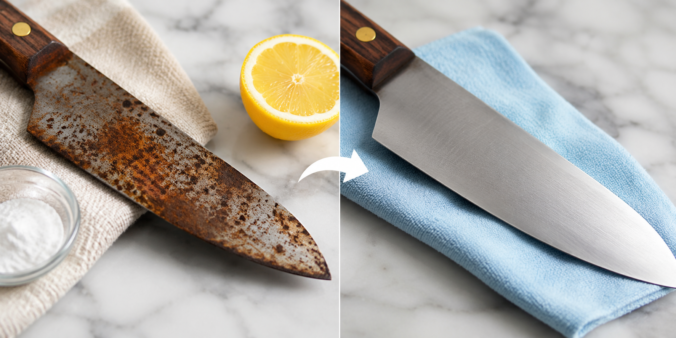
TL;DR: – Light surface rust responds to white vinegar soaks (15–30 minutes) or baking soda paste; avoid over-soaking beyond 4–8 hours to prevent blade etching
- Moderate to heavy rust requires sandpaper progression (220→400→600 grit) along the blade length, followed by re-sharpening
- Electrolytic removal works for heavily pitted antique blades; DIY setup costs ~$12–20 vs. $35–75+ for professional restoration
- Carbon steel rusts faster than stainless due to lower chromium content; patina on carbon steel is protective, not destructive
- Post-treatment with camellia oil or food-grade mineral oil prevents recurrence; store on magnetic strips, not wooden blocks
Introduction
You’ve just pulled out your favorite knife and noticed it: a rusty spot on the blade. Maybe it’s been sitting in a drawer too long. Maybe you left it wet after cooking. Either way, you’re wondering if the blade is ruined – or if there’s a fix.
Based on our analysis of kitchen knife forums, restoration guides, and metallurgical sources, rust removal is straightforward once you match the method to your rust severity and steel type. The good news? Most rust can be removed at home with pantry staples or inexpensive tools, and your blade will be as good as new.
This guide walks you through every method – from baking soda paste to electrolytic removal – so you choose the right approach on the first try. You’ll also learn why rust forms, how to prevent it from coming back, and when to stop scrubbing before you damage the blade itself.
Why Does a Knife Blade Rust?
Rust is an iron oxide, a chemical reaction where iron in steel combines with oxygen in the presence of water or moisture. All three elements must be present: iron, oxygen, and water. Remove any one, and rust stops forming.
Carbon steel rusts significantly faster than stainless steel because stainless contains a protective chromium layer. Carbon steel typically contains less than 1% chromium, leaving it vulnerable. This matters for your removal strategy: carbon steel blades tolerate acid soaks better than stainless, but they also pit more easily if you over-soak.
Carbon Steel vs. Stainless Steel Rust Risk:
| Steel Type | Chromium Content | Rust Speed | Acid Soak Safety |
|---|---|---|---|
| Carbon Steel | <1% | Fast (hours to days) | Moderate (4–8 hr limit) |
| Stainless Steel | 10.5%+ | Slow (weeks to months) | High (can soak longer) |
Here’s a critical distinction: patina on carbon steel is a stable magnetite layer that actually protects the blade from further corrosion, while active rust is hydrated iron oxide that continues consuming the metal. Patina looks grey, blue, or black and uniform. Rust looks orange-brown, flaky, and powdery. If your carbon steel blade has patina, you don’t need to remove it – it’s doing its job.
Key Takeaway: Rust requires iron, oxygen, and water simultaneously. Carbon steel rusts significantly faster than stainless due to chromium content differences. Patina on carbon steel is protective; rust is destructive.
How Do You Know Which Rust Removal Method to Use?
The wrong method wastes time or damages your blade. Here’s how to choose.
Rust Severity Scale:
- Light: Thin orange/brown discoloration; no pitting visible; blade edge still sharp
- Moderate: Visible pitting; surface feels rough; some edge dulling
- Heavy: Deep pitting; flaking rust; blade weakened or edge chipped
Decision Tree:
| Rust Level | Steel Type | Recommended Method | Time | Risk |
|---|---|---|---|---|
| Light | Carbon or Stainless | Baking soda paste OR vinegar soak (15–30 min) | 30 min | Low |
| Light | Damascus | Rust eraser or fine sandpaper (2000+ grit) | 45 min | Medium (pattern damage) |
| Moderate | Carbon | Vinegar soak (2–4 hours) + sandpaper (400–600 grit) | 2–4 hours | Medium |
| Moderate | Stainless | Bar Keeper’s Friend paste OR sandpaper (1200–2000 grit) | 1–2 hours | Low |
| Heavy | Any | Electrolysis OR professional restoration | 4–8 hours | Low (electrolysis) |
Critical Warning: High-HRC steels (above 63 HRC) are more brittle, and understanding knife steel hardness on the Rockwell scale helps explain why and prone to chipping during aggressive abrasive removal. Japanese knives often fall into this category. Use gentler methods – fine sandpaper (2000+ grit) or chemical removal – rather than coarse abrasives.
Wooden handles should never be submerged in water or acid solutions. Moisture causes warping, cracking, and handle delamination. If your knife has a wooden handle, wrap it in plastic or tape before soaking the blade.
Key Takeaway: Match rust severity + steel type to method. Light rust: 15–30 minutes. Moderate: 2–4 hours. Heavy: electrolysis or professional service. High-HRC steels require gentler methods to avoid chipping.
Method 1: Household Pantry Fixes for Light Rust
These methods cost almost nothing and work on light surface rust in under an hour.
Baking Soda Paste
Mix 2 teaspoons of baking soda with 1 teaspoon of water to create a thick paste. Apply it directly to the rusty areas. Let it sit for 10 to 20 minutes, then gently scrub with a soft toothbrush, cloth, or the soft side of a sponge.
Why it works: Baking soda is mildly abrasive and alkaline, lifting rust mechanically rather than dissolving it chemically. This makes it safe for Damascus blades and polished finishes.
Cost: ~$0.10 | Time: 30 minutes | Best for: Light surface rust only
White Vinegar Soak
Submerge the entire blade in a glass of vinegar and soak for 15-30 minutes for minor rust, and overnight for more damaged blades. For moderate rust, soak for 2–4 hours. The acetic acid in vinegar is a powerful rust remover.
Critical timing boundary: Do not soak carbon steel blades longer than 4–8 hours. Prolonged acid exposure etches the base metal, creating pitting that accelerates future corrosion. Stainless steel tolerates longer soaks (up to 12 hours) because its chromium layer resists acid.
After soaking, scrub gently with a soft brush or cloth. Rinse thoroughly with fresh water and dry immediately with a towel.
Cost: ~$0.05 | Time: 15 min–4 hours | Best for: Light to moderate surface rust on carbon or stainless steel
Lemon Juice + Salt
Lemon juice mixed with salt can treat isolated patches in 15–30 minutes. The citric acid dissolves rust; the salt acts as a mild abrasive. Apply the mixture, let it sit 15–20 minutes, then scrub gently.
This method is slower than vinegar because lemon juice has lower acid concentration, but it works for small spots without full soaking.
Cost: ~$0.20 | Time: 30 minutes | Best for: Isolated rust patches on light corrosion
Potato Slice Method
Potatoes contain high levels of oxalic acid, which acts as an excellent natural rust remover. Cut a raw potato in half, dip it in baking soda or salt, and rub it directly on the rust. The effect is limited compared to vinegar, but it’s food-safe and gentle on finishes.
Cost: ~$0.10 | Time: 20 minutes | Best for: Very light surface rust only; Damascus blades
Comparison Table
| Method | Cost | Time | Effectiveness | Best For | Risk |
|---|---|---|---|---|---|
| Baking soda paste | $0.10 | 30 min | Light rust | All steel types | Very low |
| White vinegar | $0.05 | 15 min–4 hr | Light–moderate | Carbon/stainless | Low (if timed correctly) |
| Lemon + salt | $0.20 | 30 min | Light rust | Isolated spots | Very low |
| Potato slice | $0.10 | 20 min | Very light rust | Damascus, polished | Very low |
Safety tip: Never soak wooden handles. Wrap the handle in plastic wrap or tape before submerging the blade. Dry the blade immediately after soaking – don’t let it air-dry, as moisture will cause more rust to form.
Key Takeaway: Pantry methods cost under $0.25 and remove light rust in 15–30 minutes. Vinegar is fastest for moderate rust but requires strict timing (4–8 hours max for carbon steel). Baking soda is safest for polished or Damascus finishes.
Method 2: Abrasive Removal for Moderate to Heavy Rust
When rust has pitted the surface or light methods don’t work, mechanical removal is necessary.
Sandpaper Grit Progression
Start with 220-grit sandpaper to remove material and rust, then progress through 400 and 600 to restore finish. Always sand in the direction of the blade’s existing grain lines – never cross-grain. Cross-grain scratches are harder to remove and create stress risers in high-HRC steels.
For light surface rust, use high-grit sandpaper or a steel wool polishing cloth to abrade the rust away. I recommend 2000-grit, but you can go down to 1200 at the roughest. For moderate pitting, start at 220 and work your way up.
Progression example:
- 220 grit: 2–3 minutes (removes rust and material)
- 400 grit: 2–3 minutes (smooths scratches from 220)
- 600 grit: 2–3 minutes (final polish)
Expect 10–45 minutes per knife depending on corrosion severity.
Cost: ~$8 for a full grit kit | Time: 15–45 minutes | Best for: Moderate rust; blades with pitting
Steel Wool
Steel wool grades explained: #0000 for final polish, #00 for moderate rust. Use #00 or #000 for rust removal; #0000 for final polishing. Work gently in the direction of the blade’s grain.
Cost: ~$3 | Time: 20–30 minutes | Best for: Light to moderate rust; polished finishes
Bar Keeper’s Friend Paste
Bar Keeper’s Friend contains oxalic acid as its primary active ingredient. Mix the powder with a small amount of water to form a paste. Apply to rust, let it sit for at least an hour, then scrub gently with a soft brush or cloth. Rinse thoroughly with water.
Bar Keepers Friend does include a mineral abrasive and IME is more likely to leave slight scratches than Simichrome or Flitz, so test on a hidden area first if your blade has a polished finish.
Cost: ~$4 | Time: 1–2 hours | Best for: Stainless steel rust stains; moderate corrosion
WD-40 Clarification
WD-40 is a water-displacing spray and is not formulated as a rust remover. It displaces water and lubricates, but does not remove existing oxidation effectively. You can use it to loosen rust before scrubbing, but it’s not a primary treatment.
Critical Post-Abrasive Step: Re-sharpening
Abrasive rust removal removes metal from the blade surface, which dulls the edge. After sanding, you must re-sharpen the blade. Use a whetstone or honing rod to restore the edge. Start with a coarser stone (1000 grit) if the edge is very dull, then finish with a finer stone (4000–6000 grit). Our beginner’s guide to sharpening stones covers the full process.
Cost: ~$15–50 for a whetstone | Time: 15–30 minutes
When to Stop
If you’re grinding away rust and the blade feels thin or the spine is getting sharp, stop. You’ve removed enough material. Continuing risks weakening the blade structurally. Accept the patina or pitting marks – they’re part of the blade’s history.
Key Takeaway: Sandpaper progression (220→400→600 grit) removes moderate to heavy rust in 15–45 minutes. Always sand along the blade’s grain, never cross-grain. Re-sharpening is mandatory after abrasive removal. Cost: ~$8–15 in materials.
Method 3: Chemical and Electrolytic Removal for Severe Rust
For heavily pitted antique blades or rust that won’t respond to other methods, chemical conversion or electrolysis is the solution.
Phosphoric Acid Rust Converters
Phosphoric acid-based products (such as Ospho or Rust-Oleum Rust Reformer) chemically convert iron oxide to iron phosphate, a stable, paintable surface. These are effective but not food-safe – blades treated this way are not suitable for cooking use without full neutralization and professional cleaning.
Use these only for display pieces or antique restoration, not kitchen knives.
Cost: ~$12–18 | Time: 2–4 hours | Best for: Antique blades; non-food-contact knives
Electrolytic Rust Removal
Electrolysis is the gold standard for heavily pitted blades. It works by passing low-voltage DC current through a sodium carbonate solution, converting iron oxide back to iron at the cathode (the rusty blade).
DIY Setup (cost breakdown):
- Washing soda: ~$4
- Sacrificial steel plate or rod: ~$3–5
- Alligator clips or wire: ~$5
- Battery charger (12V, 2–10 amp): ~$20–40 (if you don’t own one)
- Total: ~$12–20 in consumables (or ~$35–50 if buying a charger)
Step-by-step:
- Dissolve 1 tablespoon of washing soda per gallon of water in a non-metal container
- Connect the positive terminal of the charger to the sacrificial steel plate
- Connect the negative terminal to the rusty knife blade
- Submerge both in the solution (they should not touch)
- Run the charger at 2–10 amps for 4–8 hours depending on rust severity
- Remove the blade, rinse thoroughly, and dry immediately
- Apply protective oil to prevent flash rust
The blade emerges grey and pitted but structurally sound. You can then sand it smooth if desired.
Cost: ~$12–20 DIY vs. $35–75+ for professional dip services | Time: 4–8 hours | Best for: Heavily pitted antique blades; severe corrosion
Key Takeaway: Phosphoric acid converters are fast but not food-safe. Electrolytic removal works for severe pitting; professional services cost significantly more. Both methods are overkill for light rust.
How to Prevent Rust from Coming Back
Once you’ve removed rust, the goal is to never see it again.
Dry Storage and Immediate Drying
The single most important prevention step: dry your blade immediately after use or exposure to moisture. Don’t let it air-dry. Use a clean cloth to wipe it dry within seconds of washing.
Store knives in a dry environment. Knife blocks can harbor moisture and bacteria in their slots, particularly if knives are stored wet. Magnetic strips allow air circulation and faster drying, making them preferable for rust-prone carbon steel knives.
Food-Safe Oil Application
Camellia oil has been used for centuries in Japan to protect high-carbon steel tools. Mineral oil is a food-safe alternative. Vegetable oils are not recommended as they oxidize and become rancid.
Storage Options Comparison
| Storage Method | Moisture Risk | Air Circulation | Best For |
|---|---|---|---|
| Magnetic strip | Low | High | Carbon steel; frequent use |
| Knife block | High (slots trap water) | Low | Stainless steel; occasional use |
| Sheath (leather/cloth) | Medium | Medium | Pocket/outdoor knives |
| Drawer (loose) | High | Low | Avoid for carbon steel |
Prevention Checklist
- Dry blade immediately after use (within 10 seconds)
- Store on magnetic strip or in sheath, not wooden block
- Apply camellia or mineral oil regularly
- Keep storage area dry and cool
- Avoid prolonged contact with salt, acidic foods, or moisture
- Inspect blade monthly for early rust spots
Key Takeaway: Immediate drying + magnetic strip storage + regular oil application prevents rust. Wooden blocks trap moisture and should be avoided for carbon steel knives.
Frequently Asked Questions
Can you use vinegar to remove rust from a stainless steel knife?
Direct Answer: Yes. Vinegar works well on stainless steel because stainless’s chromium layer resists acid damage. You can soak stainless steel blades in vinegar for 4–12 hours without etching the base metal.
Stainless steel is more forgiving than carbon steel with acid soaks, but you still need to rinse thoroughly and dry immediately afterward. For stubborn stains, Bar Keeper’s Friend is also effective on stainless steel.
Is a rusty knife safe to use for cooking?
Direct Answer: A knife sporting a small rust spot not on the cutting edge can still be safely used with food, but it’s not ideal. A rusted blade presents several risks. First, the edge may dull and the blade may weaken. The surface of the knife can become porous due to corrosion development, allowing bacteria to grow. Finally, stains may appear on food, and it may also develop a metallic taste.
If rust is on the cutting edge or covers more than 10% of the blade, remove it before using the knife for food. Rust is not acutely toxic in trace amounts, but it’s a hygiene concern and affects food quality.
What is the fastest way to remove rust from a knife blade?
Direct Answer: Baking soda’s mild abrasiveness helps lift light rust in 15–30 minutes, while a white vinegar soak of 2–4 hours loosens moderate rust without harsh chemicals. For moderate rust, white vinegar soak for 2–4 hours is faster than sandpaper.
For heavy rust, electrolysis takes 4–8 hours but requires no scrubbing. Professional restoration services are fastest (1–2 days turnaround) but cost $35–75+ per blade.
Does removing rust damage the knife blade permanently?
Direct Answer: No, if done correctly. Abrasive methods remove a thin layer of metal (typically 0.1–0.5mm), which is negligible for most blades. The rust removal methods I recommend below may alter or remove the finish on your blade. Any logos, markings, or satin/polished finishes may end up damaged.
The blade’s structural integrity is not compromised unless you grind excessively. If you’re concerned about finish damage, use gentler methods (baking soda, vinegar, Bar Keeper’s Friend) rather than coarse sandpaper.
How much does professional rust removal or blade restoration cost?
Direct Answer: Professional knife sharpening and restoration services typically range from $5 for simple sharpening to $35–75 or more for full restoration involving rust removal and re-grinding. Specialist services (electrolytic dip, re-tempering) may cost $50–150+ per blade.
DIY electrolysis costs ~$12–20 in materials, making it a cost-effective alternative for heavily pitted blades if you have time.
Should I re-sharpen my knife after removing rust?
Direct Answer: Yes. Abrasive rust removal removes metal from the blade, dulling the edge. You must re-sharpen with a whetstone or honing rod afterward. Start with a coarser stone (1000 grit) if the edge is very dull, then finish with a finer stone (4000–6000 grit). This takes 15–30 minutes and costs ~$15–50 for a whetstone if you don’t own one.
Non-abrasive methods (vinegar, baking soda, Bar Keeper’s Friend) don’t require re-sharpening because they don’t remove metal from the edge.
Does rust mean my knife is low quality or defective?
Direct Answer: No. Rust is an oxidation reaction caused by the iron (Fe) present in kitchen knives. It occurs in contact with water (H₂O), which acts as a catalyst and facilitates the exchange of electrons between the iron (Fe) in the blade and the oxygen (O₂) present in the air. Even high-quality carbon steel knives rust if exposed to moisture without proper care.
Stainless steel is more rust-resistant due to its chromium content, but it can still rust if the chromium layer is damaged (scratches, salt, acid). Rust is a maintenance issue, not a quality issue. Proper drying and storage prevent it regardless of blade quality.
Ready to Get Started?
For personalized guidance on selecting quality knives built to resist rust and maintain their edge, visit Knife Depot.
Conclusion
Rust on a knife blade is fixable. The method you choose depends on three factors: how severe the rust is, what type of steel your blade is made from, and how much time you want to spend.
For light surface rust, reach for pantry staples – baking soda paste or white vinegar – and you’re done in 30 minutes. For moderate pitting, sandpaper and Bar Keeper’s Friend work well. For heavily corroded antique blades, electrolysis is your best bet.
The real win is prevention. Dry your blade immediately after use, store it on a magnetic strip (not a wooden block), and apply camellia or mineral oil regularly. These habits eliminate rust problems before they start.
Knife Depot carries a curated selection of quality knives designed for durability and rust resistance, with options in both stainless and treated carbon steel. Whether you’re building a collection or replacing a rusty blade, you’ll find reliable options that hold an edge and stand up to regular use.
Your knife doesn’t have to stay rusty. With the right method and a little patience, you can restore it to working condition and keep it rust-free for years to come.

Leave a Reply