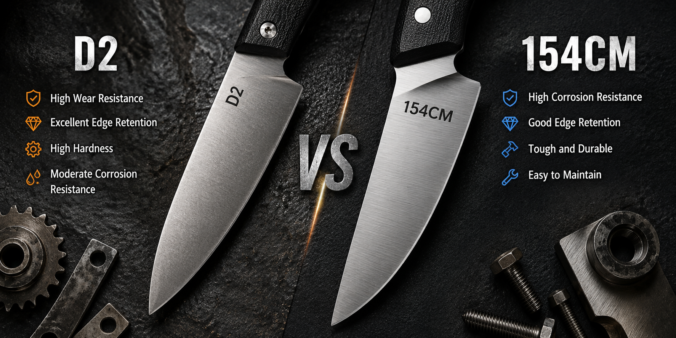
TL;DR: – D2 wins on edge retention and price; 154CM wins on corrosion resistance and sharpening ease
- D2 folders commonly run $35–$80; 154CM knives like the Benchmade Griptilian run $150–$180
- If you’re near saltwater or hate oiling your blade, pick 154CM. If you want maximum edge life on a budget, pick D2
You’re reading this because you’re staring at two knives – or two spec sheets – and you need to know which steel actually makes sense for how you use a blade. The D2 tool steel vs 154CM knife steel comparison comes up constantly in EDC forums, and most answers are vague. This one isn’t.
Based on our analysis of verified metallurgical data, manufacturer spec sheets, and community discussions across knife forums collected in June 2026, here’s the full breakdown. We pulled composition data directly from Crucible Industries, performance context from Knife Steel Nerds, and real-world user feedback from Blade Forums and Candle Power Forums.
D2 vs 154CM: Quick Answer and Key Differences
D2 gives you more edge retention and costs less. 154CM gives you better corrosion resistance and easier sharpening.
That’s the verdict. Everything below explains why – and helps you decide which tradeoff fits your situation.
| Property | D2 | 154CM |
|---|---|---|
| Carbon % | ~1.5% | ~1.05% |
| Chromium % | 11–12% | 14% |
| Molybdenum % | ~0.9% | ~4% |
| Typical HRC | 58–62 | 58–61 |
| Corrosion Resistance | Semi-stainless | Fully stainless |
| Edge Retention | Higher | Moderate-high |
| Toughness | Moderate | Moderate-high |
| Sharpening Ease | Harder | Easier |
| Price Tier | $35–$80 | $80–$180 |
D2 in one sentence: High-wear tool steel with serious edge life, but it needs maintenance to avoid rust.
154CM in one sentence: Aerospace-derived stainless that’s easier to maintain and sharpen, at a higher price point.
Key Takeaway: D2 is the budget-friendly edge retention champion. 154CM is the low-maintenance, easier-to-sharpen stainless option. Neither is universally better – it depends entirely on your use case.
What Is D2 Steel and How Is It Made?
D2 is a high-carbon, high-chromium air-hardening tool steel originally developed for industrial cutting applications like dies and punches.
According to Noblie Custom Knives, D2 steel contains approximately 1.55% carbon, 12% chromium, 0.80% molybdenum, and 0.90% vanadium. That high carbon content is what drives its wear resistance – but it also creates a metallurgical quirk that confuses a lot of buyers.
D2 is “semi-stainless,” not fully stainless. Here’s why that matters.
As CJRB’s steel guide explains, steel typically needs at least 10.5–13% chromium to qualify as stainless. D2 sits at 11–12% on paper – right at the edge. But much of that chromium gets consumed forming carbides during heat treatment, leaving insufficient free chromium in the matrix for full passivation. Total chromium and available chromium are two different things.
Urban EDC notes that D2 was patented in 1927 as a modification of high-carbon, high-chromium steels – it was built for industrial toughness, not corrosion resistance. Knife makers adopted it because of its exceptional wear resistance.
Typical hardness range: Noblie Custom Knives puts D2 at 57–62 HRC when properly heat-treated. CJRB notes it’s often heat-treated to 60–62 HRC in production knives. That’s a meaningful range – a D2 knife at 58 HRC and one at 62 HRC behave quite differently in terms of the toughness vs. wear resistance tradeoff.
Knives using D2: Cold Steel’s Recon 1, CJRB folders (Riff, Maileah), and various CIVIVI and WE Knife budget-tier models. These typically retail in the $35–$80 range.
For context on what those HRC numbers mean in practice, check out our guide on the Rockwell hardness scale for knives.
Key Takeaway: D2 is semi-stainless due to chromium carbide formation consuming available matrix chromium. It runs 58–62 HRC and dominates the $35–$80 production knife tier. Heat treatment quality varies significantly between manufacturers.
What Is 154CM Steel and How Does It Differ?
154CM is a fully stainless, high-alloy steel developed by Crucible Industries – originally for jet engine turbine components, not knives.
According to Lee Knives, 154CM is a high-carbon, high-chromium martensitic stainless steel with a composition of 1.05% carbon, 14% chromium, and 4% molybdenum. That 4% molybdenum is the key differentiator from D2’s 0.9% Mo – it substantially improves both corrosion resistance and fine carbide formation.
As Candle Power Forums notes, 154CM was “originally developed for turbine blades in jet engines” – an application demanding both wear resistance and corrosion resistance simultaneously. That aerospace heritage translates directly to knife performance.
Why 154CM is fully stainless: With only 1.05% carbon (vs. D2’s 1.5%), less chromium gets locked into carbides. More chromium stays in the steel matrix, crossing the passivation threshold. The result: genuine stainless behavior in real-world conditions.
Typical hardness range: Lee Knives puts 154CM at 58–61 HRC. That’s a tighter range than D2, which reflects more consistent heat treatment outcomes across manufacturers.
Knives using 154CM: The Benchmade 710 (a landmark American folder) used 154CM and helped establish the steel’s reputation. Current Benchmade and Spyderco models use 154CM or its powder-metallurgy variant, CPM 154. These typically retail $80–$180.
One important distinction worth knowing: CPM 154 and conventional 154CM share identical chemistry, but CPM 154 uses a powder metallurgy process that produces finer, more uniform carbide distribution. If a knife listing says CPM 154, that’s a modest upgrade in toughness and grindability over standard 154CM.
For a deeper look at Benchmade’s lineup and how they use 154CM, see our Benchmade knives review.
Key Takeaway: 154CM’s aerospace origin gives it 14% Cr and 4% Mo – enough to stay fully stainless even after carbide formation. It runs 58–61 HRC with tighter consistency than D2, and it anchors the $80–$180 mid-tier production knife market.
How Do D2 and 154CM Compare on Performance?
This is where the D2 tool steel vs 154CM knife steel comparison gets real. Let’s go property by property.
Edge Retention
D2 wins here. Full stop.
EDC Mall describes D2 as “a tool steel known for its high wear resistance” – and that’s backed by the carbide math. D2’s higher carbon content produces more carbide volume, which directly translates to longer edge life on abrasive materials like cardboard, rope, and wood.
As one Blade Forums user puts it: “I can get 154CM sharper, but it doesn’t hold the edge as well as D2.” That’s a consistent theme across community discussions – 154CM gets sharper initially, D2 stays sharp longer.
Urban EDC notes that D2 placed 24th out of 45 tested knife steels at 59.2 HRC in standardized testing – solid mid-tier performance, not exotic, but genuinely capable.
Corrosion Resistance
154CM wins decisively.
CJRB’s guide confirms D2 sits at 11–12% chromium – right at the stainless boundary, but not over it in practice. American Buffalo Knife & Tool is direct: D2 “is not a true stainless steel” and “if a D2 blade is left wet, or exposed to corrosive substances like saltwater or acidic materials for extended periods without cleaning, it can be susceptible to rust or pitting.”
154CM at 14% Cr clears the passivation threshold with room to spare. Blade Forums summarizes it cleanly: “154CM is actually stainless steel, while D2 is ‘almost’ or ‘semi’ stainless.”
For more on the carbon steel vs stainless steel spectrum and where semi-stainless fits, our carbon steel vs stainless steel comparison guide covers the full picture.
Toughness and Chip Resistance
This one is closer than most people expect.
Candle Power Forums notes that “the toughness of both D2 and 154CM are nearly the same.” But the nuance matters: D2’s larger carbides act as crack initiation sites under lateral stress, especially at higher hardness (60+ HRC). Blade Forums puts it this way: “154CM is on the brittle side and, hence a little more delicate. I think that’s fine for a folder. D2 is more abrasion resistant and tougher. It would be a better choice for a larger blade.”
Urban EDC quantifies D2 toughness at approximately 5 ft-lb in Charpy impact testing at just over 60 HRC – respectable for a high-wear steel, but not exceptional.
Sharpening Ease
154CM is easier to sharpen. D2 holds its edge longer between sessions.
American Buffalo Knife & Tool recommends diamond sharpeners only for D2 – its large, hard chromium carbides resist conventional abrasives. Blade Forums echoes this: “D2 is just too tough to sharpen” with standard stones.
154CM’s finer carbide structure responds well to ceramic and aluminum oxide stones in addition to diamond. EDC Mall confirms “154CM steel is relatively easy to sharpen compared to some other high-end steels.”
For tool selection, our guide on honing rod vs sharpening stone covers what to reach for with each steel type.
Hardness Comparison at a Glance
| Steel | HRC Range | Notes |
|---|---|---|
| D2 | 58–62 HRC | Wider range; manufacturer variance matters |
| 154CM | 58–61 HRC | Tighter range; more consistent outcomes |
Knife Steel Nerds makes an important point: sharpening angle affects performance as much as steel choice. Using a 10° per side angle produces roughly 5x the edge retention of a 25° per side angle on the same steel. Your technique matters.
Key Takeaway: D2 leads on edge retention and holds up better on abrasive tasks. 154CM leads on corrosion resistance and sharpening ease. Toughness is roughly comparable, with 154CM slightly more forgiving at high hardness.
Which Steel Should You Choose for Your Use Case?
Here’s the decision matrix that most comparison articles skip.
| Use Case | Recommended Steel | Rationale |
|---|---|---|
| EDC folder (dry climate) | D2 | Better edge life, lower cost |
| EDC folder (humid/coastal) | 154CM | Corrosion resistance outweighs edge retention advantage |
| Outdoor/bushcraft fixed blade | 154CM | Exposure to moisture, blood, and acidic materials favors stainless |
| Heavy-duty cutting (cardboard, rope) | D2 | Higher carbide volume = longer edge life on abrasive materials |
| Budget knife ($35–$60) | D2 | 154CM rarely available at this price tier |
| Mid-tier folder ($80–$180) | 154CM | Price tier aligns; easier maintenance for daily carry |
| Hunting/game processing | 154CM | Blood and acidic fluids corrode D2 quickly without immediate cleaning |
Price reality check: A D2 folder like the CJRB Riff retails around $35–$45. A 154CM Benchmade Griptilian runs $150–$180. That’s a $100+ gap for performance that’s genuinely close on most metrics. The performance difference does not scale linearly with price – you’re also paying for fit, finish, and brand.
Blade Forums captures the tradeoff well: “D2 will rust easier, but if you take care of your knives even a little bit, it shouldn’t be a problem.” If you’re disciplined about maintenance, D2 at $40 is a legitimate choice over 154CM at $160.
For budget EDC options in D2, check out our roundup of the best EDC knives under $50. For outdoor applications where corrosion resistance matters more, our guide to the best camping knives for bushcraft covers the full picture.
You can also browse the full selection at Knife Depot, which carries both D2 and 154CM options across multiple price tiers – useful for comparing actual models side by side.
Key Takeaway: Choose D2 for dry-climate EDC and heavy cutting on a budget. Choose 154CM for coastal environments, hunting, or when you want a lower-maintenance blade. The $100+ price gap between tiers is real but doesn’t reflect a proportional performance gap.
How Do You Maintain D2 and 154CM Knives?
Direct answer: D2 needs regular oiling and dry storage. 154CM is significantly more forgiving.
D2 rust prevention (do these consistently):
- Wipe the blade dry immediately after any moisture exposure – don’t let it air dry
- Apply a thin coat of mineral oil or camellia oil after cleaning and before storage
- Avoid prolonged contact with blood, citrus, or saltwater; American Buffalo Knife & Tool specifically flags these as corrosion accelerators for D2
154CM care:
- Rinse and dry after heavy use – it’s stainless, not indestructible
- Standard periodic oiling is good practice but not critical for rust prevention
Sharpening angles:
- D2: 17–20° per side. The wider angle protects the edge from micro-chipping given D2’s larger carbide structure
- 154CM: 15–20° per side. Finer angles are achievable and hold reliably
Knife Steel Nerds data confirms that edge angle dramatically affects both retention and chip resistance – a 15° edge on D2 is significantly more vulnerable to chipping than a 20° edge on the same steel.
For step-by-step oiling and maintenance procedures, our guide on how to maintain and oil a folding knife covers both steel types in detail.
Key Takeaway: D2 demands consistent oiling and dry storage – skip this and you’ll see surface rust within days in humid conditions. 154CM is low-maintenance stainless. Both steels benefit from proper sharpening angles: 17–20° for D2, 15–20° for 154CM.
Frequently Asked Questions About D2 vs 154CM
Is D2 or 154CM better for everyday carry?
Direct Answer: It depends on your environment. D2 is better for dry climates where you want maximum edge life at a lower price. 154CM is better for humid, coastal, or high-moisture environments where corrosion resistance matters more than squeezing out extra edge retention.
Both steels perform well as EDC folder materials. The maintenance gap is the deciding factor – if you oil your blade regularly, D2 is a legitimate choice at half the price of a comparable 154CM knife.
Does D2 steel rust easily compared to 154CM?
Direct Answer: Yes, D2 rusts significantly more easily than 154CM. D2 is semi-stainless; 154CM is fully stainless.
American Buffalo Knife & Tool confirms that D2 left wet or exposed to saltwater and acidic materials “can be susceptible to rust or pitting.” 154CM at 14% chromium clears the passivation threshold, making it effectively rust-proof under normal outdoor conditions. Blade Forums summarizes it simply: “D2 will rust easier, but if you take care of your knives even a little bit, it shouldn’t be a problem.”
Which steel is harder to sharpen, D2 or 154CM?
Direct Answer: D2 is harder to sharpen. Its large chromium carbides resist conventional abrasives, requiring diamond or CBN stones for efficient material removal.
American Buffalo Knife & Tool recommends diamond sharpeners only for D2. 154CM’s finer carbide structure responds to ceramic and aluminum oxide stones as well as diamond. The tradeoff: D2 holds its apex longer between sharpening sessions, so you sharpen less frequently – but when you do, it takes more effort. For best knife steel options for outdoor camping, see our dedicated outdoor knife steel guide.
Is 154CM considered a premium steel worth paying more for?
Direct Answer: 154CM is a legitimate mid-tier premium steel, but the price gap between D2 and 154CM knives often reflects brand and fit/finish more than raw steel performance.
Lee Knives notes 154CM offers approximately 20% better edge retention than 440C while maintaining excellent corrosion resistance – it’s a genuine step up from entry-level stainless. But a $40 D2 CJRB folder and a $160 154CM Benchmade are separated by more than just steel. If you’re buying purely for steel performance, the gap is real but not $120 worth of real.
Can D2 knives be used in wet or outdoor environments?
Direct Answer: Yes, but with consistent maintenance. D2 is not ideal for prolonged wet exposure without care.
American Buffalo Knife & Tool is clear that D2’s high chromium content gives it “a very respectable level of corrosion resistance” – but it’s not stainless. Wipe it dry after use, oil it before storage, and avoid leaving it in contact with blood, citrus, or saltwater. For hunting or fishing applications where the blade contacts acidic or chloride-rich materials regularly, 154CM is the more practical choice.
What knives use D2 vs 154CM steel?
Direct Answer: D2 is common in budget-to-mid production knives ($35–$90); 154CM appears in mid-to-premium production knives ($80–$180+).
D2 examples include Cold Steel’s Recon 1, CJRB folders (Riff, Maileah), and various CIVIVI models. 154CM examples include the Benchmade 710 (discontinued but historically significant), current Benchmade Bugout variants, and select Spyderco sprint runs. Candle Power Forums notes the Benchmade 710 as a landmark 154CM folder that helped define the steel’s reputation in the American knife market.
The Bottom Line
The D2 tool steel vs 154CM knife steel comparison comes down to one core tradeoff: edge retention and price (D2) vs. corrosion resistance and sharpening ease (154CM).
Neither steel is objectively better. D2 at $40 in a well-made folder punches well above its price. 154CM at $150+ earns its place with genuine stainless behavior and easier maintenance. Pick based on your environment, your maintenance habits, and your budget – not forum tribalism.
Both are proven, capable steels. The knife that gets used is always better than the one sitting in a drawer because you’re afraid to scratch it.
Ready to Get Started?
For personalized guidance, visit Knife Depot to learn how we can help.
Leave a Reply