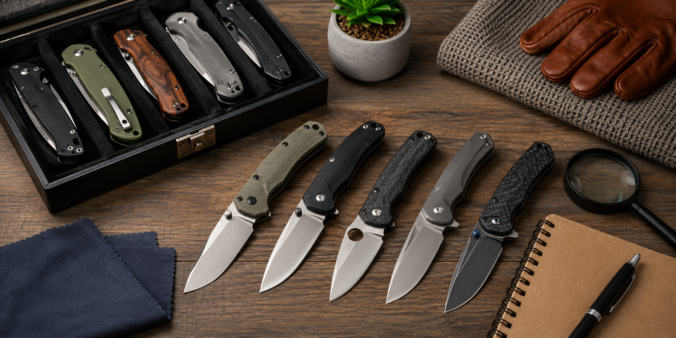
TL;DR: – Start your first collection with $150–$200 total across three knives – one EDC folder, one fixed blade, one collectible
- Chris Reeve, Benchmade, and limited Spyderco sprint runs hold value best on the secondary market
- Condition and original packaging are the two biggest levers you control as a beginner investor
The collectible knife market is quietly one of the most accessible alternative investment categories for beginners – but only if you know what you’re doing. According to Koi Knives, “the market for rare and collectible pocket knives has been steadily growing, and it presents a unique investment opportunity for collectors and investors alike.” Most beginners, though, walk in blind and spend their first $300 on knives that depreciate immediately.
This knife collecting tips for beginners investment guide is built on analysis of secondary market pricing patterns, community data from BladeForums and Reddit r/knifeswap, and sourced guidance from Blade Magazine, KnifeNews, and major manufacturers. No fabricated anecdotes – just a clear framework for building a collection that’s both personally satisfying and financially sound.
What Makes Knife Collecting Different From Just Buying Knives?
Knife collecting is the intentional, strategic acquisition of blades with attention to condition, documentation, and long-term value – not simply buying knives you like and using them. The distinction matters enormously for your wallet. A casual buyer picks up a Benchmade because it feels good in hand. A collector buys the same knife, keeps the box and papers, photographs it before first use, and tracks its secondary market value over time.
As Blade Magazine puts it, “sometimes it is more prudent to take the money you would spend on two knives and buy only one.” That mindset – quality over quantity, intention over impulse – is the foundation of every successful collection.
Three collector archetypes exist, and knowing which one you are shapes every decision you make:
- Users carry and use their knives, prioritizing function. Investment upside is limited since carry wear reduces resale value, but enjoyment is maximized.
- Investors focus on condition and resale, keeping knives NIB (new in box) or in minimal-use condition. They track secondary market prices and buy strategically.
- Historical/cultural collectors chase provenance, heritage brands, and vintage pieces. Think pre-1970 Case knives with specific tang stamps and shield variants.
These archetypes aren’t mutually exclusive, but your dominant orientation determines your storage strategy, budget allocation, and which platforms you use to buy and sell. As Eagle Valley Cutlery notes, “certain rare knives appreciate in value, but most collectors enjoy them for passion.” Understanding why premium knives are worth the investment starts with knowing your own motivations.
Key Takeaway: Collectors differ from casual buyers through intentionality – documentation, condition tracking, and strategic acquisition. Decide your collector archetype before your first purchase; it determines every subsequent decision.
How Much Should a Beginner Spend to Start a Knife Collection?
The direct answer: plan to spend $150–$200 total on your first three knives. Blade Magazine is blunt about this – rushing into expensive pieces before developing taste is one of the most common beginner mistakes. Spend time at the entry and mid-range levels first, handle different designs and steels, then step up when your preferences are defined.
A practical starter kit looks like this: 1x Kershaw Leek ($45) + 1x Buck 110 Folding Hunter ($55) + 1x Spyderco Delica 4 (~$80) = roughly $180 total. You get an assisted-open EDC folder, a classic American fixed-blade-style folder with a strong collector community, and a Japanese-made knife with premium VG-10 steel – three completely different experiences that teach you what you actually value.
Entry-Level Tier: $15–$50 Per Knife
Brands like Kershaw, Ontario, and Rough Rider dominate this range. You get functional knives with decent steel and reasonable fit and finish. What you sacrifice is resale value – these knives typically depreciate significantly and aren’t investment-grade. Their value is educational: they help you learn what blade geometry, handle material, and action feel you prefer before committing real money. Check out our picks for EDC knives under $50 to see what’s worth picking up at this tier.
Mid-Range Tier: $50–$200 Per Knife
This is where the best value-to-resale ratio lives for beginners. Brands like Spyderco, Buck, and Case offer knives with genuine collector communities, quality steels, and meaningful secondary market activity. Eagle Valley Cutlery confirms that “original boxes and paperwork increase value” – a habit worth building from your very first mid-range purchase. Keep everything.
Investment Tier: $200–$500 Per Knife
Benchmade, Chris Reeve, and similar makers live here. These are knives that can hold or exceed retail value on secondary markets – but only if you know what you’re buying. Blade Magazine recommends waiting at least six months of active collecting before stepping into this tier. You need enough experience to evaluate fit, finish, and authenticity before spending $400+ on a single piece.
Key Takeaway: Start with $150–$200 across three knives at entry and mid-range tiers. Don’t touch the $200–$500 investment tier until you’ve spent 6+ months developing taste and learning to evaluate quality.
Which Knife Brands Hold Their Value Best?
The direct answer: Chris Reeve, Benchmade, and limited Spyderco sprint runs consistently outperform the secondary market. Everything else is situational.
Here’s a practical brand investment grade overview:
| Brand | Approx. Resale % of Retail | Best Models | Verdict |
|---|---|---|---|
| Chris Reeve | 85–110% | Sebenza 31, Inkosi | Top tier – buy with confidence |
| Spyderco (sprint runs) | 120–140% post-sellout | PM2 M4, limited colorways | Excellent if you catch retail price |
| Benchmade | 60–75% | 940, Bugout, Griptilian | Solid – LifeSharp warranty adds buyer confidence |
| Case (vintage, pre-1970) | Variable, often 200%+ | Bone handle patterns | Strong but requires expertise |
| Case (modern production) | 40–60% | Standard patterns | Modest appreciation at best |
| Kershaw / Ontario | 20–40% | Most models | Use-grade, not investment-grade |
The Chris Reeve Sebenza 31 retails at $500–$550 and regularly sells used for $420–$500 on BladeForums – roughly 85–90% retention even in carried condition. That’s exceptional for a production knife. The reason is simple: Noblie Custom Knives notes that “vintage pocket knives made of high-quality steel and in excellent condition can be worth thousands of dollars” – and Chris Reeve’s titanium framelock construction and S35VN steel have earned a reputation that sustains demand.
Benchmade’s LifeSharp lifetime warranty – free sharpening and servicing, transferable to subsequent owners – meaningfully supports secondary market prices. A used Benchmade 940 worth $180 without packaging can jump to $210–$220 with original box and papers intact, roughly a 16% premium. That’s real money for simply keeping a cardboard box.
Unholyblades makes the case for sprint runs clearly: “the smaller the run, the more exclusive and valuable the knife.” A Spyderco Paramilitary 2 in M4 steel retailed around $230 and regularly resold for $280–$320 within 12 months of selling out. That’s 20–40% appreciation in under a year – but only if you bought at retail before the sellout.
Brands to avoid for investment purposes: heavily discounted no-name imports, anything sold primarily through discount channels, and any brand without an established secondary market community. Koi Knives puts it plainly: “successful collectors emphasize the importance of focusing on quality over quantity.” For a deeper look at how two of the top investment brands compare, the Spyderco vs Benchmade comparison is worth reading before committing to either.
Key Takeaway: Chris Reeve Sebenza models retain 85–110% of retail value. Benchmade holds 60–75% with LifeSharp warranty support. Limited Spyderco sprint runs can appreciate 20–40% post-sellout. No-name imports depreciate immediately.
5 Key Factors That Determine a Knife’s Collectible Value
The direct answer: steel quality, maker reputation, condition, rarity, and provenance are the five primary value drivers – in roughly that order of importance for production knives, with provenance becoming more significant for custom and vintage pieces.
Factor 1: Steel Type. Blade steel affects both performance and collector desirability. Premium stainless steels like CPM-20CV, S35VN, and M390 sit at the top of the hierarchy. M4 is the high-performance non-stainless option that collectors prize for toughness, though it requires more maintenance. Eknives notes that “stainless steel is more resistant to corrosion and staining, whereas carbon steel requires more maintenance but provides superior sharpness.” Understanding knife steel hardness and HRC ratings will help you evaluate any knife before buying.
Factor 2: Maker Reputation. A knife from an established maker with a documented track record commands premiums that an identical-looking knife from an unknown brand never will. Blade Magazine notes that maker skill level, quality, and customer service all factor into long-term value – and that these factors are sometimes overlooked when a knife is selling quickly for profit.
Factor 3: Condition. This is the factor you control most directly. Unholyblades is direct: “a mint or near-mint knife with its original packaging will bring much more money than a used or damaged knife.” NIB (new in box) commands the highest premiums. Even light carry wear can reduce value by 20–40% depending on the maker and model.
Factor 4: Rarity. Limited production runs, discontinued models, and sprint runs consistently outperform standard production. Knife Depot’s guide to Case knife collecting explains that Case “frequently puts out knives in limited quantities with numbers on them up to a predetermined production quota, which is usually around 3,000 or less” – and first run numbers are often 500 or fewer. Scarcity drives secondary market premiums.
Factor 5: Provenance. Documented ownership history, original receipts, and any connection to notable makers or events adds value – particularly for custom knives and vintage pieces. Palmetto Wood Shop recommends documenting “each acquisition’s details: source, price, maker, and materials” from day one. A structured catalog helps track growth and aids value assessment over time.
Quick scoring checklist – apply this before any purchase:
- Premium steel (CPM-20CV, S35VN, M4, VG-10)? ✓
- Established maker with secondary market activity? ✓
- NIB or minimal use with original packaging? ✓
- Limited run, sprint run, or discontinued model? ✓
- Documented purchase history or provenance? ✓
Three or more checkmarks = strong investment candidate. One or fewer = use-grade purchase only.
Key Takeaway: Condition and original packaging are the two factors you control immediately. Keep every box, paper, and accessory from your first purchase onward – it’s the easiest 15–25% value preservation available to any beginner.
How to Store and Maintain a Knife Collection Properly
Proper knife collection storage means a dry environment below 50% relative humidity, acid-free storage materials, and regular light oiling – especially for carbon steel blades. The Northeast Document Conservation Center recommends storing metal artifacts at 35–55% relative humidity with stable temperatures between 60–75°F. Fluctuating humidity causes handle material damage and accelerates blade corrosion.
Storage options range from $20 foam-lined drawers to $150 display cases with UV-protective glass. Knife rolls ($25–$60) work well for folding knives you rotate through. For investment-grade pieces staying NIB, acid-free archival boxes stored in a climate-controlled space are the right call. Avoid PVC-lined cases – NEDCC’s preservation guidance confirms that PVC off-gasses plasticizers that are corrosive to metals and damaging to organic handle materials like wood, bone, and mother of pearl.
Maintenance schedule for active collection pieces:
- Monthly: Wipe blades with a clean microfiber cloth, check for moisture or fingerprints
- Quarterly: Apply a thin coat of mineral oil or camellia oil to blade and pivot
- Annually: Full inspection – check handle scales, pivot tension, blade centering, and edge condition
Carbon steel blades need more attention than stainless. Knife Steel Nerds confirms that high carbon steel is significantly more susceptible to rust and oxidation – a thin protective oil coat after every handling session is non-negotiable. For investment-grade pieces you’re not regularly handling, quarterly oiling is sufficient in a controlled environment. For a complete walkthrough, see how to properly oil and maintain a folding knife.
Key Takeaway: Keep humidity below 50% RH, avoid PVC storage materials, and oil carbon steel blades after every handling session. A $30 foam-lined drawer and a bottle of camellia oil protect thousands of dollars in collection value.
Where to Buy Collectible Knives (and What to Avoid)
The best sourcing channels for beginners are reputable authorized retailers, established knife shows, and vetted secondary markets with reputation systems. Buying from random eBay listings or Amazon third-party sellers is where beginners get burned.
Authorized retailers like BladeHQ, KnifeArt, and Smoky Mountain Knife Works are the safest starting point. You pay retail, but you get guaranteed authenticity, manufacturer warranty support, and return policies. For sprint runs and limited editions, these retailers sell out fast – get on email lists.
Knife shows offer a different experience. BLADE Show Atlanta is the world’s largest knife show, drawing over 3,000 tables of knives from custom makers, manufacturers, and collectors annually. Handling knives in person before buying is invaluable for beginners, and show pricing on secondary market pieces is often competitive.
Secondary markets require more caution but offer better prices. Reddit r/knifeswap has a flair-based reputation system where buyers and sellers accumulate confirmed trade history – significantly reducing fraud risk compared to general platforms. BladeForums Marketplace has operated a similar feedback system for 20+ years.
Red flags to avoid:
- Pricing that seems too good (a genuine Sebenza for $80 is a counterfeit)
- No return policy or seller history
- Missing box and papers on a supposedly NIB knife
- Listings on Amazon third-party or eBay from zero-feedback sellers
Counterfeit Chris Reeve, Benchmade, and Spyderco knives actively circulate on general marketplaces. Benchmade’s official counterfeit warning states that if your knife’s action is rough, fit and finish is poor, or markings don’t match specifications, it may be counterfeit – and recommends serial number verification. similarly warns that counterfeit knives are sold online and directs buyers to authorized dealers only.
Authentication checklist for secondary market purchases:
- Verify weight against manufacturer specs (counterfeits are often lighter)
- Check pivot action – premium knives have smooth, consistent deployment
- Inspect logo and blade markings under magnification
- Cross-reference serial number with manufacturer customer service
- Confirm seller reputation score on the platform
You’ll find a solid selection of authenticated, in-stock knives across all the major brands at Knife Depot – a reliable starting point when you’re ready to make your first real purchase.
Key Takeaway: Buy from authorized retailers or vetted community marketplaces (r/knifeswap, BladeForums). Any deal that seems too good on a premium brand is almost certainly a counterfeit. Verify serial numbers before completing secondary market transactions.
Frequently Asked Questions About Knife Collecting for Beginners
Are knives a good investment compared to other collectibles?
Direct Answer: Knives can be a solid alternative investment, but only specific makers and models reliably hold or appreciate in value – the majority of production knives depreciate like any consumer product.
Koi Knives notes that “the market for rare and collectible pocket knives has been steadily growing.” The best performers – Chris Reeve, limited Spyderco sprint runs – rival mid-tier collectibles in retention. However, Eagle Valley Cutlery is honest: “certain rare knives appreciate in value, but most collectors enjoy them for passion.” Treat investment upside as a bonus, not the primary motivation.
How much does a beginner knife collection cost to start?
Direct Answer: A practical starter collection of three knives costs $150–$200 total: one entry-level EDC folder ($40–$50), one mid-range folder ($55–$65), and one collectible-tier piece ($75–$90).
A Kershaw Leek ($45) + Buck 110 ($55) + Spyderco Delica 4 (~$80) gives you three completely different knife experiences for around $180. Blade Magazine recommends against rushing into expensive pieces before developing taste – this starter kit lets you learn what you actually value before spending $300+ on a single knife.
Which is better for collecting – Spyderco or Benchmade?
Direct Answer: Both are investment-grade brands, but they serve different collector profiles – Spyderco’s sprint runs offer higher appreciation potential, while Benchmade offers more consistent resale value across its standard lineup.
Spyderco sprint runs like the Paramilitary 2 in M4 steel can appreciate 20–40% post-sellout, but you need to catch them at retail. Benchmade’s standard production models hold 60–75% of retail value with the added support of the LifeSharp lifetime warranty. For a detailed breakdown, the Benchmade knives review covers whether the premium price is justified.
How do I know if a collectible knife is authentic?
Direct Answer: Verify weight against manufacturer specs, inspect pivot action and blade markings under magnification, and cross-reference the serial number with manufacturer customer service.
Benchmade’s counterfeit notice identifies rough action, poor fit and finish, and incorrect markings as primary tells. directs buyers to purchase only from authorized dealers. For secondary market purchases, always request additional photos of the blade spine, pivot, and logo before completing a transaction.
Does using a knife ruin its collectible value?
Direct Answer: Use reduces collectible value by 20–40% depending on the maker and model, but “ruined” is an overstatement – lightly used premium knives still command meaningful secondary market prices.
confirms that “a mint or near-mint knife with its original packaging will bring much more money than a used or damaged knife.” The practical implication: if you intend to carry a knife, buy a second example to keep NIB for investment purposes. Eagle Valley Cutlery notes that “some collectors avoid sharpening vintage knives to preserve originality” – a reasonable approach for high-value pieces.
What knife types appreciate in value the most over time?
Direct Answer: Limited edition and sprint run production knives, custom handmade pieces, and pre-1970 vintage American knives from established makers show the strongest appreciation patterns.
explains that “limited edition knives are typically produced in small batches, sometimes numbering only a few hundred pieces” – and that scarcity directly drives secondary market premiums. Knife Depot’s Case collecting guide notes that Case’s first run numbers are “usually 500 or less,” making early acquisitions of limited series particularly valuable. For budget-tier collecting, the Gerber vs Kershaw budget knife comparison helps identify which entry-level brands are worth collecting versus simply using.
Where is the best place to sell collectible knives?
Direct Answer: BladeForums Marketplace and Reddit r/knifeswap are the best platforms for selling collectible knives – both have reputation systems that support fair pricing and reduce fraud risk.
Reddit r/knifeswap uses a flair-based system where confirmed trade history builds seller credibility. BladeForums Marketplace has operated a similar feedback system for over 20 years. eBay completed listings are useful for price discovery, but selling premium brands there exposes you to counterfeit competition that can suppress your realized price. Always include original box, papers, and accessories – Palmetto Wood Shop recommends maintaining documentation of “each acquisition’s details: source, price, maker, and materials” to support your asking price.
Start Smart, Stay Patient
The best knife collecting tips for beginners investment guide is ultimately a simple one: buy intentionally, keep everything in the box, focus on makers with established secondary markets, and don’t rush into the investment tier before you’ve developed real taste. The collectors who build valuable collections aren’t the ones who spend the most – they’re the ones who spend strategically.
Noblie Custom Knives captures it well: “successful collectors emphasize the importance of focusing on quality over quantity and taking a long-term approach.” Start with $180 across three knives. Learn what you love. Then scale up with confidence.
Ready to Get Started?
For personalized guidance, visit Knife Depot to learn how we can help.
Great tips and practical advice for anyone just getting started. I really appreciate how everything is explained in a simple and easy-to-follow way. Thanks for sharing such valuable insights!