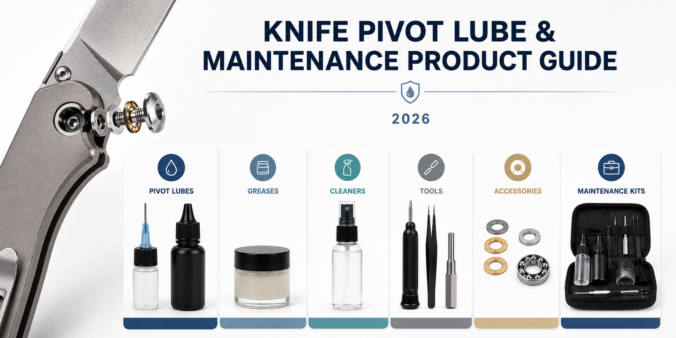
Knife Pivot Lube & Maintenance Product Guide (2026)
TL;DR:
- Knife pivot lubrication reduces blade drag, prevents mechanical wear, and stops corrosion – three failure modes that compound without regular maintenance
- KPL Original (15WT synthetic, $16.99 for 10mL) yields roughly 200 applications at ~$0.08 each; no competing product offers better cost-per-application
- Bearing pivots need thin oil (10W); washer pivots need medium-to-heavy viscosity (85W) – a distinction absent from most maintenance guides
- WD-40 is a solvent, not a lubricant – it evaporates within hours and can strip existing lube from your pivot
- Carbon steel knives require corrosion-inhibiting lube; stainless steel is more forgiving but still benefits from regular maintenance
What Does Knife Pivot Lube Actually Do?
Your knife’s pivot is the mechanical heart of the blade – it’s where the handle and blade meet, held together by washers, bearings, or bushings. Lubrication is critical to knife performance because it reduces friction between pivot components, prevents corrosion, and extends the functional life of washers and bearings.
Think of it like this: without lube, metal-on-metal contact creates drag. That drag accelerates wear. Wear creates play. Play creates wobble. Wobble becomes a broken knife.
Here’s what happens when you skip lubrication:
Blade drag. The blade opens and closes with resistance. A dull edge is more prone to slipping while cutting, and a sluggish pivot makes the knife feel cheap – even if it cost $200.
Accelerated mechanical wear. Washers and bearings are precision components. Without a lubricating film between them, friction accelerates wear rates exponentially. A knife that should last decades wears out in months.
Corrosion at the pivot interface. Moisture and oxygen attack bare metal. The pivot area – where you can’t see – becomes a rust factory. By the time you notice, the damage is internal and irreversible.
Pivot Lube keeps dirt, metal particles, and grit in suspension so they don’t cause grinding and premature wear. It’s not just about smoothness; it’s about survival.
Key Takeaway: Skipping pivot lube costs you $150+ in premature wear and potential repair. A $12 bottle of KPL prevents all three failure modes – drag, wear, and corrosion – for 200+ applications.
Top Knife Pivot Lube Products Compared (2026)
The pivot lube market is smaller than you’d think. A handful of products dominate, each with distinct viscosity profiles and use cases. Here’s how they stack up:
| Product | Viscosity | Base Type | Price (10mL) | Best For | Cost/Application |
|---|---|---|---|---|---|
| KPL Original | 15WT | Synthetic | $16.99 | All pivot systems | ~$0.085 |
| KPL Heavy | 85WT | Synthetic | ~$18 | Washer pivots | ~$0.090 |
| Nano-Oil 10W | 10WT | Synthetic | ~$14 | Ball bearings | ~$0.070 |
| Nano-Oil 85W | 85WT | Synthetic | ~$14 | Washer systems | ~$0.070 |
| Sentry TUF-GLIDE | Variable | PTFE dry film | ~$12 | Carbon steel, EDC | ~$0.060 |
| Militec-1 | Variable | Metal conditioner | ~$10 | Budget option | ~$0.050 |
| Rem Oil | Light | Petroleum | ~$8 | Budget option | ~$0.040 |
Cost-per-application calculation: A 10mL bottle contains roughly 200 drops (0.05mL per drop using a standard medicine dropper). Divide bottle price by 200 to get cost per pivot lube session.
KPL Knife Pivot Lube Line Breakdown
KPL is pretty much considered the “Industry Standard” by most who care. The brand offers three formulations, each engineered for different pivot systems.
KPL Original (15WT): This is a 15 weight, fully-synthetic oil specifically for knives. It’s the Goldilocks option – thin enough for bearing pivots, thick enough for washers. KPL actually helps clean your knife while you use it, meaning it suspends grit rather than letting it settle and grind.
KPL Heavy (85WT): For traditional washer-based pivots that need thicker film protection. If your knife has a back-lock or liner-lock with bronze washers, this is your choice. The heavier viscosity maintains a consistent lubricating film under the pressure of repeated opening and closing.
KPL Nano (proprietary): A newer formula marketed for ultra-tight tolerances. It’s harder to find and costs more, but if you own high-end production knives with precision bearings, it’s worth testing.
Temperature rating: -40°F to 400°F, so it works in cold climates and won’t thin out in summer heat.
Best Budget Alternatives to KPL
Not everyone wants to spend $17 per bottle. Here are the alternatives – and why they work (or don’t).
Nano-Oil 10W/85W: Roughly $14 per 10mL bottle. The viscosity split is cleaner than KPL’s one-size-fits-all approach. Use 10W for bearing pivots, 85W for washers. Quality is solid, though it lacks KPL’s proprietary “cleaning” additive package.
Sentry Solutions TUF-GLIDE: A dry-film PTFE lubricant that leaves minimal residue. At ~$12 per bottle, it’s cheaper than KPL and attracts less lint – a real advantage for EDC knives that live in pockets. The trade-off: it’s not as effective on heavily worn pivots that need deep penetration.
Militec-1: A metal-conditioning lubricant that bonds to steel surfaces. At ~$10 per bottle, it’s the budget option. The downside: no precision applicator, so you risk over-lubing. One drop too many and you’ve got a grit magnet.
Rem Oil: Light petroleum-based gun oil at ~$8 per bottle. It works on bearing pivots but isn’t ideal for washers. It also lacks corrosion inhibitors, so carbon steel blades need more frequent reapplication.
What to avoid: WD-40. Avoid using household oils like WD-40, as they can attract and stick more dirt in your pivot, ultimately leading to more significant problems. WD-40 stands for “Water Displacement, 40th formula” – it’s a penetrating solvent, not a lubricant. It evaporates within hours and can actually wash out existing lube, leaving your pivot drier than before.
Key Takeaway: KPL Original is the industry standard. Nano-Oil 10W/85W is the best budget alternative. Avoid WD-40 entirely – it’s a solvent masquerading as lube.
How Do You Apply Pivot Lube Correctly?
You need one drop. Not two. One.
Too much and then it collects dust and debris as well as creating friction. Over-lubing is the #1 mistake beginners make. A single drop of KPL Original is enough to coat the entire pivot interface.
Here’s the step-by-step process:
Step 1: Clean the pivot first. Isopropyl alcohol, 90% or higher, flushes out old lube and grit, evaporates fast, leaves no residue. Use a toothpick to scrape compacted lint from around the pivot. Don’t disassemble unless necessary – most knives don’t require full teardown for maintenance.
Step 2: Apply one drop. Position the needle applicator at the pivot screw. Squeeze gently. One drop. That’s it. If you’re using a bottle without a precision applicator (like Militec-1), use a toothpick to transfer a tiny amount.
Step 3: Work it in. Open and close the blade 50–100 times. This distributes the lube evenly across the washer or bearing surfaces. After it’s back together, cycle the blade open and closed 50 to 100 times. It lets the lube settle and the washers mate, and the action usually smooths out noticeably during that break-in.
Step 4: Wipe excess. Use a clean cloth to remove any visible lube around the pivot. This prevents lint and dust from sticking to the wet oil.
Bearing pivots vs. washer pivots: Ball-bearing systems (common in modern production folders) need thinner oil because bearings roll rather than slide. Washer systems (traditional back-locks and liner-locks) need thicker oil to maintain a film under sliding friction. If your knife has a bearing pivot, use KPL Original or Nano-Oil 10W. If it has washers, KPL Heavy or Nano-Oil 85W is better.
Key Takeaway: One drop, 50–100 cycles, wipe excess. Over-lubing attracts grit and creates drag. Under-lubing leaves your pivot unprotected. The sweet spot is a barely-visible film.
Maintenance Schedule: How Often Should You Lube a Knife Pivot?
Lubing your knife is not something you need to do very often. But “not very often” depends on how you use the knife.
| Use Case | Frequency | Reason |
|---|---|---|
| EDC daily carry | Every 2–3 months | Regular opening/closing depletes lube; pocket lint accelerates wear |
| Occasional carry | Every 6 months | Light use means slower lube breakdown; seasonal humidity matters |
| Hard use/outdoor | Every 4–6 weeks | Dirt, sand, and moisture accelerate lube degradation |
| Storage (3+ months) | Before storage + after | Prevents rust during dormancy; reapply before use |
| Humid/coastal climate | Every 4–8 weeks | Moisture accelerates corrosion; more frequent lube needed |
Signs your pivot needs lube now:
- Blade drag or resistance when opening/closing
- Grinding or grinding sound (metal-on-metal contact)
- Visible rust or discoloration around the pivot screw
- Blade wobbles or has play side-to-side
Don’t forget the environment you intend to use your knives in. Some very general rules: very light or a dry lubrication in dry dusty environments, thinner lubricants in extremely cold environments, thicker lubricants in extremely hot environments.
Carbon steel blades stored in humid conditions need lube every 4–6 weeks. Stainless steel is more forgiving – every 6 months is acceptable for occasional-use folders. High-carbon steels like 1095 and O1 are highly susceptible to rust and require regular oiling with a corrosion-inhibiting lubricant.
Key Takeaway: EDC knives need lube every 2–3 months. Hard-use and coastal knives need it every 4–6 weeks. Storage knives need lube before and after dormancy. Carbon steel demands more frequent maintenance than stainless.
Does Knife Steel Type Affect Which Lube You Should Use?
Yes. The blade steel composition changes both the urgency and the type of lubricant you need.
Carbon steel knives (1095, O1, 52100): These are rust magnets. High-carbon steels like 1095 and O1 are highly susceptible to rust and require regular oiling with a corrosion-inhibiting lubricant – even brief exposure to humidity causes surface oxidation. Use heavier viscosity oils (KPL Heavy, Nano-Oil 85W, or TUF-GLIDE) that form a lasting protective film. Reapply every 4–6 weeks, especially in humid climates.
Stainless steel knives (440C, 154CM, VG-10): Stainless steels are “stain-less”, not “stain proof” – they can and will develop rust if not properly maintained. But they’re far more forgiving than carbon steel. KPL Original (15WT) is sufficient. Maintenance every 6 months is acceptable for occasional-use folders.
Super steels (S30V, M390, 20CV): These premium stainless alloys are used in tight-tolerance bearing pivots. They benefit most from ultra-thin lubricants (Nano-Oil 10W) to avoid sluggish action. Heavy oils create drag in precision-ground bearing assemblies.
Handle material interaction: Petroleum-based lubricants can migrate into porous natural handle materials including wood, bone, and stabilized organics, causing uneven staining and darkening. G10, carbon fiber, and titanium handles are inert and unaffected. If your knife has natural scales, use TUF-GLIDE (dry-film) or apply lube only to the pivot, avoiding the handle junction.
Key Takeaway: Carbon steel = heavy lube every 4–6 weeks. Stainless steel = medium lube every 6 months. Super steels with bearings = thin lube every 2–3 months. Avoid petroleum oils on natural handle materials.
Common Pivot Lube Mistakes and How to Fix Them
Mistake #1: Over-lubing. Too much and then it collects dust and debris as well as creating friction. The result is a gritty, grinding pivot that feels worse than before you lubed it. Fix: Wipe away excess with a clean cloth. One drop is enough.
Mistake #2: Using WD-40. Don’t reach for the WD-40. It’s a water-displacer and solvent, not a lasting lubricant, and it tends to gum up the pivot over time. WD-40 evaporates within hours and can strip existing lube from bearing races. Fix: Use KPL, Nano-Oil, or TUF-GLIDE instead.
Mistake #3: Skipping the cleaning step. Applying fresh lube over old, gritty lube just traps dirt deeper in the pivot. Fix: Clean with isopropyl alcohol and a toothpick before relubing.
Mistake #4: Using food-grade oils (olive oil, vegetable oil). Natural oils become rancid when left on metal surfaces, creating gummy residue and foul odors. They’re not stable lubricants and gum up mechanical joints over time. Fix: Use synthetic oils designed for knives.
Mistake #5: Using grease instead of oil on bearing pivots. Grease is too viscous for ball-bearing races. It traps debris and turns abrasive. Fix: Use only light oil (10–15WT) on bearing pivots.
Key Takeaway: One drop, clean first, use knife-specific lube, avoid WD-40 and food oils, never use grease on bearings. These five rules prevent 90% of pivot lube problems.
Frequently Asked Questions About Knife Pivot Lube
How much does knife pivot lube cost compared to other knife oils?
Direct Answer: KPL Original costs $16.99 for 10mL, yielding roughly 200 applications. Budget alternatives like Nano-Oil cost less per application; premium options like TUF-GLIDE offer competitive pricing.
A single bottle lasts 6–12 months for most users, making it one of the cheapest maintenance investments you’ll make. Compare that to a $150+ professional knife repair for pivot wear, and the ROI is obvious.
Is KPL better than regular gun oil for knife pivots?
Direct Answer: KPL Original is purpose-formulated for knife pivots and includes additives that suspend grit and inhibit corrosion. Gun oils like Rem Oil work but lack these specialized properties.
KPL actually helps clean your knife while you use it, meaning it suspends metal particles and grit in suspension rather than letting them settle and grind. Gun oils don’t have this feature. If you already own gun oil, it’s acceptable for bearing pivots in a pinch – but KPL is the better choice.
How often should I lubricate my pocket knife pivot?
Direct Answer: EDC knives need lube every 2–3 months. Hard-use and coastal knives need it every 4–6 weeks. Occasional-use folders can go 6 months. Carbon steel blades need more frequent maintenance than stainless steel.
Watch for signs: blade drag, grinding sounds, or visible rust around the pivot. When you see them, it’s time to lube. Don’t wait for a maintenance schedule if your knife is telling you it needs attention.
Can I use WD-40 as a knife pivot lubricant?
Direct Answer: No. WD-40 is a penetrating solvent and water-displacer, not a lubricant. It evaporates within hours and can strip existing lube from your pivot, leaving it drier than before.
Avoid using household oils like WD-40, as they can attract and stick more dirt in your pivot, ultimately leading to more significant problems. Use KPL, Nano-Oil, or TUF-GLIDE instead.
What is the difference between KPL Original and KPL Heavy?
Direct Answer: KPL Original is 15WT synthetic oil; KPL Heavy is 85WT. Original works on all pivot systems. Heavy is optimized for traditional washer-based pivots that need thicker film protection.
Use Original for bearing pivots and general-purpose maintenance. Use Heavy if your knife has bronze washers and you want maximum film strength under load.
Does pivot lube work differently on bearing pivots vs. washer pivots?
Direct Answer: Yes. Ball-bearing pivots roll, so they need thin oil (10–15WT) that flows into the races without creating drag. Washer pivots slide, so they need thicker oil (15–85WT) that maintains a protective film under friction.
Ball bearings allows for the smoothest opening and closing action on the market. They’re sensitive to viscosity – too thick and they feel sluggish. Washers are more forgiving and actually benefit from heavier lube.
Will pivot lube prevent rust on carbon steel knives?
Direct Answer: Yes, if applied regularly. Lube creates a protective film that displaces moisture and oxygen. But it’s not permanent – reapply every 4–6 weeks for carbon steel blades, especially in humid climates.
High-carbon steels like 1095 and O1 are highly susceptible to rust and require regular oiling with a corrosion-inhibiting lubricant. TUF-GLIDE and KPL Heavy are your best choices for carbon steel because they form lasting protective films.
Conclusion
Knife pivot lubrication is simple, cheap, and essential. One drop every 2–3 months prevents blade drag, accelerates wear, and stops corrosion – three failure modes that compound without maintenance.
KPL is pretty much considered the “Industry Standard” by most who care, and for good reason. At a competitive price point, it costs less than a coffee per month to keep your knife running smoothly. Budget alternatives like Nano-Oil and TUF-GLIDE are equally effective if you’re watching your wallet.
The key is consistency. Set a maintenance schedule based on your use case – every 2–3 months for EDC, every 4–6 weeks for hard use, every 6 months for occasional carry. Watch for signs of drag or grinding. Clean before you lube. Use one drop. Wipe excess. Cycle 50–100 times.
Your knife will reward you with smooth action, rust-free pivots, and years of reliable performance. And if you’re looking to stock up on quality pivot lube and other maintenance supplies, Knife Depot carries the full range of KPL formulations, Nano-Oil, and TUF-GLIDE – all with fast shipping and expert guidance.

Leave a Reply