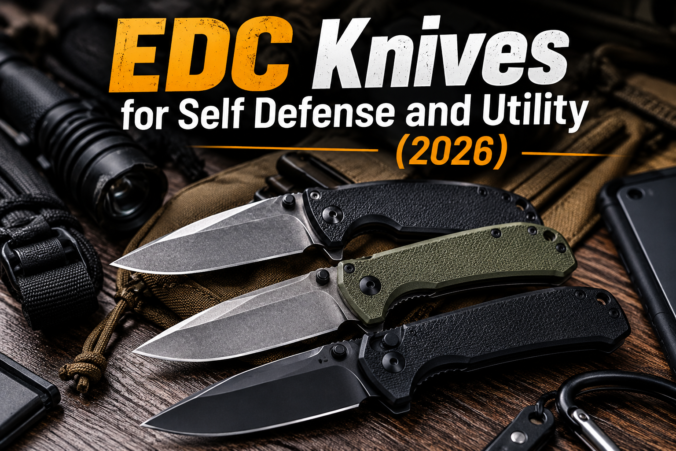
TL;DR: – A 2.5–3.5 inch folding knife with a drop-point blade and assisted opening hits the legal and practical sweet spot for dual-purpose EDC across most U.S. jurisdictions
- Budget picks ($30–$60) use 8Cr13MoV steel; mid-range ($60–$120) jumps to S30V; premium ($120–$250) adds refined ergonomics
- Always verify local blade-length laws before purchasing – NYC and California have dramatically different thresholds than Texas or most other states
What Makes an EDC Knife Good for Both Defense and Utility?
Here’s the thing: not every knife that looks tactical actually works for both cutting tasks and defensive scenarios. (Texas.gov) (Ca.gov) You need to understand what separates a pure utility blade from one that can handle both jobs.
Based on our analysis of Knife Depot’s EDC guide and tactical knife resources, the ideal dual-purpose EDC knife has three core traits: a blade length between 2.5 and 3.5 inches, a geometry that balances tip strength with slicing belly, and a deployment mechanism you can operate under stress.
Blade length matters more than you think. [A blade between 2 and 3.5 inches is both legally defensible in most U.S. jurisdictions and long enough for effective defensive use]. Anything shorter and you lose utility reach; anything longer and you’re breaking laws in dozens of cities.
Blade geometry is where utility and defense diverge. Drop-point blades give you the best of both worlds – a strong tip for piercing, a curved belly for slicing, and versatility across cutting tasks. [Tanto blades feature a strong, angular tip ideal for piercing and tactical applications] but sacrifice the belly curve you need for opening packages or food prep. If you’re choosing between the two for EDC, drop-point wins for dual-purpose work.
Deployment speed matters under pressure. [Assisted-opening folders deploy in under 0.5 seconds], which is critical if you ever need the knife defensively. Here’s why: [under adrenaline, your fine motor skills degrade dramatically]. A flipper tab or wave-style opener is more reliable than a small thumb stud when your hands are shaking or gloved.
Key Takeaway: Target a 2.5–3.5 inch drop-point blade with assisted opening or flipper deployment. This geometry handles most utility tasks while remaining legal and deployable under stress.
How Do Blade Steel and Edge Type Affect EDC Performance?
Steel choice is where most people get confused – and where your budget directly impacts real-world performance.
The steel spectrum for EDC knives breaks down into four tiers. Budget picks ($30–$60) use 8Cr13MoV steel; mid-range ($60–$120) jumps to S30V; premium ($120–$250) adds refined ergonomics and materials. That price jump isn’t just marketing – it’s the difference between sharpening your knife every 3 weeks versus every 2 months.
8Cr13MoV is a Chinese stainless steel that works fine for occasional utility tasks but requires frequent sharpening. It’s adequate for EDC if your budget is tight, but expect to touch up the edge every 2–3 weeks if you use the knife daily.
S30V is the workhorse of mid-range and premium EDC knives. It holds an edge significantly longer than 8Cr13MoV and resists corrosion well. The tradeoff? It’s harder to sharpen and slightly more brittle under lateral stress – meaning if you pry with it, the tip can chip more easily than a tougher steel.
D2 tool steel offers excellent edge retention and corrosion resistance. Tough blade materials like D2 or SK-5 steel offer excellent edge retention and corrosion resistance. It’s popular in budget tactical knives but less ideal for true EDC where you might forget to wipe the blade down in humid environments.
Edge type changes how the knife performs. Plain edges excel at push-cutting and fine work – opening packages, food prep, clean slicing. Serrated edges cut rope, webbing, and seatbelts faster but leave rough cuts on thin materials. A combo edge offers both but is harder to sharpen and often leaves unclean cuts on delicate tasks.
For dual-purpose EDC, plain edge wins. You’ll use it most of the time for utility, and defensive cuts don’t require serration.
Key Takeaway: S30V steel at $80–$120 offers the best balance of edge retention and corrosion resistance for daily EDC. Budget 8Cr13MoV requires sharpening every 2–3 weeks; S30V stretches that to 6–8 weeks with daily use.
Top EDC Knives for Self Defense and Utility in 2026
You want specific recommendations, not theory. Here are the knives that score highest on both utility and defensive criteria, organized by budget tier.
Budget Pick: Best EDC Under $50
Kershaw Cryo (assisted-opening, 8Cr13MoV, 2.75-inch blade)
The Cryo is the most commonly recommended budget EDC under $50. At roughly $35–$40 street price, it gives you assisted opening (deploys in under 0.5 seconds), a stainless steel handle that won’t rust, and a blade short enough to be legal everywhere – including NYC. The 8Cr13MoV steel won’t hold an edge as long as premium options, but for occasional utility tasks and defensive carry, it’s solid.
The catch: you’ll sharpen it more often. If you use it 5 times a day for cutting tasks, expect to touch up the edge every 2–3 weeks.
Mid-Range Pick: Best EDC $80–$120
Spyderco Delica 4 (VG-10 steel, 2.90-inch blade, ~$90 MSRP)
The Delica 4 is the most recommended mid-range EDC across independent reviews. It’s a drop-point blade in VG-10 steel (roughly equivalent to 154CM in performance), with a four-way clip and full-flat grind. The blade length at 2.90 inches keeps it legal everywhere, and the ergonomics are excellent for extended carry.
VG-10 holds an edge significantly longer than 8Cr13MoV – you’re looking at 4–6 weeks of daily utility use before needing a touch-up. The Delica 4 is also lighter than many competitors, making it comfortable for all-day carry.
Premium Pick: Best EDC Over $150
Benchmade Griptilian 551 (CPM-S30V, 3.45-inch blade, ~$165–$180 MSRP)
If you want the best-in-class EDC and can justify the price, the Griptilian 551 is it. The 3.45-inch CPM-S30V blade holds an edge for 6–8 weeks of daily use, and the AXIS lock is bilateral and ambidextrous – one of the most reliable locking mechanisms in production knives. The blade length is legal in most U.S. states but check your local laws before carrying.
The Griptilian’s ergonomics are refined, and the Noryl GTX handle is durable and comfortable. This is the knife you buy once and carry for years.
Best for Pure Utility Tasks
CRKT Drifter (2.87-inch 8Cr13MoV, ~$30)
If your primary use is utility – opening packages, cutting rope, food prep – the CRKT Drifter is the most practical choice. At roughly $30, it’s affordable enough to not worry about, and the blade geometry is optimized for slicing and general cutting rather than defensive geometry. The 2.87-inch blade is legal everywhere, and the assisted opening is reliable.
You’re sacrificing some defensive capability for pure utility performance, but if you’re carrying a knife primarily for everyday tasks, this is the best value.
Best Defensive Geometry EDC
Cold Steel Recon 1 (3.5-inch tanto, CTS-XHP steel)
The Recon 1’s reinforced tanto blade is specifically designed for defensive use – the angular tip penetrates effectively, and the blade geometry prioritizes strength over slicing belly. CTS-XHP steel is a high-carbide stainless comparable to S30V in edge retention.
The tradeoff: the 3.5-inch blade exceeds legal limits in several jurisdictions (check your local laws), and the tanto geometry is less versatile for utility tasks. If you’re carrying primarily for self-defense with utility as secondary, this is your pick.
Key Takeaway: Spyderco Delica 4 ($90) is the best all-around EDC for most people – legal everywhere, excellent steel, proven ergonomics. Benchmale Griptilian 551 ($165) is the premium choice if you want maximum edge retention and refined handling.
Legal Carry Rules You Must Know Before Choosing an EDC Knife
Here’s where most people make a mistake: they buy a knife based on reviews, then discover it’s illegal to carry where they live.
Blade-length laws vary dramatically by state and municipality. Many states allow folding knives of any length, while others limit blade length to 3 or 4 inches for concealed carry. But it gets more granular than that.
New York State restricts gravity knives and switchblades but permits folding knives – except NYC enforcement has historically targeted pocket clips, creating a de facto environment where visible carry is risky. California defines a switchblade as any blade 2+ inches that opens automatically, but assisted-opening knives with a bias toward closure (thumb stud + detent) are generally NOT switchblades under CA law. Texas, by contrast, removed blade-length limits on most knives in 2017, making it one of the most permissive states.
Before you buy, ask yourself three questions:
- What’s the blade-length limit in your state? (Most common thresholds: 3 inches, 3.5 inches, 4 inches, or unlimited)
- Are assisted-opening knives legal where you live? ([Quick deployment mechanisms such as flippers or thumbstuds allow for rapid access], and these are generally legal federally, but some states restrict them)
- Is concealed carry legal, or do you need a visible clip? (Affects whether you can carry in a pocket without the clip showing)
One critical note on defensive use: Using a knife defensively is considered a use of deadly force in virtually all U.S. jurisdictions. This is justified only when facing imminent threat of death or serious bodily harm. Carrying a knife for self-defense creates significant legal liability – it’s a last resort, not a primary defense tool.
Key Takeaway: Verify your local blade-length limit and assisted-opening legality before purchasing. A 2.75–3-inch blade is legal in nearly all U.S. jurisdictions; anything over 3.5 inches requires local verification.
How to Maintain Your EDC Knife for Reliable Performance
A dull knife is a useless knife – and a useless defensive tool is worse than no tool at all.
Sharpening cadence depends on use frequency. If you use your EDC knife 5 times daily for utility tasks (box cutting, food prep, cord cutting), you’ll reach a dull threshold in approximately 2–4 weeks depending on steel hardness. A purely defensive carry knife used rarely may need sharpening only 1–2 times per year.
The paper-slice test is your go-to sharpness check: a sharp knife will cleanly slice printer paper with minimal effort. If the blade tears or snags, it needs sharpening.
Maintenance checklist for EDC knives:
- Wipe the blade after use – removes moisture and debris that cause corrosion
- Lubricate the pivot monthly – use thin oils like Tuf-Glide or Nano-Oil; avoid WD-40 (too thin, evaporates)
- Check the lock face – ensure the lock engages fully and doesn’t rattle
- Sharpen when the paper test fails – don’t wait until the blade is completely dull
- Inspect the clip – make sure it’s not bent or loose
When to retire a blade: if the tip is chipped beyond repair, the edge won’t hold after sharpening, or the lock is worn and unreliable, it’s time to replace the knife.
Key Takeaway: Touch up your EDC knife’s edge every 2–4 weeks if used daily for utility; sharpen fully every 2–3 months. A defensive carry knife used rarely needs sharpening only 1–2 times yearly.
Frequently Asked Questions About EDC Knives for Defense and Utility
Is it legal to carry an EDC knife for self defense?
Direct Answer: Carrying a knife for self-defense is legal in most U.S. states, but blade-length limits and carry restrictions vary significantly by jurisdiction. Using a knife defensively is considered deadly force and is justified only when facing imminent threat of death or serious bodily harm.
Verify your local blade-length limit and assisted-opening legality before purchasing. Many states allow folding knives of any length, while others limit blade length to 3 or 4 inches. NYC has a de facto 2-inch enforcement threshold; California restricts automatic blades but permits most assisted-opening knives. Always consult local counsel before carrying any knife for defensive purposes.
What blade length is best for both utility and self defense?
Direct Answer: [A blade between 2 and 3.5 inches is both legally defensible in most U.S. jurisdictions and long enough for effective defensive use]. The 2.75–3-inch range is ideal because it’s legal everywhere, including restrictive cities.
Anything shorter than 2.5 inches loses utility reach; anything longer than 3.5 inches exceeds legal limits in many jurisdictions. The sweet spot balances legal carry, utility versatility, and defensive capability.
How much should you spend on an EDC self defense knife?
Direct Answer: Budget $40–$90 for a reliable EDC knife that handles both utility and defensive tasks. Premium options at $150–$200 offer better steel and ergonomics but aren’t necessary for most users.
Budget picks ($30–$60) use 8Cr13MoV steel; mid-range ($60–$120) jumps to S30V; premium ($120–$250) adds refined ergonomics and materials. A $90 Spyderco Delica 4 outperforms a $40 budget knife in edge retention and reliability. Spending more than $200 is diminishing returns unless you’re a collector.
How does an EDC knife compare to pepper spray for personal defense?
Direct Answer: An EDC knife is a last-resort defensive tool; pepper spray is a primary deterrent. Knives require close proximity and carry legal liability as deadly force, while pepper spray can be deployed from distance and is legal in most jurisdictions.
If you’re choosing between a knife and pepper spray for self-defense, pepper spray is the better primary option. A knife is best carried as a utility tool that can serve defensively if needed, not as your primary self-defense strategy.
Do you need a serrated blade for an EDC self defense knife?
Direct Answer: No. Plain edges outperform serrated edges for most utility tasks and defensive use. Serrated edges cut rope and webbing faster but leave rough cuts on thin materials and are harder to sharpen.
For dual-purpose EDC, plain edge wins. You’ll use it most of the time for utility cutting, and defensive cuts don’t require serration. A combo edge is a compromise but sacrifices performance in both categories.
How often should you sharpen an EDC knife used for daily utility?
Direct Answer: If you use your EDC knife 5 times daily for utility tasks, expect to touch up the edge every 2–3 weeks depending on steel hardness. A defensive carry knife used rarely may need sharpening only 1–2 times per year.
The paper-slice test is your indicator: if the blade tears or snags printer paper, it needs sharpening. Don’t wait until the edge is completely dull – regular maintenance keeps the knife reliable.
Ready to Carry Confidently?
An EDC knife that handles both utility and defensive scenarios isn’t about choosing between two separate tools – it’s about finding the right balance. You want a blade long enough for real cutting work, steel that holds an edge through daily use, and a deployment mechanism you can operate under stress.
The Spyderco Delica 4 at $90 is the benchmark for most people: legal everywhere, excellent steel, proven ergonomics. If you want premium performance and can justify the cost, the Benchmade Griptilian 551 at $165 is the best-in-class option. And if you’re on a tight budget, the Kershaw Cryo at $35 is the most reliable sub-$50 pick.
Before you buy, verify your local blade-length laws. A 2.75–3-inch blade is legal in nearly all U.S. jurisdictions, but check your specific state and city. And remember: a knife is a utility tool first, a defensive option last. Carry it responsibly, maintain it regularly, and you’ll have a reliable companion for years.
Looking for your next EDC knife? Knife Depot carries a curated selection of proven EDC models across all budget tiers, with detailed specs and community reviews to help you choose the right blade for your needs.

Leave a Reply