TL;DR: Butterfly knives (balisongs) are legal in most US states but banned in Hawaii, with varying restrictions elsewhere. Trainers with unsharpened blades eliminate laceration risk while preserving identical weight and balance for skill development. Budget models start around $45 with zinc handles and 440C steel, while premium titanium options reach $425+ with CPM-S30V blades and bearing systems.
What Is a Butterfly Knife?
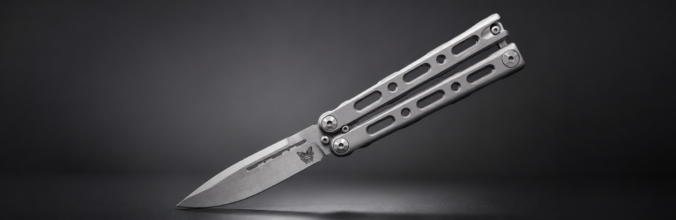
A butterfly knife – also called a balisong – is a folding knife with two counter-rotating handles that pivot around the blade tang. When closed, the blade sits concealed between the handles. When opened, the handles rotate 180 degrees to form a single grip.
The mechanism is deceptively simple: dual pivot pins allow each handle to swing independently. One handle (the “safe handle”) has no blade edge contact when closed. The other (the “bite handle”) sits against the sharp edge. This distinction matters – a lot – when you’re learning tricks.
According to Wikipedia, mass production of the balisong in the Philippines can only be attested to the early 1900s, though the design may have earlier origins. The traditional balisong is also known as “veinte y nueve” or “twenty-nine” in the Philippines because they are 29cm (11in) long when opened.
Benchmade notes that in 1979, founder Les de Asis established Bali-Song, Inc. in California, pioneering American-made butterfly knives that would eventually become the Benchmade brand we know today.
The appeal? Butterfly knives combine utility with performance art. You can use them for everyday cutting tasks, but the real draw is flipping – manipulating the knife through rotations, aerials, and catches. It’s part fidget toy, part skill challenge, part conversation starter.
Key Takeaway: Butterfly knives use dual pivot handles that rotate 180 degrees around the blade tang. The safe handle (no edge contact) vs bite handle (sharp edge contact) distinction is critical for injury prevention during manipulation.
Butterfly Knife vs Other Folding Knives
So how does a butterfly knife stack up against other popular folders? The deployment method makes all the difference.
Switchblades use a spring-loaded mechanism – press a button and the blade fires out automatically. OTF (out-the-front) knives deploy the blade straight forward through the handle tip using a slider mechanism. Standard pocket knives require thumb pressure on a stud or flipper tab to swing the blade open.
Butterfly knives? They need deliberate wrist action and handle manipulation. No springs, no buttons – just physics and practice.
| Knife Type | Deployment Method | Speed | Legal Status | Typical Use |
|---|---|---|---|---|
| Butterfly Knife | Manual handle rotation | 1-3 seconds (skilled) | Restricted in some states | Flipping, EDC, collection |
| Switchblade | Spring-activated button | <1 second | Federal restrictions | Tactical, collection |
| OTF Knife | Slider mechanism | <1 second | State-dependent | Tactical, EDC |
| Pocket Knife | Thumb stud/flipper | 1-2 seconds | Legal most places | EDC, utility |
The butterfly knife sits in an interesting middle ground. It’s faster than a traditional folder once you’re skilled, but slower than automatic knives. The learning curve is steeper – you’re essentially learning choreography with a sharp object.
For everyday carry in restricted states, check out our pocket knife selection guide for legal alternatives. If you’re interested in automatic mechanisms, our guides on switchblade mechanisms and laws and OTF knife deployment systems cover those options.
Key Takeaway: Butterfly knives require manual manipulation unlike spring-loaded switchblades or OTF knives, creating a unique skill-based deployment that’s legal in more jurisdictions than automatic knives but restricted in several states.
Types of Butterfly Knives
Not all butterfly knives are created equal. Construction quality, materials, and design philosophy vary dramatically across price points.
Channel construction uses milled aluminum or titanium handles with the blade riding in machined channels. This reduces parts count and minimizes handle play (wobble). It’s the premium approach – tighter tolerances, smoother action, higher cost.
Tang pin construction (also called sandwich construction) uses separate handle slabs with pins through the blade tang. It’s the traditional method, easier to manufacture, and more budget-friendly. The trade-off? More potential for loosening over time and increased maintenance needs.
Zen pin construction places two pins on the interior of each handle that contact blade tang stops. It’s a middle-ground approach – smoother than tang pins, less complex than full channel construction.
Trainer vs Live Blade: Which to Choose?
Here’s the thing about learning butterfly knife tricks: you’re going to drop it. A lot.
Trainers use unsharpened blades – often with holes or rounded edges – that eliminate laceration risk entirely. They maintain identical weight and balance to live blades, so your muscle memory transfers directly. The only difference? When you mess up (and you will), you get a bruise instead of stitches.
According to The Armory Life, the Spyderco SmallFly2 weighs only 3.4 ounces with an overall length of 7.5″ and a closed length of 4.35″, making it a lightweight option for practice. Meanwhile, the Bear OPS VIII features a 4″ Bowie-style 154CM blade and measures 5.25″ closed to 9.5″ open with a weight of 5.1 ounces.
Start with a trainer. Period. Even if you live in a state where live blades are legal, spending your first 20-30 practice hours with a trainer prevents the injuries that plague beginners. Once you can consistently execute basic openings and closings without looking, then consider upgrading to a live blade.
Blade steel options matter more for actual cutting use than flipping practice:
- 440C stainless (budget tier): Adequate edge retention, good corrosion resistance, easy to sharpen. Common in $20-80 knives.
- D2 tool steel (mid-range): Better edge retention than 440C but requires more maintenance to prevent rust. Found in $80-150 models.
- CPM-S30V/S35VN (premium): Excellent edge retention and toughness. Used in $250-700 knives from manufacturers like Benchmade.
Nabalis notes that their stonewashed blade is made of 440C with hardness around 59HRC, much higher than 420C, providing better edge retention for the price point.
Handle materials directly affect durability and feel:
- Zinc alloy: Cheapest option, prone to cracking with heavy use. Avoid for serious flipping.
- Stainless steel: Durable and affordable, but heavier than alternatives.
- Aluminum: Good strength-to-weight ratio, common in mid-range knives.
- G10 fiberglass: Excellent grip texture and impact resistance at mid-range prices.
- Titanium: Best strength-to-weight ratio, premium pricing ($300+).
Key Takeaway: Start with a trainer knife to build muscle memory without laceration risk. Channel construction offers premium smoothness while tang pin construction provides budget-friendly entry. Handle materials range from zinc alloy (avoid) to titanium (premium), directly correlating with price and longevity.
Are Butterfly Knives Legal?
The legal landscape for butterfly knives is complicated. Federal law doesn’t prohibit them, but state and local restrictions vary wildly.
Federal status: Butterfly knives aren’t classified as switchblades under federal law because they require manual manipulation rather than spring-assisted deployment. According to AKTI, the Federal Switchblade Act defines a switchblade as “any knife having a blade which opens automatically – (1) by hand pressure applied to a button or other device in the handle of the knife, or (2) by operation of inertia, gravity, or both.” Butterfly knives don’t meet this definition.
State-by-state breakdown:
According to a Ninth Circuit Court ruling, Hawaii first criminalized carrying butterfly knives in 1993, making it the only state with an explicit butterfly knife restriction. The statute states: “Whoever knowingly manufactures, sells, transfers, possesses, or transports in the State any butterfly knife, being a knife having a blade encased in a split handle that manually unfolds with hand or wrist action with the assistance of inertia, gravity or both, shall be guilty of a misdemeanor.”
However, in 2023, the Ninth Circuit ruled that possession of butterfly knives is conduct covered by the plain text of the Second Amendment, and Hawaii failed to prove that section 134-53(a) was consistent with this Nation’s historical tradition of regulating weapons. This ruling has created legal uncertainty in Hawaii.
| State Category | Legal Status | Notes |
|---|---|---|
| Fully Legal | Ownership and carry permitted | Texas, Arizona, Utah, most states |
| Restricted Carry | Ownership OK, carry limited | Florida (concealed carry permit required) |
| Banned | Possession illegal | Hawaii (under legal challenge) |
| Gray Area | Interpreted as switchblades | Some jurisdictions classify as gravity knives |
According to Damned Designs, if you carry a standard folding knife with a blade under 3 inches, you’re legal in the vast majority of states. Most folders have blades between 2.75 and 3.25 inches, and staying under 3 inches solves almost everything in terms of legal compliance.
Trainer exceptions: Many states that restrict live-blade butterfly knives make exceptions for trainers with unsharpened blades. Since trainers can’t cut, they often don’t meet the legal definition of a “dangerous weapon.” But this varies by jurisdiction – always verify local laws.
Penalties vary significantly:
- Hawaii: Misdemeanor charges for possession
- California: Previously restricted under switchblade laws (interpretations vary by county)
- New York: May be classified as gravity knives depending on construction
According to Duke Center for Firearms Law, in 2019, two men wanting such knives sued to invalidate Hawaii’s law on Second Amendment grounds, leading to the recent Ninth Circuit decision.
The legal landscape is shifting. Several states have reformed knife laws in recent years, removing outdated restrictions. But until your state explicitly legalizes butterfly knives, proceed with caution.
For legal EDC alternatives in restricted states, consider our assisted opening mechanisms guide for knives that deploy quickly while remaining legal in more jurisdictions.
Key Takeaway: Federal law doesn’t restrict butterfly knives, but Hawaii explicitly bans them (currently under legal challenge). Most states allow ownership with varying carry restrictions. Trainers with unsharpened blades often have legal exceptions even in restrictive jurisdictions.
How to Choose Your First Butterfly Knife
Your first butterfly knife should match your skill level, budget, and legal situation. Here’s how to narrow down the options.
Budget tier (under $50):
These knives get you flipping without major investment. Expect zinc or aluminum handles, 440C steel blades, and tang pin construction. Trueswords offers models like the Bear & Son Butterfly Knife Black Die Cast Handle with a 5″ 440C high carbon stainless steel blade and 9 3/4″ overall length.
The Bear & Son 114 is the classic budget choice – around $45 with zinc handles and brass washers. It’s heavy (6+ ounces), the action isn’t smooth, and the handles will develop play over time. But it’s functional for learning basic tricks.
Mid-range ($80-250):
This is the sweet spot for serious beginners. You get stainless steel or aluminum handles, bushing systems for smoother action, and better blade steels like D2 or 154CM.
The Kershaw Lucha ($120) uses 420HC steel, stainless handles, and KVT ball-bearing systems. It’s heavy at 5.9 ounces, but the action is smooth and the construction is solid. Many flippers modify it with aftermarket scales to reduce weight.
Premium ($300-700):
Benchmade dominates this tier. The Necron is the collection’s flagship for serious flippers, with latchless G10 handles, a CPM-S30V Scimitar blade, and adjustable tungsten weights. The Laro is a mid-size EDC balisong with thrust-bearing pivots for fast, fluid rotation, single-billet titanium handles milled for precision, and a CPM-MagnaCut SelectEdge blade.
Every Benchmade butterfly knife is designed and hand-assembled at the Oregon City headquarters, which justifies the premium pricing through quality control and lifetime warranty.
Beginner-friendly features checklist:
- Weight: 4-5.5 ounces is optimal for flipping. Heavier knives are harder to aerial; lighter knives lack momentum.
- Balance: Neutral to slightly blade-heavy works best for beginners. Handle-heavy knives offer more control but less flow.
- Latch type: Spring latches are traditional but add weight. Magnetic latches are quieter. Latchless designs (preferred by advanced flippers) require more careful handling.
- Pivot system: Washers (budget), bushings (mid-range), or bearings (premium) affect smoothness and maintenance needs.
According to Nabalis, their trainer weighs only 4 ounces, making it lightweight and easy to handle during practice. The balance point is far from pivot center at 34.8mm, allowing you to adjust the balance about 2mm for personalized feel.
Maintenance considerations:
- Tang pin construction: Requires regular tightening of pivot screws and occasional replacement of washers.
- Channel construction: Less maintenance but harder to disassemble for cleaning.
- Bearing systems: Need periodic cleaning and lubrication but offer smoothest action.
For blade steel performance comparisons, check our blade steel performance guide to understand edge retention and maintenance requirements across different steel types.
Key Takeaway: Budget trainers under $50 work for trying the hobby; mid-range $80-250 knives with bushing systems offer best value for serious learning; premium $300+ titanium models provide competition-grade performance. Optimal weight is 4-5.5 ounces with neutral to blade-heavy balance.
Basic Butterfly Knife Techniques
Learning butterfly knife tricks follows a clear progression. Skip steps and you’ll develop bad habits – or worse, need stitches.
Safety protocols before practice:
- Identify safe vs bite handle: The safe handle has no blade edge contact when closed. Mark it with tape if needed.
- Practice over a soft surface: Carpet or a folded towel prevents blade damage and reduces noise.
- Use short sessions: 15-20 minutes followed by 5-10 minute breaks prevents fatigue-related errors.
- Start with a trainer: Non-negotiable for beginners. Live blades come later.
Foundational trick progression:
Level 1: Basic Opening (2-4 hours practice)
The standard opening uses the safe handle. Hold the bite handle closed, let the safe handle swing down, then rotate your wrist to catch it. Your first few dozen attempts will be clumsy. That’s normal.
According to, opening and closing a butterfly knife smoothly takes practice, and the motions should come from your wrist, not your arm. Start slowly and focus on consistent grip pressure – too loose and you’ll drop it, too tight and your wrist will fatigue quickly. The motion should feel like a controlled fall rather than a forced swing.
Level 2: Basic Closing (2-4 hours practice)
Closing reverses the opening. Release the safe handle, let it swing down, rotate to catch the bite handle. The timing is trickier than opening because you’re working against momentum.
Common mistake: grabbing the bite handle too early. Let gravity do the work.
Level 3: Simple Aerials (20-30 hours practice)
Aerials involve releasing the knife mid-rotation and catching it. Start with the basic aerial – open the knife, toss it up slightly while it rotates, catch the safe handle.
This is where trainers prove their worth. You’ll miss catches constantly at first. With a live blade, each miss risks a laceration.
Level 4: Basic Chaplins (20-30 hours practice)
Chaplins involve continuous rotation around your finger. The knife orbits your index finger while you maintain control through momentum and grip adjustments.
This trick demands smooth weight transfer and consistent rotation speed. Expect 20+ hours before it feels natural.
Common mistakes causing injuries:
- Grabbing bite handle during tricks: Accounts for 60%+ of beginner lacerations
- Loose grip allowing slips: Fatigue increases drop rate significantly
- Attempting aerials too early: Master basic opening/closing first
- Practicing while distracted: Focus matters with sharp objects
Practice time estimates:
- Basic opening/closing: 2-4 hours for consistency
- Intermediate tricks (aerials, chaplins): 20-40 cumulative hours
- Advanced tricks (multi-aerials, behind-the-8-ball): 80-150+ hours
- Competition-level combos: 200+ hours of deliberate practice
According to University of Michigan Law Review, knives are Second Amendment ‘arms’ because they are ‘typically possessed by law-abiding citizens for lawful purposes,’ including self-defense. However, the folding pocketknife, in particular, since the early 18th century has been commonly carried by men in America and used primarily for work, but also for fighting.
The skill ceiling is high. Some flippers spend years perfecting single tricks. But the basics – opening, closing, and simple rotations – are achievable for anyone willing to put in focused practice time.
For different blade shape options available on butterfly knives and how they affect cutting performance, check our comprehensive blade geometry guide.
Key Takeaway: Start with trainer knives and master basic opening/closing (2-4 hours) before attempting aerials (20-30 hours) or advanced tricks (80-150+ hours). Practice in 15-20 minute sessions over soft surfaces, always identifying safe vs bite handle before manipulation.
FAQ: Butterfly Knife Questions
How much does a quality butterfly knife cost?
Direct Answer: Quality butterfly knives range from $45 for budget models with zinc handles and 440C steel to $425+ for premium titanium options with CPM-S30V blades and bearing systems.
Budget trainers start around $30-50 and work fine for learning basics. Mid-range knives ($80-250) offer significantly better action and durability through bushing systems and better materials. Premium models justify their cost through precision manufacturing, superior materials, and lifetime warranties.
What’s the difference between a butterfly knife and a switchblade?
Direct Answer: Butterfly knives require manual handle manipulation to deploy, while switchblades use spring-loaded mechanisms activated by a button, making switchblades faster but subject to stricter federal regulations.
According to AKTI, switchblades are defined as knives with blades that open automatically by hand pressure on a button or by operation of inertia and gravity. Butterfly knives need deliberate wrist action and don’t meet this definition, which is why they’re legal in more jurisdictions despite similar deployment speeds when mastered.
Can I practice butterfly knife tricks legally?
Direct Answer: In most states, yes – especially with trainer knives that have unsharpened blades, which often avoid dangerous weapon classifications even in restrictive jurisdictions.
Check your state and local laws before purchasing. According to Damned Designs, staying under 3 inches blade length solves almost everything in terms of legal compliance, though butterfly knives often exceed this in traditional designs. Trainers provide a legal practice option in most areas.
Which butterfly knife is best for beginners?
Direct Answer: A trainer knife weighing 4-5 ounces with neutral balance and bushing or bearing pivots offers the best beginner experience, with models like the Squid Industries Triton ($110) or Kershaw Lucha ($120) being popular choices.
trainers weigh between 3.63-4.1 ounces, making them extremely lightweight for practice. Start with a trainer to build muscle memory without laceration risk, then upgrade to a live blade once you can consistently execute basic tricks.
How long does it take to learn butterfly knife tricks?
Direct Answer: Basic opening and closing require 2-4 hours of focused practice, intermediate tricks like aerials need 20-40 cumulative hours, and advanced competition-level tricks demand 80-150+ hours of deliberate practice.
Your progression depends on practice consistency and quality. Short, focused sessions (15-20 minutes) with breaks prevent fatigue and accelerate learning compared to marathon practice sessions. Most beginners can execute basic openings within their first week of regular practice.
Are butterfly knife trainers legal everywhere?
Direct Answer: Trainers are legal in most jurisdictions because unsharpened blades don’t meet dangerous weapon definitions, but some states with broad knife restrictions may still prohibit them – verify local laws before purchasing.
Even in Hawaii, which has the most restrictive butterfly knife laws according to the Ninth Circuit Court, trainers may fall outside the statute’s scope since they can’t cut. However, legal interpretations vary, so research your specific jurisdiction.
What blade steel is best for butterfly knives?
Direct Answer: CPM-S30V or S35VN offer the best balance of edge retention, toughness, and corrosion resistance for serious users, while 440C provides adequate performance for budget-conscious beginners.
For pure flipping practice, blade steel matters less than handle balance and pivot smoothness. But if you plan to use your butterfly knife for actual cutting tasks, premium steels maintain sharp edges 3-4x longer than budget options. Check our carbon steel vs stainless steel comparison for detailed performance differences.
Do butterfly knives require special maintenance?
Direct Answer: Yes – butterfly knives need regular pivot screw tuning, periodic cleaning of pivot areas, and lubrication of bearing or bushing systems to maintain smooth action and prevent handle play.
Tang pin construction requires more frequent maintenance than channel construction. Tighten pivot screws when you notice handle wobble, clean out pocket lint and debris monthly, and apply knife oil to pivot points every few weeks with regular use. Bearing systems need occasional disassembly for thorough cleaning.
Ready to Start Flipping?
Butterfly knives combine mechanical elegance with skill-based manipulation. Whether you’re drawn to the flipping challenge, the cultural history, or the unique EDC option, understanding construction quality, legal restrictions, and safe progression paths sets you up for success.
Start with a trainer. Learn your state’s laws. Practice deliberately. The basics come quickly – basic opening in a few hours, intermediate tricks in weeks of practice. Advanced skills take months or years, but that’s part of the appeal.
At Knife Depot, we stock trainers, live blades, and everything between. From budget-friendly options for beginners to premium Benchmade models for serious collectors, you’ll find butterfly knives that match your skill level and budget.

A clear explanation of their design, history, and how they’re used.