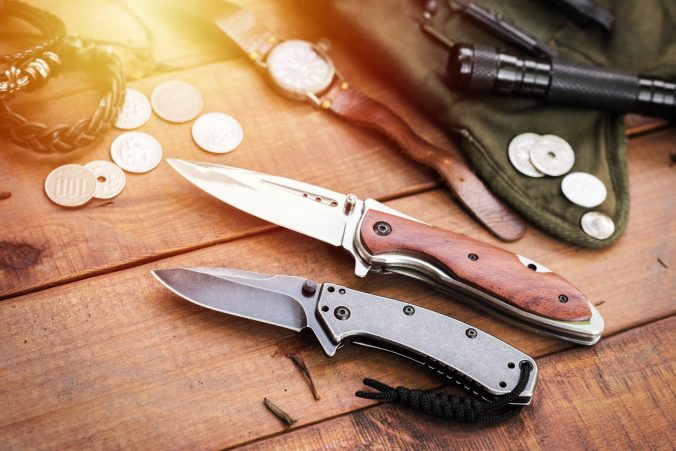
TL;DR: Automatic knives deploy blades instantly via spring mechanisms activated by buttons or levers, distinguishing them from manual folders. Legal status varies dramatically – 44 states now permit automatic knives to varying degrees, while California maintains strict restrictions on blades over 2 inches. OTF (out-the-front) models dominate tactical applications, while side-opening designs offer superior longevity with 15-25 year spring life. Quality automatics range from $60-120 (budget) to $250-500+ (premium), with blade steel and spring quality driving cost differences.
What Is an Automatic Knife?
An automatic knife deploys its blade through a spring-loaded mechanism when you press a button, flip a lever, or slide a switch – no manual blade contact required. Learn more about how automatic knives compare to manual knives. You’re holding the handle, activating the mechanism, and the blade snaps into position in roughly 0.1 seconds. This distinguishes automatics from manual folders where you physically push the blade open with your thumb.
The spring mechanism stores energy when the knife is closed. When you activate the release, that stored energy propels the blade out and locks it into position. Think of it like a mousetrap: tension builds until you trigger the release, then rapid deployment follows.
Here’s where confusion often arises: spring-assisted knives look similar but work differently. Assisted-opening knives require you to manually initiate blade movement past a detent point before the spring takes over. According to theavidoutdoorsman’s analysis of knife law shifts, this distinction matters legally – automatic knives face restrictions in some jurisdictions while assisted-opening models remain legal in most states.
The terminology matters for legal compliance. “Switchblade” and “automatic knife” refer to the same mechanism. California law defines switchblades as “a knife having the appearance of a pocketknife and includes a spring-blade knife, snap-blade knife, gravity knife, or any other similar type knife, the blade or blades of which are two or more inches in length.”
Automatic knives excel in scenarios requiring one-handed deployment: emergency responders cutting seatbelts, tactical professionals operating with gloved hands, or anyone needing instant blade access when their other hand is occupied. The trade-off? Higher mechanical complexity means more maintenance requirements and typically higher prices than manual folders with equivalent blade steel.
| Feature | Side-Opening | Single-Action OTF | Double-Action OTF |
|---|---|---|---|
| Deployment | Lateral swing | Linear forward | Linear forward |
| Retraction | Automatic | Manual | Automatic |
| Confined space use | Limited | Excellent | Excellent |
| Price range | $60-250 | $100-300 | $200-500+ |
| Spring longevity | 15-25 years | 8-12 years | 8-12 years |
| Maintenance frequency | Minimal | Monthly cleaning | Monthly cleaning |
Key Takeaway: Automatic knives use spring mechanisms for instant deployment (0.1 seconds), legally distinct from spring-assisted knives that require manual initiation. Legal status varies by state – verify local laws before purchasing.
How Do Automatic Knives Work?
The spring mechanism inside an automatic knife stores mechanical energy waiting for release. When the knife is closed, a compressed spring sits under tension, held in place by a locking mechanism connected to your activation button or lever. Press that button, and you’re releasing a catch that allows the spring to expand rapidly, driving the blade into its open position.
Side-Opening Spring Mechanisms
Side-opening automatics typically use torsion bar springs – flat metal strips that twist when compressed. These springs wrap around a pivot point, and when released, they untwist with enough force to swing the blade out laterally. The blade travels in an arc from handle to locked position, similar to a manual folder’s motion but powered entirely by spring energy.
The blade pivot is accessible for cleaning and lubrication without disassembling the entire knife. If the spring eventually weakens, replacement is straightforward compared to OTF mechanisms.
OTF Spring Mechanisms
OTF (out-the-front) knives use coil springs instead. The blade sits inside a channel running through the handle’s length. A compressed coil spring behind the blade pushes it forward through the front aperture when you slide the activation mechanism. The blade travels linearly rather than in an arc, allowing deployment in confined spaces where a side-opening knife would hit obstacles.
Safety Features
Safety mechanisms prevent accidental deployment. Button guards – raised collars around activation buttons – require deliberate pressure to engage. Slider safeties physically block the mechanism until you disengage them. Detent balls create resistance points that require intentional force to overcome, preventing pocket deployments from accidental pressure.
The locking mechanism matters as much as deployment speed. Once open, the blade must lock securely to handle cutting forces. Most automatics use liner locks, frame locks, or dedicated locking bars that engage when the blade reaches full extension. The spring that deployed the blade often provides additional pressure keeping the lock engaged.
Spring Quality and Longevity
Spring quality determines reliability and longevity. Torsion bar springs in side-opening knives typically last 15-25 years under regular use because they experience less stress per deployment. Coil springs in OTF knives work harder – they compress and extend with each deployment, leading to fatigue over time. Budget models using lower-grade spring steel may lose tension after 5-8 years, while premium knives with properly heat-treated springs maintain consistent deployment force for a decade or more.
Blade weight impacts deployment reliability. Heavier blades require stronger springs to achieve fast deployment speeds. If you’re looking at knives with blades exceeding 4 inches, expect slower deployment (0.15+ seconds) or increased spring tension that accelerates wear. Most manufacturers optimize around 3-3.5 inch blades weighing 3-4 ounces for the best balance of deployment speed and spring longevity.
Key Takeaway: Automatic knives use torsion bar springs (side-opening) or coil springs (OTF) to deploy blades in 0.1 seconds. Spring quality and blade weight determine reliability – torsion bars last 15-25 years versus 8-12 years for coil springs under regular use.
Types of Automatic Knives
Side-Opening Automatic Knives
Side-opening automatics deploy blades laterally from the handle, swinging out in an arc like a traditional folding knife. Learn more about complete OTF knife guide. The activation button typically sits on the handle spine, bolster, or side scale. Press it, and the blade swings out to lock in the open position.
These represent the original switchblade design dating back to the 18th century. The mechanism is straightforward: a torsion bar spring wraps around the blade pivot, storing energy when closed. Release the catch, and the spring untwists, driving the blade open. This simplicity translates to reliability – fewer moving parts mean fewer potential failure points.
You’ll find side-opening automatics across all price ranges. fieldandstream discusses best automatic knives with over 2,500 automatic knife models, with side-opening designs dominating the budget and mid-range categories. Entry-level models start around $60, while premium versions from Benchmade or ProTech reach $250-400.
The advantages: superior spring longevity (15-25 years typical), easier maintenance access, and generally lower prices than equivalent OTF models. If the spring eventually weakens, replacement is straightforward compared to OTF mechanisms.
The limitation: deployment requires clearance for the blade’s swing arc. If you’re working in tight quarters – inside a vehicle, in confined spaces, or against a surface – the blade may hit obstacles during deployment. This makes side-opening automatics less ideal for tactical applications where deployment space is unpredictable.
Out-the-Front (OTF) Automatic Knives
OTF knives propel blades straight out from the front of the handle through a machined aperture. The blade travels linearly rather than in an arc, allowing deployment regardless of side clearance. You’re activating a slider mechanism that releases a compressed coil spring, driving the blade forward through the front opening.
This design solves the clearance problem that limits side-opening knives. You can deploy an OTF knife while pressed against a surface, inside a pocket, or in any confined space. Tactical professionals and law enforcement favor OTF designs for this reason – deployment works in vehicle interiors, tight urban environments, or while grappling.
The mechanism complexity increases compared to side-opening designs. The blade must travel through a channel machined into the handle, requiring tighter tolerances and more precise manufacturing. This complexity shows in pricing: equivalent OTF models typically cost 40-60% more than side-opening automatics with similar blade steel and handle materials.
Maintenance demands increase with OTF designs. The deployment channel accumulates lint, debris, and pocket detritus that can slow or jam deployment. You’ll need to clean the channel every 30-60 days under normal EDC use – more frequently in dusty or dirty environments. The coil spring mechanism also requires dry lubricants (PTFE or graphite) rather than oils, which attract debris.
knifecenter notes new Microtech releases with OTF models ranging from $150 for entry-level designs to $350+ for premium versions. The price premium buys you deployment versatility and tactical advantages, but you’re trading maintenance simplicity and spring longevity compared to side-opening designs.
Double-Action vs Single-Action OTF
Double-action OTF knives both deploy and retract the blade via the slider mechanism. Push the slider forward, the blade deploys. Pull it back, the blade retracts into the handle. You’re never manually touching the blade – the mechanism handles both directions.
Single-action OTF knives deploy automatically but require manual retraction. You push the slider to deploy, but you must physically pull the blade back into the handle to close it. This reduces mechanism complexity and cost but sacrifices the convenience of automatic retraction.
The price difference is substantial. Double-action mechanisms require additional springs and more complex internal geometry to handle bidirectional movement. Expect to pay 40-60% more for double-action versus equivalent single-action models. A single-action OTF might cost $150-200, while the double-action version of the same knife runs $250-350.
For tactical applications, double-action offers clear advantages. You can retract the blade one-handed without releasing your grip or shifting hand position. In defensive scenarios or emergency response situations, this matters – you’re maintaining weapon control throughout the deployment and retraction cycle.
For EDC use, the value proposition is less clear. How often do you need to retract your knife blade without using your other hand? If you’re primarily using your automatic knife for package opening, cord cutting, or general utility tasks, single-action saves you $75-150 without sacrificing functionality for your use case.
Reliability considerations favor single-action designs. Fewer moving parts mean fewer potential failure points. The additional springs and mechanisms in double-action knives increase the likelihood of spring fatigue or mechanism binding over time. If you’re prioritizing longevity over convenience, single-action offers better long-term reliability.
Key Takeaway: Side-opening automatics offer 15-25 year spring life and easier maintenance but require swing clearance. OTF knives deploy in confined spaces but need monthly cleaning and cost 40-60% more. Double-action OTF adds bidirectional automatic operation for another 40-60% price premium.
Are Automatic Knives Legal in Your State?
Federal law establishes the baseline: automatic knives are legal to own and transport interstate for individuals with one arm, military personnel, and law enforcement. Learn more about choosing tactical knives for self-defense. The 2009 amendments to the Federal Switchblade Act removed many previous restrictions, but state and local laws vary dramatically.
According to news reports on California switchblade laws, “KOPA will remove the irrational restrictions on interstate trade in automatic knives that are legal to one degree or another in 44 states.” This reflects the evolving legal landscape – most states have liberalized automatic knife laws over the past decade, but significant restrictions remain in a handful of jurisdictions.
States with No Restrictions
Twenty-nine states impose no restrictions on automatic knife ownership or carry. If you’re in Alaska, Arizona, Arkansas, Georgia, Indiana, Kansas, Kentucky, Louisiana, Maine, Michigan, Mississippi, Missouri, Montana, Nebraska, Nevada, New Hampshire, New Mexico, North Carolina, Ohio, Oklahoma, South Dakota, Tennessee, Texas, Utah, Virginia, West Virginia, Wisconsin, or Wyoming, you can legally own and carry automatic knives without blade length limitations or special permits.
California’s Strict Ban
California maintains one of the strictest bans. State law prohibits switchblades with blades 2 inches or longer, with exceptions only for law enforcement, military personnel on duty, and one-armed individuals. mercurynews reports the Ninth Circuit upheld this ban in 2026, ruling that “California’s restrictions on the concealed carry of switchblade knives are constitutional.” Violation carries penalties up to 6 months in jail and $1,000 fine for misdemeanors, or up to 3 years in state prison for felonies.
States with Blade Length Restrictions
Several states permit automatic knives with blade length restrictions. Colorado allows concealed carry with blades under 3.5 inches. North Dakota limits blade length to 5 inches. Connecticut restricts blades to 1.5 inches maximum. These restrictions create compliance challenges – you need to verify blade length before purchasing if you’re in these states.
Special Permit Requirements
Illinois presents a unique situation. The state permits automatic knife possession with a valid Firearms Owner’s Identification Card (FOID), but restricts carry to your own property, place of business, or other land you possess. This effectively prohibits EDC carry outside these locations despite ownership being legal.
Recent Legal Reforms
New York liberalized its laws in 2019, now permitting automatic knives with blade lengths under 4 inches. This represents significant progress from the previous blanket prohibition, but the blade length restriction still eliminates many popular models from legal carry.
Local Ordinances
Local ordinances add another compliance layer. Even in states with permissive laws, cities and counties may impose additional restrictions. Before carrying an automatic knife, verify both state statutes and local ordinances for your specific jurisdiction.
The legal landscape continues evolving. Knife Rights reports that they’ve achieved “49 bills enacted repealing knife bans in 31 states and over 200 cities” over the past decade. This trend toward liberalization suggests more states may remove automatic knife restrictions in coming years, but current compliance requires checking your specific state’s current statutes.
Key Takeaway: 29 states permit unrestricted automatic knife carry, while California maintains strict bans on blades over 2 inches. Colorado, North Dakota, and Connecticut impose blade length limits. Always verify current state and local laws before purchasing – legal status varies dramatically by jurisdiction.
Best Uses for Automatic Knives
Automatic knives excel in scenarios requiring instant one-handed blade deployment. Learn more about best tactical knives for everyday carry. Emergency responders cutting seatbelts after vehicle accidents, tactical professionals operating with gloved hands, or anyone needing blade access when their other hand is occupied or injured – these situations justify the automatic mechanism’s advantages over manual folders.
Emergency Response Applications
The deployment speed difference matters in time-critical scenarios. Automatic knives deploy in approximately 0.1 seconds from activation to full blade lock. Manual folders require 1-2 seconds for two-handed opening or 2-3 seconds for one-handed thumb stud deployment. In emergency situations – cutting someone free from entanglement, responding to immediate threats, or accessing a blade while maintaining grip on another object – those seconds matter.
Tactical and Law Enforcement Use
Law enforcement and military personnel cite gloved operation as a primary advantage. Tactical gloves reduce fine motor control needed to manipulate thumb studs or flipper tabs on manual folders. An automatic’s button or lever requires only gross motor movement – press or slide – which remains reliable even with thick gloves or in high-stress situations where fine motor skills degrade.
Everyday Carry Applications
EDC applications benefit from automatic deployment when you’re frequently cutting while holding objects. Package opening while carrying items, cord cutting while maintaining tension with your other hand, or any repetitive utility task where you’re constantly deploying and retracting the blade – automatic deployment improves workflow efficiency by eliminating the need to set down what you’re holding to open your knife.
Maritime and Rescue Operations
Maritime and rescue applications leverage the one-handed deployment advantage. If you’re in water, climbing, or otherwise using one hand for support or safety, automatic deployment allows blade access without compromising your grip. Rescue professionals cutting rope, webbing, or clothing to free trapped individuals need immediate blade access – automatic deployment eliminates the fumbling that occurs when trying to open a manual folder one-handed under stress.
Understanding the Trade-offs
The limitations matter as much as the advantages. Automatic knives cost 30-60% more than equivalent manual folders due to mechanism complexity. They require more frequent maintenance – monthly cleaning for OTF models versus quarterly for manual folders. Mechanical failure rates run 3-5% within five years compared to 1-2% for manual locking folders. You’re paying a premium and accepting higher maintenance demands for deployment speed advantages that only matter in specific use cases.
For general EDC where you’re not regularly deploying one-handed or under time pressure, manual folders offer better value. If you’re primarily using your knife for casual utility tasks with both hands available, the automatic mechanism’s advantages don’t justify the cost premium and maintenance requirements. But if your use case involves frequent one-handed deployment, gloved operation, or time-critical scenarios, automatic knives deliver tangible benefits worth the trade-offs.
Key Takeaway: Automatic knives excel for emergency response (0.1 second deployment vs 1-2 seconds for manual folders), gloved operation, and one-handed use when the other hand is occupied. Trade-offs include 30-60% higher cost, monthly maintenance requirements, and 3-5% failure rates versus 1-2% for manual folders.
What to Look for When Buying an Automatic Knife?
Blade Steel Selection
Blade steel determines edge retention and corrosion resistance. Learn more about investing in premium quality knives. Budget automatic knives ($50-120) typically use 8Cr13MoV or AUS-8 stainless steels – adequate for casual use but requiring frequent sharpening. Mid-range models ($120-250) feature S30V, 154CM, or M390 steels offering significantly better edge retention. Premium automatics ($250-500+) use exotic steels like 20CV, Elmax, or CPM-3V for maximum performance.
The steel choice matters more for automatic knives than manual folders because you can’t easily access the blade pivot for maintenance. If you’re choosing an OTF knife, prioritize corrosion-resistant steels like M390 or 20CV – moisture infiltration into the deployment channel accelerates corrosion, and you can’t disassemble the mechanism for deep cleaning without voiding warranties.
S30V offers the optimal balance of edge retention and weight for automatic knives. Heavier blade steels slow deployment and stress spring mechanisms. S30V delivers excellent edge retention (60-61 HRC hardness) while maintaining moderate weight that doesn’t stress spring mechanisms.
Spring Quality Indicators
Spring quality separates reliable automatics from problematic ones. Torsion bar springs in side-opening knives should be heat-treated properly to maintain tension over thousands of deployments. Coil springs in OTF knives require precise manufacturing to avoid premature fatigue. Budget models often use lower-grade spring steel that loses tension after 5-8 years, while premium knives maintain consistent deployment force for 10-15 years.
You can’t easily evaluate spring quality before purchase, so brand reputation matters. Established manufacturers like Benchmade, Microtech, and ProTech have refined their spring specifications over decades of production. Budget brands entering the automatic knife market may use inadequate spring materials to hit lower price points – you’re gambling on longevity.
Handle Materials and Grip
Handle materials affect durability and grip security. Aluminum handles keep weight down but can show wear from pocket carry. G10 or carbon fiber scales provide excellent grip and durability at moderate weight. Titanium handles offer maximum durability and corrosion resistance but add weight and cost. For EDC use, prioritize grip texture over exotic materials – you need secure handling during deployment, especially if you’re operating with wet or gloved hands.
Maintenance Accessibility
Deployment mechanism accessibility matters for maintenance. Side-opening automatics with accessible pivots allow you to clean and lubricate the mechanism without disassembly. OTF knives with removable end caps enable channel cleaning, while sealed designs require professional service for deep maintenance. If you’re planning to carry your automatic knife daily, choose designs that allow user-serviceable maintenance.
Pocket Clip Configuration
Pocket clip configuration affects carry comfort and deployment speed. Deep-carry clips position the knife 0.5-0.75 inches deeper in your pocket, reducing printing through clothing. Tip-up carry orients the deployment button for immediate access upon draw, while tip-down carry requires grip repositioning after drawing. For tactical applications, tip-up carry with a deep-carry clip optimizes deployment speed.
Understanding Price Tiers
Price ranges reflect genuine manufacturing complexity, not just brand positioning. ravencresttactical explains OTF knife maintenance with budget automatics starting around $60 for basic models with AUS-8 steel and simple mechanisms. Mid-range models run $120-250 with premium steels and refined mechanisms. Premium automatics reach $250-500+ with exotic steels, titanium construction, and proprietary spring systems.
The value proposition shifts across price tiers. Budget automatics sacrifice spring longevity and blade steel quality but deliver functional automatic deployment. Mid-range models offer the best balance – premium steels, reliable springs, and reasonable prices. Premium automatics provide marginal performance improvements (25-30% faster deployment, 40% longer spring life) that only matter for professional or demanding tactical use.
Key Takeaway: Prioritize blade steel (S30V minimum for mid-range), spring quality (brand reputation matters), and maintenance accessibility. Budget automatics ($60-120) use AUS-8 steel, mid-range ($120-250) feature S30V/M390, premium ($250-500+) offer exotic steels and extended spring life. Choose tip-up carry with deep-carry clips for optimal EDC deployment.
How Much Do Quality Automatic Knives Cost?
Quality automatic knives range from $120-250 for mid-range models with S30V or M390 steel to $250-500+ for premium designs with exotic steels and titanium construction.
Budget automatics start around $60-120 but typically use lower-grade steels (8Cr13MoV, AUS-8) and springs that may lose tension within 5-8 years. The mid-range tier offers the best value – you’re getting premium blade steels, reliable spring mechanisms, and reasonable longevity without paying for marginal performance improvements.
Premium automatics above $250 deliver faster deployment (sub-0.1 seconds), longer spring life (15+ years), and superior materials, but the performance gains only matter for professional tactical use or serious collectors. The 30-60% price premium over mid-range models buys you exotic steels like 20CV or Elmax, titanium construction, and proprietary spring systems from manufacturers like Microtech or Benchmade.
For most users, mid-range automatics in the $120-250 bracket provide the optimal balance. You’re getting S30V or 154CM blade steel that holds an edge significantly longer than budget options, precision-ground torsion bars or coil springs rated for 10,000+ deployments, and G10 or aluminum handles that withstand daily carry wear.
Key Takeaway: Mid-range automatics ($120-250) with S30V steel offer best value with 10-15 year spring life and reliable deployment. Premium models ($250-500+) justify cost only for professional tactical use or corrosive environments requiring M390/20CV steel.
What Maintenance Do Automatic Knives Require?
Automatic knives require dry lubricants (PTFE or graphite) rather than oils, monthly cleaning for OTF models, and spring tension checks every 500-1000 deployments.
Oil-based lubricants attract lint and debris that accumulate in deployment mechanisms, causing failures. when using only dry lubricants specifically designed for automatic knife mechanisms. PTFE-based sprays or graphite powder provide necessary lubrication without attracting pocket lint.
OTF Maintenance Schedule
OTF knives need compressed air cleaning of the deployment channel every 30-60 days under normal pocket carry – more frequently in dusty environments. The blade channel accumulates lint, debris, and pocket detritus that can slow or jam deployment. ocasoknives recommends compressed air to blow out the channel from both ends, then apply a light coating of dry lubricant.
Construction workers, tactical professionals, or anyone working in dusty conditions should increase cleaning frequency to weekly. Desert operations or beach environments introduce fine particles that infiltrate OTF mechanisms faster than normal pocket lint.
Side-Opening Maintenance
Side-opening automatics require less frequent maintenance but still need periodic pivot cleaning. The accessible pivot point allows you to clean and lubricate the torsion bar mechanism without disassembly. Apply dry lubricant to the pivot quarterly, or whenever deployment speed noticeably slows.
Spring Tension Monitoring
Spring tension gradually decreases over repeated deployments. If deployment speed exceeds 0.15 seconds or the blade fails to lock positively, spring replacement is needed. Most quality automatics maintain consistent deployment force for 10,000+ cycles, but heavy users (50+ deployments daily) may need spring service after 3-5 years.
Check deployment speed periodically using a smartphone slow-motion video. If deployment time increases from the original 0.1 seconds to 0.15+ seconds, the spring is losing tension and should be replaced to maintain reliable performance.
Key Takeaway: OTF knives require monthly compressed air cleaning and dry lubricants only. Side-opening automatics need quarterly pivot maintenance. Spring replacement indicators: deployment exceeding 0.15 seconds or failure to lock positively after 10,000+ cycles.
Frequently Asked Questions
What is the difference between automatic and spring-assisted knives?
Automatic knives deploy entirely via spring power when you press a button, while spring-assisted knives require you to manually initiate blade movement past a detent point before the spring assists opening.
This distinction matters legally and mechanically. Learn more about most durable knife brands. Automatic knives store all deployment energy in the spring – you’re just releasing a catch. Spring-assisted knives use springs to help complete the opening after you’ve started it manually. Most states that restrict automatic knives permit spring-assisted designs because they require manual initiation. If you’re in a jurisdiction with automatic knife restrictions, spring-assisted models like Kershaw’s SpeedSafe or Benchmade’s Axis-assist provide rapid deployment while remaining legal.
Are automatic knives legal for everyday carry?
Automatic knife legality varies by state – 29 states permit unrestricted carry, while California bans blades over 2 inches and several states impose blade length restrictions or limit carry to private property.
Before carrying an automatic knife, verify current laws in your state and any jurisdictions you’ll visit. California maintains strict bans with possession of illegal switchblades carrying penalties up to 6 months in jail for misdemeanors. New York permits automatics under 4 inches. Illinois allows ownership but restricts carry to your property. support provides basic knife maintenance guidance for updated state-by-state legal summaries.
Which automatic knife type is best for EDC?
Side-opening automatics offer the best EDC value with 15-25 year spring life, easier maintenance, and lower prices, while OTF knives excel for tactical applications requiring confined-space deployment.
For general EDC use – package opening, cord cutting, daily utility tasks – side-opening automatics provide superior longevity and maintenance simplicity. You can access the pivot for cleaning and lubrication without disassembly, and torsion bar springs last significantly longer than OTF coil springs. OTF knives justify their 40-60% price premium and increased maintenance demands if you regularly need deployment in confined spaces: vehicle interiors, tight urban environments, or tactical applications. If you’re not regularly deploying in confined quarters, side-opening designs deliver better long-term value.
Do automatic knives require special maintenance?
Yes – automatic mechanisms require dry lubricants (PTFE or graphite) rather than oils, and OTF deployment channels need compressed air cleaning every 30-60 days to prevent lint accumulation and mechanism failure.
Oil-based lubricants attract lint, dirt, and debris that accumulate in deployment channels and cause mechanism failure. Use only dry lubricants specifically designed for automatic knife mechanisms. Check spring tension every 500-1,000 deployments – springs showing reduced deployment speed (over 0.15 seconds) or failure to achieve positive lock engagement should be replaced. Users in dusty environments need weekly cleaning to maintain reliable deployment.
Can you fly with an automatic knife in checked luggage?
TSA prohibits automatic knives in carry-on luggage, and most airlines ban them in checked bags due to federal and state law complications at destination airports.
While TSA regulations technically permit knives in checked luggage, automatic knives face additional restrictions. Airlines must consider destination state laws – if you’re flying to California, possessing an automatic knife upon arrival violates state law regardless of TSA policy. Most major carriers prohibit automatic knives in checked bags to avoid legal complications. If you need to transport an automatic knife, ship it separately via ground carrier to avoid air travel restrictions entirely.
What blade steel is best for automatic knives?
S30V offers the optimal balance of edge retention and weight for automatic knives, while M390 and 20CV provide superior corrosion resistance for maritime or humid environments.
S30V delivers excellent edge retention (60-61 HRC hardness) while maintaining moderate weight that doesn’t stress spring mechanisms. Heavier exotic steels can slow deployment or accelerate spring fatigue. M390 and 20CV (essentially identical steels) justify their 30-50% cost premium if you’re using your automatic knife in corrosive environments – moisture infiltration into deployment mechanisms accelerates corrosion, and these steels resist it better than S30V. For general EDC in dry climates, S30V provides the best performance-to-cost ratio.
How reliable are automatic knife mechanisms?
Automatic knives show 3-5% failure rates within five years compared to 1-2% for manual folders, with most failures occurring in budget models using lower-quality springs.
The mechanical complexity of automatic deployment increases failure potential compared to manual folders. Torsion bar springs in side-opening automatics demonstrate better reliability than coil springs in OTF designs – 15-25 year service life versus 8-12 years under regular use. Premium brands using properly heat-treated springs and precision manufacturing show significantly lower failure rates than budget models. If reliability is your priority, choose established manufacturers with proven track records and favor side-opening designs over OTF mechanisms. The deployment speed advantage comes with inherent reliability trade-offs that only matter if your use case demands instant one-handed deployment.
Are expensive automatic knives worth the premium?
Premium automatic knives ($250-500+) justify their cost for professional tactical use, corrosive environments, or users demanding maximum longevity – but mid-range models ($120-250) offer better value for most EDC applications.
The performance difference between mid-range and premium automatics is marginal for general use. Premium models provide 25-30% faster deployment (sub-0.1 seconds), 40% longer spring life, and superior corrosion resistance through exotic steels. These advantages matter for law enforcement, military personnel, or maritime professionals where environmental conditions or mission-critical reliability justify the cost. For everyday carry – package opening, cord cutting, general utility – mid-range automatics with S30V steel and quality springs deliver adequate performance at 50% lower cost.
Ready to Choose Your Automatic Knife?
Automatic knives deliver instant deployment advantages that matter for specific use cases: emergency response, tactical applications, gloved operation, and frequent one-handed cutting tasks. The trade-offs – higher costs, increased maintenance, and legal restrictions – make them specialized tools rather than universal EDC choices.
If you’re in one of the 29 states with unrestricted automatic knife carry and your use case involves regular one-handed deployment, the mechanism’s advantages justify the premium. Side-opening automatics offer the best value for most users with superior spring longevity and easier maintenance. OTF knives excel for tactical applications requiring confined-space deployment but demand monthly maintenance and cost 40-60% more.
For general EDC where you’re not regularly deploying under time pressure or with one hand occupied, manual folders or spring-assisted knives deliver better value. But if you’re a first responder, tactical professional, or someone who genuinely needs instant one-handed blade access, automatic knives provide tangible benefits worth the investment.
When you’re ready to purchase, Knife Depot offers a comprehensive selection of automatic knives across all price ranges, with detailed specifications to help you match mechanism type, blade steel, and features to your specific use case and legal jurisdiction. Verify your state and local laws before purchasing, prioritize reputable manufacturers for spring reliability, and choose the deployment mechanism that matches your actual use patterns rather than tactical aesthetics.
The automatic knife market continues evolving as legal restrictions ease and manufacturing quality improves. Whether you choose a budget side-opening design for occasional use or a premium OTF for professional applications, understanding the mechanism trade-offs ensures you’re investing in the right tool for your needs.


Leave a Reply