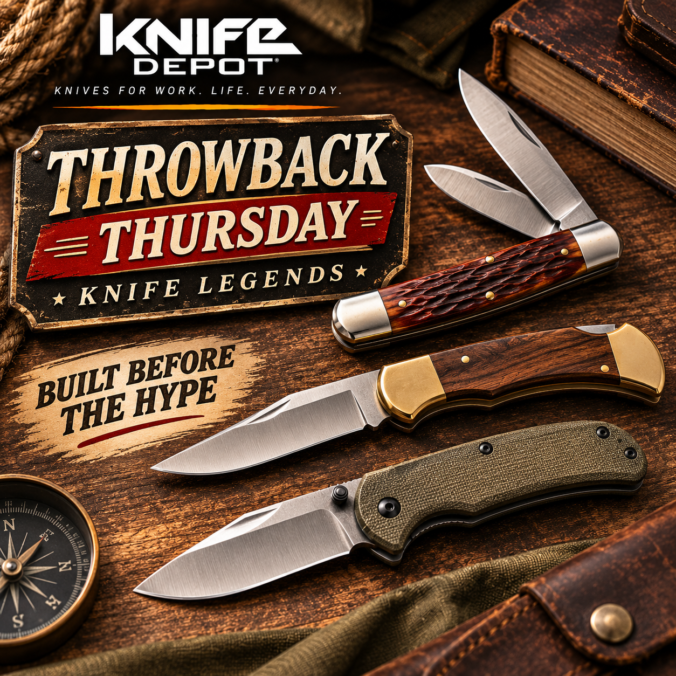
Some things don’t need an upgrade.
In the knife world, that’s especially true. While modern designs continue to introduce new materials, opening mechanisms, and advanced blade steels, traditional knives still hold a special place among collectors and everyday knife enthusiasts.
Think polished bolsters, carefully shaped handles, recognizable blade profiles, and folding patterns that have been around for generations.
These knives aren’t popular simply because they look old-fashioned. Many have remained relevant because their designs have stood the test of time.
From traditional slipjoint folders to classic lockbacks and heritage hunting knives, there’s a lot to appreciate beyond the blade itself.
For Throwback Thursday, we’re taking a closer look at the knife designs that helped shape the industry and continue to attract attention today.
Why Are Traditional Pocket Knives Still Popular?
Modern knives offer plenty of innovation, but traditional pocket knives bring something different to the table.
Their appeal often comes down to three things: simplicity, craftsmanship, and recognizable design.
Many traditional folders feature straightforward construction, familiar blade shapes, and materials that develop character over time.
Wood handles, bone scales, brass liners, and metal bolsters give these knives an appearance that stands apart from many modern synthetic designs.
Collectors also appreciate the history behind particular patterns.
A traditional knife isn’t always just another addition to a collection. It can represent a particular manufacturing era, a familiar design, or a connection to the people who carried similar knives before today’s modern EDC market existed.
1. The Barlow: A Classic With a Recognizable Profile
The Barlow is one of the most recognizable traditional pocket knife patterns.
Its defining features generally include a long handle, an extended bolster, and one or more folding blades.
The pattern became particularly popular in the United States during the 19th century.
Its practical proportions and straightforward construction helped establish its reputation as a dependable working knife.
The Barlow also developed a place in American popular culture. It has frequently appeared in stories about traditional pocket knives and frontier-era everyday tools.
What Makes the Barlow Distinctive?
- An elongated handle.
- A prominent bolster near the blade pivot.
- Traditional folding-blade construction.
- Commonly available in bone, wood, and synthetic handle materials.
- Designs ranging from simple working knives to collectible variations.
Today, Barlow-style knives appeal to collectors who appreciate traditional proportions and understated craftsmanship.
2. The Trapper: A Traditional Two-Blade Favorite
The Trapper is another classic American folding knife pattern.
Traditionally, Trapper knives feature two blades, commonly a clip point and a spey blade.
The pattern developed around practical cutting needs and became a familiar design in agricultural and outdoor settings.
Over time, its recognizable appearance helped establish it as a popular choice among traditional knife collectors.
Why Collectors Appreciate the Trapper
The Trapper combines a relatively long handle with two distinctive blades.
Its traditional appearance is often complemented by:
- Polished metal bolsters.
- Bone or wood handles.
- Brass liners.
- Traditional blade finishes.
- Decorative handle variations.
Modern manufacturers continue to produce Trapper-inspired designs using both traditional and contemporary materials.
For collectors, the appeal often comes from the combination of familiar proportions and individual handle variations.
3. The Stockman: Three Blades, One Traditional Design
The Stockman is another established pocket knife pattern with a recognizable layout.
Traditional Stockman knives generally feature three blades:
- Clip point.
- Sheepsfoot.
- Spey.
Each blade has a different shape, giving the design a distinctive appearance.
Historically, Stockman patterns were associated with ranching, agricultural work, and other practical applications.
Their multi-blade construction made them a familiar part of traditional working knife collections.
What Makes the Stockman Interesting?
Unlike many modern single-blade folders, the Stockman showcases multiple blade profiles within one handle.
That gives collectors several details to appreciate, from the arrangement of the blades to the handle construction and overall finishing.
Manufacturers continue to offer Stockman designs in different sizes, handle materials, and finishes.
It’s a good example of how traditional patterns can remain recognizable even as manufacturing methods evolve.
4. The Congress Knife: A Different Approach to Traditional Design
The Congress knife stands out because of its distinctive handle shape and multi-blade arrangement.
Traditional Congress patterns generally feature a curved handle with rounded ends and multiple folding blades.
Depending on the model, the blades may include different profiles designed around varied cutting applications.
Its unusual shape makes it particularly interesting to collectors who appreciate traditional folding knives beyond the more familiar Barlow and Trapper patterns.
Why Does It Stand Out?
The Congress design offers:
- A distinctive curved handle.
- Multiple blade configurations.
- Traditional construction.
- A recognizable profile.
- Different handle materials and decorative finishes.
Its appearance is a reminder that traditional pocket knives have always included considerable design variety.
5. The Buck 110: A Lockback That Became an Icon
Few folding knives have achieved the recognition of the Buck 110 Folding Hunter.
Introduced in 1964, the Buck 110 helped popularize the lockback folding knife design.
Its traditional appearance combines a clip-point blade, brass bolsters, and wood handle scales.
The lockback mechanism became one of its defining characteristics.
What Makes the Buck 110 Significant?
The knife brought together a folding design and a locking mechanism in a format that appealed to hunters, outdoor enthusiasts, and collectors.
Its recognizable construction includes:
- A traditional clip-point blade.
- A back-lock mechanism.
- Brass bolsters.
- Wood handle scales on classic configurations.
- A substantial folding-knife profile.
The Buck 110 remains an important reference point when discussing traditional American folding knives.
Its continued recognition demonstrates how a well-established design can remain relevant even as newer knife technologies enter the market.
6. The Bowie Knife: A Design With a Long History
Traditional knife history isn’t limited to folding knives.
The Bowie knife is one of the most recognizable fixed-blade designs in American knife history.
Associated with the 19th-century American frontier, the Bowie became known for its large blade, distinctive profile, and substantial construction.
Over time, the design evolved into numerous variations.
Some feature pronounced clip points, while others incorporate different handle materials, guards, and blade proportions.
Why Does the Bowie Remain Popular?
The Bowie has a recognizable silhouette that appeals to collectors and enthusiasts interested in historical knife designs.
Modern interpretations may feature:
- Stainless or carbon steel blades.
- Wood, synthetic, or composite handles.
- Traditional guards.
- Leather sheaths.
- Classic or contemporary finishes.
Its enduring popularity demonstrates how historical knife patterns continue to influence modern manufacturing.
7. What Makes a Classic Knife Worth Collecting?
Not every traditional knife is automatically a collectible.
Collectors often evaluate several characteristics before adding a piece to their collection.
Manufacturer and Brand History
The manufacturer can provide important context about a knife’s design, production history, and place within the industry.
Established brands may have particular patterns that attract dedicated collectors.
Handle Materials
Traditional knives are frequently appreciated for their handle materials.
Bone, stag, wood, and other natural materials can give individual knives distinctive appearances.
Natural materials may also vary from one knife to another, making each piece visually different.
Blade Construction
Blade steel, finish, geometry, and overall workmanship all contribute to a knife’s character.
Collectors often compare these details when researching different models.
Pattern and Design
Some collectors focus on specific patterns, such as Barlow, Trapper, Stockman, or Congress knives.
Others prefer particular manufacturers or historical design periods.
Condition and Provenance
For vintage knives, original condition, wear, restoration history, and documented provenance can influence collector interest.
A knife’s age alone doesn’t establish its value.
Researching the specific model and its production history is important before purchasing vintage pieces.
8. Traditional Knives vs. Modern Folding Knives
Traditional and modern folding knives have different design priorities.
Neither category is automatically better. The right choice depends on what the buyer appreciates and how the knife is intended to be used.
| Feature | Traditional knives | Modern folding knives |
| Design | Heritage-inspired patterns | Contemporary styling |
| Handle materials | Wood, bone, stag, metal | G10, aluminum, composites |
| Blade options | Traditional profiles | Wider variety of modern profiles |
| Opening | Often manual nail nick | Thumb studs, flippers, holes |
| Construction | Often slipjoint or traditional lockback | Multiple modern locking systems |
| Appeal | History and craftsmanship | Materials and modern engineering |
Traditional knives often attract collectors who appreciate heritage and familiar patterns.
Modern folders may appeal to people who prefer contemporary materials, different opening mechanisms, and more recent design innovations.
Many knife enthusiasts enjoy both categories.
9. Are Traditional Pocket Knives Still Practical Today?
Absolutely, provided the knife is selected for an appropriate task.
Traditional folding knives can still be suitable for light utility applications, general cutting tasks, and collecting.
However, their construction varies.
A traditional slipjoint knife, for example, relies on spring tension rather than a locking mechanism. It should not be treated like a modern locking folder during demanding cutting tasks.
A traditional lockback design uses a different mechanism and should be evaluated according to its specific construction and manufacturer’s instructions.
Before purchasing, consider:
- The intended application.
- Blade dimensions.
- Handle comfort.
- Locking or retention mechanism.
- Materials and maintenance requirements.
- Applicable knife regulations.
Choosing a knife based on its actual construction is more useful than assuming every traditional pattern serves the same purpose.
10. Where to Find Classic Pocket Knives
If traditional knife designs interest you, exploring different manufacturers and patterns is a good place to start.
Knife Depot offers a selection of knives from established manufacturers, including brands associated with traditional folding knives and heritage-inspired designs.
You can explore the Knife Depot Pocket Knife Buying Guide to learn more about traditional patterns, manufacturers, and available styles.
For those interested in exploring the broader selection, visit Knife Depot to browse available knives and discover different designs.
Final Thoughts: Good Designs Don’t Need to Follow Trends
Knife manufacturing continues to evolve, but traditional designs haven’t disappeared.
The Barlow, Trapper, Stockman, Congress, Buck 110, and Bowie all demonstrate how recognizable knife patterns can remain relevant across generations.
Their appeal comes from a combination of history, craftsmanship, practical design, and the personal connection collectors develop with particular knives.
Whether you’re interested in adding a traditional folder to your collection or simply learning more about knife history, these designs are worth exploring.
Built before the hype. Still worth carrying.
Discover traditional knife designs and more at Knife Depot.
Frequently Asked Questions
1. What are traditional pocket knives?
Traditional pocket knives are folding knives based on established patterns and construction styles. Common examples include Barlow, Trapper, Stockman, and Congress knives.
2. What is the oldest traditional pocket knife pattern?
There isn’t one universally accepted oldest pattern. Folding knives have existed for centuries, and different regional designs developed independently over time. Many familiar American traditional patterns became established during the 19th century.
3. What is the difference between a Trapper and a Stockman knife?
A traditional Trapper generally features two blades, commonly a clip point and spey. A Stockman typically features three blades: clip point, sheepsfoot, and spey.
4. What makes a Barlow knife different?
A Barlow is recognized by its elongated handle and prominent bolster near the blade pivot. Traditional versions commonly feature one or two folding blades.
5. Is the Buck 110 considered a classic pocket knife?
Yes. Introduced in 1964, the Buck 110 Folding Hunter is a widely recognized traditional lockback folding knife featuring a clip-point blade, brass bolsters, and classic handle configurations.
6. Are traditional pocket knives still manufactured?
Yes. Several established knife manufacturers continue producing traditional patterns using both classic and modern materials.
7. Are traditional slipjoint knives locking knives?
No. Traditional slipjoint knives use spring tension to maintain their open position rather than a mechanical locking mechanism. They should be used within the limitations of their design.
8. Are vintage knives worth collecting?
Some vintage knives attract considerable collector interest because of their manufacturer, pattern, rarity, condition, and production history. Age alone doesn’t determine value.
9. Where can I buy traditional pocket knives?
Knife Depot offers a selection of pocket knives and traditional-inspired designs. Its pocket knife buying guide is also a useful resource for learning about different patterns and manufacturers.

Leave a Reply