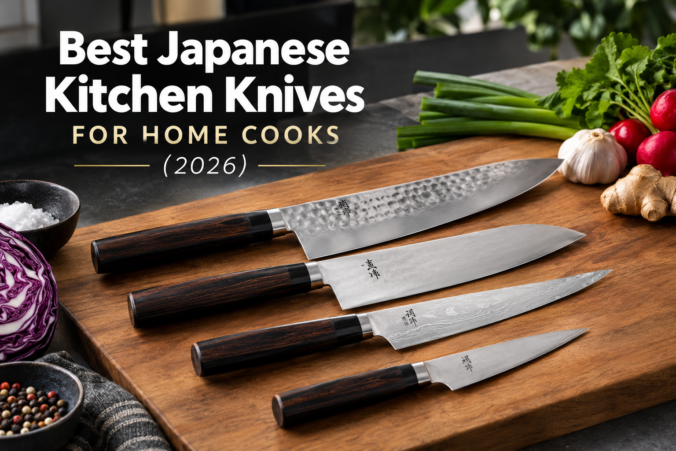
TL;DR: – Japanese knives run 60–67 HRC hardness vs. 56–58 HRC for Western knives, delivering sharper edges that hold longer but chip under lateral stress – a real trade-off for home cooks.
- Japanese knives are often made from premium Japanese steels such as VG10, SG2/R2, Aogami (Blue Steel), and Shirogami (White Steel). These steels can achieve exceptional sharpness while offering excellent edge retention.
- A 180–210mm gyuto or santoku handles most weeknight prep for most home cooks; the Tojiro DP Gyuto is the most recommended entry-level Japanese knife on Reddit, cooking forums, and by professional chefs.
- Total first-year ownership cost includes a whetstone ($30–$60): a $120 knife + $40 whetstone = $160 total investment.
- Sharpening frequency for home cooks cooking 4–7 times per week: every 3–6 months on a 1000/3000-grit whetstone – roughly 40 minutes of maintenance annually.
What Makes Japanese Kitchen Knives Different?
Japanese knives aren't just prettier versions of Western blades – they're engineered differently from the ground up. The core difference? Hardness and geometry.
Japanese knives are typically harder – 60 to 67 on the Rockwell scale – which allows for a thinner, more acute edge angle, compared to Western knives at 56 to 58 HRC. This means a sharper edge that holds longer. But here's the trade-off: that harder steel is more brittle. The trade-off is brittleness: harder steel chips more easily if you twist the blade or try to cut through bones.
For home cooks, this matters. If you're used to torquing a Western chef's knife to break down chicken or using it as a makeshift pry bar, a Japanese knife will punish you for it.
| Feature | Japanese Knife | Western Knife |
|---|---|---|
| Hardness (HRC) | 60–67 | 56–58 |
| Edge Angle | 10–15° per side | 20–25° per side |
| Edge Retention | Excellent | Good |
| Chip Resistance | Lower | Higher |
| Sharpening Frequency | Every 3–6 months | Every 1–2 months |
| Best For | Precise slicing, vegetables, fish | Robust cutting, bones, Western technique |
The geometry also differs. The cutting angle, usually between 10° and 15° per side (compared to around 20° for a Western knife) creates that laser-sharp edge. But it also means the blade is thinner behind the edge, making it less forgiving if you use poor technique.
Key Takeaway: Japanese knives achieve 60–67 HRC hardness vs. 56–58 HRC for Western knives, delivering superior edge retention but requiring careful technique and hand-washing to avoid chipping.
Which Blade Style Should Home Cooks Buy?
This is where most home cooks get confused. Gyuto? Santoku? Nakiri? Petty? The answer depends on your hands, your cutting board, and how you cook.
Direct answer: For most home cooks, a 180–210mm gyuto or santoku is the single best starting knife. Either handles most weeknight prep – onions, chicken breast, carrots, herbs – without forcing you to buy multiple blades.
Gyuto (Chef's Knife)
Gyuto is roughly translated as 'cow blade' as it was initially used to cut meat and fish. It's the closest Japanese equivalent to a Western chef's knife, but with a thinner blade and sharper edge.
A blade size of 180 to 210mm (7 to 8 inches) is recommended for home cooks, while the 240mm- 270mm (9 to 11 inches) sizes are more suitable for serious amateurs and professionals. The 210mm is the sweet spot – long enough for efficient rocking motion, short enough to control on a standard 12×18-inch cutting board.
Santoku (All-Purpose)
The santoku is shorter – typically 6–7 inches – with a flatter edge profile that suits a push-cutting motion rather than a rocking motion. If you have smaller hands or prefer a lighter knife, this is your starting point.
Nakiri (Vegetable Knife)
Nakiri translates as knife for cutting greens. It's optimized for vegetables via a flat blade and push-cut motion but is unsuitable for breaking down proteins. Plant-heavy home cooks (vegan or vegetarian) represent the primary use case. For omnivores cooking 4–7 times per week, a nakiri is a luxury second knife, not a first purchase.
Key Takeaway: A 180–210mm gyuto or 180mm santoku covers most home cook prep tasks. Choose gyuto for rocking motion comfort; choose santoku for smaller hands or lighter preference.
Best Japanese Kitchen Knives by Budget (2026)
Here's where the rubber meets the road. Real picks at three price tiers, with honest limitations for each.
Under $100: Best Entry-Level Picks
Tojiro DP Gyuto 210mm (~$85)
- Steel: VG-10 stainless
- Hardness: 61 HRC
- Handle: Composite (D-shaped)
- Weight: ~180g
- Limitation: 240mm is tight on standard home cutting boards; 210mm version recommended instead.
MAC Superior Series Santoku 6.5-inch (~$90)
- Steel: MAC proprietary alloy (~59–61 HRC)
- Handle: Composite (ergonomic)
- Weight: ~140g
- Limitation: Lighter than gyuto; better for push-cutting than rocking motion.
Fujiwara FKM Gyuto 210mm (~$70)
- Steel: VG-10 stainless
- Hardness: 60 HRC
- Handle: Composite
- Limitation: Less refined finish than Tojiro; edge consistency varies batch-to-batch.
$100–$200: Best Mid-Range Knives
This tier is where value peaks. You're paying for better fit-and-finish and slightly superior steel, but the functional cutting performance gap over entry-level is marginal.
MAC MTH-80 Professional 8-inch (~$145)
- Steel: MAC alloy (~59–61 HRC)
- Handle: Composite (ergonomic)
- Weight: ~170g
- Why it wins: Exceptional out-of-the-box sharpness; this great knife from Japanese brand Mac checked all of the boxes in head-to-head knife tests: It's sharp enough to glide through food and produce paper-thin slices, lightweight enough to allow for nimble movements, and comfortable enough for you to make your way through a mountain of onions without your hand cramping up.
Shun Classic 8-inch (~$165)
- Steel: VG-MAX (VG-10 evolution)
- Hardness: 60 HRC
- Handle: Composite with Damascus cladding
- Limitation: Beautiful aesthetics, but diminishing functional returns vs. MAC at this price point.
Yoshihiro VG-10 Gyuto 210mm (~$110)
- Steel: VG-10 stainless
- Hardness: 61 HRC
- Handle: Octagonal wa (traditional wood)
- Why it wins: Hand-finished edge; traditional handle appeals to enthusiasts; strong value.
$200 and Up: Premium Picks Worth the Price (For Enthusiasts)
Above $200, you're getting exceptional fit-and-finish and premium steel, but for a home cook who isn't a knife enthusiast, the functional gap over a $145 MAC is marginal.
Miyabi Birchwood SG2 8-inch (~$250)
- Steel: SG2/R2 powder steel
- Hardness: 63–64 HRC
- Handle: Composite with Birchwood
- Reality check: Exceptional edge retention, but sharpening requires diamond or high-grit stones. Overkill for casual home cooks.
Masamoto VG 210mm Gyuto (~$200)
- Steel: VG-10 stainless
- Hardness: 61 HRC
- Handle: Octagonal wa (traditional)
- Why it matters: Hand-finished edge from a historic Japanese maker; benchmark VG-10 performance; worth the premium only if you value craftsmanship.
Key Takeaway: Best single knife under $150 for most home cooks: MAC MTH-80 at $145. Best budget entry: Tojiro DP at $85 (210mm version recommended). Premium tier offers diminishing returns for casual use.
What Steel Type Is Right for Home Cooks?
Steel choice is where most home cooks get paralyzed. VG-10? SG2? Blue #2? White #2? Here's the honest breakdown.
Direct answer: VG-10 stainless steel is the best starting steel for most home cooks due to rust resistance, forgiving edge behavior, and compatibility with basic whetstones.
| Steel Type | Edge Retention | Rust Resistance | Sharpening Ease | Price Impact | Best For |
|---|---|---|---|---|---|
| VG-10 | Excellent | High | Easy (1000/3000 grit) | +$0 baseline | Home cooks, beginners |
| SG2/R2 | Superior | High | Difficult (diamond stones) | +$80–120 | Enthusiasts, professionals |
| Blue #2 (Aogami) | Superior | Low (reactive) | Moderate | +$20–40 | Committed home cooks only |
| White #2 (Shirogami) | Superior | Very low | Moderate | +$30–50 | Professionals, collectors |
Why VG-10? It resists rust, holds an edge well, and can be sharpened on an inexpensive whetstone without specialist skill. The edge tends to roll rather than chip under lateral stress – a key forgiving property for beginners.
Carbon steels (Blue #2, White #2) outperform on edge sharpness but demand immediate hand-washing and drying. Acid from onions or citrus can cause pitting in under 20 minutes if left wet. Only choose reactive steel if you commit to immediate hand-washing and drying after every use.
SG2 knives typically start at $150+; recommended only for home cooks committed to whetstone sharpening or professional service.
Key Takeaway: VG-10 stainless is the best starting steel for home cooks: rust-resistant, forgiving on technique, and sharpenable on basic 1000/3000-grit whetstones. Carbon steels require immediate drying discipline.
How Do You Maintain a Japanese Kitchen Knife at Home?
This is the post-purchase reality gap. Most buyers don't know Japanese knives require different care than Western knives.
Direct answer: Hand wash immediately, dry with a cloth, use a whetstone or honing rod designed for harder steels, and sharpen every 3–6 months.
Daily care routine (5 steps, under 2 minutes):
- Hand wash immediately after use with warm soapy water.
- Dry with a soft cloth within 30 seconds – don't air-dry.
- Store vertically in a knife block or on a magnetic strip (never in a drawer).
- Use a wood or plastic cutting board only (never glass or ceramic).
- Hone with a ceramic rod (fine-grit only) every 2–3 weeks if using frequently.
What NOT to do:
- Dishwasher: Detergent erodes blade patina; thermal expansion loosens handles; jostling creates micro-chips.
- Pull-through sharpeners: Remove excessive metal; damage thin Japanese geometry.
- Coarse grooved steel honing rods: Designed for softer Western steel; can damage sub-60 HRC edges.
- Glass or ceramic cutting boards: Reflect force back into blade; dull or chip edges faster than wood.
Sharpening frequency: Every 3–6 months on a 1000/3000-grit combination whetstone for home cooks cooking 4–7 times per week. A 1000/3000 combination stone handles the full maintenance cycle for most home kitchen knives – reprofiling the edge and refining it to a polished finish.
Cost reality: A reliable entry whetstone costs $30–$60. A $120 VG-10 knife + $40 whetstone = $160 total first-year investment. Professional sharpening at specialist retailers typically costs $10–$25 per knife – a viable alternative if you won't learn whetstone technique.
Key Takeaway: Japanese knife maintenance is 5 steps under 2 minutes daily, plus whetstone sharpening every 3–6 months (40 minutes annually). Total first-year cost: knife + whetstone = $160–180 for entry-level setup.
Frequently Asked Questions
Are Japanese kitchen knives worth it for home cooks?
Direct Answer: Yes, if you cook 4+ times per week and are willing to hand-wash and dry immediately. The edge retention and cutting precision justify the maintenance discipline for regular users.
Some of the best-performing kitchen knives in the world cost under $100 – and a few cost under $50. A $85 Tojiro DP will outperform most $150 Western knives in sharpness and edge retention. The real question isn't whether Japanese knives are worth it – it's whether you'll commit to their care requirements.
What is the difference between a gyuto and a santoku?
Direct Answer: A gyuto is longer (210–240mm) and suited to rocking motion; a santoku is shorter (180mm) with a flatter edge suited to push-cutting. Both are all-purpose, but gyuto is more versatile for larger cutting boards and rocking technique.
Santoku typically shorter (6-7 inches) than Western counterparts. Gyuto usually 7-9 inches. If you have smaller hands or prefer a lighter knife, start with santoku. If you have a larger cutting board and like rocking motion, choose gyuto.
Can you put Japanese knives in the dishwasher?
Direct Answer: No. Dishwashers damage Japanese knives in multiple ways: alkaline detergent attacks the steel's patina, heat cycles loosen traditional handles, and jostling creates micro-chips along the edge.
Always hand-wash and dry immediately. This takes 30 seconds and extends blade life by years.
How much should a home cook spend on a Japanese knife?
Direct Answer: $85–$150 for a single entry-level knife plus a $30–$60 whetstone. This $115–$210 total investment covers most home cook needs.
The difference between a $55 Tojiro DP and a $250 premium gyuto is largely in handle ergonomics, fit-and-finish, and aesthetics — not in how well the knife cuts food. Spending more than $200 on your first Japanese knife is premature unless you're a knife enthusiast.
How often do Japanese kitchen knives need sharpening?
Direct Answer: Every 3–6 months for home cooks cooking 4–7 times per week on a 1000/3000-grit whetstone. This totals roughly 40 minutes of maintenance annually.
For a home cook using the knife daily, sharpening on a whetstone every three to six months keeps most Japanese stainless blades in peak condition. Carbon steel may need more frequent attention (every 6–8 weeks in heavy use).
What is the best Japanese knife for beginners?
Direct Answer: The Tojiro DP Gyuto 210mm at ~$85 or MAC Superior Santoku 6.5-inch at ~$90, depending on hand size and cutting board dimensions.
For most home cooks, an 8-inch chef knife provides an excellent balance between cutting ability and control. The Tojiro DP is the most recommended entry-level knife on cooking forums and Reddit. The MAC Superior is lighter and shorter, better for smaller hands.
Is VG-10 or SG2 steel better for a home cook?
Direct Answer: VG-10 for most home cooks. SG2 only if you're committed to whetstone sharpening or professional service.
Japanese stainless steels are undoubtedly the best option for beginners, particularly VG-10 or AUS-10. VG-10 resists rust, sharpens on basic whetstones, and tolerates occasional imperfect technique. SG2 holds an edge longer but requires diamond stones or professional sharpening – overkill for casual use.
The Bottom Line
Japanese kitchen knives aren't magic. They're precision tools that reward discipline and punish neglect. If you cook regularly and commit to hand-washing, drying, and sharpening every 3–6 months, a $85–$150 Japanese knife will outperform most Western knives costing twice as much.
Start with a Tojiro DP Gyuto 210mm or MAC MTH-80 depending on your budget. Add a 1000/3000-grit whetstone. Learn to sharpen on YouTube. You'll have a kitchen knife that cuts better than most home cooks' knives – and it'll last decades if you treat it right.
Ready to Get Started?
For personalized guidance, visit Knife Depot to learn how we can help.
More from Knife Depot: Knife Depot

Leave a Reply